



Abstract
Introduction
Dungeons & Dragons (D&D) is a cooperative tabletop roleplaying game in which players gather together to tell stories. Expert players have a wealth of experiences and game knowledge from which to draw upon while playing the game. Novices, on the other hand, have little experience to depend on when navigating the first few gaming sessions.
Objectives
The primary objective of this investigation was to describe how different novices become socialized to the D&D culture in this small community at the beginning of a new gaming campaign.
Methods
The present study is a cross-sectional qualitative participant observation of D&D novice socialization through the lens of communities of practice (CoP). Observation and interviews of two experts and five novice fifth edition D&D players revealed interactions and choices made by players related to the dissemination of cultural and practical knowledge and the fluidity of player and character identity within the scope of observed gameplay.
Results
The results showed that for some novices explicit in-game training was required to learn their role at the table, but socialization could come more quickly for novices who took extra steps to gain experience by engaging in the wider distributed and virtual community through online forums or viewing streamed actual-play D&D games. Three interaction types—player-to-player, player-to-dungeon master (DM), and character-to-character—for three distinct purposes—understanding game mechanics, describing scenes, and interacting in narrative—were observed. Additionally, the character choices regarding gender and in-game actions were explored.
Conclusion
The cooperative nature of D&D can afford novices explicit training from expert players at the table. However, as was observed during the game and confirmed in the interviews, socialization into this D&D gaming community also came from legitimate peripheral participation of the novices who engaged in the wider, virtual D&D community through online forums, actual-play streams and podcasts, and general knowledge of the fantasy genre.
Keywords
Background
Introduction
There are two important points to consider about tabletop roleplaying games (TRPGs). First, it can be seen as a form of improvisational acting. Players describe what their characters do in the fantasy world and cooperatively pool their knowledge and skills to solve challenges created by the storyteller. The players and storytellers work within a well-defined game system to establish the limits on the fantasy’s reality. Second, success and failure within the fantasy are determined by probability and chance, through dice rolling (Waskul, 2006). Immersion in the narrative and the identity of the players’ alter egos are what make TRPGs different from other types of play (Cover, 2010). Dungeons & Dragons (D&D) is the most well-known communicative storytelling game. D&D was the first mainstream roleplaying game and was developed in 1974 by Gary Gygax and Dave Arneson. The game has gone through a myriad of rules and setting changes over the last 40 years resulting in the current rule system, fifth edition (Mearls & Crawford, 2014). As with most TRPGs, the players control characters who go on adventures designed by the DM. The players and DM use polyhedral dice to determine the success or failure of their actions within the narrative. Players select every aspect of the character including race, gender, background, and appearance. Most importantly, they choose the class of their character (i.e., wizard, fighter, warlock, or druid). Class determines the types of abilities that the character develops as it gains experience as the narrative continues over multiple game sessions. There is a tremendous amount of jargon and cultural knowledge required to play the game successfully and the development of specialized skills as a player and as a character comes from experience of the system and the fantasy roleplaying genre in general (Fine, 1983). That experiential knowledge is a form of social, cultural, and human capital which has value in and outside of the subculture (Mello, 2006). Players who have experience in the fantasy genre and with D&D, in particular, are at an advantage over less experienced players. However, since this game is cooperative, the power differential between experts and novices at the table is generally not detrimental.
Games as Community
In his groundbreaking study of the TRPG subsociety, Fine (1983) described the features of the fantasy roleplaying community in 1979 which helped to create and maintain a gaming subculture. First, players grouped together in home groups and at comic bookstores often belonging to multiple, overlapping groups. Second, amateur and professional magazines, called zines, conventions, play-by-mail campaigns, and official supplementary material stoked the fandom flames and kept the games running with new options and adventures. This feature suggested that while many players may not have been in direct contact with each other, they shared a system through which subcultural information could be shared. Third, mass media, including science fiction novels, movies, and medieval historical reenactment helped spread the genre to people outside of the subsociety, but also provided a basis for the shared culture of members of the fantasy gaming subsociety. The fourth feature was that members of the subsociety identified with it voluntarily and defined their membership in contrast to other contemporary subsocieties (i.e., wargaming societies). Fine (1983) suggested that fantasy roleplaying was a voluntary leisure subsociety with a distinct subculture.
Much of what Fine described nearly 40 years ago are still important features of creating a community and a shared culture in this gaming subsociety. Today, TRPG players communicate using “listservs, blogs, podcasts, social networking sites, and websites devoted to RPGs” (Jones, 2012, p. 90). Wizards of the Coast, D&D’s parent company, runs several online communities and maintains a free version of the basic rules online. They also produce play test material and online magazines frequently. The fifth edition of D&D was released in 2014 after being open play tested in the community for several years. The popular website, Reddit, has an active forum, /r/DND, with over 2.5 million subscribers around the world. Additionally, there is an unofficial D&D Facebook group, Dungeons & Dragons 5th Edition, with 170,000 members. These online communities exist to disseminate experience and knowledge. The people in these groups have different beliefs, religions, and cultural and societal experiences, but are united by their shared D&D subculture. They gather online to share stories of their home games, discuss interpretations of official rules, share homebrewed items and rules, and ask for advice in handling interpersonal relationships between players at the table.
In describing geek culture, community, and D&D in particular, Woo’s (2018) interviewees felt that there is no way to play D&D and not be nerdy or geeky (p. 32). They viewed the game as being exclusively subcultural. They used the word community in a variety of ways, but the defining features of a community included shared interests, needs, goals, experiences, spaces, and a common activity. One of the additional features of the community is ritual (Bowman, 2010). Members of that community have specific roles in the ritual and participation reinforces the unity of the community. Bowman (2010) argued that certain aspects of TRPG can be seen as a ritual. Players gathered around the table, gorged on snacks, ordered pizza, drank Mountain Dew, painted miniature figures that represent their characters, had superstitious beliefs about their dice, or pretended to be someone else. Each gaming group has a different ritual, but the objective to gather and tell stories remained the same. Even the language that is used (e.g., using first-person pronouns to narrate character actions) at the table creates a shared culture and helps players develop an understanding about the shared fantasy world (Hendricks, 2006). Fine (1983) found similar examples of idioculture within his gaming groups. Group traditions developed over time and in-jokes, snacking rituals, and personal incidents become the basis for shared culture within the individual groups. Overlapping membership in different gaming groups can illustrate the uniqueness of the idioculture. In Fine’s interviews with a game referee, they discussed the aggressiveness of a Monday night gaming group in contrast to the goody-goody nature of a Thursday night group. The cultures of the two groups are wildly different but the players are members of the same subsociety playing within the same rules and shared world.
Membership in the fantasy gaming subsociety is voluntary and members are recruited through friendship ties. Cultural experience is generally obtained firsthand but can be supplemented with additional secondhand knowledge of the genre and subculture. Secondhand knowledge can be gained from observation of the culture by engaging in discussions on the forums, reading the player’s handbooks, watching fantasy movies, or reading fantasy novels. Hendricks (2006) found cultural references (i.e., The Matrix, Star Wars, and American old West themes) in his observation could help players better understand the shared fantasy at the roleplaying table. However, since participating in D&D requires a certain amount of knowledge, some newcomers may not have the necessary subcultural capital to engage fully when they first arrive. Studying how gaming groups socialize new members into the community is an important step in answering the question of how one becomes a true member of the culture. White (2014) suggested that participation helps tyros (newcomers) learn the game more quickly and grognards (expert nerds) appreciate the game from a new perspective.
The idea of passing on experiential knowledge between people within a community is not an original one. It is the way that individuals know how to act in specific situations. How do D&D players know that trolls are weak to fire, dwarves are gruff underground miners who generally do not get along with elves, or that red dragons are viciously evil, but gold dragons are not? They could read every rulebook and fantasy novel ever published, or they could engage firsthand with the community by playing the game and gain that knowledge from more experienced community members. In recent years a third option for engaging in the TRPG community and culture has emerged. Watching and listening to D&D gameplay on platforms like YouTube, Twitch, and Podcasts have become a way to step into the D&D subculture to learn peripherally without actually playing the game. Finding a compatible community of players in a niche subculture in one’s area can be challenging but living vicariously through the adventures of Vox Machina (Critical Role, n.d.) can provide supplemental cultural knowledge and lead to more active participation in the community.
The more traditional way for novices to gain the necessary knowledge is through participation. Lave and Wenger (1991) contended that legitimate peripheral participation or situated learning is a way of analyzing how members gain membership in a community and how the relationships between newcomers and old-timers contribute to learning. The process of becoming a full member in the community is sociocultural practice (p. 29). Internalization of this experiential knowledge occurs within the community as members take on identities in relation to the cultural practice. The community of practice (CoP) framework can help map how newcomers are socialized through implicit and explicit assistance. A CoP has three distinct characteristics: the domain of interest, the community of people, and the shared practice (Wenger-Trayner & Wenger-Trayner, 2015). The domain of interest is the shared purposes and passions of a group. Knowledge is gained and shared between members of the CoP to better accomplish those goals. The community dimension of CoP refers to the sociocultural aspects of learning and the relationships between the members. Through discussion, interaction, and negotiation members gain expertise in the shared domain. Lastly, the practice is the shared knowledge and tools members have gained through experience in the domain.
In the case of fantasy roleplaying subsocieties like D&D, the domain is the storytelling within the shared system of rules and lore. Fine (1983) suggests that fantasy roleplaying is an act of creating a shared culture. In his interview with the co-creator of Chivalry & Sorcery, they explored the idea that the storytelling act becomes a group manifestation of imagination in which the DM, the players, and the characters create a wholly new experience (p. 138–139). While each individual D&D group may tell a different story, they are engaging in a shared purpose: telling a good story within a shared system.
The community are the members engaged in the storytelling. Some gaming groups meet face-to-face, others meet virtually through video conferencing applications or play through forum posts and never see each other. The immediate community are the members rolling dice at the table, but, as Wenger-Trayner and Wenger-Trayner (2015) suggest, the size and scope of the CoP vary depending on the domain. Some are small with only core members which meet face-to-face, whereas others span the globe and meet only online with many peripheral members. The community does not necessarily have to be co-located (Bryant et al., 2005; Zhang & Watts, 2008). Ramage (2010) suggests that while some researchers have issues with virtual CoPs, communities are evolving to become a combination of co-located and virtual communities. Online communities are not viewed as less meaningful than offline ones but are often essential to connecting “interested but isolated individuals into an online community of practice” (Woo, 2018, p. 120). Audio and video versions of actual-play D&D games have extended the community from the tabletop to hundreds of thousands of members who engage with the players and each other online regularly. In previous years, Critical Role and other actual-play D&D campaign such as Acquisitions Incorporated (n.d.) and The Adventure Zone (n.d.) held tours and in-person events for fans to engage with each other and meet the cast members while enjoying the game. These extended and overlapping networks might act as links between different groups and members (Jones, 2012). Peripheral participation in the virtual community might include consuming and commenting on D&D live-play content online, discussing rules in forums, asking for advice from other DMs on Twitter or Facebook, or offering unsolicited advice during livestreams. Oliver and Carr (2009) found that actions such as commenting on other players’ gameplay, looking for user interface modifications, and chatting with friends online about the game could be considered examples of legitimate peripheral participation in the World of Warcraft CoP.
The practice of D&D is playing the game and developing the specialized player and character skills, the game system knowledge, and the specific culture of that group. Knowledge is a product of the relationship between the people, the activities, the purpose, and the process. Looking at the wider range of D&D communities through the communities of practice lens, it is easy to see that group sitting at the D&D table and, to some extent, the extended online actual-play communities and forums are places of social and situated practice. Because of recent developments in technology, it has become easier for gamers to engage in distributed or entirely virtual communities within this subsociety. Other studies have investigated the negotiation of expertise in TTRPGs and D&D specifically using conversation analysis (Hendricks, 2003) and discourse analysis (Hendricks, 2006), but no other study has investigated novices and expert interactions at the D&D table using the CoP framework.
Identity
Roles at the Table
Like a hydra, the dungeon master is a singular entity with many heads. Her role is unique and often described as god-like (Fine, 1983; Waskul & Lust, 2004). She uses the system to provide the players with a story and a framework of what is possible and impossible. She is in a privileged position of power and must maintain a fair game or lose all credibility. It can be a difficult task to show true neutrality or to remember custom rules from previous adventures. She alone decides which rules to keep and which to ignore (Kociatkiewicz, 2000). Her job is to make sure everyone has a good time. This means planning the gaming session, managing the game mechanics, establishing entertaining and accurate concepts within the minds of her players, and occasionally settling disputes between players. She must use clear language and make sure that all the players are conceptualizing the world in the same way. There is nothing more awkward than a fight between players because of a misinterpretation of the imaginary world.
Players have two roles: understand the mechanical and narrative features of their character and do their best to accomplish their characters’ goals. That can mean a myriad of different things. Crandall and Taliaferro (2014) described being a player as occupying a separate identity. “For during that time, I am someone else: I am a mad wizard, a beguiling ghost, or a fire-breathing barbarian. I think speak, and act as a person who does not exist and will never exist, except in my mind” (p. 72). D&D is essentially playing as our childhood imaginary friend with real people who are also pretending to be their imaginary friends. It might seem bizarre from an etic perspective. Why would an adult do this with their free time?
According to Coe (2017), players are motivated to play TRPGs by many factors. One of the largest factors is exploring identity and learning more about themselves. He suggested that players are interested in identity work in three categories: first, to build characters that are like themselves; second, to build characters that are at least partly like themselves; and third, to build characters that act completely opposite to their own identity. Players might be drawn to the darkside, tiptoeing through moral minefields.
For Shay (2013), being a good player means embodying certain characteristics: dedication, cooperation, selflessness, creativity, intelligence, and authenticity. In this case, authenticity means understanding the game, the genre, and displaying one’s bona fides. In general, the players’ primary goal should be to work closely with the DM to incorporate the characters’ backstory into the party’s narrative and work together with other players to make a good story for everyone. A player who hogs the limelight is no different from an actor who steals the show.
Engaging With Personal Identities
Players will build social skills and create interpersonal relationships. They forge individual and collective identities based on their gaming community (Jones, 2012, p. 91). Fine (1983) and Shank (2015) suggested that players enact a fantasy self and put their real self on the sidelines at the table. Hendricks (2006) found that his participants used shared cultural references from the real world in the narrative description of the fantasy world to help solidity player understanding and shift between player and character identity. Players take on different identities as an act of performance and they will gain or lose acceptance accordingly. These identities can vary in purpose and distance from their true self (Bowman, 2010). “The act of taking on a role that one does not normally inhabit in the mundane world allows for the facilitation of self-expression and shared experience” (p. 47).
As in drama, actors explore the limits of what makes them human through immersion in narrative. Goffman (1959) suggested that people accept the way one presents themselves in the real world to protect their face. This concept rings true in fantasy roleplaying as well. At the D&D table, character identity is actively and consciously created within a group performance. The co-creation of these identities allow for a sense of bonding between the players and characters (Bowman, 2010). The player creates the character who influences the player, and “in playing characters, we converse with ourselves: every sentence spoken by our characters is addressed, in a way, to ourselves, and every action taken by our characters is directed at ourselves” (Crandall & Taliaferro, 2014, p. 77).
Expanding on this idea that D&D is identity performance, Mussett (2014) proposed that there is ground to explore the traditional ideas of gender and sexual identity. Drawing on ideas put forth by Butler (1988) and de Beauvoir (1974), she discussed how D&D and roleplaying can be used to demonstrate how gender identity is not as stable as people generally believe. Through the idea of gender as performance, Butler argues that all gender and those associated cultural norms are illusory. These norms produce social and political power differentials that people control and monitor themselves. Realizing that one’s gender identity is mutable and occasionally whimsical, can lead to liberation and a breakdown of those social norms. Mussett (2014) argued that if we can play games with gender and sex in a fantasy world, it might be possible to play the same games in our own lives. Bowman (2010) also hinted that due to the performative nature and conflicts in the fantasy narrative, players can analyze their own personal belief systems with regard to race and gender identification (p. 62). Her participants often stated they played various gendered characters in order to understand the mindset of the opposite gender or avoid the usual power structures of everyday life.
Research Questions
There are two purposes of the current observational study. The first is to explore the way that novices and expert D&D players interact in and out of character through the communities of practice framework. This approach is of interest because expert players have a wealth of cultural knowledge and experience that they can disseminate to novices. Therefore, how implicitly or explicitly the novices are culturalized into their new community is the primary focus of this research. The second purpose of this study is to observe how players use their characters to explore their own identities. As discussed above, D&D is often described as a collective improvisational performance, and this affords players the freedom to play roles in the game they would or cannot play in real world.
Methods
Participant observation and semi-structured interviews were used to examine the relationship between experts and novices in a newly formed, co-located D&D community of practice. This observation took place in a public location in western Japan. The members of this group were all English as a Foreign Language (EFL) educators living in Japan from five countries. They had only met as a group twice prior to the observation. Players and their characters change over time as people grow accustomed to each other and a gaming culture develops between the members (Fine, 1983). Catching the early stages of group development is essential for understanding the interactions between D&D experts and novices. Access to the group was granted by the group’s gatekeeper and close personal friend, the dungeon master. Following the advice of Hatch (2002), detailed fieldnotes were the primary record of participant observation. The fieldnotes contained thick descriptions of the setting, the narrative, transcriptions of direct quotations, paraphrases of interactions, observations regarding participant interaction, and my own commentary regarding possible themes and codes of interest related to novice and expert interaction. After, the five-hour observation, the raw fieldnotes were filled in with additional impressions and coded for themes. Later, the reoccurring themes and interactional purposes that were identified in the fieldnotes were used to create semi-structured interview protocols which included grand tour, mini tour, and follow-up questions (Spradley, 1979; Seidman, 2006).
Participant Observation
Player Information.
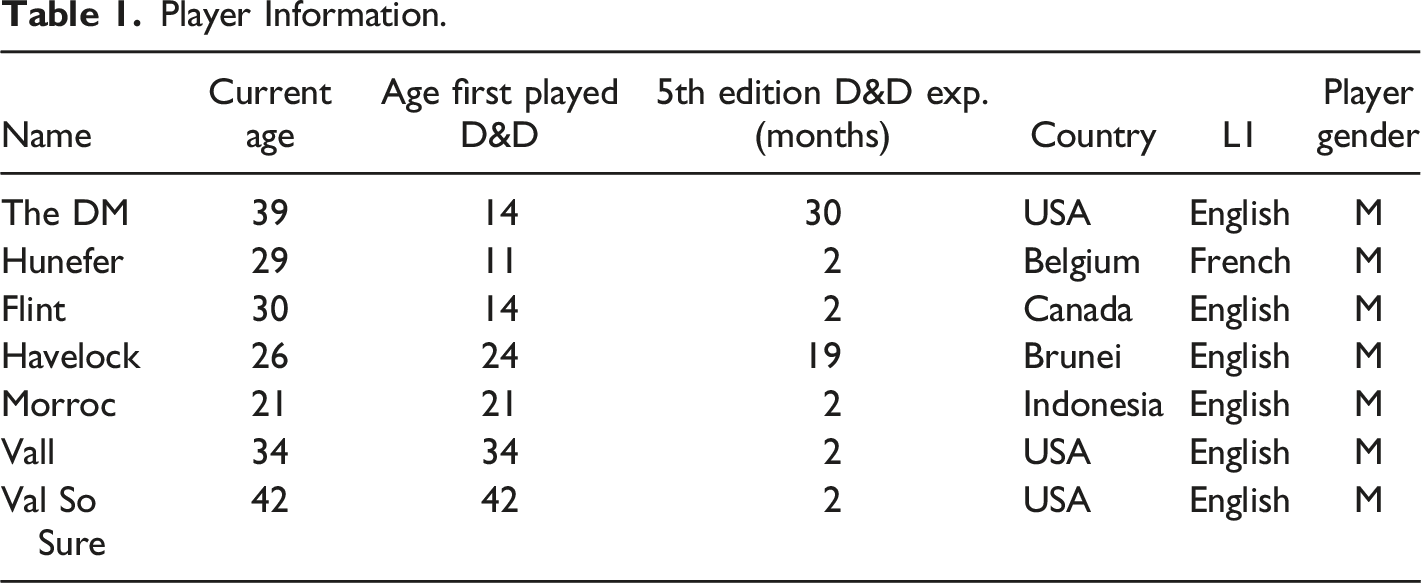
In this group, DM was the most experienced player. He had been playing D&D for over 20 years and knew the fifth edition system well. He had years of dungeon mastering experience and designed the adventure for these players from scratch. As the DM, he played all of the non-player characters (NPCs) which the adventuring party encountered during the five-hour gaming session.
Hunefer, the Orc sorceress, was the second most seasoned tabletop player. He was an 18-year D&D veteran and when he sat down at the table, he promptly placed several brand-new sets of dice down in front of character sheet. His expert status became evident in his play style. He often used first-person pronouns to refer to his character’s actions which was much more direct and declarative. In contrast, often novices will ask the DM if they can do something (Hendricks, 2003, p. 74). This shows uncertainty of the rules and the limits of the fantasy world. Hunefer declared his actions and as a result, his gameplay was efficient, and his turns were comparatively quick.
Flint, the Firbolg druid, was an experienced player as well. He had a green, felt-lined wooden tray in front of him to prevent his dice from rolling off the table. Having this item on the table suggested that he has played in many different tabletop games and was likely involved in multiple campaigns. This was the sign of a serious player. These observations were confirmed in the interview.
Havelock, the Aasimar paladin, was an experienced role player, but he was more familiar with a different tabletop roleplaying system. He often had questions about his abilities during the game. He played an active role but declined to be interviewed after the observation.
Morroc, the Tiefling barbarian, was a new player. He started playing D&D a few months before the observation and stated that he watched actual-play D&D games online. Throughout the game, he offered advice on rules and game mechanics to other players but also asked questions about mechanical aspects of the game he did not understand.
Vall, the Elf warlock, was also a new player and friend of the DM. This was his first-time playing D&D and he had yet to learn his character or many of the necessary D&D jargon. He mentioned during the observation that the DM helped him make his character in the first session. During the observation, he would often ask questions about how to do specific actions. He knew the basics of his character’s abilities due to direct assistance the DM offered him outside of the game sessions, but often required assistance from more knowledgeable players to successfully navigate his turns suggesting novice status in this group (Hendricks, 2003).
Character Information.
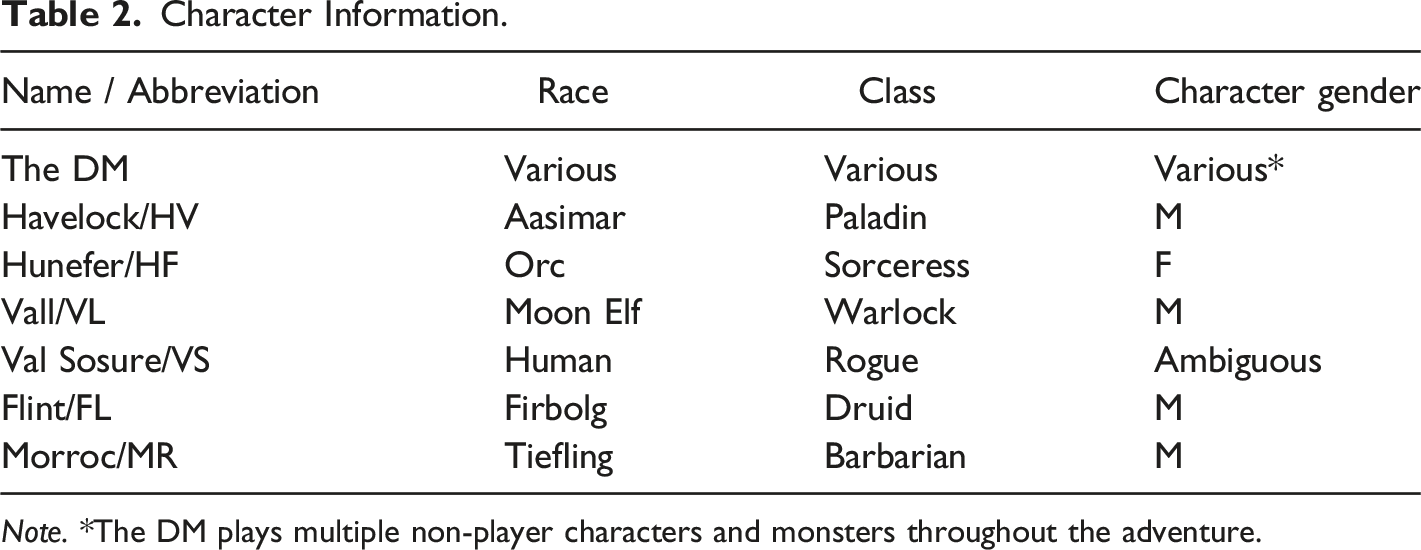
Note. *The DM plays multiple non-player characters and monsters throughout the adventure.
Codes and Themes
Three overarching themes emerged from the observation and were further explored in the interviews: Interaction Type, Purpose of Interaction, and Becoming. There were three types of interactions observed: player-to-player, player-to-dungeon master, and character-to-character. As with all interactions in a community, some members were more experienced than others and had a social responsibility to make sure that the newcomers learn the cultural rules and language (Lave and Wenger, 1991). In the case of TRPG and D&D, this means learning the rules and experiential knowledge of the genre. Of particular interest was how the interactions between expert and novices.
These interactions had varying purposes. First, players often engaged in mechanical or metaknowledge talk. This type of interaction was initiated by novices or offered by experts and included discussions about the game mechanics. Second, there were interactions describing and clarifying the situation in the game or as Hendricks (2003) called it “world conception.” Here, the DM would describe the situation and players would ask for more information. The third purpose for these interactions was in-character conversations. These were conducted by the characters, occasionally using character voices, and the DM, almost always using in-character voice.
The third and final overarching theme is one of becoming. As discussed above, TRPGs are about managing one’s real identity as a player who is sitting in food court rolling multi-sided dice and one’s character’s identity who is shooting terrifying sewer abominations with a crossbow. In a Goffman-esque way, the player must step in and out of these identities as if they were roles in a play. As such, this final theme is one of becoming the character and exploring identities.
Player Interviews
After observing the game session and analyzing the fieldnotes, an invitation to participate in a follow-up interview was extended to all members of the gaming group through the group’s gatekeeper (Hatch, 2002; Spradley, 1979). Two players, Val Sosure and Flint, and the DM, agreed to participate in semi-structured interviews. There were several topics of interest in the interviews: first, the participant’s background in D&D, fantasy genres, and roleplaying in general. Second, how the participant became involved with the group and their opinions of the game. Third, how they came to create their character and how they feel about roleplaying. Fourth, how they learned the mechanics of the game.
Val Sosure
VS was a 42-year-old American who worked in several universities and has been in Japan for nearly 20 years. As the player with the least experience in the gaming group, his experience and opinions were essential to understanding how D&D knowledge is passed from expert to novice. He played D&D once when he was 14-years old but had not had any experience with it since.
The Dungeon Master
DM was a 39-year-old American who taught at a university in Japan as well. He had been playing D&D continuously as a DM and as a player since he was 14 years old. He had experience of multiple editions of D&D and different roleplaying systems. As discussed previously, the dungeon master of gaming group tends to be the most knowledgeable player at the table.
Flint
The third and final interview was conducted with Flint. FL was a 30-year-old Canadian, native English speaker who taught at an English preschool/kindergarten with one of the other members of the gaming group. At the time of the observation, he was one of the players who seemed to know the game and the rules very well. He understood his character and his role in the group and was often helping the novices during the game. As such, FL was categorized as an expert though in the interview he denied this expert status. He first played D&D when he was 13 or 14-years old and had played the game only occasionally since then. He reported that engaging in the virtual community by watching actual-play D&D videos sparked his interest in D&D again. This group was the first fifth edition D&D campaign he had participated in, but since starting he had branched out and started a second game with a different community of friends.
Results
Types of Interactions
Player-Player Interaction
There were many interactions between players in the five-hour game session. However, one moment from the observation that illustrated this theme (D&D Ob1, lines 242–248). During Vall’s (VL) turn from the first encounter in the sewers with a vicious monster he declared his action by saying, “I’m going to roast this mother fucker.” However, he was immediately stymied by his lack of mechanical game knowledge regarding how to perform his character’s Eldritch blast action. Without prompting or request, Flint (FL), a more experienced player, stood up from his chair on one side of the table walked over to VL and helped him find the correct set of dice and explicitly taught him how to perform the action using his character sheet. In this event, VL demonstrates surface-level, novice understanding of what his character can do in attempting to use his warlock ability. He knew that the character had certain abilities and magic spells but he was not yet familiar with the mechanics of the game or the dice. In the interview with FL, he stated that he took on this role as a teacher during the game because he had “the opportunity and the chance to spend the time with the rules… so popping up and giving them [less knowledgeable novices] a pointer or pointing on their sheet” would allow them to not have to focus on the mechanics (D&D In FL1, lines 57–65). This interaction exemplifies one of the key interaction events—Player-to-player interaction and expert-novice scaffolding. This type of interaction happened many times throughout the game between players as well as between the DM and the players. Often FL and the DM would stand up and walk around the table helping those players who needed direct assistance.
Player-DM Interaction
The next interaction observed in the D&D adventure was DM scaffolding. The dungeon master is aware of his player’s experience and has spent an immense amount of time creating the adventure. The newest player, Val Sosure (VS), had not played an RPG in nearly 30 years. He was new to the action-adventure-fantasy genre as well. Throughout the game, the DM offered VS hints and suggestions on how he should play his character more like a rogue. In fact, the second half of the adventure was a trap-laden, puzzle dungeon, which was specifically designed to teach VS how to use his character. At one moment, the DM suggested that the rogue might see a trap on the ground. Then there was a long silence. At the time, it seemed like VS did not want to tell the group about the trap. The DM hinted that letting his groupmates trigger the trap would be detrimental to the group. VS relented and suggested that everyone stop.
It seemed at the time of the observation that he may have wanted his group to get trapped in order to make the scene more interesting. Or possibly he just did not know that he could disarm the trap as a rogue. When asked about this moment in the interview, VS confessed that he had no idea what he was supposed to do, and he was trying to process the DM’s suggestion to make the moment his own and not just blindly follow the DM’s advice. This kind of scaffolding by the DM happened often over the last hour of the session. This initiation into the culture and community is a direct example of a situated learning environment with explicit training. The master teaching the apprentice the ropes.
Character-Character Interaction
This type of interaction occurred in the observation but was not as common as expected. Players tended to talk to other players and to the DM much more frequently than characters talking to other characters. The relative rarity of this interaction could have been due to narrative factors. The narrative at the time of the observation necessitated almost constant combat while crawling through the sewer dungeon. There were few opportunities for nuanced character-character discussion.
There were a few situations where the characters requested items from other characters. As they were jumping into the sewers at the beginning of the adventure, the characters realized that many of them could not see in the dark underground tunnels. HF had a magic cream that once applied to the eyes, allowed them to see in the dark. In his character voice, FL requested the item from HF. The player reached out with his hands, took the imaginary item from the other player, and applied the imaginary cream to his eyes. Then he held out his hand and offered the imaginary cream to VS, who also pretended to put the cream on his eyes. This is not an unusual phenomenon in roleplay. When the players act out the action of their characters in real life, it adds a sense of immersion to the game and provides support for the contention that D&D is a type of performance.
Goffman (1959) suggests that in performance there are two extremes of a continuum, sincere and cynical. Performers make choices that put them somewhere on that continuum, those that fully commit are judged as being sincere and those that are not taken in by their own performance are judged as cynical. If D&D is anything like performance, as Mackay (2001) suggests, then these acts of talking in-character and performing the gestures of the character’s actions are ways of signaling to the other players that the player is willing to commit to the collective fantasy. If all of the players are on the same side of the sincere-cynical continuum, the more likely character-character interaction using character voices are likely to occur.
Purpose of Interactions
Gaining Metaknowledge
This theme relates to in-game knowledge and vocabulary that experienced players know about through extensive experience. This excerpt involves an exchange between three of the players: Morroc (MR), Flint (FL), and Hunefer (HF) (D&D Ob 1, lines 59–76). It takes place before the official game has started. MR asked FL directly about the differences between two classes, warlock and sorcerer. FL explained to him explicitly that warlock powers are granted by pact magic with a magic entity, but sorcerers are born with their magic. Immediately after this expert-to-novice interaction, FL asked the DM about changes he wanted to make to his character, a druid. Here, FL was trying to justify why his character should not speak Dwarven but rather Sylvan as a language when MR, a novice player jumps in: MR – FL: “What the hell is Sylvan?” FL – DM: “It doesn’t make sense that my character would speak Dwarven.” HF – FL: “Maybe he got it from his study abroad.”
There are two things happening in this excerpt. First, MR is trying to find out what Sylvan is but no one is answering him. He understood from context that Sylvan is a type of language due to the comparison with Dwarven, a well-known language. But before he receives a direct answer, HF interrupts the conversation with a joke. From a D&D expert like HF, this was a joke and some of the players laughed. What MR, the novice, did not know was that it would be unusual for a druid of any race, other than Dwarf, to spend any time with Dwarves which was FL’s initial point. This is something that someone familiar with the lore of druids and dwarves would understand. This is evidence of an expert-to-expert, player-to-player interaction, but it also served the dual purpose of informing MR about what Sylvan was. The interaction seems to have satisfied MR’s curiosity about the jargon, and he never asked about it again. This could suggest that metaknowledge can be gained implicitly without direct explanation. When asked in the interview, Flint he stated that he never heard MR’s request at all and would have answered if he heard him.
In the interview, FL reported that he started learning the rules passively at first by watching actual-play games online. Then, as he got more interested, he bought one of the rulebooks and started to understand the nuances of the game more. DM reported a similar path to learning the system. In order for people to learn the game the players should, “read the shit…make your own characters” (D&D In DM1, line 205–207). He claimed that he learned the fifth edition system by making a character for every class and combination of subclasses. This is a heavy time investment for someone who is just getting involved in the subculture. In VS’s interview, he remembered one of the more experienced players scoffing at his disfluency with regard to the metalanguage. This topic of learning the game emerged in the middle of VS’s answer to a different question (D&D In VS1, lines 215–233): VS: We don’t always speak fluently all the damn time, especially in a concept or genre that you’re not familiar with exactly, but you know so. I had a little trouble articulating what I was trying to say, and I kind of remember being oh, but at the same time he’s [HF] an expert. He knows exactly. He knows so much about this stuff and it’s like I started trying to ask him questions. Also the guy [FL] next to me, so I tried to ask them questions about what should I do what’s the thing to do, and I can’t ask [DM] because he’s running the thing as the dungeon master RE: do you think that's the best way for you to learn the game and your role as a player? VS: Well, obviously, if I had the time, the interest and the energy, I should research these things. like the Indonesian gentleman [MR], the young guy, he’s been watching games online on YouTube and stuff like that. And it’s like yeah. I could, but I have other shit to do RE: sure. There was one moment—. VS: It doesn’t mean I won’t you know. if I become involved, I might make an effort to learn more about that. Not saying I won’t do it. I just haven’t.
VS believed that he could manage his lack of metaknowledge by asking more experienced players during the game. In a community of practice, that is to be expected. He thought that in the heat of the game, it was easier to ask other players for help rather than the DM. In addition, he was aware that other novices are learning the game in different ways, and due to lack of effort and time limitations, he had not attempted to learn the game explicitly on his own, yet.
Describing the Scene
This was the most common interactional purpose used in the session. The DM would describe the setting in detail and then would pause, waiting for the players to take action. Hendricks (2006) refers to this interchange as description of the fantasy environment. Occasionally, the players would ask follow-up questions, or the characters would take actions to further the story. Sometimes the lack of cultural knowledge by the novice caused a slowdown in the flow of the game. DM described the situation and asked all the players a dangerous question (D&D Ob 1, lines 150–164): DM: “What’s your marching order?” HV: “I’ll go first. I have armor” VL: “I can see in the dark” HV: “I can see in the dark as well” VS: “I have the tools so maybe I should be in the front.”
To an experienced player, “What’s your marching order?” means that this is going to be a situation where the position of the characters in the imaginary space will be crucial. It means a fight is almost certainly coming. A player would only know what this means through experience. After this short exchange between players, one player tells VS that he should not be in the front because his character class is less armored. The other more experienced players are helping the less experienced players learn the terminology as well as the unspoken cues.
There are various factors involved in the players speaking in their character’s voice (ICV). These factors include how sincere they are playing the role, their experience, and how well the players know each other. At the planning stage of the research, the utilization of character voices was predicted to be more prevalent among experts. However, this was not necessarily the case in this observation. Most players used character voices at least once during the adventure, but the usage seemed to depend on if they were conversing with a non-player character (NPC) or if characters needed to share information with other characters.
One of the benefits of using character voices is that it is easy to differentiate when the players or DM was asking for clarification about the description of the scene or acting in the scene. In this excerpt from lines 316–320, the characters had kidnapped an enemy Kobold and were interrogating it for information. Hunefer [HF] does not have an in-character voice and the DM misunderstands him. HF – DM : “How many kobolds are there here?” DM: ICV “None of your business!”
The DM misunderstands that the player is talking to the DM and asking for knowledge that his character might know in the imaginary space and not to the Kobold NPC that he is interrogating. The DM always used a character voice when speaking as an NPC to differentiate between NPC and narration.
In-Game Story Talk
In this excerpt, the party found their way down into the sewers and were trying to find clues for their quest. Here, they found a group of “craven reptilian humanoids,” also known as Kobolds, fighting a grotesque three-legged, and tentacle wielding aberration, an Otyugh. During the course of this fight, the party decided to assist the kobolds due to the actions taken by VS in this excerpt (D&D Ob 1, lines 216–234): VS – DM: DM: “Roll acrobatics or athletics” ((they roll off)) “You got it” DM: VS: DM: ICV “Let me go. Let me go” MR – Group: “Why don’t we just knock it out and deal with it after the fight?” VS – Group: “Who can calm this thing down?” ((MR and HV raise their hands) MR: “I have a weapon called Flail” ((The kidnapped kobold breaks free, and FL tries to grab it. FL succeeds.)) DM: “That’s teamwork right there.”
Here VS asked the DM a question about the mechanics of the game. DM quickly provided him with the correct information to keep the action going out of character. Both of them were switching between their player and character identities as Fine (1983) suggested D&D players must do in order to engage in the gameplay. The DM has the responsibility for setting the challenges that the players must meet. “Roll off” in this context meant the DM and the player made opposing dice rolls to see if the character succeeded in his or her action. VS was successful in grabbing the kobold and the DM gave the party information about kobolds: they speak a different language and VS as able to communicate with them in Draconic. The DM and VS engaged in conversation as their characters: VS as the Draconic speaking rogue and the DM as the scared kobold. The players and the characters then discussed, without using character voices, what they should do with their new friend. MR proposed, as any self-respecting barbarian would, that they solve the problem with violence. Some players laughed at the barbarian’s brutal suggestion. The party continued talking with the kobold and learned that other kobolds had been eaten by this monster and they would not talk or stop until it was dead. They decided to work with the kobolds to take the monster down. This excerpt has evidence of many of the themes: player-to-DM interaction, character-to-character interaction, metaknowledge discussion, and playing their role.
Becoming
Playing Their Role
All of the players had moments in the game that showed they were playing the role they had chosen and using the skills of their character to actively participate in the narrative. HF the charisma-based sorceress used her spells and skills of persuasion and intimidation to negotiate with enemies. FL the druid utilized healing abilities to bring party members and fallen enemies back from the brink of death. MR the barbarian rejected his fair share of the loot because, “I’m a barbarian, what am I going to do with that money?” (D&D Ob1, Line 304). HV, the paladin, cast divine sense to find the undead in a crypt. However, near the end of adventure, the party had been trudging through a trapped dungeon for nearly an hour when they entered a new room. VL stated, “Should someone stealth in there?” A subtle hint from a more knowledgeable novice to another novice that VS, the rogue, should do his job and investigate the room quietly. However, immediately, VS responded, “I thought I was already doing that. That’s what I’m here for apparently” (D&D Ob 1, Lines 490–493). In the interview, the DM admitted to designing this part of the adventure to help explicitly train VS to play a rogue (D&D In DM1, lines 492–509): DM: he needs to learn what a rogue needs to do. RE: yes. DM: and so that’s what that was about. he’s= RE: that was a conscious choice on your part? DM: he’s got he’s jumping into this playing a rogue and a rogue is a very important part of the game whenever you’re coming into an area like this. I mean, this is what the rogues are all about. Is taking traps out and spotting traps. And his character is pretty perceptive a 17, passive perception, so he’s spotting most of the easy stuff. RE: yeah. DM: But that last trap he got into, that was a 20. RE: oh, the gates. DM: that was a 20 difficulty, yeah. That was a 20 difficulty that he was popping into, so I asked him before he went in there, I said, do you want to look at this? RE: Yes. DM: Do you want to look at this a little bit more in depth? And he’s like naw naw naw, I’m just going to go past, so ok, and so that’s the lesson there. You come into something, especially if the DM gives you a goddamn hint like that.
When the DM asks if you are sure you want to do something, it is usually a hint that you are doing something wrong. As the newest player who has not learned his role yet, DM knew that VS would need explicit rogue training. He designed the whole dungeon with the explicit purpose of training VS in how to use his character’s skills. Every room had secrets and traps that the rogue needed to perceive and disarm. This decision by the DM and other egalitarian actions to check in with all members of the group throughout the game seemed to run contrary to Fine’s (1983) group dynamic observations. Fine observed that referees tended to spend more time engaged with other experts than with novices (p. 156). As new players became regulars, their status in the group changes. These particular group dynamics and this power differential were not observed in the current research study. This is likely due to the difference in recruiting. All members of this group were recruited directly by the DM, and he knew the experience and abilities of each of his players. This type of cultural and language socialization seemed to be effective because in the interview with VS, he confirmed that it was at this moment in the game when he realized this was his job. He said, “…that was kind of at the sort of point where I was getting comfortable with the fact that I have the skill [referring to his rogue’s abilities]. So now, I think I know why I, they, want me here and what my job is. And what my role is” (D&D In VS1, lines 246–250).
Exploring Identity
There was a moment in the observation when the players took a break from playing the game. The players were asked to explain how they came to choose their characters’ features, in particular about their characters’ genders (see Table 2). All of the players identified as male, but HF and VS chose character genders that did not match with their own. When asked why they made those choices, VS stated, “I play as a male in my day job, so why not be ambiguous.” This line of discussion was explored further in each of the interviews. With VS, he shared that he is approaching his character as a type of Goffman-esque drama with a splash of Judith Butler’s idea of gender as performance. He went on to explain that he views gender as much socialization as it is biology, if not more. So why not play in that space? “It could be fun to see how someone with a different skin would go through the world” (D&D In VS1, Lines 345–346). Mussett (2014) expanded on this exact idea of using roleplay as a way of exploring aspects of one’s own gender and sexual identity. She argued that the identities that we co-construct in the real world are much more fluid than we usually imagine, and D&D can be a way for us to explore that fluidity in a safe space without judgment. Bowman (2010, p. 63–64) believed that alternate gender enactment allows players to “attempt to understand the mindset of opposite genders” and gender-swapping can be a release from the social demands of the real world.
FL had similar opinions and then went further to offer suggestions for dealing with uncomfortable gender and sexuality related situations if they arise in the game. FL explained that sometimes he thinks players just choose to be a different gender because they can, without rhyme or reason. He also recommended that players should be sensitive to issues of gender and sexual identity and not abuse the freedom that roleplaying affords. As he mentioned in his interview: So there is the opportunity there for some people, maybe to take things a little bit too far. And I think if that does come up, it’s on definitely not just the DM but as game players as well. … Like, you can’t do anything about it if it happens by accident. But after it happens, after a session like that, if somebody’s uncomfortable, that’s something that, like as a group, I feel that we should come together and, like if someone does have an issue, like we should be able to kind of solve that issue and steer the story in a different direction. (D&D In FL1, lines 210–219)
What FL meant by “taking things too far” is that because the game is a fantasy, some players might think that they can do or say whatever they want because it is just a game. They might try to enact their darkest fantasies or engage in themes many would consider inappropriate. This might cause other players at the table to become uncomfortable. FL’s concern for group cohesion is an admirable sentiment and good advice for the roleplaying community members. It is important to explore these ideas, fantasies, and identities in respectful, non-stereotypical ways. While Bowman (2010) and Mussett (2014) concluded that some players can use alternate gender enactment as a way of identity exploration in similar ways to VS’s ambiguous gender choice in this game, it is certainly possible that other players might view gender and sexual identity as just another customizable cog on their character sheet without spending much time thinking about the choice.
Conclusion
Through observation of the seven-member group and interviews conducted with three volunteers of a fifth edition D&D game in Japan, three interaction types between the players, between the characters, and between the DM and the players emerged. These interactions occurred for three reasons in general: rules clarification, setting description, and narrative advancement. Additionally, some player behavior was observed that supported Bowman’s (2010) and Mussett’s (2014) contention that alternate gender enactment within the fictional world can be an opportunity for players to explore their own identities.
Underneath all of these interactions and gender roleplay was a distinct power differential between novices and experts. As Hendricks (2003) observed, the expert and novice roles were not clear-cut classifications. More knowledgeable novices and experts often worked explicitly to help the less knowledgeable novices participate as full members of the group. Authenticity (Shay, 2013), geek credentials, a form of subcultural capital, can be gained more rapidly with a combination of firsthand gaming experience and secondhand community engagement and investment as was seen with more knowledgeable novices like Morroc and Flint. Flint learned the mechanics “first by passively watching others play through the streams” and later purchased the books to learn the rules explicitly (D&D In, FL, lines 38–39). In other gaming communities, full participation might not be as easy for a novice like Val Sosure who had virtually no experience or knowledge of the subculture or the genre. The nature of D&D and the atmosphere of this particular gaming group provided a cooperative space for newbies to learn on the job. The co-creative nature of the storytelling in D&D allows novices to gain firsthand experience of the genre and the game mechanics at the gaming table, given a supportive group of experts or more knowledgeable novices, but also secondhand through wider community engagement, that is, watching actual-play games, joining forums, or reading the source material. At this gaming table, novices who engaged in the wider D&D community on their own were more able to assist other novices who did not. This was evident when Morroc, Havelock, and Flint, offered game mechanic assistance to Vall and Val Sosure throughout the session. Val Sosure was aware that the other newbies at the table were taking more active roles in the game by engaging in the larger D&D community. He realized that he was the newest and the least knowledgeable of the newbies, but he was enjoying the process of starting something new.
As with many participant observations, the limitations of this study are numerous. First, this study is a small cross-sectional observation of one gaming group. As such, the dynamics within this group are subject to change over time and other groups will certainly be composed differently. Second, gaining access to this particular group was a matter of convenience and should not be considered a representative sample of all D&D groups. And third, the relatively short observation time period makes it impossible to know if the novices observed here have actually become full members of the larger D&D subsociety or socialized fully into the D&D subculture. All that can be known is that experts and more knowledgeable novices helped less knowledgeable novices learn their roles and accomplish their short-term goals and, in the process, they were able to tell a story together. It is unlikely that the results discussed here can be applicable to other contexts, but as with most qualitative research transferability of the findings will depend on the context in which this work is being compared. The relationships between the players, the DM, and the characters are complex, and every group will have a different culture, rituals, and even rules within the broader fantasy roleplaying subsociety and D&D community (Fine, 1983). Even the language that individuals use to describe their fantasy world differs between individuals but intersect between group members to create a shared culture and vision (Hendricks, 2006). It would be unlikely to find another context exactly like this.
Future studies looking to use the communities of practice framework to explore the relationship between novice and expert D&D players should take a more longitudinal approach. The current research study has only described the interactions from one five-hour session in the history of one D&D gaming community. Future researchers should track cultural knowledge acquisition and endeavor to answer the question of how novices become socialized into the subsociety at the table and through peripheral participation in online communities through a more longitudinal, ethnographic approach.
Footnotes
Declaration of Conflicting Interests
The author(s) declared no potential conflicts of interest with respect to the research, authorship, and/or publication of this article.
Funding
The author(s) received no financial support for the research, authorship, and/or publication of this article.
