



Abstract
Background
The use of instructional games in foreign language classrooms has a lot of potential. This potential helped pushing the spread of game use, but it was faced with a lot of barriers.
Purpose
The current study intended to investigate the factors behind the use/nonuse of instructional games by Moroccan high school teachers.
Methods
This study adopted a mixed methods approach, which was typified in a sequential explanatory design. Data was collected from 215 students and 10 teachers in Allal Loudyi High School in Fes, Morocco, using questionnaire, interview, observation schedule, and focus group.
Results
The findings disclosed that students reported that instructional games should be used because they motivated them, helped them enjoy learning, and fostered their critical thinking skills. The large number of learners in the classrooms and lack of enough equipment were found to be two major obstacles, in addition to other minor challenges, that prevent Moroccan high school teachers from using instructional games in the classroom.
Discussion
Crosslinguistic studies confirmed the potential motives and barriers highlighted in the current study.
Conclusion
The results had direct implications for Moroccan EFL teachers, stakeholders, and students. The implications were discussed at the end of this article.
Background
The use of instructional games in EFL/ESL classrooms has a lot of potential. Studies advocated that both teachers and students reported several advantages of instructional games in EFL/ESL classes. First, instructional games increased students’ learning motivation (Liu & Chu, 2010; Hwang et al., 2017; Ge, 2018; Homer et al., 2018; Hung, 2018; Sun & Hsieh, 2018; Ho, 2020; Zou, 2020; Alawadhi & Abu-Ayyash, 2021; Almusharraf, 2021; Chen, 2021; Kaban, 2021; Qiao et al., 2022). Second, they promoted students’ interest and involvement in the teaching-learning process (Hung, 2018; Kingsley and Grabner-Hagen, 2018; Sun and Hsieh, 2018; Ho, 2020; Zou, 2020; Alawadhi and Abu-Ayyash, 2021; Wang et al., 2021). Third, they aided in promoting authentic language learning contexts (Wu et al., 2014; Mei and Yang, 2019). Fourth, they enhanced learners’ performance and competence in English skills (Sandberg et al., 2014; Hung, 2017; Hwang et al., 2017; Sevilla Pavón & Haba Osca, 2017; Lam et al., 2018; Hashim et al., 2019; Hong et al., 2020; Zou, 2020). Fifth, they promoted learner autonomy (Sandberg et al., 2014; Rueckert et al., 2020). Finally, they boosted learners’ knowledge retention (Ge, 2018; Chen et al., 2019).
However, a lot of hurdles are encountered while implementing them in real educational settings, decreasing their probable effect on the teaching-learning process. Studies reported different types of barriers that related to the cost of equipment (Moizer, et al., 2009), the unequal access to technology (Hsu, et al., 2011), entertainment risks to the learning process (Rowan, 2016; Baalsrud et al., 2013), the time constraints (Justice & Ritzhaupt, 2015; Baek, 2008), the gender of teachers as well as their motivation and ability to work with technology (Hamlen, 2010; Justice & Ritzhaupt, 2015), lack of game customizations (Embi, 2008; Javora et al., 2021), difficulties to get game analytics and to measure the learners' progress (Hauge et al., 2014), educators and parents concerns about the inclusion of games in education (Barko & Sadler, 2013; Koh et al., 2012).
The barriers to implementing instructional games in the teaching learning processes can be grouped into attitudinal and behavioral ones. Martins and Oliveira (2019) reported that teachers and educators argued that their technological knowledge was low, resulting in their lack of experience in implementing games in their classrooms. This emanated from a belief in one's inability to utilize innovative pedagogical approaches to boost learners’ motivation and learning. Likewise, students were reported to hold negative attitudes towards instructional games. This depended on the learners' profiles, some may prefer more traditional teaching methods, such as lectures, written assignments, and exams, where they enjoy a more passive role in the learning process (Jääskä & Aaltonen, 2022). In the same line, Sousa et al. (2017) reported that learners had positive attitudes towards the recreational side of instructional games compared to their pedagogical part. Further, educators, families, and students perceived the instructional games as a sole form of entertainment or ‘waste of time’ (Sousa et al., 2017).
School policy represented a second type of barrier. Although research emphasized the crucial role of implementing instructional games in classrooms, time and aligning games with curriculum objectives posed themselves as constraints on the successful use of instructional games (Alqurashi & Alqurashi, 2017; Hu & Sperling, 2022; Marklund & Taylor, 2016).
Technological and material were the third group of barriers to successful instructional games implementation. Lack of equipment, including inadequate internet network service, outdated computers, or a lack of technical staff and software, were found to challenge the utilization of games in the teaching-learning process (Alqurashi & Alqurashi, 2017; Jääskä & Aaltonen, 2022; Kaimara et al., 2021; Manesis, 2020; Marklund & Taylor, 2016).
Many researchers have investigated this issue of the use and effectiveness of instructional games in different countries, and since this issue is on the rise, time has come to study the same issue of games within the Moroccan context. The current study forwards the investigation of these constraints to a least studied Moroccan EFL classroom context to maximize the potential of instructional games. It identifies and addresses the barriers to implementing instructional games in the target context to come up with effective intervention strategies. The significance of this study lies in the fact that the results might help teachers overcome the challenges and highlight the push factors to the use of instructional games. Moreover, the results may urge textbook designers to include some effective instructional games in the textbooks.
This study aims to answer the following research question:
(1) What are the factors that push Moroccan high school teachers to use/not use instructional games?
This study is divided into three main sections. The first section is devoted to the methods. The second section deals with results. The third section is the discussion. The study ends with the conclusion and implications.
Methods
A mixed methods approach was utilized in this study. Specifically, a sequential explanatory design was used. The quantitative approach was used to identify the reasons behind teachers’ use/nonuse of instructional games. The qualitative approach helped to explain those reasons.
Population
The participants of this study were Moroccan high school students (n:215) and teachers (n:10) from Allal Loudiyi High School in Fes. The students’ age ranged between 15 and 19 years old. The socio-economic status of the participants ranged from low to medium. The participants were chosen because they represented the right high school level at which games were incorporated in classroom practices. Further, the current study opted for the convenient sampling technique to select student participants as well as teachers.
Data Collection Instruments
This study utilized four data collection instruments. The rationale behind using the four instruments for data collection was for methodological triangulation. The data obtained from one method can be cross-examined by data from other methods of data collection (Denscombe, 2010; Kothari, 2004). More details on the rationale motivating the choice of each instrument were provided in what follows.
Questionnaire
The questionnaire was a quantitative data collection instrument used to identify the reasons behind teachers’ use/nonuse of instructional games.
Interview
To add more validity and reliability to the findings, a structured qualitative interview was used to elicit the identified factors behind the use/nonuse of instructional games.
Observation Schedule
Another qualitative instrument that was utilized in this study was non-participant observation. It was used to identify the profiles of teachers who use/do not use instructional games.
Focus Group
A focus group was conducted with students in order to add more validity to the data because they were given questionnaires only. Thus, the focus group enabled this study to either support or reject the claims of students in questionnaires.
Procedure
Data collected from the questionnaires was tabulated on SPSS to generate descriptive statistics. Simultaneously, data obtained from observation schedules and focus groups were studied carefully and common themes were deduced from the respondents’ testimonies to support data analysis regarding the main reasons that might be responsible for the use/non-use of instructional games in Moroccan high schools.
For the sake of validity and reliability, the questions included in the questionnaires, observation schedules, and focus groups were given to another researcher to review them and look for any possible data quality problems. This researcher investigated the data collection instruments in terms of relevance, feasibility, and clarity of the items’ wording. The researcher’s feedback was used to edit the items in questionnaires, focus group as well as the observation schedule.
Results
The Factors Behind the Use of Instructional Games and the Obstacles Preventing Teachers from Using Instructional Games
The Factors that Push High School Teachers to Use Instructional Games
Mean percentage of reasons that push high school teachers to use instructional games.
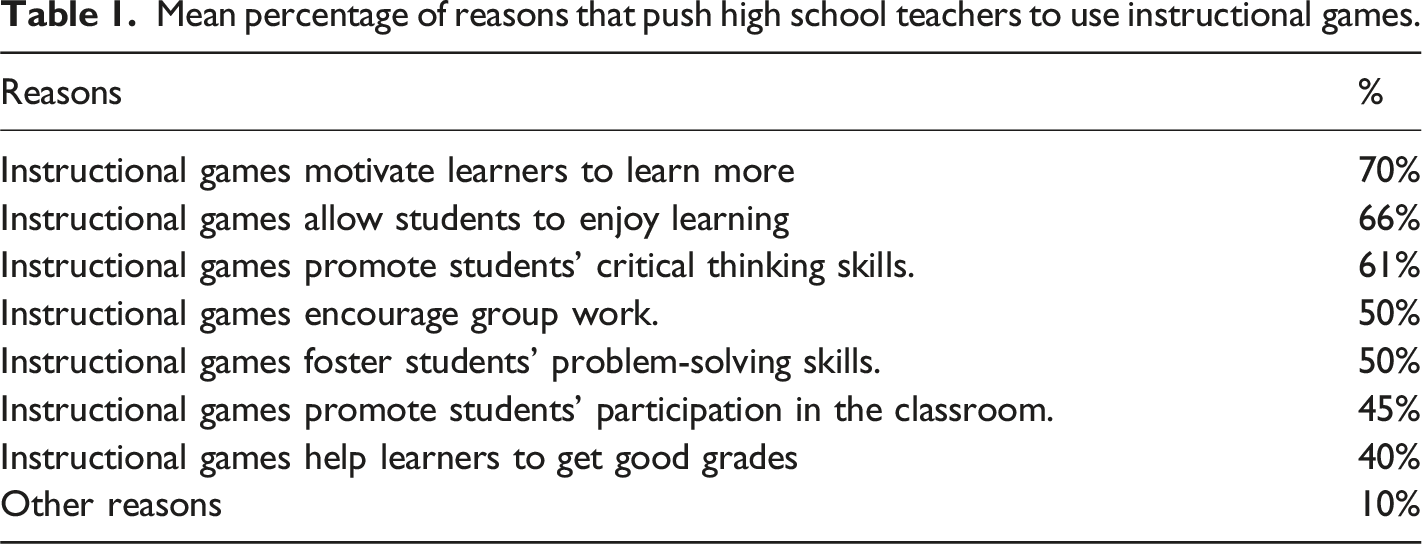
Further, the choice of “instructional games motivate learners to learn more” as the first major reason that pushed high school teachers to use instructional games with their students in the classroom was reportedly justified by students and teachers during focused groups, interviews, and observation schedules. Some students claimed that one of the major advantages of classroom games was their ability to make learners eager and motivated to keep focusing and following their teachers while explaining to them. A student interviewee (6), in the focus group, stated, “when we play a game in the classroom, we feel we are pushed from inside… we start feeling motivated to learn more and keep concentrating on what our teacher is saying”. Some other students claimed that instructional games motivate them to learn not only inside the classroom but outside as well. A female student (9) stated, “when our teacher tells us that in the next session we will play a game on a certain theme, I usually go to the internet to find more pieces of information about that… in order to win the game in the classroom.”
Teachers supported the fact that instructional games motivated learners to learn better, but they added that instructional games motivated not only students but also teachers as well. They referred to the fact that when teachers saw their students motivated, they also felt pushed to give their best to make their students understand the lesson. A female teacher (4) said, “When I play a game with my students and I see on their faces the desire to learn, I automatically feel happy and thus pushed to give my best for them…this is the beauty of instructional games.”
The element “instructional games allowed learners to enjoy their learning” was ranked as the second most important reason that pushed high school teachers to use instructional games with their students inside the classroom. No students were reported to maintain that instructional games made them forget about the time of the session. When they played a game inside the classroom, students enjoyed the lesson to the extent that they forgot about the time of the session. A female interviewee (7) stated, Sometimes, we have a session of three hours long and it depends…if the teacher only lectures us, we feel bored and sleepy, but the good thing is when we learn through a game… sometimes we really enjoy the game and the three hours move so quick to the extent that we never look at our watches to check the time.
Other students explained their joy in a different manner in the sense that when they played a certain game inside the classroom, they did not have to write a lot in their notebooks. Instead, they just kept learning through playing against each other, unlike in lecturing. A male student (8) stated, “the real joy is when we do not write too much in a lesson, and this happens only when we play a game inside the classroom”. Teachers, however, were divided into two groups: proponents and opponents of the idea that instructional games allowed learners to enjoy their learning. The first category of teachers maintained that through instructional games, students felt the joy of learning as was the case when they were children. A female teacher (12) claims, “of course when learners play a game inside the classroom, I can see in their eyes the same joy as our kids do while they are still children…it is an innate feature”. Other teachers, though they saw that instructional games led students to enjoy learning, maintained that they did not feel the same enjoyment as their students did when they played a certain game inside the classroom. They explained this by the fact that they had a syllabus to finish by the end of the year, and that their students were not aware of this, as it was mentioned by a male teacher (7), No one can deny the impact that instructional games can have on students…they feel excited, but what these students do not know is that we, as teachers, have a syllabus to complete every single year in a limited period, which our students are not aware of.
In this regard, both categories of teachers were observed in their classes, and it was noticed that some teachers felt as excited as their students did while playing a certain instructional game, but some others looked anxious. For the first category of teachers, they seemed to enjoy the lesson through the game just like their students do. However, the other category of teachers played the game with their students, but they were not as happy as their students, even if those teachers were told about the purpose behind observing their classes beforehand. This showed that while many students felt they were enjoying playing the game in the classroom, certain teachers saw it as just a waste of time.
As far as “instructional games promoted critical thinking skills” is concerned, the student participated ranked it as the third major reason that might lead high school teachers to use instructional games with their students in the classroom, as it was reported by 61% of the student participants. In this respect, some students maintained that through games, they might learn not to take everything for granted, and that they learnt to study the advantages and the disadvantages of every single step they tended to make in their learning process. A male student (12) posited, “Through instructional games, we have the chance to use our thinking as many times as possible in certain cases…thus we earn the experience of studying every step before we do it…this would help us in our learning process”. In this respect, teachers further supported the idea that instructional games helped learners use their minds critically whenever possible. A male teacher interviewee (2) stated, With an experience of playing a game called ‘find someone who’ with my students during the last two years, I started noticing how skillful the students have become…sometimes they find the answer to the question in less than 10 seconds, which proves the fact that such games have a large impact on their critical thinking skills.
Concerning “instructional games encouraged group work”, and “instructional games promoted problem solving skills”, they were equally ranked the fourth, as reported by 50% of the students. Starting with “instructional games encouraged group work”, some students in the focus groups maintained that they worked in groups only when there was a game to play in the classroom. A male student (2) said, “we usually work individually, but the only occasion we tend to work collaboratively is when our teacher plays a game with us, which is a good thing to do.” Some other students explained the role of instructional games in encouraging group work in a different way in the sense that they referred to the way instructional games managed to change them from shy to self-confident students who could talk and work in groups. One student stated, honestly speaking, though we rarely play games in the classroom, these few times changed me totally because two years ago I remember I could not even say a word inside the classroom let alone working in groups…I was so shy, but now I am able to discuss with my peers in groups easily thanks to the games we rarely play.
Teachers, however, pointed out the usefulness of instructional games in encouraging, not only group work, but noise as well in the sense that whenever students had the chance to play a game in groups, they started making noise. One female teacher (4) stated, instructional games encourage our students to work in groups, but (laughing) these games give the students the opportunity to talk to each other about things using the mother tongue, which leads to noise inside the classroom”.
This was not the case, however, while observing a second year Baccalaureate class in the sense that they respected their role-plays and performed them without making any noise. The fact that students did not make noise and were disciplined could be explained by the presence of a researcher observing them inside the classroom, which they were not used to in their casual sessions.
As for “instructional games promoted students’ problem-solving skills”, some students maintained that certain instructional games gave them the opportunity to learn certain skills to solve certain puzzle-based situations. A female student (9), in the focused group, reported, “Though we rarely play puzzle games in the classroom, my little experience with such games allowed me to learn certain skills to the extent that I quickly solve certain puzzle games.” In the same vein, teachers maintained that certain types of instructional games had a large impact on students in the sense that they helped them acquire new skills to deal with certain problem-solving situations. However, these teachers claimed that not all students benefited the same way from such instructional games. Instead, only students who had experience playing such games outside the classroom benefited the most. A male teacher (5) asserted, Of course, certain types of games teach students new techniques to solve certain problems they encounter in their learning process…but because we rarely play such games in the classroom, I think that only students who have experience playing these games outside the classroom have more chances to learn more problem-solving skills.
Research in literature, however, did not distinguish between students who had experience playing games outside the classroom and those who play only inside the classroom. Instead, literature supported, in general, the effectiveness of instructional games in fostering students’ problem-solving skills. Gee (2003) reported, By representing the simulations through gaming conventions, educators can potentially increase engagement while fostering deeper learning, as learners, engage in critical and recursive game play whereby they generate hypotheses about the game, develop plans and strategies, observe their results, and adjust their hypotheses. (As cited in Annetta, 2008, p.233).
“Instructional games encouraged students’ participation” and “instructional games helped learners get good grades” were ranked the fifth and sixth reasons that might be responsible for pushing high school teachers to use instructional games with their students in the classroom, as reported by 45% and 40% of the students. As for “instructional games encourage students’ participation”, some students claimed that though instructional games increased their participation inside the classroom, there was no significant difference between lecture-based sessions and game-based sessions in terms of the frequency of their participation. In this respect, a female student (10) said, “Yes, I agree. When we play a game inside the classroom, we tend to participate more but we participate the same way or even more in our normal sessions when there is no game to play.” Some other students pointed out the added value of instructional games in promoting the extent to which they participated inside the classroom. These students claimed that since certain games involved group work, they participated more than in casual sessions. A male student (4) said, “since most of the games we play in the classroom require us to play in groups, we discuss more and participate more than we usually do in the other sessions where there is no game to play.” Teachers, on the other hand, related the effectiveness of instructional games in promoting students’ participation to the number of students in the classroom. In this respect, they claimed that if the number of students in the classroom was low, students would be more likely to participate more since they would work in small groups. However, if the class was crowded, students would not participate more due the fact that many students had a fear of talking in front of many students. A female teacher (1) stated, it really depends on how many students in the classroom…if they are few (which is not the case) yes, I agree students would participate more, but the problem is when there are more students, which is always the case…students cannot talk in front of their peers.
This was observed in a class of 44 students in the sense that few students participated. During writing class, the teacher divided the class into groups to work collaboratively. When the teacher was trying to elicit some ideas to put them in a mind-map, only two students participated. This reinforced the idea mentioned above by the female teacher (1). Furthermore, this could be explained by the presence of an extra observer at the back of the class whom the students were aware of.
As for “getting good grades”, it was ranked as the last major reason that might lead high school teachers to use instructional games with their students in the classroom, as reported by only 40% of the student participants. This last rank was justified by some students who maintained that there was no link at all between playing a certain game in the classroom and getting a good grade in an exam. A male student (4) posited, “(laughing) actually I do not see the link…I do not think this is relevant.” Other students pointed out one of the possible ways through which instructional games might help learners achieve good grades. They maintained that if someone won a certain game, the teacher might give him/her a bonus in the form of an extra mark in the test. In this regard, a female student (10) stated, “Well, if one of us wins a certain round in a game and the teacher promises to give an extra mark, then yes I agree…otherwise I don’t see the link between playing a game and getting good grades in the exams”. Teachers, otherwise, pointed out a very important link between playing instructional games and scoring better in the tests. They claimed that when students learn a certain aspect of language through a game, they were more likely to remember the information on the day of the exam because it was taught in an enjoyable way. A female teacher (9) maintained, “The student is highly likely to retain the information on the day of the exam if he/she were taught an aspect of language through a useful instructional game”. Research in literature tackled this point by referring to the way instructional games were designed. In other words, if instructional games were done in a way preferred by students (Faser & Walberg, 1991).
Ten per cent of the student participants added different reasons they thought were relevant for the use of instructional games in the classroom. These reasons fell under four major themes: “students’ better understanding”, “relieving students’ pressure”, “establishing a good rapport between students and their teachers”, and “students’ high level of interest in the subject taught.” Starting with “students’ better understanding”, some students claimed that when their teacher taught them something through a game, they understood better than in ‘passive lecture-based sessions’. In this respect, one female student (1), in a focus group, maintained, Our teachers rarely play games with us. When they do, I personally feel I am really grasping what he is saying unlike the other sessions where I feel bored due to the passive lecture-based lessons.
Likewise, teachers reinforced this idea. They claimed that, after playing a game, when they checked their students’ understanding of a certain new form of language, they found them to grasp well. In this respect, a male teacher (5) stated, “honestly speaking, though I rarely use games with my students, when I use them, I can see the reaction of my students…when I check their understanding, they respond with enthusiasm compared to the casual lecture-based lessons”.
The second suggested reason by the students was that “instructional games helped relieving students’ pressure”. When asked about what kind of pressure they meant, some students maintained that instructional games helped them, to a certain extent, relieve themselves from the pressure of exams and studies in other subjects. In this regard, a female student (10) stated, “well, at least when our teacher plays a game with us, we tend to forget about our exams and other subjects… we tend to change the routine though for a short period of time.” Some other students, on the other hand, disagreed with this idea in the sense that they maintained that the games they played outside the classroom were mostly fun based unlike classroom games which had educational purposes, and thus put certain pressure on students. In this respect, a male student (6) said, No, I don’t agree because the games we play at school have an educational dimension…so we just feel more pressure unlike the games we play at home with friends in which we feel the real relief from pressure.
Another factor chosen by the students was “instructional games allowed for a good rapport between teachers and their students.” In this regard, there were students who agreed with this factor and other students who did not. For the students who were for this reason, they claimed that since their teachers played games with them, it meant they loved them. A female student (9) said, I know many of my friends whose teachers do not play games with them inside the classroom…but since our teacher plays with us some games, it means we are dear to him, and we also love him back.
Some students, on the other hand, rejected this point in the sense that they maintained that when teachers made use of an instructional game in the classroom, they did it as part of their job; it was not out of love to their students. In this respect, a male student (2) stated, “(laughing) it is part of their duty to use games sir!! It is not because they care about us…”
When asked about whether games led to good rapport between them and their students, some teachers reinforced the idea that teachers used instructional games with their students just because it was part of the curriculum in the sense that they stated that using instructional games inside the classroom was part of the curriculum, and that that when they used them, it was not out of care for their students but simply applying what they were told to do. In this sense, a male teacher (11) stated, “honestly speaking, there is nobody who uses games just out of love to their students…games require time and effort…teachers use them because they are obliged to do so.”
Finally, the last factor which was suggested by some students in the questionnaire to be crucial for the use of instructional games in the classroom was that instructional games generated a “high level of students’ interest in the subject taught.” In this regard, some students believed that instructional games represented a useful tool for generating their interest in certain subjects in the sense that games allowed students to be more interactive in the classroom and thus willing to keep attending classes regularly unlike passive lecture-based sessions. A male student (8) maintained, “at least when we play a game, we feel active and willing to keep attending classes of that subject unlike the other sessions when we feel passive and reluctant to attend classes.” Teachers, on the other hand, explained their support for this reason in another way. They claimed that whenever they told their students that they would have a game to play the next session, the students usually invited their friends to come and the classroom got crowded with other students from other groups, which meant they were interested in that subject due to the games played in the classroom. In this regard, a female teacher (4) elaborated, with an experience of using instructional games with my students during the last two years, I started receiving many students coming from different groups in the same school…my students usually tell their friends about the game, and they come with them… I really feel happy to see those students like my subject.
In short, students reported that instructional games should be used because they motivated them, helped them to enjoy learning, and fostered their critical thinking skills.
The Factors that Might Prevent High School Teachers From Using Instructional Games
Mean percentage of reasons that prevent high school teachers from using instructional games.

The quantitative results showed that “overcrowded classes” was ranked as the first main reason that might prevent Allal Loudiyi high school teachers from using instructional games with their students in the classroom as, reported by 50.9% of the students in the questionnaire. This first ranking was justified by the students and teachers in the focus groups and interviews respectively. Some of the students maintained that the only obstacle that might be responsible for the nonuse of instructional games was the huge number of students in each classroom in the sense that it would be more difficult if not impossible to engage all the students in the classroom in games. A female student (5) stated, “For me, I think there is no other obstacle apart from the large number of students, which makes it impossible for the teacher to handle the game within such a big number”. Other students supported the same argument from another perspective in the sense that they compared the public sector to the private sector. They claimed that in private schools, there was more frequent use of instructional games than was the case in public high schools. The only reason they argued was that private high schools had a limited number of students as opposed to the public sector. In this regard, a male student (2) declared, Based on my last years’ experience in the private sector, I can say that instructional games are used more frequently there than public schools…this is not because our parents pay money for the school to play with us games, but simply because of the limited number of students there.
Teachers, however, did not agree that the over crowdedness of classes can be an obstacle. In this regard, some teachers claimed that there were a lot of games whose main requirements were just pair work, and thus teachers could use them even with a huge number of students. It was pointed out by a female teacher (4), I don’t really think that having many students in the classroom would be an obstacle because there are games which require only pair work…so students do not have to move around the classroom…they just must work with the students beside them.
The teacher’s testimony was further proved during class observation of another male teacher. During this observation, it was noticed that despite the large number of students, the teacher was smart enough to use three instructional games in pairs, and it seemed to work effectively.
The element “lack of enough equipment” was ranked as the second most important factor that might prevent Allal Loudiyi High School teachers from using instructional games with their students in the classroom, as reported by 86.0% of the student participants in the questionnaire. This high percentage was justified in the student testimonies in the focus groups. Some students, in this respect, claimed that the school where they studied did not offer equipment for their teachers in their classrooms. One a female student (1) said, “Most of the classrooms where we study do not contain any data show for the teachers to facilitate the teaching and learning process.” In the same way, some other students pointed out that their schools were not capable of providing even whiteboards for all the classrooms let alone offering equipment for using instructional games. In this regard, a male student (12) maintained, “for sure, lack of enough equipment is highly noticeable in our high school…how can we talk about providing equipment for games and the majority of our classrooms still contain blackboards…It is a huge problem”. In the same way, teachers tackled this issue of lack of equipment in the classroom by raising another important point. They maintained that most instructional games required printing handouts for the students, but whenever they printed some copies for their students, there was no administrative support, and thus they ended up paying the handouts themselves. A male teacher (10) stated, “the majority of instructional games (you know) require us to print photocopies for the students…but when we print, we end up paying them on our own ...the administration does not offer any kind of help”. Other teachers, however, did not see the equipment as a real obstacle that might prevent them from using instructional games with their students. In this sense, they maintained that it all depended on the teacher, and that teachers must adjust to the available equipment in their schools and try to be flexible instead of making excuses. This was exactly what a male teacher (7) claimed when he said, “Look! It all depends on us as teachers... if a teacher is willing to teach through games, he/she would go for it no matter what the available equipment are…these are only excuses for not using instructional games”. The same teacher added that not all games required equipment and printing materials for the students. Instead, they only required interaction between the students. He elaborated, “by the way, not every single game demand printing handout…some games require only interaction in the classroom”.
As for “instructional games were just a waste of time”, it was ranked as the third major factor that served as an obstacle for implementing instructional games in the classroom as it was reported by 36.7% of the students in the questionnaire. This third rank was highly controversial among students because there were students who were for and others who were against the fact that instructional games were just a waste of time. On the one hand, students who were for the idea that instructional games were a waste of time claimed that whenever they played a game in the classroom, they focused on it and forgot about its educational intentions. In this respect, a female student (3) maintained, The reason why I see instructional games as only a waste of time is because whenever I tend to play a game in the classroom, I find myself concentrating on it and enjoying it while forgetting the main points our teacher wants to teach us through that game.
In the same respect, some students did not even see any clear alignment between playing instructional games and learning objectives, and thus they considered them a waste of time, as it was mentioned by a male student (4) who said, Honestly speaking, even if these games have certain educational purposes as you claim, I don’t feel the link between playing a game and learning something out of it apart from having enjoyment and fun…so we end up wasting our precious time during some sessions.”
Moreover, 34.9% of the student participants added “lack of enough time” as one other major reason. When asked to clarify their choice of this factor, some students maintained that most of their school sessions were only one hour long, and thus there was not enough time for their teachers to use some instructional games. A female student (5) claimed, “Games are good, but they consume a lot of time, and the problem is that we have only one hour long in most of the classes…”. Additionally, other students claimed that the kinds of skills they learnt using instructional games were useful only in games; they did not have any other value in other aspects of life, and thus they were only a waste of time. In this respect, a male student (2) stated, “despite the many claims we hear about games that they teach us skills that we can use in our daily life, but it’s not the case because I have never used something from a game in my personal life.” When asked about their opinion about this issue, some teachers strongly agreed that instructional games took a long time to use in the classroom, as one teacher (7) stated, “Of course games are good, but the big problem is their timing…the minimum time games take is 10 to 15 minutes, which is too much for a one-hour session”.
Furthermore, another factor suggested by the students to be responsible for the nonuse of instructional games was “schools’ view that games were just a waste of time”. The word ‘school’ in this context stood for school administrators. Most of the teachers claimed their support for this factor as one of the major obstacles not only in Allal Loudiyi High School but in all Moroccan schools. A male teacher (10) claimed, most of the school administrators not only here but in all Moroccan schools do not help the teachers with offering the needed materials including printings and technological devices to use inside the classroom…and when we ask our head teachers, they usually respond that games are not essential…they just waste students’ time.
On the other hand, students who did not agree that instructional games were only a waste of time claimed that through playing games in the classroom, they understood in less time than they usually did in lecture-based sessions. A female student (5) stated, I don’t agree that games are just a waste of our time in the classroom because personally speaking, when our teacher uses a game with us, I tend to understand the lesson better than I usually do in the other sessions in which our teacher keeps only explaining to us.
Teachers, however, went with the students who were for instructional games as just a waste of time. Some of the teachers claimed that games took a long time to play in the classroom, and thus instead of explaining other important points to the students, teachers would keep wasting precious time on games. A male teacher (2) declared, Playing games inside the classroom requires a lot of time and (you know) most if not all of the sessions are just one hour long with each group…so we would waste a precious time to explain other important things to our students.
Some other students pointed out that using instructional games would prevent them from finishing the curriculum, as one female teacher (8) stated, “We have a lot of pressure on our shoulders because we are usually concerned with finishing the required curriculum in a limited period of time…if we use games, we need to make up certain classes to catch up…”. This very particular argument was confirmed during an observation class for first year baccalaureate students. It was noticed that the teacher used one single game, and it took her around 21 minutes out of one-hour session which reinforced the teachers’ view that instructional games took a lot of time.
As far as “teachers’ negative attitudes towards instructional games” is concerned, 71.2% of students ranked it as the fourth major reason which might be responsible for preventing Allal Loudiyi High School teachers from using instructional games. This fourth rank was justified through the different testimonies offered by students and teachers in the focus groups and interviews. In this respect, some students claimed that whenever their teachers used a game in the classroom, the teachers seemed angry and wanted to finish the game as soon as possible. When asked about this point, a female student (1) maintained, Though our teachers use games with us, they don’t enjoy it the same way we do…it’s like he is doing it just because he/she must do it as part of the syllabus not because they like to do it with us.
Teachers, on the other hand, consisted of proponents and opponents of the idea that “teachers’ negative attitudes towards instructional games” could be a possible obstacle for the nonuse of instructional games. For the proponents, they maintained that most of them as teachers did not like to use instructional games because they were time consuming and required a lot of effort. In this respect, a male teacher (12) reported, Yes, I agree, most teachers have a negative attitude towards the use of instructional games …it is simply because games require a lot of time to use and (you know) one-hour is not enough to implement a game…also games require a lot of effort.
Other teachers supported their negative attitudes towards instructional games by maintaining that they were technology-illiterate since most games nowadays required technology, it was pointed out by an experienced teacher (7) that, “I have been teaching here since 1986 when there was no technology…to use these games I have first to learn how to use certain technological tools such as the laptop…because I am totally illiterate”.
However, the opponent teachers claimed that there were not enough technological devices to use in the classroom. It was reported by a female teacher (1) that, “we do not even have a data show to use in our lessons let alone having extra technological equipment for using instructional games.” This was observed in two classes of 37 and 41 students respectively. It was noticed that the two teachers in both classes were still using the traditional blackboard with the chalk, and that there was no technological support for them from the administration.
Teachers’ personality traits.

As Table 3 shows, more than 80% of the students reported that their teachers were funny; around 55% as too serious; and about 78% reported that their teachers were both funny and serious. In the same respect, some of the students justified their fifth rank for their teachers’ personality traits by maintaining that most of their teachers were funny and that their personality traits had nothing to do with their nonuse of instructional games. In this regard, one female student (3) reported, “I don’t think that our teachers’ personality has a big deal when it comes to the nonuse of instructional games because almost all of the teachers are funny”. Notably, other students reinforced the idea that teachers” personalities had no hand in the nonuse of instructional games due to the good rapport with their teachers. A female student (10), in this respect, stated, “We have a great relationship with our teachers…they keep telling us jokes and even talk to us about their personal life in a funny way, so I don’t think their personality has a deal here.” Some teachers, however, admitted that there was a minority of them who were so strict with their students to the extent that they were too serious not only in the classroom but also in their daily life. A female student (4) said, “Actually, there is a limited number of teachers who have a strict character to the extent that they do not allow for games in the classroom since the latter require fun and enjoyment by the students.” However, during observation, the students’ view that their teachers’ personalities were not the reason, was confirmed. In this observation, it was noticed that though the teacher did not use any game, he kept lecturing the students in a funny way to the extent that the students seemed to enjoy the lesson even without any game.
While “teachers’ lack of training” was ranked as the sixth main factor behind the nonuse of instructional games by 37.2% of the students, “students’ negative attitudes towards instructional games” was ranked as the last major factor that was responsible for the nonuse of instructional games by Allal Loudiyi High School teachers, as reported by 50.2% of the students. Both last rankings were justified by students and teachers in the focus groups and interviews as well as the observation of different classes. Starting with “teachers’ lack of training” on how to use instructional games, some students maintained that even though they rarely played instructional games in the classroom, their teachers showed a great use and understanding of instructional games in the classroom. In this respect, a male student (11) claimed, “though our teachers rarely use games with us, but when they use them, they show a great understanding on how to use them and explain their educational purposes, so I don’t think they were not trained”. In the same vein, teachers further claimed that they were trained on how to use instructional games. They claimed that during their training period in the centers, they went through intensive micro-teaching sessions in which they had to apply all the games they were taught. In this sense, an experienced teacher stated, “in most of our previous training sessions, we used to teach for 20 minutes in which we used to apply most of the games we were taught by our teacher trainers to teach certain aspects of language”. Therefore, students and teachers’ testimonies further reinforced the low ranking of “teachers’ lack of training” on how to use instructional games.
As far as “students’ negative attitudes towards instructional games” is concerned, 50.2% of students ranked it as the last major reason that could be responsible for the nonuse of games by Allal Loudiyi High School teachers. In this respect, some students reported that they did not have a negative attitude towards playing games. In other words, students could not refuse games since they were used to playing them in their childhood. A male student (4) argued, How can we refuse something we have been used to since we were kids? Nobody can have a negative view towards playing games because we like to interact with each other by nature and that’s what games offer us.
In the same regard, teachers pointed out that whenever they used a game with their students, the latter felt happy and excited without any exception, which reinforced the last rank for “students’ negative attitudes towards instructional games” as a possible obstacle. In this respect, a male teacher (2) maintained, “I would agree with any other reason apart from this one because when I use a game with my students, I can see the joy and happiness which I don’t see in their eyes in our lecture-based sessions, so I don’t think any student would refuse to be taught through a game”. Studies lent support to students’ and teachers’ claims in the sense that some constructivists regarded games as the perfect way through which learners could find ways to solve some of the problems faced during their learning process (Piaget, 1962).
Finally, the same students in the questionnaire added three other reasons they thought were important behind the nonuse of instructional games. As for the students who chose “undisciplined students” as another obstacle, they maintained that there were certain students who misbehaved in the classroom whenever the teacher used a game, which prevented the teacher from using such games again, as one student (6) said, “our teacher used to bring us some games to the classroom but (you know) some students are always misbehaving… so the teacher does not want to use them again.” When asked about this, teachers claimed that since students liked to play games, and they would not misbehave. One female teacher (9) stated, “students normally misbehave in lecture-based sessions more than in game-based sessions because when they see there is a play, they tend to behave correctly so that the teacher keeps using games with them in the classroom”. The teachers’ testimonies were confirmed in most observations since the students showed great discipline during game play. However, the presence of a researcher inside the classroom was still a possible variable that might be responsible for such good behavior on the part of the students.
All in all, students in this study reported that the huge number of learners in the classrooms and lack of equipment were two major obstacles that prevented Allal Loudiyi High School teachers from using instructional games in the classroom.
Discussion
The quantitative and qualitative data left us with intriguing results that lined up with most of the studies in literature. The results disclosed that the major reason that pushed high school teachers to use instructional games was the role of the latter in motivating students to learn more. This result was reiterated by findings from other studies who confirmed that instructional games increased students’ learning motivation (Liu & Chu, 2010; Hwang et al., 2017; Ge, 2018; Homer et al., 2018; Hung, 2018; Sun & Hsieh, 2018; Ho, 2020; Zou, 2020; Alawadhi & Abu-Ayyash, 2021; Almusharraf, 2021; Chen, 2021; Kaban, 2021; Qiao et al., 2022). The current study also found that instructional games allowed students to enjoy their learning, lending support to claims by Annetta (2008) that instructional games tended to enhance higher levels of students’ positive emotional involvement and joy during the learning process. In line with Craft (2004), instructional games were proven to promote students’ critical thinking skills. Further, other reasons that encouraged the use of instructional games reported in the current study were not fully supported by the literature, but they were reiterated by testimonies from teachers and students in both the quantitative and qualitative data. These included encouraging group work and participation, helping students get good grades and better understanding, relieving students’ pressure, and establishing good rapport between students and their teachers.
Despite the reported advantages, a lot of hurdles hindered the successful implementation of instructional games. The major obstacle was overcrowded classes. Surprisingly, this was not reported by previous studies in another context. This could be explained by the unique situation of overcrowded classes in Moroccan schools. The lack of enough equipment was found to be supported by studies who reported lack of equipment, including inadequate internet network service, outdated computers, or a lack of technical staff and software to challenge the utilization of games in the teaching-learning process (Alqurashi & Alqurashi, 2017; Jääskä & Aaltonen, 2022; Kaimara et al., 2021; Manesis, 2020; Marklund & Taylor, 2016). Some students and teachers held negative attitudes towards the use of instructional games and viewed them as a waste of time. Similarly, Sousa et al., (2017) reported that educators, families, and students perceived instructional games as a sole form of entertainment or waste of time. Teachers’ personality traits were found to be an obstacle to implementing instructional games. However, Jääskä and Aaltonen (2022) confirmed that it depended on the learners' profiles. Some may prefer more traditional teaching methods, such as lectures, written assignments, and exams, where they enjoy a more passive role in the learning process. Teachers reported their lack of training as a barrier to using instructional games. Martins and Oliveira (2019) asserted that this emanated from a belief in one's inability to utilize innovative pedagogical approaches to boost learners’ motivation and learning. In line with Justice and Ritzhaupt (2015) and Baek (2008), time constraint was also found to restrict the implementation of instructional games. Though it was not reported in the literature, the disruptive behavior of some students pushed teachers to refrain from using instructional games. Finally, the school policy represented a barrier towards the use of instructional games. Although research emphasized the crucial role of implementing games in classrooms, time and aligning games with curriculum objectives posed themselves as constraints on the successful use of instructional games (Alqurashi & Alqurashi, 2017; Hu & Sperling, 2022; Marklund & Taylor, 2016).
Conclusion and Implications
This article investigated the factors behind Moroccan high school teachers’ use/nonuse of instructional games. The findings showed that students reported that instructional games should be used because they motivated them, helped them to enjoy learning, and fostered their critical thinking skills. The large number of learners in the classrooms and lack of equipment were found to be two major obstacles that prevented teachers from using instructional games in the classroom.
To this end, the main implication of this article is that textbook designers should take into consideration the findings of this study to improve the quality of education in high schools. Since instructional games were found to increase students’ motivation and, therefore, involvement in the teaching-learning process, in addition to enhancing their critical thinking skills, they should be incorporated into the EFL textbooks to avoid claims that raise the issue of time constraint and syllabus inflexibility. To this end, given teachers’ poor training resulted in the non-use of instructional games, the government should provide pre-service and in-service training programs and workshops for the teachers on how to use instructional games. Further, the issue of overcrowded classes is serious, and it should be dealt with reasonably to ensure effective implementation of instructional games. Stakeholders in Moroccan public schools should take serious actions to equip, schools on equal footing, with necessary equipment to implement instructional games. Finally, teachers need to consider the positive attitudes of students towards the use of instructional games and implement them more often in the classrooms.
The first limitation of the current study was limited sample size. Another limitation was that it focused only on one high school as a case study. Therefore, more research is needed on this issue to give deep insights into the phenomenon and generalize the findings on a larger scale.
Supplemental Material
Supplemental Material - On the Use of Instructional Games in Moroccan High Schools: Motives and Barriers
Supplemental Material for On the Use of Instructional Games in Moroccan High Schools: Motives and Barriers by Khalid Lahbibi, Hamza Farhane, Mohamed Yeou, and Abderrahim El Karfa in Simulation & Gaming
Footnotes
Declaration of Conflicting Interests
The author(s) declared no potential conflicts of interest with respect to the research, authorship, and/or publication of this article.
Funding
The author(s) received no financial support for the research, authorship, and/or publication of this article.

Supplemental Material
Supplemental material for this article is available online.
Author Biographies
References
Supplementary Material
Please find the following supplemental material available below.
For Open Access articles published under a Creative Commons License, all supplemental material carries the same license as the article it is associated with.
For non-Open Access articles published, all supplemental material carries a non-exclusive license, and permission requests for re-use of supplemental material or any part of supplemental material shall be sent directly to the copyright owner as specified in the copyright notice associated with the article.
