




Abstract
Background
Innovative teaching strategies, such as gamification, are increasingly being integrated into nursing education to promote engagement and active learning.
Objectives
This study aimed to evaluate
Method
A cross-sectional study was conducted with second-year nursing students participating in a DER based on a simulated clinical case related to the nursing process. Data collection included sociodemographic variables, the
Results
Students reported high levels of enjoyment and creative thinking during the
Conclusion
The
Background
Educational innovation in university settings has driven the incorporation of active methodologies, complementing traditional lecture-based teaching with simulation, problem-based learning, and case studies to promote more practical, student-centred learning (Bussard et al., 2023). This pedagogical shift encourages engagement, critical thinking, and meaningful learning in increasingly complex professional contexts (Makri et al., 2021).
Within this shift toward active learning, gamification-the application of game elements and dynamics in non-game contexts-has gained increasing attention (Woodcock & Johnson, 2017). Gamification has emerged as a promising educational strategy to enhance student engagement, motivation and commitment, particularly in degree programs oriented toward professional practice (Huang et al., 2024; Malicki et al., 2020).
Among the diverse gamification strategies, one of the most prominent innovations is educational escape rooms, also known as escape games. These approaches, which can be implemented in both face-to-face and digital formats, immerse students in collaborative problem-solving activities tied to curricular content under time constraints (Makri et al., 2021; Quek et al., 2023). Digital escape rooms (DERs), in particular, offer flexible and scalable opportunities for engagement across various learning environments, while integrating narrative progression, time pressure, and sequential challenges within a structured digital setting. Compared with other active methodologies, DERs may promote emotional activation and sustained engagement alongside cognitive involvement (Ruiz et al., 2026).
Studies suggest that this type of dynamic may promote active learning, teamwork, decision-making, and critical thinking, skills considered essential in clinical practice (Fagundo-Rivera et al., 2024; Fernandes et al., 2025; Nicholson, 2018; Yang et al., 2023). For this reason, universities have begun using escape rooms, particularly in health sciences programs, although questions remain regarding their formal integration as a consolidated instructional strategy (Fusco et al., 2021; Reinkemeyer et al., 2022).
From a motivational perspective, gamified learning approaches are frequently grounded in Self-Determination Theory, which posits that learning environments that support students’ autonomy, competence, and relatedness are more likely to foster intrinsic motivation and sustained engagement (Uysal and Yildirim, 2016). DERs may address these basic psychological needs by encouraging active decision-making, collaborative problem-solving, and a sense of accomplishment through progressive challenges. Understanding DERs from this perspective may help explain variations in students’ motivation and engagement beyond surface-level satisfaction.
In nursing education specifically, DERs have been used to address a wide range of theoretical and practical topics related to clinical knowledge. A notable example is the study by Acebo-Seguín et al. (2024), which explores the application of DERs in the management of the infarction code. In this study, students reinforced essential knowledge and developed coordination and team response skills. Other studies have documented the use of DERs and demonstrated their adaptability in various clinical contexts, such as mental health (Arrue et al., 2024; Rodríguez-Ferrer et al., 2022), pressure ulcer management (Antón-Solanas et al., 2022), renal system pathologies (Joy et al., 2024), stroke management (Anguas-Gracia et al., 2021), sexual and reproductive health (Martínez-Galiano et al., 2024), and comprehensive care planning (Fagundo-Rivera et al., 2024).
However, existing research has focused on measuring learning outcomes or student satisfaction levels, without sufficiently exploring other factors that may influence the effectiveness of DERs as a teaching strategy. In particular, limited attention has been paid to students’ motivational profiles, prior experiences with escape rooms, or perceptions of the applicability and transferability of these activities beyond a single course or subject area, especially in more basic or foundational nursing subjects (Fernandes et al., 2025).
In this context, the Gameful Experience Scale (GAMEX) offers a multidimensional framework to examine students’ experiences with gamified learning activities, encompassing dimensions such as enjoyment, activation, creative thinking, and negative emotions. Framing the evaluation of digital escape rooms within this framework allows for a more theoretically grounded understanding of how different experiential components may influence students’ perceived learning, beyond general satisfaction measures (Eppmann et al., 2018). Considering the importance of student perspectives for the successful implementation of innovative teaching strategies, exploring learners’ experiences and evaluations of digital escape rooms is essential. Students’ feedback and evaluative perceptions can inform the refinement and future integration of DER activities in nursing curricula.
Therefore, the present study aims to analyse the experience of DER implementation in a nursing degree course, as well as gather student evaluations of its pedagogical potential and feasibility for structured curricular integration. Addressing these aspects is essential to support a more meaningful and contextually grounded use of this strategy in nursing education.
Objectives
The main objective of this study was to evaluate the experiences of second-year nursing students during their participation in a DER. Additionally, the study sought to analyse students’ opinions of the activity´s usefulness and its potential transferability to other educational contexts within the nursing curriculum.
Method
We used the STROBE (Strengthening the Reporting of Observational Studies in Epidemiology) cross-sectional checklist when writing the report (von Elm et al., 2007).
Design and Study Location
The study was conducted at the Nursing Department, Faculty of Medicine and Nursing of the University of the Basque Country-UPV/EHU during the 2024–2025 academic year. A cross-sectional design was used to explore nursing students’ gameful experiences while engaging with a DER, as well as to assess their perceptions of the activity´s usefulness and its potential transferability to other subjects. The implementation took place between September and December 2024, within the “Methodological Bases of Nursing” class, as part of the second-year nursing degree curriculum.
Description of the Subject
The course “Methodological Bases of Nursing” provides students with the foundational knowledge to develop clinical judgment and construct care plans by applying the nursing process. It integrates diverse nursing models and standardised taxonomies, including the North American Nursing Diagnosis Association (NANDA), the Nursing Outcomes Classification (NOC) and the Nursing Intervention Classification (NIC) (Herdman et al., 2024; Moorhead et al., 2024; Wagner & Butcher, 2024). This subject, valued at six ECTS credits, is delivered during the first semester of the second year of the nursing degree program. The full syllabus can be viewed online at (Web University of the Basque Country UPV/EHU, 2025).
Description of Sample and Strategies
The study population consisted of second-year undergraduate nursing students enrolled in the university’s nursing program. All students from one of the two second-year class groups in which the digital escape room was implemented were invited to participate (n=80). This approach is commonly used in educational research in teaching settings, where random sampling is often not feasible due to curricular and organisational constraints (Cohen et al., 2017).
Students were randomly assigned to one of the two class groups by the university’s academic management software upon enrolment in the first year of the program. The learning program, instructors, and course content were identical for both groups. In addition, the time commitment was equivalent: all students received 50 hours of lectures and 25 hours of workshops.
An a priori statistical power calculation was not performed; however, the sample size was comparable to those in previous studies examining digital escape rooms in nursing education (Acebo-Seguín et al., 2024; Anguas-Gracia et al., 2021; Antón-Solanas et al., 2022; Arrue et al., 2024; Fagundo-Rivera et al., 2024; Joy et al., 2024; Martínez-Galiano et al., 2024; Rodríguez-Ferrer et al., 2022; Ruiz et al., 2026). Given the exploratory nature of the study and its focus on students’ perceived learning and gameful experiences, the sample was deemed appropriate for addressing the study objectives (Cohen et al., 2017).
To minimise response bias, questionnaires were administered anonymously, and standardised instructions were provided to all participants.
Digital Escape Room Design
The DER used in this study was structured around a simulated clinical case involving an older adult with complex health needs and functional decline. The activity was developed using the institutional Moodle platform and followed a story-based format to promote engagement and immersion. Its instructional design aimed to address three sequential learning objectives: (1) to assess students’ theoretical knowledge of the nursing process and its phases through an initial test; (2) to promote the development of a comprehensive nursing care plan by encouraging diagnostic and therapeutic reasoning based on the simulated scenario; and (3) to strengthen clinical judgment and decision-making by requiring students to propose evidence-based interventions for the identified care needs, promoting critical and reflective thinking.
The intervention was implemented during the final week of the course, once all scheduled sessions had concluded. It took place in a classroom setting at the Nursing Department, Faculty of Medicine and Nursing of the University of the Basque Country-UPV/EHU facilities and had a total duration of two hours. All participating students engaged in a single session of the DER, working in small teams of four or five to encourage collaboration and peer-supported decision making.
The session began with an audio introduction to present the narrative context and the story. To progress through the activity, students completed a series of interactive challenges based on clinical reasoning. First, they were required to pass a knowledge test to access the patient’s full clinical record and receive the first part of a riddle. In the next phase, using the provided assessment data, they identified two nursing diagnoses and formulated corresponding goals and interventions based on standardised taxonomies (NANDA, NOC and NIC) (Herdman et al., 2024; Moorhead et al., 2024; Wagner & Butcher, 2024). Successful completion of this task unlocked the final part of the riddle, which in turn revealed two alternative care options.
Students then had to critically evaluate the supporting evidence for each option in order to make a well-founded clinical decision. Upon completing all tasks, groups were allowed to exit the room. The entire activity was conducted under a strict one-hour time limit, adding both challenge and a sense of realism to the experience.
Throughout the session, instructors from the nursing department, each with over six years of teaching experience, facilitated and monitored student progress, providing continuous formative feedback to support reasoning and reinforce procedural learning. To further enhance motivation, small rewards (such as chocolate snacks) were offered to the first group to complete each stage and the entire activity.
Data Collection
A digital “ad hoc” questionnaire was administered to collect data. First, sociodemographic and contextual information was gathered, including age; sex; prior experience with gamified learning activities (such as academic or recreational escape rooms) (yes/no); motivation level previous to the implementation of the intervention (rated on a five-point Likert scale: very high, high, neutral, low, very low); and whether students felt they had dedicated sufficient time to studying the subject (yes/no).
Participants were also asked to evaluate their perceived competence in applying the nursing process, including diagnostic reasoning, care planning, and clinical decision-making. This self-assessment was carried out using nine different items answered on a 5-point Likert-type scale ranging from 1 (strongly disagree) to 5 (strongly agree).
To assess the instructional experience, the Gameful Experience Scale (GAMEX) (Márquez-Hernández et al., 2019), adapted to Spanish, was used. This instrument includes 27 Likert-type items and measures six dimensions: (1) enjoyment (items 1–6), (2) absorption (items 7–12), (3) creative thinking (items 13–16), (4) activation (items 17–20), (5) absence of negative effects (items 21–23), and (6) dominance (items 24–27). Responses are scored on a five-point scale ranging from 1 (never) to 5 (always) (Eppmann et al., 2018).
Finally, participants answered a series of Likert-type and dichotomous (yes/no) questions exploring their opinions about the suitability and potential applicability of this gamified activity to other nursing subjects, providing insight into their views on its broader educational value.
Academic records were also consulted to collect data on the number of enrolments for each student.
Data Analysis
The normality of the data was assessed using the Kolmogorov-Smirnov and Shapiro-Wilk tests. Qualitative variables were presented as frequencies and percentages, while quantitative variables were summarised as mean ± standard deviation. Confidence intervals (95%) for the GAMEX proportions were calculated using the Wilson score. To evaluate the internal consistency of the scales used in the study, Cronbach’s alpha coefficient was computed. After checking the distribution of the quantitative variables, the Student’s t-test was applied to assess any significant differences within the group, while the Mann-Whitney U test was used for those that did not meet the assumption of normality. To compare a quantitative variable across three or more groups, one-way ANOVA was employed. Associations between qualitative variables were analysed using the Chi-square test. Relationships between quantitative variables were explored using Pearson’s correlation coefficient. No missing data were reported in the final dataset. Statistical significance was considered at a p-value of <0.05. Data analysis was performed using SPSS v.28 software.
Ethical Considerations
This study is part of an institutional educational innovation project titled “Reflection on the Holistic Concept of Health and Its Relationship with the Social Determinants of Health, Human Needs, and the Nursing Methodology for Designing Evidence-Based Care in the Field of Nursing”, which aims to explore active methodologies in nursing education. The Ethics Committee of the University of the Basque Country (UPV/EHU) approved the study (code CEIKDi3_2024_028). All students were informed about the purpose and procedures of the study and provided written informed consent to participate voluntarily.
In addition, students were informed that they could withdraw at any time without penalty and without having to provide any reason. All participants provided their consent.
Results
The internal consistency of the GAMEX instrument was assessed using Cronbach’s alpha coefficients. The overall reliability of the scale was acceptable, with a global Cronbach’s alpha of 0.78. The subscales also demonstrated satisfactory internal consistency, with coefficients as follows: enjoyment (α = 0.76), absorption (α = 0.70), creative thinking (α = 0.70), activation (α = 0.71), absence of negative affects (α = 0.85), and dominance (α = 0.74). These values indicate that the instrument reliably measured the different dimensions of the gaming experience construct.
Participant’s Sociodemographic Characteristics, Prior Experience, Motivation Levels before the Implementation of the Intervention, and Learning Experiences (n=70)
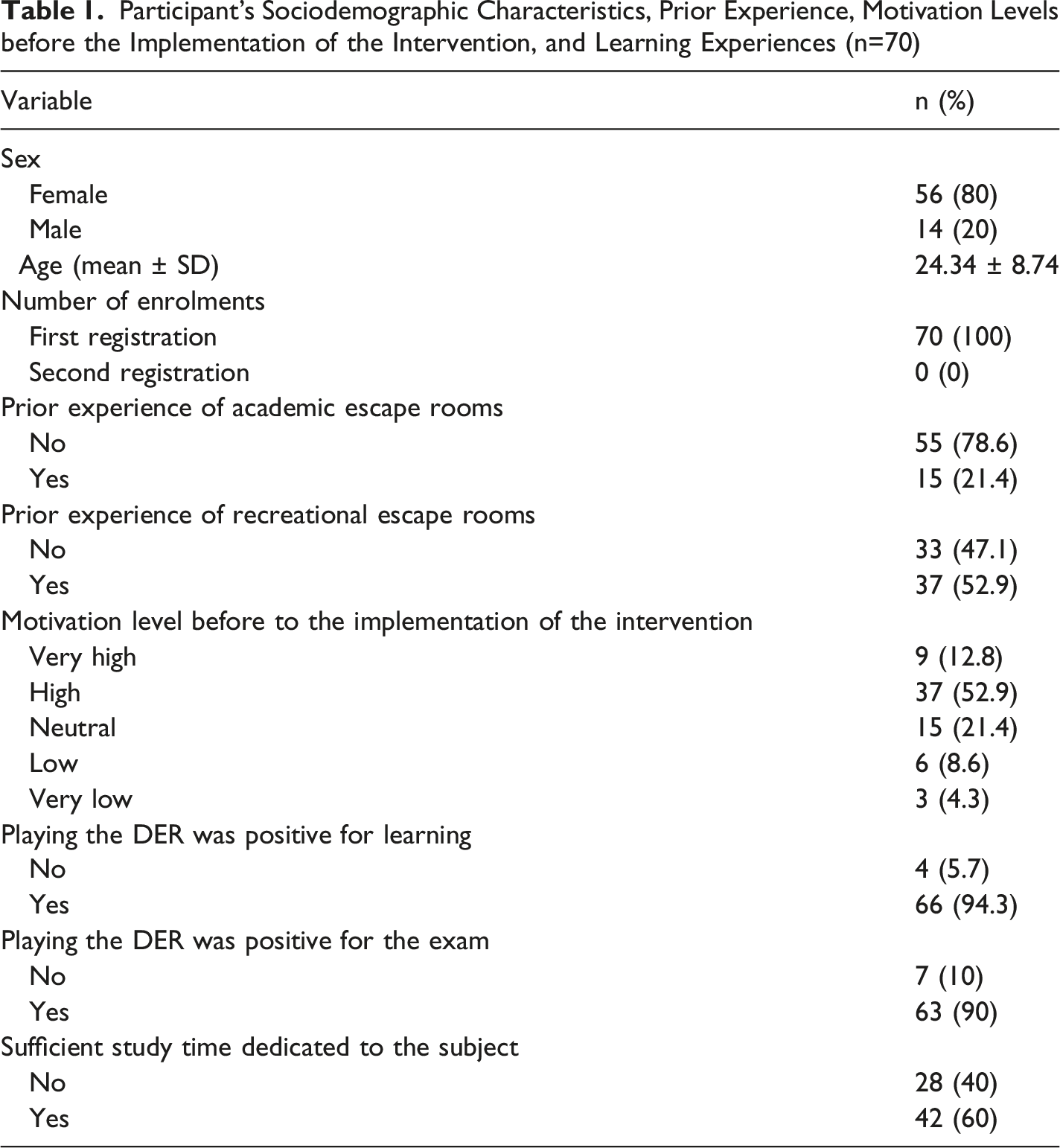
Regarding prior experience with escape rooms, 21.4% of students reported having prior experience with academic escape rooms, while 52.9% had engaged in recreational escape rooms. Most students reported a high (52.9%) or very high (12.8%) motivation level before the intervention, while 21.4% indicated a neutral motivation level, and a smaller percentage showed low (8.6%) or very low (4.3%) motivation.
When asked about the perceived educational value of the DER, 94.3% of students perceived that the DER was positive for their learning, and 90% perceived that it was beneficial for the exam. Additionally, 60% of students felt they had dedicated sufficient time to studying the subject, while 40% disagreed.
Regarding knowledge of the nursing process, the majority of students felt confident in key areas, such as conducting thorough assessments (65.7%), formulating diagnoses (65.7%), and establishing or prioritising outcomes (70%). They also emphasised the importance of individualised care (94.3%) and executing the care plan as intended (95.8%). Regarding knowledge of NANDA, NOC, and NIC taxonomies, most students (67.1%) considered their understanding adequate. Additionally, all participants agreed on the importance of using standardised systems for documenting care.
Results From the GAMEX Scale (n=70)
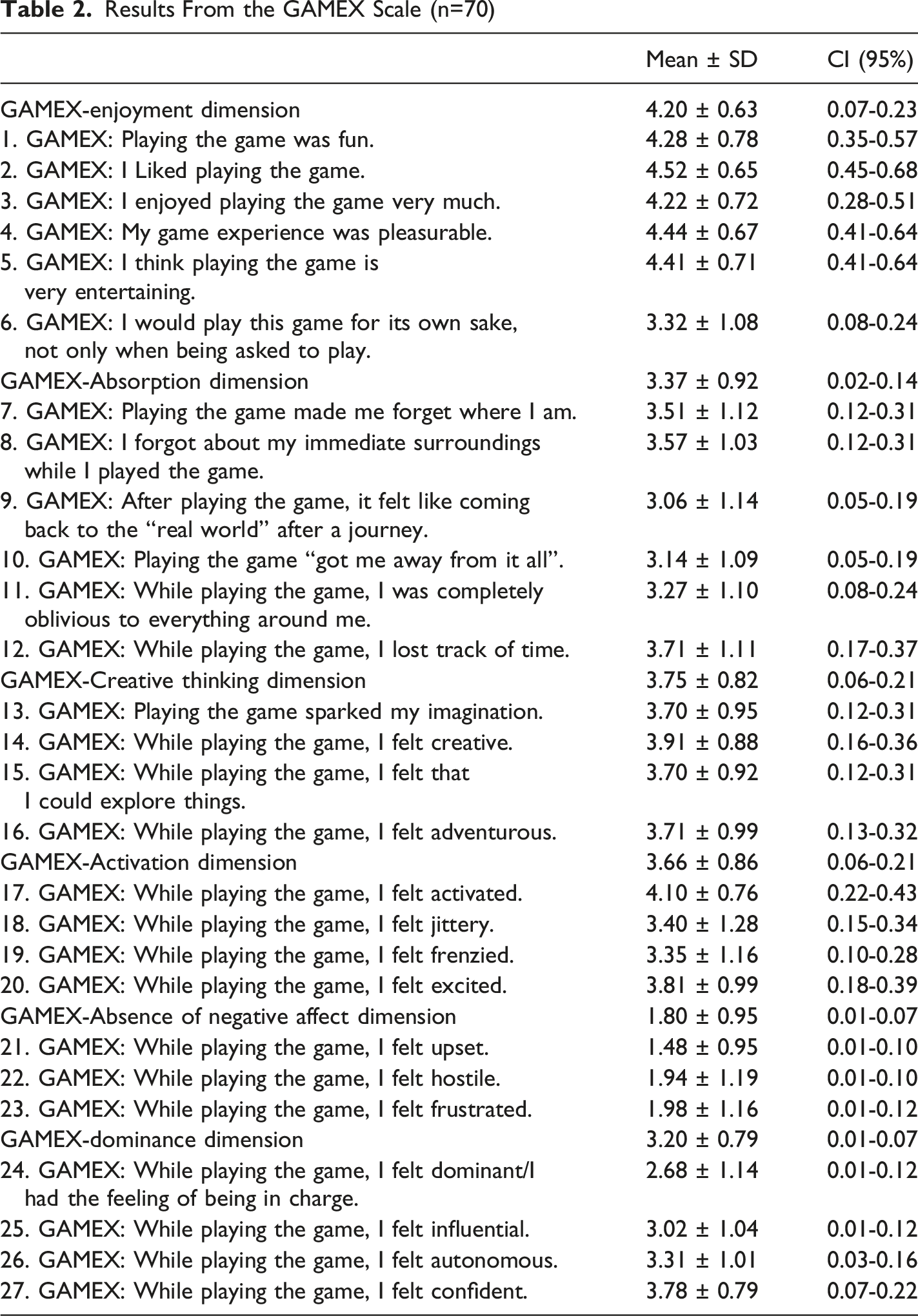
Five out of the six dimensions achieved a mean score above 3, including enjoyment (4.20 ± 0.63), absorption (3.37 ± 0.92), creative thinking (3.75 ± 0.82), activation (3.66 ± 0.86), and dominance (3.20 ± 0.79). The enjoyment dimension had the highest mean score (4.20 ± 0.63), and the absence of negative affect dimension scored the lowest (1.80 ± 0.95), indicating minimal negative emotions, with items such as frustration and hostility scoring very low (1.98 ± 1.16 and 1.94 ± 1.19 respectively). Overall, these results reflect a predominantly positive gameful experience across most dimensions assessed.
Students’ Opinions Regarding the Pedagogical Usefulness of the Escape Room Activity (n=70)
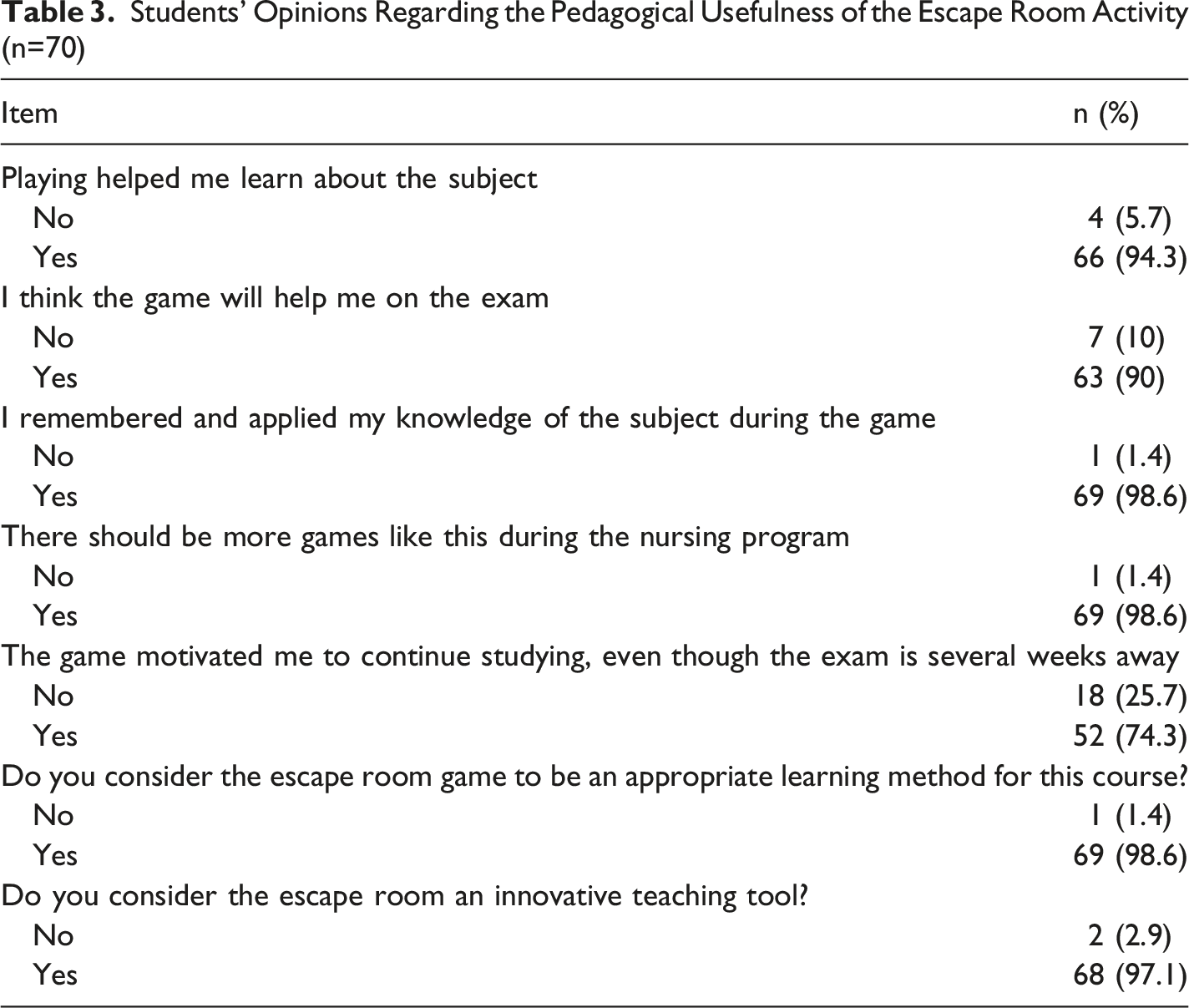
The vast majority of participants perceived the DER to be a valuable learning experience, with 94.3% stating that it helped them learn about the subject, and 90% indicating that it would be useful for the exam. Almost all students (98.6%) reported being able to recall and apply their knowledge during the activity and believed that similar games should be integrated more frequently into the nursing curriculum (98.6%). In terms of motivation, 74.3% of students stated that the game encouraged them to continue studying, even though the exam was still several weeks away. Additionally, 98.6% regarded the escape room as an appropriate learning method for the course, and 97.1% described it as an innovative teaching tool. Overall, responses reflected a high level of agreement across all items related to the perceived pedagogical usefulness of the digital escape room.
Students’ Opinions of the Potential Transferability of the Escape Room to Other Subjects (n=70)

While responses were mixed on whether the format could be extended to other nursing subjects (only 22.9% agreed or strongly agreed), most participants (74.3%) believed that implementing such activities in basic subjects (e.g., pharmacology, anatomy, physiology) would be challenging. Notably, most students disagreed with the idea that this type of activity is inappropriate for health sciences education (90%). Furthermore, a significant proportion (77.2%) agreed or strongly agreed that gamified methodologies should have greater relevance within university-level education. Overall, these findings indicate differentiated perceptions regarding the transferability of the escape room format across subjects, along with a generally positive view of gamified learning activities in higher education.
The relationships between sociodemographic variables and the different GAMEX dimensions were explored. No significant differences were observed based on sex, age, enrolment or prior experience with recreational escape rooms. However, prior experience with academic escape rooms was associated with significantly higher scores in the activation dimension (p = 0.01), suggesting that prior exposure to similar activities may enhance students’ engagement during game-based learning.
Relationship Between Motivation Level before the Implementation of the Intervention and GAMEX Dimensions Scores (n=70)

p* Anova-test.
Finally, the relationships between sociodemographic variables and students’ opinions on the activity´s usefulness were examined. A significant relationship was detected with motivation level before the implementation of the intervention (p = 0.03). A positive trend was noted, with higher levels of previous motivation associated with stronger beliefs among students that the activity could help them in preparation for the exam. No significant associations were found between sex, age, enrolment status or prior experience with academic or recreational escape rooms.
Discussion
This study explored the gameful experience of undergraduate nursing students during their participation in a DER activity, implemented as part of the “Methodological Bases of Nursing” course. Using the GAMEX scale, it assessed second-year students’ engagement with the intervention, while also examining their perceptions regarding the educational value of the activity and its potential transferability to other areas of the nursing curriculum. The findings offer valuable insights into how DERs can enhance student engagement and promote broader pedagogical innovation within nursing education.
The sample consisted mostly of women (80%) with an average age of 24.34 years, consistent with the feminisation of nursing and the profiles described in previous studies (Anguas-Gracia et al., 2021; Arrue et al., 2024). Nearly half of the students reported having prior experience with recreational escape rooms, and more than half reported high levels of motivation before the implementation of the intervention. These characteristics align with findings from the latest research, which has also identified high levels of motivation among nursing students before their participation in gamified educational interventions (Arrue et al., 2024; Ferriz-Valero et al., 2020; Gómez-Urquiza et al., 2019).
Students’ self-perceptions regarding their knowledge and application of the nursing process were largely positive, particularly in relation to nursing diagnoses and the use of the nursing diagnosis, outcomes and intervention taxonomies. These findings are consistent with those of Antón-Solanas et al. (2022), who also observed a favourable perception following a gamified experience related to the application of the nursing process in the context of pressure ulcers. However, certain items, such as assessment or therapeutic judgment, showed less decisive responses, potentially indicating a lack of confidence when applying this knowledge in more complex situations.
The GAMEX questionnaire results reveal a highly positive experience for the students, especially in the dimensions of enjoyment, creative thinking, and activation, aligning with previous studies (Fagundo-Rivera et al., 2024; Martínez-Galiano et al., 2024). High enjoyment scores and the strong perception of learning usefulness reinforce evidence that escape rooms foster emotional and cognitive engagement in nursing education. Antón-Solanas et al. (2022) highlighted the perceived value of gamification for meaningfully integrating complex content. However, some students showed more moderate scores in dimensions such as absorption and dominance, possibly because, as being a digital escape room, the immersive environment is more limited compared to a physical escape room, which may have influenced students’ levels of immersion. Additionally, the design of the activity was external to the students, which could have affected their sense of control over the experience, which in turn influenced the scores for dominance and absorption. This suggests that increasing opportunities for interaction and personalisation, as well as involving students more actively in the learning process, could enhance immersion and perceived control in future DER implementations.
Regarding the relationships between the GAMEX scale scores and the sample characteristics, no significant associations were found between sociodemographic characteristics and most of the GAMEX dimensions. While previous studies, such as Anguas-Gracia et al. (2021), have linked prior experience with escape rooms to a more positive overall perception, our findings only revealed a significant association between prior experience with academic escape rooms and the activation dimension (p = 0.01). This could be explained by the effect of contextual familiarity, whereby previous exposure to similar methodologies in educational settings may enhance participants’ confidence and their positive emotional responses during the activity. (Veldkamp et al., 2020). Additionally, motivation level before the intervention was significantly associated with creative thinking (p = 0.02) and activation (p = 0.01), aligning with studies that link intrinsic motivation to positive emotional and cognitive processes (Ryan & Deci, 2020). These results highlight the importance of addressing students’ motivational readiness prior to the activity, for example, by clearly explaining learning objectives, aligning the activity with assessment requirements and explicitly linking the game to professional nursing practice.
In the current educational context, students tend to prefer more modern, student-centred teaching methodologies that incorporate technology and interactive approaches to improve the learning experience (Morales-Morgado et al., 2023). In line with emerging literature, students in our study positively evaluated the pedagogical utility of the escape room, with over 90% indicating it helped them learn the content, would be useful for the exam, and enabled them to recall and apply prior knowledge during the game. These findings echo the latest research showing how this methodology fosters critical thinking, effective communication, and teamwork (Antón-Solanas et al., 2022). Additionally, the motivational impact was notable, similar to other studies with comparable samples (Martínez-Galiano et al., 2024), with 74.3% of students stating that the activity encouraged them to continue studying weeks ahead of the exam. These results support the potential of escape rooms as complementary tools for the development of nursing competencies, aligning with the paradigm of active learning.
However, opinions about the applicability of escape rooms to other subjects were more divided. While 77.1% agreed or strongly agreed that such activities should play a greater role in university education, 74.3% disagreed with their usefulness in basic courses like anatomy or pharmacology. This reluctance may stem from the perception that such subjects require a more traditional, memorisation-based approach (Suárez-Escudero et al., 2021; Valle & Gonzalvo, 2017). Previous research suggests that applying escape rooms to highly theoretical content requires careful instructional alignment to avoid cognitive overload and ensure coherence with learning outcomes (Buchner et al., 2022). To overcome this barrier, gradual integration strategies could be considered, such as the use of simplified clinical scenarios, progressive increases in task complexity, or hybrid approaches combining short, gamified activities with more traditional instructional methods (Ruiz et al., 2026).
Nevertheless, studies suggest that the challenge of adapting educational games to more technical content may be more closely related to a lack of teaching experience in gamification. It has been shown that teacher demands, feedback, and attention to detail are key factors in student engagement (Mateos & López, 2024). Moreover, it has been demonstrated that areas with complex theoretical and procedural content can still benefit from escape rooms if they are carefully designed with realistic simulation elements (Álvarez-Sánchez et al., 2019). These contrasts highlight the need to train faculty in innovative teaching strategies and adapt activity design to the specific learning objectives of each subject.
The present study adds to the expanding literature on the use of gamification in nursing education by highlighting the positive impact of DERs on student engagement, motivation, and perceived learning. Nonetheless, several limitations must be considered when interpreting these findings. These limitations include the specific context in which the intervention was implemented, the use of a convenience sampling without an a priori statistical power calculation, and the reliance on self-reported outcomes. In particular, variables such as digital skills, familiarity with technology, prior exposure to active learning methodologies, and group interaction dynamics were not formally controlled, which may affect the generalisability of the results.
Future research should consider longitudinal designs to assess the retention of knowledge and skills over time, incorporate objective learning measures, and explore how emotional, cognitive, and social factors interact to shape students’ experiences in gamified learning environments. It would also be beneficial to investigate the role of instructor expertise in gamification design, particularly in traditionally theoretical subjects, where resistance to active methodologies may still prevail.
Conclusion
The DER demonstrated value as an innovative educational tool. Its integration into the classroom was well received by students, who recognised its usefulness for reinforcing content and maintaining motivation throughout the learning process.
Although prior experience with similar activities did not appear to significantly influence outcomes, motivation level before the intervention´s implementation was found to play a relevant role in shaping students’ engagement, highlighting the impact of individual factors in gamified learning environments. Nevertheless, it is relevant to include additional individual variables in the design of future research. Beyond the factors analysed in this study, subsequent investigations should consider the role of other key elements, such as digital skills and teamwork dynamics, which are essential for success in collaborative dynamics like DERs.
Perceptions regarding the applicability of this approach to more technical or theoretical subjects were more divided, suggesting a need for thoughtful instructional design and faculty training to ensure effective implementation across diverse curricular contexts. Strengthening teacher preparation in gamification design and the pedagogical use of digital tools may facilitate broader and more sustainable integration of DERs across the nursing curriculum. Incorporating students’ perceptions and experiences as evaluative input may further enhance the relevance and acceptability of these strategies.
Footnotes

Ethical Considerations
The Ethics Committee of the University of the Basque Country/Euskal Herriko Unibertsitatea (UPV/EHU) approved the study (code CEIKDi3_2024_028). No payments or other incentives were offered to students for their participation.
Informed Consent
All students were informed about the study’s objectives and procedures and provided written informed consent to participate voluntarily.
Author Contributions
Iñigo Lorenzo Ruiz contributed to the study design, data collection, analysis supervision, and critical manuscript revisions.
Garazi Monasterio Gangoiti contributed to the design, data collection, analysis, and manuscript drafting.
Itziar Hoyos Cillero contributed to the conceptualization of the project, interpretation of findings, and final manuscript approval.
All authors reviewed and approved the final version of the manuscript.
Funding
This research did not receive any specific grant from funding agencies in the public, commercial, or not-for-profit sectors.
Declaration of Conflicting Interests
The authors declared no potential conflicts of interest with respect to the research, authorship, and/or publication of this article.
Data Availability Statement
The datasets generated and/or analyzed during the current study are available from the corresponding author on reasonable request.
Other Identifying Information
The research was conducted at the University of the Basque Country (UPV/EHU), with no external institutional affiliations influencing the study’s design or reporting.