



Abstract
This article reports on a study of occupational health and safety (OHS) challenges for temporary foreign workers (TFWs) in low- and high-skilled occupations, based on twenty-two cases drawn from a broader study in three Canadian provinces. Interviewees in construction, meat processing, hospitality, and fast food reported concerns regarding working conditions and OHS issues. They include precarious migration status affecting voice; contrasting access to social support; and mechanisms undermining regulatory effectiveness. Sources of vulnerability include closed work permits (making workers dependent on a single employer for job security and family reunification); ineffective means to ensure contractual compliance; and TFW invisibility attributable to their dispersal throughout the labor market. Violations include increased workload without an increase in pay and non-compliance with OHS and contractual rules without oversight. Positive and negative practices are discussed. Recommendations include improving migration security to preserve worker voice and facilitating communication between immigration and OHS authorities.
Introduction
Temporary labor migration comprises an estimated sixty-five percent of all migratory movements globally. This proportion is expected to grow in the future as an increasing number of states are using migrant workers to address demands for both high- and low-skilled workers.1,2 In Canada, the temporary foreign worker (TFW) population increased eight-fold between 1995 (50,000) and 2017 (370,000). 3 Over the years, these workers have entered Canada through a variety of programs including the Temporary Foreign Worker Program (TFWP). Program reforms introduced in 2014 reorganized temporary labor migration in Canada into two overarching programs: the TFWP and the International Mobility Program (IMP). Canadian employers using the TFWP must submit a labor market impact assessment (LMIA), administered by Employment and Social Development Canada (ESDC), which verifies that there is a need for a temporary worker and that no Canadians are available to do the job. Work permits granted under the TFWP are job, location, and employer-specific.4,5 In contrast, the IMP lets employers hire temporary workers without an LMIA, and work permits under the IMP can be open (enabling a person to work for any employer), open restricted (restricting the occupation or location but not the employer), or closed (i.e., employer-specific).
More and more temporary migrants are becoming permanent residents (PRs) in OECD (Organisation for Economic Co-operation and Development) countries. This factor is an expansion of “two-step migration,” which is understood as the transition from a temporary status to PR status within a given country. While in some countries, such as Australia, the majority of onshore immigrants are former international students, the prevailing two-step pathway in Canada is that of “temporary work-immigration.” In 2017, the number of TFWs who transitioned to PR in Canada was almost triple the number of those who did so in 2002. 3 Federal immigration program streams allowing the transition from temporary to PR status from within Canada—namely the Canadian Experience Class, the Federal Skilled Trades Program, and the Federal Skilled Worker Program—have traditionally been geared exclusively to TFWs in skilled positions. However, TFWs in low-skilled occupations can also use, and are in fact using, provincial nominee programs to transition to PR. Nominee programs are governed by federal-provincial agreements that allow provinces and territories to select immigration applicants who would meet local economic needs. Many provincial nominee streams are employer-driven (i.e., applicants require a letter of support for nomination from an employer). In light of this trend, a field study was conducted in 2014–2015 to explore the immigration intentions and lived experience with immigration opportunities of TFWs recruited through high- and low-skilled (now low-wage) positions, who have access to PR. The study’s findings shed light on the factors leading TFWs to seek PR, and the challenges that these workers face (and overcome) in their transition to PR. 6 Study participants varied greatly in terms of their source country, their length of residence in Canada, their occupation, skill level, type of work permit (i.e., closed or open), the program under which they were admitted, and the permanent residency streams available to them. They had worked in multiple provinces and in rural and urban workplaces. The resulting dataset includes insights on occupational health and safety (OHS) and conditions at work for these TFWs. These insights are the focus of this article.
In Canada, each jurisdiction (one federal and thirteen provincial/territorial) has its own OHS legislation. Many regulatory models exist across Canada 7 and most Canadian jurisdictions rely primarily on an “Internal Responsibility System.” The central pillars of the “Internal Responsibility System” are the right to know through training and access to information on hazards; the right to participate in OHS matters at work; and the right to refuse dangerous work. The current OHS regulatory regimes rely on workers’ participation and presume workers’ voice 8 to make OHS standards enforceable. By themselves, these systems are less effective when workers are not unionized, or are in unstable or precarious employment.9–11 High and low-skilled TFWs often fill these kinds of jobs.
There is broad agreement in international literature that TFWs are over-represented in hazardous industries and jobs.12–14 Much of the Canadian TFW literature, including on OHS, has focused on agricultural workers15–18 and live-in caregivers.19,20 These types of TFWs are in hazardous industries and jobs and often lack access to information, face language barriers, and are isolated: all elements which increase risks of occupational exposures.21,22
TFWs who are dependent on a single employer by virtue of an employer-specific work permit are particularly vulnerable, since they are prohibited from switching jobs which constrains their ability to speak out if they have an abusive employer.6(p8) “Deportability” 23 and workers’ fear of being medically repatriated 18 have been identified as two key determinants limiting the effectiveness of OHS protections among this specific TFW population. 24 There is thus an important connection between these workers’ “precarious” migration status25(pp240–241),26 and their employment conditions. But unfortunately, the federally regulated legal regime that regulates the entry and stay of TFWs in Canada has not sought to take this connection into account or to address it, an issue that we will examine in this article.
Working conditions, including those provided for in OHS legislation, fall for the most part under provincial jurisdiction 7 and the nexus between provincial law and federal law in the context of labor migration is weak. In the field of employment, for example, most TFWs are considered as “employees” under provincial Employment Standards (ES) legislation, and they are thus entitled to basic employment rights such as minimum wage, overtime pay after a set number of hours, minimum and maximum hours of work in some provinces, vacation with pay, and so on. 27 All these regulatory protections can affect, positively or negatively, the health and safety of workers. On the one hand, they can increase job satisfaction and commitment, reduce duration of dangerous exposures, or allow enough time for physical recovery and mental disengagement, while on the other hand, when not enforced the resulting conditions can contribute to high levels of stress and to long hours that can lead to excessive exposure to hazards and exhaustion.
This article sheds light on working conditions reported by TFWs in Canada working in high-skilled and low-skilled positions who have not entered the country through the better understood and longer standing Seasonal Agricultural Workers Program (SAWP) or the Live-in Caregiver Program, now Canada’s Caregiver Program. It seeks to document OHS hazards to which these workers are exposed and the challenges they face in exercising their OHS rights. In light of our findings, we will discuss determinants of exposures and worker voice and link the regulatory frameworks designed to protect workers’ health and well-being with some of the immigration rules that apply to them. As we shall see, the fact that parallel regulatory environments governing immigration and working conditions operate in silos undermines regulatory effectiveness of legislation designed to protect the health and safety of workers in Canada.
Methodology
Study Participants
The data set in the original study was gathered in 2014–2015 and relied on individual and group interviews with ninety-nine participants from three provinces (Alberta, Manitoba, Ontario), including forty-eight current and twenty-two former TFWs (the latter have become PRs), four spokespersons from nongovernmental organizations, twelve employers, eleven public servants (federal, provincial, municipal levels), and two labor union representatives. All of these interviews were digitally audio-recorded, and most of them were transcribed. The current analysis uses data from the twenty-two TFW interviews where participants raised issues relevant to OHS, including eleven former and ten current TFWs (described in industry specific Tables 1 to 4 except for one whose employment sector was not identified). It is also informed by relevant material drawn from the interviews with non-TFWs who participated in the original study.
Meat Processing Workers.
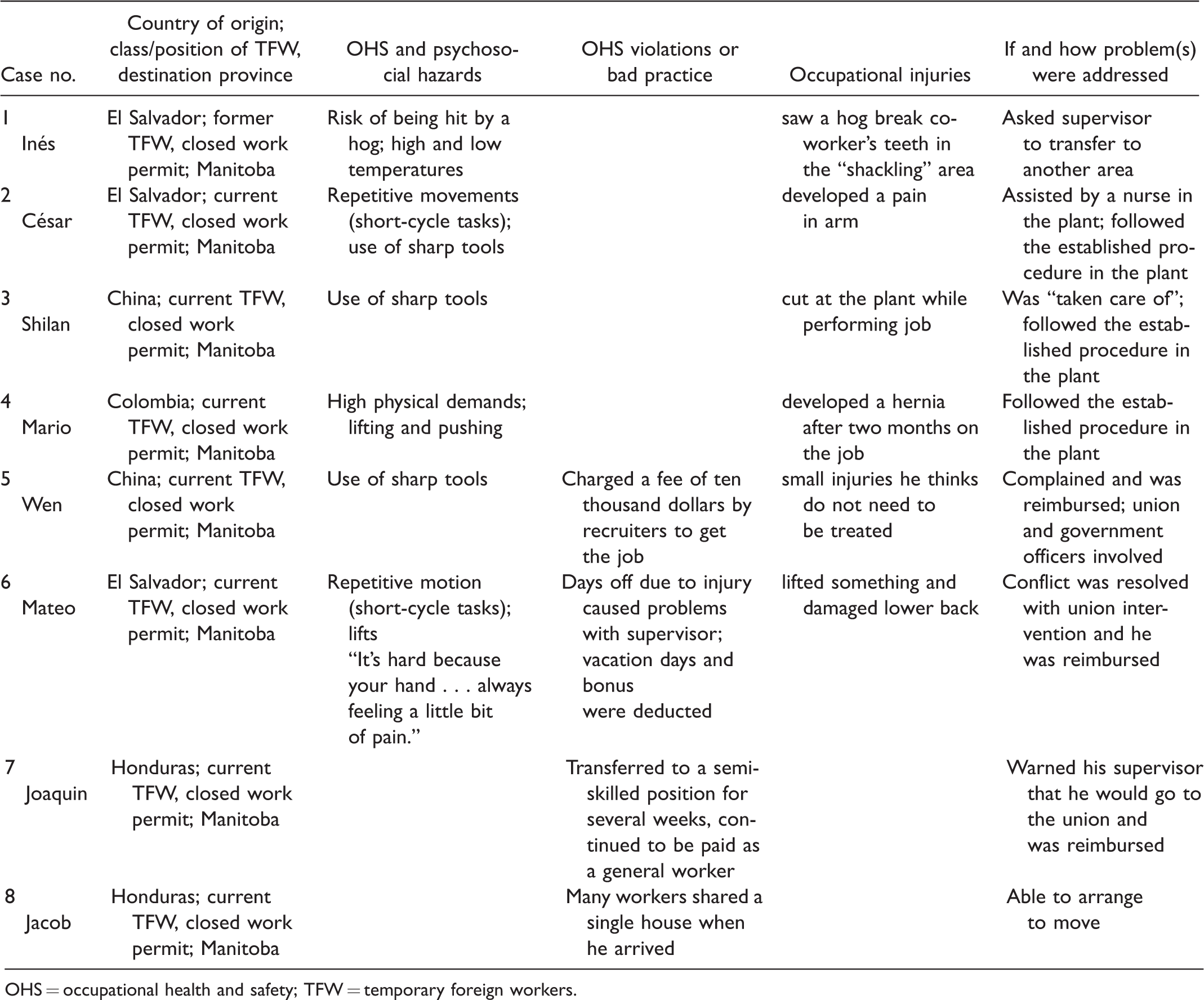
OHS = occupational health and safety; TFW = temporary foreign workers.
Secondary use of quantitative and qualitative data is a prevalent practice in many research fields, responding to expectations of some funders to maximize the investment of participants and funders. 28 In the field of public health, it has also been argued that such practices improve the timing for decisions to be taken. 29 The main concerns with the re-use of qualitative data relate to confidentiality and fidelity to the context in which the data were originally gathered. 30 While the protection of confidentiality could be easily achieved, recovery of context can only be partial, a problem that is mitigated in this study by the active participation of the primary researcher from the original study.
Overall Procedure
All of the interviews were analyzed using NVivo software. For this study, we used a two-stage analysis. In the first stage, all interview data from the original study were reviewed by a specialist in OHS who coded the relevant OHS information and organized the data by topic. In the second stage, we retained and analyzed the twenty-two TFW cases that mentioned OHS issues such as work injuries and illnesses, personal protective equipment, training, information, hazardous exposures, or determinants of OHS problems, including working time and other employment contract issues such as housing conditions or overtime. When the participants reported OHS issues, either problems or positive situations, we captured any available information about how workers and workplaces dealt with such situations.
Selected Cases
The twenty-two TFW interviewees who met our inclusion criteria originated from multiple countries and included current and former TFW participants who had experience working in both low-skilled and high-skilled occupations. Some of these workers were on a closed, employer-specific work permit, while others were on an open work permit, enabling them to work for any employer. Some changed statuses during the course of their trajectories (from TFW to PR or from an open to a closed work permit). Eleven of the twenty-two cases selected had become PRs at the time of the interview. The description of their experiences presented in this paper corresponds in all cases to the period when they were hired as TFWs. We have specified the nature of the work permit (open or closed) and position (skilled or not skilled) in the portraits of our cases in Tables 1 to 4. Eight of the twenty-two participants were in Manitoba and fourteen in Alberta at the time of the interview. These current and former TFWs had worked in meat processing (8), construction (3), food services (6), and hotels (4). Data collected from interviews with other research participants (employers, NGO representatives, labor union representatives, and civil servants) were used in this paper only to contribute to the overall analysis.
Ethics approval from the Research Ethics Board of the University of Ottawa was granted to researchers to access the data collected during the 2014 field study and for secondary use of data (File: 05–16-02). In accordance with the Tri-Council Policy Statement: Ethical Conduct for Research Involving Humans, 31 and in order to minimize risks to TFWs (who are considered a vulnerable population), all TFW participants are treated anonymously. The names of workers used in this article are pseudonyms, and names and locations of their workplaces have been removed.
Health and Safety Issues Identified by Sector
We have organized the findings by employment sector. In this section, we discuss the OHS issues raised by interviewees as well as any references to ES and contractual issues that are relevant to OHS.
Meat Processing
All of the participants who had worked in this industry had been employed in the same meat-processing facility and all entered the country as TFWs through the same low-skilled occupation stream, with a closed work permit. This plant has relied on TFWs for years. A significant proportion were recruited in their countries of origin, and all of them had passed a physical exam to warrant their fitness for the work at the time of recruitment. Table 1 provides a summary description of the situation and experiences of these workers. No workers in this plant reported contract/ES issues.
Interviewees repeatedly described work in this plant as “hard work.” Most of the workers described the work as physically demanding, entailing exposure to bad odors, extreme temperatures, prolonged standing, and hazards associated with the use of knives. This assessment was supported by a civil servant who said: “Like any other processing facility … you’re looking at very hard, manual labor … you have cold conditions, you have speed … .”
The plant is unionized and the union plays an active role in OHS. As reflected in the words of a union representative: The plant slaughters 16,000 hogs a day, every day … It works around the clock. … [The work] is very demanding, physically demanding and monotonous … it is hard on your arms and your back, it doesn’t smell good, it doesn’t look good, it’s not appealing, it is tough work … It is a very dangerous place to work. Everybody has a knife … [It] is really important that everyone understands how to work safely. We have had some pretty horrific injuries here at this plant, so communicating that is pretty important. Inés (former TFW from El Salvador): I started to work in packaging after being there for three or four weeks. They transferred me to another area, the dirtiest area in this plant … I learned shackling; that’s a very dangerous area. That’s where after they kill the hog … it is half-dead, half-alive on the table and the job is [to] shackle [it] on a chain. [When] it kicks … it can hit you. I was there for three years … I left there because a hog broke my co-worker’s teeth, so I went to another area, a place they call “the ramp” … I also worked at a place called “chasing” … I was in another where … I would get totally covered in grease … It was really hot; it was really cold outside and super-hot in there. César (TFW from El Salvador): In the beginning, any job you do there can hurt you … but knowing how to work right with the knives, they teach you how to have it sharp, and once you learn then you don’t get injured. Union representative: … a lot of these jobs are butcher jobs, so you or I could not just walk into that plant and start doing the work. It would take a couple of months of training and you would have to build up the strength in your arms.
Hospitality
Four of our cases had worked in various hotels that are part of different hotel chains. A summary description of these workers’ experiences is presented in Table 2. Three entered the country with open work permits and after their permits expired were hired by hotels through closed work permits. The fourth worker arrived on a closed work permit. Two of the hotel workers, Elsa and Ciro, are a couple and work in the same hotel. The other two, Mirta and Gloria, work in different hotels in another city. Both had problems with their contracts that led to under-payment and overwork. Their work is not light. Postural problems related to making beds and pushing the cart were identified as hazards as well as exposure to germs and cleaning products. Workers in one hotel reported a lack of protective equipment for cleaning and being harassed for reporting an injury. Below are some of their experiences.
Hotel Workers.
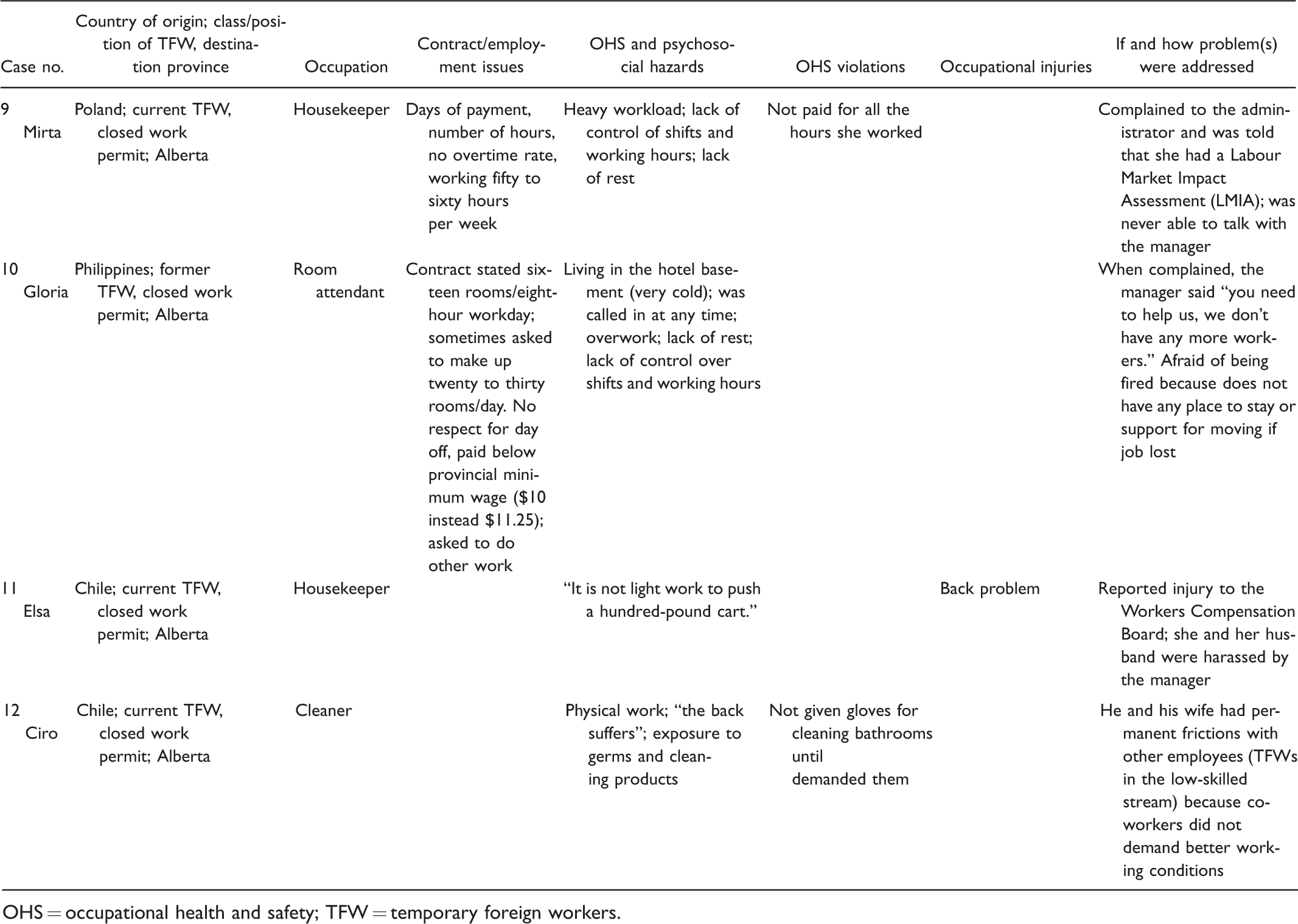
OHS = occupational health and safety; TFW = temporary foreign workers.
Gloria, now a PR from the Philippines, talked about her former experience as a TFW on a closed-work permit when she worked in housekeeping. The job description in her contract said she should do sixteen rooms a day in an eight-hour period. When the hotel was very busy, however, the workers were asked to make up twenty, and even thirty, rooms a day. When the hotel was not full, they performed other types of work. These conditions contributed to overwork and there was inadequate recovery time. Gloria said that, “there could be twelve days in a row without a day off.” She and three other TFWs lived in the basement of the hotel, where conditions were uncomfortable making it difficult to rest: “It was in a new building; it was very cold.”
Mirta, a TFW from Poland on a closed work permit worked fifty to sixty hours a week and her shifts were sometimes extended or changed on short notice. She was paid in cash, usually late, and often received less than she expected because the hours actually paid did not correspond to the hours actually worked.
Ciro, a TFW from Chile, worked on a closed work permit in housekeeping. He said: “I would only stay [in this job] three years; this is a pretty physical job and your back suffers. I understand [why PRs and Canadians do not keep these jobs]. You stay six months and you go to another job.” He said workers do not receive protective equipment. “They [his supervisors] used to have rubber gloves high in the corner of the storeroom. It’s an international standard right now; if you are cleaning toilets you need rubber gloves.” When he complained, he received the gloves.
Elsa, a TFW on a closed work permit from Chile, also worked in hotel housekeeping. She commented: … it’s so stupid that even immigration asks you for three years of experience to give you the qualifications for cleaning. It’s stupid and they call it “light-duty cleaner.” It is not light. A girl like me of 115 pounds cannot push a cart of 100 pounds, but I have to do it. That’s why when you make a repetitive task someone says you have something on your arm, and I say, “well I’m doing this every day.”
Food Services
In this section, we include the experience of six TFWs employed in two types of businesses: fast-food chains and bakeries. These are all small workplaces and workers were not unionized. A summary of these workers’ experiences is presented in Table 3.
Food Service Workers.
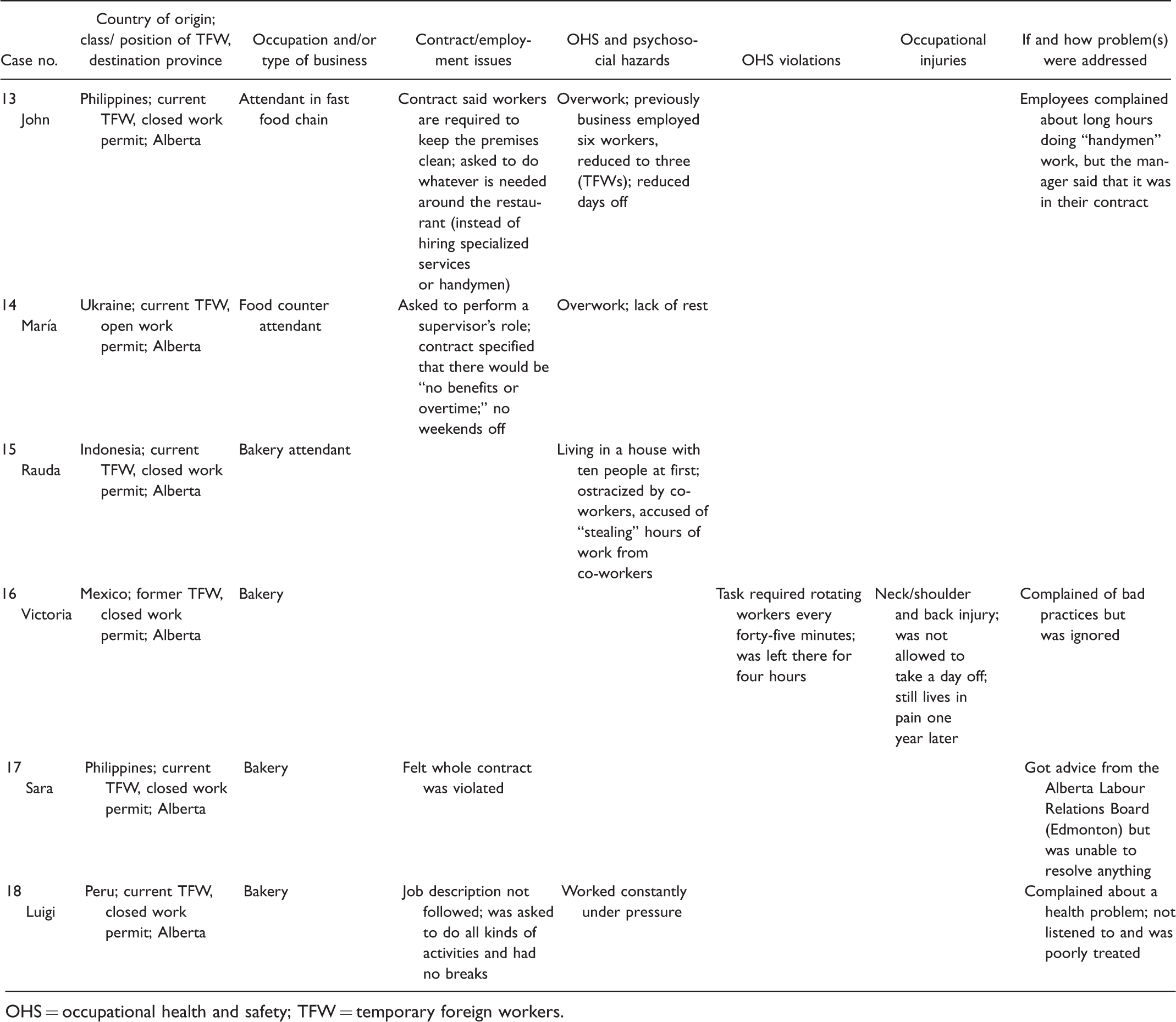
OHS = occupational health and safety; TFW = temporary foreign workers.
Construction Industry Workers.

OHS = occupational health and safety; PR = permanent resident; TFW = temporary foreign workers.
These interviewees’ experiences include breaches of contracts related to job descriptions and working hours. Workers also reported a lack of breaks and days off, pointing to OHS concerns related to overwork and insufficient rest. Some complained about over-crowded housing, far from work, that was arranged for them by their employers, both factors potentially contributing to fatigue. There were also individual complaints about working under pressure, being mistreated or denigrated behind their backs, or being injured because of the failure of OHS protections.
Luigi, a TFW from Peru working in a bakery, on a closed work permit, performs all kinds of jobs: “[I] bake, do painting, garbage—too many things.” He is barely allowed to go to the washroom or to take time to drink water because he is always in a hurry. “He [the supervisor] is all the time yelling behind me. He put me too much stress.” Luigi thought this situation could have contributed to his health problem. “I make thirty-two kidney stones, they took me to the hospital and I get surgery.” When he explained the situation to his boss and asked, without success, to work fewer hours in order to rest, “[h]e took my papers, threw them to the floor and said to me ‘your health is not my business’ … ”
Rauda, a TFW from Indonesia who entered on a closed work permit said: What bothers us is they [co-workers] didn’t like foreign workers because they always think that our arrival cuts their hours … Right, so it’s not our problem …The foreign workers have a contract already, which gives us eighty hours [bi-weekly], forty hours a week. I’m probably going to have the same treatment by the company by cutting my hours when I become a permanent resident. I got into an accident, because they are supposed to change you every forty-five minutes or every hour to prevent any injury in your body. They are supposed to rotate all the personnel. But they left me there for four hours. So I started having a lot of pain from my neck to my back, and then my shoulder. And I was there for four hours so nobody was changing me … So I deal with them and say, you know what, I have to take some days off and [the manager of the company] told me, no, you can’t because we need you.
John, a TFW on a closed work permit from the Philippines worked in a fast food establishment. He said the employer had replaced six workers with three TFWs. He was not paid the overtime rate when he worked overtime and was usually asked to stay longer. Because the contract said that workers are responsible for keeping the premises clean, the employer asked them to do whatever was needed, as “handymen,” instead of hiring someone else to clean.
Construction
Three of our interviewees worked in construction in Alberta—two of them in skilled occupations, and the other in a low-skilled occupation. This information is summarized in Table 4. Alberto, a TFW from Spain on a closed work-permit, who worked for a construction company, talks about hard work, coercion, and failure to follow the provincial OHS regulations: … it was outside working in man lifts, extension booms, baskets and putting panels and windows. We had to do the whole structure, to basically put up the panels but outside when you work January, February, March, very cold days. [On my first day] I met them at the [site], they made me sign some paperwork … they provided the harness and the hard hat and a vest, but they made me sign on a paper that if they fire you or you quit within six months you have to reimburse them … and also I had to sign a paper that I was agreeing with the company to not get paid overtime … When I started the work, I was told to “put on a harness.” I didn’t have Genie certification [for aerial lifts]; I didn’t have fall protection or certification which is required under Albertan and Canadian law, and basically I was working like that. I received the course just now; they gave me the certificate today—the Genie course and the full protection course to be able to work on that job … We did do a course three weeks ago, but before that I had been working for three months … without any certification … When they signed me up for the course they made me fill out a contract that if I quit or I was fired before six months after I had taken the course, I would have to reimburse them $250 for the course and for the fall protection it’s another $250. … but he [the boss] says he’s going to have to fire you because he’s not too happy … but he has a deal for you: if you want to stay he’ll lower your salary to $24 … if you don’t accept that, we’re going to have to give a notice to immigration that you’re not working here anymore, that we fired you and they’re going to probably deport you or you’re not going to be able to bring your family.
Detrimental and Supportive Practices for Workers’ Health and Safety
Here, we identify cross-cutting issues that contributed to the OHS experiences of the workers we interviewed.
Negative Practices and Strategies to Address Them
Some negative practices described by our interviewees have a direct impact on workers’ health, safety, and psychosocial well-being. They include being paid under the table, explicit threats of termination or of not being nominated for a PR application and, most commonly, breach of contract related to job description, working hours, and wages. Some of these are violations of OHS or ES provisions. Threats have a direct impact on workers’ voice and their capacity to report such violations, even if they know their rights.
All interviewees were asked about how they dealt with the problems they had described. Tables 1 to 4 summarize the actions they took. In general, the workers preferred to deal with their problems inside their workplaces and did not look for regulatory or other formal assistance outside of work; they did not pursue legal procedures.
Unionized TFWs in the large meat-processing facility (Table 1) who had job-related problems tended to speak up, and in general were able to solve them. The problems mentioned included: being charged $10,000 by the recruiters; having days deducted from their pay and having their bonus withdrawn for being hurt close to vacation; being paid as a low-skilled worker while doing a semi-skilled task for several weeks.
Among the hotel workers (Table 2), Mirta complained to the employer that she was not being paid for all the hours she had worked. She was told that “this is because they are giving me the LMIA [labor market impact assessment], as if it were a favor.” Workers in this category were explicitly told not to compare themselves with other workers who had not been supported through their immigration proceedings. She was never paid on time and she was paid in cash. Gloria was also overworked and was living in the hotel’s basement with the other TFWs. They could be called in to work at any time, sometimes to do work not in their job description like cleaning windows. She said: “They abused us but we were afraid to complain. What if they turn us back? I do not have any relatives here”—meaning that she would have nowhere to live. When she and her co-workers complained to the managers, they were told “you have to help us, we do not have any more people.” She and some co-workers in the same situation did not say anything until they were able to switch to another employer who treated them better.
Two other workers in this industry also talked about OHS. Ciro said, “There’s a lot of things [for OHS]; things that we’ve got now because of the hours of fighting in the office with managers.” Elsa entered Canada with an open work permit but, at the time of the interview, she had transitioned to a closed work permit in order to stay longer. Elsa filed a claim for workers’ compensation when she was hurt. She observed that her co-workers with closed permits accepted everything and did not make any demands. She said, “They don’t want to complain … Because we came with an open work permit, we were not afraid.”
A key informant, a manager of a hotel chain interviewed in Ontario, explained: In British Columbia, we had three hotels that were participating in the [LMIA/closed work permit], two of them were the big chains, but the third one I heard things [. . .]. Like employees getting injured and they were not allowed to go to the [workers’ compensation board] to claim because they didn’t want to pay that. And always the visa was used as a sort of leverage.
Some of the workers in food services (Table 3) indicated they had complained to their supervisors about contract violations and working conditions but were not listened to. Sara looked for assistance from the Alberta Labour Relations Board to confirm that her contract was not being followed and she was unable to resolve anything with her boss or the recruitment agency. Her manager said to her, “‘your contract is just a front for the labor—for your [LMIA] to be approved’.” She was unable to resolve anything.
John, a cook, and his co-worker, an attendant in a fast food outlet, said he knew he and his co-workers were overworked and were being asked to do work that was not in their job description. He commented, “Sometimes we complain, but they [the managers] say, ‘it is in your contract: maintenance and cleaning’.”
The challenges for workers in construction (Table 4) ranged from accepting imposed conditions to keep their job (Alberto) to tolerating abuses in changing shifts and extended hours until they got their PR (Pedro). Pedro explained: I’m attached to this company, and I cannot move to other company because I want to achieve the residency and in the meanwhile I hate this guy, he hates me, and we say to each other, well I need him, he needs me and he’s abusing that. And you feel like a slave at some point. I mean this work, you are not a slave really, but that situation that they need you and you need them. We have the rights, but basically if you don’t do whatever they say, they’re going to fire you [. . .]. The problem is you don’t know that many people. I know they fired the Polish guy this week. He was [on a closed work permit] and they fired him. They [the managers] don’t let you keep copies … I do take pictures of my time sheets. I have all my time sheets on my phone, but I don’t know where I could go to do anything about it, or if I could do anything.
Supportive Practices
At the time of the interviews with workers in the meat-processing plant, the union provided support on a daily basis at the workplace. The inclusion of resources in languages other than English was useful to the workers when conflicts arose. Supervisors, interpreters, and union representatives spoke other languages (including Chinese and Spanish) and the collective agreement was translated into the languages of the workers in the plant. English classes were available, supported by negotiated agreements between the union, employer, and municipal government. The regulatory environment in Manitoba at the time of the study played a supportive role, not only by mandating the monitoring of compliance with the legislation but also by actively promoting the establishment of new plants in the province and collaborating with employers in the recruitment of TFWs. The government’s role has evolved over the years, but it remains vigilant in tracking the placement of TFW and regulatory compliance of employers who make use of their services.32–34
Mario, a former employee from Colombia, had access to English classes through the union. He thought the company was a good employer and that all of the information was disclosed from the beginning [for example that the work was going to be hard]. He said that the union helps [the workers] a lot, for example, in filing taxes and providing assistance with problems, both work-related and others.
Although work at the plant was physically hard, exposing them to ergonomic and safety hazards that could lead to musculoskeletal disorders and injuries, there were protective practices in place that could decrease the risk of being injured, including (1) OHS training; (2) a joint health and safety committee; (3) OHS information in various languages; and (4) a system of moving from less demanding to more complex operations, allowing workers to gradually gain experience and skills. The union representative explained: It used to be that having a sign in every language, it would go on the floor and nobody would read it. We went to a new system to educate people about how to work safely … We have the same language for our health and safety group too, so that translation services are available in both the health and safety side and the labor relations side as well.
None of the workers outside of the meat packing plant mentioned being unionized. Some workers in other industries and locations who could not solve their complaints within the confines of their workplaces looked for support elsewhere. For example, when Ernest and his co-workers failed, after months of attempts, to resolve their housing problem with the employer and the agency, they went to the Edmonton Community Legal Centre and were told “‘You have the right, just give them a month’s notice … ’ [because] the employer was deducting our salary directly and gave it to the agency to pay for our house. So basically it’s technically illegal.” Elsa went to the Workers’ Compensation Board of Alberta when she was injured and was told how to proceed, “[Ciro and Elsa told the employer that] he should fill in some paperwork and he said ‘okay, cool, whatever, I understand, I know everything, and we will take care of that.’”
Discussion
In this section, we focus on two themes that emerge from the findings: the OHS hazards specific to sectors in which TFWs are employed and the determinants of supportive and detrimental OSH practices.
Hazards Specific to Sectors of Employment
Twenty-one of the twenty-two workers retained for this study had worked in employment sectors which are known to be hazardous, a finding that is not surprising given that we selected these cases because they had raised OHS concerns. Meat processing, hospitality, food services, and construction are all sectors that have attracted the attention of OHS scholars.
Meat processing
There are many references in the international literature to the ergonomic exposures including repetitive movements, awkward postures, and cold environments in meat processing.35–38 Some work practices in this industry such as a pre-determined work pace, long hours, short cycle time, and ergonomic difficulties have been found to be related to job stress. 39 A study from the Netherlands on the use of posted or migrant workers in meat processing, found that these workers were more likely to confront the “exclusionary effects of posted employment” as compared to construction workers, because the meat processing workers reside in the Netherlands for longer periods. 40
In his 1990s study of OHS in Canada’s meat processing industry, Novek 41 reported increased injury rates in the context of increased mechanization, organizational restructuring, and changes in labor relations. More recently, an analysis of Manitoba’s Workers Compensation Board data for the period between 2003 and 2013 showed that the mean injury rate per 100 full-time workers was greater in the Manitoba meat processing industry (20.1) than in all manufacturing jobs (13.6) and all industry sectors in the province (7.9).33(p108) Alberta meat processing workers have the highest probability of a disabling injury among all manufacturing employees in that province, with a rate more than double the manufacturing average. 42 One concern related to international meat processing workers employed in Canada is that there are no recent published studies about how this industry has assessed and adapted the workstations to match the anthropometric characteristics of its diverse worker population. 43
Hospitality
Hospitality was not historically considered to be a high-risk industry. 44 However, recent studies have shown that hospitality work is not light work and that international migrant workers confront significant hazards and particular challenges in the sector. The International Labour Organization, in case studies of migrant workers in the hospitality industry around the world, noted that “migrant workers face particular vulnerabilities in terms of health and safety in hotel work and are more likely to be involved in workplace accidents.” 45 In Australia, work intensification associated with a wage system based on piece-work (pay based on the number of rooms cleaned) was found to be associated with musculoskeletal injuries. The authors suggest that temporary employment agencies, including those employing migrant workers, have allowed the luxury hotel chains to undermine the working conditions that originally prevailed in the sector. 46 In the U.S., hotel workers are forty percent more likely to be injured than those in any other occupation in the service industry, and housekeepers were found to be the most affected among the hotel workers in a study conducted in five hotel chains across the country. 47 Another study on OHS issues of unionized hotel room cleaners, also set in the U.S., found that seventy-eight percent of these workers had experienced work-related pain in the previous twelve months, and workers with English as a second language (ESL), or Hispanic workers, were more likely to experience work-related pain than those whose first language was English. Hispanics, ESL workers, along with immigrant workers, were more likely to have lost work days because of the pain, yet most had not filed for workers’ compensation or reported their pain to management, and those who did were less successful in their compensation claims. 48
There is limited research on OHS hazards in this sector in Canada, and we found none focused on TFWs. Based on an ergonomic analysis of work activity, a study of hotel workers in Montreal identified detailed work organization problems and various hazards: repeated heavy lifting, awkward postures, time pressure, lack of control, and use of chemicals are among job exposures in this type of work that can lead to poor health outcomes. Social dynamics among the different groups of workers from a variety of ethnicities and classes contributed both to solidarity and division. 49
The OHS hazards reported by hospitality sector TFW interviews in our study are generally consistent with those identified in other studies including the possibility of higher exposures to heavy workloads than among non-migrant workers.45,50
Food services
Given its size, research on OHS hazards in the food service sector is quite limited. 51 We found no Canadian research on OHS hazards among TFWs working in the Canadian food service sector despite the large numbers employed there. According to figures of ESDC from 2010 to 2017, 132,482 TFW positions were in this sector, which accounted for thirteen percent of all the positions in Canada for the same period of time. 52
An Australian study of the fast food industry described the intense work-pace 53 and a Canadian study of the restaurant sector found it ranked first in reported work accidents and workers under thirty represented half of those injured. 54 Many food service businesses are small and medium-sized enterprises where a broad range of operations and managerial styles are practiced.55,56 OHS hazards identified by our food service study participants varied (Table 3); some of them correspond to challenges associated with small workplaces where unpredictable shifts and immediate requirements for extended shifts, as well as a lack of well-defined job descriptions, are common.55,56
Construction
The construction sector is one of the largest and most hazardous industrial sectors globally. Safety-related hazards in construction include the risk of falls from heights; trench collapse; scaffold collapse; electric shock and arc flash/arc blast; and failure to use proper personal protective equipment. Ergonomic hazards include heavy lifting, awkward postures, vibration and force application, and psychosocial constraints increase the risk of musculoskeletal disorders such as low back pain 57 and contribute to negative outcomes for physical and mental health. 58 Dust and chemical exposures are also common in construction work. 59
In Alberta, more than one-third of the fatality claims accepted by the WCB came from the Construction and Construction Trade Services 60 and an increasing number of TFWs are working in this industry. 61
Training, certifications, and personal protective equipment are required for Canadian construction workers based on their specific occupations/tasks, although requirements vary across provinces and each province has a construction safety association. Our construction interviewees reported safety-related exposures and OHS violations including violations of the mandatory training requirements (Table 4).
Determinants of Supportive and Detrimental OHS Practices
Three key factors acted as determinants of these workers’ OHS experiences: the links between their migration status and their ability to speak up (voice); the importance of social support; and the relative ineffectiveness of regulatory frameworks in ensuring compliance with OHS and ES provisions.
Constrained mobility and worker voice
The origins and linguistic abilities of these TFWs were somewhat different from those of many participants in the SAWP, where linguistic and cultural challenges have been shown to act as impediments to effective OHS protection.14,21–23,62 A translator was needed for only one of the interviews whereas other participants had reasonable English-speaking abilities, either because they were educated in English, had worked in other English-speaking international settings, or had come from European countries where use of the English language is widespread. Some came from middle-income economies with similar OHS regulations and some had higher educational training. Thus language barriers and lack of awareness of regulations and rights were not major determinants of the OHS vulnerabilities of most participants.
Consistent with research done elsewhere, work-related cultural differences are of relevance. 63 In our study, the acceptance and trust in the union was a learning process for some of the workers from Central America and China, who had not had confidence in unions in their home countries.
A study of Polish construction workers in Norway found that the construction culture in Poland differed from the construction culture in Norway and these differences, as much if not more than language differences, acted as determinants of the workers’ OHS experiences and practices. 63 For instance, worker voice was expressed differently in Polish construction firms: for Polish workers in Norway, speaking up or filing incident reports was seen as “snitching,” while this was not the case for Norwegian workers. Even without shared language, however, a skilled foreign worker could be acknowledged and respected by Norwegians in the same trade because of the shared skill set.
While most workers in our cases performed work in Canada that differed from their occupations in their home countries and thus would not have brought with them job-specific OHS cultural understandings and practices, two construction workers, two workers in the meat processing industry, and one worker in the fast food sector came to Canada with their own professional identities and practices. Those experienced as butchers in their own country moved up more quickly in the Canadian meat-processing plant.
The main determinant of voice in our study was migration status. Employers have substantial power, for extended periods of time, over workers on closed work permits. It is extremely difficult for these workers to switch to another employer even when they experience exploitative labor conditions, particularly if they want to have their employers’ support in the nomination process leading to PR. Alberto accepted a lower rate of pay because he needed to save money to show the immigration authorities that he had sufficient income to allow him to bring his son to Canada. Pedro complained of being exploited by his new boss but stayed in the job because he needed to complete several years of employment to apply for PR. Other sources of vulnerability that tend to silence many TFWs are related to their high dependency on employers, even for a place to live. As Gloria said, “[t]hey abused us but we were afraid to complain. What if they turn us back? I do not have any relatives here,” meaning that she could not face losing her job and shelter, at least not right away.
Regardless of the sector in which migrants are working, as reported in a previous study, “[o]nce the decision to immigrate is made [TFWs] are usually not willing to give up, despite the difficulties they face.”6(p20) As Salami and colleagues found in their scoping review of the literature on the health of TFWs in Canada, [i]mmigration policy that places a worker’s health into the hands of a single employer has the potential to lead to exploitation and create barriers in access to health services as the employer has a role to play in whether the worker remains in Canada [. . .].18(p552)
In summary, worker voice, the ability to speak up when confronted with hazards in the workplace or contractual violations, 8 is compromised for these workers particularly for those who depend on a single employer. Such precarious immigration status gives inordinate power to employers and in some cases leads to unchecked abuse. Similar findings have been reported in studies looking at labor rights and OHS challenges in Australia, Canada, the UK, and Sweden.13,14,65,66
Social support
A key element in our findings is the contrast in the actions, including willingness to complain, between unionized and non-unionized workers. None of the unionized workers in the meat packing facility, who were all covered by a collective agreement, complained about breach of contract. As described in Table 1, their problems were generally resolved and the support of the union was a key element in this, even in cases where the union was not asked to intervene directly. However, other factors were also at play in this facility. This large, unionized facility had systems in place for workers to develop skills and acquire OHS training. It was registered under the Manitoba Worker Recruitment and Protection (WRAP) Act as required for any company that hires TFWs in Manitoba, the first province to explicitly regulate employers of TFWs. 67 In contrast, workers in other industries, working in other provinces, almost uniformly said their contracts had been breached (Tables 2 to 4). While some of those workplaces were small and employed a handful of workers, others were larger and were franchises or part of a chain. In some of these cases, like that of Luigi, there was not only an absence of social support in the workplace, there were also very negative social interactions with his supervisor, as illustrated by the situation where the latter threw his papers to the floor and stated “Your health is not my business.” In the case of Rauda, it was the co-workers who were a source of negative social interactions, because they perceived the TFW as the source of their reduction in hours. Low levels of social support or social isolation are known to affect workers’ mental health 68 and negative social interactions with co-workers69,70 can further undermine psychological well-being.
The beneficial effect of union representation in empowering workers to speak up about health and safety violations has been extensively documented in the international literature. 10 There is also research showing the role of NGOs in supporting worker voice, particularly among precariously employed workers.6,71 As we have seen, our interviewees received information and support from social organizations such as the Edmonton Legal Centre and the Catholic Social Service in Edmonton.
Regulatory effectiveness of OHS and ES protections
Our study findings provide several examples of violations of OHS and ES legislation. Victoria felt she could not refuse work even when she knew that the activity she was asked to do involved longer hours than safe practice dictated; the number of hotel rooms Mirta and Gloria had to clean surpassed contractually stipulated quotas as well as the safe ratios recognized elsewhere.47,49 Alberto was required to perform construction work before receiving mandatory safety training and none of the Alberta-based workers were paid correctly for overtime hours. These are just some examples showing that workers’ protections under the applicable OHS legal frameworks, such as the right to refuse dangerous work, the right to protective equipment, the right to receive training and information about hazards, and the right to participate in OHS matters at work are not effective for many of these workers, particularly those who are not unionized.
As for the ES violations, workers’ well-being is compromised by wage theft, low wages, and extended hours without access to overtime rates, work intensification, overwork, over-exposure to hazards, and insufficient rest. They, in turn, can contribute to fatigue, musculoskeletal disorders, and stress-related health problems. 46
The Canadian “internal responsibility system” depends on workers knowing their rights and being able to participate actively in OHS and to refuse dangerous work. 8 External intervention by the inspectorates in OHS and ES systems are complaint-driven. In our study, TFWs rarely complained to management and those complaints hardly ever went beyond the workplace, making this system ineffective. Fay Faraday, in her study on regulatory effectiveness of Ontario labor legislation applied to TFWs, noted the need to move beyond a complaints-based system to allow for anonymous complaints and more proactive enforcement by regulators, as well as promotion of active involvement of community organizations to support TFWs’ voice. 72 Her conclusions are applicable to the workers’ situations in our study, particularly with regard to those who are not unionized.
Interwoven within our discussion of sectoral challenges and overarching issues, we find several factors of vulnerability identified by Sargeant and Tucker 14 in their article mapping layers of vulnerability of TFWs in relation to OHS. They identify migration factors, including the instability of immigration status, TFW factors (including socioeconomic conditions in the home country), education and language skills, and receiving country factors including socioeconomic conditions in the receiving country, sectors in which migrant workers are employed, access to collective representation, social inclusion or exclusion, and regulatory protections and their effectiveness. This framework reflects our findings related to the OHS challenges for low-skilled and skilled TFWs in Canada. Contributing to this analysis, we underline the frailty of the regulatory protections under labor legislation applied to TFWs because of the interaction between the immigration rules and processes and the disconnect between authorities responsible for the implementation of labor legislation and those responsible for allowing TFWs to work in Canada. These findings contribute to a broader literature on regulatory effectiveness of labor law applied to TFWs in Canada. 73
Our study illustrates an under-studied problem related to the employment contracts produced during the immigration process. These contracts, provided by employers to meet visa requirements, affected the expectations of the workers in our study and may undermine the effectiveness of provincial ES and OHS legislation because of the confusion they create, as the workers believe they are binding on the parties and enforceable.
Most of the interviewees compared their actual working conditions, including the job description, hours of work, wages, and housing (when provided by the employer) with stipulations in these employment contracts that had been produced for the purpose of the immigration process; very few workers referred to existing OHS and ES regulations.
While the “sample contract” refers to standardized issues relating to working conditions,
67
some interviewees indicated that their employers treat them as no more than the paperwork required by immigration law to enable them to hire TFWs, rather than as legally binding contracts with the workers. It is also not clear how these contractual agreements are enforced. As stipulated in the instruction sheet accompanying the sample contract, cited by Fudge and MacPhail67(p30): [t]he Government of Canada is not a party to the contract [… and] has no authority to intervene in the employer/employee relationship or to enforce the terms and conditions of employment […].
Although the employment contract contains mandatory provisions, the federal government cannot use it to enforce the employment rights of TFWs because the “Government of Canada is not a party to the contract” and thus “has no regulatory authority to monitor employer compliance with the employment contract.”74(p23) While provincial regulators may have jurisdiction to remedy contract violations if the violation is also a violation of mandatory provincial employment or OHS standards, workers hesitate to use these remedies for the reasons discussed above.
Conclusion
This study of TFWs in low-skilled and high-skilled occupations adds to the body of research on OHS challenges for TFWs in Canada, most of which has focused on agricultural workers and live-in caregivers. Like seasonal agricultural workers, the workers we studied are easily silenced and unlikely to denounce illegal practices that could compromise their health and well-being and even the health and safety of their co-workers. This is particularly true when a worker’s status depends on an individual employer, as when the worker holds a closed work permit, but some workers with open work permits are also vulnerable because if they lose their job they are isolated and have limited resources and support while they look for another job. Those seeking their employer’s support to allow them to bring their families to Canada are similarly constrained. Dependence on the employer clearly increases vulnerability and reduces worker voice.
In light of our interviews, a set of factors that showed positive impact in protecting workers against abusive practices, including breach of contracts, was the presence of an active union representing all the workers, including TFWs, in synergy with managerial policies in the meat processing plant and the support of the province and local governments throughout the whole process from recruitment to the permanent settlement of these workers and their families. In recent years, as illustrated by the interview data in this issue,75,76 better support systems have been provided by NGOs and unions in some jurisdictions. Our study underlines the importance of a holistic approach to support TFWs: those support systems that provide help regardless of the specific silo within which a problem falls (OHS vs. ES vs. housing vs. immigration) in order to better respond to the needs of these workers.
A significant factor undermining OHS protections and regulatory effectiveness is the inadequacy of communication pathways between federal institutions that manage the immigration programs and provincial institutions responsible for ensuring compliance with labor legislation, including laws governing ES, workers’ compensation, and OHS. At the time of our study, there were no links between immigration authorities and the provincial regulators, who, in most provinces, had no way of knowing where TFWs were working, a problem that is particularly important with regard to the TFWs outside the SAWP, as they are dispersed throughout the labor market which increases their invisibility. Our study shows that there is a need for better connections between employment regulatory authorities and those responsible for immigration law so that the contracts produced during the immigration process that create legitimate expectations are binding upon the employers who should be subject to efficiently applied sanction in case of contractual violations.
Some provinces have included provisions governing TFWs in their ES legislation.27(AppC) For example, in Manitoba, the Worker Recruitment and Protection Act, S.M. 2008, ch. 23 (2008), which came into effect on 1 April 2009, provides for a registration system for employers who employ TFW and it is an offense, subject to fines as high as $50,000, to recruit foreign workers without registering.67(p32) In 2018, Québec enacted new provisions requiring licensing of recruiters of TFWs and allowing the Labour Standards Commission to file a complaint relating to the violation of a TFW’s rights even if the worker does not complain about the violation; however, the draft regulations to implement these provisions, submitted for discussion in April 2019, have yet to be enacted. 77 In October 2018, the Government of British Columbia announced its intention to establish a registry for migrant workers designed to protect them from exploitation by employers and recruiting agents. 78 It is thus too early to monitor the effects of these new provisions. Although there have been some developments recently, including promises of new regulation in British Columbia and increased federal funding to support NGOs promoting labor rights of TFWs, 78 we have yet to see structured collaboration between immigration authorities and those responsible for ensuring compliance with contractual and regulatory requirements governing working conditions.
Some scholars have recommended extending pathways to permanent residency to all TFWs, including agricultural workers and providing safer and smoother transition to PR. 21 This study, based on secondary analysis, was not structured or designed to craft broadly based policy solutions; however, we do have clear recommendations regarding the issues that need to be addressed to reduce vulnerability for the workers we have studied.
First, it is clear that those who work in Canada should have effective access to federal and provincial regulatory protections related to working conditions, regardless of their temporary or permanent immigration status. Second, our study and others cited in this paper have found that workers’ dependence on their employer, because of the latter’s role in the immigration process, has the effect of silencing workers’ voice—and this needs to be addressed by mechanisms that are well adapted to the needs of TFWs from different streams and different programs.
Our study contributes to the understanding of workers’ experiences related to OHS in sectors that have been under-studied and highlights the importance of three main constraints: difficulties of getting PR associated with dependence on their employer; disparities between the literal interpretation of their written employment contract produced for immigration purposes (what their contracts stipulated regarding job description and employment conditions) versus their actual working conditions; and limited pathways to enforce those contracts and enjoy the current legal protections provided to workers in Canada. Our study and those of others cited in this paper21–23 found that the employer role in the immigration process, which makes workers dependent on the employer, has the effect of silencing workers’ voice, and this needs to be addressed as a priority. Future studies could investigate working conditions in workplaces where both TFWs, IMP and local workers work together, in order to gain a better understanding of the OHS implications of precarious migration status.
In closing, it is important to highlight certain positive changes that are currently taking place regarding the TFWP. Indeed, in May 2019, the federal government proposed a regulatory change to allow migrant workers to leave an abusive workplace. 79 In June 2019, 80 the federal government also announced a consultation process on the introduction of occupation-specific work permits which would reduce the direct control of individual employers. This suggests that the regulatory environment is changing rapidly, and future research will need to take these modifications into consideration.
While improvements have been made to the TFWP in recent years, largely because TFWs admitted under this stream have been the focus of critical policy research and NGO mobilization, the IMP stream has operated largely below the radar of public debate. Programs about TFWs were reformed in 2014 in the midst of our initial study; however, some of the TFW participants had permits based on programs that, today, are part of the IMP, which has become the dominant mechanism for international workers to legally work in Canada.81–85 In fact, in 2017, the number of IMP work permit holders was eight times higher than that of TFWP work permit holders 3 and the effectiveness of regulatory protections for some of these workers, particularly those on a closed-work permit in the IMP, may well be equally problematic. Lack of knowledge regarding employment and OHS conditions of IMP workers is of particular concern in a context where the number of IMP workers with a closed work permit is increasing, with no compliance system in place within the program to ensure that employers follow the rules.
Footnotes
Acknowledgments
The authors wish to thank all the participants in our study as well as the reviewers and editors who have contributed their ideas and support in the finalization of this article. The authors are deeply indebted to Amanda Butt from SafetyNet at Memorial University for her meticulous copy editing of the manuscript.
Declaration of Conflicting Interests
The author(s) declared no potential conflicts of interest with respect to the research, authorship, and/or publication of this article.
Funding
The author(s) disclosed receipt of the following financial support for the research, authorship, and/or publication of this article: The On the Move Partnership: Employment-Related Geographical Mobility in the Canadian Context is a project of the SafetyNet Centre for Occupational Health & Safety Research at Memorial University. On the Move is supported by the Social Sciences and Humanities Research Council through its Partnership Grants funding opportunity (Appl ID 895–2011-1019), Innovate Newfoundland and Labrador, the Canada Foundation for Innovation, and numerous university and community partners in Canada and elsewhere.