




Abstract
Concerns have been raised regarding toxic chemicals found in tire crumb used as infill in artificial turf and other play surfaces. A hazard-based analysis was conducted, comparing tire crumb with other materials marketed as alternative infills. These include other synthetic polymers as well as plant- and mineral-based materials. The comparison focused on the presence, absence, number, and concentration of chemicals of concern. No infill material was clearly free of concerns, but several are likely to be somewhat safer than tire crumb. Some alternative materials contain some of the same chemicals of concern as those found in tire crumb; however, they may contain a smaller number of these chemicals, and the chemicals may be present in lower quantities. Communities making choices about playing surfaces are encouraged to examine the full range of options, including the option of organically managed natural grass.
Introduction
Artificial turf fields have been installed widely in the United States and elsewhere. Most of these fields are constructed with infill made from waste tires (tire crumb). A substantial quantity of waste tire material is used in these fields. In 2017, 25 percent of scrap tires in the United States were made into ground rubber; of this amount, 23 percent of the ground rubber was used in sports surfaces. 1
Artificial turf generally has several components, including a base layer made from gravel or stone; an artificial grass carpet, including a backing material and artificial grass fibers; and one or more infill materials, used to hold the grass fibers upright and provide cushioning, among other functions. Infill is the portion of the artificial turf that mimics the role of soil in a natural grass system. Many artificial turf fields also include a shock pad below the carpet for additional cushioning. 2 Depending on the infill type, this shock pad may be an optional component of the turf system or may be required in order to provide a more resilient playing surface. The technology and materials used in artificial turf have changed over time and can vary from one field to another, complicating the task of assessing their health and environmental implications.
All artificial turf fields pose a number of concerns, including high temperatures, loss of green space, and migration of infill particles and particles of synthetic grass fibers into surrounding soil and water.3,4 High lead levels in synthetic grass fibers have been measured at some fields. 5 Legal action in California led to replacement of many of these fields, and several manufacturers have committed to eliminating lead in artificial grass blades. 6 Recently, testing has indicated the presence of certain per- or poly-fluorinated alkyl substances in samples of artificial turf carpet. 7 Antimicrobials used for artificial turf maintenance are also a source of concern for human health and the environment. 8
In sunny, warm weather, artificial turf reaches much higher temperatures than natural grass, raising concerns related to heat stress for users of the fields. Heat is a concern for all types of artificial turf. Some infills may become hotter than others, but the artificial grass blades also play an important role in trapping heat. Hot artificial turf surfaces can damage equipment and burn skin, as well as increasing risk of heat-related illness. 9
Chemicals found in infill materials have been a particular source of concern. Substantial literature has been generated on chemicals present in, and potentially released from, infill made from waste tires. Concerns have been raised about exposure of athletes, children, and others who play or spend time on the fields, as well as about environmental impacts such as chemicals in rainwater runoff. Numerous risk assessments have examined the possible human health implications of exposures that may be experienced by those playing on the fields.2,10 These studies have fed into an extensive debate over whether the use of artificial turf is acceptable from the perspectives of children’s health, athletes’ health, and environmental impacts. Concerns have also been raised about health implications for workers producing tire crumb 11 or installing or maintaining artificial turf.10,12 Additional research into health effects of tire crumb is ongoing; in the United States, this includes multiagency studies at the federal level2,13 and at the state level in California. 14
Concerns about the health and environmental effects of exposure to tire crumb have fueled a growing market in alternative infills. Alternatives include a range of synthetic materials as well as plant- and mineral-based materials. These alternatives, in general, have been much less extensively studied than the incumbent material, tire crumb. The introduction of alternative infills raises questions about whether alternative infills are safer than tire crumb, whether one alternative presents a clearly safer option compared with the others, and whether there is the potential for adverse substitutions, in which a toxic chemical and/or material of concern could be replaced with one of equal or greater concern.
This article presents a chemical hazard-based comparison of materials conducted by the Massachusetts Toxics Use Reduction Institute (TURI), taking into account the results of similar assessments by two other government entities, the Norwegian Environmental Agency, and the National Institute for Public Health and the Environment (RIVM) in the Netherlands.3,4,12 We present this comparison in the context of methods developed for alternatives assessment, with modifications to account for the need to compare materials containing multiple chemicals. Our findings about individual infill materials are presented with the goal of supporting institutions and communities in making well-informed decisions about these materials. We also caution that resolving questions about the choice of infill material is just one piece of a larger picture, as artificial turf presents a variety of important health and environmental concerns that go beyond the questions about infill materials.
Context: Alternatives Assessment Methodology
Alternatives assessment is a decision-assisting tool that has been developed to help governments and businesses make more informed and better considered decisions about chemical safety, performance, and costs. It is intended to help identify safer, technically feasible, and cost-effective alternatives to toxic chemicals or materials and to help decision-makers to avoid regrettable substitutions. 15 The methodology is designed to focus on action rather than on analysis for its own sake, on inherent properties of chemicals rather than on risk, and on the functional use of the chemical or material in question, in order to support timely decision-making on complex topics.16–18 An early framework for alternatives assessment was developed by TURI, 19 and government agencies in the United States and Europe have further developed and refined the approach.20–22
A typical alternatives assessment begins with identifying a range of alternatives to replace the “incumbent” chemical of concern. These can include chemical or material substitutes as well as different technologies or process redesigns that can achieve the same function provided by the incumbent. Alternatives are then assessed in comparison to the incumbent based on considerations of hazard, economic feasibility, and technical feasibility. 22 More recent alternatives assessment frameworks also encourage the evaluation of comparative exposure and life-cycle considerations.15,23
Alternatives assessment methods have been designed primarily for comparing a chemical with alternative chemicals or processes. They have not been fully refined for use in comparing products to one another, or making comparisons among materials or formulations, each of which may contain many chemicals, 21 although there have been recent efforts to extend the methodology in systematic analyses of baby mattresses 24 and of antifouling boat paints. 25
Most hazard assessments organize information about alternatives based on health endpoint. We chose instead to organize the available information based on the presence, absence, number, or concentration of specific chemicals or chemical categories of concern. Many of the chemicals or chemical categories found in infill materials are associated with one or more adverse health effects, and organizing the information by chemical made it possible to be more specific in our comparisons across materials. Thus, the analysis described here is a modified version of the hazard assessment component of alternatives assessment, focusing on presence/absence/level of individual chemicals within a complex material.
It is important to note that exposure to low doses of many chemicals in a complex mixture poses particular concerns which go beyond a simple additive effect of each individual chemical.26,27 Health effects of mixtures are not captured in our analysis. Further complexity is introduced by the mixing of multiple materials (e.g., synthetic polymers with mineral-based materials) within an infill product.
Approach to Comparison of Playing Surface Materials
The analysis was structured around queries that TURI received from municipalities and school districts. Many of these queries focused on the question of whether the problems associated with tire crumb infill could be solved by choosing an alternative infill. Communities also posed questions about the full range of effects of artificial turf fields, including the environmental impacts of synthetic grass fibers (carpet) as they wear and disintegrate over time.
In addressing these queries, it was necessary to choose an approach. One option is to consider artificial turf as an entire system, comparing it to the use of natural grass or other playing surfaces. A second option is to compare specific materials that may be used within the artificial turf system. This latter approach provides a means to systematically evaluate a set of materials serving the same function but necessarily omits a variety of other important elements.
TURI took a hybrid approach by comparing artificial turf broadly with natural grass for our examination of physical and biological hazards and of costs. Among other findings, the comparison found that artificial turf poses particular concerns related to skin abrasions 9 and that natural grass is more cost effective than artificial turf over the life of the product. 28 TURI chose to compare infill materials with one another because it was not readily evident whether one or more materials could be clearly identified as a safer alternative. TURI’s examination of chemical contents of infill compared tire crumb, the incumbent material, with alternative infill materials. We did not undertake a comparison based on cost, performance, or other factors, as the priority was to determine whether any material was clearly preferable from a health or environmental standpoint. This article presents the results of our chemical hazard-based comparison among infills.
The Norwegian Environmental Agency’s study was undertaken in response to concerns about microplastics in the environment. The agency had found in a prior study that artificial turf infills were an important contributor to microplastic pollution. The assessment of alternatives was undertaken with the goal of determining whether alternative options were available to reduce generation of microplastic pollution associated with sport surface materials. The agency found that none of the alternative infills it reviewed was “significantly superior” to tire crumb when taking a wide range of factors into account, including performance, cost, maintenance needs, and health and environmental impacts. 4
RIVM’s analysis was developed to support a regulatory proposal to limit polyaromatic hydrocarbon (PAH) levels in infill used in the European Union. This effort was undertaken after RIVM found, in an earlier study, that existing regulatory standards governing PAH levels in tire crumb were not sufficiently protective. Tire crumb is currently subject to the regulatory limits for PAHs in mixtures, and this level is much less protective than the regulatory limit for consumer products or for toys. RIVM concluded that most measured levels did not pose a substantial concern, but that existing regulations did not ensure safety. 29
Under the European Union’s Registration, Evaluation and Authorization of Chemicals (REACH) regulation, a restriction proposal must be accompanied by a socioeconomic analysis, which includes an alternatives assessment portion. Restricting PAH levels in infill could limit the extent to which waste tires can be used in this application, so RIVM analyzed the availability of lower-PAH alternatives, including the option of reducing PAH levels in waste tire material itself. 12
RIVM limited the scope of its study to alternative infills, without considering the broader question of artificial turf impacts. For purposes of regulating PAHs in infill, RIVM needed only to determine whether low-PAH infills were available and financially and technically feasible for use. The Norwegian Environmental Agency, on the other hand, did attempt to compare artificial turf fields broadly to the use of natural grass as a playing surface.
Methods
We examined a set of infill types that were available on the market. For the chemical hazard-based comparisons, we first conducted a document and literature review to obtain information on toxic chemicals present in the materials. We checked the product website for at least one brand of each infill type, requested laboratory testing results from at least one manufacturer or vendor for each infill type, and reviewed government agency reports and peer-reviewed studies for additional information on these materials. We also contracted with a laboratory for limited additional testing of infills to supplement the information available from vendors and in existing literature.
We constructed a hazard comparison table using a modified version of the TURI framework, as reviewed by Jacobs et al. In this framework, the “incumbent” chemical or material is shown as the first column, and the subsequent columns show how the alternatives compare to the incumbent. The framework is designed to provide comparative information and to make it possible to clarify tradeoffs among options; it is not designed to necessarily produce a final selection or “winner.” 22
When comparing infill materials, many of the same chemicals appear in multiple materials. For example, several infills contain lead, zinc, or PAHs, although at varying levels. For each chemical or chemical category of concern, we noted whether the chemical is present or absent in the material, and whether it is found at higher or lower concentrations compared to tire crumb, if this information was available.
Alternatives to tire crumb infill materials that were included in this assessment include ethylene propylene diene terpolymer (EPDM), thermoplastic elastomer (TPE), waste athletic shoe materials, acrylic-coated sand, and mineral-based and plant-derived materials. Each category of infill can include a variety of materials, including a range of polymers as well as additives such as cross-linking agents, accelerators, stabilizers, plasticizers, fillers, or antimicrobials. Specific polymer formulations are often not disclosed. Additives were taken into account in the hazard analysis to the extent that it was possible to obtain information about them.
Results
Results below present the findings from our comparative hazard assessment followed by a detailed review of inputs to this assessment. Additional background information is included to help differentiate the various materials. It is important to note that the information presented here only considers chemicals and that infills may also vary in other important ways, including amount of respirable dust generated, effect on injury rates, or other factors.
Comparative Hazard Assessment
The alternative materials all either contained smaller numbers of chemicals of concern or lower levels of certain chemicals compared with tire crumb. However, many of these materials do contain some chemicals of concern, and in some limited cases, levels of certain individual chemicals were higher in the alternatives than in the tire crumb (Table 1). It is important to recognize that materials may not be homogeneous, so tests from one batch of infill may not be fully applicable to another.
Comparing Tire Crumb With Alternative Infills: Selected Categories of Chemicals of Concern. a

Note. L1 = one order of magnitude lower; L2 = two orders of magnitude lower; L3 = three orders of magnitude lower; EPDM = ethylene propylene diene terpolymer; TPE = thermoplastic elastomer; VOCs = volatile organic compounds; RSL = Restricted Substances List; PAHs = polyaromatic hydrocarbons; TURI = Toxics Use Reduction Institute.
aWhere a value is noted as “higher” or “lower,” it is in comparison to tire crumb. Where a value is noted as “expected,” this is based on professional judgment using available information about the material. This table covers selected chemicals in infills and is not comprehensive. It does not cover all chemicals of concern and does not discuss other turf components such as artificial grass blades. Decision-makers should obtain up-to-date test data and should consider additional health and safety factors, such as size/respirability of dust particles, migration of particles into the environment, treatment with antifungals or antimicrobials, and quality of fall protection.
bSome information in this column is drawn from Nike’s RSL. VOCs: Nike’s RSL restricts benzene to 5 ppm and a number of other VOCs to a total of 1,000 ppm. PAHs: Nike’s RSL restricts certain PAHs to 1 ppm each and sets a 10 ppm total for all PAHs on the list. Phthalates: Certain phthalates are listed on the RSLs of major shoe manufacturers. Specifically, Nike restricts all orthophthalates to a total of 1,000 ppm.
cUS EPA. 2
dInformation drawn primarily from Norwegian Building Research Institute (NBI - BYGGFORSK). 30 Additional information on VOCs: Moretto 31 ; PAHs: RIVM 12 ; Bauer et al. 4
eDye et al. 32 Note: In this study, phthalates measured in airborne dust at a TPE field were found to be lower at one time, and higher at another time, compared with levels measured at a tire crumb field.
fPlants can produce some substances that are classified as VOCs. However, based on currently available information, the plant-based materials used in infill are not expected to pose concerns related to VOCs. PAHs can be taken up by plants from ambient pollution in some cases.
gAIRL, Inc. 33 Detection limit 10 µg/Kg for PAHs, 0.25 mg/Kg for metals.
hPAHs: TURI contracted with the Icahn School of Medicine at Mount Sinai to conduct limited testing to supplement information available in existing literature. Benzothiazole: TURI contracted with Applied Technical Services, Inc. to conduct this testing. Applied Technical Services Chemical Test Report Ref. C321135-2, 30 September 2019. Benzothiazole values, ppb: tire crumb: 45,000; EPDM: 34; shoe material: 1,980; TPE: not detected (detection limit 25).
iBy definition, the vulcanized rubber products (tire crumb, EPDM, and shoe materials) may contain residual vulcanization compounds. TPE is not vulcanized; however, in some cases, products marketed as TPE are a blend that also contains vulcanized rubber.
jOther metals are not shown in detail in this table, but full data on metals should be considered in decision-making. Metals that can pose a concern from an environmental perspective include high levels of zinc, among others. Except where otherwise noted, information is drawn from Labosport.34,35 These are the most current data from Fieldturf as of 2 January 2020 (Darren Gill, FieldTurf, personal communication, January 2, 2020). For lead, detection limit is 0.5 mg/kg.
kCrystalline silica exposure may be a concern when some sand products are used. Zeolite, when present, poses a serious respiratory hazard.
Many artificial turf vendors make test data available on presence of metals in their products. Thus, it is relatively straightforward for communities to examine these data for the products they are considering, while keeping in mind the potential limitations of any individual set of tests. For example, in some cases, tests may be based on a small sample size or may have high limits of detection, limiting their usefulness. Information on organic (carbon-containing) compounds is less readily available from vendors, so communities may need to make special requests for this information, conduct additional laboratory testing, or build chemical testing requirements into the specifications provided to vendors.
Metals
The information on metals in Table 1 is drawn primarily from one set of tests on individual infill products provided by a vendor of multiple infill types.34,35 Lead and zinc are described here as examples. However, communities considering any individual product should examine data for all the metals for which information is available.
Lead and zinc were present in all the synthetic polymer products. In one set of vendor test data, EPDM contained the highest level of lead, and waste athletic shoe material contained the highest level of zinc. Lead was below the limit of detection, and zinc was present, in test data for acrylic-coated sand. Limited test data for plant- and mineral-based materials indicated the presence of zinc, and the absence of detectable lead, in certain materials.
PAHs
The limited number of sources available to us indicated consistently that tire crumb is likely to contain higher levels of PAHs compared with alternative infill materials. However, many of the alternative infills do contain some PAHs. For the samples obtained by TURI, the tire crumb sample contained the largest total PAH concentration. Waste athletic shoe material and EPDM had the next largest total PAH concentrations, although they were both an order of magnitude lower than tire crumb. 36
Volatile organic compounds (VOCs)
VOCs have been measured in many of the materials but are higher in some than in others. One study found a smaller number of VOCs, and lower levels of the VOCs, in EPDM compared with tire crumb. Similarly, a study found lower levels of VOCs in TPE compared with tire crumb. A comparison study is not currently available for waste athletic shoe materials, but if the shoe materials are from a brand that has a Restricted Substances List (RSL), then at least selected VOCs are subject to limits. In summary, it is reasonable to expect that some of the alternative infill materials will have lower VOC levels compared with tire crumb.
Vulcanization compounds
Vulcanization compounds (chemicals used in rubber curing) are likely to be found in tire crumb, EPDM, and waste athletic shoe materials.
Provided they are not chemically treated, mineral- and plant-based materials are unlikely to pose concerns related to the broad categories of synthetic chemicals listed in the table, but some can pose other important concerns, including respiratory hazards.
Hazard Review: Tire Crumb (Incumbent)
Tires are made from a number of materials, including styrene butadiene rubber. Tires can contain a wide variety of intentionally added chemicals, as well as substances that may adhere to the tire during its useful life. Different types of tires can be mixed together in the waste stream, creating additional variation in the final tire crumb product.
In a literature review, the U.S. Environmental Protection Agency (US EPA) identified just over 350 chemicals or chemical categories that were discussed in existing literature on tire crumb. 2 These include metals, VOCs, semivolatile organic compounds, and a variety of uncategorized chemicals including vulcanization compounds. 37 The presence and amount of a given chemical can vary depending on the sample of tire crumb.
Some of the chemicals found in tire crumb are endocrine disrupters (e.g., phthalates); some are known or suspected carcinogens (e.g., arsenic, cadmium, benzene, styrene); and some are associated with other human health effects.2,38–41 A recent study evaluated the potential carcinogenicity of 306 chemicals found in tire crumb and found that 197 of them met certain carcinogenicity criteria, while fifty-eight of them were actually listed as carcinogens by a government agency. 42 Another study exposed chicken embryos to tire crumb leachate and documented a variety of adverse effects from exposure to the chemical mixture. 43 For illustrative purposes, additional detail is provided here on selected chemical categories.
Metals
A number of metals of concern can be found in tire crumb, including lead, zinc, arsenic, and cadmium, among others. 44 For example, in its review of the literature, US EPA identified twenty-one studies that examined lead in tire crumb and found levels ranging from 10 mg/kg to 271 mg/kg.45–47 Lead levels detected in these studies were all below US EPA's standard for bare soil in children's play areas of 400 mg/kg. Regarding zinc, studies conducted in Italy found zinc levels in tire crumb that were orders of magnitude higher than an Italian standard of 150 mg/kg for metal levels at polluted sites.46,48 In its examination of aquatic toxicity, the Connecticut Department of Environmental Protection 49 notes that “there is a high potential for artificial turf to leach acutely toxic levels of metals especially copper and zinc” and that “certain samples of crumb rubber also leached acutely toxic levels of cadmium, barium, manganese and lead.” 49 Concerns have been raised regarding toxicity of zinc-containing leachate for aquatic organisms. 50
PAHs
High-aromatic oils used in tire manufacturing can be an important source of PAHs in tire crumb. Marsili et al. found that the release of chemicals from tire crumb “represents a major contribution to the total daily intake of PAHs by different routes.” Marsili et al. quantified the levels of fourteen PAHs in nine tire crumb samples, including five that had not yet been spread on playing surfaces and four from surfaces already in use. The total level of these fourteen PAHs combined ranged from just over 8 mg/kg to more than 46 mg/kg. Considering the subset of these PAHs that are known to be carcinogenic, the total level of carcinogenic PAHs ranged from 2.5 to 22.8 mg/kg. The most toxic PAHs identified in the tire crumb included benzo(a)anthracene, chrysene, benzo(a)pyrene, and benzo(ghi)perylene. 46 TURI’s supplementary testing project, considering sixteen PAHs, found the highest level of PAHs in the tire crumb sample. 36 Donald et al. 51 used silicone wrist bands to test for potential exposure to PAHs and oxygenated PAHs associated with exposure to synthetic turf with tire crumb infill. This study detected a number of PAHs and oxygenated PAHs not previously discussed in the literature on tire crumb; some of these PAHs may be more carcinogenic than other PAHs that have been discussed in existing literature. 51
Phthalate esters
Phthalate esters are used as plasticizers to increase the malleability of rubber or plastic materials; a number of them are reproductive toxicants. 52 A number of studies have examined levels of phthalate esters in tire crumb.30,50,53,54 For example, the Norwegian Building Institute (NBI) noted “significant quantities” of certain phthalates in tire crumb leachate, especially diethyl phthalate and diethylhexyl phthalate. 30 RIVM found that diethylhexyl phthalate and di-isononylphthalate were the phthalates present at the highest levels in the samples tested (median 7.6 mg/kg and maximum 27.2 mg/kg for diethylhexyl phthalate and median 35 mg/kg and maximum 61 mg/kg for di-isononylphthalate). 29
VOCs
A wide range of VOCs of concern have been detected in tire crumb. A number of studies highlight benzothiazole, a chemical used in rubber manufacturing, as a potential concern for athletes’ exposure via inhalation.40,55,56
Polychlorinated biphenyls (PCBs), dioxins, and furans
A few studies have tested for PCBs, as well as dioxins and furans, in tire crumb. Menichini et al. 57 found that the sum of PCBs in the sample they tested was three times the Italian standard “for soils to be reclaimed for use as ‘green areas,’” while the sum of dioxins and furans came to two-thirds this standard. RIVM 29 found PCBs present at a median level of less than 0.035 mg/kg and a maximum of 0.074 mg/kg. 29
Hazard Review: EPDM (Alternative)
EPDM rubber is a specialty elastomer that can be mixed with high levels of additives and oils while retaining its desirable physical properties, including strength and resistance to tearing. Additives can include oil, carbon black, and other materials.58,59 Like tire crumb, EPDM is a vulcanized (cured) rubber product, so it can be expected to contain zinc or other vulcanization compounds. EPDM infill was examined in some detail in a 2004 study by NBI, comparing levels of selected chemicals in one sample of EPDM infill with those found in three samples of “recycled rubber granulate” or tire crumb (Table 2). It was also reviewed by one study supported by the tire industry, as well as by the Norwegian Environmental Agency and RIVM.
Comparison: Tire Crumb (“Recycled Rubber Granulate”) Versus EPDM Infill (NBI 30 ).
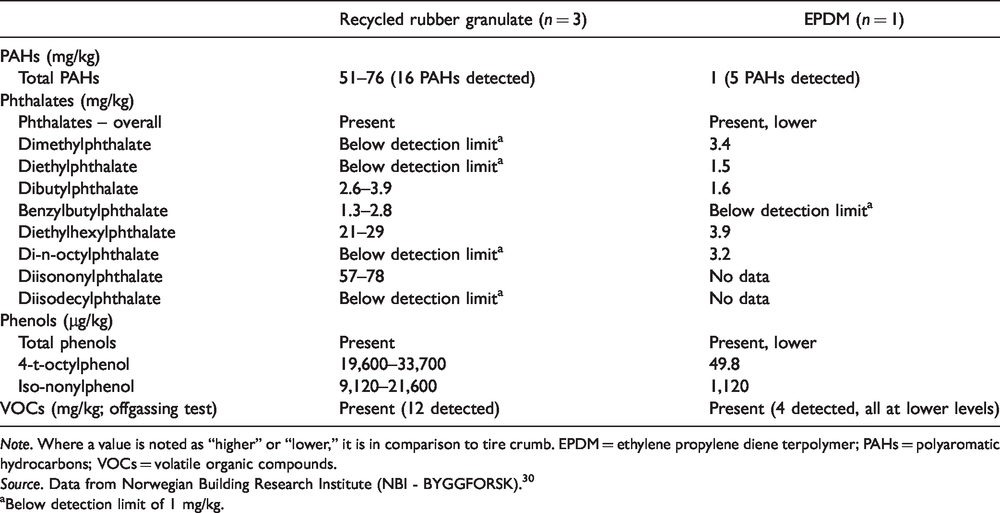
Note. Where a value is noted as “higher” or “lower,” it is in comparison to tire crumb. EPDM = ethylene propylene diene terpolymer; PAHs = polyaromatic hydrocarbons; VOCs = volatile organic compounds.
Source. Data from Norwegian Building Research Institute (NBI - BYGGFORSK). 30
aBelow detection limit of 1 mg/kg.
Like other alternative infills, EPDM infill has not been studied in nearly as much depth as tire crumb. Since the exact composition of this and other infill materials is not disclosed, for purposes of comparing the materials, it is necessary to rely on studies that have tested individual infill samples. Available information suggests that EPDM infill is likely to contain some of the same chemicals of concern as tire crumb, although there may be a smaller number of these chemicals, and those that are present may appear at lower concentrations.
Metals
NBI found that the EPDM rubber contained more chromium than the tire material and similar amounts of zinc. 30 They noted that both the chromium and zinc levels in the EPDM “exceed the Norwegian Pollution Control Authority’s normative values for most sensitive land use,” defined as areas intended for “housing, gardens, nurseries, schools, etc.” Zinc levels in leachate from the EPDM corresponded to the Norwegian Pollution Control Authority’s “Leaching Class IV (strongly polluted),” while the chromium levels corresponded to “Environmental Quality Class II (moderately polluted).” 30 RIVM’s review of existing literature on EPDM infill as well as its own testing found that leaching of zinc from EPDM could potentially pose a concern similar to the level of concern posed by tire crumb. 12
PAHs
PAH Comparison: Tire Crumb Versus EPDM.
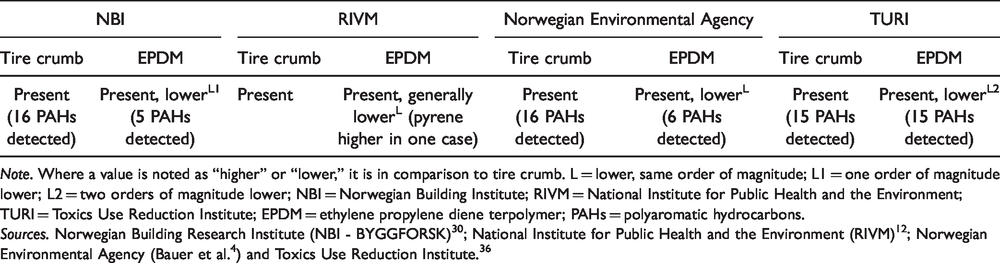
Note. Where a value is noted as “higher” or “lower,” it is in comparison to tire crumb. L = lower, same order of magnitude; L1 = one order of magnitude lower; L2 = two orders of magnitude lower; NBI = Norwegian Building Institute; RIVM = National Institute for Public Health and the Environment; TURI = Toxics Use Reduction Institute; EPDM = ethylene propylene diene terpolymer; PAHs = polyaromatic hydrocarbons.
Phthalate esters
The NBI study found a lower total concentration of phthalate esters in the EPDM compared with the tire crumb. However, some individual phthalate esters were present in EPDM and absent in tire crumb, and vice versa (see Table 2). RIVM’s review also found that phthalate esters such as diethylhexyl phthalate may be present in the material.
Phenols
Nonyl- and octylphenols, also endocrine disrupters, were detected at low levels in both EPDM and tire crumb. The NBI study found levels several orders of magnitude higher in the tire crumb compared to the EPDM.12,30
VOCs
NBI found that when heated to 70°C, the EPDM released lower levels of VOCs into air than the recycled rubber. All were at lower levels than those found for the same chemicals in the recycled rubber granulate. 30 A study supported in part by the tire industry in France resulted in different findings, measuring larger amounts of VOCs emitted from EPDM compared with tire crumb. 31
Other chemicals of concern
PCBs, which were found in one sample of recycled rubber, were not found in the EPDM. 30 RIVM identified carbon black as a possible concern in black EPDM, but not in EPDM of other colors. 12
In summary, the limited information available about chemicals in EPDM infill indicates that it poses concerns similar to those of tire crumb for certain chemicals, such as zinc, but is likely to offer lower levels of other chemicals of concern, including PAHs among others.
Hazard Review: TPE (Alternative)
As a family of polymers, TPEs are characterized by their ability to maintain their form after being stretched and generally do not require curing or vulcanization during manufacturing.60,a TPEs are composed of two materials: one that is hard at room temperature and one that is soft and rubbery at room temperature. The two materials can be either chemically bonded or blended together. One safety data sheet described a TPE infill product as composed of a styrene block copolymer, polyethylene, paraffin oil, calcium carbonate (chalk), carbon black, and unspecified stabilizers/antioxidants. 61
As with EPDM infill, TPE infill has not been studied extensively. A 2006 study by the Norwegian Pollution Control Authority (Dye et al.) compared three indoor fields: two containing tire crumb and one containing TPE infill (see Table 4). 32 To supplement the information available from the Norwegian study, TURI reviewed safety data sheets for TPE infill products. Safety data sheets are useful to a limited extent, although they are sometimes incomplete and can contain inaccurate information. 62 RIVM and the Norwegian Environmental Agency also reviewed information on TPE.
Based on the limited information available on TPE infills, they appear to contain lower levels of many toxic chemicals than tire crumb. In particular, measurements indicate that TPE infill emits fewer VOCs. Furthermore, since TPE does not require vulcanization (curing), it is generally expected to be free of the vulcanizing agents that are likely to be found in tire crumb or EPDM. 53 However, TPE infill can contain and emit some chemicals of concern. Furthermore, since TPE is a general term that can encompass a variety of materials, individual TPE products may vary widely.
Particulate matter
In measurements of airborne dust, Dye et al. found that the quantity of fine particulate matter (PM2.5) was elevated for the two tire crumb fields, while quantities were in the expected ranges for an indoor setting for the TPE field. The researchers also noted that the dust generated by the TPE field was free of the vulcanization compounds, preservative compounds, and carbon black found in the tire crumb fields. Dust from all locations contained PAHs, but the levels in the dust generated by the TPE field were lower than those in the tire crumb dust.
VOCs
Dye et al. found that total VOCs measured at the TPE field were lower than those measured at the tire crumb fields. Both benzothiazole and toluene were present in the air and dust associated with all three fields, although the levels were lower for the location with the TPE field. Another VOC, 4-methyl-2-pentanone, was present at the tire crumb field locations but low or absent at the TPE field location.
Phthalate esters
Dye et al. found that phthalate esters were present at comparable levels at all locations; phthalate esters measured in airborne dust during one time period were slightly lower at the TPE field but were higher at the TPE field during another time period.
PAHs
PAHs were also present in the air at all locations but were lower in the location with the TPE field. 32 TURI’s testing project found lower levels of PAHs in TPE compared to tire crumb and EPDM.
Total air quality contaminants
Overall, Dye et al. found that the tire crumb infill produced more air quality contaminants than the TPE infill, based on the limited parameters they were able to examine in the study. These parameters were designed on the basis of existing knowledge about chemicals found in tire crumb, so they did not necessarily account for all substances that could potentially be found in TPE.
Other tests
The manufacturer of a TPE infill also provides information on a number of tests that have been conducted on its product. In one test, 1 L of distilled water was passed through the infill, then tested for a number of metals. 63 The results showed nondetectable levels of the metals. It is not clear how informative this test is for relevant environmental conditions. Another leaching test found a number of metals to be below the detection limit, with the exception of chromium, which was detected. 64 An aquatic toxicity test using rainbow trout showed signs of stress in the fish exposed to the infill, but no fish mortality. 65
Another test examined TPE infill in relation to the European toy safety standard (EN 71‐3). 66 Using Category III, which has the highest allowable levels of the metals, the infill met the standard for all nineteen of the metals included in the standard. 67 Using the more stringent Category I standard, it was not possible to determine whether the infill meets the standard for all the metals. Another test checked for six metals and six phthalates listed under California’s Proposition 65 and found nondetectable levels of all of them, given the detection limits of the particular test that was used. 68
Test data for two other TPE infill products 34 showed the presence of certain metals; lead was present in one of the two samples. Comparing the test results to the EN 71 Category I standard, both products meet the standard for nearly all the chemicals on the list. For hexavalent chromium, it was not possible to determine whether the materials meet the standard.
RIVM review
RIVM’s literature review suggests that little information is available on TPE infills but that they are likely to contain lower levels of metals and VOCs than tire crumb or EPDM, lower or comparable levels of PAHs, and comparable levels of phthalate esters. 12
In summary, like EPDM, TPE is likely to contain smaller numbers and/or lower levels of many chemicals of concern compared with tire crumb, but it is not free of chemicals of concern. Furthermore, the category of TPE can encompass a variety of materials with variable contents.
Comparison of Air Quality for Indoor Artificial Turf Fields With Tire Crumb and TPE Infills (Data From Dye et al. 32 ).
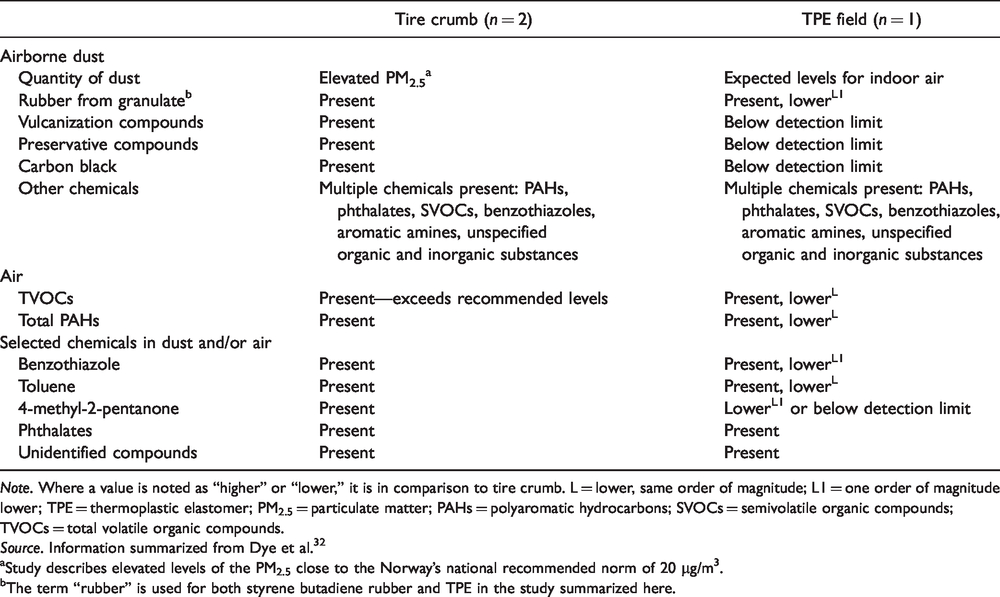
Note. Where a value is noted as “higher” or “lower,” it is in comparison to tire crumb. L = lower, same order of magnitude; L1 = one order of magnitude lower; TPE = thermoplastic elastomer; PM2.5 = particulate matter; PAHs = polyaromatic hydrocarbons; SVOCs = semivolatile organic compounds; TVOCs = total volatile organic compounds.
Source. Information summarized from Dye et al. 32
aStudy describes elevated levels of the PM2.5 close to the Norway’s national recommended norm of 20 µg/m3.
bThe term “rubber” is used for both styrene butadiene rubber and TPE in the study summarized here.
Hazard Review: Waste Shoe Material Infill (Alternative)
Shoe manufacturing uses a wide variety of materials, and manufacturers’ choices about these materials vary over time. As with other rubber products, the performance characteristics of the polymers used in shoe soles depend partly on additives, which may include vulcanizing agents, antioxidants, colorants, stabilizers, and plasticizers. Factors relevant to the environmental, health, and safety characteristics of athletic shoe materials include the polymers used in shoe soles, the additives that impart key performance characteristics to those polymers, and the mandatory and voluntary testing protocols used to limit toxics in shoe materials.
Waste shoe material can contain some of the same chemicals of concern as other rubber infills, although it offers the advantage that levels of some of the chemicals of highest concern may be regulated by an RSL. Neither the Norwegian Environmental Agency nor RIVM prioritized waste shoe material for in-depth review; the Norwegian Environmental Agency simply noted that it does not help to address the problem of microplastic pollution, although it could offer reduced toxicity compared with tire crumb. We have not identified detailed independent studies of waste shoe material as used in infill.
Infill made from postindustrial waste shoe material can be made from a single brand of shoe product, or from several combined. 69 Some shoe materials are governed by RSLs developed by shoe manufacturers to minimize or eliminate the use of certain chemicals that pose particularly high concerns. For example, Nike has an RSL that “restricts approximately 350 substances that have been regulated or voluntarily phased out of our manufacturing processes,” 70 and Nike Grind materials are governed by the RSL. 71
PAHs
TURI’s testing project found that PAH levels in the sample of infill made from waste athletic shoe materials were an order of magnitude lower than those found in tire crumb, but among the alternatives to tire crumb, it had the highest PAH levels. 36
VOCs
According to Nike’s RSL, certain VOCs (such as benzene or toluene) are subject to tight control in the manufacturing process. Thus, these substances are not necessarily absent from Nike products, but they are used in the minimum quantity possible to achieve the desired effect. Nike also limits the levels of other categories of chemicals of concern, such as specific PAHs and specific phthalates. 70
Additives
A substantial literature is available on allergic reactions to additives used in shoe rubber.72,73 Chemicals implicated in shoe dermatitis have included n-isopropyl-N-phenyl-p-phenylenediamine, an antiozonant used in the vulcanization process, and 1,3-diphenylguanidine, an accelerator used in vulcanization, as well as n-dodecyl mercaptan, an additive used in synthetic rubber. 74
Mercaptobenzothiazole, a rubber accelerator, is recognized as an important cause of rubber allergy causing shoe contact dermatitis. Other chemical categories associated with shoe contact dermatitis include thiurams and carbamates. 75 Glues used in shoes can also be a source of allergic reactions, 72 although this may not be relevant for infills if they are made from preconsumer materials that do not contain glue.
Overall, based on limited available information, waste shoe materials pose some chemical concerns similar to those of tire crumb and of EPDM; PAH levels are lower than those of tire crumb and higher than those of the other materials based on one set of tests; and the RSLs of major athletic shoe manufacturers may provide some assurance that certain chemicals of concern are either absent or present in limited quantities only.
Hazard Review: Acrylic-Coated Sand Infill (Alternative)
TURI was able to gather information on one acrylic-coated sand product that is currently marketed for use in artificial turf. 76 According to the manufacturer, this product is composed of sand, a proprietary (undisclosed) acrylic, a Microban® antimicrobial, and a pigment. 77
The specific acrylic used in the product is a proprietary component of the manufacturer’s process, so no other information was available on its health and environmental properties. According to the manufacturer, it does not contain any additives beyond the pigment and antimicrobial. 78 Laboratory test results provided by the manufacturer show that all PAHs for which tests were conducted were below the detection limit. 33 The manufacturer also states that the product was below the detection limit for all VOCs for which tests were conducted. 79
The antimicrobial helps to protect the acrylic coating from deterioration. The company currently uses ZPTech, a zinc-based antimicrobial. According to the Microban® website, “ZPTech® is a broad-spectrum antimicrobial.” 80 According to Microban®, the product “encapsulates zinc pyrithione in customized carriers.” Zinc is released when the material is exposed to water. 80 The product is also available without the antimicrobial.
According to the manufacturer, the antimicrobial product originally used in the product was triclosan, but the transition to the zinc-based antimicrobial has been complete since the end of 2016. 78 Triclosan poses concerns based on bioaccumulation and adverse health and environmental effects.81,82 This could potentially pose a concern if infills installed prior to the phaseout date were to be recycled for use in new fields.
Metals
Test data are available from the vendor both for presence of metals in the material and for leaching of metals from the material. The tests indicate that the sample meets the EN 71‐3 Category 1 standard for most metals. For arsenic, chromium (VI), and mercury, it is not possible to determine from these results whether they would meet the Category 1 standard because the detection limit is higher than the standard to be met. 83 The metal that appears in the largest quantity is zinc. 84
In summary, many of the categories of organic chemicals of concern that are present in the other synthetic infills may be lower, or absent, in acrylic-coated sand. On the other hand, little is known about the environmental impacts of sand coated with an antimicrobial-infused polymer.
Hazard Review: Plant- or Mineral-Based Infills (Alternative)
A growing list of mineral- or plant-based materials is marketed for use in infill. Mineral-based infills can be made with sand or zeolites. Plant-based infills include those made from coconut fibers and hulls, rice, cork, walnut shells, olive cores, and wood, among other materials. In some cases, plant-based materials may also be mixed with sand or with zeolites.
At least one of these options, zeolite, poses serious health concerns. The other materials have generally not been studied in depth. As with the other infill materials, it is essential to gather detailed information on these materials to understand their potential health or environmental impacts. This section mentions a few areas of concern but is not comprehensive.
Zeolite
Zeolite poses a respiratory hazard. Animal studies suggest that exposure to some types of zeolites may be associated with increased risk of developing mesothelioma. 85 Erionite, one type of zeolite, poses particular concerns; its health effects can be similar to those of asbestos. 86 Using zeolite-based infill in place of synthetic polymers can be considered a regrettable substitution.
Sand
Sand is frequently mixed with plant-, mineral-, or synthetic polymer-based infills. If sand is used, the size and source of the sand particles can affect safety. Silica, the principal constituent of sand, is a carcinogen if inhaled in the form of crystalline silica dust. Industrial sand that is freshly fractured or that has been highly processed to contain very small particles can be a respiratory hazard when inhaled. Thus, it is important to understanding the source and type of any sand used in a recreational setting.
Plant-based materials
Possible hazards of plant-based infill materials could include exposure to respirable dust and fibers, as well as allergic reactions or sensitization. For example, respiratory disease has been documented in cork workers exposed to cork dust. 87 Fungi that frequently colonize cork appear to play some role in the disease, although the disease is not fully understood. 88 Nut shells can pose concerns related to allergies if nut allergens are present on the shells.89,90
A variety of respirable plant-based fibers can cause disease and disability. For example, cotton dust is a well-known source of respiratory disease. 91 We did not identify any studies that consider possible hazards related to plant-based fibers in infill.
Vendor test data
We reviewed test data provided by one vendor for several plant-based products. In general, levels of lead were below the detection limit and levels of zinc and other metals were lower than those for synthetic infills. Information was not provided on any antimicrobial treatments or other organic chemicals that could be present.
From an environmental perspective, plant- or mineral-based infills do not contribute to plastic or rubber pollution in the environment. Provided that they are not coated or otherwise treated with synthetic chemicals, they can be expected to be free of many of the toxic chemicals that have been measured in synthetic infills.
In summary, certain plant- or mineral-based infills may be a safer alternative to tire crumb from a chemical perspective, while others, such as those containing zeolite, pose hazards. However, there are unknowns about respiratory exposure to dust generated by some of these materials, among other possible hazards.
Industry and Regulatory Standards
No comprehensive regulatory or testing regime for artificial turf materials has been developed in the United States. In the European Union, a proposed restriction under REACH could, if adopted, set a maximum level of 17 mg/kg of eight PAHs combined for materials used as infill or as loose playground surfacing. 12 Some limited regulatory standards are currently applied in some cases in Europe; for example, Germany has adopted requirements related to leaching of certain chemicals from artificial turf. 92
Regulatory standards drawn from other contexts are sometimes used as reference points by researchers and by infill vendors. These include regulatory standards for soil, sediment, groundwater, surface water, and drinking water, as well as standards for products such as building materials and toys.12,47,49 In California, the Safe Drinking Water and Toxic Enforcement Act of 1989 (Proposition 65) requires disclosure of the presence of chemicals that are identified by the state of California as causing cancer or reproductive harm. The CAM 17 test (California Administrative Manual, currently known as the California Code of Regulations) tests for the presence of certain metals in waste streams.
A standard cited frequently by vendors in the United States is European Standard EN 71‐3 – safety of toys Part 3: migration of certain elements (the European Toy Safety Standard). This standard covers nineteen metals or categories of metal compounds. It divides toy materials into three categories associated with different assumptions about the amount a child may ingest in the course of play. Corresponding to these assumptions, the categories list different allowable values for metals. For example, for lead, the least stringent category allows the presence of up to 160 mg/kg of lead in the material, while the most stringent allows up to 3.4 mg/kg. In the laboratory reports provided to TURI by vendors, the metal levels measured in infill were generally compared with the least stringent of the EN 71–3 standards. 93
A number of industry groups have voluntarily adopted an American Society for Testing and Materials (ASTM) International standard, ASTM F3188-16, which specifies maximum levels for eight metals.94,95 The standard is intended to help protect players who may ingest infill accidentally in the course of play.
In the absence of comprehensive regulation of these materials, it is important for decision-makers to understand the limits of the standards noted here, especially to the extent that they are used as reference points by vendors. In particular, information based on the list of metals included in the European Toy Safety Standard should not be mistaken for a thorough examination of the full range of organic and inorganic compounds in the material.
Discussion
Comparing synthetic infill materials with one another, based on limited testing, both EPDM and TPE contain lower levels and/or smaller numbers of toxic chemicals compared with tire crumb, yet each of them can contain chemicals of concern; for example, EPDM can contain high levels of zinc; both EPDM and TPE can contain phthalates; and depending on the sample tested, EPDM may have lower or higher levels of VOCs compared with tire crumb. Vulcanization compounds may be a concern in tire crumb, EPDM, and shoe materials; and PAHs are present in several of the synthetic infills, though at lower levels than tire crumb, based on available data. Among the synthetic options, acrylic-coated sand may contain the fewest chemicals of concern for human health. However, environmental impacts are still a concern.
A clear hierarchy among the infill types remains elusive. Plant-based materials are likely to contain the fewest toxic chemicals of concern, provided that they are not chemically treated, but could pose hazards related to respiratory fibers, molds, and/or exposure to allergens. If concerns about allergens, dust, and mold growth can be addressed, then these materials may be a safer choice from an environmental health and safety perspective.
The assessment of infills provides an example of an effort to systematically assess and compare hazards of materials rather than those of individual chemicals or processes. However, exposure to low doses of multiple chemicals can have health effects that may not be predicted based on the expected effects of each individual chemical. For this reason, in some cases, it may be more useful to consider the effects of a mixture of chemicals rather than analyzing each chemical individually. This has been done to a limited extent in studies of occupational exposures to tire crumb. 96
A hazard assessment of materials is further complicated by the fact that most formulations are proprietary. In addition, variable formulations are available for each of the materials, so different samples can yield different results with regard to chemical contents and levels. In this regard, our analysis bears some similarity to a hazard assessment developed by the Northwest Green Chemistry Institute for antifouling boat paints. 25
It is worth noting that some groups have greater access to information than others. For example, in Europe, trade union safety representatives could obtain important chemical information on infills via safety data sheets, while individuals living near or playing on artificial turf fields would not necessarily have access to the same level of information.
Regardless of infill type, artificial turf poses other health and environmental concerns, including chemicals in artificial grass blades, dispersion of synthetic polymer particles in the environment, loss of habitat, and excess heat. 3 TURI has identified organically managed natural grass as a safer alternative and has worked with a number of communities to document their experiences with natural grass playing fields.97,98 More information is available on TURI’s website at www.turi.org/artificialturf and https://www.turi.org/Our_Work/Community/Organic_Grass_Care.
Conclusion
Of the alternative infills we have reviewed, none can be identified as entirely free of health or environmental concerns, based on the limited information available for review in this study. However, the analysis has clarified differences and similarities among the materials and areas of concern that may warrant further attention. Whereas risk assessments have estimated excess cases of disease that could result from tire crumb exposure, these efforts at comparative hazard assessment can serve as a starting point for communities wishing to make informed choices among the options available to them, including the option of natural grass. Communities considering the use of artificial turf would do well to obtain and review test data for PAHs, VOCs, semivolatile organic compounds, metals, phenols, per- or poly-fluorinated alkyl substances, and other compounds in both infill and other turf components.
Footnotes
Acknowledgments
Preliminary research on this topic was conducted under the mandate of the Massachusetts TURI to respond to community queries on toxic chemicals.
Portions of this paper have been previously published on TURI’s website. Daniel Schmidt provided comments on TURI’s original, more detailed documents on EPDM and TPE. Liz Harriman, Chris Hansen, and Tracy Stewart provided input on some elements of the research. Ken Geiser, David Kriebel, and Richard Clapp provided detailed comments on a draft of this article. The authors also thank two anonymous reviewers for their valuable comments.
Declaration of Conflicting Interests
The author(s) declared no potential conflicts of interest with respect to the research, authorship, and/or publication of this article.
Funding
The author(s) disclosed receipt of the following financial support for the research, authorship, and/or publication of this article: The preliminary research on this topic was funded through the Massachusetts Toxics Use Reduction Act. More detailed research and the drafting of this and related documents were supported through a grant from the Heinz Endowments.
