




Abstract
Children as young as ten-years-old can legally work as hired farm labor in the United States. In North Carolina, many hired children are part of the Latinx farmworker community. Agriculture is a hazardous industry, and child workers experience high rates of injury, illness, and mortality. As part of a community-based participatory research study, we draw from thirty in-depth interviews with Latinx child farmworkers aged ten to seventeen to describe their experiences of personal and observed workplace injury and close calls. Nearly all child workers had experienced or observed some form of injury, with several reporting close calls that could have resulted in severe injury or fatality. Overall, children reported a reactive approach to injury prevention and normalized pain as part of the job. Highlighting Latinx child farmworkers’ structural “vulnerability, this analysis contextualizes understanding of workplace injury among this largely hidden population. We offer policy recommendations to protect and support these vulnerable workers.
Keywords
Introduction
Background
Agricultural child labor represents a unique setting for understanding how structural vulnerability subjects populations to forms of structural violence. Agriculture is one of the most hazardous industries in the United States, yet children as young as ten-years-old are legally permitted to work as hired labor (Table 1). Estimates place the number of hired child farmworkers in the United States between 30,000 and 79,325 annually between 2005 and 2016.1,2 The majority of children hired to work on farms are children of immigrants or immigrants themselves. 3
Employment Permitted by Federal Regulations for Children in the United States, Comparing Agriculture With Other Industries.
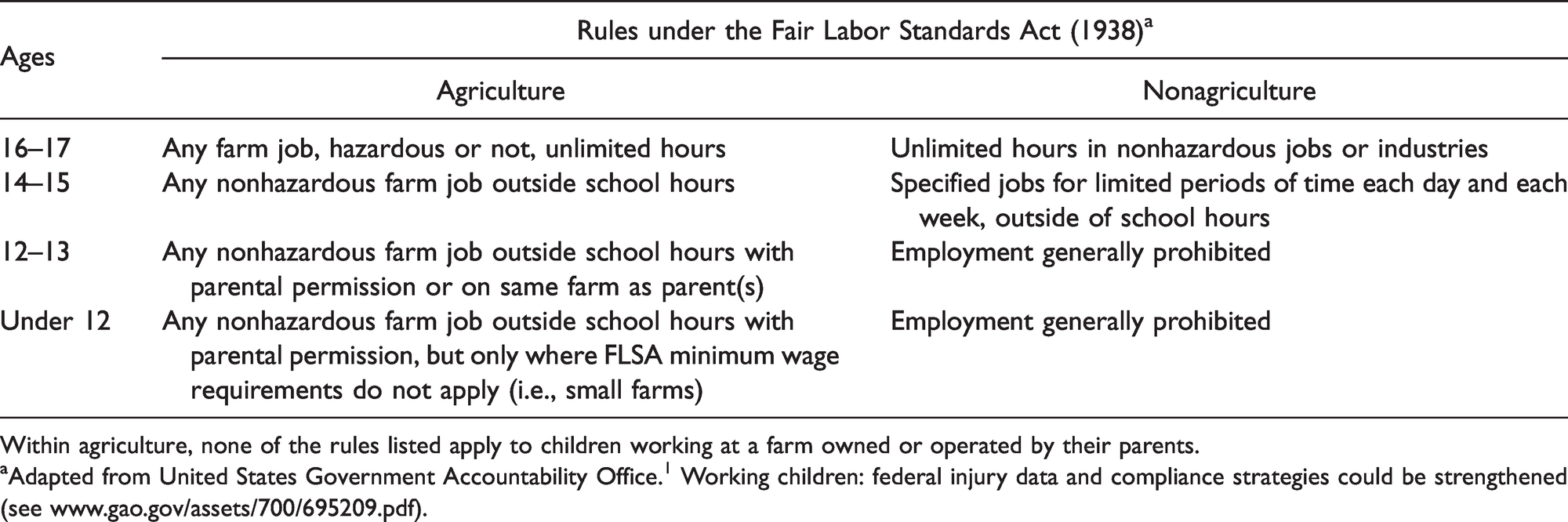
Within agriculture, none of the rules listed apply to children working at a farm owned or operated by their parents.
aAdapted from United States Government Accountability Office. 1 Working children: federal injury data and compliance strategies could be strengthened (see www.gao.gov/assets/700/695209.pdf).
In the United States, between 2001 and 2015, nearly half of all fatal injuries to youth and child workers occurred in agriculture. 4 Latinx child farmworkers experience many occupational hazards potentially leading to morbidity and mortality. 5 Most crop work occurs during peak summer months, which exposes workers to high temperatures and increased risk of heat-related illness.6–8 Machinery and tools represent significant hazards for child farmworkers, which vary by type of agricultural work. 4 Child workers experience agrochemical exposures through various pathways, which can have both acute and chronic health effects.9,10 Many children in the eastern United States work in tobacco, presenting the unique risk of green tobacco sickness (GTS). GTS is an occupational illness of tobacco workers caused by acute nicotine poisoning resulting from transdermal nicotine absorption.11,12 The agricultural workplace also presents other social and physical hazards, such as discrimination and sexual harassment.13,14
A child dies in an agriculture-related incident about every three days, and about thirty-three children are injured every day in agricultural incidents in the United States. 4 Agricultural injury studies in different regions of the United States that have included Latinx child workers demonstrate that injuries are common among this population.15–20 Few studies have explored their injury experiences qualitatively. First-hand accounts of injury and illness experiences are helpful in understanding the perspectives of the injured and the circumstances surrounding the injury event.21,22 The intent of this paper is to add to our understanding of the types of injuries child farmworkers experience and contexts in which they occur in order to supplement findings from quantitative studies and inform future research.
Theoretical lens
The qualitative data presented here focus on the micro-level of how Latinx child farmworkers view and experience workplace injuries. Yet, interpreting these micro-level experiences as isolated from the macro-level historical and structural forces that simultaneously permit and largely hide this violent reality from the public would miss an opportunity to understand the context of their injury experiences. The lens of structural vulnerability is apt for analyzing Latinx child agricultural injury. Key to structural vulnerability is understanding the ways in which various forms of exploitation, racialized discrimination, and symbolic subjectivities combine to create a positionality in which groups are subjected to forms of violence in patterned ways.23–25 Child farmworkers in the United States are a particularly vulnerable group due to a constellation of social structures, policies, and histories shaping the context in which they live and work. 10 McLaurin and Liebman 26 highlight the intertwined issues many of these children and their families face including poverty, migration, substandard housing, immigration status, differences from the dominant culture, language, education, food security, lax regulatory standards and enforcement, and limited access to healthcare. The present analysis seeks to situate the injury experiences of Latinx child farmworkers in the United States, as described by the children themselves, within the broader structural forces that necessitate and permit children working. Children working in farm work experience a variety of exposures that can have both acute and chronic health effects.
Recently, Holmes applied Berlant’s 27 conceptualization of “slow death” as a way to understand how chronic harm and injury becomes normalized for farmworkers. 28 Holmes posits that the extended temporality of farmworker injury over many years acts as a barrier to full understanding of their experience via isolated epidemiological measures. Quantitative research has important implications for understanding the scope and scale of farmworker injury, but Holmes questions what researchers may miss by these approaches that are readily apparent on a granular level of lived experience. Hazardous agricultural exposures among children may have latent effects that manifest in different ways when compared to adult farmworkers. Child farmworkers represent a particularly poignant example of how lived experiences materialize in embodied inequality and how intergenerational experiences of unequal life chances are perpetuated by a system that leaves few other options. 29
The farm work context and organization of work are highly varied for child workers. The crew-leader system in agriculture, where labor contractors work as intermediaries between the grower and a crew of workers, can create conditions that exacerbate child worker vulnerability to wage theft, unsafe work practices, and job insecurity. 5 Analyses by Quandt et al. 5 demonstrated that North Carolina child farmworkers faced significant demands to work quickly and take risks. They had very little control over their work environment. The level of support they received from family members, supervisors, or peers was highly variable. Similarly, Arcury et al. 30 found that child farmworkers reported a low overall safety culture in their work sites. Most training took the form of informal suggestions by family members or co-workers to “be careful.” Formal pesticide and other safety training was rare. 30 These conditions are similar to those reported in Oregon 31 and California 32 in focus groups with adolescent migrant farmworkers.
Aims
This paper has two aims. The first is to describe the broad experience of personal and observed workplace injuries of Latinx child farmworkers in North Carolina as reported by the children themselves. The second aim is to highlight the ways in which Latinx children’s labor in one of the most hazardous industries is produced and sustained by structural factors that increase their vulnerability, constrain their agency, normalize preventable bodily harm, and largely conceal this reality from the public.
Methods
Overview
The Hired Child Farmworker Study is a mixed-methods project examining the health and development of hired Latinx child farmworkers in North Carolina. We used formative qualitative methods (thirty in-depth interviews), followed by three years of repeated survey and clinical measures among a prospective cohort of 202 child farmworkers. 33 This analysis is limited to the thirty in-depth interviews we conducted in 2016. Our community-based participatory research (CBPR) approach partners with co-investigators from Student Action with Farmworkers (SAF), including youth co-investigators from SAF’s Levante leadership institute. 34 In addition, the project is informed by a professional advisory committee, comprised of stakeholders from various farmworker service organizations. The Institutional Review Board at Wake Forest School of Medicine approved all study procedures (approval number: IRB00036403).
Participants
From June to September 2016, we recruited thirty child farmworkers to complete in-depth interviews by working with farmworker service organizations. We also attended community events for Latinx farmworkers in rural North Carolina towns in order to identify potential participants. To be eligible for the in-depth interview, participants had to be between ten and seventeen years old, have worked in agriculture in the last twelve months, be fluent in English or Spanish, and self-identify as Hispanic or Latinx. We balanced the sample by gender, region of the state, and farmworker status (seasonal and migrant) in order to capture child farmworkers’ broad experience. A 2013 pilot study identified variability of work experience along these dimensions. 35 Our final sample consisted of thirty children in thirteen different North Carolina counties.
Data Collection
Community partners briefly discussed the study with the parents and children who fit the eligibility criteria and received permission for our study team to contact them. We then contacted the child’s parent via phone to verify interest and set up a home visit. We discussed the study with the parent and the child, answered any questions, and, if they agreed to participate, we obtained signed parental permission and signed youth assent. The assent forms were tailored to the appropriate age groups (10, 11–15, 16, and 17) and language of preference (English or Spanish). We received a waiver of parental permission from the institutional review board to include minors who were unaccompanied by a parent in North Carolina (n = 3).
We requested that the interviews take place in a quiet, semi-private setting, usually a front porch. Two authors conducted the one-on-one interviews in the language that the participant preferred. Seven participants preferred Spanish, and twenty-three preferred English. Interviews lasted between forty-five and sixty minutes and were audio-recorded. The semi-structured interview guide covered a range of topics including personal characteristics, family, housing, community, farm work experience, work organization, work risk, and personal and observed occupational injury experience. We used probes to elicit detailed descriptions of the work environment. Participants received a $25 incentive for completing the interview.
Data Analysis
A professional translation and transcription company produced the transcripts of interviews. We verified all transcripts to ensure proper transcription and translation. Data analysis followed an iterative and recursive process. We held frequent study team meetings during data collection, beginning with the first interview, to discuss emergent themes, issues, and items to collect more information on during subsequent interviews. After thirty interviews, we determined that we had reached saturation, as participants were revealing no new information.
We coded the transcripts using ATLAS.ti (Version 7.2). Upon review of the transcripts, we developed a code book with mutually exclusive definitions for each code. The code book included demographics, housing, social context, farm work experience, farm work tasks, work-related risk behavior, occupational injury, work organization, wages, and safety culture. One study team member applied codes to each transcript, and two other team members reviewed the original coding. If there were disagreements about the coding of transcripts, we discussed these issues and came to a consensus for a final coded transcript. We then used a variable-based, “cross-sectional” analysis 36 by creating an output of all quotations for the codes “occupational injury” and “work risk,” and then summarized them to ensure they accurately reflected the code. We also considered threats to validity such as a focus on extreme cases when reviewing the summaries. 37
Upon review of these codes, we created a matrix with columns and brief summaries of the occurrence to classify injuries as they emerged. We operationalize “injury” as the immediate or potential bodily harm resulting from a specific event or series of events. The matrix included: type of injury personally experienced, which was further broken down into musculoskeletal (pain in any area of the body), traumatic (cuts, bruises, blows to the head), dermatological (skin rash, sunburn), sickness from pesticides (light-headedness or nausea when discussing pesticides); heat-related illness symptoms (fainting, nausea, dizziness, vomiting, headaches when discussing extreme heat); GTS (participants discussing vomiting, nausea, dizziness, headaches after working in tobacco) (see Arcury et al. 38 ); personal or observed close calls; observed injury; hear of other workers’ injury. We provide exemplary quotations as a way of describing the types of injuries that children reported and the circumstances surrounding them. We include Participant Identification Numbers (PIDs) after each quote in order to demonstrate the diversity of participants quoted.
Results
Description of Sample
Participants included thirteen girls and seventeen boys (Table 2). Fifteen participants were born in the United States, eleven were born in Mexico, and four were born in Guatemala. Nine participants were ten to thirteen years old, eleven were aged fourteen to fifteen years old, and ten were aged sixteen to seventeen years old. Sixteen were considered seasonal workers (meaning that they lived in the same place year-round) and fourteen were considered migrant workers (meaning that they changed residences throughout the year to do farm work). These classifications were based on the most recent pattern of their moving. Children discussed their lifetime experience of working in farm work and the most recent crops in which they had worked. The most common crops in which participants had been working at the time of the interview were tomatoes, blueberries, and tobacco.
Participant Characteristics and Crop Experience (N = 30).
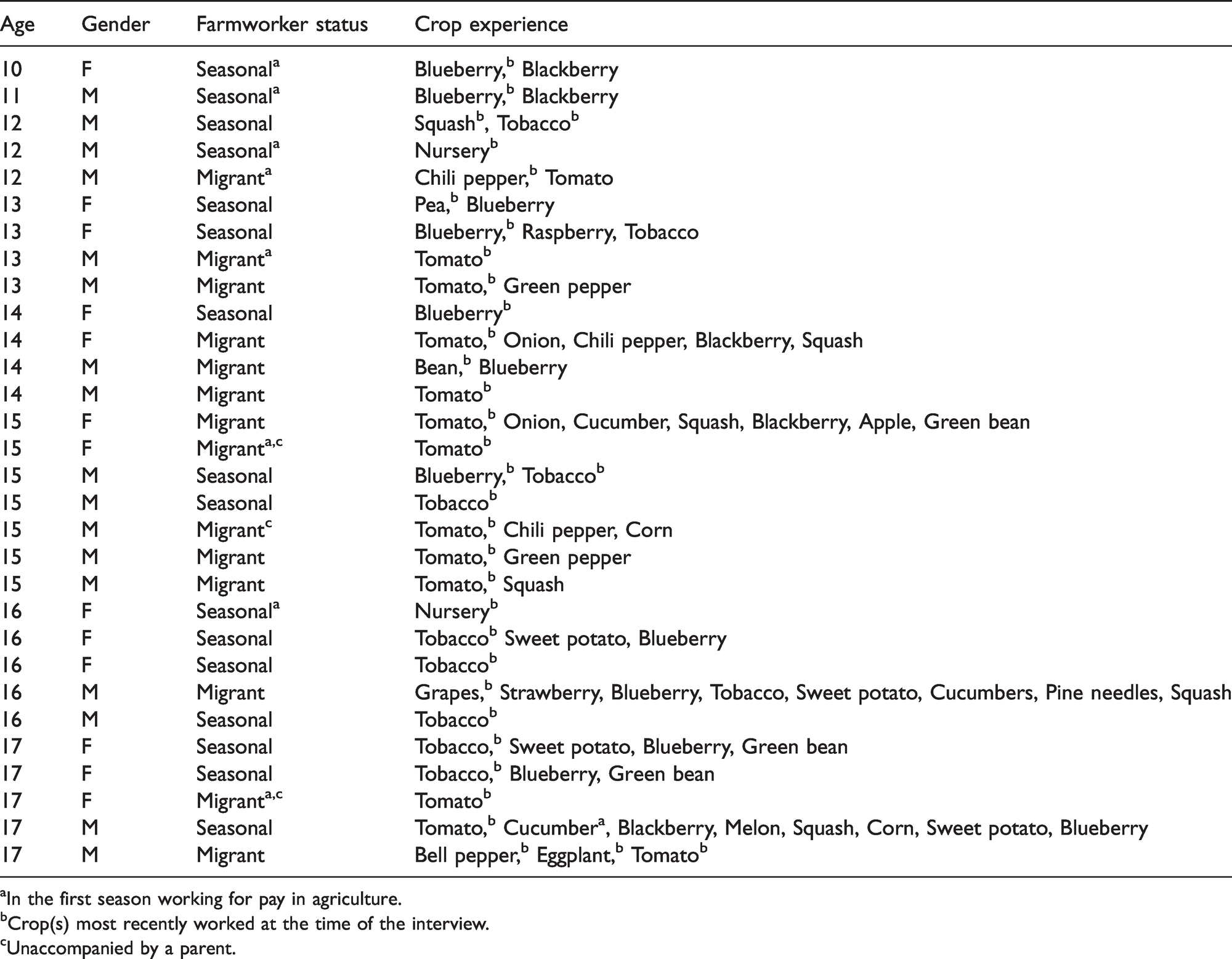
aIn the first season working for pay in agriculture.
bCrop(s) most recently worked at the time of the interview.
cUnaccompanied by a parent.
Personal Injury Descriptions
All but two participants discussed experiencing at least one type of injury, as defined in this analysis, while working in farm work (Table 3). Most participants described experiencing more than one type of injury. These injuries ranged in severity from minor scratches or muscle soreness to serious cuts, blunt trauma, and GTS.
Personal Injury Experiences, Close Calls, Observed and Nonobserved Injuries Described in Interviews.
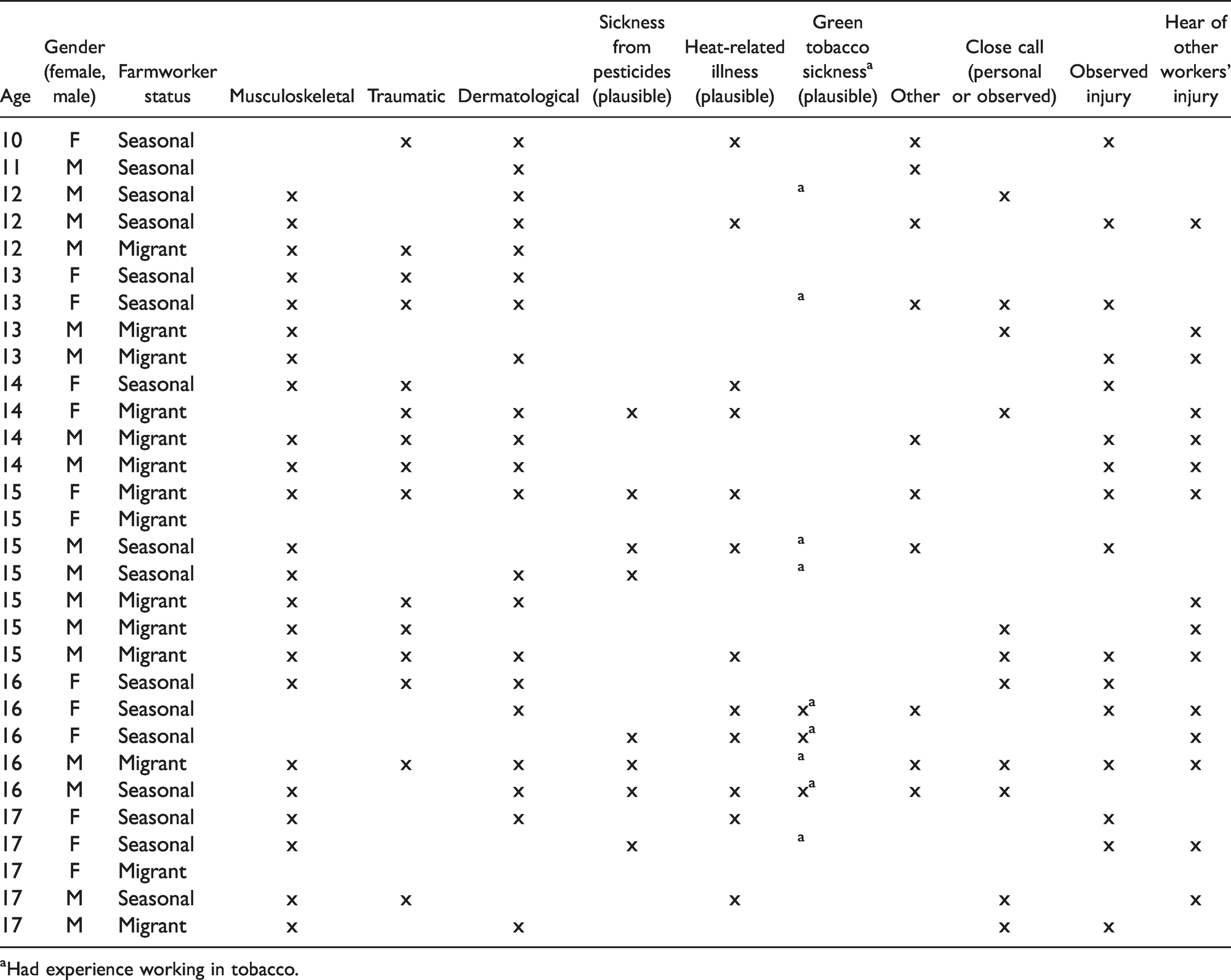
aHad experience working in tobacco.
Musculoskeletal
Most children, across all crops, reported muscle pain and soreness in various parts of the body. A fourteen-year-old migrant boy working in tomatoes described pain in several areas of his body, especially when first working, Well, the first time I came here, like, you know how when you pull your muscle, I think they call ‘em cramps? Well, I got that the first day—my hands, I couldn’t move. That was basically it—and tired, like, your back. Right now, we're doing the second twining row, but, you kinda bend down a little bit, so your back kinda hurts a little bit. And, well, your arms and your feet will, from walking. That's basically it. [#10]
Another fifteen-year-old migrant boy working in tomatoes said, Since you kind of bend over the whole time, the whole day, when you get back up to put your bucket, it kind of hurts. At night, it kind of hurts. But you kind of get used to it. And when it hurts a lot, you can take a day off. [#11]
A seventeen-year-old girl talked about the difficulties of picking sweet potatoes: [Participant] “You can’t even sit down [after work].” [Interviewer] “Why is that?” [Participant] “‘Cause, when you’re pulling the [sweet potatoes]—you gotta be squat down really low . . . . You gotta be picking them up, you gotta be there 24/7 till they say break time, 12:00. And that’s pretty much a lot of time to be squat down. So it hurts.” [#18]
A sixteen-year-old girl who worked seasonally at a nursery reported, My feet would hurt from standing all day, but, no, I would never take medicine. I just go home to the chair and go to sleep. I would go to sleep really early. I would just eat and [go] straight to bed because my feet would hurt. [#14]
Traumatic
Children also reported various types of traumatic injuries. Some occurrences were minor, and not considered an injury by the children. Several described getting scratched by blueberry bushes, getting splinters from wood stakes, or being poked with thorns. Others reported cuts. For example, a thirteen-year-old girl was working seasonally in peas when she sustained a cut. I was grabbing the bucket to take it somewhere else. I guess there was, like, this little hole—I don’t know what was in there. But I just—my finger got stuck in there, and then I tried to pull it out. When I pulled it out, I pulled my skin off. . . . It was bleeding a lot, so I wrapped it in a bandana and I just continued. [#15]
Several migrant children working in tomatoes discussed the same injury of getting a cut on their hands from tying twine, and how they decided to wear gloves after the injury occurred. One migrant fourteen-year-old girl fell off of a parked tractor while washing squash, So when I was trying to get up, I didn’t see that there was a piece of squash right there, so when I got my feet up, I slipped back and I fell, and I hit myself in [the knee] and it was like all over it, wanting to bleed but it didn’t bleed. [#3]
She said that it took about a month for it to heal. While working in tomatoes, several children reported hammering stakes that are used to support tomato plants. One migrant fifteen-year-old boy was hammering stakes with a metal post driver and sustained a head injury: [Participant] “The first time that I hammered, I did hit my head.” [Interviewer] “Yeah? And what happened?” [Participant] “Because I was going really fast and hammering hard. So, the stake broke and the hammer hit me in the head.” [Interviewer] “And what happened that time? What did you do?” [Participant] “No, I didn’t do anything . . . . I don’t really remember what they gave me, but yeah, [the contractor] put something on my head.” [#7]
Dermatological
The most common dermatological injury that participants reported was sunburn. The children thought of these sunburns in various ways. A twelve-year-old boy working seasonally in squash described how he would get a sunburn. “I forget to bring my long sleeve, ‘cause I have no more long sleeves to wear, so I wear t-shirts” [#4]. A fifteen-year-old migrant girl described experiencing a very serious sunburn which led to her taking extra precautions, It was my whole back right here, it got all red and dark, because I didn’t wear anything that day. So I went to Wal-Mart and I bought the [sun]screen protector, and we bought bandanas and hats, so it will cover us from the sun. [#6]
An eleven-year-old boy said, “It hurts. It burns you. It falls off. You shed skin” [#20]. Several participants cited social reasons for preventing their skin from “becoming darker” as the primary reason for using sun protection.
Other children reported rashes or severe itching caused by chemicals, or plants such as poison ivy. Areas surrounding many cultivated fields are covered by poison ivy and poison oak. A 10-year-old girl described her experience of poison ivy, The itchiness . . . if you touch it when you have it and you scratch yourself like the weeds stays in your fingers then you pass it to your face or some other part and you get bumps and pimples there.
When probed about identification or avoidance of contact with poison ivy, she continued, “We do know, but we are not looking at what is what, since we are just picking the blueberries and maybe we touch a plant and that is what starts everything” [#19]. She reported that her mom bought some cream that minimized the itchiness and that the rash went away after a few days.
A sixteen-year-old girl discussed feeling itchy, and attributed it to contact with tobacco plants and not having a way to wash in the fields. [Participant] “So there's times where the plant touches your face or something, and it starts burning . . . . And you just—the only thing you can do is wash your face.” [Interviewer] “How can you wash your face?” [Participant] “Well, we can't, so we just wait until the end, and we go—we come home or we go somewhere to the store, and we wash our face and hands.” [Interviewer] “Why can’t you wash your face there?” [Participant] “They don’t have no bathrooms or no water to wash your hands.” [#17]
Other tobacco workers described similar symptoms. A seventeen-year-old girl simply stated of her tobacco work: “I had to work. Only lasted for one week, because I wasn’t able to take it no more. Had a rash everywhere” [#18].
Heat-related illness
Children cited heat as the primary negative aspect of working in farm work. They reported feeling dizzy, had headaches, or as if they were about to faint, and they attributed this to working in the heat. A fourteen-year-old girl working in blueberries said, “‘cause of the hotness, like my head will be hurting sometimes” [#5]. A seventeen-year-old boy described a 95° day: There was one time where I started feeling so dizzy that when I got to the car, I just stayed there, and I couldn't go back to work. Like, I just stopped for the rest of the day . . . the heat was pretty brutal, and I wasn't wearing a hat. I had forgotten to wear a hat that day, so the sun [and] the heat got to me badly that day. [#23]
A sixteen-year-old boy working in tobacco attributed frequent nosebleeds to the heat, It was hot, and when it got too hot, I used to get nosebleeds . . . . So I had to take a break off almost every day because I had nosebleeds . . . . I would feel dizzy [from the heat] sometimes, but I’d just work.
He also recalled that the crewleaders used to tease him about the nosebleeds, “. . . the leaders used to say like ‘oh, he can’t handle it’ and stuff like that” [#28]
Green tobacco sickness
Out of the nine children who had worked in tobacco, three of them discussed experiences of plausible GTS, but most did not call it GTS. A sixteen-year-old girl said that she got a fever from touching something in the plant, the day before I had that fever, I did feel like—I didn’t want to eat nothing. Like, I would just look at the food and I’d feel really sick. And I never threw up, but I did feel sick at that job. [#17]
One participant described several discrete experiences of GTS as well as the remedies that her caregivers gave her. That day—well when you go cut the four leaf [a task involved in harvesting tobacco], because that work is hard, you go early and you leave early, and we were already off work. And I took a shower when I got home. And then—at the beginning, when I got home, I didn’t feel sick. I just took the shower and I laid down. That’s when I started feeling bad. I started feeling dizzy. I was with my godmother and she gave me a Gatorade, but that Gatorade made me throw up so I had to throw up. And then she gave me a lime, and that made me throw up too. And she gave me milk, and that made me throw up too so she just stopped giving me things and she just told me to go to sleep, and try to rest, and stuff like that because I was probably tired. Then my mom came and we went to the store, but I was feeling bad. And then my mom bought me a milk and she gave it to me, but I wasn’t feeling good. And then, like the third time—like around 10:00 at night—mom gave me milk again and I got well. [#30]
When asked about the effectiveness of these remedies, the participant responded, My mom said it was tobacco sickness, and why would I go to the doctor if it's something normal? And, like, my parents used to—well my dad used to work at the tobacco too when he was younger. He said that happened to him too and he would just drink milk until he got better [#30].
Some of those who claimed to have avoided experiencing GTS knew of other workers who had experienced it.
Pesticide effects
Child farmworkers reported various ways in which they are exposed to pesticides. They recognize the presence of pesticides in the workplace, and some report acute effects such as headaches or feeling nauseous. A fourteen-year-old migrant girl remembered a time when a tractor was spraying tomato fields near the workers. [Participant] “The chemical does—it harms you from the smell . . . I don’t really like smelling it when I smell it. Like I put a bandana on my head, so I just take it off and just put it right here [over the mouth and nose], not to smell it because it gets me like wanting to throw up . . . It kind of hits you, the smell. So it’s just—it just like wants to get you dizzy. So I just like don’t like smelling it at all or I just move away . . . They bring the tractor, which actually sprays that.” [Interviewer] “And so you’re standing nearby and you felt sick before?” [Participant] “Well, just once, but he got off the tractor and like he saw all of us like covering [ourselves]. He goes ‘well, there’s five minutes; five minutes left of work, so if you guys wanna get out, it’s okay.’” [#3]
A sixteen-year-old migrant boy discussed how he felt while cropping tobacco, [Participant] “So you start smelling the tobacco and some of them smell really bad ‘cause they still smell like they sprayed toxic chemicals and pesticides . . . so you can smell it and then they just go through your lungs.” [Interviewer]: “And how do you feel after that?” [Participant]: “Well, everything you touch or everything you eat is very sour. Like if you touch something sour or if you just go like this with your lips. You don’t really touch your lips but you just [move your lips], you can smell it—you can taste it for yourself. It's really bad. It smells bad.” [#24]
Many children reported a similar experience of their food tasting sour that was not alleviated even if they washed their hands. In several cases, there was no water or soap available in the fields.
A seventeen-year-old girl working in tobacco explained that some workers would have irritated skin and attributed it to the chemicals, but said that she avoided it, . . . the chemicals would smell bad. That’s all I would feel. Like, it smells bad. It’s too strong, or like, my head would hurt. But that’s, that’s all. I mean, nothing would happen. My skin wouldn’t get irritated or nothing like that. [#22]
Several children believed that they “got used” to the chemicals. A fifteen-year-old boy recounted when he first began going to the fields with his mom at the age of six: That’s when they started introducing me to the fields, just little by little . . . And then after that I kinda got used to it, but after that I was getting kinda sick ‘cause I wasn’t used to working in the fields at that time, so that’s all . . . Like, since I was new to the chemicals, I would have fevers. Like, I’d have stomach aches, sometimes I would throw up ‘cause I wasn’t used to the chemicals they put in the plants first . . . And then later on I got used to the chemicals ‘cause I kept going almost every year for like a month or two and I kinda got used to it. [#21]
A sixteen-year-old boy shared a similar sentiment about getting used to it, We used to work on fields that were like close together and one time I saw the machine spraying the other field and I could smell it from that field . . . It smelled bad . . . We’d have to cover up our noses.” [Interviewer]: “Did you feel sick or anything?” [Participant]: “At first, yeah. At first you get a little bit sick, but you just get used to it.” [#28]
Observed Injuries and Close Calls
Many children reported close calls, where they felt they might have been in a situation leading to an injury, but it did not come to pass. A substantial number of children had also observed other workers sustain an injury or had observed the consequences of a workplace injury. Many children reported seeing other workers slip and fall in the fields. These were generally due to slippery and muddy conditions after a rain, uneven surfaces in the fields, or falling off a truck or trailer. Cuts and other traumatic injuries were also relatively common. One twelve-year-old boy who worked at a nursery reported that another worker stepped on a nail, “and it went through his boot and went through his feet,” and had to go the hospital [#13]. Several children reported other workers falling off trailers or trucks and sustaining mild-to-severe injuries. A fifteen-year-old migrant boy recounted working in tomatoes in the back of a box truck, where workers bring buckets of tomatoes for sorting by size and color.
. . . sometimes I worry about falling because my brother fell once. Like, ‘cause when I throw the buckets, sometimes they fall. They can hit a worker if I don't throw them right, or when I go get a bucket and I’m tired, I feel like I’m gonna lean over and just fall. [#11]
Seeing other workers faint from the heat was also common. A seventeen-year-old boy described a time when his mom passed out from the heat while climbing on a trailer to get water, She was trying to get on top, and that’s when she finally was given the last moment, last moment of passing out. And she slid, and so her knee hit, her knee hit, and her elbow hit. Only thing is that right before she passed out she screamed for help, and two other workers that were nearby managed to hear her, and so they ran towards where she was, and helped her out.” [#23]
Several of the children who worked in tobacco had seen other workers vomit, a possible symptom of GTS. A sixteen-year-old migrant boy recalled an experience while harvesting tobacco, “I saw a friend who was vomiting blood, too, yeah, and my brother-in-law, too.” When probed about the cause of this, he responded, “probably ‘cause the chemical [in the tobacco] or something.” Evidently, these experiences influenced the decision to choose a different type of tobacco work [topping/suckering] that occurs earlier in the season and is seen as less dangerous. He continued, Yeah, but we don’t really crop [pick] the tobacco right now, ‘cause my mom doesn’t like it ‘cause it’s bad for us, but we took the suckers out which, that’s not bad . . . Only when it’s hot. When it’s too hot, it’s bad. [#24]
Another participant did not observe one of the more sobering injuries first-hand, but he reported that a young child from his church was run over in the fields because he was sitting under the truck and his dad did not see him. The fifteen-year-old elaborated in a somber tone, “Yeah, just kind of bad . . . Like, his leg doesn't work. I think he has, like, um, a little, uh, a machine, a machinery that’s covering his leg so he can walk a little bit more, like a cast. It was really bad, I think. He was lucky he survived” [#11]. Other children told stories of workers who had died in the fields in Florida or North Carolina. Variations of these stories circulated and were common knowledge, whether family members told them, they heard something on the news, or other workers discussed them.
Several other children or workers had close calls, frequently involving machinery. Many children reported the close calls that they or their co-workers had experienced when falling off of a trailer or narrowly escaping being ran over by a box truck. A twelve-year-old boy planting tobacco recalled, When we sit down, when planting the tobacco, there’s like a wheel there. And it has like a bar there that's flat, so we can put our feet down. And my feet almost got caught there in the wheel one time. [#4]
A thirteen-year-old migrant boy observed several close calls involving tractors, including a time when his uncle almost crashed into his father, “He just kept on going. He didn’t even notice my dad” [#2]. A fourteen-year-old migrant girl said that sometimes people have their feet “way too close to the wheel [of a tractor]” and nearly have their feet run over when the tractor begins to move [#3]. Several participants reported actually driving tractors themselves and feeling fearful at first. A fifteen-year-old migrant boy recalled the first time he drove a tractor when he was twelve, “[I was] really nervous. I thought I was gonna crash” [#1]. A sixteen-year-old migrant boy working at a vineyard recalled, “When we were with the wine, with the machines, I thought I might fall, but I didn’t” [#24]. A seventeen-year-old migrant boy remembered almost being run over by a truck going in reverse when he was eight, “I was hanging off of the truck, you know, and I fell, and, like, I was going under the truck already, till the workers yelled, like, ‘Stop, stop,’ you know” [#27]. For some, work transportation was also dangerous. A migrant child discussed feeling overheated while riding with nine other workers in the back of a box truck. He feared that all of the boxes of tomatoes would fall on him as they traveled the curvy western North Carolina mountain roads.
Discussion
These findings paint a descriptive picture of the everyday experiences of agricultural risk and injury among hired Latinx child farmworkers. Overall, children took a more reactive approach to injury prevention, frequently deciding to use protection, such as wearing gloves or sunscreen, after an injury had occurred. Agricultural work sites present frequent dangers that can have both acute and chronic health effects, especially among children who are developing physiologically, psychologically, and behaviorally.10,26,39 The contextual information about injuries afforded by the perspectives of children themselves contributes to understanding the persistent agricultural risk environment and how it becomes normalized. The information provided by the children also gives credence to the idea that the lived experience of chronic farmworker suffering, conceptualized as “slow death,” inhabits a different temporality than a single injury event captured by statistics.27,28
Quantifying occupational injuries among farmworkers is notoriously difficult. Surveillance systems are inaccurate, and uncertainties in numerators of injuries and denominators of farmworker populations makes calculating injury rates a challenge.40,41 Among child farmworkers, these challenges are even greater. The “why” and the “how” an injury occurred are almost uniformly missing from injury reporting systems. 42 Nevertheless, using various designs and definitions, several studies have characterized injuries among Latinx child farmworkers.
North Carolina studies have classified injury types into subcategories to obtain cross-sectional injury prevalence among child farmworkers. A pilot study among eighty-seven Latinx child farmworkers aged ten to seventeen reported that 54.0 percent reported musculoskeletal injuries, 60.9 percent reported traumatic injuries, and 72.4 percent reported dermatological injuries in the last year while working in farm work. 15 Using the same recall period, a subsequent and larger survey of 202 child farmworkers found 42.6 percent reporting musculoskeletal injuries, 26.2 percent reporting traumatic injuries, and 44.1 percent reporting dermatological injuries. 16
In Texas, among 410 Latinx farmworkers aged thirteen to nineteen, Shipp et al. 19 calculated an injury rate of 27.0/100 full-time equivalents. When broadening the injury definition, the rate increased to 73.6/100 full-time equivalents. 19 Shipp et al.20,43 also found high levels of severe and chronic back pain among these adolescent farmworkers. A Washington study including 122 teenage Latinx farmworkers found a rate of injury similar to that of Shipp et al. in Texas. 17 These findings are piecemeal, but demonstrate that farm work injury among Latinx children is common. The lack of a comprehensive national approach to tracking and explaining child agricultural injuries has led some researchers to create an agricultural injury news clippings database in order to provide more contextual information.44,45
The participants in our study reported many of the same injury types as found in the quantitative studies cited above, and they elaborated upon their experiences. In many of these cases, a limited work safety culture exacerbated by a lack of regulatory oversight contributed to these injury experiences. 46 Evidence of an incompatibility between the scale of agricultural work space and body size of children were also present. A few children reported wearing boots that were too big that led to slips and trips in muddy fields. Others reported that the buckets for harvesting blueberries, tomatoes, or sweet potatoes were large and heavy. Still others reported that the rows of tobacco or tomatoes were too long and they could not keep up pace with the adult workers.
A prominent theme running through the interviews was the idea that you “get used to” the pain. In the context of discussing sore muscles or suffering heat-related illness symptoms, the children believed that, while very difficult at first, you eventually “get used to” it as the season progresses. While acclimatization is important, other preventative measures are also crucial. A few children held inaccurate views that you also “get used to” the chemicals in the field. This perspective is consistent with a study of adult farmworkers that found limited knowledge of the health effects of long-term, low-level exposure to chemicals. 47 One child reported vomiting and other acute effects of pesticide exposure when he started working very young. He attributed his sickness to “not being used to the chemicals yet.” As he kept going to the fields year after year, he said he gradually got used to them. This view contrasts with scientific evidence that show pesticides are harmful to health in the short and long term. It is true that one can acclimate to the smell of chemicals over time, but this does not mean the exposure does not occur or that it becomes less detrimental to health. 47 Among young children, pesticide exposure can affect neurodevelopment. 48 A Texas study found that neurotoxicity symptoms were positively associated with injury among adolescent farmworkers. 49 Similar to “getting used to” hazards and their adverse health effects, the hazards themselves were also normalized. The girl who recounted her repeated experiences of GTS said her parents deemed it as a normal part of the job.
Precautions, Limited Agency, and Structural Vulnerability
In this environment of persistent risk, some children did take precautions. A twelve-year-old boy, fearing that he might cut himself, decided to stop using a knife to cut squash when he first started at age ten. A seventeen-year-old boy feeling ill from heat decided to rest in the car and not go back to work for the day. Others reported that they took days off when they were feeling too tired. However, the degree to which they were able to resist dangerous work was generally contingent on external factors. In a few cases, when a tractor was spraying pesticides nearby or had recently sprayed where they were working, an adult worker might speak up. Similarly, during extreme heat, the workers might be able to leave early. Yet, this requires a decision between lost income or risking heat-related illness. In many cases, the workers would also look out for each other. For example, several children described that other workers would come help if someone passed out in the fields. In one case, other workers actually saved a young boy’s life as a box truck nearly backed over him. Another way of avoiding dangerous work was to take jobs that were deemed “safer.” One child reported that, after his brother-in-law vomited blood while working in the tobacco harvest, his mom chose to leave that specific type of tobacco work, opting for the safer task of suckering/topping tobacco.
While some examples of “choosing” safer work or taking other precautions are present, the agency of workers—especially children—to intervene is highly constrained by their structural vulnerability at multiple levels. A study examining housing conditions at migrant farmworker labor camps demonstrated that farmworkers were keenly aware of the structural impediments to improving their living and working conditions. 50 The nature of their housing arrangement being tied to their employment generally led them to “put up with it.” 50 Fear of retaliation for speaking out pushed them to opt for small improvements they could handle themselves, rather than requesting changes from their employer. 50 Children’s involvement in one of the most hazardous industries and the resulting injuries are not separate from the structural factors that create and maintain the need for children to work to help supplement their families’ income.
At the macro level, historical underpinnings tracing back to the beginning of the country’s agricultural system are still present. The system itself was built upon the forced labor of indentured servants and enslaved Africans. In the early days after the abolishment of slavery, a racist structure persisted that systematically disadvantaged black sharecroppers.51,52 Today, farm labor still depends on disenfranchised workers, predominantly immigrants, 53 and historical processes have created the conditions that continue to make farm work one of the lowest paid, most dangerous jobs. 52 The regulatory environment of agriculture both permits child labor and creates unsafe work. Legal scholars have described “agricultural exceptionalism” as the historical processes in which agricultural rules remain different from all other industries, despite dramatic shifts in the nature of the agricultural enterprise over time.54,55 The Fair Labor Standards Act (FLSA) of 1938 created a separate set of rules and provisions to allow young children to work in agriculture, which still apply today.56,57 The FLSA also excludes agriculture from certain minimum wage and overtime requirements. At the same time, agricultural work sites frequently avoid oversight and enforcement of existing safety laws.55,57
Immigration and trade policy continue to create the conditions for ensuring a steady flow of disenfranchised workers.58,59 Andreas 60 aptly referred to this system as “Open Markets, Closed Border.” The North American Free Trade Agreement (NAFTA) destabilized agricultural and other sectors in Mexico and pushed workers north. 61 The revised United States-Mexico-Canada agreement (U.S.M.C.A) passed in 2018 will likely have a similar effect. While Latinx children only make up a small fraction of the agricultural work force, their involvement is not isolated from these historical processes and the resulting trajectories of their families in both sending and receiving countries. Trade policy is only one of the many factors leading to immigration. Several children in our study revealed experiences of border crossing when they were young, or recent separation from family related to immigration status. Casteñeda et al. 62 argue that immigration itself must be viewed as both socially determined and as a social determinant of health.
For some Latinx children, farm work is one of the few options available to supplement family income. Many farmworker families have mixed immigration status, 53 in which some members are U.S.-born citizens and others are undocumented. Agricultural work arrangements are frequently informal and may not require formal work authorization, so children and parents can work together and boost their income in the low-wage setting. Agriculture is also the only industry in which young children are permitted to work. Limited rural, low-cost child care options for farmworker parents can also contribute to children coming to the fields to work. The Trump presidential administration stoked fears of immigrants and employed harsh anti-immigrant rhetoric and policy. These practices affect Latinx children on multiple levels, including heightened personal and observed experiences of racism and discrimination63,64 and fear of separation or personal and parental deportation. 65 These policies also affect children and their families’ access to healthcare,53,66 an additional vulnerability should a serious agricultural injury occur.
Other notable vulnerabilities, which vary from child to child, include farm work migration status and language capacity. Children who migrate for farm work tend to have higher injury rates 16 and other social vulnerabilities.10,63 Again, migration itself must be placed into context. Migration is a survival strategy for many who have few other options due to the seasonal nature of farm work and the low wages. By migrating to work in the harvest of seasonal crops, families can boost their income, but this also multiplies vulnerabilities including substandard temporary housing 67 and social and school disruptions.63,68 Disruptions to schooling can increase the likelihood of dropping out and can have ripple effects of limiting future opportunities. 69 For children especially, constantly changing work environments across the migration cycle can exacerbate the effects of their lack of experience and injury risk. Our study also included a few minors who were unaccompanied by a parent. For them, the international migration experience and their life in the United States was filled with challenges. Limited English proficiency also increases vulnerability, and it appears that some rural school districts lack adequate services for non-English speaking students. 63
Several noteworthy examples also reflect the vulnerability to injury presented by the work context itself and the lack of protections at higher levels (e.g., lack of regulation; lack of enforcement). North Carolina has no heat standard, a and multiple children reported that the box truck parked in the fields was the only source of shade, so workers would congregate near the truck during breaks from the sweltering heat. At the same time, it was common for the children and other workers to have close calls with being run over by the box truck. Similarly, a few participants reported feeling extremely itchy on their face and hands and they attributed this to chemicals on the plants. While they said the only way to alleviate the itching was to wash their face and hands, there were no sanitation facilities provided in the field. They reported having to wait to wash their face and hands until they got home after work; sometimes they actually went to a store during breaks for this purpose. Lack of sanitation facilities in the fields is a violation of Occupational Safety and Health Administration’s field sanitation standard. 70 However, North Carolina studies have revealed that these conditions appear to be the norm.71,72 In a survey of 202 Latinx child farmworkers, Arcury et al. 46 found that field sanitation facilities were uncommon. Only 37.1 percent reported that water for washing was provided in the fields, one-fifth (19.8%) reported availability of soap, only 16.3 percent reported availability of disposable towels, and less than half (44.1%) reported that a private toilet was provided.
Despite this violent everyday reality, there is a lack of widespread public knowledge of children’s involvement in agricultural labor in the United States. A series of Human Rights Watch reports have highlighted many of the same hazardous conditions observed in our study, but the situation continues to be relatively hidden.73–75 Ramos 76 argues that without a human rights approach, child labor, specifically in hazardous tobacco production, will inevitably persist. Yet, the United States is conspicuously missing as a unit of analysis from official reporting sources of child labor. The Bureau of International Labor Affairs (ILAB) maintains a list of goods produced internationally by child labor and forced labor in order to “raise public awareness.” 77 The most recent report, and its related “Sweat & Toil” digital app, includes a list of agricultural sectors (including tobacco, tomatoes, and blueberries) in seventy-seven countries in which children work. 77 However, a glaring exclusion from the list is any mention of the involvement of children working in the exact same crops in the United States. Buried within the report is a brief section that touches on different age limits that apply to U.S. agricultural work, but no data are presented on the scope, scale, or outcomes of this agricultural child labor. In 2011, the DOL’s Wage and Hour Division proposed new rules to protect child workers that would have amended existing hazardous agricultural orders for employment of children under 16. 78 In 2012, after pushback from agricultural industries and farm owners, the Department of Labor under the Obama administration withdrew these proposed rules, opting for a “non-regulatory approach.” 79
Policy Recommendations
The agricultural enterprise, the scale of farms, and the resulting characteristics of farm labor have changed drastically since the passage of the FLSA of 1938. 57 Policymakers should re-evaluate the existing legal framework that allows child labor in one of the most hazardous industries in the United States, while prohibiting it in other industries. Existing safety laws and standards need to be enforced in order to protect workers. Policies should also focus on structural factors, such as immigration laws, which have downstream effects on many agricultural workers by limiting their work options, diminishing their ability to report injury, and increasing barriers to healthcare. Policies should be developed in partnership with the affected communities, and address the low wages of farm work that necessitate children working. Agricultural injury surveillance systems need improvement to better characterize injury among child workers and to collect information about the context surrounding the injury in order to develop evidence-based interventions. The National Agricultural Workers Survey (NAWS) should include and interview workers younger than fourteen years in its sampling frame to broaden understanding of their personal characteristics and experience. Official accounts and research on global child labor should include U.S. agricultural child labor.
Strengths and Limitations
This study provides important contextual information about how Latinx child farmworkers experience and view workplace injury. We collected information about close calls and injuries observed among their co-workers, which are rarely considered in quantitative studies. Our CBPR approach encouraged collaboration across community groups in order to ensure the relevance of the study. It also allowed access to a vulnerable, hard-to-reach group, who had ample reasons to decline participating in research considering the renewed anti-immigrant policy and rhetoric during the Trump presidential administration. The information provided by the children themselves highlights future areas of inquiry and policy-making to create a safer environment.
The study also has several limitations. The findings from this analysis may not reflect the experience of Latinx child farmworkers in other states or other crops. Our sample was recruited with the intention of capturing the perspectives of a diverse set of child farmworkers based on variation in age, gender, migrant status, and agricultural crops. While we accomplished this goal, the small, nonrandom sample is not intended to make any statistical associations between the children’s characteristics and injury experiences. Finally, we interviewed children aged ten to seventeen and asked them to describe their injury experiences during their entire tenure of farm work. Some of these children had begun working when they were as young as six years old, so recall bias is possible.
Conclusion
This study provides novel information about injury experiences and their context from the perspective of child workers themselves. Many children see injury and pain as normal and their lived experience reflects this reality. These experiences occur within a broader social context in which they are frequently made invisible. The U.S. food system is built upon the exploitation and physical harm of farmworkers, including children. These children are especially vulnerable to acute and chronic injury, but they receive few protections and little training. Qualitative data about the context in which injuries and close calls occur is useful for highlighting topical areas for future safety training initiatives (e.g., enforcement of required pesticide training, box truck safety) and understanding how to best tailor the trainings. Enhanced training, workplace safeguards, and policy changes to protect this especially vulnerable population in this industry are long overdue. Future research should focus on mixed-methods and longitudinal designs in order to understand the short- and long-term consequences and impacts of agricultural child labor on health and well-being, and to better understand specific target areas where increased protections are specifically needed for these vulnerable workers. Child labor and poverty are inevitably bound together and if you continue to use the labor of children as the treatment for the social disease of poverty, you will have both poverty and child labor to the end of time. —Grace Abbott (1878–1939)
Footnotes
Acknowledgments
The authors appreciate the support and participation of Student Action with Farmworkers’ Levante Leadership Institute co-investigators and members who serve as the youth advisory committee, and the members of the professional advisory committee. The authors also appreciate the valuable contributions of community organizations in helping with participant recruitment. The authors especially thank the children who participated in this study.
Declaration of Conflicting Interests
The author(s) declared no potential conflicts of interest with respect to the research, authorship, and/or publication of this article.
Funding
The author(s) disclosed receipt of the following financial support for the research, authorship, and/or publication of this article: Research reported in this publication was supported by the Eunice Kennedy Shriver National Institute of Child Health & Human Development under Award Number R01HD084420. The content is solely the responsibility of the authors and does not necessarily represent the official views of the National Institutes of Health.
