



Abstract
Breastfeeding inequities by race are a persistent public health problem in the United States. Inequities in occupation and working conditions likely contribute to relatively less breastfeeding among Black compared to White mothers, yet little research has addressed these interrelationships. Here, we offer a critical review of the literature and a conceptual framework to guide future research about work and racial inequities in breastfeeding. There is a strong public health case for promoting breastfeeding equity for mothers across race groups and occupation types. Existing theory suggests that employment opportunities and working conditions are a likely pathway that connects structural racism to Black-White breastfeeding inequities, in addition to other known factors. We propose a new conceptual model for studying the interrelationships among work, race, and breastfeeding outcomes.
Introduction
Inequities in breastfeeding, particularly racial inequities, are recognized as a serious and persistent public health problem facing the United States.1–7 The majority of new mothers work during the period when exclusive breastfeeding is recommended (first 6 months postpartum) 8 and need to combine breastfeeding with work activities.9,10 In addition to factors such as quality of health care,11,12 access to competent lactation consultation,13,14 and family norms and support,11,12 workplace barriers and facilitators are highly relevant to understanding breastfeeding inequities. Informed by existing theory about structural racism as a fundamental cause of health inequities, and the impact of underlying working conditions on health and health behaviors, we propose a conceptual framework wherein race and racism lead to differences in employment, occupation, and working conditions among working mothers, and those conditions in turn influence breastfeeding and other health outcomes. We then share empirical evidence for these relationships. Although there is ample evidence to suggest that working conditions are a pathway through which race and racism lead to breastfeeding inequities, there remain many gaps in the literature. We believe this critical literature review and framework can aid future occupational health research to better understand and promote breastfeeding equity.
Racial Inequities in Breastfeeding
Epidemiologic evidence points to a broad “constellation” 15 of health benefits for children and mothers from breastfeeding.16–19 For this reason, the American Academy of Pediatrics 20 and the World Health Organization (WHO) 21 recommend exclusive breastfeeding until infants reach 6 months of age, and continued breastfeeding along with supplemental feeding until at least 12 months (24 months, in the case of WHO). In the US, the Healthy People 2030 national public health objectives include increasing the proportion of infants exclusively breastfeeding until 6 months and the proportion continuing to breastfeed at 12 months. 22 Most American mothers are not meeting these targets. Among births in the US, 83 percent of mothers initiated breastfeeding, yet only 25 percent exclusively breastfed until 6 months. 3
Breastfeeding behaviors vary by most sociodemographic characteristics. Mother's age, educational attainment, and household income are all positively associated with breastfeeding initiation and duration. 4 Breastfeeding also varies by race of the infant and mother. In the United States, infants who are Asian, White, or Latine are more likely to be breastfed at all and to reach 6 months of exclusive breastfeeding, while infants who are Black, American Indian, or Alaskan Native are less likely. Specifically, among infants born in 2015, 86 percent of White infants were breastfed, compared to 69 percent of Black infants, 89 percent of Asian American infants, 85 percent of Latine infants, and 76 percent of American Indian or Alaskan Native infants (crude rates, based on National Immunization Survey data). 3 Similar patterns emerge for exclusive breastfeeding until 6 months. 3 Also, while breastfeeding duration has increased across the board in the past decade, the White-Black disparity in breastfeeding duration has widened, indicating limited progress in reducing this disparity. 3
Breastfeeding may influence health outcomes later in life for mothers and children.23–31 For this reason, there is strong public health interest in understanding and addressing persistent racial inequities in breastfeeding.2,7 Although inequities among all of the aforementioned groups are important public health concerns, in this review, we focus on the inequities between Black and White mothers. This narrow focus allows for a more specific and informative examination of race, racism, and occupation for these 2 groups of women.
Race is a social construct 32 and it relates to most health outcomes, including breastfeeding behaviors, because it determines exposures to other causal factors. 33 There is nothing intrinsic to any race group that determines breastfeeding outcomes; rather, racial inequities in breastfeeding behaviors are related to racism and white supremacy, which in the United States has meant preferential treatment of White Americans and harmful treatment of Black Americans, historically and in the present, in many aspects of their lives.34,35 Structural racism refers to racial discrimination implemented by institutions, often through rules or policies that can be intentionally discriminatory, and/or discriminatory in their effect.36,37 The bulk of research addressing racism, discrimination, and health has focused on interpersonal racism, which has to do with interactions between individuals. Less research has focused on structural discrimination, even though both concepts are essential for understanding and ameliorating health inequities. 36
Scholars and policymakers have noted the need for a better understanding of structural drivers of breastfeeding inequities. 2 One far-reaching, yet understudied, structural pathway connecting race, racism, and breastfeeding behaviors is work. By work, we refer to employment status, occupation, and working conditions. To guide future research in this area, we have conducted a critical review of the literature 38 on the topic of breastfeeding, health disparities, employment, and working conditions. We prioritized empirical studies from the United States when possible. In addition, we considered the existing theory that informs our understanding of social inequality and health behaviors. We critically examined the empirical literature in light of those theories. In the present paper, we discuss relevant theory, offer a new conceptual framework depicting the connections between race, racism, occupation, and breastfeeding outcomes, and provide an overview of empirical literature in this area.
Theoretical Grounding
Work as a Structural Determinant of Health
The motivation to focus on structural, rather than individual or interpersonal, drivers of breastfeeding behaviors come from a number of established theories. These theories serve as the foundation for our proposed conceptual model. First, we are grounded on the perspective of structural racism as a fundamental cause of health outcomes and health disparities. 39 Phelan and Link describe how structural forces, including access to power in institutions such as education, government, and industry, are a primary way racism has worked to unfairly advantage White Americans. Accordingly, one pathway linking race to health outcomes is by way of socioeconomic status, including occupation. 39 We extend this idea by connecting occupation to working conditions and in turn to the ability to engage in breastfeeding. In alignment with applications of Critical Race Theory, 40 we aim to make explicit that race is a deeply rooted social construct, and that it is not race itself but rather racism, from the interpersonal to the systemic level, that influences inequalities in health behaviors such as breastfeeding.
The Social Ecological Theory emphasizes the role of higher-level institutional, community, and policy factors, such as one's occupation and the policies and institutional factors that shape working conditions, in explaining why people do or do not engage in health behaviors. These are in addition to the more commonly studied intrapersonal and interpersonal factors. 41 A similar theory, albeit more geared toward direct practice, exists in occupational health. The Hierarchy of Controls model posits that to protect the health of workers, it is more effective to address the fundamental, structural features of a job, rather than focusing on things like administrative changes, which rely on individuals to implement them. 42 Although the Hierarchy of Controls model is more often applied to physical, chemical, and electrical hazards 43 as opposed to health behaviors like breastfeeding, it highlights the necessity of addressing underlying working conditions relevant to a specific health outcome. In the case of breastfeeding, these models point toward examining working conditions such as low job control that can make breastfeeding difficult, and not solely focusing on lower-level, circumscribed interventions like improving lactation spaces. 44
Theory related to psychosocial working conditions also informs our understanding of work and breastfeeding. The term psychosocial working conditions often refer to psychosocial stress at work,45–47 but more formally, psychosocial working conditions are defined as the interactions among factors such as the work environment, organizational conditions, job content, and the characteristics of the workers.48–50 Low job control is a psychosocial working condition that may be especially informative for understanding breastfeeding. It is part of the Job Demand-Control model 51 and describes jobs with low decision-making discretion and few learning opportunities for workers. Combined with high demands, low job control leads to job strain51,52 and is thought to impact a variety of health outcomes through the stress pathway.53,54 Low job control may also impact health by impacting health behaviors.55,56
Integration of Work and Family
An additional area of theoretical grounding comes from social theories about the integration of work and family roles. Here, we highlight 2 distinct perspectives. First, Work-Family Conflict theory emphasizes conflicts between workers’ roles at home and their roles at their job. 57 In addition, the theory of Intensive Mothering posits that idealized motherhood requires a substantial investment of time and resources, frequently at the expense of a mother's professional priorities.58,59 Taken together, Work-Family Conflict and Intensive Mothering suggest that mothers’ paid work necessarily presents barriers to breastfeeding and will be very difficult to reconcile.
Second, and in contrast, Dow's Market-Family Matrix framework postulates that women's work and family roles can be integrated in many ways, either conflicting or mutually beneficial, depending on the characteristics of each. 60 This theory grew out of qualitative research about motherhood among middle-class Black women, which found that Black women may perceive more benefits and fewer drawbacks with combining work and family in comparison to White women, and in an apparent contradiction to traditional work–family theory. 60 The breastfeeding behaviors under study here serve as a topical focus within the broader range of family roles that parents hold.
Proposed Conceptual Framework
Anchored by the above theories, and motivated to examine the interrelationships among race, work, and breastfeeding outcomes, we are proposing the conceptual model shown in Figure 1. Here, race functions as a proxy for exposure to unequal access to education and job opportunities on account of structural racism. This includes unequal access to resources needed to obtain and maintain work, such as high quality, reliable transportation, 61 and childcare. 62 Unequal access to job opportunities in turn influences employment status, occupation, and working conditions experienced by working mothers. Those conditions determine a mother's workplace breastfeeding experiences and can be determinants of breastfeeding initiation and duration. The model shows that race and racism can influence breastfeeding through pathways unrelated to work. Income and health insurance are drivers of breastfeeding behaviors that, while distinct from working conditions, may be associated with a mother's employment status and occupation. Lastly, the model highlights how breastfeeding initiation and duration can contribute to physical and mental health outcomes for the mother/worker and infant, as well as occupational outcomes such as productivity, absenteeism, and retention.
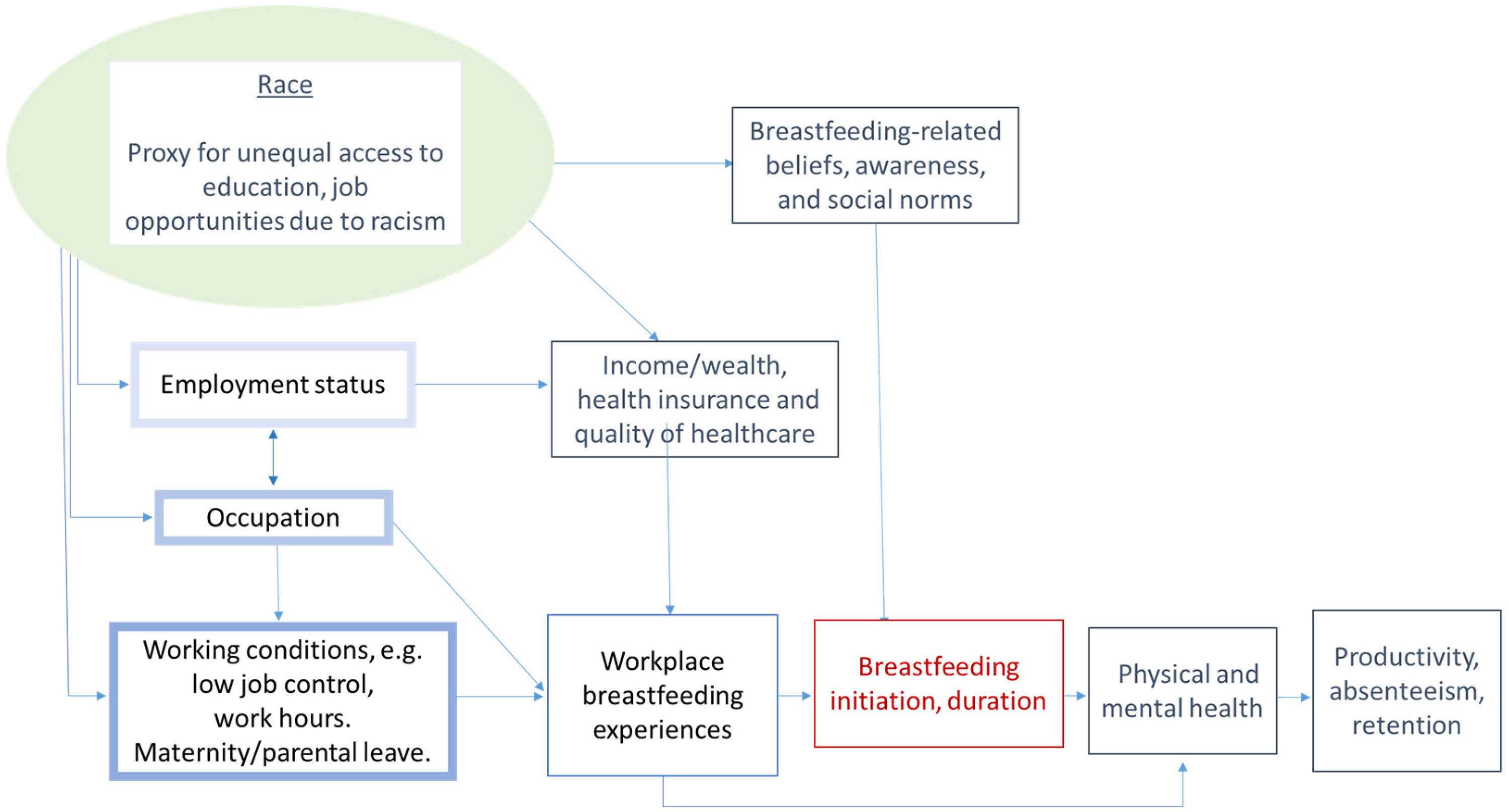
Conceptual model for race, work, and breastfeeding. Employment status refers to whether or not a person is working for pay. Occupation refers to the type of work that a person does (eg, childcare worker, librarian, and cashier). Workplace Breastfeeding Experiences refer to experiences people have trying to maintain lactation while also being employed, including barriers and facilitators encountered. Working Conditions refer to mental demands, physical conditions, schedule/time considerations and other conditions that people face in the workplace (See International Labour Organization, Working Conditions, 1996-2022).
Literature Review
Our conceptual model posits that work, including employment status, occupation, psychosocial working conditions, access to maternity or parental leave, and workplace breastfeeding experiences, partially mediates the relationship between race and breastfeeding (Figure 1). In other words, we argue that work-related variables function as a mechanism through which race and racism influence breastfeeding. 63 This is a logical extension of theory about work as a social determinant of health and the integration of work and family responsibilities, and it aligns with observations by experts in the field. 2 The empirical evidence, however, is not fully fleshed out. As we describe below, 2 studies that assessed whether employment mediated Black-White breastfeeding inequities for large samples of American mothers suggested either no relationship 64 or an inconsistent one. 65 The employment rate among White mothers (51%) and Black mothers (52%) is similar (Table 1). Studies that considered more specific aspects of work, such as part- versus full-time employment 66 or low job control, 67 may explain more about breastfeeding inequities. We then examine a broader range of evidence, including both quantitative and qualitative studies and for a wider range of populations, addressing the relationships among race, work, and breastfeeding.
Occupation by Race and Ethnicity Among Employed Women, 2020.a
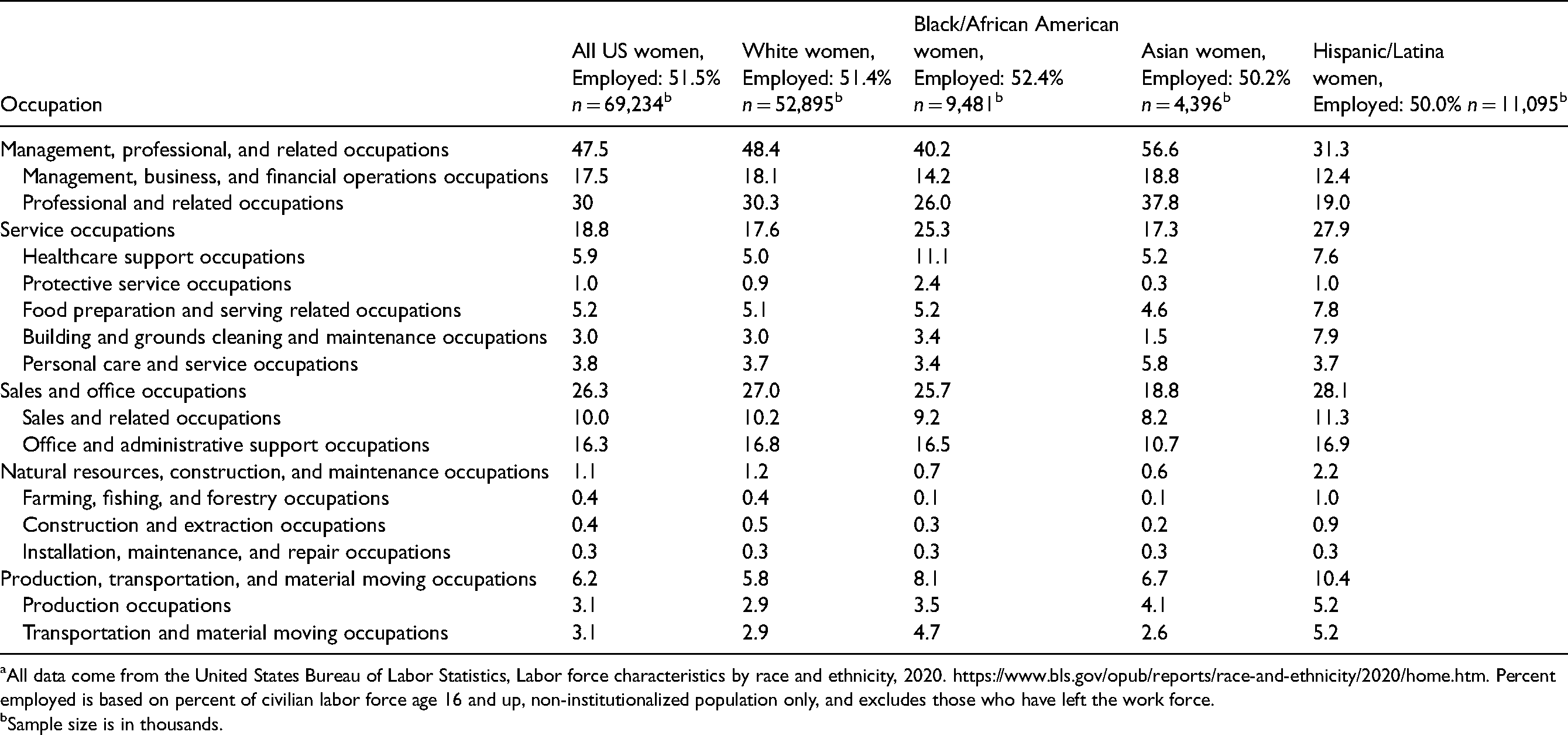
All data come from the United States Bureau of Labor Statistics, Labor force characteristics by race and ethnicity, 2020. https://www.bls.gov/opub/reports/race-and-ethnicity/2020/home.htm. Percent employed is based on percent of civilian labor force age 16 and up, non-institutionalized population only, and excludes those who have left the work force.
Sample size is in thousands.
First, McKinney and colleagues quantitatively assessed an array of potential mediators, including employment status at one month postpartum, as well as health beliefs, health conditions, and breastfeeding family history, to determine which explained variation in breastfeeding initiation and duration among Hispanic, White, and Black mothers in 2008 to 2010. 64 Regarding the Black-White disparity, they found that poverty, education, and marital status explained the initiation disparity, and that formula feeding in-hospital as well as education and marital status explained the difference in duration. History of breastfeeding in the family explained higher breastfeeding initiation among Hispanic compared to White mothers. 64 Employment rate did not vary significantly among the racial/ethnic groups in the study, and that variable was not included in the full mediation analysis. 64 Because the study operationalized employment through a dichotomous variable for employed or not, and it did not take into account the type of occupation or working conditions that have been linked to breastfeeding,10,68–75 the findings about work as a mediator are limited.
Similarly, Safon and colleagues examined whether multiple variables including maternal employment during pregnancy (as a dichotomous variable), sociodemographic variables like age, and breastfeeding-related attitudes and perceived norms mediated the relationship between White and Black race and breastfeeding outcomes, taking place of birth into account, for a sample from 2011 to 2014. 65 They found that the breastfeeding inequities between US-born Black compared to US-born White mothers were partly explained by employment status, as well as other variables (age, education, infant birthweight, family caregiving arrangement, participation in the Special Supplemental Nutrition Program for Women, Infants, and Children (WIC), use of infant care information, and breastfeeding-related attitudes). 65 In this study, US-born Black mothers were less likely to be employed in pregnancy and less likely to exclusively breastfeed at follow-up than US-born White mothers, yet path analysis showed that being employed during pregnancy was associated with shorter breastfeeding. 65 The implications for how employment relates to racial differences in breastfeeding were unclear. Further, like the study by McKinney and colleagues, 64 the study by Safon and colleagues considered only employment status, operationalized dichotomously, and not occupation type or working conditions.
In contrast to the aforementioned studies that found little relationship between employment and breastfeeding, studies that have considered working mothers’ employment in greater detail have shown stronger connections to breastfeeding inequities. For instance, although the authors did not conduct mediation analysis, Ryan and colleagues observed that part- versus full-time work may relate to differences in breastfeeding among Black and White mothers. Their nationwide study of mothers who gave birth in 2003 showed that those working full time had shorter breastfeeding duration compared to those working part time or not at all. Black women were both more likely to work full time and were less likely to breastfeed until 6 months when compared with White mothers. 66 Even after controlling for maternal education, geographic location, participation in WIC, and infant birthweight, full-time maternal employment was significantly predictive of less breastfeeding. Specifically, compared to working full time, not working resulted in twice the odds of breastfeeding until 6 months, and part-time work resulted in 50 percent higher odds. In the same model, participation in WIC, which is a program for low-income families, predicted less breastfeeding. This suggests that lower income and full-time work may each independently contribute to shorter breastfeeding.
Another study, by Whitley and colleagues, found that in a nationwide sample from 2007 to 2015, greater exposure to low job control among Black mothers partially explained their reduced breastfeeding compared to White mothers. 67 Among the sample of working mothers with young children, Black mothers had lower job control on average compared to White mothers. A path analytic model showed a significant path connecting race (Black compared to White), low job control, and breastfeeding for at least 6 months. A decomposition of effects suggested that job control mediates roughly a third of the relationship between race and breastfeeding.
In short, employment status alone does not seem consistently to explain Black-White differences in breastfeeding outcomes,64,65 but characteristics of working mothers’ jobs, like part-time versus full-time employment 66 or specific working conditions like low job control 67 may be informative. The body of literature tying such work-related variables to racial inequities in breastfeeding is limited, in spite of the ample evidence showing how work relates to breastfeeding.
Employment, Occupation, and Working Conditions as Drivers of Breastfeeding Behaviors
Employment status and occupation are known predictors of breastfeeding. 76 More than 25 percent of new mothers are working by the time the infant reaches 3 months, and more than half by 6 months. 8 The proportion of mothers who engage in paid employment within one year of giving birth has increased substantially during the past 5 decades. Only 14 percent of new mothers were working at 6 months postpartum in the 1960s, compared to 57 percent in the early 2000s. 8 Continuing to breastfeed while physically separated from the infant requires that mothers regularly express (or pump) breastmilk, store it at a sufficiently cool temperature, and transport it home each day.9,11,12 These demands make it challenging for working mothers to continue breastfeeding. Currently, women who are not employed typically breastfeed longer than those who are, particularly those working full time.66,77,78 However, the relationship between employment status and breastfeeding may differ by race, such that not working predicts longer breastfeeding among White mothers but not among Black mothers. 79 Breastfeeding-related problems with work or school are commonly cited reasons for cessation. 80 Returning to work sooner after giving birth is associated with shorter breastfeeding duration,81,82 while access to (paid) maternity leave is also associated with longer breastfeeding.10,83 The fact that leave time as well as income and resources are important for breastfeeding underscores the importance of paid leave.
It is not just a mother's employment status that matters for breastfeeding but also whether her job accommodates breastfeeding. Women who work in jobs that are hazardous, inflexible, lack parental leave benefits, and/or do not have lactation accommodations tend to breastfeed for a shorter duration,10,71–75,84 as do women working non-professional jobs, such as service and manual labor jobs.68–70,82,85
Working conditions
Working conditions refer to a broad range of factors, including psychosocial conditions, physical conditions, hours, breaks, schedules and pay, that characterize people's relationship to their paid work. 86 The term psychosocial working conditions refers to the interaction among individuals in a workplace, and how that interaction relates to the way workers do their jobs.48,49 Qualitative findings illustrate how psychosocial working conditions, including control over taking breaks and support from supervisors and colleagues, can determine whether working mothers continue breastfeeding. For instance, some mothers describe not being able to take pump breaks when they needed and as a consequence losing their milk supply, while others describe having support from colleagues that enabled them to take pump breaks whenever they needed.11,12
One psychosocial working condition that may be particularly relevant to breastfeeding is low job control. Low job control, defined by Karasek, 52 describes jobs that offer workers little or no decision-making discretion and limited learning opportunities. Jobs characterized by both low job control and high demands produce job strain,51,52 which is associated with heart disease53,54 and other adverse health outcomes.87–92 Low job control is also associated with decreased physical activity 56 and poor diet among workers, 55 and low job control among pregnant working mothers has been linked to low birth weight for their infants. 93 Moreover, low job control predicts shorter breastfeeding duration among working mothers. 67
In sum, the literature supports the idea that employment status, occupation, working conditions such as job control and work/life policies, help determine breastfeeding behaviors among working mothers. These relationships are demonstrated by the boxes in the lower left portion of the framework (Figure 1).
In addition, income is a well-established predictor of breastfeeding in the US; 15 percent of mothers living below the poverty line breastfed exclusively until 6 months, compared to over 25 percent of those with incomes of at least 400 percent of the poverty level. 4 Poverty and household income can be shaped in part by mothers’ employment status and occupation (through her earnings), as well as by a partner’s income and income from public programs.94,95 Income may be associated with breastfeeding by way of women's working conditions and also by way of the working mother's earnings and access to other resources. When considering the relationship between employment and breastfeeding, it is important to take into account mothers’ income and access to resources.
Can Working Conditions Help Explain Racial Inequities in Breastfeeding?
Occupation is of particular interest in explaining population-level breastfeeding inequities in the US because occupation is racially patterned, or segregated.96,97 Inequities in education, in hiring, firing, and layoffs and other systemic barriers have benefited White Americans and disadvantaged Black Americans when it comes to job opportunities and working conditions.98–100 These dynamics have impacted working mothers. White women are disproportionately likely to work in professional or management positions, while Black women are disproportionately likely to work in service occupations or transportation.96,101 The distribution of occupations among employed women by racial/ethnic category is shown in Table 1. Of the 4 racial/ethnic groups shown, Asian and White women have the highest representation in management/professional occupations and also the highest breastfeeding initiation rates. In contrast, Black mothers have low representation in management/professional occupations and relatively low breastfeeding initiation rates. Notably, Latina mothers have high breastfeeding initiation but low representation in management/professional occupations; while occupation may be a useful predictor of breastfeeding, there are other factors at play.
There are racial inequities in working conditions, as well. White workers are more likely than Black workers to have flexible work schedules and the option to work from home. 101 Among mothers of young children, White women had significantly higher job control than Black women. 67 Black women are also more likely to work in jobs that do not offer paid maternity leave.102,103 Even within the same occupation, Black women can face additional breastfeeding barriers than White women, 104 including racist treatment from a supervisor.104–108
Accordingly, the left side of our framework shows how, because of racism and unequal access to education and job opportunities, race is associated with employment, occupation, working conditions, and workplace breastfeeding experiences (Figure 1). When connected to breastfeeding and subsequent outcomes, the framework suggests that work is interrelated with racial inequities in breastfeeding. In particular, work may partially mediate, or serve as one mechanism through which racism can influence breastfeeding outcomes. 63 The framework shows that, in addition to work, other factors likely serve as partial mediators connecting race, racism, and breastfeeding, such as a family history of breastfeeding,11,12 attitudes and beliefs about breastfeeding,11,109 medical conditions, 11 and experiences with health care providers,11,110,111 including lactation consultants.13,14,112
Conclusion
In this critical review, we have described the current state of the scientific literature about the contribution of work and working conditions to breastfeeding inequities, particularly by race. We identified a need for research that examines the mediating role that occupation and/or working conditions may play in racial breastfeeding inequities. Finally, we have proposed a new theoretical framework that describes how, because of racism, race is correlated with employment status, occupation type, and working conditions, which can then impact workplace breastfeeding experiences and breastfeeding outcomes.
We sought to identify and synthesize existing literature on the topic of work and racial inequities in breastfeeding. Our goal was not to review the literature systematically but rather to analyze and aggregate prior work in a way that can strengthen future investigation in this area. 38 This work builds on prior scholarship that examined multiple levels of breastfeeding facilitators and barriers, from individual to community to policy, in line with the Social Ecological Theory. 113
Many factors beyond employment opportunities and work influence breastfeeding behaviors. A family history of breastfeeding,11,12 breastfeeding experience with a previous child, 110 supportive family members and partners,11,110,111 positive attitudes and beliefs about breastfeeding,11,109 and support from health care providers,11,110,111 are facilitators of breastfeeding. In contrast, health care providers who give inadequate breastfeeding guidance,11,12 medical issues with breastfeeding (eg, problems with latch), 11 and lack of family or partner support12,110 are barriers. In some cases, lactation consultants, who are disproportionately White, 112 have provided Black patients with lower quality or discriminatory treatment.13,14 Some of these barriers, while ostensibly separate from a mother's employment status and working condition, may nonetheless be intertwined with work. For instance, if working conditions limited one's own mother from breastfeeding a generation ago, that could affect present-day breastfeeding attitudes within that family and community.
Public Health Relevance of Breastfeeding
Population-level inequities in breastfeeding may contribute to other health inequities later in life, for both the child and the mother.114–116 For infants and children, breastfeeding is associated with a decreased likelihood of sudden infant death syndrome27,117–120 and postnatal deaths in general. 121 Women who breastfeed have a lower risk of breast and ovarian cancer,27–30,122–125 type 2 diabetes,27,126–129 cardiovascular disease,31,130–132 and depression.27,133,134 Breastfeeding cessation can worsen symptoms of anxiety and depression; however, anxiety and depression may themselves contribute to earlier cessation.19,135,136
Breastfeeding is also imbued with social and personal significance for many mothers. 137 It is now the normative form of infant feeding in the United States; most women intend to breastfeed for 6 months, although, as we described, the majority do not. 3 Mothers who do not meet their personal breastfeeding goals may feel guilty or ashamed, particularly if they believe others are negatively judging them.138,139
In addition, breastfeeding is considered a human rights issue by the United Nations140,141 as well as many breastfeeding advocates and scholars.142–144 In that light, removing barriers and ensuring equitable access to breastfeeding is one way to promote basic rights for children and women. Perez-Escamilla and Sellen summarized this perspective, stating, “any social, economic, political, legal, or biomedical factors that prevent women from implementing their choice and right to breastfeed can be framed as a fundamental social injustice that needs to be understood through an equity lens.” 144 (p 12)
Promoting fair access to breastfeeding across the US population requires that practitioners, researchers, and other stakeholders understand both what the population level inequities are and why those inequities exist. There has been far more consensus and clarity about the former point than the latter. 2 In this review, we have made a case for why work and working conditions are a key component to understanding racial breastfeeding inequities.
Footnotes
Declaration of Conflicting Interests
The author(s) declared no potential conflicts of interest with respect to the research, authorship, and/or publication of this article.
Funding
The author(s) disclosed receipt of the following financial support for the research, authorship, and/or publication of this article: This work was supported by the Southern California NIOSH SCERC Targeted Research Training Fellowship in Occupational Health, Eunice Kennedy Shriver National Institute of Child Health and Human Development (grant number T42OH008412, P2CHD041028).
