



Abstract
Instrumental performance that approximates real-world models is one way in which a general music curriculum can encourage high levels of engagement and potential for lifelong musical activity. Although guitars, keyboards, and various folk instruments are useful for this purpose, orchestral instruments can also provide significant solo and ensemble performance opportunities, as well as a meaningful avenue for encountering various styles of orchestral music. In this article, the author discusses a 4-year experience using orchestral strings to engage early secondary (ages 11-14 years) general music students in performing. One of the crucial aspects that led to this program’s success was the multiple sequencing of technical development such that all students, regardless of ability, musical background, or special needs could participate meaningfully in the class ensemble learning experience. The discussion aims to provide teachers who have access to strings or other orchestral instruments ways to incorporate ensemble performance in the general music curriculum.
Given the high levels of interest and motivation adolescents reveal in authentic learning tasks that are meaningful to their personal and social lives, general music classes can be effectively conceived as cognitive apprenticeships (Brown, Collins, & Duguid, 1989), practicums (Elliott, 1995), and laboratories (Regelski, 2004) focused on exploring real-world models. In this conception, students are given opportunities to perform, improvise, compose, and listen in contexts that at least resemble those in which they are currently practiced. Such approaches can encourage engagement in music making that has the potential to continue well beyond the school years.
Among the most satisfying experiences during my time teaching music in an international education setting was the development of a string ensemble component for a general music curriculum. In the position to which I was posted, I had the opportunity to start and run a music program for the new secondary school campus of an international school in China. The task initially involved teaching general music to early secondary students (Years 7 to 9 of the U.K. curriculum, which includes students aged 11-14 years) and initiating an after-school music activity. Since, in addition to my training as a generalist, my background includes violin playing and teaching, as well as an instrumental music qualification, I was eager to find a way to use my background to engage students in an authentic performing experience. Fortunately, there was a budget for the program, and the instruments were sufficiently affordable to be purchased for an entire class, which comprised, on average, between 15 and 20 students. In addition to my prior experience with strings, the decision to use strings rather than winds was influenced by the homogeneity of string ensembles: since classes in international education are in constant flux, it is important to have instruments that still blend well when members are added and subtracted. Also advantageous was the fact that, unlike some winds, no string instruments require transposed parts. Moreover, I reasoned that employing orchestral instruments in the class would stimulate the desire to participate in an after-school ensemble.
The process of adapting an instrumental music education program for a general music curriculum was a challenging but largely successful experience. Students were generally focused, motivated, and on task throughout these lessons, and classroom management presented no great challenge, provided established procedures for setup, rehearsal, practice time, and so on, were in place. The purpose of this article is to describe my approach to teaching ensemble performance in a general music context, focusing on the way multiple sequencing, i.e., arrangements with parts for various levels, led to highly engaging music learning for a diverse range of students. Although the situation I describe is possibly unique, my hope is that teachers will find insights that can be applied to similar contexts for using instruments in general music education.
An Orchestra for All Students
The implementation of my string program posed two unique challenges. First, as a component of a general music curriculum, the activities would have to suit the needs of all students, not just those with prior instrumental performance experience; and, second, I would have to take into account the fact that students come to international schools from very diverse backgrounds, including some with a strong background in music learning and others with next to none. My classes comprised a wide range of learners, from those with several years of private study on an instrument to those with no experience in productive music making.
In such situations, as Regelski (2004) observes, method books, which present one learning sequence to the whole class, are of limited value. Although I did use a string method, particularly in the initial stages and at later points for technical training, I did not simply follow the book through in linear fashion. Those with prior experience in, for example, violin or cello, would have become quickly bored, whereas beginning students might have been overchallenged, resulting in off-task behavior. Regelski (2004) proposes a solution to the problem of teaching instruments in general music, which he refers to as “multiple sequencing.” In this approach, the entire class plays the same material but in “arrangements that provide for multiple levels of technical progress per each piece” (Regelski, 2004, p. 219). Regelski’s method borrows from Bunting’s (1986) system of teaching traditional instruments in the general music classroom: Each piece is arranged as a series of variations from simplified versions of the melody to those with more challenging embellishments. I employed this approach in creating material for my classes, including arrangements not only for method book pieces but also for literature related to the various topics explored in the curriculum. Each student would receive a part arranged not only for his or her particular instrument but also commensurate with that student’s specific level of ability. Early performers’ parts focused mainly on open strings and simpler rhythm patterns, whereas advanced players would work with the principal part and more complicated variations. Class sessions included time spent working through individual parts (while the others engaged in silent fingering practice) and rehearsing the entire arrangement as a class ensemble. Further details concerning these arrangements are discussed in the next section.
In addition to multiple sequencing, it is important to set realistic goals for the given context. Obviously, one cannot expect to achieve the same outcomes within the boundaries of a general music curriculum as one could in a purely instrumental music program. In addition to student diversity, there is also the need to balance the curriculum with aspects of music learning besides string performance. Thus, I limited technical development throughout Years 7 to 9 to the basic skills needed to perform the given repertoire and other material required. Restrictions included, among others, keeping to simple bowings and playing in first position in the keys of D, G, C, and F major along with related minor, Dorian, and pentatonic modes. Techniques introduced in Year 7 would be reviewed and expanded in Year 8, with Year 9 being a review and application of the basic skills developed in previous years. Thus, students suddenly appearing in Year 9 (a common occurrence in international education) would not have too much to learn in order to participate meaningfully in the class.
Students were asked to make three choices of the four possible string instruments, numbering them according to priority. This allowed me to assign a third choice if the needs of a particular student or the balance of the ensemble warranted it. I tried to approximate proportionally the balance of a typical string orchestra and to avoid having too many playing in the bass register. Also, since the first year provides the opportunity to begin instruction for the whole class, I would normally try to assign instruments such that those with prior experience playing, for example, violin would learn cello, and vice versa. This tactic would at least ensure some level of uniformity in the learning during the early phases. Later, as differing levels of ability develop, students would be divided into the various sequences according to their learning needs. However, despite the difference among parts, I would have stronger students paired with those with less ability—particularly newcomers to the class—so that peer support could be possible. This peer assistance was especially useful during segments of class time devoted to supervised practice, as it was difficult for me to tend to the needs of the whole class in such limited time. Given the minimal technical requirements and the generally motivated behavior of the students, in-class practice times were normally sufficient to achieve the required outcomes. In rare situations, students were given additional supervised practice during a lunch or recess break. More often, the requirement to come for extra practice during break was used to prevent off-task behavior during class practice times.
Setting limits on technical requirements and encouraging peer support helped not only to prevent learner frustration but also to maintain emphasis on the main objectives, which were to develop a basic procedural knowledge of ensemble playing and to learn various styles of music through performing. However, there were students whose ability and prior experience required further technical challenges to ensure continuing interest and meaningful learning. At times, including ensemble parts with more sophisticated variations of the piece was not sufficient to meet a student’s needs. For example, one student in particular, who came with a high aptitude for music and advanced piano skills, was able to learn cello at an unusually quick pace. In her case, I introduced further techniques during practice times, such as playing in third position, which would provide the needed challenges not included in the original version of a particular part.
Arranging Music for Multiple Sequencing
Although arranging differentiated parts for students in the class ensemble mainly concerns the use of musical scores, it is important to note that early in each year, as well as at other appropriate times, instruction focused on rote learning, which also involved multiple sequencing. For example, a Year 8 class, comprising new students as well as those who had worked with strings in Year 7, might involve the experienced students in a new rote exercise using pentatonic patterns, while the new students accompany on open strings. Thus, it is the technique and not simply the score reading that is being accommodated in this approach.
Initially, my method of arranging music for classes generated four individual parts: “novice,” “developing,” “standard,” and “advanced”. “Standard” level refers to the original unison melody or part in an ensemble piece. Students finding the standard level too easy would study the “advanced” part, which offered variations to challenge the player. The “novice” part more often divided into two parts: one with only open strings and the other including very simple fingering, usually one finger. An important feature of these parts was the way rhythm was represented. Although one note with four beats might look easy on the page, the kind of bow control required would be too difficult for the novice level. Therefore, parts were characterized by quarter note patterns and later, simple quarter and eighth note couplet patterns. Finally, the “developing” level would be appropriate for those beyond the beginner level who cannot yet manage the standard part.
Early in the development of the program, however, it became apparent that more parts would be required between these levels to accommodate students who were, for example, getting tired of playing a particular part but who were not yet ready for the next level. This basically involved adding more parts to the “developing” phase, but it could also require including another, less challenging, variation on the standard tune, which could be approached prior to the more difficult variation. The importance of flexibility cannot be overemphasized. Each class presented unique needs that individual parts had to address; it was not possible simply to produce all arrangements beforehand in a form suitable for all situations.
The example in Figure 1 shows a basic multiple sequence of the well-known tune “Lightly Row,” with all parts shown in the treble clef for clarity. This piece would be taught during the first year when strings are introduced, likely early in the year if the string component commences from the beginning. In this instance, students would not yet have learned to read key signatures and thus accidentals are used. Parts 4 and 5 are for novice learners and are restricted to open strings. Part 5 is easier in that it allows string changes to be made during rests. Parts 2 and 3, for developing players, maintain the rhythm of the piece while simplifying the notational content: Part 3 is limited to open strings and first finger, whereas Part 2 avoids the thirds in the opening two measures. Part 1 is the standard form of the tune and Part 1* provides a variation part for advanced learners.
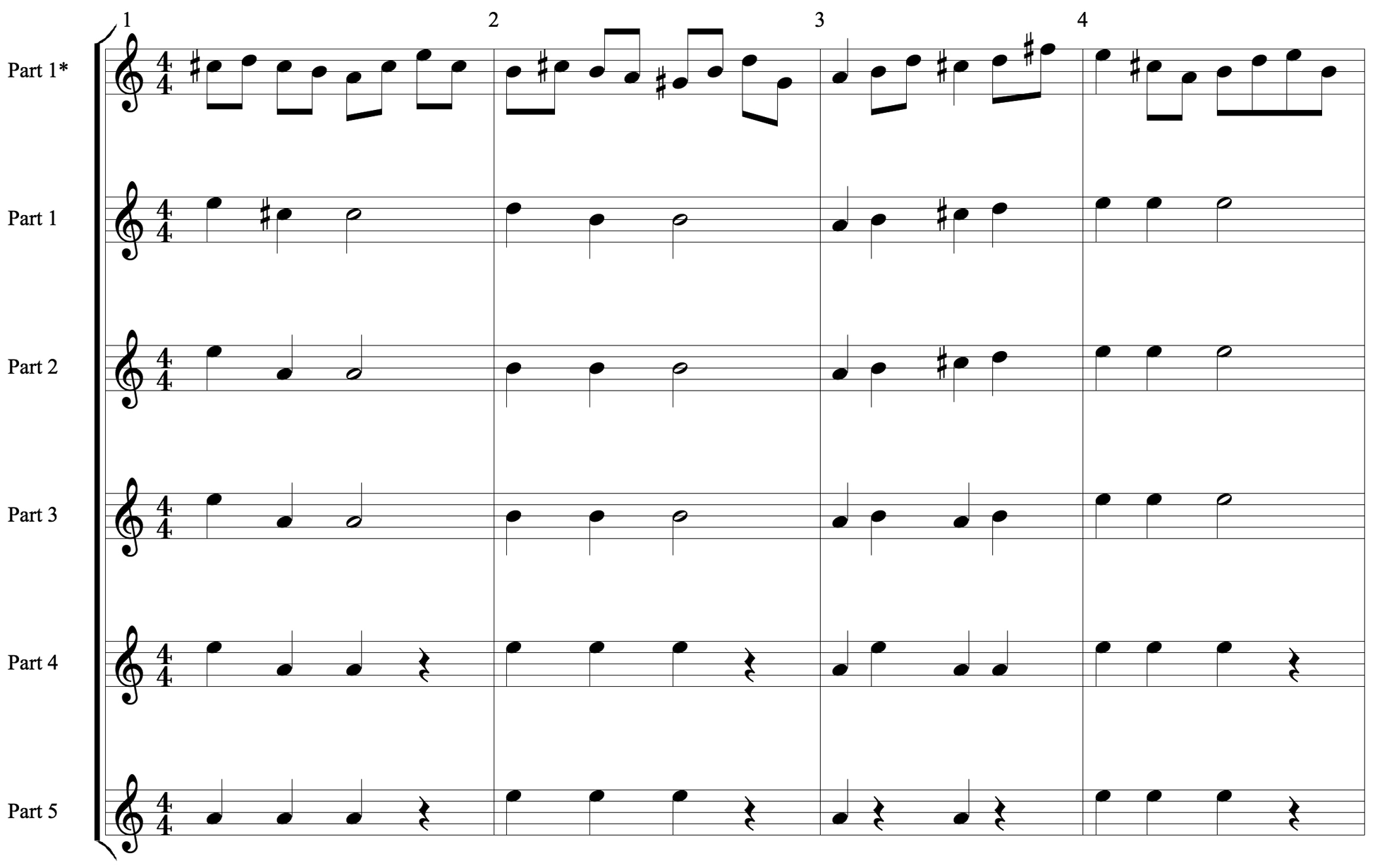
Excerpt from a basic multiple-sequence arrangement of “Lightly Row”
Doubtless, there are drawbacks to this approach. First, the need to create as many separate sequences as a class may require can result in a cumbersome array of parts for the teacher to direct. The difficulties in knowing and leading the class in several parallel lines are not very different from those facing a conductor with a large orchestral score. Also, making arrangements to accommodate diverse student needs puts great demands on teacher preparation time, at least in the first year of the program when the initial material is produced. Despite these problems, the reward of having a class in which every student, regardless of background, was focused and fully engaged in music making together made the effort worthwhile.
Learning Music, Not Just Learning About Music
This program not only encouraged motivation and engagement in performing but also provided one effective way to engage students in learning various styles of music. Too often in general music classes, musical styles related to ensemble or orchestral performance are studied only through listening and analyzing recorded examples. When performing and composing activities are used to facilitate this learning, they are more often conceived as mere classroom activities purposed to aid the understanding of abstract concepts about music. In such cases, the emphasis on understanding verbalized concepts detracts from the holistic nature of music making, in which conceptual knowledge plays a role, but procedural knowledge is central (Elliott, 1995). Moreover, if styles of ensemble music are taught as subjects for (receptive) learning, or simply to “cover” conceptual content, they will not likely be perceived by students as meaningful.
In my program, learners pursued topics based on various practices and styles of music. In some of these, the class could engage in both procedural and conceptual aspects by performing arrangements of representative pieces as a class orchestra. For example, an exploration of the Classical symphony would center on performing an abridged arrangement of a movement of a symphony by Haydn or Mozart, whereas a unit on swing style would turn the class ensemble into a string band, with the possible addition of guitar playing students. Some of these arrangements were featured in assembly and school concert performances, delighting students and parents alike. String instruments were also useful for other areas of the curriculum: Many of my students used their string instruments for group composition, as well as for improvising simple jazz phrases.
A particularly interesting experience one year involved two Year 8 classes exploring a unit on the Baroque concerto. Each of these classes included students who were strong enough performers to be “soloists” in an arrangement of a concerto movement. One of the classes explored a Bach keyboard concerto, with an advanced-level piano student learning the solo part while the rest of the class worked with the individual parts of my arrangement. The other provided an opportunity to perform a movement of one of Corelli’s concerti grossi: Two violinists and a cellist were capable of learning the concertino of an arrangement that also included parts for a class ripieno.
Despite the noticeable preference among many of my students for popular music and the instruments associated with it, they came to classes involving string performance with considerable enthusiasm. It was clear that, regardless of the musical style in question, the very fact of playing together with peers was a meaningful experience that offered the kinds of challenges and social context the students desired. This level of interest provided a significant point of access for experiencing and appreciating less familiar musical practices.
Integrating Ensemble Performance in the General Music Classroom
The notion of learning music through performing is not new and has even been a guiding principle in instrumental music programs (Allen et al., 2001; Blocher, Cramer, Corporon, Lautzenheiser, & Lisk, 1997). The perspective offered here opposes the relegation of performing to extracurricular activities for a select few. Given the positive reception of students, the potential for music learning through authentic ensemble performance is high.
However, the program I describe is merely one example among many and does require some knowledge of string playing and teaching, as well as the ability to produce effective arrangements for those particular instruments. There are other ways to integrate ensemble playing in the general music classroom that are suitable for situations lacking the resources and budget for the program described above. One possibility is to create a mixed ensemble from the school’s existing instruments and those students bring from home. However, this approach depends on there being enough students owning portable instruments and that they bring them to school prior to the day they are required for class. Also, the experience would be more satisfying if the school owned band instruments, or others associated with authentic practice, rather than merely those produced for classroom teaching.
Another alternative is to incorporate arrangements of ensemble music for more easily acquired and maintained instruments, such as inexpensive electronic keyboards. Regelski (2004) lists various options for creating ensembles in the general music classroom, including those comprising guitars, keyboards, and various folk instruments, along with many practical suggestions for teaching. Groupings can be either homogeneous (e.g., “guitar ensemble”) or heterogeneous (e.g., mixing melodic instruments with chord-playing guitars and keyboards). However, combining various groups of similar instruments provides the possibility of emulating the sections of orchestras or chamber groups. Exploring multiple-sequenced arrangements of orchestral pieces, using ensembles of instruments requiring less in-class training, can be an initial step for teachers facing time constraints.
Regardless of which instruments and combinations are chosen, there are some practical concerns revealed in my program that could also apply to other situations incorporating ensemble performance in the general music classroom. First, it is important to have sufficient practical knowledge of each instrument in order to guide students in producing satisfying performance experiences and to enable arranging parts appropriate for both the instrument and the student’s level. Second, I have found that certain classroom preparations increased the program’s time and efficiency. One involves storing the instruments on stands around the classroom, arranged by section, and easily accessible by students when asked to go as a section to collect them. Another arrangement entails seating students such that there is sufficient space to move quickly to assist individual performers. My preference with smaller and beginning classes was to form a kind of “U-shape” with a row of violins on the left, cellos and basses on the right, and violas in the center. Setting up the seating prior to class (as well as checking the tuning of the instruments), when possible, also increased the time available.
Third, both instrument sections and multiple-sequenced parts need to be taught separately as well as rehearsed together. Therefore, students in one section or part should be prepared to do silent practice (e.g., fingering only, with no sounds) while another is getting instruction. Prior to any supervised individual or pair practice of various parts, students must be clear concerning what to practice, what steps to follow in practicing, and how they will demonstrate what they have learned during practice. Also, as mentioned previously, teachers need to be ready to provide further challenges for those with more ability, or who have instruments that are easier to play, if they are to remain on task during group or individual practice sessions.
Introducing ensemble performance in the general music classroom can be a highly satisfying and motivating learning experience for students, even when time constraints permit only a few such experiences throughout the year. The use of multiple sequencing allows students from a range of educational settings, including international and urban schools among others, access to pleasures often restricted to after-school activities and ensemble programs. It is hoped that the experience discussed here will provide an impetus for the development of more ideas and methods for general music instrumental ensemble learning.
Footnotes
The author(s) declared no potential conflicts of interests with respect to the authorship and/or publication of this article.
The author(s) received no financial support for the research and/or authorship of this article.