




Abstract
Increasingly, music teachers are required to assist, tutor, or teach reading skills in the music classroom. In the effort to meet such mandates, music teachers may be challenged to either relinquish valuable music instruction time or attempt to combine instructional strategies of both music and reading into singular lessons, units, and classroom activities. It may prove beneficial for music educators to understand common characteristics inherently shared between the two subjects. This article details terminology, learning processes, and instructional strategies shared between music and reading instruction. Activities demonstrate ways reading instruction is naturally supported in the music classroom.
The National Institute for Literacy (NIL) reports that more than 74 million adults—approximately one third of the American population—do not possess the “functional” literacy skills to perform some basic tasks, ensure individual opportunities, and contribute to the national economic infrastructure (NIL, 2008). Functional literacy is evaluated through three primary domains: prose literacy, the ability to read printed information, such as newspapers, magazines, and books; document literacy, the ability to complete forms and applications such as employment, payroll, or college applications; and quantitative literacy, the ability to execute basic arithmetic, such as balance a checkbook or calculate simple loan interest (National Center for Educational Statistics, 2005); each domain requires fundamental reading and writing skills. As the number of individuals with reading deficiencies rapidly increases, emphases have been placed on the U.S. public school system in hopes to increase literacy achievement, to find alternative practices, and to determine intervention processes of struggling readers.
In response, many schools and districts require increased reading instructional time and mandate all teachers to take a more responsive role in reading intervention, including music teachers (Kirsch, Jungeblut, Jenkins, & Kolstad, 1993; Rabb, 2004; Stedman & Kaestle, 1987). Increasingly, general music teachers are required to assist, tutor, teach, and incorporate reading strategies into the music classroom (Fisher & McDonald, 2001). Music and reading, as independent subjects, are vast in scope and have complex and multifaceted instructional practices, and therefore, music teachers may be challenged to either relinquish valuable music instruction time or attempt to embrace the task of combining instructional strategies of each subject into singular lessons, units, and classroom activities.
O’Brien and Stewart (1990) found that music teachers felt inadequately prepared to teach reading skills because of the lack of instructional materials, inadequate classroom teaching time, and insufficient training. Hall (2010) investigated the preparation of music teachers to teach reading skills and found that approximately 54% of colleges and universities require a reading course in the degree program; however, approximately 92% of such courses were taught through the Colleges of Education and very few courses provided the preservice music teachers with specific strategies to incorporate reading content into the music classroom.
A growing body of research has examined the effects of music instruction on the ability to enhance and teach basic reading components. Correlations have been identified between music instruction and enhanced letter recognition (Nicholson, 1972; Register, 2001), language development and oral communication skills (Braithwaite & Sigafoos, 1998; Kelley, 1981), phonological awareness (Gromko, 2005; Lamb & Gregory, 1993), word decoding, reading comprehension, and word knowledge (Register, Darrow, Standley, & Swedberg, 2007), reading ability (Anvari, Trainor, Woodside, & Levy, 2002; Bowles, 2003; Kemmerer, 2003; Lamb & Gregory, 1993), and prewriting and print conceptualization (Register, 2001).
It is not the intention of this article to advocate that music teachers become reading teachers. However, it may prove beneficial for music educators to understand the similarities and parallels between the fields of music and reading in order to effectively address reading content while maintaining the integrity of music learning. Therefore, the purpose of this article is to (a) equip music teachers with reading terminology, (b) provide reading processes and instructional practices that mirror music learning processes and instructional practices, and (3) present music activities that explicitly demonstrate how music teachers currently support language learning in the music classroom.
Music and Reading
In general, music and reading share three primary learning processes: auditory, the ability to hear and manipulate sound (Hansen, Bernstorf, & Stuber, 2004); symbolic representation, the use of symbols to effectively and efficiently communicate information to others (Slater, 2005); and coding, the employment of encoding and decoding systems to process and construct meaning (Sadoski, Paivio, & Goetz, 1991). In addition to these common learning processes, music and reading also share similar instructional strategies that may be complimentary when conceptualizing the process of integrating reading into the music classroom. Because of the vast scope of content in music and reading, this article will focus on the parallels between music and the five components of reading instruction as outlined by the National Reading Panel (2000): phonemic awareness, phonics, fluency, vocabulary, and comprehension.
Phonemic Awareness
In reading, phonemic awareness refers to the ability to identify and distinguish individual sounds (phonemes) in words (Torgesen, 2002). Prior to formal training in phonemic awareness, students typically experience language through sound. For example, children aurally recognize, understand the meaning, and accurately use the word “dog” prior to having the ability to identify and understand the meaning of “d-o-g” through visual representation. Likewise, prior to formal training in music, children aurally recognize and incorporate the “Sol-Mi” falling third in songs or chants, prior to having the ability to identify and understand the meaning of “Sol-Mi” through visual representation. Music activities that involve sound discrimination (i.e., pitch, timbre, duration, form) can assist in refining phonemic awareness skills in young children (Butzlaff, 2000; Gromko, 2005; Lamb & Gregory, 1993) and increase the ability to discriminate phonological sounds (i.e., sound, syllables, onset, and rhymes). Figure 1 provides an example of using rhythmic discriminatory skills to reinforce phonological process of word syllabication.

Phonemic awareness (sound discrimination) teaching activity
Phonics
Phonics instruction is a two-step process that connects aural representation of sound (phonemes) with written representation of sound (graphemes). Phonics includes beginning and ending sounds, short and long vowel sounds, the process of linking sounds to letters (i.e., diagraphs, consonant blends, and diphthongs), naming and sounding the letters of the alphabet, and using the phonic language to make plausible attempts phonetically at more complex words (National Reading Panel, 2000); such experiences occur regularly in the music classroom when singing folk songs, chants, and choral pieces as in Figure 2.

Phonics (visual representation) music activity
Fluency
Fluency, in both music and reading, is the ability to read quickly (automaticity), accurately and with expression (prosody), and each involves perception and interpretation of patterns and relationships (Armbruster & Osborn, 2003; O’Herron & Siebenaler, 2007). Fluency occurs in written language when the reader uses samplings of text or clues that make sense within the context of the reader’s experiences and constructs meaning from these clues using the internalized rules of the language as a guide (Ambruster & Osborn, 2003). Similarly, “fluent music readers do not read every note but rather sample the score and predict continuations that are likely or appropriate within a certain musical idiom” (Hahn, 1987, p. 42); likewise, the fluent musician uses music text or clues to construct meaning, based within the context of the musician’s experiences, sets these clues into the internalized rules of music and predicts probable continuations. Swanwick (1994) asserts that in addition to critical and sensitive analysis of fundamental music material (i.e., sound, tone color, duration, pitch direction, dynamics), “there must inevitably be some development of fluency with voices and instruments” (p. 128) within the music curriculum. Hansen et al. (2004) contend that the inherent movement of music assists in building fluency as demonstrated in the melodic and rhythmic patterns of Figure 3.
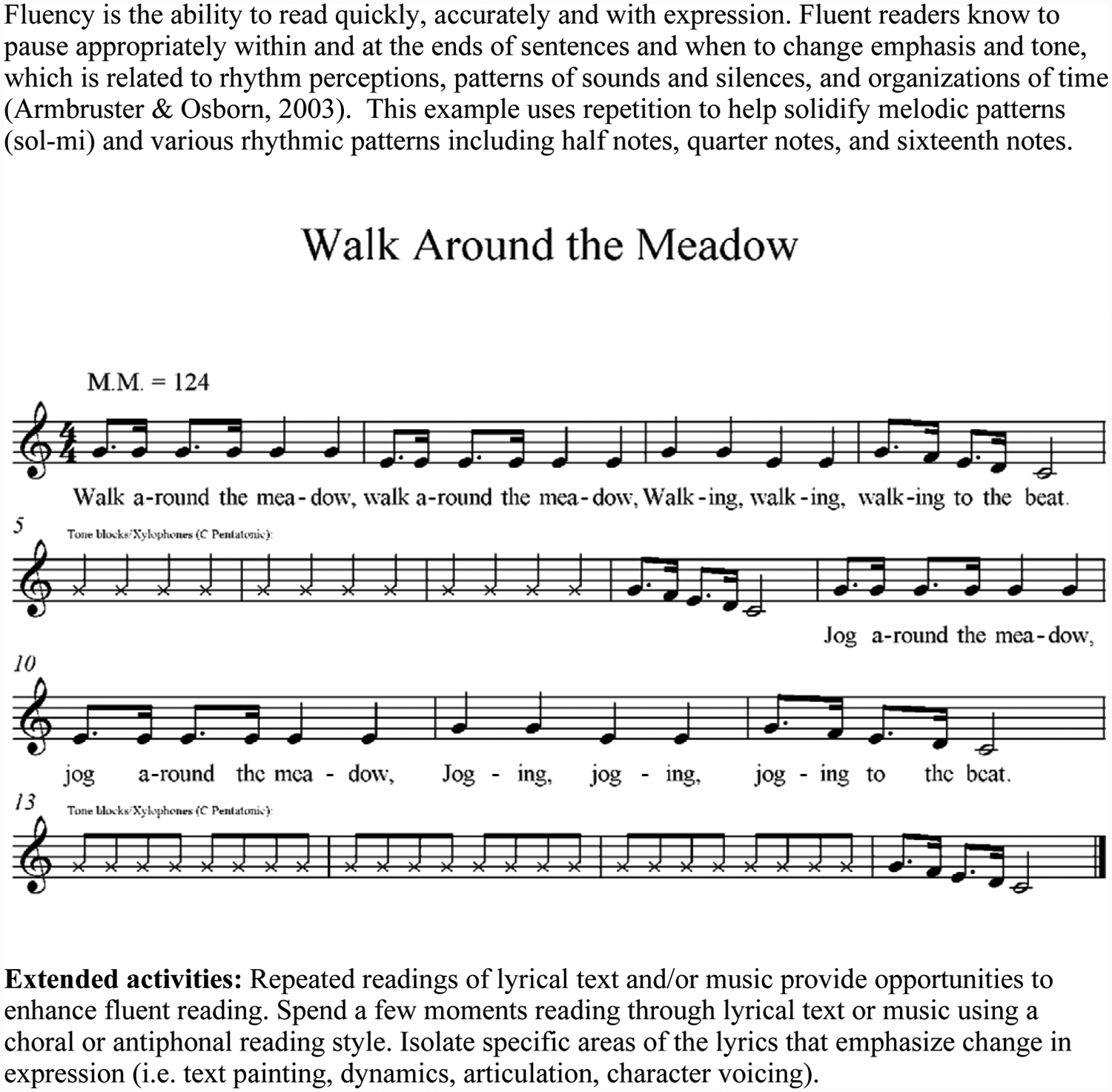
Fluency music activity sample
Vocabulary
In both music and reading, vocabulary refers to the words or symbols required to communicate effectively both orally and in written form (Ambruster & Osborn, 2003). For proper execution, one must have an understanding of the definition, meaning, and function of the specific vocabulary words (Curtis, 2007). In reading, the reader uses vocabulary words and context clues to effectively comprehend and/or execute the author’s intention accurately (Hahn, 1987); likewise, in music, vocabulary words/symbols are embedded within compositions that the musician must understand within musical context clues to effectively execute the composer’s intention. In the music classroom, students develop a repertoire of vocabulary words that assists them in describing and interpreting music based on their perception and perspective as shown in Figure 4.
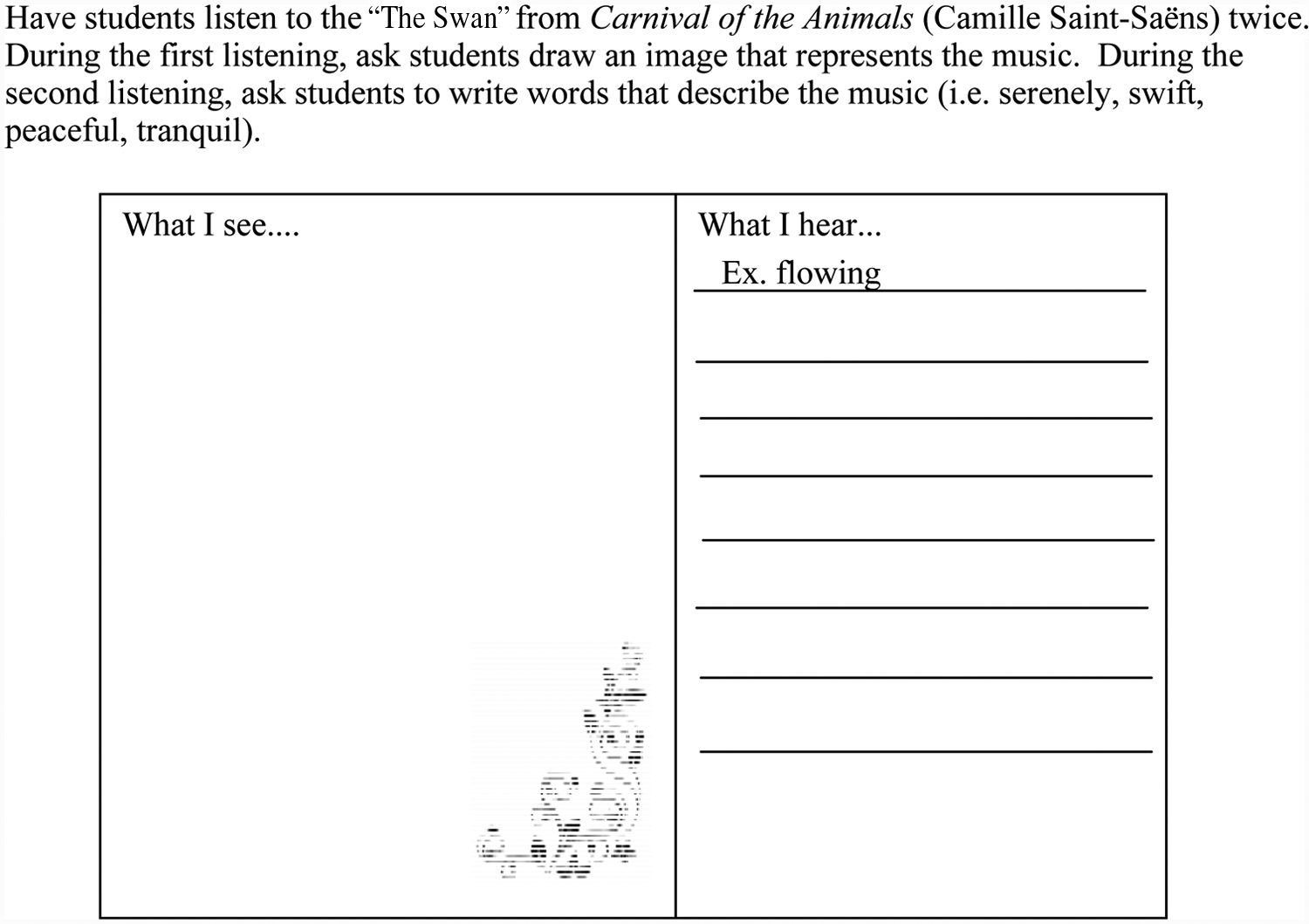
Vocabulary music activity sample
Comprehension
For both music and reading, comprehension is the ability to understand, remember, and communicate with others about what is read or performed. It is important not to confuse fluency and comprehension. Fluency in music may indicate a skilled musician, however, it may not indicate that comprehension or musical understanding has occurred (Gromko, 2004; Hayward & Gromko, 2009). The National Reading Panel (2000) found that [reading] comprehension is dependent on “active and thoughtful interaction between the text and the reader” (p. 4-11) where the reader employs a conscious set of steps to make meaning of text (Armbruster & Osborn, 2003). Music teachers often employ comprehension strategies when introducing technical, emotional, and historical aspects of a musical piece (Eisner, 2001; Gromko, 2004). Eisner (2001) asserts that music scores are filled with ambiguity in which the reader must use constructive devices to make meaning of the music. Gordon (1999) also addresses comprehension when he discusses the concept of audiation.
When you listen to music, you aurally perceive sound . . . Sound becomes music only through audition, when, as language, you translate the sounds in your mind to give them context [meaning]. (p. 42)
In 1986, Raphel developed the question–answer relationships (QARs) reading comprehension technique in efforts to promote deeper understanding when reading text. QARs use four levels of questions to explore written text that requires students to examine concrete answers provided “from the text” in addition to abstract answers developed “in their head” (metacognition). Music teachers can use this model to develop deeper understanding of music lyrics, concepts, and elements as in Figure 5.
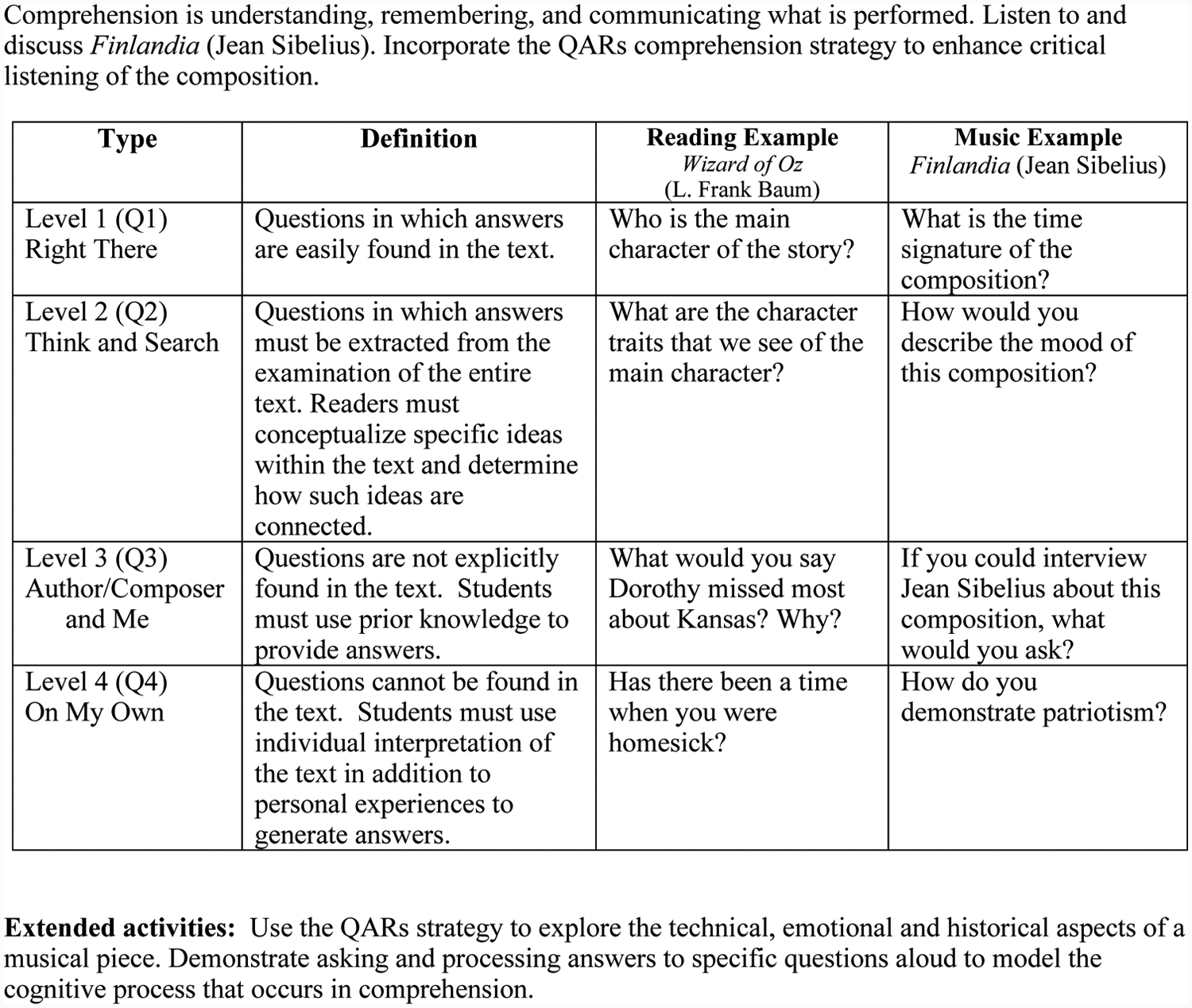
Comprehension music strategy sample
Conclusion
There are several inherently similar characteristics shared between music and reading, and such commonalities may provide opportunities for extended learning in the music classroom. Both subjects employ listening, rhythm, communication, creating, thinking, expression and memorization, vocabulary, audiovisual characteristics, and perceptions (McIntire, 2007). Music enriches the vocabulary, articulation, and pronunciation, and it can assist in enhancing other reading skills such as left to right progression, phrase reading, and rhythmic eye movement (Diamantes, Young, & McBee, 2002).
As federal mandates require music educators to participate more in reading instruction, it is important that music teachers are equipped with terminology, content, and teaching processes specific to reading and language arts (Hall, 2010). The examples in this article merely provide ways to support reading content that are inherently embedded in a well-structured music lesson. It is important to emphasize that the intent of this article is not to suggest that music teachers should become reading teachers, but music teachers can teach music effectively, and when appropriate, highlight or support reading elements within the context of the music lesson. As Barrett (2001) suggests,
when connections between music and another discipline are valid the bonds between the disciplines are organic; that is, they make sense without forcing a fit or stretching a point. Valid connections carry meaning across the boundaries of subject areas. (p. 28)
In essence, music teachers should not search outside of music to support reading, but look for the inherent connections within music that are naturally there. In doing, music educators will maintain the integrity of teaching music.
Footnotes
Declaration of Conflicting Interests
The author(s) declared no potential conflicts of interest with respect to the research, authorship, and/or publication of this article.
Funding
The author(s) received no financial support for the research, authorship, and/or publication of this article.