




Abstract
The excitement of playing an instrument is one of the greatest motivating forces in teaching general music to students. The autoharp, which may be long forgotten in the general music classrooms of the 21st century, is an ideal instrument to “re-introduce” to students. The teaching of a traditional folk instrument provides advantages for connecting students with music and fostering performance-based music making. The author explores beginning instruction of the autoharp for general music, emphasizing the simplicity of use and the benefits of immediate success. The connection to American culture and folk song repertoire is advocated in addition to recommendations for purchase, care, and tuning of the instrument specifically for student use. Teaching strategies are given, including references to the standards and informal, formal, and peer assessments. A recommended resource list comprising online references, instruction books, and beginning folk song repertoire is included, with a listing of suggested two- and three-chord songs.
“The autoharp? Does anyone still teach with the autoharp in general music?” The autoharp, which may have been long forgotten in the general music classrooms of the 21st century, is an ideal instrument to “reintroduce” to students. In a technology-driven world, the teaching of a traditional folk instrument can provide advantages for connecting students with music and a positive way to foster individual and performance-based music-making in the classroom. The natural simplicity and ease of playing offers young players success on their first experiences with the autoharp—providing a “hook” that can entice students. This positive success becomes greater as instruction continues and students become confident performers.
Why Teach with Autoharps?
The excitement of playing an instrument is a motivating force in teaching general music to students. “For many children, instruments are the tangible symbols of music and instrumentalists rather than singers constitute the ‘real musicians’” (Campbell, 2010, p. 241). Most young students enjoy singing, movement activities, dance, and musical lessons in general, but the shouts of happiness are often the highest when students realize that the music lesson for the day includes playing instruments. Whether an unpitched rhythm instrument, bells, xylophones, or the recorder, the act of playing an instrument excites students lesson after lesson. The autoharp is no exception and is an excellent choice for students.
Students of the 21st century have ample opportunities to explore a plethora of musical experiences on a daily basis. Students encounter music through venues barely imagined just a decade previous. Through the rapid changes in technology, students can experience music through iPods, smartphones, tablets, computers, video games, media, television, and more. The acts of practicing, rehearsing, and performing have acquired a new level of competition among these digital avenues in an age where music for the masses has become instant. Music educators know the value and importance of practice, rehearsals, and performances, although students will need a consistent reminder and reinforcement of the importance of these experiences throughout their musical education. The act of engaging students in a motivating, personal music-making process is priceless. “Until children can be engaged in the practice of music making, they are not likely to fully understand the musical structures behind the sound” (Campbell & Scott-Kassner, 2010, p. 219). There is a unique attribute to teaching the discipline of music through the involvement of instruments that grabs a child’s attention, often engaging the most withdrawn or at-risk student.
Because musical instruments are extensions of the musical self, when children play they are often demonstrating what they know and can express musically. To play a musical instrument is to deliver to others ideas that are not easily expressed verbally. (Campbell & Scott-Kassner, 2010, p. 218)
Playing an instrument in general music class can be highly motivating to students and allows them to excel in a way other than singing, participating in discussions, or completing musical assignments. It becomes personal, as students take ownership of their new endeavor and success.
The Autoharp
Charles F. Zimmerman, who patented the idea for the autoharp in 1871, is credited with popularizing the autoharp as an instrument in the United States, although Karl August Gütter also patented a similar-style instrument in 1883 (Stiles, 1991). Autoharps have been used in the United States for performing bluegrass, country, and folk music, perhaps most famously by the Carter family during the second half of the 20th century. As with many stringed instruments, the cost of an autoharp can vary greatly, but the average cost of an autoharp, suitable for classroom (and adult) use, may range between $250 and $350, depending on models and manufacturers.
Thought of by many as a dated instrument from general music of long ago, the modern autoharp is available in 15- or 21-chord models and has also been called a “chorded zither.” The autoharp is a stringed instrument with a series of chord bars on one end, with 35 to 37 strings (depending on the model) stretched across a wooden body. A chord bar, when pressed, applies pressure to dampers, which mute all the strings except those needed for the desired chord. On applying pressure to a chord bar, the player then simply strums across the strings to gain the sound of the chord, alternating between chords as the player desires.
The autoharp is played by many (and usually beginners) by placing it across the lap or on a table, although younger students may be more comfortable placing it on a carpeted floor for playing. Applying pressure to chord bars with the left hand, the right hand crosses over the left to strum across the strings using a flat pick. The autoharp is often used as an accompanying instrument, performing chords with melodies sung or played on other instruments, as traditionally taught in general music classes. Modern or advanced players of autoharp perform melodies using a flat pick or finger picks in addition to open-chording techniques or chord combinations. This creates a fuller sound, while the instrument becomes more melodic, intertwined with accompaniment. More- skilled performers may choose to hold the autoharp in an upright position, cradling the left arm around the instrument with left-hand chord bar pressure, while the right hand performs a combination of strumming, picking, and plucking various combinations of strings.
The Autoharp—In the Classroom
Although more recent literature in music education does not suggest a wide usage of the autoharp in the 21st-century general music classroom, the autoharp has been a “staple” of the general music classroom and the curriculum for decades. The autoharp has been used by elementary general music teachers in the classroom for accompanying singing beginning in the 1950s, although it was also used by classroom (nonmusic) teachers. An article from a 1960 issue of the Music Educators Journal cites Margaret Cleator, a second-grade classroom teacher at Hoover School in Yakima, Washington, referencing her personal experiences with the autoharp in her classroom. “Making use of the autoharp in my classroom for the first time this term has provided one of the most worthwhile and rewarding experiences, musically, that I have had with children” (Cleator, 1960, p. 102). She states the autoharp was included as a daily part of her instruction, which she would use to accompany singing, often with students taking turns accompanying. The values gained from her student experiences included attributes beyond just musical value—helping build confidence, independence, perseverance, characteristics of sharing and thoughtfulness of others and as a soothing quality for emotionally disturbed students. Cleator concludes the article by stating the autoharp “has added spark to our music program—it has given me more security in my teaching of music” (p. 104).
Hultin (1973) references the use of autoharps in the classroom to accompany group singing and as an ensemble, suggesting an orchestral effect. Hultin recommends that groups of students (e.g., an autoharp ensemble) play with recordings from a varied repertoire including early jazz to the classics. Hultin suggests teaching strategies including the mastering of basic chord progressions, the combining of chords by multiple players, color-coding visual charts for visual rehearsing, and adding percussion instruments.
The autoharp fell out of favor with many music teachers in the years following, although reasons are not clear through reading and research. Perhaps it was the passing of time and the many new teaching strategies and resources available for music teachers that have become more popular during the past 30 years. During the 1980s, the autoharp began to come into its own in the world of folk music, as folk musicians began to explore new techniques of playing, as opposed to the simplicity of chord buttons and simple strumming for beginning musicians (Bristol, 1983). There is a lack of referenced research for the use of autoharps in the music classroom during this time period, although many music classrooms still have autoharps in their storage rooms from their more popular days.
In a study of classroom instrument preferences among younger students, Killian and Basinger (2004) revealed that students between the ages of 4 and 9 years (N = 22) most frequently chose the autoharp to play, when given the choice of six specified instruments over a 5-minute time of free-play environment. The choice of the autoharp by students was more popular than the playing of the drum. The authors suggest, “Professionals working with young children may find this information useful in helping find the most effective instruments and activities to ensure that the learner is quickly engaged in musical exploration” (p. 38). The autoharp continues to be an important aspect of the general music classroom and a recommended instrument for students.
Simple and Fun—Playing the Autoharp with Students
As budget permits, autoharps can be purchased in small quantities (or one at a time) and used with classes of students as numbers allow. For example, students may work with a partner or in small groups of 3 to 4 students with one autoharp, as each student in the group is assigned a different responsibility—then rotating their responsibility every few minutes (player, singer, chord pointer, etc.). Students in groups may also have the responsibility of using an unpitched percussion instrument to accompany a song while another child performs. The autoharp can be used with a variety of age groups, depending on the needs and musical ability of a school population. There are varying factors that will determine age-level appropriateness, of which the music teacher must determine, based on the familiarity of their students. The autoharp can be successful for younger students, although it is recommended for upper elementary students (third, fourth, and fifth grades) and middle school students, with students in fourth and fifth grades building on skills learned from the previous year(s).
As time progresses and budget permits, a new autoharp (or autoharps) could be purchased in following years, building an instrumentarium of autoharps as the years progress. An additional option would include contacting another school in the current district (or surrounding district) whose teacher, supervisor, or principal approves and would be willing to borrow or switch instruments for a short amount of time during the school year. For example, a school with a set of autoharps could exchange their set with another school or district for a set of another type of instruments such as xylophones, guitars, recorders, dulcimers, for a quarter (or selected weeks) of the school year. As with many general music programs, groups of instruments are often used for a short portion of the school year, thus sitting on the shelf unused for the remaining part of the school year.
On introduction of the instrument to students, a thorough demonstration and understanding of the instrument should occur, including a short history of the instrument. Students should have an understanding of the autoharp and its connection to American culture—which may also influence the choice of many of the songs they will learn to accompany and sing (but not limit the variety of repertoire which could be played). Also, the music teacher should explain and demonstrate the difference between melody and accompaniment. Students will need a clear understanding of these two concepts, since many general music students have musical experiences primarily centered on concepts involving melody. Teaching chords and the concept of accompaniment may require a lesson prior to the introduction of the autoharp. It may be helpful to provide video examples from Internet sources to demonstrate the playing of the autoharp and to gain a foundational knowledge of the instrument, which many may be unfamiliar.
After a clear explanation and demonstration, students will be anxious to “get their hands” on an instrument and start strumming—which they most definitely should experience on the first day of autoharp instruction. Before students are assigned to a group and place their hands on an instrument, it is suggested they take a few minutes to experience the autoharp through a laminated picture of the instrument. The first two chords they will learn from their beginning song can be highlighted for easier explanation. As the teacher models, students place two fingers of their left hand on the indicated chord bars and use their right hand to cross over their left and “pretend” to strum across the strings. This is a valuable teaching activity as the teacher can assess the correct placement of each hand and be sure students understand the crossed arm position. The music teacher plays the song (which will also be the student’s first song) on the demonstration autoharp, while students sing and strum along on their laminated copies, changing chord bars at the correct time—teacher assistance as needed. For example, the teacher begins instruction using the song, “Skip to My Lou,” containing the F and C7 chords. The teacher demonstrates the location of the two chords on the laminated cards (F and C7 are highlighted) and strums across the strings. A visual is displayed on the board (see Figure 1), indicating the succession of chords in the song, noting the pattern and the change in the last phrase. Students can explore the chords, refer to the visual, and practice on their own. Students are then prepared to experience playing the actual autoharp—they move to small groups, directions are reviewed for care and handling, and the students are playing their first song—on their first day with autoharps—awesome! See Figures 1–4.
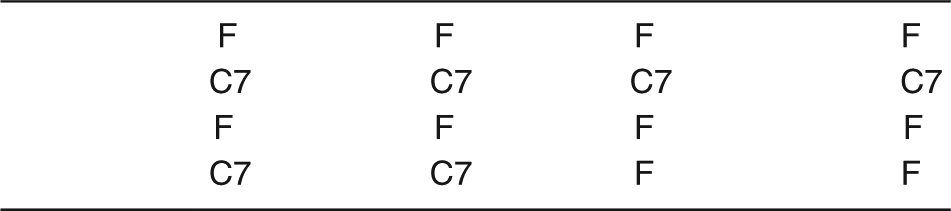
Chord visual to “Skip to My Lou.”

Fifth-grade student practices playing a song on the autoharp.
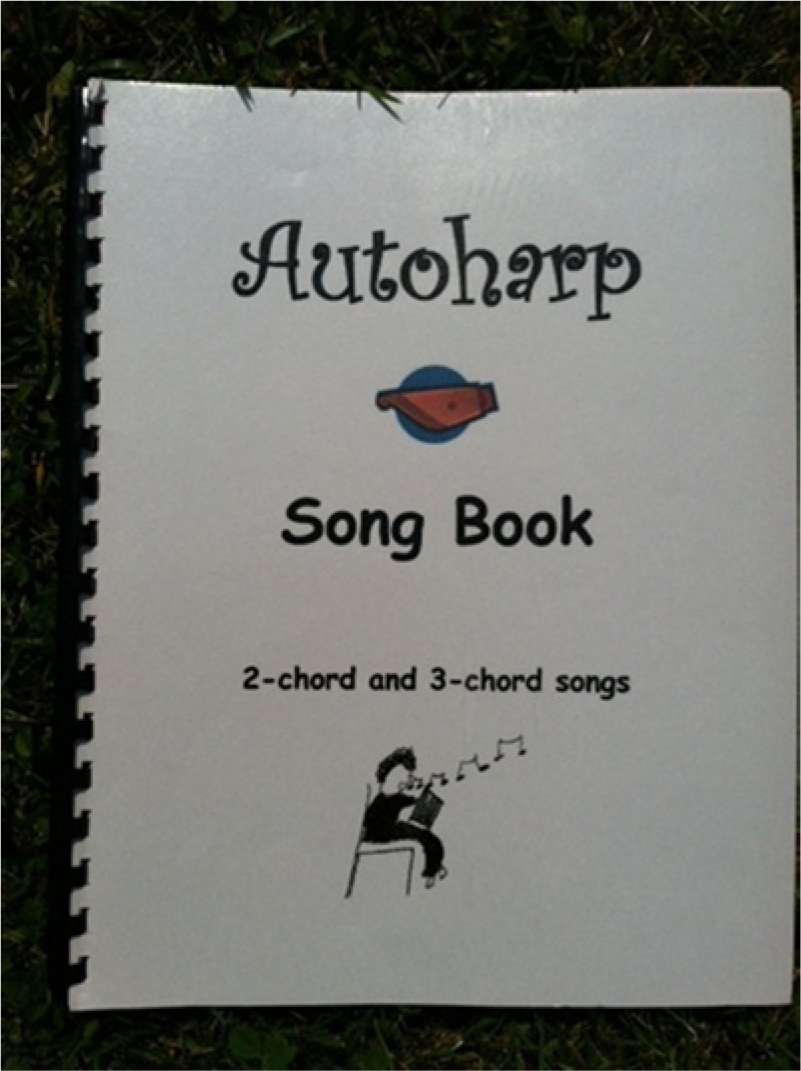
Autoharp songbook example.
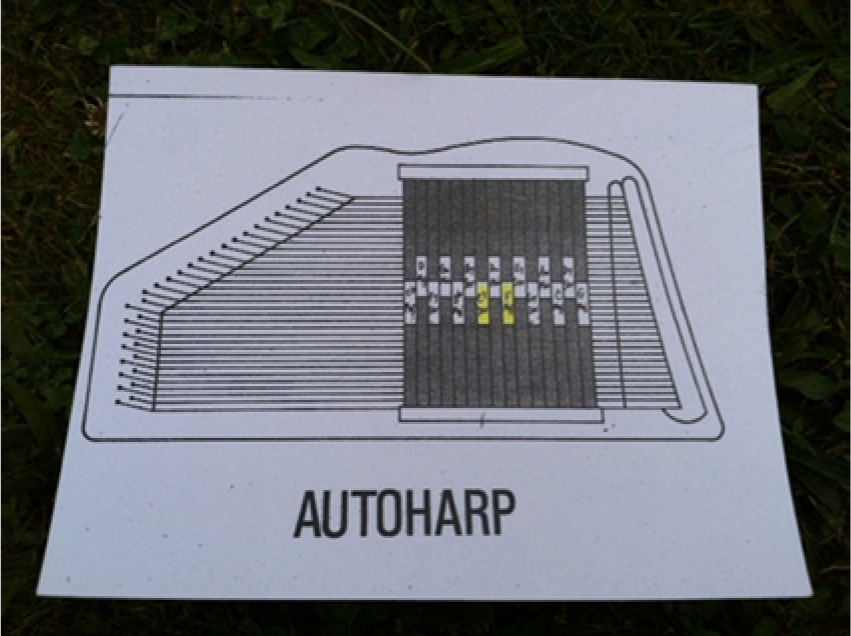
Laminated copy of autoharp picture, with beginning chords highlighted for student use.
Assessing With Autoharps
Teaching lessons through the use of the autoharp provides ample opportunities for assessment with students. The music teacher may choose informal assessments throughout the progression of lessons, with more formal assessment at the culmination of the lessons or unit. Informal assessments are used to inform instruction and are content and performance driven, as opposed to formal assessments, which usually refer to a standard measure such as a test. Informal assessment may include verbal comments from the teacher and/or peers about student playing, asking questions concerning technique, choice of song, or providing feedback while students are performing with a partner or in small groups. Informal assessment may include the teacher viewing group practice of assignments as students have weekly practice time during music class. The music teacher may accompany the autoharp players with piano or another instrument with chords or melody as everyone is included in singing. Informal assessment may include peer grading—where students work in small groups with a predetermined grading worksheet to complete as each member of a group practices/performs the assignment for the lesson that day. Informal peer assessment can provide immediate verbal or written feedback for students and a valuable perspective for students, seen differently from the response of a teacher.
Formal assessment on the autoharp may include a culminating performance of a selected song or section of a song, including structured scoring such as a rubric, where the student clearly understands the objective and required elements for the grade received. Formal assessment can take place individually, where students perform a song for the teacher or with partners or small groups of performers. Formal assessment may include more structured assignments that require students to practice over successive lessons or class time, allowing for growth in their performing skills.
A key component of student motivation of playing the autoharp includes the selection of songs and allowing students to have a decision in part of the assessment process. A preselected collection of songs for autoharp is played by students throughout successive lessons, centering on skills to be mastered, selected by the teacher, such as two-chord or three-chord songs or songs containing specific chords (see list of recommended songs). After assigned songs and lessons are completed, students may be given the final assessment choice of selecting a song to perform (from the selection provided during lessons) of which they feel most comfortable and confident.
Involving students in their assessment, whether formal or informal, is key to motivating students and their continuance and determination to become better musicians. It also provides students of varying learning and performance levels a broad selection of song difficulty. Some students may require a teacher “reminder” for choosing a song for final assessment that may need to be more challenging, whereas others may need assistance by the teacher (or peers) with a more beginning level of song difficulty. Teaching general music in the 21st-century general music classroom can be challenging as students of multiple learning and performance levels are included in class assignments. Varying the choices in formal and informal assessment assists the general music teacher in providing differentiated instruction to meet the needs of all students in the classroom.
Tuning, the Standards, and More
The autoharp is one of few diatonic instruments that with very little initial instruction can be played successfully during first attempts—a great choice for use with general music students, many with minimal musical experiences. Tuning an autoharp may seem like an undertaking at first glance—due to the amount of strings—but it only appears intimidating. Generally, a quality autoharp, on proper care, will only have a few strings out of tune at the same time. A chromatic tuner is recommended for use while tuning, although a piano or other instrument with a fixed, accurate pitch can also be used to match pitch. The autoharp, on purchase, should include a tuning wrench, which when applied allows each pin to gently tighten or loosen each string, as needed. When an autoharp is new, it requires more frequent tuning. As the wooden body and strings settle into their permanent position, tuning should become less frequent. When presenting and demonstrating the autoharp to students, the teacher may elect to include a discussion and demonstration of the aspects and importance of tuning. Students may then be more apt to help maintain accurate tuning by their own use and care while playing the instrument.
The National Standards for Music Education include Standard 2, “Performing on instruments, alone and with others, a varied repertoire of music” (Consortium of National Arts Education Associations, 1994; NAfME, 1974). Just as playing the autoharp clearly fulfills this standard, several National Standards are also met with a unit of instruction using autoharp, including “Singing alone and with others”; “Reading and notating music”; “Listening to, analyzing, and describing music”; “Evaluating music and music performances”; “Understanding relationships between music, the other arts, and other disciplines outside the arts”; and “Understanding music in relation to history and culture” (Consortium of National Arts Education Associations, 1994; NAfME, 1974). If the music teacher chooses autoharp instruction including the use of student composition or arranging songs, the National Standard on “Composing and arranging music within specified guidelines” would also be met (Consortium of National Arts Education Associations, 1994; NAfME, 1974).
The Importance of Song Selection and Performance
As with instruction on any instrument, a music teacher selects songs that are appropriate for students including content, difficulty, and style. The autoharp, due to its cultural connection to American history and tradition, is an excellent opportunity for teachers of general music to correlate lessons with the rich history of song literature of American heritage. Many students of the 21st century have become less familiar with American folk songs and songs of American cultural heritage and more familiar with the latest pop culture and music of the day. It has (unofficially) become the added responsibility of the general music teacher to teach and instill the importance of these songs, as many children who once came to school knowing many of them are no longer familiar with them. American folk songs and songs of cultural heritage are examples of song repertoire that are easily learned and sung—excellent choices for chordal accompaniment on autoharp. These songs, which may often now be absent from the repertoire of many 21st-century students, can be experienced in a new, motivating way, while making a strong connection to history and culture. Song repertoire for autoharp may include the choice of literature of varying genres and cultures, as the population or needs of individual general music students and classes determine.
Students in general music enjoy the opportunity to perform. They are proud and eager to demonstrate their newly acquired musical skills to all who will listen. Often, students in general music miss the opportunity to perform on stage for a live audience, as members of the band, orchestra, or chorus are often provided during the school year. General music teachers must remember: Music is a performing art and students of general music class deserve the experience of performance as well. Performances can include a stage and a live audience but more often may include performance opportunities within the classroom setting among peers with partners, in small groups, or for classmates. As time and schedules allow, general music students may also have the opportunity to perform within the school day—for students in younger grades, during morning announcements, lunch shifts, or school assemblies or as a “piggyback” to an already-scheduled event. This is an excellent opportunity, as a general music teacher may not have enough interested students to perform an entire concert by itself but could easily provide music for a school-sponsored annual event such as reading night, fundraiser, art show, technology night, or a PTA-sponsored activity. The teacher may also invite autoharp players from general music class to perform as an “opener” or “closer” to an instrumental or choral concert or provide music in the lobby of the school before a concert begins, welcoming attendees. Performance opportunities for general music students can be intentional and creative, involving an entire class, selected students, or volunteers. As all music teachers know, the rewards for students who experience performance are great—an opportunity that general music students should be given. Unless students are involved in instrumental or choral music, students who grow beyond their years of general music class often end their experiences and opportunities to perform. For many students, general music is the only experience they may have with a performing art and the learning and performing experience of playing an instrument.
The Future
The history of the autoharp spans over 100 years. It began as a 19th-century instrument for parlor room entertainment, transformed into a folk instrument from the mountains, developed into a popular instrument for classrooms, and became an instrument for serious, accomplished musicians. The role of the autoharp has been as wide and varied as its players and performers. It is exciting to imagine where it will continue to take its players in the future. Younger students can push a chord button and strum, older students can adapt it for more popular songs, and adults and professionals can impress with performances of melodies and accompaniments. The autoharp is a versatile, adaptive, and valuable instrument of choice for everyone, and the general music classroom is an excellent opportunity for students to begin to explore the possibilities.
Footnotes
Declaration of Conflicting Interests
The author(s) declared no potential conflicts of interest with respect to the research, authorship, and/or publication of this article.
Funding
The author(s) received no financial support for the research, authorship, and/or publication of this article.
Autoharp Resources: Internet Sites
Autoharp Resources: Instruction Books
Beginning Autoharp Instruction Book (Alfred) You Can Teach Yourself Autoharp (Mel Bay) Complete Method for Autoharp (Mel Bay) Autoharp Method in Four Easy Steps (Mel Bay)
Suggested Songs for Getting Started
The choice of song is limitless. The songs listed below are suggested as a starting point for students, limited to two and three chords for beginner success, taken from the many songs of American folk and cultural song heritage.
Two-Chord Songs*
Skip to My Lou (F–C7) Old Joe Clark (F–C7) Shoo, Fly (F–C7) Hot Cross Buns (G–D7) Kookaburra (D–G) Oh, My Darling (F–C7)
Three-Chord Songs*
This Land Is Your Land (C–G–D7) You Are My Sunshine (F–Bb–C) When the Saints Go Marching In (G–D7–C) Oh! Susanna (F–C–Bb) Jingle Bells (G–C–D7) Red River Valley (G–D7–C)
*Chords may vary on selected arrangements of songs.