




Abstract
Students come to the music classroom with different educational readiness, learning styles, abilities, and preferences. In addition to these learner differences, classrooms in the United States are becoming more linguistically and culturally diverse each year. Differentiated instruction is an approach to teaching and learning that allows for these individual differences. Differentiated instruction involves working with groups of students and individualizing the curriculum for those within the group. It shares many of the Universal Design for Learning goals for teaching and promoting student learning, with both initiatives established to embrace student differences and ensure that students have every opportunity to learn in ways that best suit their individual needs.
Successful interdisciplinary communication requires that stakeholders have not only knowledge of their own disciplines but a clear understanding of their colleagues’ disciplines as well. Music educators who work with students receiving special education services will find special educators one of their closest allies. Consequently, it is important for music educators to understand concepts and initiatives in the field of special education, as well as to know and use the associated appropriate terminology when communicating with IEP (Individualized Education Program) team members, parents, and school administrators. A shared core vocabulary is helpful in establishing a common framework through which music educators and special educators can best meet the needs of students with disabilities. Being able to converse about current topics in special education also demonstrates professional awareness, an understanding of recent developments in the field, and a willingness to work collaboratively with other professionals (Adamek, Darrow, & Jellison, in press).
A number of initiatives in special education have occurred over the past 15 years, with some being mandated by amendments to the Individuals With Disabilities Act (IDEA, 2011). Having working knowledge of these current perspectives in special education is necessary for music educators to have informed discussions with colleagues and to participate more fully in IEP meetings. Some initiatives in special education, or certain elements of initiatives, may already be a part of music education practices, though terms may be identified by different names. Knowing what elements of special education and music education practices are shared allows for more consistent and coordinated efforts on behalf of students with disabilities. Following is a brief introduction to Differentiated Instruction (DI) for music educators who teach students with disabilities, and who would like a basic understanding of this important special education initiative.
Differentiated Instruction
Students come to the music classroom with different educational readiness, learning styles, abilities, and preferences. In addition to these learner differences, classrooms in the United States are becoming more linguistically and culturally diverse each year. DI is an approach to teaching and learning that allows for these individual differences. Thousand, Villa, and Nevin (2007, p. 9) define DI as “a process where educators vary the learning activities, content demands, modes of assessment, and the classroom environment to meet the needs and to support the growth of each child.” Various accommodations and adaptations are also included as a part of the instructional process.
Working with individual students is not the same as DI. DI involves working with groups of students and individualizing the curriculum for those within the group. It shares many of the Universal Design for Learning (UDL) goals for teaching and promoting student learning, with both initiatives established to embrace student differences and ensure that students have every opportunity to learn in ways that best suit their individual needs. Both UDL and DI include built-in supports for students and suggest scaffolding instruction. However, DI differs from UDL in how and when instructional adjustments are made for students. DI makes use of formative assessments with accompanying adjustments in the curriculum. Although DI and UDL share several important principles for learning, the distinguishing feature of DI is less emphasis on proactive instructional design in favor of a formative instructional design based on student learning.
Tomlinson (2001) identified three elements of the curriculum that can be differentiated: content, process, and products. In brief, curriculum content should be aligned with learning goals and objectives, for all students, with its complexity varied based on students’ abilities to comprehend the material. Content delivery is varied, based on groupings that are flexible and fluid, and beneficial to both students and teachers. In DI, formative assessments are a key feature and are used to direct the curriculum. Formative assessments are used to evaluate students’ readiness to learn and acquire knowledge. DI operates under the assumption that not all accommodations for learner differences can be planned proactively. Instruction should be adaptable and variable, depending on the changing needs of the learners.
A layered curriculum is one of the most salient features of DI. Although the focus of the subject matter—the essential concepts—is the same for all students, individual students are learning the curriculum content at different levels of complexity and are expressing what they know at different levels of sophistication. Giangreco, Cloninger, and Iverson (1993) suggested four levels of curriculum design: same, multilevel, curriculum overlapping, and alternative. In the first level, students are taught the same curriculum with only minor changes in the amount to learn or the time to learn it. In the second level, students are involved in the same curriculum with the same goal but have different learning objectives based on subject matter complexity. A musical example might be some students identifying note names on a staff, whereas others are identifying whether the note is on a line or space, and still others are identifying the number of the line or space the note is on. In the third level, students are engaged in the same lessons, but the overall goal for learning the material may be different, such as a social goal versus an academic goal. In the final level, alternative curriculum, students’ goals may be unrelated to those of their peers. The learner goals, objectives, and curriculum content are appropriate alternatives that are more suited to the needs of the individual student. An example might be a student who is involved in a vocational training program whereas peers are given a more traditional academic curriculum. A musical example might be having a choir student who has autism and is nonverbal find information about the composer of the choral piece the choir is working on and then distribute the information to the class. A student with multiple disabilities might be learning to access vocal music on an iPad or a computer.
Teaching multilevel or alternative curricula can be facilitated best through learning centers set up in the music classroom. By using prepared worksheets, programmed iPads, or computer software at classroom learning centers, music educators can allow some students to work independently or to work under the supervision of a paraprofessional or peer tutor. The following story is an excellent example of implementing an alternative curriculum for one student during an orchestra class (Adamek & Darrow, 2010).
A student signed up for high school orchestra. He had always wanted to play a string instrument. When the student came to class, the director was surprised to find that he could not read music but perhaps was even more surprised to find that he could move neither his arms nor legs. The director called a friend, a music therapist, and she sent him information on a client who had used a computer with a mouth stick to compose music. The orchestra director went to work and set up a workstation in one of the practice rooms. The student came to class every day and worked through a music reading program on the computer. After finishing the program, he told the director he would like to learn something about arranging music for strings. The director gave him his college arranging text to read and a number of scores to study. The students then learned to use the notation software Finale using the computer in the practice room. The student, who was, as it turned out, very musical, wrote a beautiful suite for string ensemble. The high school orchestra premiered the suite on their spring concert. At the conclusion of the piece, the orchestra invited the composer to come on stage and be recognized by the audience and his peers. This student was not participating as other students were; nevertheless, he was making a meaningful contribution to the ensemble. His director found a way to use an alternative curriculum such that this student’s talents were not lost.
Another important component of DI is varying the instructional process, which is similar to the UDL principle of providing multiple means of representation. Ways of varying the instructional process is using multiple instructional formats, strategies, environments, as well as varying student and teacher configurations (Thousand et al., 2007). A final important component of DI is varying the expected products or outcomes of learning. Similar to the UDL principle of allowing for multiple and flexible expressions of student learning, this component of DI allows students to choose among options or to design their own method of demonstrating what they know. Having varied methods of learner assessments in the same classroom also necessitates assigning multiple criteria for mastery of the curriculum content. Thousand et al. (2007, p. 189) recommend gathering important student information by using the following template:
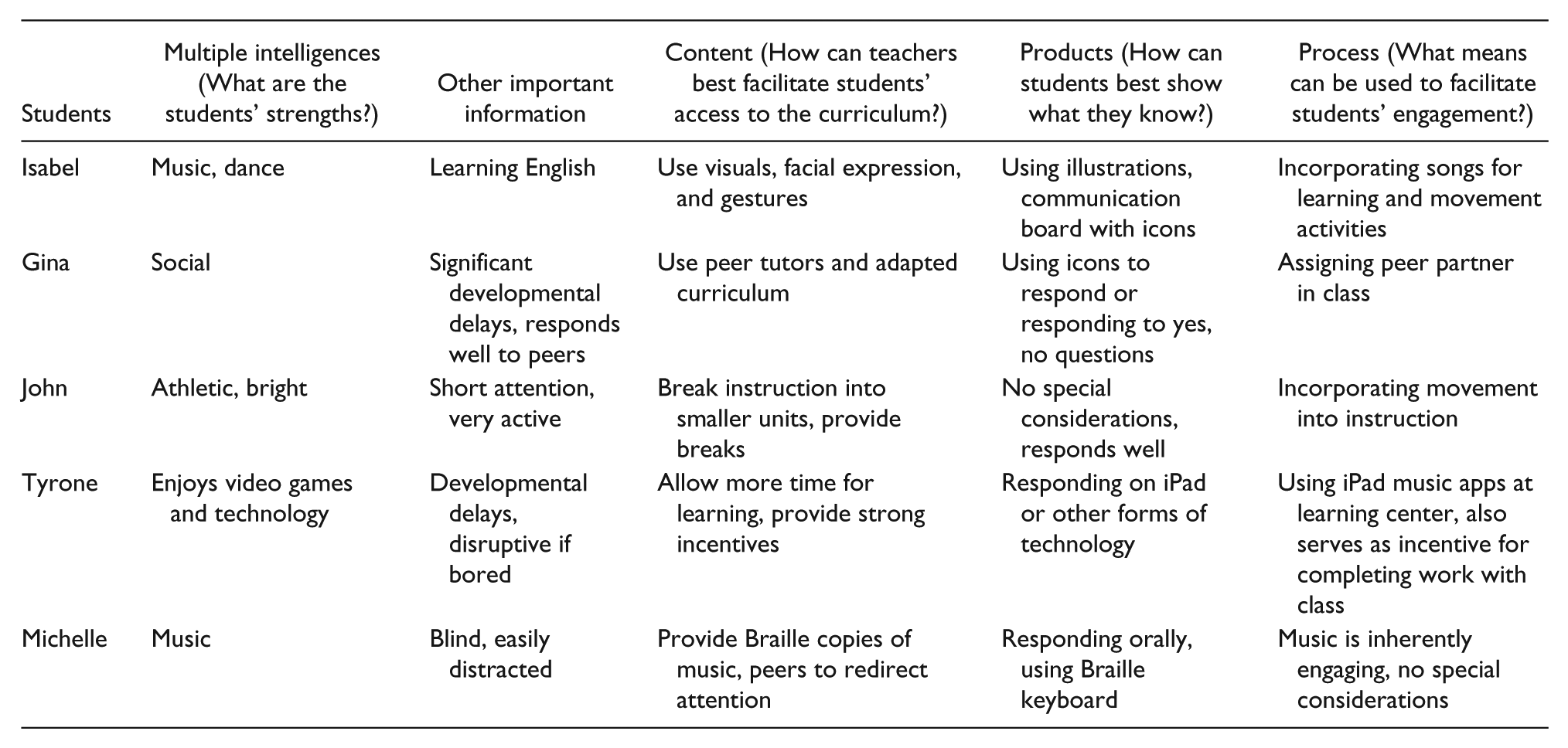
Because DI is based on the outcomes of formative evaluations, music educators need to assess periodically and then rethink the above information in light of students’ learning. Are they making significant progress, some progress, no progress? When revisions in the DI process are needed, collaboration is a likely means to improved instruction. Music educators can consult with students’ classroom or resource teachers, or with the students themselves. Students with disabilities are often quite knowledgeable about their learning styles and eager to share their preferences for responding to instruction. Students who realize teachers are invested in their learning are more open to communicating their needs and often more willing to respond to instruction. Preparing a multilevel curriculum and planning for its implementation are not easily accomplished, and both can be time consuming; however, most educators find their time and effort are well rewarded in terms of student learning.
Conclusions
Rarely do music educators find that instructional initiatives benefit only the students for whom they were designed. All students are better served when instruction is flexible and there are options for learning and responding. Some music educators may already be implementing many of the strategies associated with DI. Nevertheless, their efforts will be more efficient and productive when they can communicate with their special education colleagues using a shared vocabulary. Understanding and employing concepts and initiatives in special education are only a beginning to improved instruction for students with disabilities. Students with disabilities, like all students, require the time and attention of skilled and sensitive music educators.
Footnotes
Declaration of Conflicting Interests
The author(s) declared no potential conflicts of interest with respect to the research, authorship, and/or publication of this article.
Funding
The author(s) received no financial support for the research, authorship, and/or publication of this article.