



Abstract
Integrating curriculum provides rich opportunities for students to focus on relevant applications to the real world and make meaningful connections across different disciplines. This article attempts to go beyond common discourse and platitudes by offering specific examples, showing we—an ethnomusicologist and a mathematics educator—attempted to integrate music and mathematics education curriculum in a graduate mathematics education classroom, with nonmusician graduate students. In our project, we designed and taught a group of graduate mathematics education students a lesson focused on mathematics and world music percussion to explore the ways that nonmusician preservice teachers might experience and use the specific connections between mathematics and music.
In mainstream American society, music and mathematics are both treated as important; connections between music and mathematics are touted so often as to be, by now, cliché. Recently, the National Core Arts Standards (National Coalition for Core Arts Standards, 2014) have identified “Connecting” as one of the four foundational artistic processes for students. The Connecting process is defined as “relating artistic ideas and work with personal meaning and external context.” Within the Connecting process, Anchor Standard 11 calls for students to “relate artistic ideas and works with societal, cultural, and historical context to deepen understanding.” Relatedly, the Standards for Mathematical Practice (Common Core State Standards Initiative, 2010), Mathematical Process Standards (National Council of Teachers of Mathematics, 2000), and Mathe-matical Proficiency Strands (National Research Council, 2001) all promote processes, practices, or dispositions that call for students connecting across content areas and to the real world, seeing mathematics as useful and relevant, and focusing on real-world problems.
These ideas underscore the importance of understanding interrelationships between music and other disciplines, including mathematics. In general education, however, mathematics is treated as more practically important than music, with elementary music programs facing increased scrutiny and cutbacks (Pederson, 2007; Schneider, 2005). At the same time, mainstream American social attitudes tend to treat music and mathematics as similarly complex—indeed difficult—with both fields requiring specialized knowledge, and thus not for everyone. How might integrating the study of music and mathematics strengthen each one? How might this kind of integration approach a reconciliation of the contradictions in mainstream attitudes to music and mathematics?
Our analysis approaches the role of music and mathematics in elementary education from two disciplinary perspectives—ethnomusicology and ethnomathematics. These fields find common ground in the idea that people everywhere “do” music and mathematics in culturally specific and valid ways. In taking the broad view, these fields encourage us to remember that music and mathematics are for everyone, that they are connected, and that they can strengthen one another. If nonmusicians can do music, then, we believe, nonmathematicians can do mathematics. A more practical objective of this research is building skills in both music and mathematics. In music, our lesson addresses counting, rearranging music patterns, understanding time values, and introducing polyrhythms. In math, our lesson addresses fractions, addition, subtraction, multiplication, abstraction, and seeing the application of math “in the world.”
Research suggests that content integration with the arts increases student achievement (Catterall, Dumais, & Hampden-Thompson, 2012; Walker, McFadden, Tabone, & Finkelstein, 2011). An integrated approach can provide more meaningful and cohesive instruction for students (Frykholm & Glasson, 2005; Koirala & Bowman, 2003). According to Rinne, Gregory, Yarmolinskaya, and Hardiman (2011), arts integration involves ways of thinking that have been shown to improve comprehension and long-term memory.
As reflected in recent educational policy, there is increasing interest in interdisciplinary teaching as a powerful means of education reform. One foundational Standard for Mathematical Practice within the Common Core State Standards states, “Mathematically proficient students can apply the mathematics they know to solve problems arising in everyday life, society, and the workplace” (www.corestandards.org). The benefits of interdisciplinarity are many.
1
However, the greatest impact of interdisciplinary learning seems to be in the potential for making connections: across disciplines, between individuals, and with the wider world. As Beane (1991) wrote,
To students, the typical curriculum presents an endless array of facts and skills that are unconnected, fragmented, and disjointed. Like working the jigsaw puzzle without a picture, one can only trust that the pieces do make one, that they do fit together, and that there are just the right number and combination of pieces. (p. 9)
Research studying brain function has found that the brain seeks patterns and resists information that may seem meaningless and is presented alone. With a more integrated curriculum, students are better able to make and draw their own connections through experience. They are able to construct the metaphorical pieces of the puzzle and see the big picture. 2
In the following text, we outline our project, some of its results, and its potential for building interdisciplinary music and mathematics collaboration.
The Students
The location of our lesson was Lehman College (City University of New York), a public, Hispanic-serving Institution located in the Bronx, New York. In the spring of 2012, we taught 18 graduate students enrolled in an elementary mathematics methods course, aimed at providing experiences for prospective teachers to explore the ways that children develop an understanding of mathematical illiteracies in family, neighborhood, and school settings. The students come from diverse cultures and backgrounds, mostly African American or Latino. We sought to approach this classroom multiculturalism as an asset in our lesson, since “schools are a place where different cultures, races and ethnicities meet . . . . It is paramount that educators and youth development professionals harness the opportunities that such an environment presents” (Bronx Education Summit, 2012, p. 6).
In a statement directed to music educators in 1994, the National Association for Music Education wrote that “to participate fully in a diverse, global society, students must understand their own historical and cultural heritage and those of others within their communities and beyond” (http://musiced.nafme.org). Seeking to ground the class in students’ lived experiences, we began the lesson with an invitation for students to share their own stories about playing musical instruments and the role of everyday music in their families and communities. Many students talked about the music they experienced in their churches, at cultural events as connected to ethnic holidays, or embedded in their neighborhood. One student’s father was even a professional jazz musician. One student explained the importance of music to her Dominican culture—both here in the United States as well as in the Dominican Republic. Another student shared a regular interaction with local subway performers. While none of the students were musicians, nearly all of them shared the idea that music is very important to them. By thinking about the role of music in their own lives, students took important steps toward making the lesson more connected and relevant to each of them, in particular the idea that music is deeply embedded in many of our lives; music knowledge can be easily accessible, even for students of mathematics education.
Examples
After discussing students’ personal experiences with music, we asked them to think specifically about the connections between music and mathematics. Many thought back to their childhood piano lessons, counting 1–2–3, 1–2–3, and so on, while others raised more sophisticated issues such as patterning in melodic and rhythmic organization. Again, these students were not musicians, and we encouraged them that this fact was not as important, in this case, as an interest in music and a willingness to listen carefully.
Next, we played three examples of percussion music from around the world. The point of integrating world music listening examples was intended to do two things: first, to give a sense of the diversity of percussion music in the world, and second, to reinforce the universality of music and organizational rhythmic approaches in vastly different cultural contexts. Before playing the examples, we distributed a handout, which included listening prompts (e.g., What do you notice about the drumming? How does it make you feel?) but did not include identification of the piece of music. Thus, a final round of questioning asked, Where does this music come from? “Dropping the needle” assignments are common in world music curricula, forcing students to approach often less familiar (or not) music with fresh ears and without preconceived notions about culture or stereotypes about the people involved.
The first example was a commercial recording of gamelan music, the traditional pitched percussion ensemble native to Indonesia. The second was “Jingo Lo Ba,” a West African hand-drumming ensemble piece from the Nigerian drummer Babatunde Olatunji’s iconic album, Drums of Thunder. Finally, the third and last example was a live recording of the drum circle at Zucotti Park in Manhattan from 2011. At that time, protesters had been camped out for weeks in the Wall Street area’s Zucotti Park, as part of the anticapitalist movement known as “Occupy Wall Street,” and a regular part of their activities was improvised music performance, consisting of whatever instruments people had at hand—generally snare drums, hand drums, and horns.
Students’ responses to the music were generally related to density and complexity. Whereas students described the gamelan piece as having space, the Nigerian drumming, on the other hand, was much denser. Both of these, students noted, seemed carefully organized and complex, an impression aided no doubt by the fast pace of these first two recordings. The third example, on the other hand, was much slower; while students described a similarly dense sound overall, they felt that the organization was not as precise and seemed much more haphazard.
Notation
A clear connection between music and mathematics is that each field uses written representations of abstract phenomena (although, to be clear, most musicians across the world learn and perform music as an oral, rather than as a written, practice). Ethnomusicological approaches to music notation fit well with ethnomathematics, in the sense that just as there are culturally specific ways of thinking about mathematics, so too are music notation systems rooted in cultural context. The notation most Americans learn in piano lessons or elementary school music classes is more properly known as Western notation (since it was originally developed by composers of European music). Like any written representation of the abstract, this system has its limitations, and ethnomusicologists sometimes find its use inappropriate in the study of world music.
Pursuant to our objective of student recognition of notation systems in music and math as visual abstractions, and because we assumed that of all notations, students were most likely to be familiar with the Western variety, we decided to introduce a hand-drumming notation that looks unfamiliar to eyes accustomed to Western clefs and staves. The drumming notation is somewhat obscure but not so much that it prevented its publication in a popular magazine article—on the Occupy Wall Street movement.

West African drumming notation (Barshad, 2011).

West African drumming notation in standard Western notation.
The notation uses a series of letters (P–d–G–T–g) aligned with 16 hash marks to indicate the type of right-hand and left-hand stroke to be played by a drummer at a specific moment in time. The letters correspond to the oral tradition of West African hand drumming syllables, given verbally by the teacher to the drum student as an aid in learning new patterns.
Pa (P): right hand open tone
do (d): left hand slap tone
Gun (G): right hand bass tone
Ta (T): left hand open tone
go (g): right hand slap tone
In our class, the graduate students were not given any instruction in the written notation but rather were left to work with a partner to decipher it. In relatively short order, they figured out the basic logic, that is, the letters represented the placement of the hands on certain parts of the drum over 16 evenly spaced moments in time, or beats. Finally, to show the notation in a more familiar form, we also displayed it in standard Western notation.
After a discussion of the different notation systems, the students were invited to perform the rhythm using hand drums (djembes) brought to class for the occasion. We began by reading the notation and reciting the syllables (pa, pa do/gun, gun ta/go do pa do/go ta go do) very quickly, ignoring the written notation and learning the pattern through eye contact and repetition, typical of West African music pedagogy, and students individually performed the rhythm on a drum with the ethnomusicologist. In some ways, this was an ambitious task to undertake with nonmusicians: Playing a hand drum using five different hand positions is not necessarily intuitive for beginners. On the other hand, some of the students did very well, and the level of complexity in this basic West African rhythm proved a good demonstration that a lot of information can be packed into a short music notation. Students also gained insight into an alternative music notation system, one arguably more appropriate than Western notation in the representation of West African–style music pedagogy. In the online supplemental video, observe one student, Damon, as he succeeds in performing the rhythm from above (available from http://gmt.sagepub.com/supplemental).
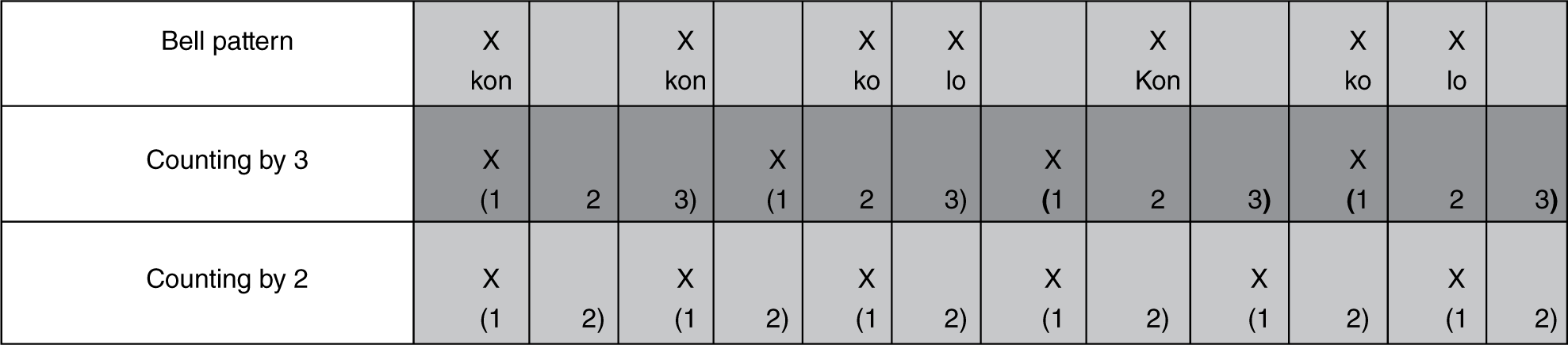
Two-against-three polyrhythm, with bell pattern, in TUBS notation.
Polyrhythm
An important concept for young mathematics students from any cultural background is the understanding that seemingly disconnected numbers can simultaneously inhabit the same space. Three times 4 equals 12, but so does 6 times 2. The musical concept of polyrhythm—meaning more than one rhythmic pattern happening at the same time—is a good illustration of the simultaneous coexistence of seemingly unrelated numbers and patterns. In our lesson, we taught students a typical West African two-against-three polyrhythm to illustrate this idea.
Similar to the hand drumming example above, we chose the polyrhythm example in part for its complexity. For many North Americans, two-against-three polyrhythms sound exceptionally foreign. Many sub-Saharan Africans, on the other hand, are enculturated to understand this pattern from birth. Peoples from different world regions can thus relate to number, pattern, and rhythm in fundamentally different ways. The musicologist Van der Merwe (1992) wrote,
From infancy Africans are trained to hear the six-pulse unit as interchangeably 3 + 3 and 2 + 2 + 2, beginning with the lullabies they hear from their mothers. In some styles there are long stretches of two-against-three rhythm, performed with such a balance of emphasis that it is difficult for the outsider to know which of these patterns qualifies as the beat. (p. 158)
The two-against-three polyrhythm involves the simultaneous division of a six-beat pattern in two different ways: two groups of three beats and three groups of two beats. 3 For our exercise, we divided the class in half, one half clapping and counting “by 3” and the other half clapping and counting “by 2.” In this exercise, students were able to make mathematical connections to the patterns inherent in skip counting and finding common multiples. Students explored the counting “by 2” pattern and the counting “by 3” pattern to discover the common multiples of 2 and 3 or counting “by 6.”
Afterward, each group was given a set of drums, and the ethnomusicologist taught one student to play a “bell pattern,” a cyclical rhythm that alternately aligns with the “by 2” and “by 3” patterns, which increases the polyrhythmic tension. The bell pattern, using the West African drum syllables kon kolo, is twice as long as the 6-beat polyrhythm; therefore, we expanded the pattern to 12 beats. The following example includes a third notation type. While the previous two were hand drumming and Western notations, this is a type known as the Time Unit Box System, or TUBS. Each box indicates an equal unit of time—a single beat—while “X” indicates when an instrument is struck.
Reflections and Homework
Throughout the lesson, the students, all prospective math teachers, made connections between the demonstrated music exercises and examples and their own teaching experiences and lesson plans. For instance, after performing polyrhythms, students immediately made connections to fractions and the least common multiples principle. Additionally, after class, the students were asked to complete a homework assignment in which they responded to a set of reflection questions about their experiences as learners in the integrated lesson. They reflected on what they had learned about music, mathematics, and integrating subjects, as well as how they anticipated on using this experience to plan integrated lessons or units for elementary students. Graduate students identified a variety of ideas about music and its connections with other realms, especially mathematics. Students expressed surprise that mathematics and music “have so much in common.” Noted commonalities included “patterns, shape, symbols, and notation,” as well as the idea that music “uses fractions, parts, and wholes.” “Music is not just sound,” one student wrote, “It is organized, and has length, speed, and intensity. It takes knowledge.” Another student connected music and number directly, writing that “segments and counting are what actually give us music.” Finally, several students wrote that they felt they had much more to learn about music, with one student expressing surprise about this fact considering that “I listen to music on a daily basis.”
The students were then directed to each create a lesson plan that integrated mathematics and music. Students devised a variety of lesson plans, demonstrating a range of integration methods. A basic lesson that several preservice teachers created for younger students included using common songs, such as nursery rhymes, to help students identify and create patterns. For example, one preservice teacher created a lesson plan that engaged first graders with music by having them listen to the song “Baa Baa Black Sheep,” and then to clap, stomp, and snap to the different patterns that they heard in the song. This would be followed by writing out the patterns by using letters to represent the beats. Another lesson example, created for older elementary students, explored the fraction values of notes, linking the values of different musical note durations to their fractional value. The lesson included an introduction to note durations and the value of whole, half, and quarter notes, connecting them to mathematical fractions.
These assignments lend themselves to multicultural integration, from examples using piano instruction melodies to rhythms drawing on world music sources, such as Dominican merengue percussion. Teachers and students can use their own experience to make mathematics and music “come to life” in the classroom. Furthermore, while this group of graduate mathematics education students developed some basic ideas for integrating mathematics and music lesson plans, a main goal of this article is to suggest that this type of lesson is ideally suited for interdisciplinary collaboration: mathematics teachers should collaborate with music teachers, each drawing on the other’s expertise to strengthen student learning experiences—as well as the teaching experiences and opportunities for growth for educators. Good examples of this type of collaboration can be found in the pages of this journal, in the rhythm worksheet examples shared by S. Jones and Pearson (2013) in their article on integrating math concepts in the general music classroom.
Conclusions
By way of a conclusion, we offer not final answers but rather a step toward interdisciplinary collaboration, aiming at (1) strengthening mathematics education through the integration of music/cultural curriculum and (2) showing the importance of music education in the study of other disciplines (in this case, mathematics). Questions for collaborative-minded educators to consider include the following: How does experiencing an integrated lesson influence prospective teachers’ understanding of content and how does one integrate curriculum? What are the necessary components of learning about integrating curriculum that help support transfer to practice? How can students’ own cultural and educational backgrounds be mobilized to engage understanding of mathematics and music as particular sets of enculturated knowledge? We believe that ethnomathematics and ethnomusicology can help answer these questions.
Teachers benefit from interdisciplinarity by furthering their knowledge by learning from other colleagues that may be experts in a certain topic. This allows for greater interaction among teachers. Many schools do not provide ample opportunities for teachers to collaborate or even communicate with each other (Choy et al., 1993; Sandholtz, 2000) even though studies have shown that teachers are more likely to turn to each other for support when problems arise and are more satisfied with their jobs when there are greater chances of interaction among coworkers (Driscoll, 1993; Sandholtz, 1999, 2000). Interdisciplinary teaching also allows teachers to feel more connected with the school, therefore increasing retention rates. Teachers are challenged to learn new methods in teaching their classroom in order to incorporate ideas from two different disciplines, allowing them the opportunity to further their own knowledge outside of strict professional development courses (Crow & Pounder, 2000).
The ideas in this article are aimed at facilitating collaboration of mathematics and music educators, across the spectrum, from preservice to working professionals. Individual educators should, of course, tailor implementation of these ideas to suit their own needs and to fit their strengths; there are likely as many ways to teach these concepts as there are educators. However, we would urge educators to seriously consider the examples offered here and not to be discouraged by seemingly complex topics such as polyrhythms. 4 One need not be a master percussionist to communicate the important cross-cultural mathematical and music awareness embodied in this idea.
Since music is important in students’ cultural backgrounds and everyday lives, students should have opportunities to explore music in a variety of educational contexts. Traditionally, elementary students are exposed to music only in music classes, but our project suggests that this need not be the case. Beyond drumming, other music approaches can be used in the mathematics classroom. For instance, ukulele instruction is becoming more and more widely accepted as a highly accessible instrument, and music educator Philip Tamberino advocates for it in terms of affordability and playability (see Tamberino, 2014); an educator with 10 ukeleles could use them to teach a range of addition, subtraction, counting, and patterning concepts in a mathematics classroom. Performing a simple “12-bar blues” with three chords on ukuleles would provide students an understanding of both cyclical chord progressions in music, as well as the division of a 12-bar cycle into three groups of four. Students could use worksheets (e.g., S. Jones & Pearson, 2013) to write new chord change patterns.
Additionally, the lesson outlined in this article—including listening to drumming from around the world, performing polyrhythms, and exploring alternate music notation systems—can be used to bring world music into the general music classroom. Collaborations between music and math educators can also help teachers fight against the perception (on the part of administration, students, and many more) that music is marginal to overall education goals in the United States.
Integrating curriculum provides opportunities for students to focus on relevant applications to the real world and make meaningful connections within mathematics as well as across different disciplines. Furthermore, students often find school to be a place that does not recognize the cultural knowledge or experiences they bring from their homes or communities. According to Hall (2007), future teachers would benefit from seeing ethnomathematical topics in their courses, allowing students to make connections to culture and develop deeper mathematical understanding. Gay (2002), an advocate of culturally responsive teaching defined as “using the cultural characteristics, experiences, and perspectives of ethnically diverse students as conduits for teaching” (p. 106), posits that connecting content and culture helps build knowledge and meaning for students. The interdisciplinary approaches to music and mathematics education outlined in this article can help reach students from a variety of cultural and educational backgrounds, as well as reinforce the idea that mathematics is not simply abstract but exists in “the real world.” Ethnomathematical and ethnomusicological perspectives are well suited to this kind of collaboration.
Music and mathematics are connected, in ways that are not fully understood, in either academic or mainstream discourse. In this article, we have tried to show that exploring those connections not only is rewarding in itself but also has the potential to make music and mathematics more accessible to students and educators alike.
Footnotes
Declaration of Conflicting Interests
The author(s) declared no potential conflicts of interest with respect to the research, authorship, and/or publication of this article.
Funding
The author(s) disclosed receipt of the following financial support for the research, authorship, and/or publication of this article: U.S. Department of Education Teacher Quality Partnership Grant (Grant/Award No. U405A100103)
