




Abstract
Children’s picture book biographies on composers and musicians can prompt powerful music learning experiences. Biography breaks are the reading aloud of a picture book biography and the questions or activities the teacher engages students in while and after reading the book. In the music classroom, biography breaks can be used with children of all ages to introduce students to composers, musicians, music elements and concepts, music vocabulary, music genres and styles. Biography breaks provide a groundwork for discussing the historical, social, and cultural context of music, as well as a catalyst for engaging students in meaningful music experiences creating, performing, responding to, and connecting with music.
Keywords
As fifth graders crowd into Whitney Smyth’s classroom for music, the unmistakable sounds of Elvis Presley’s “Jailhouse Rock” entice them to dance and sing along. When Mrs. Smyth asks if anyone knows who the musician is, a chorus of student voices call out “Elvis Presley!” The children know “stuff” about Elvis—his looks and style, his flamboyant movement, his fanatic fans—many of whom are now their parents and grandparents. Even these fifth graders, two generations later, recognize his songs.
Mrs. Smyth brings out the book Elvis: The Story of the Rock and Roll King (Christensen, 2015) and begins to share details about Elvis’s life: his upbringing, his struggles, his influences, and his successes. She pauses occasionally to invite the students to respond to her questions.
“What in the book has surprised you so far?” she asks. Answers show the children have been listening: I can’t believe Elvis was teased so much when he was a kid. In our civil rights unit, we learned how people rejected other races. But I didn’t know they rejected other races’ music. I always thought he was famous. I didn’t know he was trying to make different kinds of music.
As Mrs. Smyth closed the book, the children wanted to listen to more Elvis songs. Mrs. Smyth rewarded them with “Hound Dog,” along with the promise to teach them to play it on the ukulele.
The use of picture book biographies can bring about powerful classroom learning. Music teachers can use many of the biographies published recently about musicians and composers to enhance music learning experiences in music classrooms. This article introduces biography breaks, provides a rationale, and suggests ways for using them in elementary music classes. The authors provide instructions on how to select picture book biographies, and address ways biography breaks address the National Arts Standards. The authors also share a number of outstanding picture book biographies from various genres and styles of music (e.g., jazz, Western European, world music, rock, folk, and hip-hop) that may be useful in music classrooms, and continue the music lesson plan based on Elvis Presley’s life and music.
Teaching Music With Biographies
Esmé Raji Codell, a well-known children’s book author and Chicago Public Schools librarian, developed the notion of biography breaks (Young & Bradley, 2011). Codell is well known for her book, Educating Esmé: Diary of a Teacher’s First Year (1999), and her website, Planet Esmé (planetesmé.com). She describes two important aspects to a biography break: reading the picture book biography aloud and asking questions while reading the book (Young & Miner, 2015). Heisey and Kucan (2010) found that students learn more and understand content more deeply when questions are asked during the reading rather than afterward. Typically, the reading and discussion of the biography can be completed in 20 to 30 minutes (Authors, 2011). As time is often limited in music classes, teachers who are hesitant to spend 20 to 30 minutes reading a biography can select a portion of the book to introduce students to composers, musicians, music concepts, music genres, or styles.
Biography breaks provide a meaningful context to study music as students gain insight into the feelings and inspiration music portrays—individuals’ lives as well as their music. Biographies are more engaging than a cursory discussion summarizing events, music genres, or historic time periods. The illustrations in a good picture book biography extend the author’s words and help children understand the societal and cultural context in which the musician lived. Moreover, Wooten and McCuiston (2015) referenced brain research suggesting that “illustrations provide visual entry points that guide students’ imaginations to a better understanding” of the text and topic (p. 35).
Biography breaks can also provide opportunities to address the skills found in the National Music Standards: perform, create, respond, and connect. At various grade levels, students are encouraged to connect music with their own lives, relate music to a broader context, deepen understanding about musicians’ personal and creative choices, and respond personally to music. During biography breaks, students can connect with the musicians portrayed, the historical contexts in which the musicians lived, the choices they made, and the ways they expressed themselves through their art. Thus, students better understand the music elements and ideas, and they strengthen connections to historical people, places, and events.
Many biographies written about musicians portray the individuals’ artistic, personal, and political choices, reacting through music to world events and cultural issues of the time in which they lived. For example, several biographies have been written about jazz musicians—such as Swing Sisters: The Story of the International Sweethearts of Rhythm by Karen Deans (2015), How Jelly Roll Morton Invented Jazz by Jonah Winter (2015), and Benny Goodman and Teddy Wilson: Taking the Stage as the First Black-and-White Jazz Band in History by Lesa Cline-Ransome (2014)—which include information about the genre, the musicians, and the ways that jazz as a music movement reacted to societal and historical conditions. As students study the biographies of these influential musicians in tandem with historical events, they learn of innovative music concepts while refining the way they understand music history and people.
Reading Aloud and Developing a Lesson
Elementary music teachers can incorporate biography breaks to engage readers in various ways and the following are suggestions for incorporating biographies in the music classroom:
Suggestions for Reading Aloud Efficiently
Show the images to the entire class. Position the book so students can see it by using a document camera.
Engage the students with one or two questions while reading.
Scaffold the text before you begin reading by sharing information about the time period and context. It is also important to briefly introduce a few critical vocabulary words prior to reading the book.
Read with expression and gesture to bring the words to life for the students.
When you ask questions, provide a partner share activity and then call on a couple of students to tell what their partners shared. Sharing with a partner gives every child an opportunity to respond, and limiting the full-class sharing saves a great deal of time.
Follow up by listening to related music and making connections, focusing on the music elements, and discussing the decisions that musicians made.
Mrs. Smyth’s lesson on Elvis Presley uses the above suggestions effectively. After engaging her students by reading the book Elvis: The Story of the Rock and Roll King (Christensen, 2015), Mrs. Smyth introduces the song “Hound Dog” by inviting the students to think of two or three adjectives to describe the music they are about to hear. The students are clearly engaged as Mrs. Smyth shows the video of Elvis singing “Hound Dog” on the Ed Sullivan show: Many of the students sing along while others laugh at and mimic his dance moves. When the video ends, Mrs. Smyth goes around the room inviting each student to share the adjectives they came up with to describe the music. The students describe the music as bouncy, fast, loud, dance-like, catchy, repetitive, short, and so on. Mrs. Smyth notes all of their answers on the board and invites them to help her add the names of the instruments that they saw and heard to their list.
After the class listens to Elvis’s “Hound Dog,” Mrs. Smyth explains that “Hound Dog” was written not by Elvis but by songwriters Jerry Leiber and Mike Stoller. “In fact, Elvis was not the first person to record ‘Hound Dog,’’’ says Mrs. Smyth. “It was originally recorded by Willie Mae ‘Big Mama’ Thornton on August 12, 1952, about 4 years before Elvis recorded it.” Mrs. Smyth then asks the students, “What do you remember from the story we read about Elvis regarding what was happening with music during his time?” The students recall the racial segregation in music but explain that Elvis was different: He was inspired by all kinds of music and was trying to write a new kind of music.
Mrs. Smyth explains that they are going to compare and contrast Elvis’s version of “Hound Dog” with Big Mama Thornton’s. She draws a Venn diagram on the board encircling all of the student responses from Elvis’ version of “Hound Dog” on one side, and writes “Big Mama Thornton” at the top of the other circle. As she did with the Elvis version, she invites the students to be prepared to share two to three adjectives to describe Big Mama Thornton singing “Hound Dog” as they watch the next video clip. After listening to the music, the students describe words such as angry, sad, slow, and smooth to describe Big Mama Thornton’s version of “Hound Dog” and point out the similarities and differences in the lyrics of the two renditions and the instruments used.
Selecting a Picture Book Biography
While many picture book biographies featuring musicians and composers are available, not all of them are ideal for biography breaks. The best books for this purpose have limited and accessible text, incorporate music elements and vocabulary, include illustrations that add meaningful details to the text, use engaging language, provide useful back matter, and are authentic nonfiction as opposed to fictionalized biography. A brief discussion describes these criteria and provides sample books that could be used in the elementary classroom.
Limited and Accessible Text
Limited text includes the amount of text per page or per opening/double page spread. Traditionally, picture books are 32 pages; today many consist of 40 to 48 pages. We recommend selecting books in the 32-page range that are accessible to children across the elementary grades. Depending on how the biography is used, limited text facilitates different kinds of learning experiences. Typically, the younger the children, the less text required. For the text to be accessible, the book should incorporate vocabulary the children will understand but also include words that will stretch and expand their knowledge about the subject. Accessible language also implies appropriate subject matter.
Two notable biographies with limited and accessible text are Swing Sisters: The Story of the International Sweethearts of Rhythm by Karen Deans (2015) and Before John Was a Jazz Giant: A Song of John Coltrane by Carole Boston Weatherford (2008). A book that has much more text yet still works well is Ella Fitzgerald: The Tale of a Vocal Virtuosa by Andrea Davis Pinkney (2007); this text is accessible despite its length because the story is very engaging—attracting and holding children’s interest. We recommend that music teachers who are engaging students in longer biographies read only the portion relevant to the music concepts being taught.
Bonnie Christensen’s (2015) Elvis: The Story of the Rock and Roll King works well for biography breaks, as noted in the lesson scenarios. The book is short enough that it could be read during a music class period. However, if the teacher wants to shorten the time required, its simplified time line format with poems makes it easy to select key pages to highlight particular events in Elvis’s life that will support the teacher’s learning objectives without having to read the entire book. Ms. Smyth reads the entire book to her students during the first introduction of the book and then highlights important passages relevant to the music concept or integrated opportunity. Another strategy to provide more time for discussion or for integration of music elements is to read the book over multiple class sessions. Codell recommends that if a teacher chooses to do this, using a cliff hanger as a stopping-starting point helps to keep students engaged (Authors, 2011).
A final recommendation when choosing books with limited and accessible text is a warning about books with topics, contents, or storylines that might be considered inappropriate for elementary-aged children. For example, Gary Golio’s (2012) Spirit Seeker: John Coltrane’s Musical Journey is a very detailed biography of John Coltrane. While it offers a wealth of information about John Coltrane’s tragic life and distinctive music, the text is quite lengthy. Also, the author describes John’s personal and spiritual struggles, including deep religiosity as well as alcohol and drug abuse. While it can be beneficial to discuss difficult topics with students, the teacher will have to determine what material is appropriate for the class, whether parents may object to having these topics discussed in school, and if there is adequate class time to address them sufficiently.
Elements and Vocabulary of Music
The primary purpose of the biography break in music classes is to teach core music elements such as rhythm, melody, harmony, and expression. A biography with music vocabulary will authentically refer to terminology such as largo, forte, syncopation, and so on. Incorporating music elements and vocabulary could also include references to music genres, and time periods. While connecting musicians to music concepts, biography breaks create a space for students to explore the composer’s intent and music decisions. This context makes concepts related to composing and listening to music more meaningful.
The picture book biography Becoming Bach by Tom Leonard (2017) can be used to provide an opportunity to engage students with music vocabulary. Leonard introduces instruments used in the Baroque period including the harpsichord, trumpet, violin, flute, organ, and voice. He also introduces readers to Bach’s use of patterns in creating his music, an idea that can be explored with students as they listen to Bach’s music. Benny Goodman and Teddy Wilson: Taking the Stage as the First Black-and-White Jazz Band in History by Lesa Cline-Ransome (2014) provides percussive onomatopoetic language such as bop and boop, along with music terms like meter that can be used to explore the music element of rhythm. The Music in George’s Head: George Gershwin Creates Rhapsody in Blue by Suzanne Slade (2016) introduces readers to the individual composers, genres, and styles of music that influenced George Gershwin’s most famous work.
Music teachers can use several of today’s biographies to provide opportunities to explore contemporary music such as rap, pop, country, and rock with their students. When the Beat Was Born: DJ Kool Herc and the Creation of Hip Hop by Laban Carrick Hill (2013) can engage older students in a discussion of instruments, equipment, the evolution of hip hop music, along with the context and effects of this style of music and dance. Neri’s Hello, I’m Johnny Cash (2014) is written in verse text that connects Cash’s songs to the stories behind them, providing engaging perspectives for teaching students various aspects of song writing. Neri’s When Paul Met Artie: The Story of Simon & Garfunkel (2018) is also written in verse and describes the childhood friendship of two musicians and their place in the rise of the counterculture folk music scene. Barb Rosenstock provides backgrounds and perspectives in Blue Grass Boy: The Story of Bill Monroe, Father of Bluegrass Music (2018) that explore the challenges Bill endured as part of his music journey and the role that his upbringing in Kentucky had in creating bluegrass.
After comparing and contrasting two versions of the song “Hound Dog,” Mrs. Smyth refers back to the story to see if the students can recall the various types of music Elvis listened to and by which he was inspired. Their responses—“jazz,” “blues,” and “gospel”—enabled her to transition easily: “Those are all correct. Let’s talk more about the blues.” Mrs. Smyth displays the lyrics to “Hound Dog” and invites the class to sing them: You ain’t nothin’ but a hound dog, cryin’ all the time. You ain’t nothin’ but a hound dog, cryin’ all the time. Well, you ain’t never caught a rabbit and you ain’t no friend of mine.
“What do you notice about the lyrics?” Mrs. Smyth asks. “The first two lines repeat” comes the answer. Mrs. Smyth labels the phrases AAB and explains that this is the common form of the 12-bar blues, which is the music form used for the song “Hound Dog.” “Let’s write our own verse of ‘Hound Dog.’ How should we start?” Mrs. Smyth allows the students to create a verse of “Hound Dog” as a class and sing it together.
Effective Illustrations
The illustrations of biographies should add meaningful details, engage attention with the text, and lead the reader from one page to the next. Illustrations do not need to be realistic but should reflect the tone, topic, and historical context of the book. Raul Colon’s stylistic illustrations in Leontyne Price: Voice of a Century by Carol Boston Weatherford (2014) invite readers into the text. Similarly, Theodore Taylor’s stylized illustrations to When the Beat Was Born: DJ Kool Herc and the Creation of Hip Hop (Hill, 2013) support the text by portraying the time, culture, and context in which hip-hop music was born—at a teen party in a South Bronx park with a big brother as a disc jockey. Unrealistic illustrations may provide an individualized view of reality. Dizzy by Jonah Winter (2006) begins with representational pictures and morphs into abstract images that exemplify what music might sound like with colorful shapes, two-dimensional figures, and jazz-like rhythms. Brian Pinkney’s scratchboard illustrations in Ella Fitzgerald: The Tale of a Vocal Virtuosa by Andrea Davis Pinkney (2007) provide a unique perspective to the biography, as characters twist or fly about in imaginative contexts.
After reading Christensen’s (2015) Elvis: The Story of the Rock and Roll King, Ms. Smyth invites the students to look closer at the illustrations in the book to observe, reflect, and question. Ms. Smyth asks her students to observe what they see in the illustrations, specifically identifying people, objects, and locations. Their responses include “train tracks,” “a church,” “people playing guitars,” “people singing.” After multiple responses, Ms. Smyth authentically transitions the discussion by asking students to reflect about what they know about the time period, the music, and Elvis. Throughout the discussion, students make inferences and ask questions about the people, often referring back to the text and their previous social studies lessons about the time period.
Specific to this biography about Elvis, Ms. Smyth and the students talk about several of the illustrations as she invites the students to analyze the illustration of Elvis and compare it to actual photographs (see Figures 1 and 2).

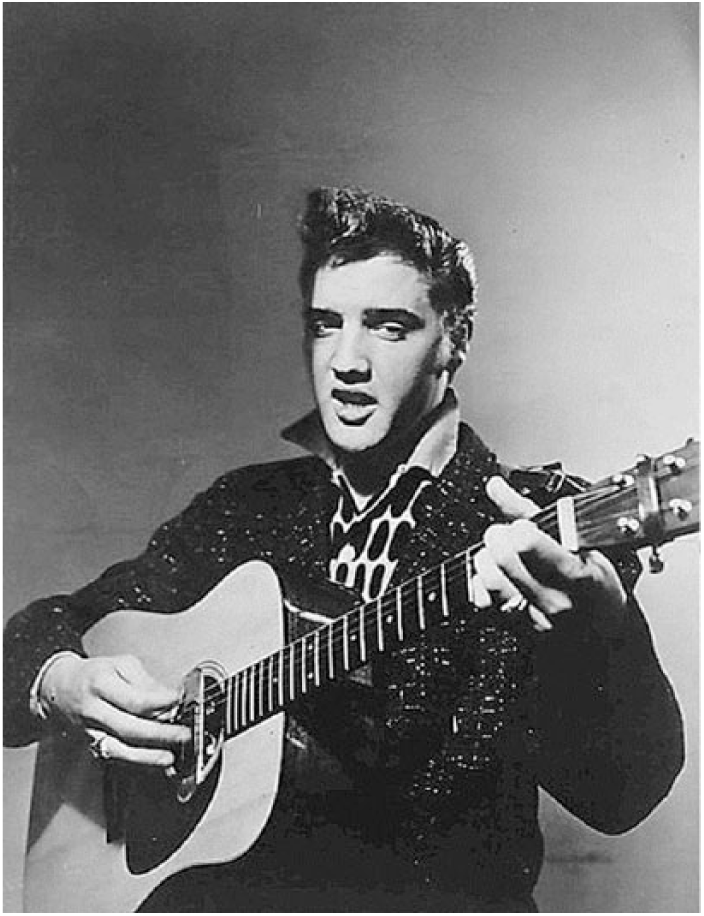
Note. Retrieved from https://commons.wikimedia.org/wiki/File:Elvis_Presley_first_national_television_appearance_1956.jpg. Via Creative Commons.

Engaging Language
According to Neal Porter, picture book biographies “are a very good way to convey information to relatively young children” (as cited in Marcus, 2014, para. 15). However, to offer children more than a list of facts, these biographies must be written in ways that both “challenge and excite young readers” (Marcus, 2014, para. 17). Music biographies need to be written so that children will want to hear more. For example, Leontyne Price: Voice of a Century by Carol Boston Weatherford (2014) brings readers into the story with phrases like “Marian glided on stage in a whoosh of satin” (p. 9). Descriptive, strong verbs in particular create imagery that engages students through sensory involvement. Celia: The Life of Celia Cruz by Monica Brown (2004) introduces readers to Cuban music using words that inspire movement. Brown invites children to “shake, shake, shake” their hips and “clap, clap, clap” their hands. Phrases such as “My voice feels like feet skipping on cool wet sand, like running under a waterfall, like rolling down a hill. My voice climbs and rocks and dips and flips with the sounds of congas beating and trumpets blaring” (p. 1) invite students to engage in the story through her descriptive language. The language Brown uses portrays facets of Cuban music in vivid ways with engaging language. Brown also provides both English and Spanish translations of the story.
Some true biographical works have language as exciting as fictionalized pieces. When Stravinsky Met Nijinsky: Two Artists, Their Ballet, and One Extraordinary Riot by Lauren Stringer (2013) recounts the incredible and unlikely collaboration of two improbable extraordinary personalities/talents and the real riot that occurred on the night their ballet opened. Stringer described the choreographer: When Nijinsky composed dances all by himself, his torso floated—a swan. His legs leaped—a deer! And his feet, like a sparrow, tippy-tip-toed, while his arms curved and swerved like a snake. But he dreamed of making something different and new. (p. 3)
Written by poet Margarita Engle (2015), Drum Dream Girl: How One Girl’s Courage Changed Music incorporates words like “whirh, clack” into rhythmic text. But her style embeds the whirh and clack into vivid metaphors such as the “comforting pat of her own heartbeat,” “the clack of woodpecker beats,” “the rattling beat of towering dancers on stilts.” Duke Ellington: The Piano Prince and His Orchestra by Andrea Davis Pinkney (1998) involves vivid language like “left-handed hops and right-handed slides,” along with cultural language like “fine as pie,” “good looks and flashy threads,” and “Harlem’s swankiest hangout.”
Mrs. Smyth brings her students back to the biography about Elvis and helps them identify the descriptive text. “But music—it was everywhere. Jazz floating between neighborhoods, blues chugging up both sides of the tracks, spirituals and gospel pouring out of churches. Music lifting spirits up” (p. 2). Mrs. Smyth asks the children, “What images come to your mind as your listen to the words?” Several students reply with important connective insights: “It feels like the music is connecting people that are normally separated.” “It feels like the music bridges the two sides of the tracks.” The class then engages in a discussion of how music has the ability to convey meaning beyond the words, and in this case the author also used her words to connect the descriptions to time period.
Additional Back Matter
The back matter (information provided after the main text) often included in biographies can consist of the author’s note, a time line, list of recordings, background information, glossary, and photographs. Back matter provides the music teacher with information to provide historical context and help students make connections, as well as extend students’ learning as they listen to and engage in creative activities with music.
Several biographies provide exceptional back matter. Spirit Seeker by Gary Golio (2012) includes sources and resources, selected discography, and website references, as well as an author’s note discussing music and religion and their interactive influence on Coltrane’s early music. Little Melba and Her Big Trombone (Russell-Brown, 2014) also includes an afterward by the author that extends the information about the Melba Liston, and includes an extensive discography list. Benny Goodman and Teddy Wilson: Taking the Stage as the First Black-and-White Jazz Band in History by Lesa Cline-Ransome (2014) contains a time line that includes important names, dates, and locations in the development of jazz music. Talkin’ Guitar: A Story of Young Doc Watson by Robin Gourley (2015) includes back matter explaining how Doc partnered with his son, as well as referencing music festivals, additional books, and current awards and performances.
The back matter in Christensen’s (2015) Elvis: The Story of the Rock and Roll King was used both by Ms. Smyth and the students throughout multiple parts of the unit. Ms. Smyth referred to the time line the author provides at the end of the book to gain a greater understanding of the sequence of events in Elvis’ life, and to gather additional ideas for images, videos, and recordings that she can use in class. Building on their natural sense of curiosity and inquiry, Ms. Smyth used the time line at the end of the book to answer questions the students had about Elvis and his music—“How old was Elvis when he became famous?” “Did Elvis have any other jobs besides music?” “Was he famous his whole life?” and “When did he die?”
Nonfiction Versus Fictionalized Biography
Although we have included some biographical works that are fiction with some music content, our strongest recommendations are for nonfiction. This criterion is especially important for young learners who can find it difficult to distinguish between fact and fiction. There are quite a few books on musicians and composers that appear to be biographical but are actually fictionalized stories. For example, both Mozart Finds a Melody by Stephan Costanza (2004) and Hallelujah Handel by Douglas Cowling (2003) provide context for Mozart’s Piano Concerto No. 17 in G Major and Handel’s Messiah through a fabricated story loosely based on events from the lives of the composers. Because of the possible integration of music biographies with social studies and English-language arts curriculum, biographies must be chosen that reflect current and accurate facts.
When teaching students about Louis Armstrong, teachers could be easily attracted to the vividness of Weinstein’s (2008) When Louis Armstrong Taught Me Scat, which is fiction with some good background and description of jazz. Weinstein’s (2010) Play, Louis, Play! The True Story of a Boy and His Horn is nonfiction and highly recommended. Using the two together to create synthesis of some of the elements could work well if done carefully. By adding the picture book What a Wonderful World by Bob Thiele (2014), which portrays the song immortalized by Louis Armstrong, teachers and students gain more insights into his music and character. Music teachers can also use this book as a launching point for students to make connections between the musician and his music.
Mrs. Smyth notes the enthusiasm of her fifth graders as they leave music class talking about Elvis, humming his songs, and even practicing his dance moves as they line up to leave. The following week she reviews blues form and gives the students the opportunity to work in small groups to develop more verses of “Hound Dog.”
Through the example of Mrs. Smyth’s use of Elvis: The Story of the Rock and Roll King (Christensen, 2015), we explored how picture book biographies provide meaningful opportunities for students to connect with music elements, genres, and musicians through limited and accessible text, elements and vocabulary of music, effective illustrations, engaging language, and additional back matter. Through an authentic connection with the text and illustrations, biography breaks provide a meaningful context to study music as students gain insight into the feelings and inspiration music portrays. Rather than a cursory summary of events, genres, and musicians, good picture book biographies help children connect what they are learning in the music classroom to the societal and cultural context provided through good literature.
Footnotes
Declaration of Conflicting Interests
The author(s) declared no potential conflicts of interest with respect to the research, authorship, and/or publication of this article.
Funding
The author(s) received no financial support for the research, authorship, and/or publication of this article.