



Abstract
The use of picture books in the elementary music classroom not only promotes imaginative play but also contributes to exposure and involvement in the dramatic arts. Picture books can also assist teachers and students in developing cultural knowledge and help promote inclusivity in a meaningful way within the classroom. The inclusion of ethnically diverse children’s literature, in tandem with music activities and experiences, can cultivate an environment where students see themselves. Mini-lessons presented in the article offer examples of music and literature activities that reflect the various cultures that make up today’s classroom.
Keywords
The United States is a multicultural, multiracial society, and by 2060, “nearly one in five of the nation’s total population is projected to be foreign-born” (Colby & Ortman, 2014, p. 9). Educators from all subject areas are striving to create classroom environments where students feel valued for their authentic selves. Therefore, the implementation of culturally inclusive practices remains a high priority for teachers and teacher preparation programs (Liu, 2020). Nurturing a culturally inclusive classroom requires educators to recontextualize their teaching practices toward those that demonstrate a commitment to working with students of diverse backgrounds.
There is extensive research about multiculturalism (Banks, 1999, 2002; Campbell, 2018), culturally relevant (Gay, 2002; Ladson-Billings, 1995), culturally responsive (Abril, 2013; Herrera et al., 2012; Pearson, 2015), and culturally sustaining (Paris, 2012) pedagogical practices. A joint facet among these practices is the necessity in developing a curriculum that reflects students’ cultural and racial identities. Music teachers are positioned well toward accomplishing this goal as music is present in every culture (Huron, 2001) and holds a significant connection to identity (Campbell, 2018; Kelly-McHale, 2013).
For years general music curricula have mainly been inundated with content from the European classical tradition (Abril, 2013), but as the topic of inclusion has become central to education discourse, efforts to expand the musical landscape to embrace music from other cultures are increasing (Campbell, 2018; Chen-Hafteck, 2007). Although there has been significant progress, “it is still common for many music teachers to teach from single, Eurocentric point of reference, finding musical diversity too complicated or too irrelevant to implement” (Cain, 2015, p. 464).
While multicultural resources exist, research indicates that teachers are reluctant to use them due to the lack of firsthand experience with cultures not of their own (Cain, 2015; Kelly-McHale, 2013; Robinson, 1996). Conversely, Shaw (2015), who examined teachers’ pedagogical approach in an urban classroom, reported that successful teachers who taught diverse populations relied on their cultural “insiders” (p. 209). Cultural insiders, or “culture bearers,” (Campbell, 2004) are community members, parents, colleagues, or students with whom teachers work in partnerships for cultural exchange. These insiders bring aspects of culture into the classroom through presentations, discussions, or performances to assist teachers in garnering the cultural knowledge and experiences needed to support their diverse students resulting in immeasurably rich moments of cross-cultural awareness and understanding. In addition to the inclusion of diverse repertoire and the support of culture bearers, children’s literature within music instruction can also aid teachers in creating an inclusive classroom.
The use of children’s literature in the elementary classroom serves as a vital resource for teaching an array of topics, including those that are challenging and complex (Sigmon et al., 2016). In the music classroom, children’s literature assists in the understanding of concepts and skills (Colwell, 2013), like structure, expression (genre), and harmony (Gauthier, 2005) as well as making connections to history and culture (Colwell, 2013). They also offer a unique opportunity to immerse students in a multisensory experience using sound, graphics, and text. Picture books uses text and illustrations concurrently to tell a story (Villarreal et al., 2015). Prater et al. (2006) describe this unique relationship when stating, “the skillful blend of these features allows authors to connect with readers in ways that are exciting and new or that expand readers’ personal perspectives” (p. 15). Incorporating culturally diverse picture books within the music curricula creates an environment where students see a representation of themselves (Robinson, 2006; Galda & Cullinan, 2006). It also validates student voices and experiences, creating a sense of belonging that lends itself to free exploration and learning on the part of the students (Wanless & Crawford, 2016). Additional benefits include having the author of a text serve as a “culture bearer.” The text can also elicit a whole new meaning toward the discussion of music from various cultures. Here are some considerations when choosing ethnically diverse literature in the general music setting.
Choose literature that reflects the identity of the students in your classroom. At the beginning of the year, provide ample opportunities for students to share something about themselves, who they are, the lives they live, and what matters most to them. This will require music teachers to get to know their students in a more intimate way (Abril, 2013; MacLeod & McKoy, 2012). For example, organize a multicultural day, for each class, where students bring aspects of their home culture through pictures, music, or other artifacts. Teachers can take inventory of the diverse cultures represented, keeping in mind that culture is not static, and develop an initial library representative of the classroom demographics. From this initial library, teachers should expand their selection to include diverse voices and experiences from cultures that are not represented.
Choose literature with stories that are either told by a cultural insider or share a biographical narrative. It is necessary to spend time doing background research on the author to determine whether the author is from within the culture or someone writing the story from an outside perspective. Snowy Day, published in 1962, told the story of a young black boy enjoying a day in the snow from the perspective of Ezra Keats, a white author. This groundbreaking children’s book enabled black children to see themselves and relate to a character in a story for the first time. Today, stories from authors of all backgrounds sharing stories that depict the lived experiences from various cultures are readily accessible. For example, Chief Jake Swamp, a highly regarded leader of the Mohawk people, serves as a cultural insider in the story Giving Thanks: A Native American Good Morning Message (1995) as he recounts the thanksgiving message taught to young children in the Mohawk culture. Through the text, readers get a glimpse of his life from a cultural perspective.
There are specific genres in literature designed to shed light on cultures. Folklore and legends help understand cultures from around the world, and biographies help to understand people’s thoughts and ideas. These novels offer intricate details about various facets of culture, including characters, locations, experiences, or traditions (Yenika-Agbaw, 2014).
Choose literature with representations of different aspects of daily life within a culture, with particular attention given to issues of setting and racial relevance (Banks, 2002; Wanless & Crawford, 2016; Yenika-Agbaw & Napoli 2011). This helps to quell cultural incongruity and create a level of cultural understanding and awareness essential for building classroom community. Consider also options that present characters in professional roles. Hearing stories of professionals encourages aspirational goals for all students. For example, books such as Rap a Tap Tap by Leo and Diane Dillon (2002) or Dancing Hands: How Teresa Carreño Played the Piano for President Lincoln by Margarita Engle (2019) share the story of legendary performers and their journey in the arts.
Use culturally diverse literature as a springboard to discuss culturally diverse genres of music. Children’s literature can be the means where culture and music converge. Through literature, students can acquire context for deep engagement with music from other cultures making the experience meaningful, relevant, and tangible. Students see members of a culture, hear their stories or perspective, which, in turn, humanizes the musical experience. Books such as Too Many Tamales by Gary Soto (1992) can be used to present cultural context that supports a deeper understanding of the music from the culture.
Link text or illustrations to opportunities that evoke students to respond, perform, create, or connect to music in meaningful ways. Every story has the intent of sound, whether it is explicitly stated in the text or implied by the images. Teachers can introduce or reinforce music concepts (i.e., melody, form, rhythm, expression) that can enhance the picture book bringing the story to life. Campbell (2018) encourages music teachers to use stories as a framework for interdisciplinary projects with culture at the core. For example, in the story When I Was Young in the Mountains by Cynthia Rylant (1982), the author describes her childhood experiences growing up in the Appalachian Mountains. By including this text in the music classroom, teachers can teach a lesson on Appalachian fiddle music and teach or reinforce binary form, the form often used in that genre of music.
The following lesson examples were used in a professional development conducted for a school district with a diverse student population. The literature was carefully selected by either identifying authors from the culture that was represented in the school district or biographical narrative. For the sake of brevity, the activities focus only on the use of the picture book with connections to music concepts to which music teachers can extend to meet additional music objectives. The grade level indicated are recommendations by the author of this article and not those suggested by the authors of the texts. It is encouraged that teachers modify the grade level to those that best suit their students’ needs. It must also be noted that the activities presented only represent one step toward being culturally inclusive in the classroom. Further strategies are warranted for effective inclusive practices.
Using ethnically diverse children’s literature in the elementary general music setting can be a springboard for cultural exchange where all students feel welcomed. Through the combination of music’s inherent ability to reflect culture and language’s ability to tell a story, students can begin to develop a knowledge base for cultural diversity that is important for a thriving classroom community.
Footnotes
Appendix
|
|
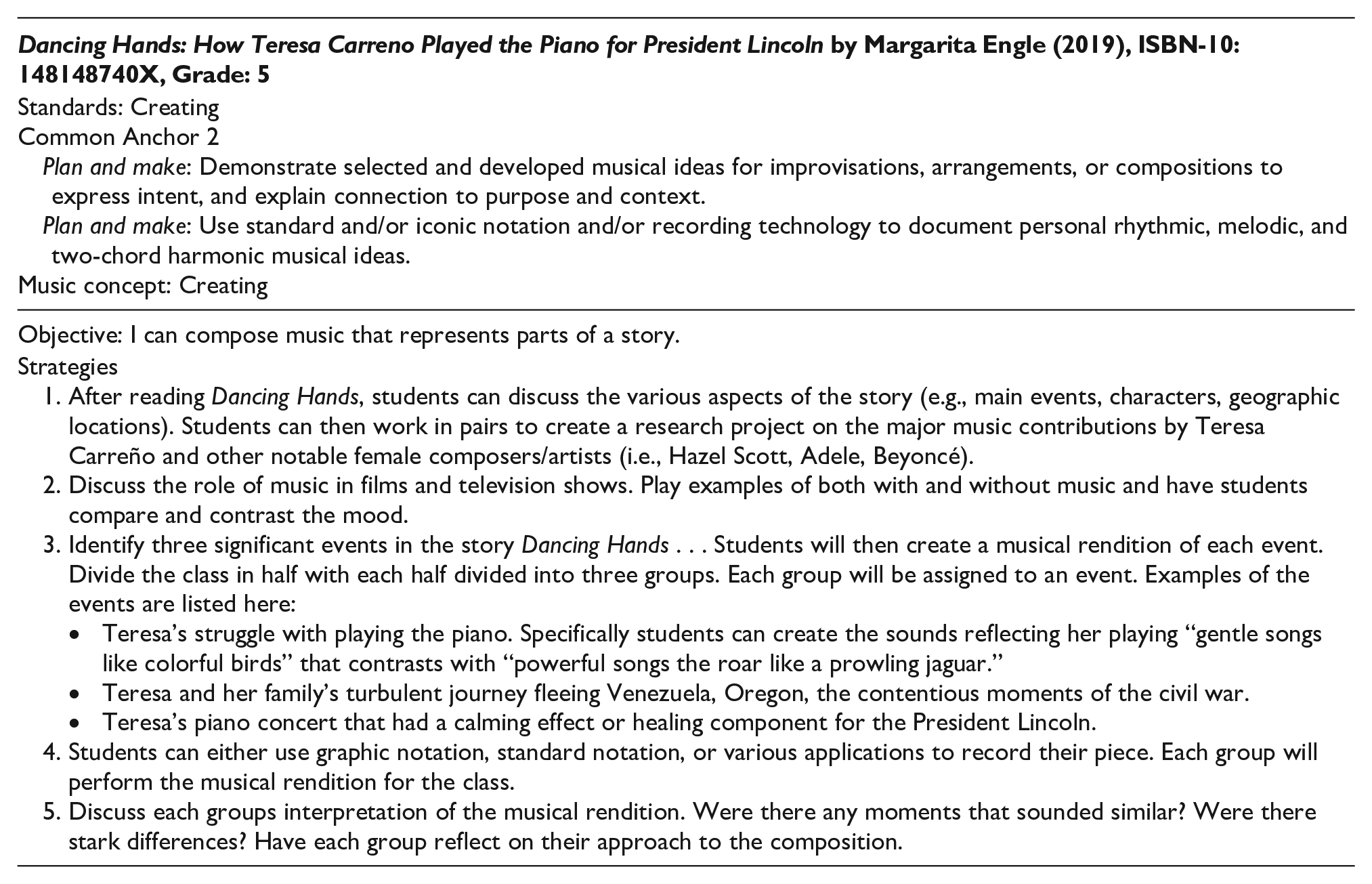
| Standards: Creating Common Anchor 2 Plan and make: Demonstrate selected and developed musical ideas for improvisations, arrangements, or compositions to express intent, and explain connection to purpose and context. Plan and make: Use standard and/or iconic notation and/or recording technology to document personal rhythmic, melodic, and two-chord harmonic musical ideas. Music concept: Creating |
| Objective: I can compose music that represents parts of a story. |
| Strategies 1. After reading Dancing Hands, students can discuss the various aspects of the story (e.g., main events, characters, geographic locations). Students can then work in pairs to create a research project on the major music contributions by Teresa Carreño and other notable female composers/artists (i.e., Hazel Scott, Adele, Beyoncé). 2. Discuss the role of music in films and television shows. Play examples of both with and without music and have students compare and contrast the mood. 3. Identify three significant events in the story Dancing Hands . . . Students will then create a musical rendition of each event. Divide the class in half with each half divided into three groups. Each group will be assigned to an event. Examples of the events are listed here: • Teresa’s struggle with playing the piano. Specifically students can create the sounds reflecting her playing “gentle songs like colorful birds” that contrasts with “powerful songs the roar like a prowling jaguar.” • Teresa and her family’s turbulent journey fleeing Venezuela, Oregon, the contentious moments of the civil war. • Teresa’s piano concert that had a calming effect or healing component for the President Lincoln. 4. Students can either use graphic notation, standard notation, or various applications to record their piece. Each group will perform the musical rendition for the class. 5. Discuss each groups interpretation of the musical rendition. Were there any moments that sounded similar? Were there stark differences? Have each group reflect on their approach to the composition. |
Declaration of Conflicting Interests
The author(s) declared no potential conflicts of interest with respect to the research, authorship, and/or publication of this article.
Funding
The author(s) received no financial support for the research, authorship, and/or publication of this article.
