Abstract
In Word of Mouth 26:4, I reviewed an article by Barnes, Kim, and Philips (2014) that reported a study showing that students’ ability to properly introduce characters in stories was moderately and positively correlated with literate language feature use, narrative comprehension, narrative quality, and oral language comprehension. The fact that the skill of proper character introduction was correlated with a variety of other language skills indicates that these expressive and comprehension language skills may develop concurrently with proper character introduction. Proper introduction of characters appears to require greater literate skills, and literate skills enable the better introduction of characters. Understanding the role characters play in narratives is an important component of the Common Core Standards (National Governors Association Center for Best Practices & Council of Chief State School Officers, 2010), for example,
Second grade: Describe how characters respond to challenges.
Third grade: Describe character traits, motivations, feelings; explain how character actions contribute to sequence of events.
Fifth grade: Compare and contrast two or more characters, settings, or events in a story (e.g., how characters interact).
Fourth grade: Describe in depth a character, setting, or event in a story or drama, drawing on specific details in the text (e.g., a character’s thoughts, words, or actions).
Eighth grade: Analyze how particular lines of dialogue of incidents in the story or drama propel the action, reveal aspects of a character, or provoke a decision.
Eighth grade: Analyze how differences in the points of view of the characters and the audience or reader create effects such as suspense or humor.
Speech-language pathologists (SLPs) and teachers frequently explicitly teach students the parts of stories, which include setting, character, initiating event, reaction, plan, attempt, consequence, and resolution. Understanding characterization in stories, however, requires more than labeling who the characters are, what they look like, and what they do. The physical and psychological characteristics of characters are often the driving force behind stories. Characterization is revealed in multiple ways. The narrator may directly describe the nature of the characters (the patient boy and the quiet girl did not disobey). Or, authors or narrators may show things that reveal the personality of characters indirectly through the looks, speech, actions, relationships, and thoughts of characters. On YouTube, watch “Characterization Lesson/Using Disney’s Frozen” (https://www.youtube.com/watch?v=-ZnD0AGqQ7I). This video shows the multiple ways that the personalities of the characters in Frozen are revealed.
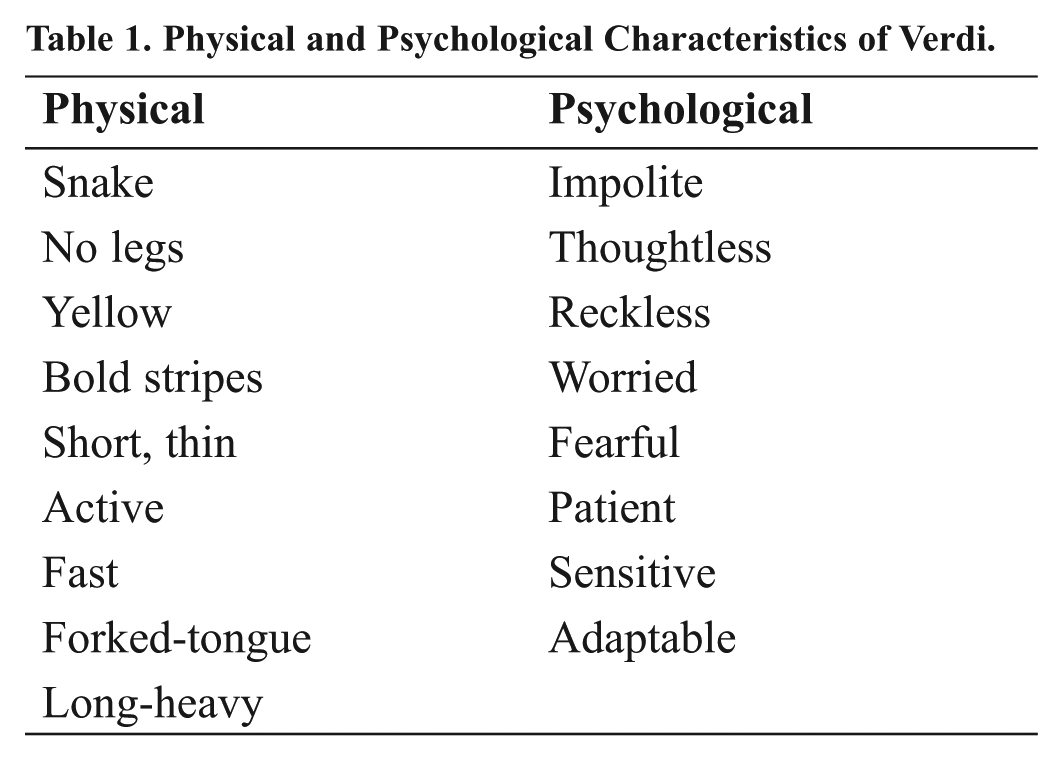
Children can be asked to complete physical/psychological charts for characters. For example, a chart about the story, Verdi (Cannon, 1997) and pythons might look like Table 1. Verdi’s physical and psychological characteristics change from the beginning to end of the story.
Physical and Psychological Characteristics of Verdi.
The African animal tales by Mwenye Hadithi are particularly useful to use with this technique to develop understanding of physical and psychological aspects of characterization. (The books are published by Hodder and Stoughton, but all are available through Amazon). Each story describes both physical and psychological attributes of the animal characters, and the stories typically arise because of an interaction of these traits. The book, Greedy Zebra, is about how the animals of the world, once all a dull color, acquired their furs and spots and stripes and horns, and how Zebra’s greedy appetite caused him to get his particular coloring. In Lazy Lion, the lion orders the other animals to build him a house. They do their best, but Lion is proud and very difficult to please. This is the story of how Lazy Lion found his home on the great African Plain. In Running Rhino, Rhino was so short-sighted he would run at anything that moved. Finally, brave little Tickbird stood up to Rhino, challenged him to stop running around, and won the contest. Other books in this series include Hot Hippo, Crafty Chameleon, Baby Baboon, Hungry Hyena, Laughing Giraffe, Enormous Elephant, Handsome Hog, Cross Crocodile, and Bumping Buffalo.
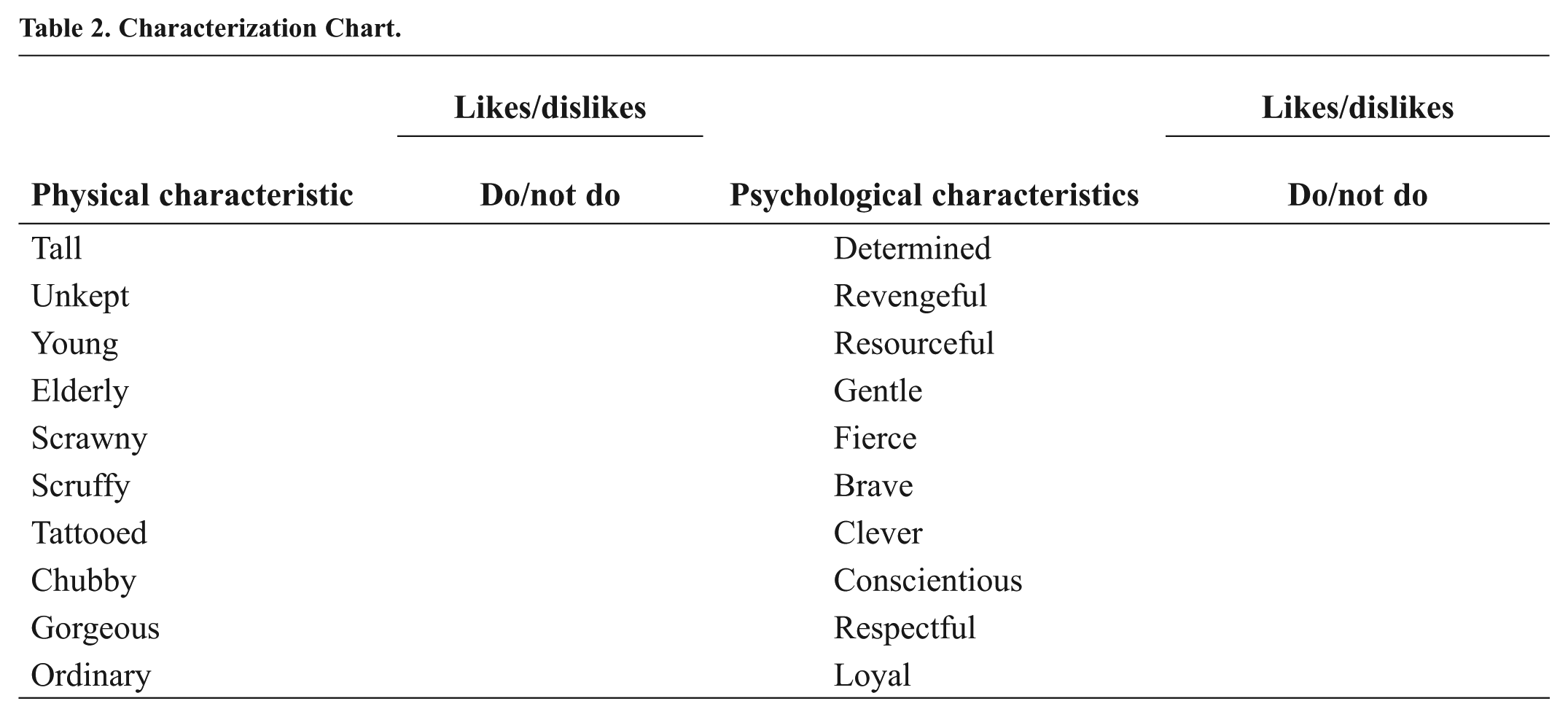
At a more abstract level, students can be asked to list words that describe physical and psychological characteristics, what persons with these characteristic might like or not like, and what they are likely to do or not do (see Table 2).
Characterization Chart.