



Abstract

In recent issues of WoM, I have discussed issues in development and assessment of personal narratives and life stories. Typically, narrative interventions in schools have focused on developing students’ comprehension and production of fictional narratives by explicitly teaching them the story grammar elements and the syntactic patterns to explain the relationships in stories. Several studies have demonstrated the effectiveness of this approach for preschool and school-aged students (Gillam, Gillam, & Reece, 2012; Gillam, Olszewski, Fargo, & Gillam, 2014; Petersen et al., 2014). Few studies have focused on developing personal narratives (Noel & Westby, 2014; Petersen et al., 2014). Here are some suggestions for developing children’s ability to tell personal stories.
Reminiscing and Personal Stories
Because personal narratives develop from reminiscing experiences, clinicians may want to begin by reminiscing with children about recent experiences. Parents can be trained to provide more elaborative reminiscing with more autonomy support, which results in better autobiographical memory (Cleveland & Morris, 2014). If clinicians have contact with parents, they could model for parents how to provide high-quality reminiscing. It is difficult for clinicians to reminisce with children when they have not shared the experience. Many children with language impairments or autism have great difficulty relating an experience. If clinicians have not shared experiences with children, they cannot scaffold the telling and they cannot determine whether what the child is saying is accurate. Hence, it is best to reminisce about therapy activities. Interesting thematic language activities can include science, art, or cooking activities (or if possible, field trips). Rather than having a totally different activity for each therapy session, sessions can begin with reminiscing about earlier activities. The Pictello app is useful for reminiscing. One can take photos or videos of an experience, then write the story that goes with the pictures. The photos provide support for children with language impairments to reminisce. Having videos of the experiences helps achieve accuracy of the reminiscing.
A recent popular Disney movie, Inside Out, talks about emotions and core memories. It is the story of a Riley, a troubled teenaged girl, as told from the perspective of the emotions inside her head. Many students have seen it, and even if they have not, there are several clips on YouTube that can be downloaded and discussed. In one section of the movie, the character, Joy, explains Riley’s core memories and shows examples from her life (https://www.youtube.com/watch?v=AXGhfYVAOKE). Each core memory is represented by a ball (different colored balls for different emotions). Clinicians explained the concepts to parents of children in a language intervention program and asked them to send in photos that could represent core memories for their children. In group, children watched the Inside Out clip about core memories. Clinicians bought large clear plastic balls that could be opened. Children put a picture in each ball, decorated their balls, and shared with one another in their groups their memories about the pictures.
Using Books to Promote Personal Narratives and Life Stories
Fictional narratives can also be used to promote development of personal narratives. To promote a personal narrative, clinicians can share stories from books with children and asked if something like that has happened to them. For example, young children can listen to the story, Franklin in the Dark (Bourgeois, 1986), about a turtle who is afraid to go into his shell because it is dark. He visits his friends to learn what frightens them. Children can then be asked about something frightening that happened to them. Or they can listen to the story, My Rotten Redheaded Older Brother (Polacco, 1994). Patricia falls off the merry-go-round and has to have stitches in her head. Children are then asked about their experiences with accidents. In Duck in the Truck (Alborough, 2009), duck gets his truck stuck in mud, and many of his friends come to help him out. Children can talk about ways they have helped their friends. Older children can read Harvesting Hope: The Story of Cesar Chavez (Krull, 2003), discuss how Chavez helped people, and then share experiences in which they have helped someone.
Telling turning point stories is an important aspect of life stories. Life turning points can be a complex concept for students, but many children’s books provide examples of turning points. In Tomas and the Library Lady (Mora, 1997), Tomas is a Mexican migrant child in Iowa. One summer, he encounters a librarian in a small rural town who works with him and lets him check out books. This was a turning point for Tomas. He went on to become the chancellor of the University of California at Riverside. In The Promise (Davies, 2014), a young girl living in the inner city is hard and mean. She steals what she wants. One evening, she snatches a bag from an old woman. Initially, the old woman holds onto the bag but releases it with the condition that the girl plants what is in it. The girl discovers acorns in the bag. She does plant them—the planting transforms her life and the lives of those around her. Calkins (2006) suggests the following questions to get students to think about turning points in their lives:
First/last time you did something hard to do
First/last time you did something you now do every day
First/last time with a person, an animal, a place, an activity
A time you realized something important about yourself or someone else
A time you realized a huge change in your life almost happened (Calkins, 2006).
Many life story turning points bring about significant changes in the psychological traits of characters. Thank you, Mr. Falker (Polacco, 1998) is a true story of the author. At the beginning of the story, Patricia cannot read; she feels lonely and afraid, thinks she is dumb and stupid. Mr. Falker, a teacher, recognizes her problem and teaches her to read. This was a major turning point in her life. She realized that she was smart; she became confident; and ultimately she became one of the foremost children’s authors. In The One and Only Ivan (Applegate, 2012), Ivan is a gorilla in a cage in a mall. He keeps his head down and focuses on himself, what he knows, and his painting. He does not think beyond the immediate. Stella, the old elephant becomes ill, and asks Ivan to take care of Ruby, the baby elephant. With this responsibility, Ivan begins to change, thinking about others and thinking beyond the present. When Stella dies, Ivan plans how to get Ruby out of the mall and successfully achieves his goal. Graphic organizers such as those in Figures 1 and 2 can be used to help students chart these transformations. (Blank versions of these graphic organizers are available free online at http://notebookingfairy.com/.http://www. and dailyteachingtools.com/free-graphic-organizers.html)

Transformation in Thank you, Mr. Falker.
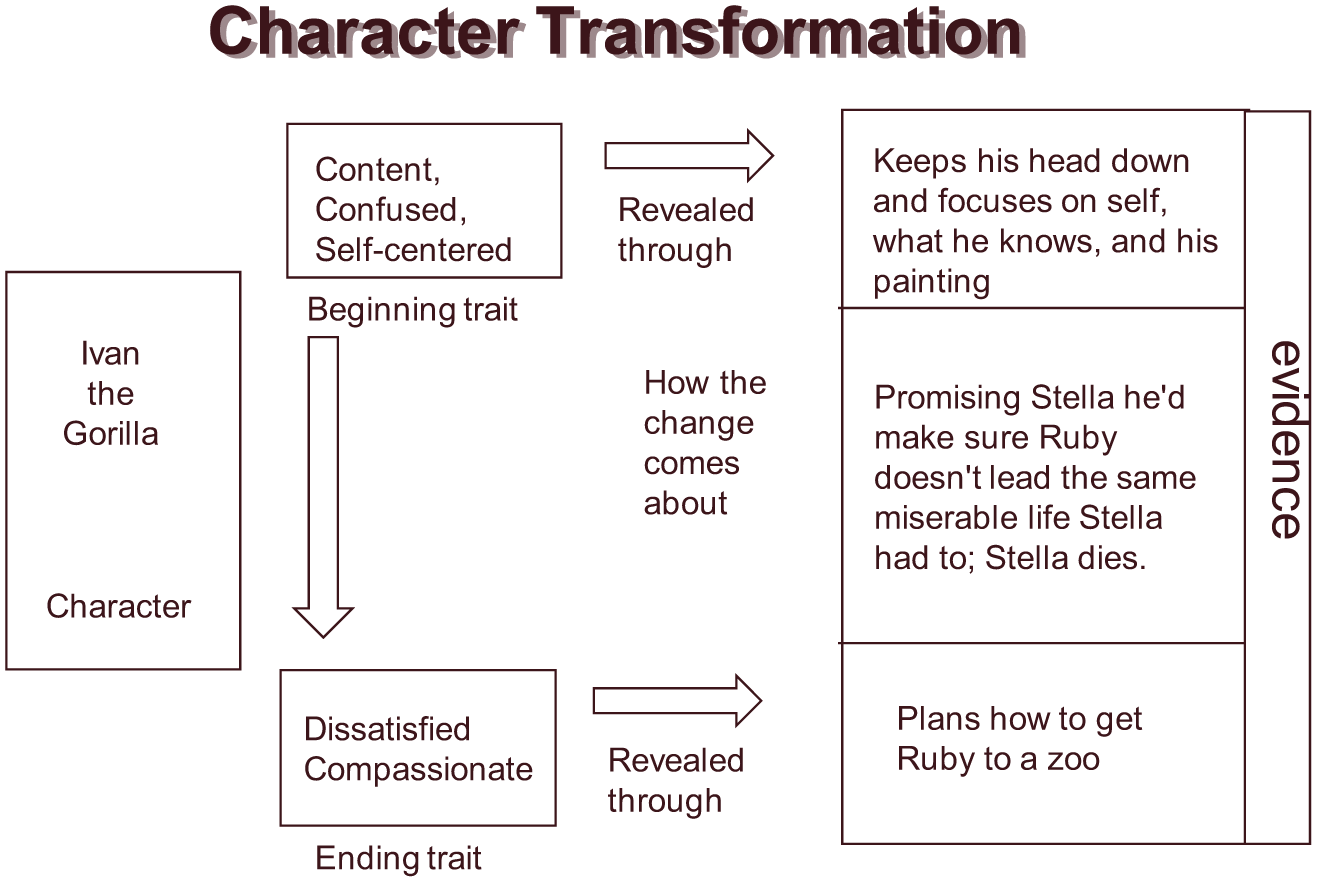
Transformation in The One and Only Ivan.