




Abstract
Objectives: The Employment Hope scale (EHS) was designed to measure the empowerment-based self-sufficiency (SS) outcome among low-income job-seeking clients. This measure captures the psychological SS dimension as opposed to the more commonly used economic SS in workforce development and employment support practice. The study validates the EHS and reports its psychometric properties. Method: An exploratory factor analysis (EFA) was conducted using an agency data from the Cara Program in Chicago, United States. The principal axis factor extraction process was employed to identify the factor structure. Results: EFA resulted in a 13-item two-factor structure with Factor 1 representing “Psychological Empowerment” and Factor 2 representing “Goal-Oriented Pathways.” Both factors had high internal consistency reliability and construct validity. Conclusions: While findings may be preliminary, this study found the EHS to be a reliable and valid measure, demonstrating its utility in assessing psychological SS as an empowerment outcome among low-income jobseekers.
Introduction
As the national overall unemployment rate continues to maintain around 10% and remain disproportionally higher for underrepresented populations (U.S. Department of Labor, 2010), securing gainful employment becomes a greater challenge for low-skilled and low-income individuals entering the labor market. Social work practice in the area of employment support and workforce development faces significant obstacles during declining employment opportunities and toughening of individual work responsibility requirements in the postwelfare reform era (Harvey, Hong, & Kwaza, 2010). The biggest dilemma in social service administration is the uncontested programmatic goal of “self-sufficiency” (SS). Despite lack of agreement on what the term specifically means, this concept, often interpreted as an “economic” or “financial” outcome, has risen to the top priority for benchmarking and demonstrating success in the current social policy context (Hawkins, 2005).
SS in workforce development research and practice has two dimensions—economic and psychological—with the latter receiving relatively less attention (Hong, Sheriff, & Naeger, 2009). A review of the literature suggests that the definitions of SS are economic and financial in nature for the most part. For instance, Sandfort and Hill (1996) used SS income as an outcome variable measured by “young mother’s average annual income from labor, child support, and assistance from relatives” (p. 315). A marriage-oriented SS income was defined as “average annual income in the woman’s family from her labor, her husband’s labor, child support, and assistance from relatives.” Cancian (2001) used SS to connote leaving poverty by way of work or finding “steady employment in a good job” that would pay at least $8 per hour for at least 35 hr per week (p. 312). Johnson and Corcoran (2003) similarly used the term to mean leaving welfare and finding a good job with $7 per hour wage for those with health care coverage and $8.50 for those without.
SS is frequently used interchangeably with such terms as self-reliance, self-supporting, and independence. A study by Haveman and Bershadker (1998) proposed poverty to be seen as inability to be self-reliant and defines the term as “the capability of families to meet some minimum level of living by means of their own efforts” (p. 343). Although implicit, Cain (1998) discussed becoming economically self-supporting to mean families working their way out of poverty by obtaining jobs at above-poverty wages. In an agency-based study, Perry-Burney and Jennings (2003) introduced the agency’s definition of SS: “a family’s ability to pay 100 percent of their necessary bills without assistance from government, social service agencies, and churches” (p. 87). Taylor and Barusch (2004) use SS based on the common assumption that it is leaving welfare for work. Caputo (1997) used welfare exit as a measure of SS by dichotomizing those who had left welfare and those who did not. Mulroy and Lauber (2004) in conducting an evaluation of a program using a logic model cited the program’s definition of “moving to SS” as “moving to independence from government subsidies” (p. 575).
While having enough economic and financial resources through paid work to meet the family needs without public support may be the overarching definition, lack of clarity in the specifics of the definition makes it very difficult to effectively evaluate the success of SS policies and programs (Hawkins, 2005; Long, 2001). Therefore, these economic and financially driven definitions create challenges for many nonprofit programs as many tend to fall short of reaching their goal of promoting SS (i.e., a low percentage success rate in achieving economic SS) for their clients (Bratt & Keyes, 1998; Harvey et al., 2010). The economic SS outcome is less than empowering for individuals trying to make ends meet and the agencies serving their needs (Harvey et al., 2010).
Based on the key tenets of Workforce Investment Act of 1998 (U.S. Public Law 105–220)—employment, retention, independence, and earnings—social service agencies have responded to the calls by funders and governments to monitor the economic SS benchmarks. However, these outcomes lie outside of the direct control of agency programming that focuses primarily on work-readiness counseling, mentoring, education, and skills training. Hypothetically speaking, agency evaluations could be subject to failure when the supply and demand side of the labor market cannot be adequately matched, in which case the success measure of “finding and keeping a job for more than 12 months” (Fleischer, 2001) lies exogenous to the agency setting. This could potentially lead to reduction or termination of funding for many agencies and therefore services could become inaccessible to many vulnerable jobseekers in need.
In this sense, Daugherty and Barber (2001) have argued that economic SS is “a classical liberal philosophical ideal that inappropriately focuses on a rational and economic view of personhood” (p. 662). The change in SS that one wish to see for an individual as a result of workforce development practice can be less than empowering when only focusing on the economic outcome minus the psychological process (Hong et al., 2009). What then would be a more “socially just” definition of SS (Juntunen et al., 2006)? How can a more empowerment-based definition (Becker, Kovach, & Gronseth, 2004) be incorporated into evaluation of services, programs, and the workforce development system at large? To answer these questions, this study focuses on developing a measure of the psychological dimension of SS, which was defined by low-income jobseekers as employment hope (EH), a precursor to achieving economic SS (Hong et al., 2009).
Psychological SS and EH
From a policy standpoint, psychological SS is a concept that directly responds to welfare reform’s key concern—the so called debilitating psychological dependency of the poor on the welfare system that creates a culture of public dependency (Mead, 1992). The political rhetoric that gave birth to the Personal Responsibility and Work Opportunity Reconciliation Act of 1996 (U.S. Public Law 104–193) considered the cultural and psychological barriers being the main cause of welfare dependency. Counterintuitively, the work-first policy prescription introduced a pathway that work-limiting psychological dependency would be overcome by way of labor force participation without directly addressing the psychological concerns. This largely overlooked the most logical problem definition in this policy context that psychological SS or empowerment of welfare recipients would lead to economic SS. Therefore, when providing services to assist clients to achieve SS at the local level, social service agencies face challenges in meeting the funders’ success goals when SS is defined primarily as an economic outcome (Harvey et al., 2010).
While some studies have examined the effects of psychological strength variables on economic SS—that is, self-efficacy (Herr & Wagner, 2003) and self-esteem (Kunz & Kalil, 1999)—this area remains a major gap in the literature. In fact, a few studies have suggested reconceptualizing SS in a more holistic way to include psychological well-being. Gowdy and Pearlmutter (1994) included autonomy and self-determination, financial security and responsibility, family and self well-being, and basic assets for community living as part of their multidimensional scale of SS. Hawkins’s (2005) argued that SS can be viewed as Personal and Family Sustainability—“maximizing full human potential to establish long-term economic, physical, psychological, and social well-being for individuals and their families” (p. 86). An empowerment definition of SS offered by Becker, Kovach, and Gronseth (2004) is: An individual who has self-sufficiency can define her own needs, decide what to do, implement that decision, and move on to meet the next need … It implies taking care of your needs, having confidence, and being able to find solutions for yourself. There is an aspect of survival in being SS. It’s living life on life’s terms. (p. 332)
Hong et al. (2009) analyzed that the two components of their bottom-up definition of SS embodies the concept of hope, of which the two key aspects are (1) goal-directed determination (agency component) and (2) planning of ways to meet goals (pathways component; Snyder et al., 1991). In this regard, this study maintains that the psychological dimension of SS is referred to as “EH” and seeks to validate this measure. Snyder (2000) disaggregated the construct into three primary components: goals, pathways to the goals, and motivation to achieve the goals. These components constitute a large portion of the extant hope literature and remain the focus of further tools designed to measure this construct. Indeed, these three components constituted the EH measure validated within this article.
Vocational research provides an excellent background to the construct of hope. McWhirter, Hackett, and Bandalos (1998) provided three models of career psychology that were supported through empirical examination. These included Betz and Fitzgerald’s (1987) realism of career choice, Farmer’s (1985) achievement motivation model, and Hackett and Betz’s (1981) self-efficacy of career model. Lent, Brown, and Hackett (1994) expanded on this model and developed the social cognitive career theory that “aimed at understanding the processes through which people develop educational/vocational interest make career-relevant choices, and achieve performances of varying quality in the educational and occupational pursuits” (Lent et al., 2002, p. 62).
While these theories postulate generalizability to the majority populations, others have focused on understanding vocational behavior and hope in minorities. Recently, Diemer and Blustein (2007) developed a vocational hope and identity measure for urban adolescent career development. McWhitter, Hackett, and Bandalos (1998) focused on career expectations for Mexican American high school girls. Herth (1992) sought to measure hope within the homeless family, and Yakushko and Sokolova (2010) published validation of work hope measures among Ukrainian college students. And although each tool measured a different aspect of vocational behavior and hope, together the studies represented a portion of the existing literature to describe hope in minority individuals.
Moreover, these studies represented the need to measure hope within differing populations. Herth’s (1992) general hope scale examined the dimensions of hope in clinical populations. Juntunen and Wettersten’s (2006) Work Hope scale measures a sense of hope about the work situation. Diemer and Blustein’s (2007) vocational hope defined four constructs of vocational identity. Finally, the oft-utilized hopelessness scale described an individual’s level of pessimism of future outcomes (Beck, Weissman, Lester, & Trexler, 1974). One key group not discussed in the hope literature is the welfare recipients who are transitioning from welfare to work. The result of investigations by Hong et al. (2009) led to the development of Employment Hope scale (EHS), and this study sought to validate this measure. Validating the EHS would fill this gap and contribute to evaluating of and strengthening of empowerment practice in workforce development for low-income individuals and families.
Method
Sample and Data Collection
After obtaining Institutional Review Board approval from the authors’ institution, we administered the 24-item EHS (see Appendix A) along with a number of other measures to a sample of low-income individuals that recently went through a job training program at The Cara Program (TCP) in Chicago between June 2009 and August 2010. TCP’s main mission is to empower individuals affected by homelessness and poverty to transform their lives and achieve real, lasting success—through its formula of intensive job training, job placement, and year-long job retention services. TCP has placed over 2,000 individuals into quality, permanent jobs—currently at an average of $10.69/hr (with benefits) and job retention rates of 72% at 1 year of employment.
The total number of clients served at the beginning of the program is slightly more than 500 and about 50% remain at the end of the program to be placed in a job and receive follow-up retention services. Typically, a client at TCP would initially undergo Interviews, at which time initial screening of candidates occurs. Once admitted into the training program at TCP, clients participates in modules established to provide training in Life Skills and Career Skills. When placed in employment and clients are followed up for 1 year. In 2008, the specific number of clients at each stage of the program was (1) 551 in Interviews, (2) 446 in Life Skills Training, (3) 350 in Developing Career Skills, and (4) 250 in Job Placement and Retention.
The sample was drawn from each cohort group in the four TCP program stages. At Stage 1, a convenient sample of individuals being interviewed for admission was provided with the surveys. At Stages 2 and 3, research interns from TCP and Loyola University Chicago attended the group sessions in the classrooms and solicited and administered the surveys. For Stage 4, program case managers were asked to recruit and administer surveys to participants due to lack of access to individuals during the Job Placement and Retention stage. Once placed in the job, clients do not typically participate in regular group sessions and only meet with their case managers on a monthly basis.
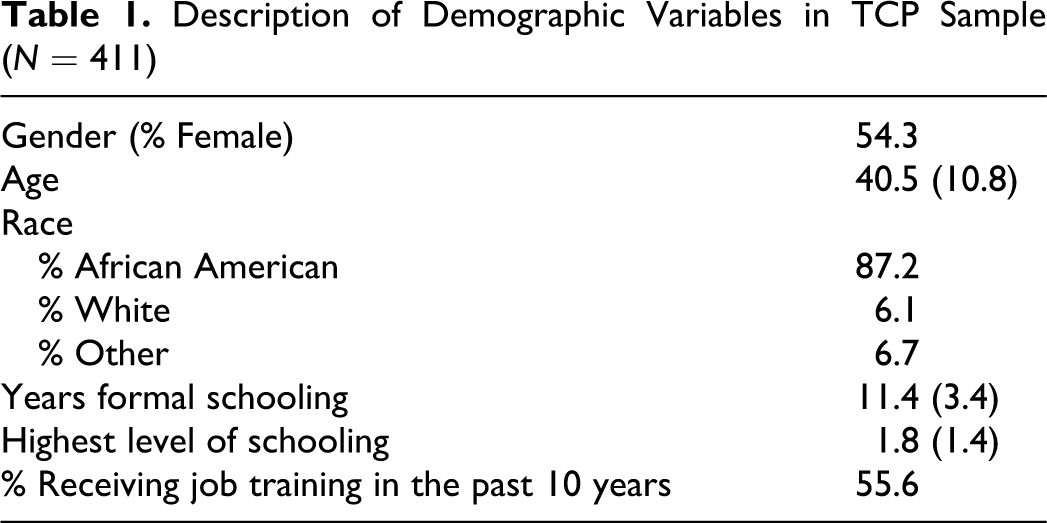
A total of 411 participants were respondents to the survey. The sampled clients were participating in the following stages: (1) 108 in interviews (26.3%), (2) 118 in life skills training (28.7%), (3) 99 in developing career skills (24.1%), and (4) 86 in job placement and retention (20.9%). The sample is representative of the overall program participants at TCP as the demographic descriptive and frequencies closely resemble the characteristics at large. Table 1 summarizes the study’s demographic characteristics. The sample was evenly divided by gender (54.3%) and consisted of individuals mostly between 30 and 50 years (M = 40.5, SD = 10.8). The vast majority of TCP sample was African American (87.2%), with White participants (6.1%) and other races (6.7%) accounting for much smaller proportions. Most individuals completed at least 12 years of formal schooling (62.6%) and had received job training in the past 10 years (55.6%). A majority of participants earned less than $5,000 the previous year (50.5%) and a large portion of the sample rented their place of residence (46.0%). Accounting for missing data, the analysis total equaled 379 participants.
Description of Demographic Variables in TCP Sample (N = 411)
Measures
Hong et al. (2009) found that there were six key constructs that conceptually fell under two components of EH—psychological empowerment and process of moving toward future goals—as suggested by their qualitative analysis of the client-centered definition of SS. The former captures the agency component and the latter the pathways component of hope (Snyder et al., 1991). Using the language that best reflects the themes generated from the qualitative study (2009), 4 items were developed for each of the six dimensions: (1) psychological empowerment (self-worth; self-perceived capability; and future outlook) and (2) process of moving toward future goals (self-motivation; utilization of skills and resources; and goal orientation).
As illustrated in Table 1, the 24 total items captured hope in the employment context, thereby referring to it as the EHS. Self-rated 11-point Likert-type items ranging from 0 to 10 required respondents to identify the degree to which they agreed with each statement. A score of 0 indicated strong disagreement to the statement, a “10” indicated strong agreement, and a score of “6” indicated neutrality. Items 1–12 represented psychological empowerment, and Items 13–24 represented the process of moving toward future goals. The self-worth dimension (Items 1–4) was captured by the use of such expressions as confidence, “good enough,” “respectful toward who I am,” and worthy. The self-perceived capability dimension (Items 5–8) reflected in the words such as capable, “strength to overcome obstacles,” “can work in any job I want,” and “good at anything … if I set my mind to it.” Future outlook about the job situation (Items 9–12) was captured using such terms as positive, “don’t worry about falling behind bills,” career job, and “better position … than where I am now.”
The process of moving toward future goals started with the self-motivation dimension (Items 13–16) that brought together one’s ability to tell oneself to “take steps toward reaching career goals,” being committed, being energized, and having the willingness to give one’s best. The utilization of skills and resource dimension (Items 17–20) characterized awareness of one’s level of skills and resources to obtain employment and the ability to utilize the skills and resources to move toward career goals. The goal orientation dimension (Items 21–24) assessed the extent to which individuals are “on the road toward” and “in the process of’ reaching career goals and how much they believe in the possibility of reaching the goals one day by following the current path.”
Analysis
Exploratory factor analysis (EFA)
To assess the latent factor structure of the 24-item EHS measure, we utilized EFA. This statistical procedure assessed the intercorrelations between variables to create factors (Kahn, 2006; Tabachnick & Fidell, 2007). Often EFA will reduce the number of test items to produce a more parsimonious measure.
Following the procedures outlined by Tabachnick and Fidell (2007), the first step to conduct an EFA was to choose an extraction process. Although many extraction procedures were available, two general extraction processes pervade the industry: principal components analysis (PCA) and principal axis factor (PAF). PCA generally is acceptable when the primary extraction goal is to reduce the number of items in a test, while PAF is used to create and understand latent factors. The goal of the current project was to determine the underlying factor structure, and therefore we utilized the PAF extraction procedure.
Our next step was to assess the number of factors extracted. Fabrigar, Wegener, MacCallum, and Strahan (1999) discussed the use of eigenvalues greater than 1.00 and Catell’s Scree test (Catell, 1966). Fabrigar et al. cautioned against the practice of extracting factors based solely on eigenvalues greater than one because this procedure has been shown to overextract factors. We therefore utilized both procedures to determine the correct number of factors to extract.
The third and fourth steps are for utilizing the PAF procedure concerned rotation of the factor structure and factor loadings. In order to understand the factor loadings efficiently, Kline (2008) suggested myriad factor rotation. Again, researchers must decide between two general procedures for rotation, orthogonal, and oblique. Orthogonal rotation constrains the structure to a zero-order correlation between the factors, while oblique rotation allows for interfactor correlations. We hypothesized that factors would correlate moderately and therefore chose direct oblique rotation.
Proceeding factor rotation, we determined the items that constituted factor structure. We retained items that loaded highly on one factor and minimally loaded on another. Kahn (2006) suggested using a cutoff of at least .50 and less than .20 on other factors to estimate purer measures of factors. However, it is often the researchers’ judgment to decide which items load high and low on a factor. For the purposes of this project, we hypothesized that items must load above .45 and below .20. The final measure eliminated items that failed to meet this criterion.
The data set was assessed for normality and missing data prior to extraction. Multivariate normality should be assumed when factor extraction is a priority (Tabachnick & Fidell, 2007); thus, we eliminated items that failed to meet this criterion. Missing data were assessed for missing completely at random (Enders, 2010) and cases deleted list-wise prior to extraction. This practice led to the analyzed participant total of 379.
Reliability
An important determination in the utility of a factor is its interitem reliability. Tabachnick and Fidell (2007) suggested that factors should produce α coefficients above .7 to be considered practically meaningful. As such, we estimated Cronbach’s α reliabilities for each factor prior to gathering construct validity evidence.
Construct validity
We collected evidence of construct validity by estimating the empirical relationship between the created EHS subscales and theoretically related measures (Campbell & Fiske, 1959; Messick, 1980; Rubin & Babbie, 2008). The two primary principles of convergent and discriminant validity evidence are central tenets of construct validity. Convergent validity evidence is gathered for a measure when a theoretically similar measure correlates with the measure of interest. We hypothesized that the EHS subscales would correlate with Synder’s Hope Measure (Snyder, 2000), a Work Hope measure (Juntunen & Wettersten, 2006), and a Self-Efficacy scale (Chen, Gully, & Eden, 2001). Divergent validity evidence is collected when a theoretically unrelated measure fails to correlate or has a weaker correlation than convergent measures with the measure of interest. We hypothesized that the EHS subscales would not correlate strongly with age, race, and gender.
In addition, we collected concurrent criterion validity evidence by regressing the EHS subscales on a criterion measure (Cronbach & Meehl, 1955). Evidence of criterion validity is found if the measure/measures of interest predicts a criterion. Some debate has been given to the criterion; Kane (2001) indicated, however, that a self-report measure could be utilized instead of an external variable, given the unavailability of an external criterion. We hypothesized that the EHS subscales would predict the individual’s self-reported hopefulness of finding employment in the next 1 month, 6 months, 1 year, and 5 years. Participants answered “worse than today,” “don’t know,” “about the same,” “better.” These answers were then combined to create one measure of hopefulness (α = .79). To assess the predictive qualities of each subscale, we constructed a hierarchical regression model assessing the change in R 2 for each variable. A significant change in R 2 signified concurrent criterion validity for that variable.
Results
EFA
Initial factor analytic procedure results revealed that the 379 complete cases satisfied data requirements (Kaiser-Meyer-Olkin [KMO] = .95) and sphericity (Bartlett’s test: p < .001). Thus, we conducted a PAF analysis to estimate the latent factor structure. Our preliminary results revealed that three factors generated eigenvalues greater than 1.00. Upon further review, however, the third factor accounted for less than 1.0% of the total variance; hence, we constrained the procedure to estimate only two factors.
Constraining the model to estimate only two factors produced an efficient structure. The results revealed a 10-item factor that accounted for 50.28% of the total variance (eigenvalue = 12.07), and a second 4-item factor that accounted for 7.44% (eigenvalue = 1.79). Analysis of Catell’s scree plot further confirmed our hypothesis of two factors. Next, we utilized a direct oblimin rotation to estimate the factor loadings because we hypothesized that the two factors shared a relationship. Items 11, 15, and 17–24 met the factor-loading criteria of limited cross-factor loading and loadings above .5 and below .2 to constitute the first factor, and Items 3–6 met criteria to constitute the second factor (Table 2). Further, our hypothesis of a strong relationship between the factors was confirmed (r = .60, p < .01). The other 10 items failed to load sufficiently and were thus dropped from further analysis.
Factor Analysis Results (N = 379) for the Employment Hope Scale (EHS)

Note. Bold typeface indicates a significant factor loading of above .45 on one factor and below .2 on the other factor.
We named each of the factors based on the factor analysis results. The larger 10-item factor we hypothesized to constitute a measure of goal-oriented pathways. The second 4-item scale we hypothesized to measure an individual’s psychological empowerment. Both factors confirmed previously stated hypotheses.
Reliability
We utilized Cronbach’s α to estimate the reliability of this sample’s scores across the final 14-items and each subscale. The total remaining 14-item EHS measure revealed high internal consistency (α = .94). The pathway and empowerment subscales results also revealed high internal consistency (α = .93, .90, respectively). These results further confirmed the latent factor structure and utility of these subscales.
Construct Validity
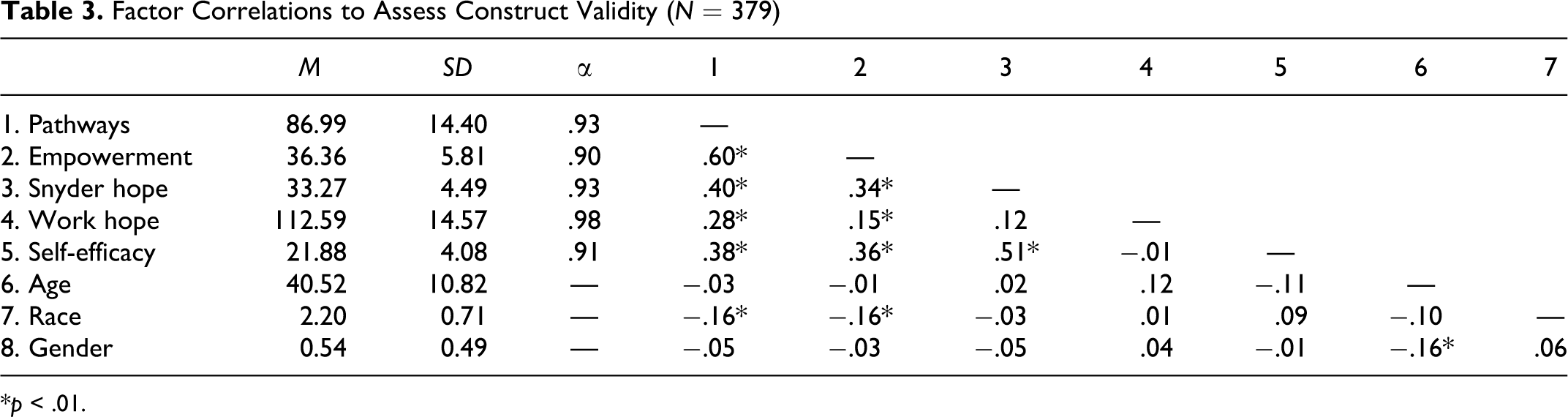
We gathered construct validity evidence by estimating the empirical relationships between theoretically related constructs. Convergent validity evidence was gathered by measuring the correlation between two theoretically related measures, while discriminant validity evidence was gathered by correlating two theoretically unrelated measures (Rubin & Babbie, 2008). To correct for experiment-wise error rate, we utilized Bonferrini’s correction and established an “a priori” α rate of .01. Because this study’s sample remained relatively large, we had much power to achieve statistical significance. Therefore, the empirical size of the correlations should also be considered.
The results revealed strong convergent validity evidence for both subscales. First, we correlated the pathway subscale of EHS with the Snyder’s (2000) hope and Juntunen & Wettersten (2006) work hope measures. As illustrated in Table 3, the results revealed a moderate positive correlation with the hope scale (r = .40, p < .01) and a smaller yet positive relationship with the work hope scale (r = .28, p < .01). Second, we assessed the relationship between the psychological empowerment subscale and the general self-efficacy scale (Chen et al., 2001). Again, the results revealed strong evidence of convergent validity (r = .36, p < .01).
Factor Correlations to Assess Construct Validity (N = 379)
*p < .01.
To collect discriminant validity evidence, we correlated the two subscales with theoretically unrelated measures. We hypothesized that age, race, and gender were unrelated to either of the measures. Moderate evidence was found to support this hypothesis. The pathways scale was unrelated to age (r = −.03, p > .01) or gender (r = −.06, p > .01), but a small negative relationship was found with race (r = −.16, p < .01). We also estimated the correlations between the 4-item psychological empowerment subscale and the three demographic characteristics. Although gender (r = −.05, p > .01) and race (r = .03, p > .01) lacked a relationship, a small negative statistically significant relationship was found between age and psychological empowerment (r = −.16, p < .01).
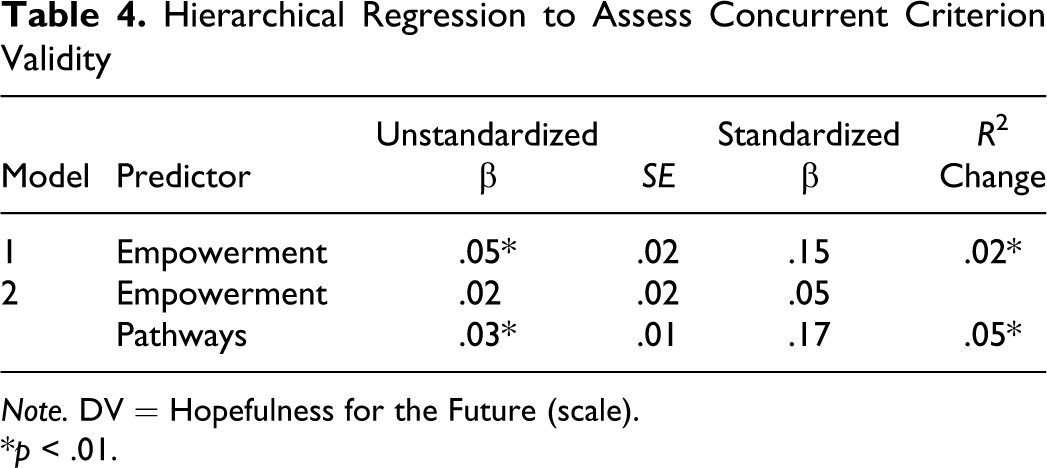
Final construct validity evidence was gathered in the form of concurrent criterion validity. We hypothesized that the one or both of the subscales would predict a self-reported hope scale. We utilized a hierarchical regression analysis that began by regressing the empowerment subscale on the criterion variable then adding the pathways subscale. A significant R 2 changed statistic indicated evidence of criterion validity. The results revealed that the pathways subscale was positively related to the criterion variable (β = .03, p < .01) but the empowerment subscale was not significantly related (β = .02, p = .42). This analysis provided moderate evidence of criterion concurrent validity because of the significant predictive relationship of the pathways scale and criterion variable of hope (Table 4).
Hierarchical Regression to Assess Concurrent Criterion Validity
Note. DV = Hopefulness for the Future (scale).
*p < .01.
Discussion and Conclusion
This study validated the EHS measure, which was conceptualized by Hong et al. (2009) as reflecting the psychological definition of SS provided by job training participants. It responded to their assertion that a tool to measure this bottom-up, client-centered concept of SS was required. Based on their extensive qualitative examinations, an empowerment-based assessment tool was developed in order to best mirror the experiences of low-income jobseekers and their understandings of SS. The original EHS measure consisted of 24 items that were categorized into 2 components with 6 dimensions. The latent factor structure of the EHS measure was examined using the EFA, more specifically the PAF analysis.
The PAF result revealed a two-factor structure that comprised 14 items in the newly developed EHS. As expected, psychological empowerment and goal-oriented pathway were found to be the two main factors. Self-worth (Items 3 and 4) and self-perceived capability (Items 5 and 6) remained in the validated 4-item psychological empowerment subscale of EHS. One of the 4 items originally conceptualized as future outlook (Item 11) resulted in being included in the goal-oriented pathway subscale. Only 1 item from 4 designed to represent self-motivation (Item 15) remained in the pathway subscale. All the items capturing utilization of skills and resources (Items 17–20) and all 4 items representing goal orientation (Items 21–23) remained significant parts of the goal-oriented pathway subscale. The 14-item EHS was found to have a high reliability and construct validity.
Viewing SS as psychological well-being is relatively less conventional in the literature on SS and in employment support practice than the economic outcome definition. This newly validated EHS is an empowerment assessment that fills this gap and helps account for the other essential aspect of SS. Assessing individual development on EHS during the course of job training participation and/or education will help monitor more appropriately not only individual empowerment process but also program success in line with the organizational mission of job training or social service agencies. EHS could be used as an intermediate, short-term outcome that results directly from the program intervention. Measures of economic SS could then be used as a long-term outcome, with which one can validate the path of psychological SS leading to economic SS.
Further, in order to strengthen the use of EHS, one would need to conduct confirmatory factor analysis (CFA) as the next validating procedure. CFA’s goal constitutes confirming the hypothesized latent factor structure of a measure. The procedure can be used to test hypotheses, as the goal implies, or to validate that the factor structure remains across samples (Kahn, 2006). Future research should plan to conduct both procedures to validate and confirm the latent factor structure. Confirmation of the proposed latent factor structure will embolden future analyses by ensuring that subsequent analyses utilize the intended measure.
Social work intervention in workforce development, job training, education, and employment support and services will need to focus on both components of EHS in order to formalize the informal empowerment interventions. Psychological empowerment is generally recognized by social workers as crucial to transforming individuals in poverty to become competent workers, but it is often considered from outside of the profession as an intangible thing that merely supports the main program input—that is, training, education, transitional job experience, and so on. Social work interventions involving individual psychological assessments, counseling, reflection, employment support groups, and so on could be developed to address the key elements of the EHS.
As a way to address the goal-oriented pathway in social work intervention, one should design individually based motivational interviewing method to involve the individuals in the goal-setting process. Developing a sense of future, being motivated to move forward, having a realistic sense of skills and resources and being able to appropriately utilize them, and setting oneself on the path toward individual success goals have to be part of the motivational interviewing intervention. Social workers should design the intervention modules or motivational interview schedules that could not only best address these topics but also effectively put individuals in a curriculum that makes their participation a transformative process. Only when low-income, low-skilled jobseekers have employment hope—being psychologically empowered and are set on the goal-oriented path—will they be able to start the move toward achieving their long-term goals of economic SS.
Footnotes
Appendix A
The authors declared no potential conflicts of interest with respect to the research, authorship, and/or publication of this article.
Faculty Fellowship from the Center for Urban Research and Learning (CURL) and Multidisciplinary Research Grant from Loyola University Chicago.