



Abstract
Objectives:
The purpose of this article is to present a theoretical frame of reference for the study and assessment of social work from the perspective of a history of ideas.
Method:
The study employed an analysis of primary and secondary historical sources.
Results:
Social work as a practice and research field is embedded in the genesis of modern social science as developed by the Scottish School of thinking, and organized practice for the betterment of life conditions of individuals, groups, and communities.
Conclusion:
The history of ideas of social work provides a theoretical frame of reference for identifying the historical roots of social work, defining its core as well as professional and research territory relative to other professions and disciplines, and placing evidence-based social work practice in a historical context.
Research disciplines emerge and develop in specific historical contexts. Historical events and ideas associated with research disciplines can be explored from a vantage point of the history of ideas. A historical approach may help those within a discipline get a productive idea of its theoretical and methodological roots, and of its historical role in society. It may also help generate legitimacy for the discipline within the community of sciences. Social work is no exception. While both normative and programmatic definitions of social work have been developed over the years, no consensus has been reached as to the core, boundaries, objects of study, theories, and methodology of the scientific discipline.
I perceive social work as a professional practice and a scientific discipline. This viewpoint is not without complications, but it is perhaps the only reasonable one. Like any other profession, social work needs to define its professional territory and earn recognition as a legitimate profession. Likewise, social work also needs to define its research territory as distinct from territories of other disciplines. We still lack a reasonably well-developed frame of reference for the study and assessment of ideas in the history of social work. What are the traditions of thought and action in which we can find the roots of social work? Who are the originators of these traditions? In other words, are there any so-called classics in which we can find the roots of social work as a discipline and as a practice? What historical right does social work have to lay claim to certain classics? Are there any criteria by which we can claim that social work can be rooted in traditions of thought and action, as well as in the classics? In such a case, what are the traditions of thought and action in social work? What kind of delimitation problems are involved in relation to other disciplines?
The aim of this article is to present a theoretical frame of reference for the study and assessment of social work from the perspective of a history of ideas. Conceptually, the article draws heavily on my earlier book on the same topic (Soydan, 1993a, 1993b, 1999). However, I am revisiting my conceptual framework in light of the recent development of evidence-based social work practice, which in my view stands as a bold expression of social work’s historical dedication to research-driven professional practice.
At times, a starting point for studies of this kind has been the assumption that human beings are programmed for mutual help and entertain an innate propensity to provide help. When choosing this approach, the main focus is on social work as an informal exchange between human beings. The scientific dimension lacks primary relevance (Soydan, 1999, pp. 12–16). Another starting point is to seek the historical roots of social work in traditions of thought and action in which social work is grounded in purposefully organized activity or scientific thinking. It is the latter that marks the origin of my journey. In this perspective, social work practice to help those in need and to change people’s conditions of life for the better is connected to the scientific analysis in a given historical context. From the viewpoint of a history of ideas, this is generated by two historical events: the emergence of scientific analysis of society during the second half of the 18th century and the application of scientific social analysis and prognosis as instruments of action for social change.
To approach how social work as a practice can be grounded in a social science tradition, I have used Eriksson’s study (1988) of the origins of social science. In his account of the origins of scientific social analysis, I find roots of, and a scientific basis for, social work. In those thinkers who first developed scientific social analysis, I also find the idea of the “spirit of human progress,” which is of importance to social work as a practice and as scientific activity. It is against this background and in my analysis of social work that it can be claimed that social work consists in three components: practical activity, an academic discipline, and a research tradition. A study of traditions of thought and action that analyze society, and that carry forward the work of change based on the spirit of human progress and an innate propensity to offer aid, reveals two tendencies that can be refined from the history of ideas. I call these tendencies in the evolution of the history of ideas “from theory to practice” and “from practice to theory.”
A purposeful and planned action for social change aims at altering what is regarded as undesirable and a social problem. A central issue in traditions of thought and action is whether people or society constitutes the basis of social problems. Historically, the term sick was attributed to individuals or society to locate dysfunctional or undesirable conditions.
In the context of searching for social work’s roots in the evolution of the social sciences, the question of its relationship to other disciplines and activities arises. In this article, I shall discuss its historical relationship to the discipline of sociology as an illustration of the need for social work to define its own territory of inquiry. These two subjects have at least two points of intersection. The first is their interest in the study of social problems, and the second is their interest in social change and action for social change. In contemporary discourse, similar intersections may be observed in relation to other disciplines and professional practices such as nursing, psychology, psychiatry, social development, and so on.
As developed in my earlier work, this article presents a theoretical frame of reference based on historical empirical data on the development of social science and how societies perceived and defined the locus of social problems. In my view, such a frame of reference may help us (1) study and contextualize classical thinkers and practitioners so as to examine differences and similarities between them; (2) explore ideas and human agency leading up to modern thinking in social work; and (3) justify why certain thinkers and activists can be claimed as classics of social work.
The Origins of Social Science as a Starting Point
The central thesis pursued by Eriksson (1988) is that the sociological analysis of society fundamentally originated during the Age of Enlightenment. The “sociological analysis of society” is a much broader concept than what is implied by the word “sociology.” Sociological analysis refers to concepts and working methods in sociology as well as other disciplines, such as economics, political science, psychology, and social work.
Eriksson argues that the decisive point of transition to a modern understanding of social scientific methodology is located within the group of social philosophers and historians that is usually called the Scottish School. It is a common belief (e.g., Aron, 1965; Zeitlin, 1981) that the emergence of social analysis is attributed to the Enlightenment, and the French Enlightenment philosophers are given a central role in this process of change. The originality of Eriksson’s contribution lies in an analytic approach of how the scientific or sociological analysis of society underwent a revolutionary transformation through the work of the Scottish School, with Adam Smith, Adam Ferguson, and John Millard as the driving forces. Their work is based on the so-called four-stage theory that embraces four assumptions. First, society is a system in which the various components of society are dependent on each other. These different components are linked by horizontal relationships whose interconnected changes constitute what we call history. Second, the dynamics of society are independent of the intentions of individuals. The collective activities of individuals form the basis of societal development. Third, society has grown at the cost of the individual. This relationship between the individual and society has meant that the individual has become increasingly civilized and is more legally secure, but individuals have also become more dependent on society and imprinted with societal factors (eloquently elaborated on by Norbert Elias, 2000). Fourth, despite the fact that societal development is unplanned, with no goal or end, society shows a large number of patterns that can be discovered by the scientist.
In sum, the Scottish School played an important role in originating the foundations of modern social science. They carried out an analysis of history and explained the mechanism of change in society. Consequently, they laid the foundations of action for social change that is based on scientific analysis. But they did not make any predictions about future changes in society. It would be some time before these theories of society were linked to action for social change. The history of ideas in the 19th century was rooted in the 18th-century scientific analysis of society, and developed the central theme that “sick” or dysfunctional social conditions should be changed by means of scientific models and theories. In this sense, developments during the 19th century are of central importance to social work.
A Contemporary Perspective on Social Work and Social Science
At this point, it is encouraging to observe some of the recent advances of social work in terms of further anchoring itself in scientific foundations and developing its professional identity. Social work’s advances during the last two decades, especially in the United States, are unprecedented (Soydan, 2011). In my view, the social work profession’s (as a science and practice) awareness of and efforts to associate itself with high-quality scientific evidence is the core of this unprecedented development. Dedication to intervention research, outcomes research, systematic research reviews, and translational research is a token of the recognition of the importance of scientific knowledge in driving practice, as well as the crucial role of practice in guiding research.
Origins of modern intervention research in social work and the human services were shaped during the post–World War II era. Presidents Kennedy and Johnson, and to some extent President Nixon, launched nationwide programs to improve the conditions of the most needy and underserved cross sections of the American population. These social reforms aimed to induce change constitute an important backdrop to what later came to be defined as intervention research. The American psychologist Donald T. Campbell coined the concept of the “experimenting society,” meaning that the eradication of societal problems should be based on the scientific principle of experimentation and evaluation of intervention outcomes (Soydan, 2009). However, social work’s professional and scientific advancement came into full blossom in the early 1990s.
One of the most important steps has been the report of the Task Force on Social Work Research (1991) prepared under the auspices of the National Institute of Mental Health. The report provided a powerful account of the breadth of the problems the social work profession deals with, and expressed strong concern about the need for the profession to secure the effectiveness of the services it provides. Awareness generated by the report led to the establishment of the Institute for the Advancement of Social Work Research in 1992, the founding of the Society for Social Work and Research in 1994, and a stronger commitment by the National Institutes of Health to support research on social work practice. Establishment of high-quality social work journals such as Research on Social Work Practice (1991) and Scandinavian Journal of Social Welfare (launched in Europe in 1999 and later renamed International Journal of Social Welfare) further strengthened the identity and legitimacy of social work.
The establishment of the Cochrane Collaboration (1993) and the Campbell Collaboration (2000) has boosted the profession’s efforts to further advance its scientific positions. The Cochrane and Campbell collaborations develop and disseminate high-quality systematic reviews of effectiveness studies in health, social work, and other behavioral and educational fields. The collaborations have been instrumental in developing a science of systematic research reviews and raising the scientific bar for evidence used in action for change. After all, the foremost principle of any profession dedicated to improve the lives of others is “not to harm.”
Although not yet proliferated to all levels of the profession, there is currently an aspiration in many layers of the profession worldwide to strengthen its scientific base to advance its practice for the benefit of clients. This is the dedication of the profession to evidence-based interventions and programs. But what about the profession’s dedication to evidence-based practice as a process of translating and implementing evidence-based interventions? Evidence-based practice (EBP) is defined by its founders as the integration of best available evidence with client values and acceptance as well as organizational and other structural circumstances.
Elaborating on this question in detail is beyond the main purpose of this article. While a brief answer would be that the profession’s dedication to EBP is currently unclear and ambivalent, one aspect of the issue seems pertinent to the context of the article. As I discussed elsewhere (Soydan, 2009), knowledge is never 100%! In social work science as in all science, what we call evidence, including the “gold standard” evidence, consists of estimates and approximations of our measurements of real-life situations. Karl Popper famously emphasized: “No matter how many instances of white swans we may have observed, this does not justify the conclusion that all swans are white” (1972, p. 27). So, there is a good reason to acknowledge that there are limits to scientific evidence. This limitation prompts caution when applying scientific evidence in action for change, an insight that urges social workers to dedicate themselves to EBP.
In sum, social work’s dedication to evidence-based interventions, programs, and practices has to be understood in light of the profession’s historical association with scientific knowledge as a base for its actions.
The Spirit of Human Progress
As the aim of social work as practice is to solve social problems, a question that will be discussed later, Ferguson’s Law of Progression is of particular interest. The Law of Progression was one of three basic assumptions concerning human nature that we can find in the work of the Scottish thinkers (Eriksson, 1988). Yet, the idea of the spirit of human progress is much older than the Scottish School. Ferguson suggested that human beings continually strive to improve the conditions of their life. He argued that people were not created to rest, and that they were constantly making improvements and continually learning from their mistakes.
From this basic assumption it is not far to the idea that social work has some of its roots in human sociality and mutual aid. The Scottish writers call this “the bettering of circumstances”—that is, a progression from less good to better conditions. This parallelism is also reinforced by the Scottish writers’ second basic assumption about mankind, called sympathy by Smith, which deals with a phenomenon that is covered in modern social work by the term empathy. The assumption is fundamental to all social work.
At the end of the 18th and beginning of the 19th centuries, widespread social unrest was taking place. The French Revolution affected European political life, and the need for social change was urgent. Analyzing changes in society up to the present and not attending to future changes in society, as the Scottish writers did, was alien to how thinking about social scientific progress developed in the 19th century. The thinking was if we had analyzed changes in history, we could, and indeed must, make predictions about the future in order to build a society that functioned better. We have to construct a philosophy of history that would form a moral foundation for social change. How else could we do anything about the political chaos that prevailed in society? The sick society had to be cured. This changed attitude toward the overall role of social science in society was a central element in 19th-century thinking.
Marquis Marie Jean de Condorcet was predominant thinker in the 19th-century history of ideas and its striving toward a better society free of social problems. Condorcet worked on the basis of scientific analysis and knowledge. He wrote his Esquisse d’un tableau historique des progres de l’ esprit humain in 1793, and it was published posthumously in 1795. In it, Condorcet gave a description of how mankind has developed. His presentation finished with a future vision of human society. Condorcet calls this phase “progres futurs de l’esprit humain,” the future development of the human spirit. For Condorcet, human progress was inevitable, as it was based on mankind’s capacity for achieving perfection. According to Condorcet, mankind had a built-in driving force that knew no bounds and that guided human society forward to a better condition. Condorcet hoped this innate force would ultimately lead mankind to societal perfection. In his presentation of the phases of development in the history of mankind, he also emphasizes the decisive role of science and knowledge. The road to perfection was scientific knowledge.
The theory of history of the Scottish writers and the philosophies of history that developed in the 19th century in Condorcet’s footsteps complemented one another. The idea was that the problem-generating social conditions—the sick society as it was known at the time—could be changed for the better using a scientific analysis of society. This was the central theme of the 19th-century tradition in the history of ideas. Many thinkers could be mentioned within the social sciences. Henri Saint-Simon, August Comte, and Karl Marx, just to name a few, were central figures in this development. They and other figures in the history of ideas are regarded as central classics of, above all, sociology. In this context, Eriksson discusses the concept of “sociology as agent activity.” My thesis is that this development in the history of ideas can also be ascribed to social work, and I shall return to this notion later in the article.
What is Social Work?
This question is often raised by both practitioners and researchers in social work. Here, I shall distinguish between three independent but interrelated concepts to explore what social work may involve. It is important analytically to separate social work as a practical activity, an academic discipline, and a research tradition.
Social work as a practical activity. Social work as a practical activity aims to help people who experience social problems. The earliest and most distinct definitions of social work as a practical activity are to be found in Mary Richmond's works, and refer to social work as casework. As examples, here are some definitions from her works and those of others: The art of doing different things for and with different people by cooperating with them to achieve at one and the same time their own and society's betterment. (Richmond, 1915, p. 43) The art of bringing about better adjustments in the social relationships of individual men, or women, or children. (Richmond, 1917, p. 389) An art in which knowledge of the science of human relationships and skill in relationship are used to mobilize capacities in the individual and resources in the community appropriate for better adjustment between the client and all or any part of his environment. (Bowers, 1949, p. 317) Social work seeks to enhance the social functioning of individuals, singly and in groups, by activities focused upon their social relationships which constitute the interaction between man and his environment. These activities can be grouped into three functions: restoration of impaired capacity, provision of individual and social resources, and prevention of dysfunction. (Boehm, 1958, p. 18) Casework has always been a psychological treatment method. It recognizes both internal psychological and external social causes of malfunctioning and endeavors to enable the individual to meet his needs more fully and to function more adequately in his social relationships (Hollis, 1964, p. 1) By provision of certain services and material resources and by psychologically therapeutic supports and counsel, casework modifies either the problem experienced in the individual case or the person’s modes of coping with it or both. The aim of casework is to restore or reinforce or refashion the social functioning of individuals and their families who are having trouble with person-to-person or person-to-circumstance encounters. (Perlman, 1965, p. 607) Social workers focus on problems in living which fall into three areas: (1) problems and needs associated with tasks involved in life transitions; (2) problems and needs associated with tasks in using and influencing elements of the environment; and, (3) problems and needs associated with interpersonal obstacles which impede the work of a family or a group as it deals with transitional and/or environmental tasks. (p. 602)
Social work as an academic discipline
An academic discipline is an institutionalized representation of a combination of a certain mass of accumulated knowledge and teaching. An academic discipline is often formalized by educational and research policies to develop, maintain, and sustain a domain of knowledge, skills, and teaching. In a historical perspective, specialization of knowledge is a main driver of the establishment of academic disciplines. For instance, some of the modern academic disciplines such as psychology, sociology, economics, and statistics are offspring of knowledge and teaching domains such as philosophy, mathematics, and theology. Academic disciplines are embedded in complex organizational settings. At the core of a discipline’s organizational setting are the traditional academic schools and departments, hosted by universities. Other components of an academic discipline include intraacademic rules and ethics, teaching methods, diplomas for various types of accomplishments, criteria by which quality of scholarly outcomes are assessed, accreditation systems, and so on. Social work as an academic discipline shares similar characteristics with other academic disciplines.
Social work as a research tradition
As stated in introductory comments, it is crucial to understand social work from the perspective of a history of ideas, to investigate thinkers, practitioners, movements, and traditions to which social work as a research tradition can lay claim. We can then ask, for example, questions such as: Is Max Weber a classic of sociology or political science? Is Adam Smith a classic of sociology or economics? Or are they both? The same type of questions can be related to social work. Who are the classics of social work? Does social work have its own classics? Can social work claim classics traditionally attributed to other disciplines?
From Theory to Practice—Research for Change
In social work as a research tradition, we can see two mainstream tendencies in the history of ideas. My terms for these are from theory to practice and from practice to theory. By from theory to practice, I mean that research results and theoretical knowledge are intended as a foundation for social practice, regardless of whether the research is based on current professional and sociopolitical priorities or merely on issues raised theoretically (intrascientifically). By from practice to theory, I mean that social practice conducted by individuals may generate research findings that may be distilled to generalized knowledge (much similar to practice-based research, a term used in the current social work discourse). In 19th-century ideas of significance to the development of social work, these two tendencies exist side by side, and to a certain extent are interwoven. This is because the traditions that develop as practice, and which then attempt to form a theoretical foundation, are influenced by the theories of other traditions. How these tendencies are interwoven and how this manifests itself in the perspective of developments in the history of ideas are empirical questions that remain to be studied.
Action for social change seen from the viewpoint of the from theory to practice tendency in the history of ideas can be studied in both its narrow or its wide meaning. The former refers to research explicitly formulated in such a way that its purpose is implementation for change. We can call this “research for change.” The latter refers to social analysis and social theory used by a group of agents in order to change society. It should be emphasized that “social work” and “action for social change” are used as synonyms, since all social work ultimately aims at social change.
In his book Historic Themes and Landmarks in Social Welfare Research (1977), Sidney E. Zimbalist, once a Columbia University social work professor, studies the type of research referred to here as research for change. Zimbalist reviewed research projects in social work and social welfare carried out in the United States from 1870 to the mid-1960s.
The l870s are chosen as the starting point since organized social work starts to develop with the founding of the National Conference of Charities and Corrections (NCCC) in 1879. References are also given in the book to research work undertaken in the 1970s. However, Zimbalist generally sets the limit as the mid-1960s, as he concentrates on long-term research themes and milestones whose delimitation is dependent on a longer historical perspective.
Zimbalist (1977) uses the concept of “historical research theme” and writes: In the course of the investigation of the development of research in this field, it was found that there have been a number of distinct “waves” or “cycles” of emphasis in research interest and activity over the years. While they overlap each other considerably and in some instances have either been recurrent or continuous through many decades, nevertheless they tend to be more or less self-contained, coherent, and cumulative trends over a given period. In most cases they may be said to reflect current research “fashions” in the field—swings of the scientific pendulum, as it were—that arose out of current professional and social priorities, crystallized and proliferated to a peak of popularity, and then often subsided or stabilized (p. 7).
Zimbalist identifies six research themes:
Research into the causes of poverty.
Measuring the distribution of poverty.
The social survey movement.
Quantification and indexing in social work.
Evaluation research into the effectiveness of the social services.
Studies of multiproblem families.
An important issue revealed by Zimbalist is the delimitation of research in the work of social change. Here, he uses both “social work research” and “social welfare research” as starting points, as well as research in adjacent fields, such as sociology, psychology, and economics. Zimbalist (1977) uses the following criteria to identify research in the work of social change:
Research on a problem identified in or by social work practice of within any of the usually recognized social welfare services or social work programs of the period.
Research conducted by a professional social worker (or the contemporary equivalent thereof).
Research conducted under the auspices of a social work agency and schools of social work.
Research financed by social work agencies or funding bodies.
Research published in social work journals or in other media dealing primarily with social work.
All of these criteria are extrascientific. Criteria 2–5 refer to the organizational relationship of the research to social work. The first criterion is also extrascientific, but in addition has to do with action for social change. Zimbalist points out that this research has its origin in current professional and sociopolitical priorities. In other words, the inspiration for the formulation of the problems comes from social work practice. The problems are extrascientifically formulated. But, the relevant issue is that the decisive process moves from theory to practice. The procedure is that practical activity provides impulses for professional and sociopolitical considerations, which in turn provide impulses for research. The production of knowledge is carried on to change social reality. First comes the systematic and scientific production of knowledge and then follows action for social change—hence the moniker “research for change.”
As noted above, Zimbalist identifies six central research themes in his survey of American research for change since the 1870s. These themes have also been, and still are, of interest in a European context. Some of the research reviewed by Zimbalist has its origins in British research, for example. Standard-of-living studies in Sweden during the last two decades can be largely regarded as research on the distribution and quantification of poverty, and “indexing” in social work. Evaluation research is once again of interest as a consequence of economic crises in welfare states, increased awareness of service quality, and comparative effectiveness. However, the strongest current expression of research for change is the development of outcomes studies and intervention research (Fraser et al., 2011).
From Theory to Practice—Agent Activity
As described above, the continuity in the history of ideas runs from the work of the Scottish School of thinkers throughout the social change philosophies of the 19th century. The basic idea of these philosophies is that societal problems and deficits should be compensated by means of scientifically acquired knowledge.
During the 19th century, several movements emerged that claimed to be able to change and improve society through scientific knowledge. Some of the most important were Saint-Simonism and Proudhon in France, the Fabian Society in England, and Verein fur Sozialpolitik in Germany (e.g., Frängsmyr, 1980; Hirdman, 1989). The Marxist movement with the Internationals in the forefront holds a special place in this context. In his writings on phalanstery—a utopian form of community in which all property is shared—Charles Fourier tried to carry on the work of change through his campaigns—one example of a single individual who fought a rather lonely battle to implement a program for social change in the 19th century.
These authors’ works and achievements are summarized as “sociology as agent activity” (Eriksson, 1988). In other words, it can be said that sociology exists as agent activity when a group of people with a theory on the future development of society want to speed up its change in that direction. It follows that sociology as agent activity is made up of three disparate but interconnected elements: a theory of society and history; a program for changing society from a bad present situation to a better future one; and a group of people who are committed to implementing this change.
In the language of the present article, agent activity corresponds to the from theory to practice tendency in the history of ideas (see Soydan, 1993a, pp. 47–75). The tendency described here means that research, the philosophies of history, and the theoretical constructions form the basis and origin of programs and action strategies for social practice, the action for social change. The central issue is, of course, the relationship between sociology as agent activity and social work as action for social change, an issue that will be discussed in a later section.
From Practice to Theory
I have called the second tendency in the history of ideas from practice to theory. In terms of process, the practice—the action for social change—is the primary step and forms the foundation for the accumulation of knowledge. Within this tradition, social work manifests itself mainly as a practical activity, the goal of which is to help people and communities affected by social problems. I have already indicated that one way of familiarizing oneself with this tendency has been by seeking social work’s heritage of ideas in human sociality and mutuality in assisting fellow human beings. I suggested that this approach does not really provide us with much guidance in terms of understanding social work as a practice and a scientific discipline. Sociality or social responsiveness is a fundamental feature of all human social existence. Social responsiveness is embedded in social work. But social work as a practical activity and a scientific discipline, seen from the perspective of from practice to theory in the history of ideas, has its roots principally in the development of industrialism. The rapid industrialization of Europe and America with urbanization, unemployment, shortage of housing, and other social problems as consequences triggered in people a desire to remedy what they considered problematic. At times it was thought that society generated social problems. Consequently, something must be done about the problem-generating society. But it was also thought that the individual generated social problems, and as a result, action strategies for change must be directed toward the problem-generating individual. Within the framework of the from practice to theory tendency, we find both of these concepts, which to some degree have developed in conflict with each other. Social work as a practical activity developed both in Europe—especially in Great Britain where the industrial revolution originated—and the United States. Developments in Britain provided impulses for developments in America, and vice versa.
After the American Civil War, the so-called dependent classes—the poor, the mentally ill, and criminals—gradually came under the protection of the state. The care and control of these groups were gradually transferred to mental health care institutions, prisons, and state charity boards. Within the private sector, voluntary organizations and child care agencies began to grow. People engaged in both public and private charity work, and together with a number of intellectuals, organized the American Social Science Association (ASSA) in 1865. It soon became apparent, however, that these practitioners and members of academia saw their interests differently. The intellectuals in ASSA felt the primary aim was to develop and compile knowledge that could be used to impact social problems. Conversely, the practitioners, those responsible for the care and control of the socially underprivileged, were interested in developing immediate methods and interventions. Conflicts of interest became increasingly serious. In 1874, the practitioners left ASSA and formed a new organization, the Conference of Charities, which in 1879 was rechristened as the NCCC. This organization later became known as the National Conference on Social Welfare.
Germain and Gitterman (1980) point out that the ideological conflicts in the development of practical social work were more complex than the organizational changes. Several conflicting schools of ideas manifested themselves. There was even conflict within each ideological movement. The central controversial issue, however, was the origin of evil. Is it society or the individual that generates social problems?
During the 1880s, two professional groups developed in the United States: charity organizations and the settlement movement. Both movements spread relatively fast and their different ideologies had their origins in Victorian Britain. The movements also had different working methods. They attracted well-educated young people from the upper and middle classes, especially young women who, through their involvement, acquired social status and economic independence. Both movements had strong religious roots. Despite their different ideologies and working methods, both of these movements—the settlement movement and the Charity Organization Society (COS)—had great influence on the development of social work.
Jane Addams and Mary Richmond were two important pioneers in these movements. Addams and her sympathizers settled in poor neighborhoods and lived side by side with the people they served. The basic view of the settlement movement was that the environment—that is, society—generated social problems, and that changes must be made in people’s surroundings if social workers were to improve the social situation of individuals and combat poverty. However, the COS, with Mary Richmond at the forefront, was not interested in social reforms. Its ideas were based on the belief that individuals were the cause of poverty and social problems.
However, one common feature shared by these two important forces in the history of social work is that they first developed as movements, as practice. Their social activity was naturally based on an understanding of the origins and character of social problems and insights into how they could be eliminated. But it was clear that the movements were born as social activities among and for people in need. They were not movements with their origins in strong and well-formulated research traditions or philosophies of history. It was not until later that they discovered the need to base social activity on the systematic production of knowledge. This was expressed earlier and more clearly in the work of Jane Addams than that of Mary Richmond, even if the latter eventually wrote two of the classic method books of social work.
The settlement movement sought contacts with knowledge-producing institutions relatively early. There were personal contacts between Jane Addams and her colleagues and prominent researchers involved in social issues such as John Dewey. These contacts, and the eagerness of the settlement movement to establish a base for its practical social work in the production of knowledge, led to the founding of the Chicago School of Civics and Philanthropy, which in 1920 became the School of Social Service Administration at the University of Chicago (see Soydan, 1993a, pp. 105–129).
Mary Richmond took a different attitude. In striving to establish a base for casework through professional schooling, she was against university-based courses. She believed that it would ruin the natural commitment of social workers to their work, and argued in favor of an independent school for training social workers. Through the COS in New York, the New York School of Philanthropy was established. It was later known as the New York School of Social Work and was incorporated into Columbia University in 1959, ultimately being designated as the Columbia University School of Social Work in the 1962–1963 academic year.
The from practice to theory tendency in the history of ideas in social work is a strong tradition. It is a tendency that first and foremost provides social work as practice with a historical identity. It also provides the profession with an identity. But what role does it play in relation to social work as a research tradition? Has it worked as a driving force for research in social work? And, if so, in what way? My hypothesis is that this tendency has had a significant impact on social work as a research tradition. The hypothesis can only be substantiated by means of a description of the history of ideas within the tendency.
Delimitation Problems in Social Work
Social work as a practical activity has points of contact with several neighboring fields and professions. Psychologists, psychotherapists, nurses, lawyers, and police officers are examples of professionals whose fields touch on or partly coincide with those of trained social workers. Social work as a practice and profession develops side by side with these and other professions, and sometimes in competition with them.
Similarly, social work as a scientific discipline has points of contact with other disciplines such as sociology, psychology, psychiatry, public health, law, and social policy. These disciplines lay claim to different aspects of social life and insist that each has its own specific object of study. In some cases, hybrids are formed between disciplines with the purpose of examining a common object of study—the sociology of law is one such example. Even social work itself has been perceived as a hybrid science. But as time has passed, the need for social work to create an identity of its own as a research discipline has become clearer and clearer. The professionalization of social work practice is, of course, another important factor.
That social work, sociology, psychology, and other disciplines claim to be specific research traditions is a result of the specialization that has taken place in the social and behavioral sciences. Both extrascientific and intrascientific reasons lie behind this tendency toward specialization, which also involves fragmentation, a problem addressed by multidisciplinary collaboration and approaches.
It should be noted that it was society’s need to use the social sciences that contributed to a high degree of this specialization. Several disciplines were involved as the basis for the education of a growing number of professions. During the 19th century, theoreticians searched for holistic solutions to social problems or social change. In the 20th century, the orientation has been toward solving limited problems through so-called piecemeal engineering, meaning that the demand for specialists, including social workers among others, increased. But there were also other reasons for specialization. The large number of new methods and theories developed to deal with increasing amount of material and practical tasks was an important driving force behind specialization (Liedman, 1983). The emergence and the development of the science of systematic research reviews and meta-analysis by the Cochrane and Campbell collaborations for the last decade or so should also be seen as a response to increasing amounts of empirical data.
Multidisciplinary (or, as in earlier terminologies, interdisciplinary or transdisciplinary) studies have been thought of as an antidote to the negative consequences of specialization. But such attempts have, for several reasons, not yet proved very effective. One considerable obstacle is that the participating disciplines only contribute to the multidisciplinary research work with their own theoretical and methodological traditions, without necessarily trying to adapt new and innovative methodologies.
Interestingly, the question of the relationship between sociology and social work was once referred to in an insidious way in an evaluation of Swedish sociology. The three Nordic sociology professors responsible for the evaluation write: For disciplines without a theoretical tradition of their own and with no obvious international roots, noticeable identity problems arise. This is the case with social work. The most common solution has been that those working in the discipline stay within their original discipline in their research, but at the same time collaborate with other subjects. Most teachers of social work have also actively pursued their research activities in this way. The problem is that representatives of social work in the second generation risk being totally without the identity of a discipline and the theoretical core that connections to disciplines like sociology and psychology. This is perhaps why certain representatives of the discipline . . . devote a great deal of energy to constructing a theoretical disciplinary identity of its own, or a “field of content,” for social work. This seems, however, to lead to artificial constructions and, in the first place, reinforces the skepticism felt when faced with the prospect of social work creating its own disciplinary identity that would remain constant at a minimum level over a period of time. It is reasonable to wonder whether or not social work as a university discipline should be linked much more strongly to both sociology and psychology than is the case at present. It is, on the other hand, important that social workers have opportunities of expressing their common interests as professional body. (Allardt, Lysgaard, & Bottger Sorensen, 1988, p. 47)
I share the evaluators’ view as far as the difficulties ascribed to social work are concerned, but I would add that problems associated with defining the territory of a discipline is not confined to social work. I do not share their overall conclusion that social work should be incorporated into other disciplines so that it is ensured its own identity as a discipline at a minimum level of constancy over a period of time. I am of the opinion that these authors overrate the ability of sociology (and other social and behavioral disciplines) to solve its theoretical and methodological problems, and underrate the ability of social work to develop a theoretical and methodological identity of its own.
It is true that, since the Scottish School of writers, sociology has developed both theory and method for analysis of society, and that the discipline has an established organization as a result of a high degree of institutionalization, among other factors. There are many characteristics that underline the fact that sociology is an established discipline. The discipline has developed many productive theories, thereby revealing important processes and mechanisms in society and social life, as well as a great number of applicable methods. But it is also true that the recurrent discussions about the discipline’s theoretical core and methodological problems show that the discipline of sociology, in principle, is struggling with the same type of problems as social work with regard to theories of science and knowledge. Typically, a sociologist writes: “Sociology has no examples whatsoever of such an amalgamation of empiricism and theory, where it is difficult to say where the boundary between them goes. They are on the whole totally independent of each other, something that is indicated by the usual comment on examination work: ‘Perhaps you could try to push in a bit of theory somewhere as well’” (Eriksson, 1981, p. 11).
Another reason why the “rescue” of social work does not require incorporation into other disciplines is that social work as a research discipline is not so lacking in traditions as may be thought. The main thesis of this article is that there are traditions in the history of ideas that social work can build upon, and Soydan (1993a) provides empirical examples of traditions in ideas that can form a basis for the identity of social work as a scientific discipline.
As I see it, there are at least two relevant points of intersection between sociology and social work: one is their approach to social problems and the other is their approach to social change and action for social change.
Let us first look at the connection between sociology and social work through the concept of social problems. In their classic work on social problems, Rubington and Weinberg (1971) point out that the study of social problems was a central issue for American sociology. This went hand in hand with studies of what the authors considered another central object of inquiry, namely, social interaction.
They argue that the study of social problems was a central occupation about 110 years ago in the United States with the development of sociology. They state: “Sociology deals with social interaction, those situations in which two or more people adapt their conduct to each other. Most social problems arise in the course of or in consequence of social interaction. Few of the developing disciplines in the late nineteenth century dealt with matters of this kind. Thus, partly by choice and partly by default, sociology appeared on the American scene to deal simultaneously with social problems and with social interaction” (Rubington & Weinberg, 1971, p. 334).
Of particular interest from the perspective of a history of ideas, Rubington and Weinberg (1971) also write: The great bulk of the leading American sociologists were ministers’ sons who had moved from small rural towns to the rapidly growing cities. They witnessed the changes from a farm to a factory economy. All about them they saw the signs of rapid change, its positive as well as its negative features. A philosophy of history that pointed toward moral progress guided their thinking. Yet at the same time they wished to improve the world in which they were living. Thus, on the one hand, early American sociologists were more or less convinced that progress and moral uplift would occur, yet, on the other hand, were concerned to take a hand in solving some of the immediate problems of life in a rapidly changing society. In dealing with the philosophy of history as it had come down from the fathers of European sociology, American sociologists had begun to deal with the problems of their discipline. In responding to their own reformist impulses they also began to deal with the problems of society. (p. 5)
Certainly, the strong interest of sociology in studies of social problems does not only concern American sociology. It also applies to a great extent to sociological traditions in which structural social mechanisms are the focus of attention, such as Marxist sociology. For many sociologists, the study of social problems meant that they also became involved in the practical work of social change. American sociologists worked with piecemeal engineering—that is, reforms involving small step-by-step changes—while Marxists entered into political action with systemwide changes as their goal. Much later, the tradition of action research was developed to combine sociological research with the practical work of change.
Study of social problems by social workers is self-evident. A great deal of empirical research is conducted by social workers within the science of social work. However, shaping a science of social work involves competition between social work and sociology (and, other social behavioral sciences). This competition challenges social work science to come out methodologically and theoretically strong in order to perform practice relevant and increasingly effective studies of social problems, and thus become able to define its research territory and gain legitimacy. The outcome is an open and empirical question.
The other relevant point of intersection between sociology and social work concerns the approach of these disciplines to social change and action for social change. From a historical point of view, attitudes toward social change and action for social change are controversial in sociology. Renowned social scientist Max Weber’s (1977) well-known essays “Science as a vocation” and “Politics as a vocation,” in which Weber argues that we must distinguish between scientist and politician roles, serve as a milestone in the debate on the ambiguity of sociology.
In social work, however, social change and action for social change are fundamental components. The task of contributing to and engaging with social change is a built-in element in social work. In a certain sense, social work is the work of social change. It is because of this aspect of the science of social work that the two terms are used synonymously in this article. We have already seen the rationale for the convergence of these two terms. In the from practice to theory tendency in the history of ideas, social work means quite simply action for social change. All production of knowledge has its starting point in social work as social practice. In that sense, action for social change is built into social work. The same aspect is also relevant in shaping a science of social work.
Regardless of which tendency in the history of ideas is taken as a starting point, it seems to be that the production of knowledge and the relationship of research to action for social change are characterized by nearness and immediacy in the discipline of social work. Social change is of natural concern to social work, and action for social change is taken as something natural to pursue.
The relationship of sociology to social change and action for social change, on the other hand, has always been controversial, particularly with regard to the latter. The various sociological traditions formulate different interests in knowledge and ascribe different roles to the researcher. Positivist sociology, for example, has adopted a technical–programmatic interest in knowledge production and prescribed the researcher’s role as descriptive. Marxist sociology formulates its interest in knowledge production as political and emancipatory, and regards the researcher as a participant in action for social change.
The early sociologists and social philosophers had a lot to say about what was right and wrong in society, but spoke very little about the role of sociology in terms of social change. The origins of American sociology, which to a certain degree coincide with the European classics, present another orientation for the social role of sociology. As I stated earlier, American sociologists were pragmatists; from the beginning, sociology was interwoven with studies of social problems and social reforms.
A Theoretical Frame of Reference
Two central variables of different aspects of social work are brought out in this article: the first is the development in the history of ideas in which the interplay between theory and practice acquires a prominent role. In this context, I have carved out two tendencies in the history of ideas: from theory to practice and from practice to theory.
Second, I want to illustrate the nature of the causes of social problems. Historically, two polarized concepts manifested themselves: society generates social problems and the individual generates social problems. It is both possible and productive to carve out ideal–typical variable values, and consequently perform a dichotomization for analytic purposes.
In my presentation, the two tendencies in the history of ideas have been refined with the aim of elucidating different working processes pursued by thinkers and practitioners. In reality, the relationship between theory and practice is complicated and constitutes one of the most central issues in the philosophy of science and theories of knowledge.
If, for analytical purposes, we refine the relationship between theory and practice, it seems to me that we can only do so in terms of tendencies. I have thus used the concepts of from theory to practice and from practice to theory as tendencies. By from theory to practice, I mean that research results and theoretical knowledge form the foundation of and support social practice, or action for social change. I have emphasized the primacy of theory and have sought to bring out its central role as a guide to the work of social change. But in so doing, I have not attempted to detract from the role of practice in its interplay with theory within the framework of the prevailing tendency. The same goes for from practice to theory, in which social practice, or action for social change, forms a foundation for the production of theoretical knowledge.
A word of warning is warranted at this juncture to remind us that modern social sciences and social work have already transformed themselves beyond this historical perspective. For instance, intervention research in social work typically involves from theory to practice and from practice to theory in the same context, as an intertwined and interactive process, in an unprecedented fashion.
Similarly, dichotomizing “origins of social problems” is pertinent in the perspective of the history of ideas only. It does not serve as an adequate analytical tool when applied to modern understanding of social problems. Modern understanding of causes of social problems is a continuous rather than dichotomous variable. Social sciences in general, and the science of social work in particular, perceive causes of social problems as a multilevel and interactive complex of variables. The “origins of social problems” variable has also been dichotomized, in spite of the fact that today we are well aware that the causes of social problems are to be found at a number of levels, and there exists a complicated and lively interaction between these multilevel causes. It is, however, historically justified to refine and dichotomize this variable. If we examine it from a history of ideas viewpoint, we see that thinkers and practitioners have thought and acted on the basis of the dichotomy “society is sick” and “the individual is sick.”
Those who have sought the causes of social problems in society have considered society to be sick. As pointed out earlier, this was a central idea among many 19th-century thinkers and systems builders. The systems builders often directed their efforts at total upheavals of society to develop better conditions of life for mankind. The most classical example is that of the Marxist analysis of society and revolutionary program of social change. But among those who believed the causes of social problems had origins in society itself, there was also an alternative strategy to the overhaul of society. Social changes through reforms, partial changes, or piecemeal engineering, as the English philosopher Karl Popper (1957) put it, was the other strategy. During the 20th century, references were gradually made to the environment, or the structural conditions in society.
The opposite view was to regard man as the source of social problems, and to seek the causes in individuals themselves. Psychopathological or moral defects in the individual were assumed to create social problems. In order to eradicate social problems, subscribers to this assumption believed the individual had to be cured by means of psychiatric, psychological, and moral treatment methods.
The variables chosen for the frame of reference incorporate two central, connected circumstances in the development of social science. The first variable, the interaction of theory and practice, refers ultimately to the knowledge-producing nature of the working process. In the interplay between theory and practice, we try to explain and understand social phenomena. When we consider that we have knowledge of a certain social phenomenon, either by charting the causes that explain the phenomenon or through an understanding that alludes to the social meaning attributed to it, we can go one step further in the working process. This step consists of attempts to change social reality, which in turn presupposes that we have a theory of what should be changed to achieve the desired effects. We can say that while the interplay between theory and practice has to do with the production of knowledge in general, the nature of the causes of social problems deals with what specifically should or is to be changed. In this way, the two variables are linked together as evidenced by history of ideas.
A dichotomized cross-tabulation of the variables “the development of the interaction between theory and practice in the history of ideas” and “the nature of the causes of social problems,” with the variable values from theory to practice and from practice to theory, as well as “society generates social problems” and “the individual generates social problems,” produces a four-field table (Figure 1). The figure illustrates the historical empirical relationship between scientific social analysis, social problems, and social change. As evidenced by the historical empirical study, the different fields of the theoretical frame of reference are not isolated empirical islands, but instead share a flowing interrelatedness (as illustrated by the arrows).
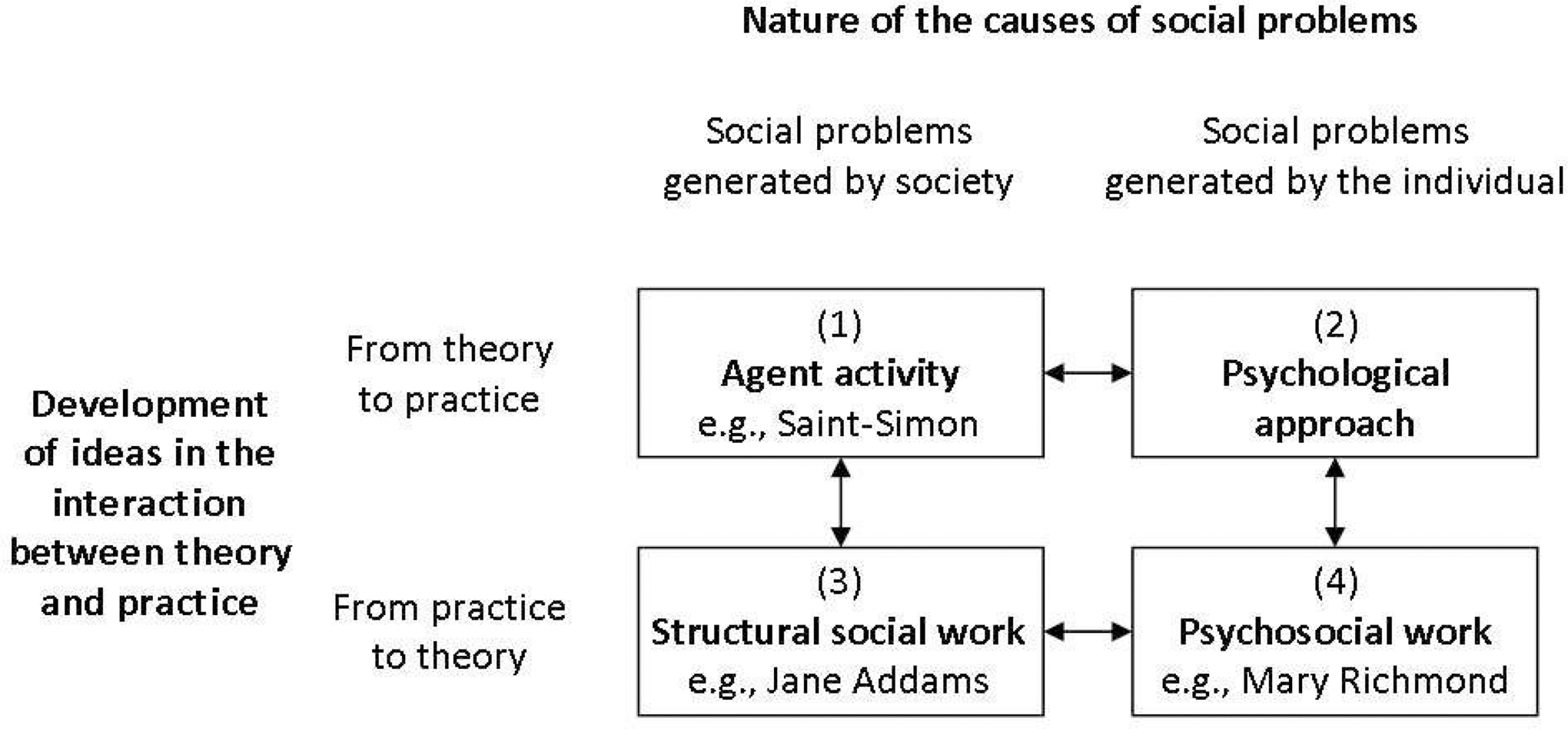
The fields of history of ideas in social work.
The thinkers and practitioners who are considered to be the classics and pioneers of social work can be placed in the different fields of the table. However, it is not my intention to include every conceivable classic and pioneer. The aim is to give examples that are considered typical of the characteristics of each field.
Field 1 is characterized by developments in the history of ideas in which the predominant tendency runs from theory to practice. Here, the focus is on society as the generator of problems. “Sociology as agent activity,” Saint-Simonism, and Marxism are good examples of movements and traditions of thought that are placed in Field 1.
Field 2 is characterized by a movement from theory to practice. The causes of social problems are sought in the problem-generating individual. In the social sciences, mainly psychological approaches are located in this field of knowledge.
Field 3 is characterized by the predominance of the tendency to transition from practice to theory, coupled with the belief that the causes of social problems are to be sought in society. Jane Addams and the settlement movement are examples of pioneers who can be placed in this field.
Research for change, referred to previously, can be placed in any of these three fields, but truly belongs in the upper part of the four-field table, particularly in Field 1. However, against the background of external interaction between theory and practice in research for change, this type of research and practice in social work can be related to the lower half of the table, especially Field 3.
Field 4 is characterized by a predominant tendency to move from practice to theory, while subscribers to this theory believe the causes of social problems are to be found in the individual. A typical example is the Charity Organization Movement with Mary Richmond as a leading social worker.
Summary
The purpose of this article has been to develop a theoretical frame of reference for the study and assessment of social work in the light of the history of ideas. My starting point was that social work is a practical activity and a scientific discipline. Can the discipline be defined so precisely that its main area of work, its conceptual content, and its historical traditions can be specified? It is apparent that there are many different types of definitions that can be applied to social work as a practical activity and a scientific discipline. It is natural that different definitions can be provided since there is constant interplay between concepts and social phenomena. What researchers and practitioners do within the social work profession has a dynamic character. The conceptual content of the discipline varies because research and the practical work of change are carried on in different fields over time. The historical conditions of the discipline develop as time goes on, and therefore, understanding the historical situation in which social work develops will be crucial to developing definition/definitions of social work. That social work has so many different definitions is thus a natural state of things. It is the task of a study of the history of ideas to discover the various definitions that have been given to the discipline.
Social work is also a practical activity, action for social change. The concept of homo ad juvendum paratus—that is, the human propensity to strive for mutual aid and assistance—is an important basis for social work. This fundamental human sociality has been laid as a foundation, and even as a criterion of determining the history of ideas in the discipline (Soydan, 1999). Naturally, this starting point has its value, but it cannot be productive if we understand social work as a practice and a scientific discipline. I argue that the description and analysis of the historical background of ideas in social work must be founded on the development of social science. This means that the development of social analysis in the Western tradition of thought during the 19th century must be the first arena for digging up the roots of the history of ideas in social work. This development is followed by the prevailing 19th-century tendency toward the work of social change. What happened in the 19th century is of central importance to social work. While developments in the history of ideas during the 18th century can be seen as preludes, it was the progress made in the 19th century that is the basis on which social work developed. The discipline of social work develops partly hand in hand with other disciplines, which gradually take on sharper contours in the process of specialization in social science, and partly as a result of the practical work of social change. From this development there arise questions of crucial importance to the social legitimacy of the discipline: What is the discipline's identity? What are the boundaries of the discipline in relation to other professions?
In this article, I have dealt with the relationship of social work with sociology and pointed out two important points of intersection between these disciplines. Soydan (1999) also addresses social work’s relationship to psychology. With regard to the relationship with sociology, I draw the conclusion that the problem of delimitation will remain for the foreseeable future. Both sociology and social work lay claim to common areas of activity, both in their research work and in their work of social change. The present balance of power indicates that sociology is stronger as regards social theory and methods of analysis, whereas social work has its strength in its orientation toward social change, which has always been the mainstay of the discipline’s tradition.
The struggle for where the limits are to be drawn, and partly the division of labor between them, will be dependent on how each discipline develops, which remains an open question. In this struggle, the exploration of the classics of social science is an important research task. Classics are regarded as such because they have a message for today’s society. An important mission for the discipline of social work is to root itself in the classics of social science and thereby create an increasingly clear-cut identity for itself.
It is with this purpose in mind that the frame of reference is intended to be used. The frame of reference is based on two variables that, in the perspective of history of ideas, play a central role in the development of social science disciplines. The interplay between theory and practice, and views of the nature of causes of social problems are central themes among the classics.
Establishing a base for the history of ideas in social work in the classics of social science can be done using the frame of reference to classify and assess thinkers and practitioners. In this way, we can clarify similarities and differences between the classics, which is a means of elucidating issues that form a field of tension in social work. The frame of reference is intended to be used to (1) classify classical thinkers and practitioners to identify similarities and differences between them, and to study lines in the history of ideas that lead to deeper reflection on social work, and (2) justify why certain classics may be considered the classics of social work. The frame of reference is thus intended to be used for the purpose of generating hypotheses in the research process.
Footnotes
Author’s Note
This article was prepared for the conference on “Shaping a Science of Social Work,” held at the University of Southern California School of Social Work on May 23–24, 2011. This article was invited and accepted by the editor.
Declaration of Conflicting Interests
The author declared no potential conflicts of interest with respect to the research, authorship, and/or publication of this article.
Funding
The author received no financial support for the research, authorship, and/or publication of this article.