



Abstract
Evidence based practice (EBP) is reflected in social work publications, accreditation standards, research, and funding opportunities. However, implementing EBP in social work practice and education has proven challenging, highlighting the need for additional resources. This paper describes the Transdisciplinary Model of EBP, a model based on advances in EBP across health disciplines including social work and its application to the development of an online EBP training portal. Utility of the Transdiciplinary Model and a training portal for social work education is discussed. Also included is a description of the training modules, the Council on Social Work Education Educational Policy and Accreditation Standards competencies reflected in the modules, and a case example using the modules in a master s of social work course.
Introduction
The influence of evidence-based practice (EBP) is increasingly reflected in social service funding mandates and policies as well as social work educational standards and scholarship. The demand for EBP from social workers is particularly strong for those working in health and behavioral health services. Social workers provide a large proportion of mental health, substance abuse, medical, and public health services in the United States (Bureau of Labor Statistics, U.S. Department of Labor, 2011), and there is an ever-growing arsenal of effective behavioral health interventions available in these areas of practice (The Campbell Collaboration, 2011; The Cochrane Collaboration, 2011). Furthermore, technological advances have facilitated the identification, synthesis, and dissemination of information about effective interventions.
Despite these pressures, opportunities, and advances, the implementation of EBP in usual practice has proved challenging. One valuable strategy to advance the use of EBP in the social work profession is to equip new and practicing social workers with the knowledge and skills to identify, assess, and apply research in practice. Unfortunately, studies of EBP education in social work highlight the limited and inconsistent integration of EBP content in social work education and the challenges associated with preparing social workers to use EBP in the field (Rubin, 2011; Rubin & Parrish, 2007; Weissman et al., 2006; Wike, Bledsoe, Bellamy & Grady, in press; Woody, D’Souza, & Dartman, 2006).
In this article, we present the transdisciplinary model (TM) of evidence-based behavioral practice (EBBP) and its potential to support EBP training and education in social work education (Satterfield et al., 2009). The TM was designed to increase the coordination of evidence-based behavioral health training, communication, research, and practice across allied health disciplines including social work, psychology, medicine, nursing, and public health. Toward that end, this model has been applied to develop a flexible web-based training portal (EBBP.org) that can be used as a tool to advance EBP training in social work. We describe the TM and the EBBP.org training portal as well as the correspondence between the training content provided by this portal and the competencies required by the Council on Social Work Education (CSWE) (2008) Educational policy and accreditation standards (EPAS). Finally, we provide an example and an assessment of the use of this web-based training portal in a master’s level social work research course and discuss other possible applications in social work education.
Background and Significance to the Field
EBP Training in Social Work Education
EBP for social work involves the integration of science-based assessments and interventions while taking into account client and community preferences and available resources in order to improve the conditions of individuals and populations. By “science-based assessments,” we mean measuring instruments and procedures with acceptable reliability, validity, sensitivity, and specificity as established by research methods; and, by “science-based interventions,” we mean intervention procedures validated through research methods for the problems and populations served. Efforts to use research to inform social work practice have a long history. EBP represents a contemporary effort to bridge the long-standing research to practice gap (Howard, McMillen & Pollio, 2003; Rubin, 2007; Rubin & Parrish, 2007). Efforts to integrate EBP content into social work education are reflected in recent changes to CSWE accreditation standards, which place greater emphasis on training in the use of research in practice (CSWE, 2008). Numerous presentations on EBP are delivered at the CSWE Annual Program Meeting and the Annual Conference of the Society for Social Work and Research, and a growing number of EBP textbooks and other training materials have been created for social work educators (e.g., CSWE, 2011; Danya International Inc., 2008; Mullen, 2010a; Rubin, 2007; Shlonsky & Gibbs, 2004).
Despite efforts to infuse social work education with EBP training, existing research suggests that the integration of EBP and evidence-supported interventions into classroom and field instruction has been limited and varied (Rubin, 2011; Rubin & Parrish, 2007; Weissman et al., 2006; Wike et al., in press; Woody et al., 2006). These studies suggest that few schools of social work formally endorse, emphasize, or require training in interventions with a strong evidence base. Although research courses are part of the core social work curriculum, the EBP process does not appear to be prominent in social work training programs (Wike et al., in press).
One of the reasons for this lack of emphasis on EBP may be social work educators’ attitudes toward EBP. Scholarship in the field has reflected debates and doubts as to the use of EBP in social work practice (e.g., Mullen, 2010b; Mullen & Streiner, 2004). Frequently discussed concerns include a loss of provider autonomy, lack of respect for clinical judgment in practice, use of EBP language to deny needed services and reduce costs, and limited research evidence for intervening with some social work problems and populations. Even some proponents of EBP express doubt that social work educators can accept EBP as an approach to practice, given these negative perceptions (Roberts & Yeager, 2006; Walker, Briggs, Koroloff, & Friesen, 2007). However, recent studies suggest that social work faculty and administrators have generally positive attitudes toward EBP (Bledsoe, Manuel, Bellamy, Fang, & Mullen, 2013; Rubin, 2007). The limited uptake of EBP into social work education suggests the presence of other barriers, many of which also impede the teaching of EBP in allied disciplines (Bilsker & Goldner, 2004; Straus, Richardson, Glasziou, & Haynes, 2005).
One barrier to the integration of EBP into social work education is the existing faculty’s lack of knowledge and skills necessary to teach EBP. For example, a 2007 survey of social work faculty revealed that respondents had varied definitions of EBP and uncertainties about how to use evidentiary hierarchies to judge the quality of research evidence (Rubin, 2007). EBP is a relatively new framework for social work practice and education. Because EBP is a relatively new approach to practice, many faculty and instructors who teach at schools of social work may not have had formal training in EBP. Others do not have doctoral level research training. A dearth of expertise in EBP may particularly characterize relatively small schools that lack doctoral programs or a strong research focus (Bledsoe et al., 2013). Moreover, many schools of social work employ adjunct faculty instructors to teach courses in social work practice; and very likely these instructors have even more varied training in EBP and research than faculty. Furthermore, social work education extends beyond the classroom and into the field. Field supervisors and social service agencies that provide an essential and large component of social work training may not have the necessary resources and knowledge to support students’ training in the application of EBP in social service contexts (Edmond, Rochman, Megivern, Howard, & Williams, 2006; Mullen, Bellamy, Bledsoe, & Francois, 2007). The nature of field placement training received by social work students reflects the range of EBP-related attitudes, resources, and behaviors of their supervisors (Edmond et al., 2006). Given the variation across faculty, instructors’ and field supervisors’ attitudes, knowledge, skills, and comfort with EBP, the EBP training experiences that students receive are likewise widely variable.
EBP Training Models in Social Work
Promising training models have emerged to increase social work practitioners’ positive attitudes, knowledge, and ability to implement EBP (Bellamy, Bledsoe, Mullen, Fang, & Manuel, 2008; Bledsoe et al., 2013; Coomarasamy & Khan, 2004; Glisson, Dukes, & Green, 2006; Manuel, Mullen, Fang, Bellamy, & Bledsoe, 2009; Parrish & Rubin, 2011). Many models were created chiefly for practicing professionals and involve partnerships with social work researchers or continuing education classes. In general, studies of these training models suggest that social work practitioners can be motivated to engage in EBP and can learn the basic steps of the EBP process (Bellamy et al., 2008; Parrish & Rubin, 2011). Less research is available to inform the integration of EBP education models into undergraduate and graduate social work training programs (Edmond et al., 2006; Howard et al., 2003; Rubin, 2011; Rubin & Parrish, 2007).
EBP Training Across Disciplines
Although existing training models in social work are promising, they are also limited because they are discipline specific. Social workers employed in multidisciplinary environments may find that the language, models, and approaches to EBP in which they are trained differ from those of their colleagues in other health disciplines. These differences could lead to difficulties in coordination and communication across disciplines. The demand for and the difficulty in implementing EBP in practice is not specific to social work. Allied professionals in behavioral health care are also facing demands to implement EBP. They are likewise striving to develop strategies to increase the use of EBP in their respective fields. Each major health profession (i.e., medicine, nursing, public health, and psychology) has focused on building their evidence base for practice (APA Presidential Task Force on Evidence-Based Practice, 2006; Brownson, Baker, Leet, Gillespie, & True, 2010; Greiner & Knebel, 2003; Gray, 1997; Mullen, Bledsoe, & Bellamy, 2008; Richardson, 1996; Sackett, Rosenberg, Gray, Haynes, & Spring & Hitchcock, 2009; Spring & Neville, 2010; Stetler, 2001; Straus et al., 2005; Titler et al., 2001). Unfortunately, advances in EBP are not easily shared across disciplines. Social work and allied professionals are collaborators in practice, but the development of research and training materials has historically remained profession specific. Each discipline has specific knowledge and strengths that could contribute to other disciplines’ training in EBP, but there has been an absence of interprofessional EBP education (Newhouse & Spring, 2010), thereby hampering efforts to move effective practices into team-based community care (Brekke, Ell & Palinkas, 2007). The development of a shared EBP vocabulary and conceptual foundation would facilitate collaboration in interprofessional research and practice. This more cohesive approach would be to the ultimate benefit of the broader field of behavioral health care and the clients served by it.
Existing barriers to interprofessional science and practice include dissimilar academic language, training, culture, and knowledge formation as well as profession-specific experiences. A common base of training and tools is needed to access, critically appraise, and iteratively apply the research evidence generated by each discipline. Establishing a common framework and forum to synergize the knowledge and perspectives of each discipline represents an important step toward facilitating interprofessional communication and understanding.
Development of the Transdisciplinary Model of EBBP and EBBP.org
In 2006, the National Institute of Health’s Office of Behavioral and Social Science Research commissioned Bonnie Spring to create the Resources for Training in Evidence-Based Behavioral Practice (EBBP) project. The goal of the project is to bridge the gap between behavioral research and practice by harmonizing and upgrading the EBP approach across health professions. The EBBP Project team is comprised of a multidisciplinary Council, Scientific Advisory Board, Practitioner Advisory Council, and a panel of expert consultants. The Council for Training in Evidence-Based Behavioral Practice includes representative experts from medicine, nursing, psychology, public health, and social work. Using a team science approach (www.teamscience.net), the EBBP Project identifies training gaps and creates learning resources to facilitate research to practice translation across disciplines. Professionals from the major health disciplines are collaborating to learn, teach, and implement EBP through the training project’s website (www.ebbp.org). In addition to training tools, the Council has collaborated to create the Three Circles of EBBP conceptual model as well as a description of competencies needed for EBBP, both of which are described next.
Conceptual Model
The transdisciplinary EBBP model integrates advances made within EBP models for social work, nursing, medicine, public health, and psychology while attempting to address remaining deficiencies (Figure 1).
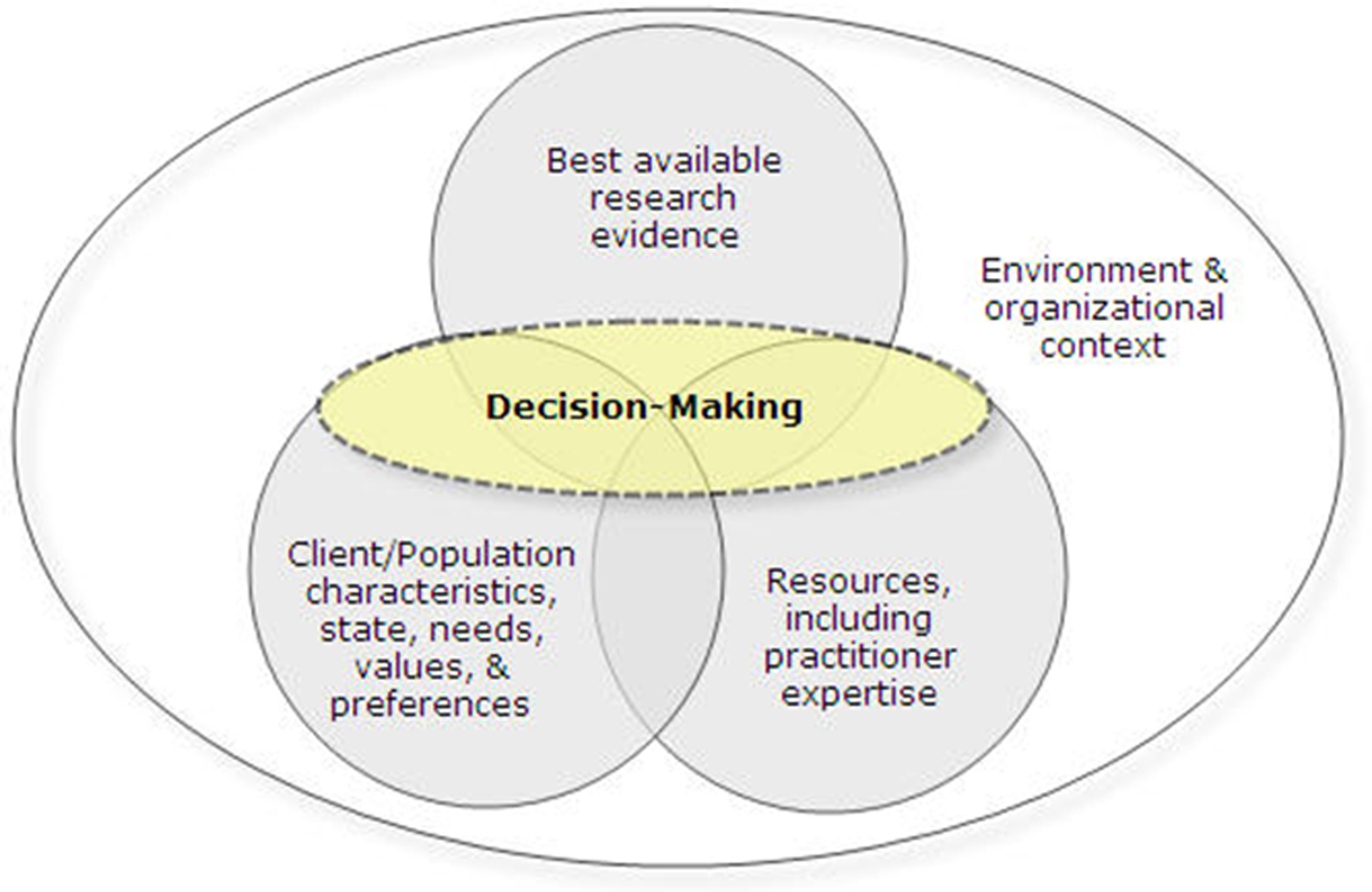
The transdisciplinary model of evidence-based behavioral practice (EBBP).
Earlier discipline-specific EBP models upon which the TM builds as well as a full description of the model are described in a previous publication emanating from the EBBP.org project (Satterfield et al, 2009). We use the term transdisciplinary (as opposed to multidisciplinary or interdisciplinary) to refer to an approach to EBP that moves beyond collaboration with or coordination between disciplines and reflects both a shared integrative conceptual framework of EBP and a common EBP skill set (Choi & Pak, 2006). The model is grounded in an ecological framework. As such it reflects an emphasis on shared decision making among professionals and with clients as well as the use of EBP across policy, public health, and direct client care decisions. This framework includes environmental and organizational factors, creating a cultural context that facilitates the acceptability of an intervention, its feasibility, and the balance between fidelity and adaptation needed for effective implementation. As part of the transdisciplinary approach, each discipline has contributed to important contextual lenses to the process—for example, nursing practice with its focus on coordination of care, organization, governing policies, purchasing agreements, and affiliations that modify the feasibility of practice recommendations; social work incorporating attributes of the client and community environment into the plan of care; and public health’s focus on policy enactment through organizations and communities. The best available scientific evidence is one of the three circles with evidence defined broadly so as to incorporate the various disciplinary perspectives and values.
Practitioner expertise features prominently in the model. Practitioner expertise includes four components: competence in performing the EBP process, assessment, communication, and collaboration as well as engagement and intervention (Spring & Neville, 2010). EBP process skills involve proficiency in the five steps of the EBP process or the five “As” (1) (Ask) formulate answerable practical questions, (2) (Acquire) acquire relevant evidence, (3) (Appraise) appraise evidence for quality and relevance, (4) (Apply) apply the evidence via shared decision making that also integrates client characteristics and resource considerations, and (5) (Analyze and Adjust) analyze outcomes and make adjustments as appropriate. Assessment skills designate competency in the appraisal of clients and communities as well as the appraisal of one’s level of expertise to implement and evaluate the outcome of a needed behavioral health service. Communication and collaboration skills entail the ability to convey information clearly, and to listen, observe, and adjust to achieve understanding and agreement on a course of action. Engagement and intervention skills involve, at a minimum, proficiency at motivating interest, constructive involvement, and positive change from stakeholders.
Decision making is at the center of the model and is seen as the cognitive action that moves evidence into contextualized practices. Rather than being based on the skill (or whim) of an individual professional, decision making is seen as a shared decisional process that integrates research evidence with client, resource, and contextual considerations. Its central position in the figure signifies the great difficulties and practical challenges in reconciling the various inputs needed to make evidence-based decisions about clinical care, public health, or public policy. By highlighting the nuances of data collection and decision making in the various disciplines (e.g., elevating patient preferences in nursing, more heavily weighting quantitative research evidence in medicine), and providing a TM that equally represents all of the various inputs, a practitioner using this EBBP model can collaboratively discuss the differing perspectives and needs of participating stakeholders, while centering the process on the client’s needs. This person-centric approach focuses the team to contribute in a way that helps clients and communities weigh the risk and benefits of their intervention options. Moreover, the emergence of disciplinary conflicts may trigger attention by policy makers who can direct resources to provider training, patient education, and community development that supports a shared model of evidence-based care.
EBBP.org
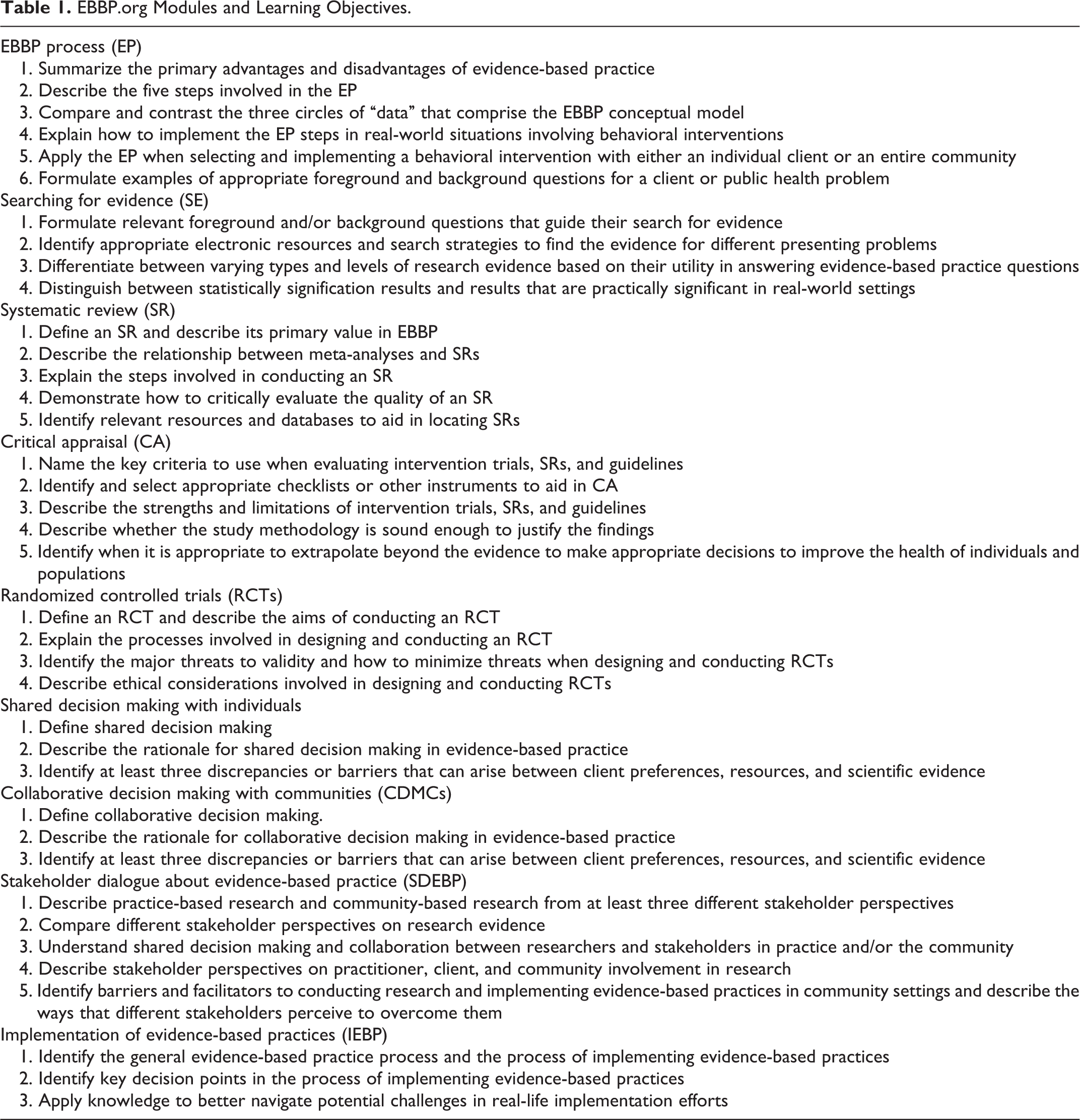
The EBBP.org website includes a detailed description of the EBBP conceptual model, including the EBBP competencies derived from the TM (Spring & Neville, 2010). Nine interactive training modules designed to target these EBBP competencies are accessible free of charge to the public through the website. The modules include the (1) EBBP Process (EP) module, which teaches users how to conduct the steps of the EP with a simulated client and/or community; (2) Searching for Evidence (SE) module, which is focused on strategies for choosing and using EBBP information tools; (3) Systematic Review (SR) module, which shows users how to evaluate and conduct an SR; (4) Critical Appraisal (CA) module, which teaches users about CA of research and introduces the hierarchy of evidence; (5) Randomized Controlled Trials (RCTs) module, which conveys the basics of how to design and conduct RCTs; (6) Shared Decision Making with Individual Clients (SDMCs) module, which leads users through the shared decision-making process by having them work through cases and attempt to balance the best available evidence with client preferences and resources in a clinical setting; (7) Collaborative Decision Making with Communities (CDMCs) module, which is focused on the collaborative decision-making process by having users work through a case from the point of view of a public health program manager working in a local health department; (8) Stakeholder Dialogue about Evidence-Based Practice module, which combines didactic contact on practice-based, commun-ity-based, and community-based participatory research, along with video interviews of stakeholders discussing barriers and facilitators to EBP; and (9) Implementation of Evidence-Based Practices module, which provides learners with information about the implementation process through the use of theoretical frameworks and the illustration of two real-world case examples of EBP implementation. A list of the modules and their corresponding learning objectives are presented in Table 1.
EBBP.org Modules and Learning Objectives.
An online evaluative component for each of the nine modules includes queries about demographic features (age, gender, degree, and profession). Each module also features an optional pretest and posttest, which allow users to assess their initial level of attitudes, knowledge, and skills in EBP and to gauge learning after completion of the module.
The EBBP website also is host to several other interprofessional training resources including up-to-date announcements of relevant events and funding opportunities, a platform for users to upload and download syllabi on EBP, a resource library with links to articles, glossaries, and teaching tools, and a blog with contributions from experts across disciplines. Initially, the EBBP training modules were targeted toward graduate students across disciplines, but subsequent modules have evolved to include practitioners on an interprofessional level. The goal of the site is to provide a user-friendly, informative, interactive forum where students, practitioners, and academics can learn about EBP in an interactive, translational, interprofessional format. In the 4 years since its launch in late 2008, the site has hosted 67,190 users (44,723 unique users) from 147 countries, with current traffic averaging 1,513 users per month. Of the 4,875 visitors who have used one or more of the modules, 1,590 have been social workers, with the remainder trained in medicine, nursing, psychology, or public health. A subsequent report will characterize and compare the EBP attitudes, knowledge, and skills of learners from these different professions.
The online training format offers some advantages over in-person EBP training models commonly used in social work education. First, it is less expensive because the resource is free to users and neither trainers nor participants have to travel. These benefits are particularly attractive in the context of increasingly limited resources reflected in both practice and education. Second, the online training platform promotes consistency in EBP training because participants are exposed to the same training components. Third, this approach to EBP training is convenient for participants who can engage in the training at any time from any location that provides Internet access. These online training advantages are realized both in academic and in practice settings, whether they are used in training programs or in the context of continuing education. Practicing social workers can also earn free continuing education credit through the online training portal, which may make it particularly attractive for licensed practitioners.
EBBP.org Training Modules and CSWE Educational Policy and Accreditation Standards
The CSWE EPAS outline 10 core competencies that direct the explicit curricula of accredited U.S. social work training programs (CSWE, 2008). The TM and the EBBP.org training modules are congruent with many core competencies and their corresponding knowledge, values, skills, and practice behaviors. Social work educators who are seeking to integrate EBP training into their program curricula can use the EBBP.org training content to increase EBP skills and target these social work competencies. In this section, we provide an overview of how 7 of the 10 EPAS’ core competencies are reflected in the EBBP model and website content. Although the content and training likely relate to other EPAS’ competencies, we highlight those competencies that we feel are most directly reflected in the training content. The core competencies as well as their corresponding practice behaviors and modules are provided in Table 2 and described in more detail below.
CSWE Core Competencies and Characteristic Knowledge, Values, and Skills Reflected in EBBP.org Training Modules.
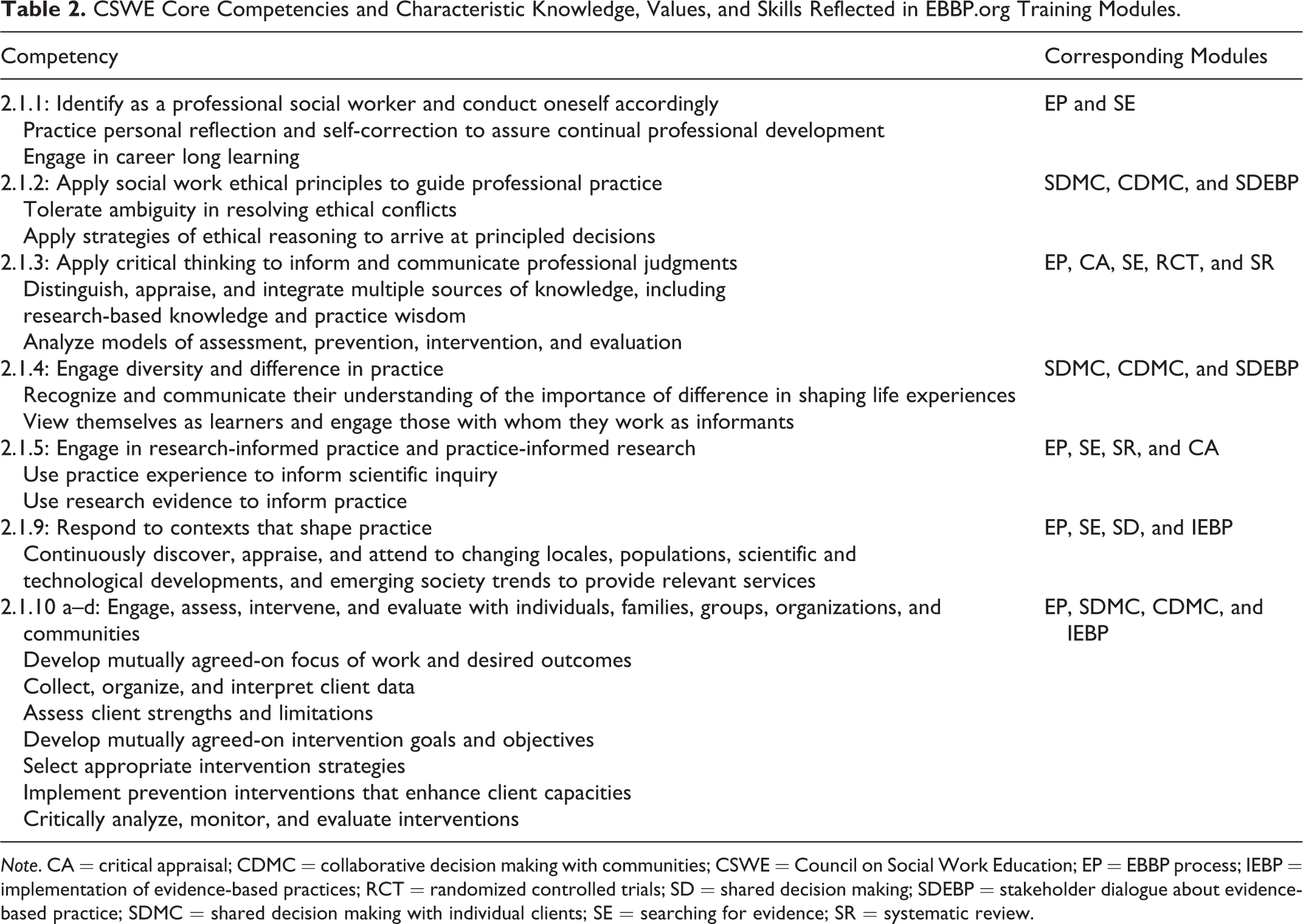
Note. CA = critical appraisal; CDMC = collaborative decision making with communities; CSWE = Council on Social Work Education; EP = EBBP process; IEBP = implementation of evidence-based practices; RCT = randomized controlled trials; SD = shared decision making; SDEBP = stakeholder dialogue about evidence-based practice; SDMC = shared decision making with individual clients; SE = searching for evidence; SR = systematic review.
Identify as a Professional Social Worker and Conduct Oneself Accordingly
Conducting oneself as a professional social worker includes practicing personal reflection and self-correction as well as engaging in a career of lifelong learning. The TM reflects the cyclical process of EBP whereby reflection on the process and outcomes associated with the selection and application of interventions are continuously evaluated. The EBBP.org modules guide participants through this reflective cycle as they engage in the EBP process and are cued to assess their own skills, decisions, and thought processes as they learn. The value of lifelong learning throughout one’s professional career is a guiding principle of the EBP framework, and this value is explicitly highlighted in the module on the EP and reflected throughout the website content on the evolving nature of research evidence, service contexts, and community partnerships.
Apply Social Work Ethical Principles to Guide Professional Practice
Ethical concerns and competing demands on practitioners are reflected in many of the scenarios used to illustrate the EBP process through the training modules. These scenarios were constructed to encourage participants to reflect on, and struggle with, complicated client and community situations. Many of the values outlined in the National Association of Social Workers (NASW, 1996) Code of Ethics are invoked in these scenarios. For example, the EBP framework guiding the modules prioritizes the social work professional value of dignity and worth of the person. Learners are asked to consider diverse clients and preferences and honor individual and community self-determination over personal or professional preferences. The value of competence or professional skills is also highlighted as learners are directed to realistically appraise their own skills and abilities to ascertain the “best available” treatments that they can provide as a resource to clients.
Apply Critical Thinking to Inform and Communicate Professional Judgments
Social workers are trained to balance multiple sources of knowledge and this complex professional thinking is reflected in the EBBP.org modules. Learners are asked to increase their proficiency in the identification and evaluation of research evidence, including significant content dedicated to research designs. The modules on the EP and shared decision making highlight how research evidence alone does not dictate practice with individuals and communities. Recall that the best available research evidence is only one of the circles represented in the TM. This commitment to other sources of knowledge, client, and community preferences, resource constraints, practice context, and the role of the professional in managing all of these sources of knowledge are explicitly explored.
Engage Diversity and Difference in Practice
Just as the modules present the opportunity for social workers to build competency in using many sources of knowledge, the modules also direct learners to engage individual clients and communities as partners. Three of the modules, one on SDMC, another on CDMC, and a third on stakeholders, speak directly to social workers’ need to learn from and engage those with whom they work as partners. The EBBP.org training module scenarios and examples reflect diverse settings and scenarios reflecting the varied communities and settings within which social workers practice.
Engage in Research-Informed Practice and Practice-Informed Research
This competency is perhaps most obviously linked to the EBBP.org training modules. EBP has evolved and advanced rapidly. Because the modules were developed using a transdisciplinary process, advances in EBP in social work as well as advances produced in other allied disciplines are reflected in the modules. The training content reflects the state of the art in EBP expertise through the leadership of The Council for Training in Evidence-Based Behavioral Practice.
Respond to Contexts that Shape Practice
Older EBP training models have often neglected the role of the practice environment and focused primarily on individual practitioner skills in finding, assessing, and understanding research evidence. The TM, by contrast, places the practice environment prominently in the EBP process. The EBBP.org training modules have likewise been built with particular attention to the contextual issues that impact the EBP process. The modules were explicitly designed to integrate contextual considerations by highlighting the roles of client and community stakeholders, resource limitations, and other complexities of practice contexts and by placing these considerations and skills needed to address them at the center of many of the modules (e.g., modules on shared and collaborative decision making as well as implementation).
Engage, Assess, Intervene, and Evaluate With Individuals, Families Groups, Organizations, and Communities
The five steps of the EBP process outlined earlier are reflected in The Council for Training in Evidence-Based Behavioral Practice. The objectives of the EBBP.org modules are to provide learners with training in each of these steps as well as assessment, collaboration, engagement, and intervention. These same skills are required of competent social work practitioners as they seek to work with clients through the intervention process.
Application of EBBP.org in Social Work Education
EBBP.org in the Classroom and the Field
The EBBP website can be used to support EBP training in social work education in the classroom, field training, and continuing education. The training modules may be applied in core social work practice courses, courses related to behavioral health care as well as courses on EBP and social work research. EBBP.org may be a particularly important teaching resource for social work faculty and instructors who have less training, expertise, or comfort in using EBP. The entire series of modules could be used as an alternative or a complement to social work textbooks on EBP; or individual modules could be selected as an alternative to traditionally assigned readings. The EBBP website can also easily be folded into online courses and other web-based learning tools that are increasingly being used in social work education (Coe Regan & Youn, 2008). Similar to other web-based training materials, EBBP.org may also be particularly useful in the context of training programs designed to provide educational opportunities to social work students in rural areas, working professionals, or other students who are difficult to reach through traditional classroom-based programs.
Concerns about the disjointedness between EBP education in the classroom and EBP education in field placements suggest the need for efforts to better connect these two training experiences for students (Coomarasamy & Khan, 2004; Mullen et al., 2007). Because the EBBP website is directed at both social work students and practitioners in the field, it could be used as a tool to bridge classroom and field education. Many schools of social work provide field supervisors with training and continuing education opportunities. If students participate in the same EBBP.org modules as their field supervisors as part of their classroom or field training, this could serve as a virtual common touchstone for learning and discussion across the classroom and field contexts.
The EBBP website is also useful as a stand-alone high-quality continuing education course in EBP. Many social workers are required to engage in continuing education hours to maintain licensure. However, online continuing education courses currently available to social workers vary widely in terms of how up-to-date, accurate, and evidence-based they are. It can be challenging for social workers in the field to critically assess and select strong continuing education courses among the overwhelming array of courses offered both online and off-line. Schools of social work, who offer continuing education resources, include links to online training, which might include EBBP.org as a resource.
Teaching Case Example: Application of EBBP.org into a Clinical Research Course
In order to provide an example of how the EBBP website might be folded into a more traditional social work classroom-based course, we will describe the use of EBBP modules in a required clinical social work course taught by the first author, including this author’s reflections on the use of the modules as well as student feedback. The course used as an example here is titled, “Clinical Research: Integrating Evidence into Practice.” This course is designed to provide students with an introduction to the EBP process using a problem-based learning experience. Students are asked to work through the steps of the EBP process and apply the related skills necessary to build competencies related to using EBP in social work practice. A copy of the full syllabus is available for download from EBBP.org in the teaching resource library section of the website.
Four EBBP website modules were integrated into this course, including the modules on the EP, SE, SRs, and CA. The modules were used to replace regularly assigned textbook chapters and journal articles on similar topics in this course. Using these modules to replace some of the traditionally assigned readings had some of the advantages from the social work educator’s perspective. First, the web-based interactive content provided a way to offer students a more varied learning environment, which is responsive to students’ diverse learning styles and preferences, and provides some opportunities to reinforce course content while reducing redundancy. For example, students interacting with the steps of the EBP process online also participated in a classroom lecture and discussion on the steps of EBP, and applied the steps in their assignments. As an unanticipated benefit, this social work instructor found it helpful to walk through the EBBP modules to get some new ideas about how to communicate EBP content to students using a transdisciplinary perspective. In the past, the assigned readings, assignments, and examples were drawn mainly from medicine and social work, but the EBBP modules encouraged a larger frame for teaching EBP that was inclusive of direct practice with individuals and families as well as community perspectives.
Seventeen students provided feedback on each of the four modules regarding learning objectives as well as the strengths and weaknesses of each of the modules. This feedback was collected as part of an anonymous midcourse evaluation process. Students were asked to indicate whether or not each learning objective was met or not met for each of the four modules (see Table 1 for a list of learning objectives 1).
Overall student feedback indicated that the modules were successful in meeting stated learning objectives. Seventy-five percent or more of the students felt that each of the learning objectives was met after participating in the corresponding module. The one exception was one learning objective in the module on searching for research evidence. Specifically, only 40% of the students felt that they were able to distinguish between statistically significant results and results that are practically significant in real-world settings after using this module. To respond to this student feedback, the instructor differentiated between two separate research-to-practice translation challenges and provided examples and explanations of each. The first concerns the need to be wary of statistically significant changes that are too small to be clinically important. The second concerns the challenge of external validity, that is, findings that may have limited generalizability because the research population studied was so highly selected as to be atypical (Green & Glasgow, 2006). In addition to providing an assessment of how well the modules met learning objectives, the students were asked to provide some general qualitative feedback on the strengths and weaknesses of the online training modules.
Overall the students reacted highly positively to the interactive nature of the modules. They felt that interacting with the material online helped them learn the material better and understand the EBP concepts and their application to “real-world” practice settings and kept their attention. Students liked how clearly some of the EBP skills were described. For example, they liked the content on the skills related to SE, including how the steps of the SR process were described and the clear distinction between an SR and a traditional review. Some of the areas in which the students found the module on CA particularly helpful were providing examples of what to look for when appraising studies, clear presentation of material and terms, and the usefulness of the modules as a refresher on students’ basic research knowledge.
Of the four modules used, the module on SE was less enthusiastically received by students as compared to the EP module. Student feedback suggests that part of the reason for this relative dissatisfaction was that this module followed the EP module, which was more interactive by comparison. Some students found the search module boring and too text heavy. Many students commented on the valuable resources presented through this module but felt overwhelmed by the amount of information to which they were exposed. In order to address these concerns, the faculty instructor reviewed some of the key databases and other search materials for students, answered lingering questions, and provided students with additional handouts on searching strategies and resources. In addition, one of the assignments for this course requires students to engage in a systematic search process, which seemed to help the students gain some more comfort and mastery with searching for research in general. Other less positive comments included that some of the students felt that some of the modules were long, they wanted even more interactive materials, and they needed some additional help or directions in using some of the interactive case materials.
Discussion and Conclusions
An essential component of advancing the implementation of EBP in behavioral health practice is professional education. Although social work has made some advances in EBP training and education, numerous gaps and challenges remain. The profession would benefit from the use of additional EBP training supports and resources. The TM of EBBP offers advantages as framework to guide further advancement of social work training in EBP. This model is benefited by knowledge and practices developed across allied disciplines, including social work’s emphasis on including a consideration of client and community attributes into the plan of care. This model also provides a common base from which social workers and allied health professionals can advance EBP together from a more synergistic and less segmented approach. This coordinated and cross-discipline approach to EBP has the potential to benefit the clients and communities that social workers serve. Improving professional collaboration through the use of a more consistent language and framework of intervention can reduce barriers to communication between professionals, better align intervention efforts delivered by interdisciplinary teams with complementary EBP competencies, increase the likelihood the social work will benefit from EBP advances in other disciplines, and likewise provide more opportunities for other disciplines to benefit from social work perspectives and knowledge.
The TM is also useful to social work educators in particular in that it concretely specifies EBP-related competencies. Although the CSWE has endorsed competency-based learning and the EPAS standards guiding social work education include language that is supportive of EBP, the EPAS provides little guidance as to how exactly to increase EBP-related competencies for social work students. Using the training content of EBBP.org to guide instruction on related EBP competencies could be a useful tool for social work programs seeking to increase the content and consistency of EBP training at their schools—especially in schools where EBP knowledge and training of social work instructors may be limited or inconsistent.
The example presented on the use of EBBP.org modules in a social work clinical research course suggests that these modules are generally well received by social work students and can provide a useful resource for social work educators. Integrating the online content provided a helpful alternative to traditional textbook and journal article readings and classroom lectures, and students were particularly appreciative of opportunities to engage in interactive content and apply EBP concepts in “real-world” search, appraisal, and application examples. It is difficult to say the degree to which the use of this particular model of EBP training resulted in improved learning outcomes for students. In general, there is a need for more rigorous studies of the use of technology to support EBP training. Existing research suggests that social workers generally feel positively inclined toward online continuing education resources (Barnett-Queen, 2001). Web-based continuing education is an attractive option for social workers who have difficulty finding time to fit classroom-based training into their schedules or cannot access classroom training due to geographical constraints. Existing studies of online training in social work appear to be generally as effective as traditional classroom approaches (Coe Regan & Youn, 2008); however, more research is needed to test the effectiveness of these approaches for advancing EBP in the field.
The TM and the EBBP.org training portal provide new opportunities to increase interprofessional training and dialogue on EBP and can perhaps serve as a model or catalyst for the development of more shared training experiences. Although the training modules were generally well received by students and appeared to be useful in meeting learning objectives in the case example provided, there was clearly room for improvement as well. This appears particularly true in terms of teaching students how to search for research evidence. Overall, more development and testing of transdisciplinary learning experiences, both online and off-line, are needed. We argue that there is a great deal of potential in EBP educational efforts that stretch across disciplinary boundaries and build on varied disciplinary strengths and perspectives. These efforts, however, are just emerging. Objective measurement of the extent to which learning outcomes are achieved for each of the EBBP.org modules is needed both for further module development and for guidance to future users considering use. Such outcome measurements should specify outcomes by user types and seek to identify barriers to use and facilitators needed to support positive outcomes.
Footnotes
Declaration of Conflicting Interests
The authors declared no potential conflicts of interest with respect to the research, authorship, and/or publication of this article.
Funding
The authors disclosed receipt of the following financial support for the research, authorship, and/or publication of this article: This project was supported in part by contract N01-LM-6-3512, Resources for Training in Evidence-Based Behavioral Practice, awarded by the National Institutes of Health Office of Behavioral and Social Science Research to Dr. Spring, Northwestern University.