




Abstract
Objective:
This study tested the effects of integrating evidence-based practice (EBP) process material into a research curriculum for master of social work (MSW) students.
Methods:
A quasi-experimental design (N = 152) was used across 12 sections of a required program evaluation course, with half integrating EBP process material and half using the traditional curriculum. A version of the Evidence-based Practice Process Assessment scale (EBPPAS) was administered at the beginning and end of the course. Analyses examined changes from pre- to posttest on EBPPAS subscales and assessed group differences.
Results:
At posttest, the EBP group had significantly higher ratings than the comparison group on the familiarity subscale. Both groups’ scores significantly increased at posttest on the familiarity with and engagement in the EBP process subscales.
Conclusions:
MSW students’ participation in a traditional program evaluation course is associated with increased EBP self-efficacy, and intentional introduction of EBP process material may further these outcomes.
The evidence-based practice (EBP) process model, initially conceived in medicine, was disseminated in the late 1990s and rapidly gained popularity within other allied fields such as nursing, psychology, and social work (Gibbs & Gambrill, 2002; Sackett, Rosenberg, Gray, Haynes, & Richardson, 1996; Sackett, Straus, Richardson, Rosenberg, & Haynes, 2000; Thyer, 2004). EBP is a decision-making model for practice that emphasizes the use of practice expertise to integrate the best available evidence, client’s values, preferences and culture, and the practice context and circumstances to ensure that the best care is provided for clients (Mullen, Shlonsky, Bledsoe, & Bellamy, 2005). The model was developed to close the research–practice chasm (Rubin & Parrish, 2012) in which many practice decisions are made without attention to a vast evidence base and few decisions are evaluated thoroughly (Mullen, 2006; Nelson, Steele, & Mize, 2006).
The EBP process model involves five steps (Straus, Richardson, Glasziou, & Haynes, 2005). Practitioners are encouraged to (1) ask a well-structured question related to the needs of the client/community they are serving; (2) search efficiently for evidence to answer their question; (3) appraise the evidence they find critically to determine its impact (effect size), applicability (usefulness), and validity (accuracy); (4) apply the best evidence by integrating this information with their understanding of their client’s values, preferences, characteristics, and situation as well as the resources available; and (5) evaluate the effects of their practice to determine whether they are efficient and associated with positive outcomes for the client (Straus et al., 2005).
The EBP process model, as well as recent advancements in technology, has increased optimism among social work educators regarding the possibility of narrowing this research–practice gap among social work students and future practitioners (Rubin & Parrish, 2007). First, this approach appears to be more acceptable to practitioners, as it allows for the flexibility of considering the best available research evidence within the complex factors encountered in the practice setting, such as varied client characteristics and presenting issues, agency contexts, and practitioner expertise (Parrish & Rubin, 2011a). This model also emphasizes the importance of informed consent and self-determination, where the client is provided with the research evidence, and then empowered to make a collaborative decision with the social worker regarding the potential solution or intervention (Parrish & Trawver, 2013).
Second, technological advances in the last decade have resulted in nearly all social workers having access to a wide array of evidence (O’Neill, 2003). A variety of online resources, such as the Cochrane and Campbell Collaborations, which provide systematic reviews that synthesize the best available literature, have sprouted up, making research-based evidence more quickly and easily accessible than before. In fact, most practitioners can sign up at their local library for free remote access to most of the research databases that universities provide. When an intervention or program is identified, empirically supported manuals and guidelines are increasingly being provided online with information about possible training opportunities (Parrish & Trawver, In press). When this is not possible, practitioners may be able to refer their clients to free or reduced cost interventions provided by phone or Internet. These developments are providing practitioners in a variety of settings, from remote rural areas to those with limited resources, with new and exciting possibilities to close the research–practice gap.
Why EBP and Social Work?
While there has been some concern with too quickly adopting the EBP process model in social work (Adams, LeCroy, & Matto, 2009), most social work educators agree that it is important to integrate research into real practice settings (Gibbs & Gambrill, 2002; Rubin & Parrish, 2007). The EBP process model appears especially well suited for integrating research into social work practice because it resonates with social work’s ethics of informed consent, self-determination, competence, and respect for diversity and the worth of the person (National Association of Social Workers [NASW], 2008). In fact, the EBP process practice question emphasizes the inclusion of specific client characteristics (e.g., age, gender, ethnicity/race, and culture) to guide the search for the best available evidence. Once the evidence is located using the search terms in the question, the various practice options are presented to the client (informed consent), and they are engaged in a collaborative decision-making process regarding their care (self-determination). The emphasis on the use of the best available research evidence ensures that options with the best probability of working for a particular client will be prioritized, increasing the likelihood that they will be helped. This process also supports practitioner competence and empowerment by encouraging practitioners to critically examine the evidence base.
Although some have argued that the use of outcome studies to identify interventions for practice minimizes emphasis placed on relationship factors (Adams et al., 2009), the EBP process model suggests the importance of both using interventions supported by evidence and engaging clients in a trusting therapeutic relationship when trying to obtain the best outcome. For example, when treating posttraumatic stress disorder (PTSD), unquestionably, it is important to both develop a positive, trusting therapeutic working relationship with a client and provide one of the interventions that are empirically supported to reduce symptoms. It is not merely enough to be a supportive, warm therapist with positive regard for the client. Similarly, providing an intervention, even a highly effective one, without a supportive, trusting relationship between practitioner and client, may not lead to positive outcomes for the client. Just as social workers are bound by the social work code of ethics to work with clients from a basis of positive regard, social workers are ethically bound to provide practices based on empirical knowledge (NASW, 2008). If there is a treatment that has been shown to be most effective in reducing symptoms of PTSD and a social worker is not using it, we would argue that this is a serious ethical issue.
While there remain challenges to the implementation of the EBP process, these challenges do not negate the importance and value of social workers continually striving to engage in practice supported by the EBP process, in other words practice that is reflective; is self-critical; uses evidence to discern what is most likely to work; evaluates practice decisions to ensure client needs are met, resources are not wasted, and harm is not inflicted; and considers clients values/preferences and one’s own professional abilities. So while we may not have a perfect evidence base for all practice questions, or ideal systems within which to implement them, these are not acceptable reasons for not engaging in the tenets of this model. In fact, it is our ethical duty according to the NASW Code of Ethics to engage in all aspects of the EBP process model (NASW, 2008). For this reason, it is essential to train social work students and practitioners to be aware of potential feasibility issues when implementing EBP and to work within and with such issues to maximize these principles.
Recent Efforts in Social Work to Support Education on EBP
There has been wide acceptance of the EBP process model in social work education (Drake, Jonson-Reid, Hovrnand, & Zayas, 2007; Edmond, Megivern, Williams, Rochman, & Howard, 2006; Howard, McMillan, & Pollio, 2003; Rubin, 2007). To illustrate such acceptance, there have been myriad professional meetings, presentations, and publications focused on the use of this model for closing the gap between research and practice as well as ways to ensure this model is taught and disseminated among social work practitioners (Rubin, 2007; Rubin & Parrish, 2012). To further cement these goals, several changes were made to the current Council on Social Work Education (CSWE) Educational Policy and Accreditation Standards statement to promote aspects of the EBP model within schools of social work, while leading schools, such as the Brown School of Social Work, have made this model their guiding curricular framework (CSWE, 2008; Drake et al., 2007).
As the EBP process model is gaining increasing support in social work education settings, it is clear that educators are gaining skills in appropriately disseminating this knowledge to master’s-level social work students (MacGowan, 2010). Educating social work students typically includes introducing students to the importance of the EBP while exposing them to the process (posing a research question, systematically searching the literature, critically reviewing the evidence, and applying it to practice), and presenting them with resources for searching (Drake et al., 2007). The goal is to enable students to develop familiarity and begin to assimilate these concepts as common practice (Drake et al., 2007). In doing so, instructors utilize their expertise in research methodology to help students interpret and appraise findings in the literature (MacGowan, 2010). Extending beyond research courses, it has been argued that EBP practices should be infused throughout the entire curriculum (Walker, Briggs, Koroloff, & Friesen, 2007), so that assignments in every course and field practicum experiences reflect the EBP process (Drake et al., 2007).
Despite such substantial efforts, there remains a dearth of evidence testing whether classroom instruction about the EBP process results in changes in students attitudes and behaviors (Mullen, Bledsoe, & Bellamy, 2008; Parrish & Rubin, 2011a). Moreover, even with a variety of efforts to disseminate information to practitioners regarding the EBP process, there continues to be low levels of EBP implementation in the real world across various behavioral health professions (Parrish & Rubin, 2012). Consequently, it is essential to assess the effectiveness of various efforts to educate social workers on EBP as well as identify the barriers or facilitators of successful implementation in “real-world” settings.
The Current Study
This quasi-experimental study reports on a comparison between a standard program evaluation course and a program evaluation course with additional curricular components that emphasized the EBP process. Although program evaluation curricula may differ slightly by school, standard program evaluation courses typically cover basic research methods (e.g., formulating research questions, ethical considerations, literature search, research designs, sampling, and data collection), while applying such methods to evaluating the outcomes associated with a social work service or program. In the current study, this traditional format is compared to a curricula approach that enhances traditional content with greater detail on the EBP process model (described further below). Using the validated Evidence-based Practice Process Assessment scale (EBPPAS; Rubin & Parrish, 2010, 2011) to assess the differences between the two groups, we hypothesized that the program evaluation course with enhanced EBP content would be associated with more positive attitudes about EBP, higher levels of familiarity with EBP and perceived self-efficacy in implementing it, higher current engagement in the EBP process, greater belief that EBP is feasible in the real world, and greater intention to engage in the EBP process in the future.
Method
Sampling and Procedures
Students who participated in this study were obtaining a master’s degree in social work (MSW) and were enrolled in a program evaluation course at a university in a midsized western city. Program evaluation was a required course and students selected a section of the course based on instructor and schedule preferences. In the term prior to the course, instructors of all 15 sections were sent an e-mail from the principal investigator inviting them to have their course sections participate in the study. Ten instructors teaching a total of 12 sections agreed to have their course sections participate and were subsequently asked whether they would be willing to modify their traditional curriculum by integrating additional material on the EBP process through lecture, discussion, and assignments. Approximately half of the instructors agreed to modify their courses and were subsequently sent EBP process materials (detailed below) to integrate into their course. Due to some instructors teaching more than one section, this resulted in five sections (n = 86 students) of the course taught with a standardized traditional curriculum and seven sections (n = 94 students) taught with integrated EBP process material. Tenure-track and adjunct professors were equally represented in the EBP process group and the comparison group.
Students in both the EBP process group and the comparison group received the curriculum over the course of 10 weeks. On the first day of class, all students willing to participate were given a pretest assessment, the EBPPAS, to evaluate their baseline knowledge and intent to apply EBP principles. The same assessment was given to students on the last day of class to determine the extent to which their values, beliefs, and attitudes toward EPB processes had changed. Instructors in all seven sections of the EBP process group administered the posttest assessment, and three of the five comparison section instructors administered the posttest with their students. Analyses were based on students who completed both pretest and posttest assessments (see Figure 1 for flowchart of participants in study). This study was approved through the University Institutional Review Board, and proper precautions were taken to ensure confidentiality and obtain consent.
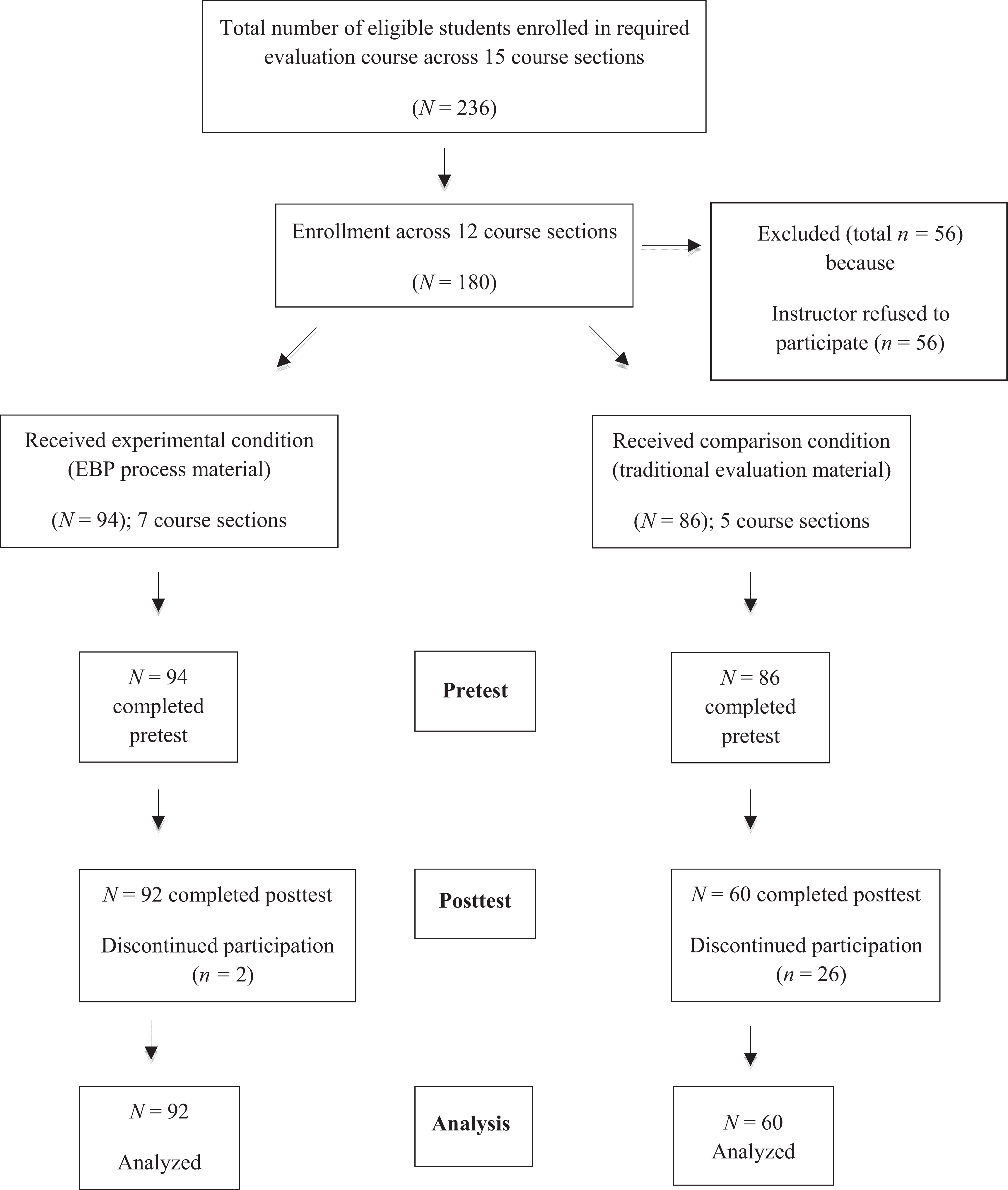
Flow of participants through each stage of the quasi-experimental research study.
Course Content
Approximately half of the students (five sections; n = 60 students) in a program evaluation course, labeled the comparison group, received a traditional program evaluation curriculum partially standardized across sections (same syllabus and assignments). These comparison sections taught students skills for evaluating social work practice and programs through lectures, activities, and discussions about research and evaluation concepts (formulating research questions, ethical considerations, literature search, research designs, sampling, and data collection); students applied these skills by proposing an evaluation plan for the agency in which they were conducting their field placement. Primary assignments included a feasibility assessment, in which students developed logic models of target programs and determined agency evaluation needs, and an evaluation proposal, in which students detailed their plan for evaluating some aspect of the program. Although students were required to search the literature to inform their proposal development, EBP process material was not explicitly required in these comparison sections.
The other half of students taking this required course (seven sections, n = 92 students), labeled the EBP process group, received a revised curriculum that included many of the same elements as the comparison group but focused intentionally on integrating EBP process material. The EBP process group aimed to build student proficiency in conceptualizing and applying the EBP process while learning traditional program evaluation skills. The additional curriculum for the EBP process group included education on methods for formulating EBP questions, searching the literature, appraising the validity of evidence, and assimilating evidence into agency and program environments. This material was included via PowerPoint slides, facilitated discussions, and a new assignment, the EBP process worksheet, which replaced the feasibility assessment. The EBP process worksheet (see Appendix) walked students through the EBP process as applied to their current field placement, including asking well-stated questions, searching the literature, appraising the evidence, integrating that evidence with the needs of the agency and clients served, and developing an evaluation plan. Like the comparison group, students’ final assignment for the course was a proposal for a program evaluation that was to be carried out the following term. Although both versions of the course required students to use research evidence to support their proposed program evaluations, only the EBP process group received instruction on the process of integrating research evidence into practice.
Measures
A revised, shortened version of the EBPPAS was administered by graduate research assistants in paper and pencil format at pretest and posttest to students in different sections of the program evaluation course. The scale assesses student and practitioner attitudes of the EBP process and evaluates their application of these principles (Rubin & Parrish, 2010, 2011). Our revised shortened version of the EBPPAS was composed of 40 items that follow a 5-point Likert-type scale (1 = strongly disagree, 2 = disagree, 3 = neutral, 4 = agree, or 5 = strongly agree). Five subscales included familiarity with the EBP process (10 items), attitudes about the EBP process (14 items), feasibility to engage in the EBP process (3 items), intentions to engage in the EBP process (6 items), and current engagement in the EBP process (6 items). The subscales included questions such as “I understand how to formulate questions about practice that can be answered with research evidence” (familiarity), “EBP helps improve client outcomes” (attitude), “I have enough time to engage in the EBP process” (feasibility), “I intend to read about research evidence to guide my practice decisions” (intention), and “I rely on research evidence as the best guide for making practice decisions” (engagement). The EBPPAS has been validated as a reliable scale with α subscales ranging from .74 to .94 (Rubin & Parrish, 2010, 2011). For the current study, a few items were removed from three subscales (feasibility, intentions, and engagement) to increase relevance for students currently in field placements rather than employed as social workers. The remaining two subscales (familiarity and attitudes) remained the same as the original instrument. Our revised shortened version demonstrated adequate reliability across subscales, including αs for familiarity (.89), attitude (.84), feasibility (.67), intent to engage (.75), and engagement in the EBP process (.80).
Data Analysis
Data analyses were conducted in Statistical Package for the Social Sciences (version 18.0). Items from each subscale were averaged for each individual and then means across groups and across time were compared. To assess change in individual students over the course of 10 weeks, paired t-tests were conducted. To compare differences among the intervention group and the comparison group, independent samples t-tests were conducted. For all t-tests examining group differences, an effect size (Cohen’s d) was also calculated as described by Howell (2011) to provide an indication of the magnitude of the effect (.20 = small; .50 = medium, and .80 = large; Cohen, 1992). Finally, to examine instructor-level differences, analysis of variance was used to analyze differences at posttest across instructors.
Results
Individual demographic variables were not collected in an effort to protect student confidentiality; however, demographic information for all students enrolled across sections was collected from the school registrar. Students enrolled in the program evaluation course had the following characteristics: the average age was 28 years (SD = 6.1); 91% were female and 9% were male; 79.2% identified as White; 3.4% identified as Asian, 3.4% identified as Black or African American, 2.1% identified as biracial, 0.8% identified as Native Hawaiian or other Pacific Islander, and 11% identified as unknown. Approximately 79.2% of the students were in their second year of the MSW program and 20.8% were advanced standing MSW students.
The EBP process group and comparison group did not differ significantly on any of the EBPPAS subscales at pretest (see Table 1). On average, students in both the intervention and the comparison groups were neutral about their familiarity with (M = 3.05 and 3.15, respectively, on a 5-point scale) and current engagement in the EBP process at pretest (M = 3.01 and 3.12). Students in both groups tended to agree with statements indicating positive attitudes toward (M = 3.74 and 3.72) and intentions to use the EBP process (M = 3.86 for both groups). Students in both groups were just slightly more likely to be positive about the feasibility of implementing EBP in practice (M = 3.43 and 3.40).
Intervention and Comparison Group EBP Subscale Ratings at Pretest and Posttest.

Note. EBP = evidence-based practice. EBP process = intervention group; Comp = comparison group; d = Cohen’s d effect size.
*p < .05. **p < .01. ***p < .001.
At posttest, the intervention group (M = 4.05, SD = 0.40) reported significantly higher ratings of familiarity with the EBP process than the comparison group (M = 3.87, SD = 0.51), although this was a small-to-medium effect (d = 0.42). Both the intervention (d = 1.56) and the comparison groups (d = 1.01) demonstrated large and significant increases in familiarity by the end of the course. The two groups did not differ at posttest on the remaining four outcome variables—attitudes, feasibility, intentions to engage, or current engagement in the EBP process in their work. However, by the end of the course, moderate gains were made in both the intervention (d = .49) and the comparison groups (d = .40) in their engagement in the EBP process. In addition, both groups demonstrated small increases (d = .24) on attitudes toward the EBP process.
Neither group increased their intentions to use the EBP process in the future, nor their beliefs that the EBP process was feasible. In fact, the EBP process group reported decreased feasibility ratings from pre- (M = 3.43, SD = .56) to posttest (M = 3.30, SD = .66). Subscale means did not vary significantly by instructor/section with the exception of students’ ratings of familiarity at posttest, F = 2.82(df = 9), p = .004, where 2 of the 10 instructors, both in the comparison group, were rated lower than others.
Discussion and Applications to Social Work
The results of this quasi-experimental examination of integrating EBP process materials into an existing MSW program evaluation curriculum show that the addition of EBP process materials was associated with increased student familiarity with the EPB process. However, this significant effect was small to moderate. Familiarity, as measured by the EBPPAS, is an indication of students’ self-efficacy in using the EBP process; for example, it includes items such as “I understand how to formulate questions about practice that can be answered with research evidence” and “I know how to find systematic reviews.” The EBP process curriculum was associated with an increased sense of EBP-related self-efficacy more than the traditional program evaluation curriculum. Given the substantial empirical base linking domain-specific self-efficacy with goal setting and subsequent performance in that domain (Bandura, 1982; Bandura and Locke, 2003; Zimmerman, 2000), it is possible that students’ increased self-efficacy in the ability to implement the EBP process will lead to subsequent successful implementations of the EBP process. In other words, because students feel more confident in their knowledge of the EBP process, they may be better equipped to apply it in their work with clients, agencies, and communities. Thus, it is encouraging that the EBP process materials led to greater familiarity or self-efficacy in the EBP process.
It is similarly encouraging that the traditional program evaluation curriculum also facilitated familiarity with EBP, although to a slightly lesser extent, and that both the EBP process and the traditional program evaluation curricula led to increased positive attitudes toward and engagement in EBP. Changes in these three dimensions suggest that students’ knowledge and perceptions of EBP are shifted in the process of being educated about scientific evidence as part of their MSW programs. These results are consistent with goals articulated for advancing the effectiveness of social work practice education through the inclusion of EBP materials in MSW curricula (e.g., Howard, Allen-Meares, & Ruffolo, 2007; Proctor, 2007).
As is often the case with quasi-experimental studies conducted in “real-world” settings, there are certain limitations to be considered in interpreting our findings. We were not able to randomly assign students to condition, nor, more importantly, randomly assign course sections to either the EBP process or the traditional program evaluation condition. Thus, the results may be limited by self-selection bias, in that instructors volunteered to participate in the study and subsequently volunteered to be in the intervention group. As a result, it is possible that those instructors who agreed to include additional EBP materials were particularly interested in and motivated to emphasize EBP. Conversely, it is also possible that those who did not volunteer to participate in the EBP process condition may have already been including other EBP-related process, as instructors followed a standard syllabus but were able to modify content individually. Because random assignment was not feasible given the constraints of the host institution, the latter explanation could suggest the intervention and comparison condition differed less than hypothesized in regard to the inclusion of EBP material and therefore few significant differences were recognized across groups at posttest.
In addition to random assignment, a test of the EBP process curriculum would ideally include greater fidelity assessment, which would allow for better assessment of the quality of implementation of the added EBP process material and its affect on outcomes. Systematic monitoring may have encouraged greater consistency across instructors within each group; however, in a “real-world” academic setting, where instructors have some autonomy in the classroom, such controls were not possible. Relatedly, observations that assess for the dose or exposure of EBP process material included in every course section (intervention and comparison) would provide valuable information, but unfortunately resources were not available to monitor fidelity or exposure systematically. Finally, due to lack of resources, follow-up surveys were not feasible, limiting our understanding of the longer term effects of each condition.
Although identical posttest procedures were used, attrition was higher among comparison group participants; however, attrition was related to instructors not administering the posttest survey rather than individual students selecting not to participate. Analyses examining change over time or comparing the two groups at posttest could only be conducted on students who completed the posttest survey. It is therefore possible that those instructors least invested in the topic of EBP declined to administer the posttest, providing a conservative estimate of differences between the intervention and comparison groups, and elevated estimate of positive changes in regard to EBP attitudes across groups. In regard to the EBPPAS, some may question whether students who are currently only practicing in field practicums or internships may be overly optimistic or idealistic in their responses on several scales (e.g., intent to engage in EBP process); the degree of idealism or optimism may have varied based on student’s placements and degree of autonomy in practice experienced by each student.
Despite these limitations, this study suggests implications for social work education, practice, and research. In discussing these implications, it is important that we acknowledge our caution in generalizing our findings to other schools of social work nationally. Our study was conducted in one, private, mid-sized school of social work in the West. Findings are most applicable to schools that attract similar student bodies.
In regard to implications for social work education, our results suggest providing curricula on program evaluation research to MSW students is associated with increased familiarity, engagement, and more positive attitudes toward the EBP process model. This was true of traditional program evaluation curricula, and even more so of curricula enhanced by explicit instruction on the EBP process, in regard to improving familiarity. To some degree, schools of social work may already be presenting the EBP process as part of their program evaluation courses. However, doing so explicitly, through assignments that require students to work the steps of the process, may enhance students’ self-efficacy significantly. This is a promising step in the goal of training social workers to use evidence in practice.
In addition, our study generally finds positive attitudes toward EBP across students at pretest. This suggests many current students may be entering MSW programs with a value and appreciation for the importance of the EBP process in informing their work. Schools of social work may not need to convince students of the value of EBP but instead inform them of the EBP process steps and give them opportunities to implement the model experientially.
Schools of social work should also be aware that, although our findings show that students were more familiar with EBP, engaged with the process, and had positive attitudes about it, they were neutral about the feasibility of implementing EBP in the real world. Neither the additional EBP process materials nor the traditional program evaluation curriculum led to an increase in students’ perception that using EBP in practice is feasible. In fact, the group with greater training on the EBP process decreased their ratings from pre- to posttest in regard to feasibility. It may be that gaining a deeper understanding of the process reinforced for the intervention group, the tools, and resources necessary to use the process in practice. It could also be that the EBP process group, in integrating empirical evidence with current practices at their agency, may have given greater attention to implementation issues, leading them to identify feasibility issues unrecognized by the comparison group.
Feasibility is a major barrier to the translation of EBP and research knowledge into practice and highlights the need for additional intervention to aid in this translation. Findings from a recent implementation of an EBP process intervention in agency settings similarly highlight the need for multilevel interventions that address both individual attitudes and knowledge (as did our intervention) along with agency-level and systemic barriers to the use of evidence in practice (Manuel, Mullen, Fang, Bellamy, & Bledsoe, 2009). Given the need to intervene at multiple levels, students’ skepticism about the feasibility of implementing EBP in practice may indeed reflect their accurate assessment of the organizational and systemic barriers that hamper EBP implementation. Students value information and training on how to access the resources required to properly implement the EBP process in their practice. Addressing feasibility issues may result in greater intentions for using the EBP process upon graduation. Instruction should explicitly address methods for finding evidence efficiently as this may be one barrier to feasibility. In addition, it is important to address organizational and systemic barriers to EBP implementation. While research is one avenue for reducing these barriers, educators can also prepare future social workers to increase their comfort with such barriers and to partner with various entities (e.g., researchers, evaluators, funders, and policy makers) to actively reduce them. As the field continues to find methods for making evidence more accessible to practitioners (e.g., through online clearing houses), and students are better prepared to grapple with and solve real-life barriers related to the integration of research and practice, EBP implementation in practice may become more feasible.
In the meantime, social work research should seek to better evaluate the influence of research curricula in changing the knowledge, attitudes, and competencies of social work students in regard to the EBP process. Building upon the work presented here, future evaluation should aim to enhance methodological rigor through randomized design, monitoring fidelity of instruction and exposure to EBP content, and attempting to reduce or assess the impact of attrition. Future evaluations should use the unmodified EBPPAS for more reliable measurement, as our reliability estimate for the feasibility subscale was adequate but not ideal, and complete subscales, including the feasibility and attitudes subscales, yielded good to excellent internal consistency and sensitivity in this and other studies (Parrish & Rubin, 2011b; Rubin & Parrish, 2010, 2011). Enhancing the rigor of future research on training social work students on the EBP process model is likely to overcome many of the threats to internal validity inherent in this initial study. Future research should seek to test causal relationships between curricula provided and student knowledge and skills, assessing for how well, how often, and to whom the curricula is provided. Additionally, future studies should assess whether social work curricula aiming to enhance EBP knowledge and skill have effects once students are engaged in social work practice in the field. The field of social work is likely to benefit from such enhanced efforts to incorporate EBP process material in social work education and evaluate this effort rigorously.
Footnotes
Appendix
Declaration of Conflicting Interests
The authors declared no potential conflicts of interest with respect to the research, authorship, and/or publication of this article.
Funding
The authors disclosed receipt of the following financial support for the research, authorship, and/or publication of this article: Dr. Bender received funding from the University of Denver's Center for Teaching and Learning to support this research.