



Abstract
U.S. tenure-track positions have steadily declined over the past 30 years and emphasis on research productivity has escalated. To achieve higher research and scholarship goals, the literature revealed that African American scholars have additional issues to overcome beyond the usual hurdles and challenges confronting other faculty. This study explored current research productivity by examining citation impact scores (h-indices) collected from Publish or Perish of African American scholars in top 25 ranked schools of social work cited in the 2012 U.S. News and World Report. The resultant sample consisted of N = 14 scholars with h-index scores of 9 and higher. Results revealed nonsignificant statistical differences between specified subgroupings, and 80% of these scholars overexceeded their respective school mean h-index scores. Future research calls for a more comprehensive knowledge of faculty research and scholarship activities overall, including unique subgroups of Social Work scholars such as African Americans.
Keywords
Introduction
Today, North American colleges and universities are struggling to hold on to depleting public funds due to economic downturns that drastically altered educational spending (federal and state) over the past 30 years or more (Bruininks, Keeney, & Thorp, 2010). Institutions of higher education are not only in competition with one another, but also with the increasing fiscal demands policy makers are faced with, such as health care, public safety, and quality of life issues (Bruininks et al., 2010). Kane, Orszag, and Gunter (2003) stated “state appropriations for higher education in the U.S. should be about 20% (or $14 billion) higher than they currently are, if appropriations had sustained the same ratio to personal income as in 1977” (p. 2). They further asserted that the state of higher education is due in large part to the decline in appropriations that never fully rebounded during the last economic recovery; and the unchecked increased growth of health care and entitlement appropriations (Kane, Orszag, & Gunter, 2003). Therefore, as Bruininks, Keeney, and Thorp (2010) stated, the new reality for higher education “is a world with fewer public dollars to support the education, research, and outreach mission of public and land-grant universities” (p. 114). Although private institutions are not as reliant on public funds, they too aren’t totally exempt from such important trends and their impact.
In addition to increasing economic uncertainty, colleges and universities are faced with higher state levels of accountability. As states are ostensibly strapped for cash, some policy makers are pressing educational institutions to produce clearer evidence of specific student learning outcomes, and others are pressing for more research and external funding productivity (Doyle, 2006). For state officials and policy makers, the cost and value of education is paramount therefore, transparency and results are the current expectation norm (Bruininks et al., 2010). In response, institutions of higher education have realigned their missions and fiscal strategies to better survive organizationally, and hopefully prosper (Holosko, Winkle, Crandle, & Briggs,
Consequently, it is no secret that North American colleges and universities have evolved to become more reliant on prestige-seeking ventures and corporate models. For instance, faculty members are increasingly charged with enhancing institutional prestige through esteemed research publications, more so than teaching and service (Backes-Gellner & Schlinghoff, 2010). Allen, Epps, Guillory, Suh, and Bonous-Hammarth (2000) asserted that taken together, the quality, quantity, and visibility of faculty research and the prestige of institutional employment all determine the status of their faculty members. Conversely, Schrecker (2012) contended that corporate-style restructuring has led to the casualization of faculty labor. She noted: … roughly 75% of instructors in American colleges and universities are part- or full-timers who are neither tenured nor on the tenure track. The increasing use of faculty members with contingent appointments not only hollows out the academic profession by assigning most of its former work to people without professional rights and conditions of employment, but also undermines the quality of higher education, because even though most adjuncts are dedicated and well qualified, the often abysmal circumstances of their teaching, including low pay and lack of professional autonomy, make it hard for them to do what regular faculty members do. (p. 39)
According to the 2011 Digest of Education Statistics, there were 1.4 million faculty members in degree-granting colleges and universities in the fall of 2009, and of that number 50% were full time and 50% were part time (Snyder & Dillow, 2012). However, between 1999 and 2009, there was a significant increase in part-time faculty, adjuncts, and graduate assistants. This report stated that “most of the increase in part-time staff was due to the increase in the number of part-time faculty (63%) and graduate assistants (43%) during this time period” (p. 280). In turn, tenure had also declined during 2009–2010 to 49% full-time instructional faculty, as compared to 56% in 1993–1994, although the purchasing power of salaries has increased (Snyder & Dillow, 2012). In 2010–2011, the increase in average faculty salary resulted in an average salary of $74,000 which was about 7% higher than in 1970–1971 (Snyder & Dillow, 2012). So collectively, what do these statistics really mean for North American universities? First, these institutions did not escape the uncertain economic landscape in America, by shifting their own fiscal priorities accordingly. Second, there has been an overall increase in reliance on more prestige and accountability. Third, academia has transformed and seems to have enthusiastically bought into a more capitalist corporate model. Finally, the meritocratic nature of the academy has become increasingly competitive, exclusive, and stressful for many full-time academics.
As indicated previously, keeping in step with a corporate “do more with less daily” mind-set to preserve and enhance the “bottom line,” traditional full-time tenure-track faculty positions are being replaced by part-time and temporary instructors resulting in a relatively contingent labor force (Jackson-Weaver, 2010; Schrecker, 2012). Furthermore, part-time and temporary instructors have less inclination, time, and opportunities to build their research and publication portfolios, thereby excluding or minimizing their chances for securing promotions and tenure (Schrecker, 2012). Finally here, given the disproportionate demographic of our Caucasian dominated North American universities, one might wonder if these effects are proportionately spread across the entire body and culture of the American university professoriate. Thus, this study seeks to determine how minority faculty, specifically African American social work professors, have fared in these downsized and corporatized research-oriented institutions of higher education.
African American Faculty
According to Synder and Dillow (2012) in the 2011 Digest of Education Statistics: 7% of North American college and university faculty were Black, 6% were Asian/Pacific Islander, 4% were Hispanic, and 1% American Indian/Alaska Native, in the fall of 2009. For African American faculty in 2009, only 3.4% were full professors, 5.5% associate professors, 6.4% assistant professors, 7.5% instructors, and 5.3% lecturers and “other faculty.” This compared disproportionately to their Caucasian counterparts, as they represented 79% of all faculty and 84% of full professors, 79% associate professors, 69% assistant professors, 75% instructors, 70% lecturers and other faculty (Snyder & Dillow, 2012). Although African American faculty increased slightly from 4% to 7% from 1975 to 2009, they were still very much underrepresented when compared to the U.S. demographic population of African Americans (Griffin, Bennett, & Harris, 2013; Snyder & Dillow, 2012).
As of 2011, this underrepresentation has remained constant with no significant percentage changes either way, for African American faculty over the past 40 years (Griffin et al., 2013; Jackson-Weaver, 2010; Snyder & Dillow, 2012). Elaborating on this issue, Jackson-Weaver (2010) stated “ … at this rate of improvement, it will take more than 180 years for the black faculty percentage to reach parity with the black percentage of the U.S. population” (p. 12). Considering these rather daunting statistics for African American faculty in North American colleges and universities, some insights into a rather unique journey of career development, requiring a rather exceptional skill set to navigate the current outcome-oriented meritocratic process, has unfolded.
Normally, in the career development of African American faculty members pursuing tenure, numerous challenges, hindrances, and dilemmas have prevented their recruitment and retention in the academy (Jackson-Weaver, 2010); and, these are well documented across various academic disciplines (Turner, González, & Wood, 2008). Considering their small cohort size in the North American professoriate, particularly within the higher ranks of the organizational hierarchy, Trower (2009) noted, “it is very difficult for those who rank lower in the organizational hierarchy to challenge the [historically] combined forces of precedence, position, and power precisely when change is most needed” (p. 2). Therefore, as research productivity continues to be the crux of merit-based advancement which is defined, measured, and controlled by the dominant group in the academy, the African American path to tenure remains both arduous and constricted (Griffin et al., 2013).
It has been noted that African American faculty are further faced with the following additional documented challenges: (1) persistent feelings of isolation and alienation within homogenous academic departments and campuses that do not offer support for the unique needs of faculty of color, (2) limited opportunities to connect with mentors who can assist with navigating their obligations to balance teaching, scholarship, and service, (3) individual faculty perceptions of overt obligations to mentor the majority of the minority students in a school or academic unit, thereby jeopardizing their own time in teaching and research productivity, and (4) research interest, particularly minority- or race-related topics, not being valued and deemed meritorious academic scholarship, overall (Delgado & Stefancic, 2000; Griffin et al., 2013; Jackson-Weaver, 2010). In a 2009 study exploring the experiences of minority faculty, Jackson-Weaver (2010) stated:
… faculty of color often have been challenged on the nature of their research—the focus on ethnic content, their use of alternative approaches rather than traditional research methods, and the significance of their research findings to the larger academic community. Negative attitudes toward the scholarship of faculty of color can adversely affect their ability to achieve tenure or promotion. (p. 13)
Although this literature has primarily addressed the various challenges of African Americans across various disciplines, there is also a plethora of literature documenting these challenges in social work’s cognate disciplines. For example, among the social sciences, the fields of criminal justice, psychology, and sociology have conducted investigations on the status of African American faculty and their scholarship. However, there is a paucity of research regarding the academic challenges of African American social work faculty, particularly as it relates to scholarship productivity. Indeed, there has been a lapse in the literature since Schiele (1991, 1995) examined the publication productivity and submission rates of African American social work educators some two decades ago. He found that a minority of African American faculty (mostly males) were submitting the majority of manuscripts, that submissions for about half of these faculty were accepted for publication, faculty productivity was associated more with individual factors rather than structural ones, and that these faculty produced slightly fewer publications than did social work faculty of the majority population (Schiele, 1991, 1995).
Only one other study conducted by House, Fowler, Thorton, and Francis (2007) documented the same challenges faced by African American social work faculty, especially in academic leadership positions, as those experienced by others in cognate disciplines. These authors (2007) noted:
… the rise to academic leadership positions for African Americans is often wrought with socio- and ethno-cultural challenges with little or limited mentoring. The obstacles faced by African American faculty in academia, such as lack of mentoring, isolation, and racism, which are not conducive to a productive faculty career, are well documented. (p. 69)
This void in the social work literature served as the main rationale for this study. A second rationale was to add to this paucity of literature in the social work academy for African American scholars by advocating for greater recognition and dissemination of their overall scholarship. The purpose of this investigation was to examine the impact of African American social work scholarship over the past 10 years using current bibliometrics, namely the h-index. The main exploratory question was what is the scholarly impact (h-index) of the top African American faculty in our top 25 ranked schools of social work?
Method
Sample
The top 25 ranked schools of social work were obtained from the U.S. News and World Reports (USNWR; 2012) website http://www.usnews.com/education. The USNWR analyzes data from various academic programs of North American colleges and universities every 4 years (in different 4 year cycles for different schools) to produce the so-called best school rankings. These top ranked schools are generally deemed as the “aspirational” programs for all others in the United States. After these top 25 schools and their websites were obtained, four additional steps were taken to identify and confirm a composite list of 80 identified African American faculty at the top ranked schools. First, a roster of Minority Fellows from the Council on Social Work Education (CSWE) Minority Fellows Program Director, which also included the race/ethnicity of each fellow, was sought. Second, when unclear race designation was verified using face validity by obtaining photographs of the fellows through a search on Google and their respective school of social work websites. Third, when a photo could not be obtained, a member of the research team contacted the fellow directly to verify his or her race. Fourth, names of other African American faculty (not on the aforementioned lists) were obtained through key institutional informants who could corroborate and verify the race of all faculty members initially identified.
To collect study data, eligible scholars comprising the study sample included full, associate, and assistant professors at all of the top 25 schools of social work. Faculty with part-time or adjunct status and serving primarily in an administrative capacity were excluded from these data due to low expectations and opportunities for conducting research (Barner, Holosko, King & Thyer, in press). In the fall of 2013, the h-index for each eligible identified scholar was obtained from the Publish or Perish software with an “Author Impact” search criteria for publications found in Google Scholar in the past 10 years (2003–2013). The final top ranked citations consisted of faculty (N = 14) with h-index scores of 9 and higher, indicating considerable research productivity and impact (B. Thyer, personal communication, October 2013).
Outcome Measures for Scholarly Productivity
Currently, the most popular citation analysis metric used in scientific fields (including social work) of North American colleges and universities is the h-index created by physicist Jorge Hirsch in 2005 (Lacasse, Hodge, & Bean, 2011). Hirsch (2005) defined the h-index as “a scientist has index h if h of his or her Np articles have at least h citations each, and the other (Np – h) papers have ≤ h citations each” (p. 16569). In other words, an h-index of 10 means an author has published 10 articles that have each been cited at least 10 times (Barner, Holosko, & Thyer, 2013; Hodge & Lacasse, 2011; Lacasse et al., 2011). In short, this index is a composite of two factors, the number of articles published and number of citations per article, and presents a cumulative “career-long achievement” indicator that recognizes the most cited scholarship as being the most impactful (Lacasse et al., 2011).
The Hirsch’s h was obtained from the free Publish or Perish software program developed by Harzing (2007) and is provided online at http://www.harzing.com/pop.htm. This software generates 18 bibliometric and scientometric indicators interfacing with the result set of a publication search in Google Scholar, regarded as the most widely used database housing published literature available (Jasco, 2009). In addition to providing metrics for individual publications, Publish or Perish offers indicators for journals through the “Journal Impact” search option and provides an opportunity for assessing research contributions of academic programs (Lacasse et al., 2011). The user-friendly platform of Publish or Perish has proven to be a popular tool scholar’s use for career development and pursuits and administrators use for hiring, tenure, and promotion decisions (Barner et al., 2013).
Results
Table 1 presents the USNWR 2012 top 25 ranked schools of social work with respective mean h-index and rankings; and Table 2 presents the top ranked 14 African American scholars (9 or higher h-index) with their respective h-indices, titles, and schools. The overall h-index mean score for the top 25 schools of social work (in Table 1) was 6.62 (SD = 2.87, Ra = 9.23); and the overall h-index for the African American scholars was 12.14 (SD = 3.16, Ra = 10). In Table 2, male and female scholars were equal (7 each), while 57% were full professors and 43% associate professors. Given the small sample size, a Fisher’s exact test was run to ascertain any significant differences in h-index mean scores between (a) males and females, (b) associate and full professors, and (c) top 5 ranked schools and nontop 5 ranked ones. The results of these comparisons revealed nonsignificant differences for each previously noted subgrouping (a–c). The h-index mean score in Table 2 for males was 12.43 (SD = 3.31, Ra = 10) and females was 11.86 (SD = 3.24, Ra = 9) representing a nonsignificant statistical difference; for professors, the overall h-index mean score was 12.75 (SD = 3.69, Ra = 10) and associate professors 11.33 (SD = 2.34, Ra = 5) with no significant difference (p = .604). The school ranking variable was transformed to a dichotomous variable (Top Five? No = 0, Yes = 1). There were six schools with the highest five rankings and the Fisher’s exact revealed no significance with other schools in the nontop 5 (p = .389). However, a t-test of the top 5 ranked school category did show quite a significant relationship (t = 3.122, p = .008), but a higher N is required to determine anything further about the relationship or make inferences about this rather spurious finding (Rubin, 2013).
Aggregated Normalized h-Index Individual Rankings—Top 25 Social Work Schools.
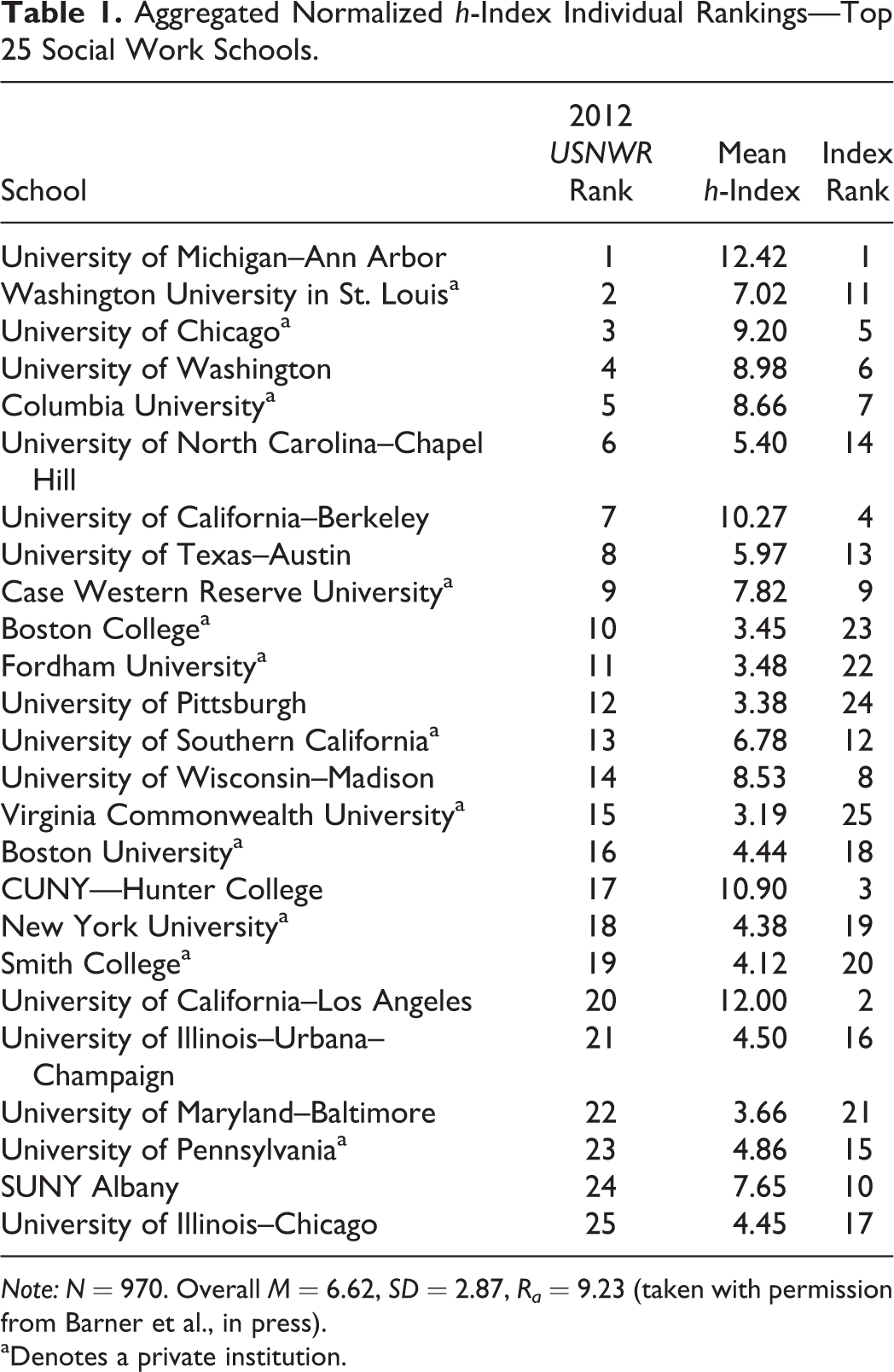
Note: N = 970. Overall M = 6.62, SD = 2.87, Ra = 9.23 (taken with permission from Barner et al., in press).
aDenotes a private institution.
H-Index for the Top African American Faculty in the Top Schools of Social Work.

Note: Overall M = 12.14, SD = 3.16, Ra = 10, (N = 14).
aDenotes a private institution.
All scholars in Table 2 had doctorate degrees in social work, except two who held degrees in psychology (#2, #14). Sixty-four percent held faculty positions at schools ranked in the top 5 ranked schools: University of Michigan–Ann Arbor (#1, #2, #3, #13), Washington University of St. Louis (#11), University of Chicago (#7, #12), and Columbia University (#5, #10). The remaining schools, University of North Carolina, Chapel Hill, Boston College, University of Southern California, University of Illinois, Urbana Champaign, and University of Maryland Baltimore each had 1 faculty member among these 14 scholars. Furthermore, the h-indices for 79% of these scholars exceeded the mean h-index of their respective school means, as indicated in Table 1.
Discussion
The “new normal” of academia—prestige-seeking and commodity-driven—has imposed undue pressure on the professoriate, overall. As tenure-track positions continue to fade away, U.S. tenure-seeking scholars are more “under the gun” to maximize research productivity for a variety of individual and institutional reasons. For African American scholars, however, this reality is intensified due to a number of unique experiences (i.e., barriers to research productivity and impact) along the path toward tenure, previously noted in the literature. Although other cognate disciplines have extensively studied challenges faced by African American faculty, inquiry into this matter for African American social work scholars is far more modest. Therefore, this study set out to explore the research productivity and impact of these scholars as an inaugural investigation of part of a more expansive look into the character and impact of African American scholarship in social work. This study answered the main research question posed and sought to showcase who these scholars were, what their h factors were, and where they worked.
Although this analysis yielded no statistical significant differences between male and female scholars, associate, and full professors, and top 5 ranked schools and others, another important finding was worth noting. For almost 80% of these top scholars, their individual rates of citation impact exceeded the mean impact scores of their entire faculty, suggesting that they would be highly esteemed within the profession, their departments, and by their colleagues. For example, the h-index of the top 3 scholars (#1, #2, and #3), who were all faculty members of the USNWR number 1 ranked school, University of Michigan, all exceeded their school h-index mean of 12.42, by about 2 points minimally. However, since the primary unit of analysis in this study was individual impact scores, the h-index does not capture the research culture of these departments or any unique culture of African American scholarship, such as we noted in the qualitative data set, as some scholars authoring numerous publications as part of a research team ultimately increased their individual h-index scores by such partnerships.
Limitations
There are several limitations of this study. First, our intent was to identify the impact of African American social work scholars holding a faculty position at a USNWR top 25 ranked school of social work. However, the methodology used by USNWR to determine rankings is not overtly publicized leaving reliability and validity assurances unclear. In a study conducted by Barner, Holosko, and Thyer (2013), the rating methodology for schools of social work consisted of “one subjective question sent to deans, directors, and administrators to rate the “academic quality” of social work programs on a 5-point Likert-type scale: “outstanding,” “strong,” “good,” “adequate,” or “marginal” (p. 19). Thus, the USNWR rankings for social work schools were done solely by reputation. To offset the spurious reputational rankings, we also ranked the schools by their mean h-indices (Table 1).
A second limitation pertains to the reliance of the Publish or Perish results on accuracy and completeness of Google Scholar data (Jasco, 2009). Although Google Scholar and Publish or Perish allow for updates and corrections to be made to publication records, it is up to the scholars to pursue this provision (Jasco, 2009). Regarding the limitations of the h-index metric itself, freshman scholars are disadvantaged because of the influence of academic age in its computation (Barner et al., 2013; Holden, Rosenberg, Barker & Onghena, 2006). For example, “a researcher’s h-index score cannot exceed the total number of papers they have published, regardless of the impact of these papers” (Lacasse et al., 2011, p. 601). Furthermore, the “time-to-publication” for social work journals is typically longer than other cognate disciplines, such as medicine and psychology, therefore, social work scholars who published in journals of cognate disciplines may have had an advantage to increase their h-index scores (Lacasse et al., 2011; Thyer & Myers, 2003). Another point to consider when evaluating scholarly impact by the h-index is the opportunity for scholars to increase their impact scores through self-citation which can inflate impact (Bornmann & Daniel, 2005).
Finally, the USNWR rankings and the Publish or Perish results should not be considered a conclusive reflection of the most impactful schools of social work or their social work scholars. The mean h-index school scores were only computed for the schools ranked among the top 25 of the USNWR report. Therefore, since the USNWR ranking methodology is delimited as mentioned, there are schools with higher scholarly impact that are ranked lower on the USNWR list (i.e., see #17 Hunter College and #20 UCLA in Table 1), as well as scholars with higher h-index scores who hold faculty positions at schools ranked lower on the list (i.e., #12, #13, Table 2).
Implications for Future Research
The h-index alone is a singular measure assessing the impact and character of scholarship and should be included in a more comprehensive profile of a scholar’s research activities. Such a profile could include additional metrics offered by Publish or Perish, qualitative factors such as references from peers, and the inclusion of nontraditional or other creative venues for publishing (i.e., nonacademic media publications). Expanding the scope of evaluating faculty for promotion and tenure by using such measures could have favorable implications for other African American social work scholars. Therefore, this initial examination of the h-indices for African American social work scholars in the top 25 ranked schools of social work paves the way for further exploration into the overall impact and character of African American scholarship, including the extent to which a distinct culture of research production exists to neutralize longstanding and identified barriers these scholars may experience within social work academia (Barner et al., in press). However, one looks at these data, despite the aforementioned challenges to African American scholarship in academia, these 14 social work scholars obviously found ways to circumvent, and/or navigate around them, and much can be learned from their experiences with such “barrier negotiation.”
This study is the first in a set of three to recognize and add additional empirical knowledge about African American scholarship and research in schools of social work. We are appreciative of the outreach by the editor of Research in Social Work Practice for the invitation to submit this initial part of our work in this continuing and important area of study.
Footnotes
Declaration of Conflicting Interests
The authors declared no potential conflicts of interest with respect to the research, authorship, and/or publication of this article.
Funding
The authors received no financial support for the research, authorship, and/or publication of this article.