




Abstract

This January 2015 issue marks the 25th anniversary of the initial publication of Research on Social Work Practice (RSWP). For some readers, the journal has been present throughout their entire professional lives. However, back in the late 1980s, one heard frequent complaints over the poor quality and excessive length of time the peer review process took among the existing stable of social work journals. Once accepted, it often took 2 or more years for an article to appear in print, and print was the only option back then. Much of what was published was of little relevance to the world of social work practice, and much was of poor quality. Social work journal impact factors (IFs) were either nonexistent or very low, and often journal issues appeared quite late after their scheduled publication date. With these factors in mind, I submitted a proposal for a new journal to the staff at Sage Publications. Marquita Flemming, a senior editor at Sage, gave me a sympathetic ear during a 1989 conference in New Orleans and subsequently pitched the idea to management. Sage conducted a national survey of social work Deans and Directors asking them what they thought of a new journal devoted to intervention research and the responses were very positive. In due course, I was offered a contract to edit the new journal, and I began assembling a high-quality review board, and drafted peer review policies designed to mirror those found in prestigious behavioral science and practice journals.
The journal adopted a few innovative policies. One was that reviews were shared, not just with the author of the submitted article, but also with the reviewers who could see the other critiques and my decision letter. This helped keep me honest and ensured that I followed their recommendations. For years, the editorial board members have self-selected the papers they reviewed, and could space them out according to their own schedule. This was in contrast to other social work journals which often sent reviewers five or more submissions at once and asked for them all to be reviewed within a couple of weeks, an impossible task to do well. Unlike many mainstream journals that rely on an old-boy/old-girl network of patronage and personal relationships to select people to the editorial board, every 3 years RSWP publishes an open call for self-nominations from individuals who wish to serve on the journal’s editorial board, and almost the entire board is replaced. This helps promote a greater diversity of intellectual talent available to help screen submissions. The journal has never imposed an arbitrary page limit on its submissions, preferring to rely on the reviewers to suggest superfluous content for deletion. As a result, our articles are somewhat longer than those published in other journals.
Since January 1991, the journal has never had a late issue, and it has published hundreds of original research articles, guest articles (some of which are among the journal’s most highly cited ones), book reviews, and occasional special issues. Back in the early 1990s, my most ambitious hope was that the journal would eventually get 1,000 subscribers. Things took a leap in that direction when the Society for Social Work and Research polled its members and asked them to vote on whether or not to increase their SSWR dues in return for getting a print subscription to RSWP. This was approved by a large majority of SSWR members and the board of directors subsequently provided RSWP as a membership benefit as of 1999 (Thyer, 2006). Additionally, the Internet made it possible to later provide electronic subscriptions at a reduced cost, and despite the decision of SSWR to discontinue RSWP as a membership benefit in 2012, SSWR members can still obtain a subscription to RSWP for the remarkably low price of US$27.00 a year (see https://secured.sagepub.com/rswp.html)!
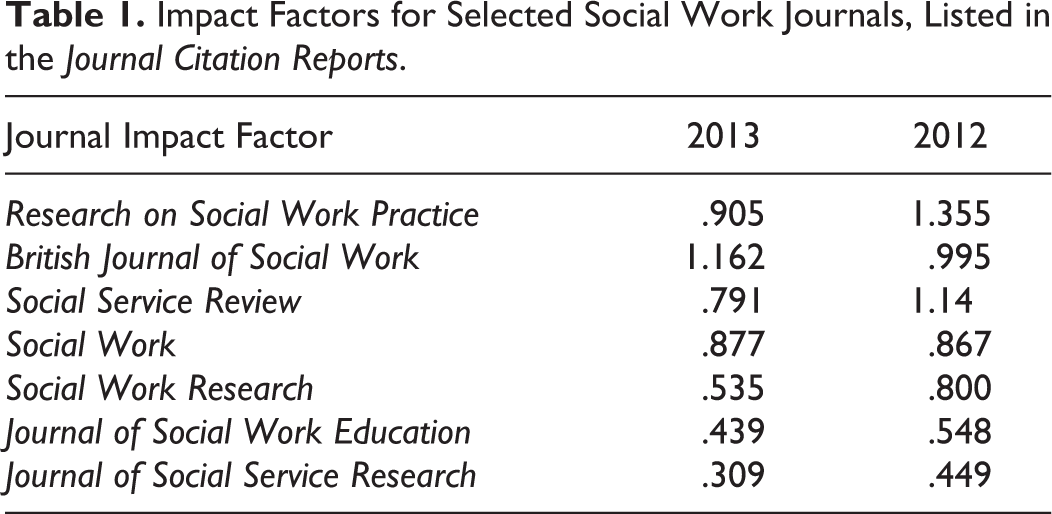
In 2013, the journal was received by over 8,000 subscribers. Its IF is also quite impressive. Table 1 depicts the IFs for selected social work journals for the past 2 years, as reported by the Journal Citation Reports (JCI), where RSWP has been at or near the top for some time. There are some other journals with higher IFs, erroneously listed in the JCI as social work journals (e.g., American Journal of Community Psychology), but among the real social work journals, RSWP’s IF has consistently exceeded that of major outlets such as the NASW’s Social Work, Social Work Research, and the CSWE’s Journal of Social Work Education for years. This is unusual for a nonassociation-based independent periodical. Each year over 160,000 articles are downloaded from the journal’s website, and they are widely available electronically via most university libraries and via its own website. Fifteen of the 100 most highly cited journals in social work during the decade 2000–2009 were published in RSWP (Hodge, Lacasse, & Benson, 2011). RSWP authors now have the option of paying a modest fee to provide for the open access of their article, which also helps disseminate findings. One month a year Sage opens up the journal to open access, which is also a terrific time for readers to search for and download useful studies. Seven years after its initial appearance as a quarterly journal, RSWP’s frequency was increased to publishing 6 times a year. And beginning in 2015, we are moving to a seven-issue a year schedule! In contrast, sadly, back in 2001, the NASW’s flagship journal Social Work, was reduced from a 6 times a year publication schedule to only four times a year.
Impact Factors for Selected Social Work Journals, Listed in the Journal Citation Reports.
So much for the past. Looking ahead, beginning with this issue, we are promoting additional recommended and required standards regarding the quality and transparency of reporting contained in research manuscripts. The use of these reporting standards and checklists is to help authors include all important information about their research. Adherence to recommended reporting guidelines will facilitate review of manuscripts, increase the probability of acceptance, and improve the utility of research findings from your study by others for further research and practice. Akin to the checklists used by experienced airline pilots and surgeons, these standards will help improve the trustworthiness and credibility of work reported in RSWP. The journal’s new policies can be found elsewhere in this issue (and in subsequent issues) as well as on the journal’s website (http://www.sagepub.com/journals/Journal200896), but here are some highlights.
RSWP’s Continuing Focus
RSWP is a disciplinary journal devoted to the publication of empirical research concerning the assessment methods and outcomes of social work practice. Social work practice is broadly interpreted to refer to the application of intentionally designed social work intervention programs to problems of societal and/or interpersonal importance. Interventions include, but are not limited to, behavior analysis and therapy, psychotherapy or counseling with individuals, cognitive therapy, case management/care coordination, education, supervision, practice involving couples, families, or small groups, advocacy, community practice, organizational management, and the evaluation of social policies. At least one author of a submitted article must be a professional social worker, and/or the interventions evaluated must have been provided by professional social workers. These requirements are what distinguishes RSWP as a disciplinary social work journal aimed at serving the profession of social workers. To some extent, it is a discipline’s scholarly literature which defines its professional identity. By being clearly identified as a social work periodical, RSWP helps build the body of knowledge specifically associated with our profession. This strengthens our image and reputation as a discipline grounded in scientific research. Interdisciplinary-authored works are of course continued to be welcomed.
The journal will continue to serve primarily as an outlet for the publication of: Original reports of empirically based evaluation studies on the outcomes of social work practice; Original reports of empirical studies on the development and validation of assessment methods useful in social work research or practice; and Original systematic reviews or meta-analyses of the practice–research literature that convey direct applications (not simply implications) to social work practice. The two types of systematic reviews considered for publication are as follows: Systematic reviews of the effectiveness of a particular psychosocial intervention or assessment method or Systematic reviews of different psychosocial interventions applicable to clients with a particular psychosocial problem.
Manuscripts that do not fit into one of the previously mentioned categories should not be submitted, and if received will be returned to the author unreviewed. Occasionally, other types of submissions apart from those listed previously are published in the journal (e.g., guest editorials and research center descriptions), but these are usually invited and accepted at the discretion of the editor or included in special issues commissioned by the journal. Some may believe that this is an overly narrow focus for a journal, but a look at the breadth of practice areas, research methods, and conceptual frameworks represented in each issue belies any claims as to being too focused. Some focus is good, as in the companion journals published by Sage Publications, Qualitative Social Work and Affilia: The Journal of Women in Social Work.
The journal welcomes empirical research appropriately derived from a variety of etiological and intervention theories, as well as studies that focus on evaluation and assessment issues not based upon formal theoretical frameworks. Studies using diverse methodologies, such as group or single-system research designs and/or quantitative and qualitative approaches, are invited, as are interdisciplinary works. Replication studies are welcome, as are well-designed studies with negative findings or reports of treatment failures. Authors are encouraged to submit only articles of the highest quality for editorial review and possible publication. The submission of seriously flawed or marginal studies is discouraged. Reports of inferential statistics involving significant differences must be accompanied by suitable measures (and a discussion of their clinical importance) of effect sizes and/or proportions of variance potentially accounted for by an intervention.
The journal does not usually publish narrative case studies, surveys, program descriptions, theoretical, philosophical or conceptual works, purely correlational investigations, historical reviews, retrospective predictor studies, purely methodological articles, descriptive studies, or needs assessments. Authors are urged to submit such studies to the many other social work journals which do not have the intervention research focus of RSWP. The journal publishes occasional special issues devoted to a particular topic and readers with an interest in proposing a topic for such a special issue and to serve as a guest editor for that issue are welcome to contact the editor.
The journal does publish book, software and audio-visual media reviews, and the authors of newly published books or other media who believe that their product is congruent with the focus of the journal are encouraged to contact the editor with respect to arranging a review, as are individuals who themselves wish to author a book review of a newly published book. The submission of unsolicited book reviews is welcome, providing the work relates to RSWP. Book reviews should be formatted in strict APA style, and initially submitted as an e-mail attachment in Microsoft Word, to the editor, at
Guidelines for Preparing Quantitative Outcome Studies
The journal now requires that accepted quantitative manuscripts be formatted in compliance with the Journal Article Reporting Standards found on pp. 247–253 of the sixth edition of the APA (2010) Publication Manual. Note that apart from general guidelines, there are separate additional guidelines for reporting experimental (these are similar to those found in the CONSORT statement) and quasi-experimental studies, as well as for meta-analyses. There are also guidelines for reporting a study participant flow chart, which should be included in nomothetic outcome studies. Mixed methods papers involving quantitative analyses should have this element of the article compliant with these guidelines. Causal inferences, if any, should be made conservatively and not go beyond the limits imposed by the presented methods and data (see Rubin & Parrish, 2007). In addition, the abstracts of data-based articles must include the following headings in boldface:
Single-case research studies which build upon traditional case narrative reports by adding the systematic measurement of clinically relevant variables (e.g., client’s problems or strengths) before, during, and after treatment begins are welcome submissions. Outcome measures must have acceptable levels of reliability and validity, the intervention must be well described, and the inferences drawn must not go beyond those legitimately derived from the data. Data must be presented in the form of line graphs. The guidelines by Kratochwill et al. (2010) are recommended in this regard.
The authors of articles reporting the results of a controlled quasi-experimental outcome study (e.g., nonrandomized control group design) are encouraged to follow the standards found in the Transparent Reporting of Evaluation Studies using Nonrandomized Designs (TREND) checklist, and include a completed TREND checklist as an appendix to your paper (see http://www.cdc.gov/trendstatement/). This will greatly facilitate the timely peer review of your submission. Uncontrolled pretest/posttest nomothetic studies are welcome to be submitted, as are posttest-only studies, providing they contain innovative information or are pilot studies conducting preliminary investigations of novel treatments. Basically, the research design must be suited to the questions being asked or hypotheses being tested. Simple questions only require simple designs, and so on.
RSWP now requires a completed CONSORT 2010 checklist and flow diagram as a condition of submission when reporting the results of a randomized trial. Templates for these can be found here on the CONSORT website (www.consort-statement.com) that also describes several CONSORT checklist extensions for different designs and types of data beyond two group parallel trials. You should ensure that your article, at minimum, reports content addressed by each item of the checklist. Meeting these basic reporting requirements will greatly improve the value of your trial report and may enhance its chances for eventual publication. The authors of randomized clinical trials (RCTs) submitted without a completed CONSORT-10 checklist will be required to submit one prior to the article being reviewed. Additional resources to help journals develop editorial policies around reporting guidelines can be found on the EQUATOR Network website. Grant et al. (2013) is a recommended resource for authors to consult, as is Boutron, Ravaud, and Moher (2012).
Authors submitting an RCT for review and publication are also strongly encouraged to have preregistered their study protocol in a suitable clinical trials registry, such as clinicaltrials.gov. The article by Harrison and Mayo-Wilson (2014) can provide guidance regarding the rationale for and process of preregistering their protocol. The submitted article should include a statement giving the reference to any clinical trials registry they have submitted their protocol to. The authors of clinical trials that were not preregistered in a trial registry are welcome to submit their work to RSWP, as preregistration is not a requirement of the journal. However, some U.S. and European government funding agencies are now requiring trial preregistration as a recondition for funding, so this aspect of randomized experiments will assume increasing importance in years to come (see Thyer, 2014a, 2014b).
Guidelines for Preparing Systematic Reviews and Meta-Analyses
RSWP welcomes well-crafted systematic reviews of the literature. Such articles should be focused on the evidence regarding a particular psychosocial intervention, various interventions for a particular psychosocial problem or focused on the reliability and/or validity of an assessment measure useful in social work practice or research. Review articles should have a clear social work focus, and cite the relevant social work literature, if any exists, in addition to pertinent findings from the broader fields of behavioral and social science. Articles of this type should provide the reader with clear and compelling applications to practice, not untested implications. Articles claiming to be a systematic review must adhere to the guidelines for preparing systematic reviews found in the Preferred Reporting Items for Systematic Reviews and Meta-analyses (PRISMA) statement, found at: http://www.prisma-statement.org/. Include a copy of a completed PRISMA checklist as an appendix to the submitted manuscript, to help ensure the timely review of your paper. The Cochrane and Campbell Collaborations provide additional guidelines on the preparation of systematic reviews (Higgins & Green, 2009; see http://handbook.cochrane.org/). Campbell and Cochrane standards are getting ever more stringent with their new Methodological Expectations of Campbell Collaboration (C2) Intervention Reviews (see http://www.campbellcollaboration.org/news_/Campbell_adopts_MEC2IR_guidelines.php). Poorly crafted systematic reviews are discouraged from submission.
Authors submitting a systematic review for review and publication are strongly encouraged to have preregistered the review protocol in a suitable registry, such as PROSPERO (www.crd.york.ac.uk/PROSPERO). The article by Stewart, Moher, and Shekelle (2012) can provide guidance regarding the rationale for and process of preregistering systematic review protocols. The submitted article should include a statement giving the reference to any registry in which the protocol is published.
Guidelines for Studies on Outcome Measures
RSWP welcomes well-crafted, empirically based reports on the design, development, and validation of outcome measures useful in research on practice. When appropriate, it is preferable that such studies employ samples of real-life clients, as opposed to college students (i.e., the sample should reflect the intended audience). Reliability may be reported in terms of internal consistency, test–retest, split-half, and so forth. Validity may be reported in terms of concurrent, predictive, discriminative, and factor structure. Recommendations should be conservative and not go beyond the data. For example, do not recommend a newly developed instrument for use in practice if only its reliability has been demonstrated, not its validity. Reports of newly developed rapid assessment instruments, rating scales, and observational measures must include an actual copy of the scale or instrument as a table or an appendix, as it is intended to be administered, to be published with the article itself. The guidelines provided by Abell, Springer, and Kamata (2009) and Cabrera-Nguyen (2010) are especially recommended.
Guidelines for Preparing Qualitative Studies
RSWP welcomes well-written rigorous qualitative outcome studies as studies using such methods have always been an important component of the armamentarium of scientific methods (Thyer, 2012). Studies of the processes of social work intervention, reflecting the perspectives of clients, caregivers, or service providers should not be submitted to RSWP, unless such evaluations are a component of a larger study of client outcomes. The rationale for this limitation is that studies of the processes of intervention, absent credible evidence that the intervention under investigation is actually helpful or effective, are of unknown value to improving practice. Authors are encouraged to judiciously take advantage of the journal’s lack of a page limitation and craft a manuscript that sufficiently details the context and methods to provide transparency of the study. The sampling, data collection, and analysis should make sense considering the chosen research issue, question, and the method. Authors should describe strategies employed to ensure the trustworthiness and credibility of the study. It is highly recommended that authors of qualitative studies make use of the Consolidated Criteria for Reporting Qualitative Research (COREQ) checklist when submitting their paper to RSWP. COREQ is described in Tong, Sainsbury, and Craig (2007) and can be found on the EQUATOR website. Qualitative data analysis software may be appropriately used in the analysis, but is not required. For suggestions on creating well-written qualitative articles, consult Fawcett et al. (2014), Staller and Krumer-Nevo (2013), and Pratt (2009).
The authors of submissions to the journal who do not make use of the previously mentioned standards and guidelines will likely find that, if a revision is invited, the reviewers and editor will require their use upon submission of a revised paper and failure to do so will result in the paper being turned down. Adoption of these standards will take some getting used to, but it is anticipated that they will result in improved scholarly communication and the promotion of useful knowledge for the field. The peer review and publication system is an imperfect one, but by striving to control for bias and reduce the omission of crucial information, we can improve our knowledge for practice and policy and ultimately the services provided to clients and the development of effective programs and practices. Social work authors who cannot adopt these newer standards are welcome to submit their papers to the many other journals that lack the quality controls exemplified by RSWP.
Summary
RSWP is a continuously evolving journal. As we gain experience with these newer reporting standards, they will undoubtedly be modified and improved. One issue under active consideration is whether or not the journal should accept outcome study protocols, for example. This evolution is called progress. The journal’s relatively narrow foci are consistent with those found by Marsh, Cha, and Kuo as among the most relevant and useful to social work readers: “ … those that provide information or evidence about (1) a social problem of clinical diagnosis, (2) the effectiveness of social work practice … the types of articles that are
The successes of RSWP during the last quarter century are due to many people. I am grateful to the support provided by the superlative staff at Sage Publications, to those who most capably served on the journal’s editorial board over the past two and a half decades, to the authors of submissions to RSWP, the past support of the Society for Social Work and Research, and to the journal’s numerous readers, especially students. The support of my wife, Laura Myers, a fellow social worker, has been especially significant and important to the success of the journal. The journal’s continuing associate editor, David Albright, PhD, is one of the most capable social workers I have ever met, and he keeps me on my toes. Thank you David. I look forward to this journals’ second quarter century with continued enthusiasm and remain dedicated to coordinating high-quality and timely peer review, and to publishing the very best examples of Research on Social Work Practice.
Footnotes
Acknowledgments
David Albright, Sean Grant, Jo Ann Yaffe, Evan Mayo-Wilson, and Brandy Maynard provided helpful feedback in the preparation of this article.