



Abstract
Objective:
Psychometric details of the Parental Press for Academic Achievement and Postsecondary Planning Scale (PPS), developed by Chicago Consortium of Chicago School Research, are scarce. The purpose of this study was to reexamine the properties of this 7-item measure.
Method:
The study utilized cross-sectional, self-reported data from 100 low-income, first-generation undergraduate students at a university in the southern United States.
Results:
Factor analysis on the PPS revealed two dimensions with all items loaded, accounting for 81.44% of the variance. Reliability of the PPS was sound, that is, average interitem correlation was .62 and Cronbach’s α and split-half coefficients were .918 and .923, respectively. Convergent validity was suggested via significant correlations between the PPS and its theoretically similar constructs, that is, valuation of high school (r = .32) and parental support for college (r = .82).
Conclusion:
The PPS appears to be psychometrically appropriate for appraising students’ perceptions of parental support for academic success and postsecondary education.
Keywords
As the national push for college attendance has intensified in the United States (Engle & Tinto, 2008), many students are entering into higher education to pursue professional careers and to compete in an expanding economy. For instance, policy initiatives, such as Race to the Top (U.S. Department of Education [USDOE], 2009) and the reauthorization of the Higher Education Opportunity Act (P.L. 115-315), increasingly promote postsecondary education for all students. There also is a push for vulnerable and marginalized students to matriculate and persist at colleges and universities to reduce long-term poverty and promote educational growth in our country (Engle & Tinto, 2008; Mortenson, 2007). It is often assumed, however, that these students have the necessary resources and support to utilize these opportunities (Roderick, Coca, & Nagaoka, 2011). In fact, researchers have found that low-income and first-generation (LIFG) college students may be lacking several factors that are strongly associated with increasing their likelihood of college enrollment (Chen, 2005; Choy, 2001; Engle & Tinto, 2008). The involvement of students’ parents in college planning is one such factor (Warren, Hong, Rubin, & Uy, 2009).
Parental involvement in education is integral in providing support, assistance, and encouragement for students prior to college. Parental involvement has become a predictor of an individual’s achievement, yet the mechanisms for understanding its influence need further evaluation (Davis-Kean, 2005). Several researchers have sought to understand the influences parents have on children’s postsecondary education. The Consortium of Chicago School Research (CCSR, 2005) studied the impact of parental press on vulnerable students prior to their matriculation to postsecondary institutions. They defined parental press as “the extent to which parents pushed students to do well in school” (Roderick et al., 2011, p. 117). Their measure, Parental Press for Academic Achievement and Postsecondary Planning Scale (PPS), was used to survey seniors prior to their exit from high school. The PPS was recently used in a research study of LIFG college students at a large southern university to examine students’ adjustment to college through the exploration of potential risk and protective factors (Bates, 2014). Although Bates reported overall reliability on the PPS, a complete psychometric understanding of this measure is lacking. As such, the purpose of this study was to reexamine the psychometric properties of the PPS among LIFG students. An in-depth understanding of this measure’s psychometrics will provide insight into a method of measuring parent involvement in schools and influences students’ postsecondary attendance and retention.
Literature Review
Family Involvement Among LIFG Students
In 2011, half of all school children in the United States were from low-income families, a proxy indicator of family poverty status (U.S. Department of Agriculture, 2012). These children represent the nation’s future college population derived from low-income families. The growing number of LIFG college students has drawn attention to the need for retention in college for this population, as LIFG students are known to be 6 times less likely to graduate as a result of their economic and educational predispositions (Mortenson, 2007). This disparity causes LIFG students to have higher rates of dropout, thus perpetuating a cycle of poverty and low educational attainment. Specifically, these students face disadvantages prior to enrollment in higher education and need additional assistance once enrolled in comparison to their peers (Thayer, 2000).
Two specific needs common among LIFG students are a lack of family support and a lack of knowledge about the benefits of postsecondary education (Rosenbaum, 2004; Venezia, Kirst, & Antonio, 2003). The inability to understand college requirements and little emphasis on high school education are evident problems for college matriculation. Thus, parental involvement and valuation of education may be factors that may positively affect students’ transitions to college as well as their aspirations and performance once in college (Roderick, Nagaoka, & Allensworth, 2006).
Transitioning to college may be especially difficult for LIFG students as a result of never having parents or guardians who attended college (Chen, 2005; Choy, 2001). Additionally, LIFG students are more likely to attend high schools in low-income neighborhoods with high concentrations of families with low social capital (American Psychological Association, 2013). Moreover, Engle and Tinto (2008) found that LIFG students had fewer familial and community supports than their higher income peers. The existing research is clear that a lack of familial support and resources impact college matriculation for LIFG students (Engle & Tinto, 2008). Therefore, parental involvement has become an expanding area of educational research striving to counteract these various risks.
Similar to parental involvement, the beliefs and value students place on their education in high school can be predictive of their enrollment and retention in college. Davis-Kean (2005) found that positive beliefs and expectations were associated with increased achievement-related behavior and positive perceptions of achievement, especially among low-income students. These positive behaviors and perceptions then lead to greater academic success for individuals (Davis-Kean, 2005). Researchers also emphasized that, in addition to measured qualifications, students’ college aspirations and values were shaped by whether they had the information, resources, and skills necessary to effectively navigate college admissions processes (Roderick, Nagaoka, & Coca, 2009).
Background on the PPS
The CCSR used data from Chicago Public Schools (CPS) to track high school students’ college plans and enrollment. Within CCSR’s research, various measures have been developed to assess how parental involvement and beliefs about high school influence students. In 2005, CPS became the first major school system in the United States to track postsecondary attainment and enrollment via the Senior Exit Questionnaire (Roderick et al., 2006). The Senior Exit Questionnaire asked high school seniors to report on their plans after graduating, participation in searching for college, and application to college. Additionally, the Senior Exit Questionnaire included a scale to measure parental press for academic achievement and postsecondary planning among high school seniors. Roderick, Coca, and Nagaoka (2011) were the originators of this measure, which was intended to assess the extent to which a parent/parents encourage/encourages the student to do well in school. For the purpose of this study, parental press was further defined as the normative emphasis on academic success and postsecondary education that students receive from their parents during high school. Valuation of high school was also evaluated in the Senior Exit Questionnaire and defined as the extent to which a student felt his or her high school academic experience is important to his or her future (Roderick et al., 2011).
Various analyses of the Senior Exit Questionnaire have shown positive relationships among parental press for academic achievement and postsecondary planning, valuation of high school, and application/enrollment in a 4-year college among LIFG students (Roderick et al., 2011). As such, parental press for academic achievement and postsecondary planning and valuation of high school may serve as either (a) protective factors for LIFG youth as they look toward college enrollment or (b) barriers to LIFG students in high school if parental press and valuation of high school are low. Since this research is ongoing and important to understanding the matriculation and retention of LIFG students, psychometric evaluation of the PPS is warranted. Outlining a brief theoretical foundation of parental press may assist to further understand this measure and the need for such evaluation.
Theoretical Foundation
Epstein’s framework of parent involvement in schools (Epstein, 2001; Epstein & Salinas, 2004) outlines six different ways in which parents’ involvement may enhance children’s educational success. They include the following:
active parenting, which can improve the child’s school attendance and understanding of the importance of school; communicating, which increases contact between school and home, interactions with teachers, and responding appropriately to behavior problems; volunteering, which promotes student’s skills of respecting adult interactions and appreciating their contributions within their school; learning at home, which helps with the child’s organization and goals to plan for college; decision making, which emphasizes that parents become leaders in areas of advocacy and increase their networking to influence change, in turn, leading to the child feeling better protected and represented at school; and collaborating with the community, which emphasizes that the use of community resources for health, social support, and/or partnerships correlates with the child’s increased participation in extracurricular activities and understanding of career options.
This framework highlights the ways in which parents may be engaged in children’s learning and their schools. Press is an additional way that parents may encourage their children to succeed academically. Within Epstein’s framework, parental press most clearly exemplifies active parenting and learning at home. The existing framework also illuminates particular areas of focus for parent involvement among vulnerable populations of parents and students, such as LIFG families. LIFG students are 6 times less likely than their higher income peers to earn a 4-year degree (Mortenson, 2007) and less likely to attend college altogether (Roderick et al., 2011). This gap in attendance and degree attainment may be based on many factors affecting LIFG students, including an array of factors related to parental press and educational expectations or valuation (Chen, 2005; Choy, 2001; Engle &Tinto, 2008; Thayer, 2000).
Research Questions
Iterating the purpose, this study aimed to reevaluate the psychometric properties of the PPS. As such, the following research questions were formulated:
Procedures to uncover the answers to these questions are detailed in the next section.
Methodology
This study utilized cross-sectional, self-reported survey data from students enrolled at a large, public southern university. The students were recruited from a university program that served LIFG or disabled students with academic counseling, tutoring, social activities, mentoring, and academic workshops. The sample was recruited from a sampling frame of 269 LIFG undergraduates utilizing this program. Identification as LIFG meant maintaining a family income level of less than US$25,000 and having no parents/guardians who graduated from a 4-year postsecondary institution. Participants were recruited using the following two strategies: e-mail recruitment for an online survey and in-person data collection (paper-and-pencil survey) through a freshman study skills course and program workshops. Participation was voluntary with assured confidentiality. To encourage participation, two participants with completed surveys were randomly selected for US$25 iTunes gift cards.
These strategies resulted in 110 students agreeing to participate, representing 41% of the sampling frame. Ten participants completed less than half of the measures and were removed from the sample. The final sample size in the current study was 100 LIFG undergraduate students, reflecting 38% of the sampling frame. Given that correlations would be conducted for validity purposes, the researchers determined, via a priori power analysis, that the study’s sample size (i.e., greater than 52) was sufficient to obtain adequate power with a large effect size at α = .05 (Cohen, 1992; Soper, 2014).
Measures
The first segment of the data instrument solicited the following demographic information: age, gender, ethnicity, marital status, English as first language, disability status (yes/no), and U.S. citizenship. The remaining measures relevant to the current study were the PPS and measures of constructs theoretically linked to it.
PPS
Parental press for academic achievement and postsecondary planning was measured using a modified version of the CCSR’s original Parental Press for Academic Achievement and PPS (CCSR, 2005). This 7-item measure was originally designed to measure high school seniors’ perceptions of parental press. Because this study’s sample was currently in college, the items were modified to ask the LIFG college student sample to reflect on their experiences of parental press while they were in high school. An example item is “Please state the extent to which your parents encouraged you to work hard in high school.” The 5-point Likert-type response format ranged from 1 = strongly disagree to 5 = strongly agree. Global scores range from 7 to 35, with higher scores indicating stronger, perceived levels of parental support to attend college. A previous study (Roderick et al., 2011) showed its Cronbach’s α at .64, warranting further examination of its internal consistency.
Valuation of high school
The Valuation of High School Scale from the Chicago School Research Senior Exit Questionnaire (CCSR, 2005) was used to measure participants’ valuation of high school. Similar to the PPS, this measure was revised to ask participants to reflect on their high school experiences. Students were asked to rate 5 items that described the extent to which their high school prepared them for the future, for example, “My high school classes gave me useful preparation for what I planned to do in life.” The 5-point Likert-type response format ranged from 1 = strongly disagree to 5 = strongly agree. Global scores ranged from 5 to 25, with higher scores indicating a greater value placed on high school. This measure in this study demonstrated strong reliability (Cronbach’s α = .89).
College parental press
Students’ perceptions of the parental press they experienced while in college were measured using another modified version of CCSR’s 7-item Parental Press for Academic Achievement and Postsecondary Planning (CCSR, 2005). Originally, the items within this scale assessed high school seniors’ perceptions of parental press in high school. In this study, the items from the scale were modified to ask the LIFG college students to reflect on parental press, as it relates to their college experiences. No known research has measured college parental press. An example item is “Please state the extent to which your parents encourage you to work hard in college.” The 5-point Likert-type response format ranged from 1 = strongly disagree to 5 = strongly agree. Global scores ranged from 7 to 35, with higher scores indicating greater levels of perceived college parental press. Cronbach’s α of .89 was demonstrated for this measure in this study.
Analytic Strategy
All statistical analyses in this study were conducted using Version 22 of the Statistical Pack for the Social Sciences (SPSS). Data were cleaned and screened for errors, inconsistencies, and missing data. Exploratory analyses were used to determine the distribution of the data and relationships among the variables. Means, standard deviations, and analyses of skewness and kurtosis were used to test the assumption of normality (Tabachnik & Fidell, 2007). We used scatterplots and bivariate correlations to assess for linearity and multicollinearity, respectively. No univariate or multivariate outliers were identified as problematic based on the examination of z scores and Mahalanobis’ D (Tabachnik & Fidell, 2007).
Descriptive statistics were analyzed for sample characteristics and for the primary variables, namely, the PPS, valuation of high school, and college parental press. Frequencies and percentages were reported for nonparametric variables, and central tendency and dispersion were reported for parametric variables. Exploratory factor analysis (EFA) addressed the first research question (Research Question 1), examining the factor structure on the PPS. EFA was used because of the measure’s first-time usage with college students, a slight departure from the measure’s original intent to measure high school students’ experiences. We determined that principal axis factor analysis with an oblimin oblique rotation, and no factor limitation was most appropriate because previous research on the CCSR’s Parental Press for Academic Achievement and PPS already identified relationships among these variables with a different population; thus, principal axis factoring allowed us to examine the covariance among these variables (Costello & Osborne, 2005; Fabrigar, Wegener, MacCallum, & Strahan, 1999). Identification of underlying factors was based on an analysis of the scree plot, the traditional eigenvalue of 1.0, and a parallel analysis (Hayton, Allen, & Scarpello, 2004). Per the recommendations of O’Connor (2000), additional syntax for SPSS was used to conduct the parallel analysis. The minimum pattern coefficient threshold for PSS items was .52 according to the following formula (Norman & Steiner, 1994): 5.152/√(N − 2).
Addressing Research Question 2, reliability (internal consistency) of the PPS was examined via interitem correlations, Cronbach’s α, and Guttman split-half coefficients. Addressing Research Question 3, convergent validity of the PPS was examined via zero-order correlations between aggregate global scores on the PPS and measures of its theoretically linked constructs: valuation of high school and college parental press. Because all correlations were purely parametric, Pearson’s r was used. Significance threshold (p) was set at ≤.05.
Results
Sample Characteristics
The mean age of students was 20.10 (SD = 3.82), with a range of 18–49. Students also reported their current credit hours earned, with a mean of 46.67 (SD = 35.28) with a range of 6–118. The possible range of hours for the students sampled was 0–120, as the majority of degree programs at the university required 120 hr (Bates, 2014). Females (71%) represented the majority of the college student sample. Regarding ethnicity, the plurality responded as African American/Black (39%) followed by Caucasian/White (37%). Almost the complete sample reported marital status as single (97%). The vast majority reported English as first language (92%). Almost one third of the sample (31%) reported as registered with the university’s disability services. The entirety of the sample reported U.S. citizenship. See Table 1 for detailed sample demographics.
Sample Characteristics.
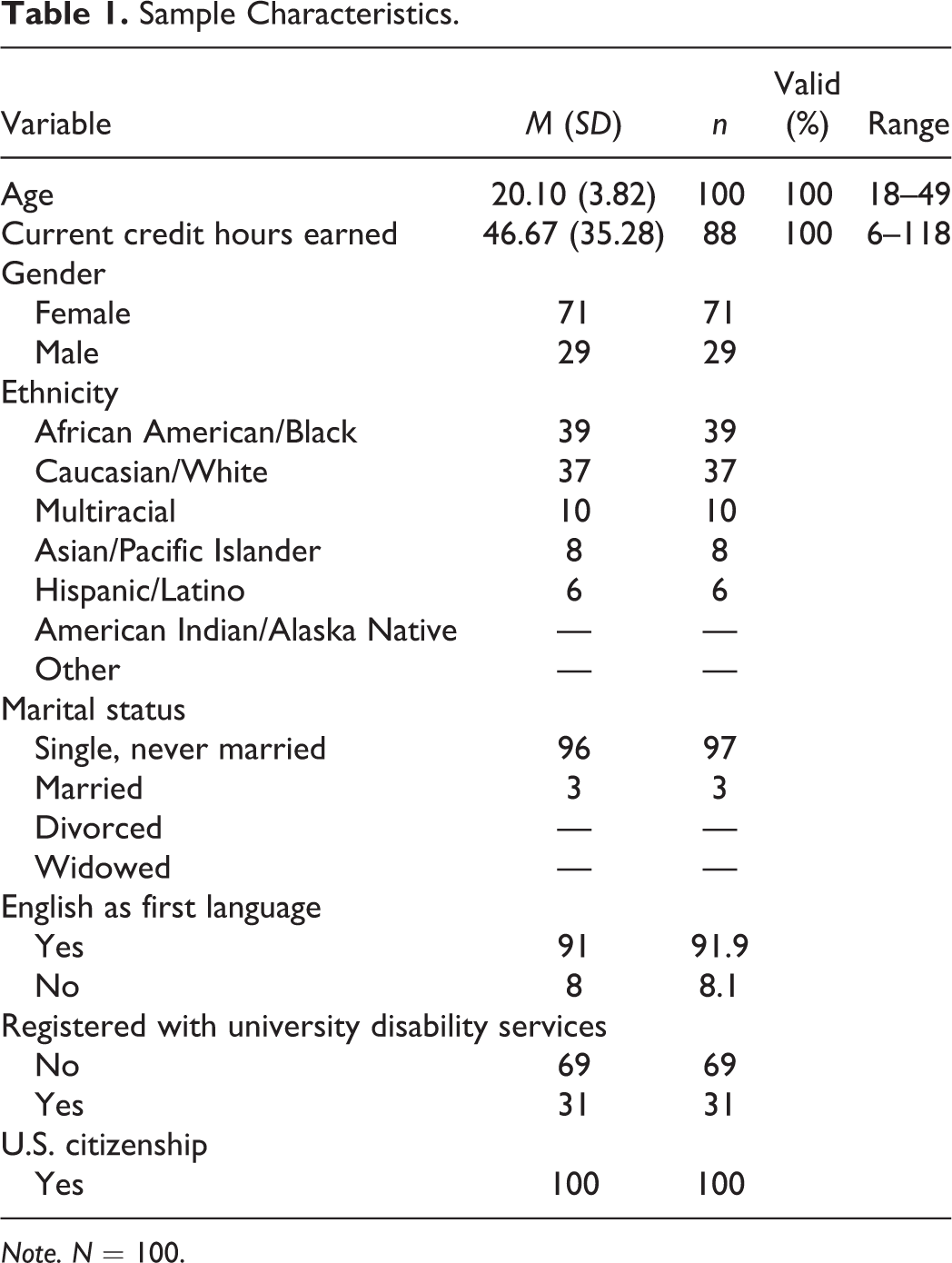
Note. N = 100.
Psychometrics of the PPS
Addressing the purpose of the study, psychometric properties were examined on the PPS. The first of such properties analyzed was its factor structure. All items had adequate extracted item communalities, ranging from .60 to .88, indicating that the items each added to the factor structure sufficiently (all communalities are listed in Table 2). EFA revealed one underlying factor with an eigenvalue greater than 1.0 (eigenvalue = 4.74), accounting for 62.5% of the variance. The sum of squared coefficients associated with Factor 1 after rotation was 4.073. The scree plots and parallel analysis suggested that factors with eigenvalues greater than 0.61 may be retained. In this case, two factors had eigenvalues greater than 0.61—Factor 1 (eigenvalue = 4.74) and Factor 2 (eigenvalue = 0.96). Considerable debate about the use of parallel analysis for principal axis factoring suggests that the findings of this analysis should be considered in light of conceptual criteria (Crawford et al., 2010; Hayton et al., 2004). As such, we examined the factor loadings of the items in consideration of previous research on parental press. See Table 2 for pattern and structure coefficients for each item. Four items loaded strongly on Factor 1, with pattern coefficients ranging from .55 to .98 and structure coefficients ranging from .49 to .94.
Coefficients and Communalities for the Parental Press Scale.
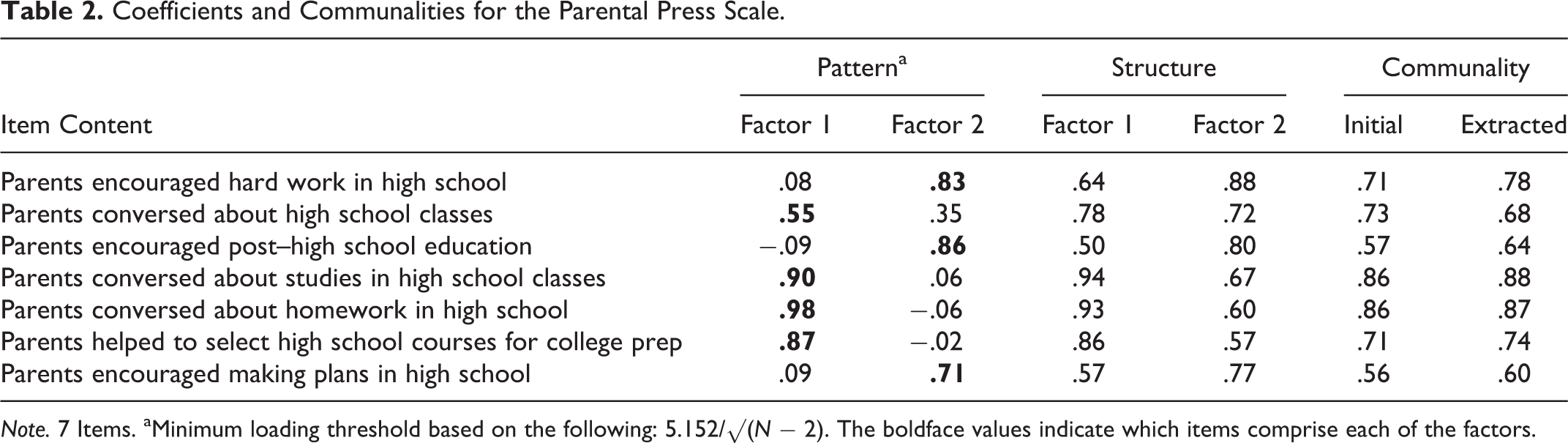
Note. 7 Items. aMinimum loading threshold based on the following: 5.152/√(N − 2). The boldface values indicate which items comprise each of the factors.
The remaining 3 items loaded strongly on Factor 2, with pattern coefficients ranging from .71 to .86 and structure coefficients ranging from .60 to .80. Factor 2 accounted for 13.8% of the variance, and the sum of squared coefficients after rotation was 3.654. Notably, the items on Factor 1 indicated that parents “talked to” or “helped” their children during high school. The items on Factor 2 indicated that parents “encouraged” or “pushed” their children during high school. Factors 1 and 2 were highly correlated as well (r = .68). We decided to retain all 7 items (accounting for 81.44% of the total variance) in the final scale, given the results of these analyses, the previous findings of the CCSR in relation to their Parental Press for Academic Achievement and PPS, and a conceptual understanding of parental press.
The second psychometric property examined on the PPS was reliability. Overall reliability of the measure (7 items) was determined via Cronbach’s α of .92. Guttman split-half reliability analysis yielded a coefficient of .92. Interitem correlations ranged from .40 to .91, each statistically significant, yielding an average interitem correlation of .62. See Table 3 for all interitem correlations on this measure.
Interitem Correlations on the Parental Press Scale.
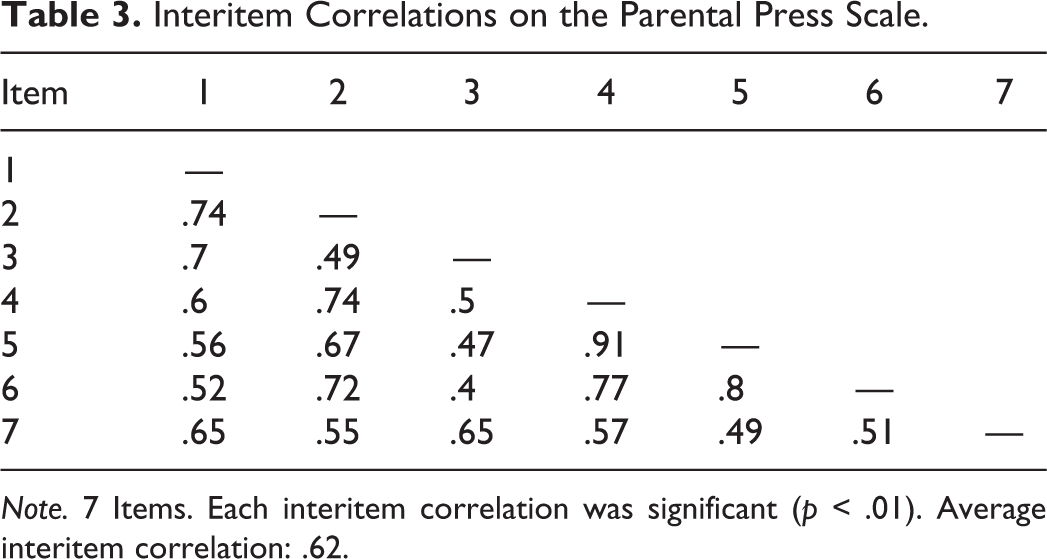
Note. 7 Items. Each interitem correlation was significant (p < .01). Average interitem correlation: .62.
The final psychometric property examined on the PPS was convergent validity. As noted in the literature review, parental press for academic achievement and postsecondary planning is theoretically linked with valuation of high school and college parental press. Accordingly, significant, zero-order correlations were observed between aggregate global scores on the PPS and measures of the aforementioned constructs, that is, valuation of high school (r = .32, p < .01) and college parental press (r = .82, p < .01).
Discussion
Roderick et al. (2011) initially developed their scale for use with high school students; this study was a reexamination of the measure among LIFG college students. The results of this study indicated that the 7-item PPS is a psychometrically sound tool with good reliability. The EFA yielded a two-factor solution that measures LIFG students’ perceptions of parental press for academic achievement and postsecondary planning in high school. Additionally, tests for convergent validity indicated that the scale was related to theoretically linked constructs in expected ways. Specifically, participants’ perceptions of parental press for academic achievement and postsecondary planning in high school was significantly and positively related to participants’ perceptions of their valuation of high school and college parental press. Existing research points to the importance of parental involvement in education (Davis-Kean, 2005) and the need to better understand the factors related to LIFG students’ college success (Roderick et al., 2009). Parental press is one way in which parents may be engaged in their children’s education, and the PPS serves as a tool to operationalize parent involvement in relation to LIFG college students.
It is important to note the limitations of this study and potential implications for future research. There are no confirmatory factor analyses of this measure, and it has not been tested for invariance across multiple samples. Confirmatory analyses are needed to further understand the measurement structure of the PPS. This tool may have limited external validity as well. This study was conducted on a sample of LIFG students within one Southern state, and Roderick et al.’s (2011) study was limited to one urban Midwestern city. Although the two studies together provide additional information about parental press, further research will be needed to confirm the applicability of the PPS to other settings. There also was a potential for recall bias among this sample, as participants reflected on their experiences in the past. Further, the factor structure identified in this study presents only one possible representation of the relationships among the study variables.
Other limitations include the use of the PPS to measure students already enrolled in college and not currently in high school (the population it was originally created to measure). Having students reflect, retrospectively, on their levels of parental press in high school may have influenced the validity and accuracy of their responses. Thus, inaccurate informant responses are a limitation within this study. Future research utilizing the PPS among LIFG students enrolled in high school could combat this limitation. It is also important to clarify why the authors chose to use the PPS to measure LIFG college students’ parental press. The PPS was selected to measure the LIFG college students’ parental involvement prior to attending college in order to understand risk and protective factors relating to their matriculation. In order to gather information about these students’ high school experiences supportive of matriculation, retrospective data were needed. Similarly, the PPS was modified for the college population because no existing scales examined parental press for students enrolled in college.
Additionally, the sample used in this study poses limitations to understanding how parental press influences matriculation since these students were already enrolled in higher education at the time of the study. This may indicate some level of success among these students and not portray an accurate account of the experiences of the LIFG student population, including those who do not enroll in higher education or those who delay enrollment. This sample, therefore, may cause the results to reflect positive levels of parental press since their application and enrollment in college was successful. Future research, with a larger sample and greater assurances of differentiated experiences of enrollment among the LIFG student population, is recommended to enhance our understanding of parental press on college matriculation.
It is also important to note that parental press is one way in which parents may engage in their children’s learning, but Epstein (2001) emphasizes that parents may contribute to their children’s education in a number of meaningful ways. These include communicating with the school, volunteering their time, fostering children’s learning at home, making decisions in relation to education, and collaborating with other community partners. Further, other scholars call on schools to consider innovative methods of parent engagement that address families’ needs first, positing that parents are only able to fully engage in their children’s learning when their basic needs are met (Anderson-Butcher, 2006). Likewise, other components of parent involvement in schools, such as empowerment and self-efficacy, are important to consider as social workers seek to engage parents meaningfully (Ball, 2014). Still, the PPS is a starting point for research on LIFG college students. This scale may be used in future research to further examine parental press and parent engagement in schools, along with other measures to assess the various factors associated with students’ college-going experiences, such as valuation of high school and other forms of parent engagement (e.g., parent empowerment, leadership, and support).
Implications for Practice
The use of this measure could provide social workers with valuable information about LIFG college students’ perceptions of parental press in high school. The PPS may be used individually or in aggregate form to assess students’ previous experiences in high school. This may be useful for social workers practicing in postsecondary education and community settings, as they conduct needs assessments and design programming to address LIFG students’ needs. For instance, LIFG students’ experiences of parental press in high school may influence their successful transition to college (Roderick et al., 2006). The use of the PPS in practice may help social workers identify the needs among LIFG students and, in turn, target programming to focus on parental press if needs assessments indicate that special attention is warranted.
In addition to asking students to reflect on their perceptions of parental press, the PPS can be used for high school social work practitioners to measure and moderate services for LIFG students while they are still in high school. Since parental press was considered protective in promoting the matriculation of LIFG students to college (Bates, 2014), high school social workers can advocate for certain parental involvement programs to be incorporated in their schools if low scores on the PPS are found among their students. Practitioners can also evaluate what existing programs or individual factors foster positive parental press among students if scores are found high upon measurement. Further, an example for practice using the PPS would be to use it in pretest and posttest measures to assess the implementation of a program designed to promote positive parental involvement. Evaluation of parental involvement through the use of the PPS can support evidence-based practice among high school social workers and improve their capability to advocate for resources that promote parental press.
Administrators and policy makers also may use the PPS, as there is a pressing need to understand LIFG college students’ experiences and perceptions of education. Generally, the LIFG student population experiences less family support for college and has limited knowledge about postsecondary education (Rosenbaum, 2004; Venezia et al., 2003). It is important for university administrators and policy makers to be attuned to these needs and understand the important role that families play in LIFG students’ success in college. The PPS is one measure of parent involvement in LIFG students’ education that could provide useful information about students’ experiences prior to their entry in postsecondary education.
Conclusion
This study found that the PPS is a brief measure of LIFG college students’ perceptions of parental press for academic achievement and postsecondary planning in high school. The results of the psychometric testing indicated support for the reliability and factorial validity of the PPS. The use of this measure could provide social workers with valuable information about parental press and, in turn, may document specific areas for school- and community-based social workers to focus their practice. This measure may be used in future research to further examine parent involvement in education, particularly in relation to college readiness and preparation. Future research should continue to examine the use of this measure in multiple settings and in relation to other variables that may be related to children’s academic success in secondary and postsecondary education.
Footnotes
Declaration of Conflicting Interests
The authors declared no potential conflicts of interest with respect to the research, authorship, and/or publication of this article.
Funding
The authors received no financial support for the research, authorship, and/or publication of this article.