




Abstract
Social work students placed on a multidisciplinary team will be exposed to diverse ways of interpreting a case, which is an invaluable experience. Placement in a multidisciplinary setting can be an excellent way to engage students in teamwork. Supervisors need to adequately address various aspects in working on a team with students. A survey of 44 bachelor of social work students placed in an internship designed to help them learn about community organizing, program development, or fund-raising revealed that 41 students wanted to better understand the roles of different disciplines in service provision. Although 33 students reported participating in multidisciplinary team meetings and 23 reported discussing working on a team in supervision, less than half (21) reported that they discussed how different disciplines work together to assist clients. This article will discuss the importance of learning to work with other disciplines during training to prepare students for future work in social services.
Staff interaction and collaboration is essential for patient care in any agency. It is becoming more evident, in many fields, that working with interdisciplinary teams plays an important role in the assessment and management of patients (Tanaka, 2003). Multidisciplinary teams combine several branches of learning or fields of expertise to work on a complete solution for complex problems. Teams often include members of the medical profession, including doctors, nurses, dieticians, pharmacists, and physical therapists, as well as members of the legal profession and the community.
Once in the field, social workers will become integral members of interdisciplinary teams and will play an important role in the assessment and management of patients in many agency settings. Therefore, it is important that students are trained to function as members of a team during their educational process. Each member of the team has a role that is constructed or given and boundaries that are defined or inferred. Staff identity and cohesion on the team results in outcomes that effect patient care outcomes. Students should learn to develop skills in leadership and facilitation during their internship experience through observation and discussion of patterns of team decision making in supervision.
Service learning is important in the pedagogy of social work education. The educational component is enhanced and strengthened through the field experience. In addition to obtaining essential clinical skills in engagement, treatment planning, and evaluation, students should develop an understanding of the organization. Having a clear understanding of the organization goals, mission, and the work it performs will enable the student to participate in the work that the agency performs more effectively. If this is processed in supervision, it will concretize and enhance theory and content from the classroom material.
Supervision is often focused on client interaction but should include elements of experience with the staff and aspects of organizational interaction. It is essential that students engage in critical thinking about the field experience from different lenses. In this way, learning can encompass a more comprehensive skill set that includes professional development, understanding of other discipline’s expertise, and the characteristics of leadership.
Why Develop Skills in Interdisciplinary Collaboration
There are multiple reasons for social workers to gain skills in cooperation and leadership since they have always seen the client as the center of numerous systems: educational, financial, housing, family, and social. There has often been an intersection of these systems in problem formation, as a need to include numerous systems in developing comprehensive solutions. Clients often need help navigating between providers, including occupational, physical, psychological, and developmental services. The Council on Social Work Education (CSWE) has recognized that social work practitioners have to “synthesize and apply a broad range of interdisciplinary and multidisciplinary” knowledge and that advanced practitioners have the ability to “assess, intervene, and evaluate to promote human and social well-being” (EPA M2.2). Two of CSWE’s core competency standards (8 and 9) require social workers to “collaborate with colleagues and clients for effective policy action” and “provide leadership in promoting changes in service delivery and practice to improve the quality of social services” (CSWE, 2008).
The World Health Organization has identified the need to develop innovative strategies to develop and bolster the global health workforce and has identified mechanisms for successful collaborative teamwork to apply in local health care systems (WHO, 2010). It is also important to note that the Affordable Healthcare Act refers to using a team approach in health care delivery. The Act requires care to be delivered in a culturally competent way using multiple services. This puts social work in a critical and unique position to coordinate patient care. We have been taught to see our clients within their environment, interacting with multiple systems of service delivery. Historically, social workers have provided clients with linkages to necessary services and have been trained to navigate complex systems to accomplish this. As a profession, we understand how cultural issues relate to problem development and to take this into account when developing solutions. Social workers have often worked to provide transitional services to clients in efforts to accomplish their long-term goals.
In addition, the complexity of the human condition requires us not to treat people in isolation of their community, family, culture, and other influences. The biopsychosocial approach is becoming more critical to care and is being adopted by other professions. Nursing education has begun to include patient simulations that include schools of social work, pharmacy, and medical professions. It seems to be clear that intricacies of patient treatment and engagement require a multidisciplinary approach to meet all of their service needs. Interdisciplinary collaborations will result in a comprehensive, positive outcome.
Matzer et al. (2012) studied emergency room patients in Manchester, England, and found that frequent users of emergency rooms often have concurrent needs that have to be addressed. They found that often patients have simultaneous and multiple burdens intersecting their health care needs, with social and/or psychological problems. Without the coordination of health care, any chronic physical problem will often be exacerbated by residential instability, psychiatric symptoms, or interpersonal dysfunction. They concluded that it is important for all patients to have an assessment to recognize their multidisciplinary needs so they can be addressed concurrently with their medical problems. They found that patients with complex needs often visited the emergency more often and frequently, they lived alone. If psychosocial needs are not identified and addressed, ultimately, the patient may not be able to follow through with medical interventions and remain out of the emergency room.
Given that interdisciplinary teamwork on service provision is important in meeting service needs, it makes sense to prepare professionals to work collaboratively with others during their education. Social workers are key to the coordination of patient care and will be able to provide more comprehensive outcomes when they learn how to effectively engage other disciplines in this process. Hospitals and other inpatient care facilities often use social workers to plan for discharge and community reintegration. Social work training includes preparation for relationship development, working collaboratively with a client on mutual goals, understanding the influence of culture on treatment, and advocacy for their clients to get all of their entitlements and services.
Health care reform has been working toward a patient having a health care home. This would be a place where the patient goes for management of all of their needs, including health, mental health, and dental health (Allen, 2012). This home would be a place where information from all of the providers working with a patient is collected and would ultimately result in less fragmentation and duplication of services. The health home providers would be aware of all of the services the patient is receiving, the medications, and conditions the patient is managing, and would be a place for patient-centered coordinated and comprehensive care. This holistic approach, taking into account the person’s environment, has been a core value of social work. Training with other disciplines to embrace this approach, and view the patient from a wider lens, will result in the most beneficial care coordination and outcome.
Therefore, developing relationships trust and rapport with other professionals is essential for social workers. There is a great deal of emphasis on cost-effective, comprehensive care, and minimizing gaps (Copperman & Newton, 2007). Another positive outcome of interprofessional collaboration is to make maximum use of resources and avoid duplication of services. In the current cost-containment climate, this is an essential aspect of care. Having multiple perspectives in making a case formulation will increase the likelihood that all needs are covered. Each discipline brings a different set of knowledge and skills to the fore, which results in a more thorough assessment and actualization of needs.
Interprofessional collaboration may be ideal for patient care, but it is not without challenges. There may be barriers to accept the perspectives of other disciplines, as well as conflicting professional priorities. Discharge planning can be initiated by different members of the patient’s team. The medical, nursing, and complementary staff, including physical therapists or other rehabilitation professionals, may all have a differing opinion of when their services are no longer beneficial. Therefore, readiness for return to the community is seen from different lenses. It is a priority for a person to leave an inpatient setting when there is no longer a need for primary care, however, is the person’s residence equipped for the return, are the necessary aftercare services in place, and is there enough support for the person to succeed on their own? This will likely be considered by a social worker who sees a person in environment and considers their ability to navigate systems once released. This may not be the main concern of the medical or administrative staff that can be focused on treating only issues of medical necessity.
A person may need additional supports in their environment to make discharge safe. This may require a home visit, a family meeting, or setting up aftercare appointments. There may be a need for applications to be made for financial or other services, like transportation to outpatient therapies, or in home accommodations for safety. The social worker may have to advocate for more time or a step down plan for these to be put into place. This will take communication and advocacy skills to ensure that these things are considered by the other professionals involved in the case. Rodriguez (2013) reports that the best possible outcomes for clients that have multiple problems come about when there is seamless are across specialties and that care is coordinated through a dialogue between service providers.
Social Work Training Needs
It is well known that fieldwork experience is an essential part of social work education. Programs that train social workers at all levels, BSW and master of social work (MSW), include direct practice with clients in an agency as part of an internship. Programs have a class directly tied into the field experience that is used to process and provide a structure to discuss the experience. These classes often focus on the student’s clinical experience with clients and include in the curriculum theories focused on intervention and relationships. The essence of the “Practice” class is on helping student social workers to develop relationships, assess problems and develop goals, and plan for clients effectively. Practical skills are developed for interventions with individual groups and communities.
Field learning directly relates to the academic component of social work education and strengthens skills for professional development. Given that many of the agencies where students are placed in require interprofessional collaboration, it is essential that classroom discussions include this aspect of their work. Professionals do not work alone, but as part of a system of care embedded within an organizational structure. In order to be able to help someone, a group or a community, develop fully, there must be a clear understanding of the organizations’ mission and goals. Understanding the organizational structure will inform the student of the process in the agency to work with clients and indicate the capacity and limitations of what they are able to do and what the agency can provide.
In addition to understanding the agency as a whole, the student should be able to evaluate the role of the personnel in the agency and how they interact to get the job done. Students may be focused on their work with the client or task assigned, not on the process of how decisions are made or processed between staff members. It would be a more complete educational experience to have the student put thought into how the agency provides services and systems in place for service provision.
Schools of social work offer classes in policy which may contribute to student understanding of agency function. However, unless this is weaved into the practical experience, it may not engage the student in thinking through how their interaction with an agency process directly impacts their ability to provide for their clients. Student placements often involve working with other professionals on a case, so why should this not be addressed in the classroom and be part of the supervisory discussion? Students should be able to understand other disciplines scope of knowledge so they can draw on this to provide comprehensive services. In addition, while accepting what others can offer for their client, they have to represent their social work identity. This is something that should be highlighted as part of the student learning to develop a professional self.
Student Supervision in Interdisciplinary Team Placements
Pollard, Miers, and Rickaby (2012) found that preparing individuals working in health and social services to work with colleagues of other disciplines has a positive impact on working together and service delivery. Participants in their survey reported that interprofessional work in health care was helpful in communicating with other professionals, as well as improving documentation, understanding roles, and leading to mutual respect. This group also reported that management and organizational factors contributed to this improved ability to work together. Learning to work on a multidisciplinary team helped members to feel able to speak their minds allows for each profession to be represented in case formulation. This becomes important as we move toward working with clients in a Health Home where in addition to medical services, other community and social supports can be provided to clients with multiple needs. Bao, Caslino, and Pincus (2013) stress the importance of coordination of care when behavioral health needs are apparent. They report that an estimated 60% of those currently uninsured will receive these services when the Affordable Care Act is fully implemented.
Purpose
A study of 44 BSW students in their senior year of their program was done to evaluate if teamwork and interdisciplinary collaboration was processed in their supervision. The students were placed in agencies to undertake community organization, fund-raising, and administrative agency tasks. They were queried to determine whether they felt interdisciplinary training would be helpful for them while in the field. They were given a survey to find out what other professionals they interacted with in their agency, if they were involved in team meetings with other disciplines, and if they ever evaluated or discussed this interaction in their supervision.
Method
A convenience sample of 44 BSW students placed in agency settings were queried about their supervisory experience while working on macro internship projects. These projects included community organizing, program development, outreach, and fund-raising for assigned agencies. All of the students reported having weekly supervision with an MSW. They were asked yes/no questions about their agency experience in working with other disciplines on teams, in meetings and on tasks. They responded to questions about their supervisory discussions related to their teamwork and interdisciplinary experience. Results are presented in Table 1.
Student Survey Responses.
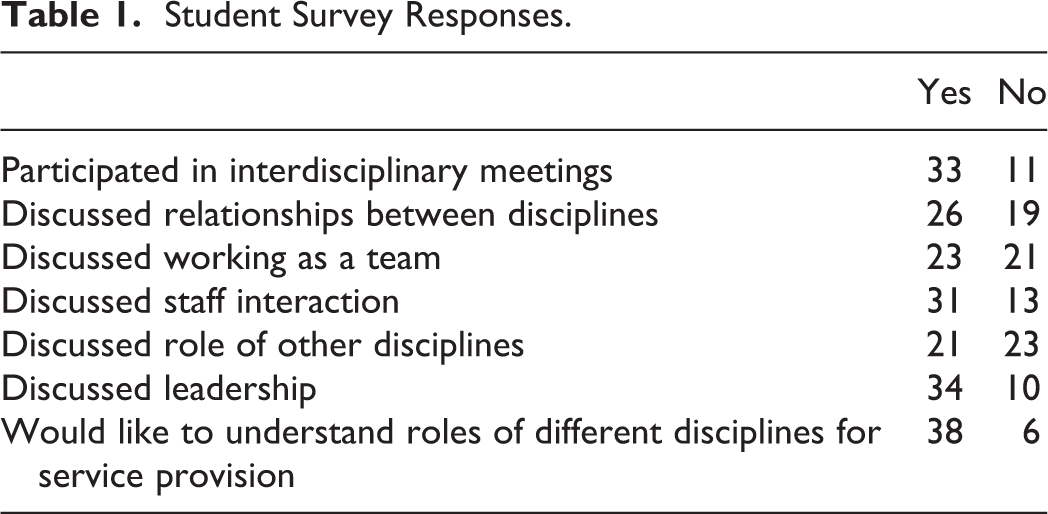
Thirty-three students reported working with other disciplines including nurses, pharmacists, administrators, and various therapists (psychologist, physical, and occupational) in their agencies. The majority (75%) of the students in placement worked with other disciplines, participated in meetings with other professionals and worked on a team, but about half (52%) discussed this with their supervisor. Most supervisors discussed leadership (77%) and working with a team (68%) in supervision. Most students (86%) wanted to have a better understanding of the roles of different professional disciplines in helping a client and several (16) wanted more discussion on clarifying agency structure.
Discussion and Applications to Social Work
Treating a person’s needs holistically includes working with a team of professionals that can provide expertise in a variety of areas to provide comprehensive treatment. If a person has unmet needs in their environment, plans for their physical and mental health well-being may not work for the long term. Research has shown that professionals provide better care when they are prepared for work with other disciplines and have an understanding of each disciplines’ role and contribution to the client. It seems intuitive to provide a base for working interprofessionally while a student is in school, as part of their professional training. Learning the role of each team member will limit duplication of services or unnecessary referrals to outside agencies. When we are aware of the skills of each member of the team, we can create a comprehensive plan and fully utilize available knowledge.
A small sample of social work students reported that they would like to have a better understanding of professionals’ roles within their agency. They were able to observe interdisciplinary interaction when at their internship, but many did not process this when they discussed their work in supervision. If each professional felt comfortable in their role, they could provide a full array of services within their domain and cover a wide range of client needs.
This article reflects the need for professional training programs to provide interdisciplinary experiences for students to prepare for their future work. This is clearly important for social work students since the trend is for care coordination and movement toward a health home. The Affordable Care Act and many insurance providers are moving toward each client getting a service coordinator to manage the various treatments and interventions provided for the client. It would be ideal if all members of a client’s care team understood how the other disciplines communicated and had knowledge of each team members’ skill set. Having a clear understanding of each person’s role in the treatment will allow for maximum care benefit for the client. The full range of services can be provided without overlap or confusion of roles.
The supervision social work interns receive while in placement should include a discussion of the team participatory process, how decisions are made and feedback on team observation. The internship experience will be enhanced by an evaluation of the flow of communication on the team, and the role of the leader in managing interdisciplinary processes. Learning how decisions are made, the skill set of other professionals, and how to relate to each person’s role will be important for future employment success. The social work field has always seen the Person-In-Environment, now it is important that the roles of each provider in the plan to be identified and appreciated.
Footnotes
Authors’ Note
This article was presented at the Third International Conference on Practice Research, Silberman School of Social Work at Hunter College, New York City, June 2014. It was invited and accepted at the discretion of the Editor.
Declaration of Conflicting Interests
The author declared no potential conflicts of interest with respect to the research, authorship, and/or publication of this article.
Funding
The author received no financial support for the research, authorship, and/or publication of this article.