




Abstract
Grounded in an indigenous holistic worldview and borrowing from the four Rs (values of relationships, responsibility, reciprocity, and redistribution), this article supports the inclusion of translational science and the integration of core metacompetencies into social work doctoral education as innovations in the field of social work science. The author argues that these innovations will enhance the ability of social–work–trained researchers to serve on transdisciplinary research teams, which are necessary to address complex metaproblems found in the natural world. Further, the author asserts that transdisciplinary scientific integration is helpful to social work science, as it builds awareness and appreciation of social work scholarly inquiry, promotes the inclusion of social work values in scientific research, and helps erode the scientific hierarchy that has traditionally existed between the natural and social sciences. By leveraging personal experiences in transdisciplinary education, the author offers a conceptual framework for innovations in doctoral education.
Guided by the theme of innovations in social work science and research, I offer this article to explore indigenous conceptual frameworks and make recommendations for further innovations in social work doctoral education. I first reflect on being the only social work researcher in transdisciplinary spaces and share why I believe service in these spaces is necessary. I then transition into a discussion of indigenous knowledge and values and how these inform my work in transdisciplinary spaces. Next, I offer my own doctoral education experience as an example of a T-shaped education. According to Kemp and Nurius (2015), vertical T-bar is deeply grounded in social work research and scholarship and the horizontal T-bar places emphasis on transdisciplinary science and translational partnerships. Finally, I offer recommendations for innovations in doctoral education grounded in an indigenous conceptual framework.
The “Other” Researcher in the Room
I have experience being the only social–work–trained researcher serving on transdisciplinary research teams. I have experienced the surprise of colleagues once they learn about the advanced research methodologies training we receive in social work and our ability to bring significant strengths to complex scientific inquiry. Service in these spaces is critical for three reasons. First, it builds awareness and an appreciation of social work scholarly inquiry. Second, social welfare researchers add value to the research process because our code of ethics requires us to pay particular attention to the needs of people or groups who are living in poverty, vulnerable, or oppressed (National Association of Social Workers, 2008). And third, social welfare researchers and the resulting science can begin to chip away at the scientific hierarchy that has traditionally existed between the natural and social sciences by adding value to transdisciplinary teams (Annerstedt, 2010). Being the only social worker on a transdisciplinary team forces individuals in our field to be ambassadors for our discipline, building our reputation and brand at the same time. This is good for social welfare science. However, researchers who pursue transdisciplinary research need to be courageous risk-takers to serve in these spaces (Rosenfield, 1992), because it can be difficult to serve on these teams without the necessary training.
I’ve had my own experience being the other in a variety of settings. As a citizen of the Lumbee Tribe of North Carolina and a descendant of the Coharie Indian Tribe (also of North Carolina), I am often the only American Indian serving on university task forces, search committees, advisory boards, and transdisciplinary research teams. Further, I am often the only scholar with social work and legal training in the room. Serving in these spaces requires me to communicate across cultures and disciplines, being mindful to add value to the discussion while at the same time educating others (often colleagues). This can be mentally challenging work, requiring those who are the other to multitask as a researcher, a team contributor, an ambassador, and an educator.
To serve effectively in these spaces, it is necessary to learn how to communicate across disciplines, integrate social work models and theories into the larger discussion, and collaborate with teams of individuals from different scholarly fields, all with confidence. Until these metacompetencies (Kemp & Nurius, 2015) are incorporated into doctoral education, it is up to senior and junior faculty members to teach these skills that will build our brand as social welfare researchers and allow for significant contributions to the scientific marketplace.
Lending Indigenous Knowledge to the Transdisciplinary Conversation
There are many lessons taught by indigenous knowledge that support a transdisciplinary approach to higher education. Vine Deloria, a notable American Indian scholar and leader, once wrote the following: Indians have found even the most sophisticated academic disciplines and professional schools woefully inadequate because the fragmentation of knowledge that is represented by today’s modern university does not allow for a complete understanding of a problem or of a phenomenon. Every … professional must qualify his or her statements on reality and truth with the admonition that the observations are being made from a legal, political, sociological, anthropological, or other perspective. These statements then are true if confined to the specific discipline and its methodology by which they are formed.… Indian knowledge is designed to make statements that adequately describe the experience or phenomenon. That is to say, they include everything that is known about the experience. (1999, pp. 146–147)
Deloria supports the notion of transdisciplinary thinking in higher education. Indigenous teachings espouse that no one discipline has the necessary tools or theories to address the complexity of the world we live in. I agree. As an indigenous person, my personal framework for examining and engaging the world is holistic, best summarized by a team of First Nations researchers in Canada as appreciating the physical, intellectual, emotional, and spiritual aspects of people, communities, and the society as influenced by history, present, and future and the interconnectedness of all things on all levels (micro, mezzo, and macro) in the natural world (Kenny, 2004). According to this model, the natural world is complex and therefore requires interconnectedness across disciplines. Further, the natural world requires the exchange of ideas, theories, and knowledge. I offer this holistic indigenous worldview as further support for integrating the horizontal T-bar into social work doctoral education.
I also lend indigenous values to this discussion. Harris and Wasilewski (2004) at the Center for Interactive Management at George Mason University in Virginia have identified four core values that seem to cross geography, generation, and tribes in the United States. It is important to note that these obligations have been observed in many communal societies, not just American Indian. Tribal and indigenous societies worldwide have been acknowledged for varying degrees of these obligations and values, often necessary to the continuation of a communal society (Lesorogol, 2008). They explained these values as the four Rs characterized as valuing (a) relationship, (b) responsibility, (c) reciprocity, and (d) redistribution (Harris & Wasilewski, 2004). The four Rs should serve as a guide for teaching metacompetencies in doctoral education. Figure 1 depicts a merging of the holistic framework with the four Rs to create a model for innovations in social work doctoral education. Numerous indigenous holistic conceptual frameworks have been developed to deal with complex societal issues in different indigenous communities across the globe (Christie, 2006). However, the framework described here is offered as a tool for redesigning doctoral education, not informing research questions or community development processes.
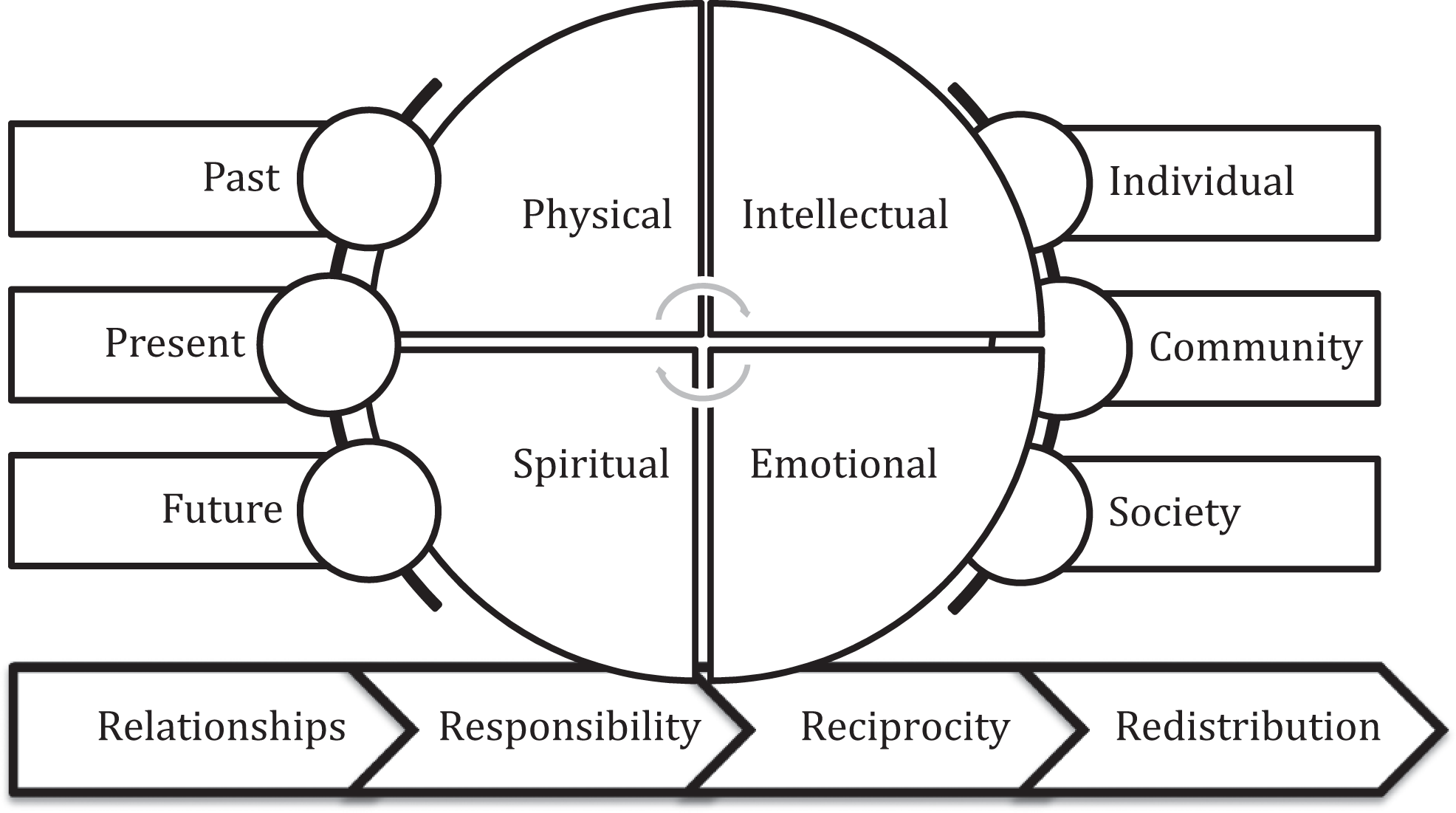
Indigenous conceptual framework for innovations in doctoral education.
We can use this model as a foundation to inform innovations in social work doctoral education that will support translational science and integrate core competencies into social work doctoral studies. The value placed on relationships underscores the importance of developing partnerships with scholars outside our discipline to collectively seek innovative solutions to today’s problems. Responsibility speaks to the value that different academic disciplines bring to the marketplace of scholarly inquiry. Either through the questions they pose or the tools they deploy, all disciplines can add value because they are charged with certain responsibilities and guided by ethical standards. In transdisciplinary teams, researchers share the role of addressing issues through a reciprocal exchange of ideas, theories, and interventions, which is at the heart of transdisciplinary research. Finally, a redistribution of scholarly inquiry from a single discipline to many disciplines allows for the development of new conceptual models and innovative interventions. When this happens, the potential for tremendous innovations is created and opportunities to influence the four dimensions of self (physical, intellectual, emotional, and spiritual), three dimensions of time (past, present, and future), and three levels of examination (individual, community, and societal) can be achieved.
In some ways, I chartered my own T-shaped preparation by obtaining a juris doctorate and later a doctorate in social work. I was fortunate to complete my doctoral studies at Washington University in St. Louis at the Brown School of Social Work, where my class was the first to blend both social work and public health scholars in a single cohort. I recall entering the program concerned that I would not learn the depth of social welfare research and methodologies necessary to compete with others learning in traditional doctoral education programs. For 2 years, I learned alongside public health colleagues who posed different questions, employed different theories, and constantly introduced different perspectives in the classroom. My training as an attorney and social worker was enriched by my public health cohort members, allowing me to build metacompetencies necessary to work across disciplines. Further, I learned the value and contributions of each discipline, building relationships that have benefited my career and my translational research skills. Indigenous knowledge also added to my ability to build respectful reciprocal relationships with transdisciplinary faculty members and researchers that require a constant balance and rebalance of resources, knowledge, and methodologies. Based on my personal experience as a T-shaped scholar, transdisciplinary studies should be a requisite aspect of social work doctoral studies. Further, dual doctoral degrees have the ability to propel an awareness of our discipline forward while building our brand.
Although I appreciate the value of the T-shaped metaphor, my cultural lens translates the horizontal T-bar into an arc. The vertical bar still represents the depth of knowledge in a particular field of study or discipline with the arc (or the horizontal T-bar), serving as the ability to connect and bridge social welfare scholarship with different disciplines. This arc and vertical bar resembles more of an umbrella; if you place enough of these umbrellas together, a team of transdisciplinary researchers can encircle an issue with all the necessary knowledge, skills, and expertise to identify innovative workable solutions. Dual doctoral degree programs expand professional networks, build metacompetencies, and enhance the ability of researchers to more adequately encircle and describe the complex natural world around us. This along with traditional indigenous teachings should help guide the future of social work doctoral education.
Footnotes
Author’s Note
Portions of this article were presented at the IslandWood Conference on Social Work Innovation held on July 21–23, 2015 at Bainbridge Island, WA.
Declaration of Conflicting Interests
The author declared no potential conflicts of interest with respect to the research, authorship, and/or publication of this article.
Funding
The author received no financial support for the research, authorship, and/or publication of this article.