




Abstract
This article presents data from an exploratory study of the demographic and published scholarship profiles of the deans and university provosts of the top 50 schools of social work as ranked by the 2016 U.S. News and World Report ratings.
Method:
The authors used an exploratory design to conduct a content analysis of the demographic and scholarship characteristics of the deans and provosts of the 50 top schools of social work.
Results:
The data show that the majority of deans and provosts of the top 50 schools of social work are Caucasian. The frequency of mentions of African Americans and other ethnically diverse groups in published articles by deans is uneven.
Implications:
This study highlights recommendations to enhance the opportunities for deanships among racially diverse faculty and to guide further research that explores the reasons for lack of racially diverse candidates selected as deans of schools of social work.
Keywords
Historically, predominately white institutions (PWIs) have operated within a cultural context that reinforces the oppressive practices of the ruling class. Chief among the myriad of unequal experiences is the minimization of access and opportunities for African Americans to secure positions of scholarly leadership (Wolfe & Dilworth, 2015). Given the historical Caucasian domination of academic institutions, is “whiteness” still a qualification to be hired as dean or provost in a PWI?
Despite advancements in racial diversity attitudes at PWIs, roles for African Americans in university administration tend to involve “token” managerial responsibilities in highly visible support service departments such as student affairs, diversity, equity, inclusion, and equal opportunities. African Americans rarely occupy roles as members of the board of regents or leadership roles such as deans and provosts of PWIs (Jackson, 2004; Wolfe & Dilworth, 2015). The study of the origins, correlates, and consequences of a Caucasian monopoly on professions with social justice missions has not been examined.
The current study is guided by three main questions: (1) Are African Americans appropriately represented in roles as deans given the social justice aims of the profession of social work? (2) Are African Americans and other ethnic groups a focus of the published research of the top 50 deans? and (3) Are the h-index scores of the deans of the top schools of social work comparable across race?
With social science’s increased emphasis on scholarly productivity, the h-index has fast become an important indicator used in social work as a marker of scholarly impact (Wehbi, 2009). In many ways, deans serve as prominent public representations of the institutions they lead. While we recognize that a high h-index score is not a necessary condition for being an effective administrator, the dean’s h-index scores are institutional proxies of academic excellence and quality of the leadership.
To investigate the abovementioned salient questions, the authors define several concepts: (1) social justice, as “an ideal condition, in which all members of a society have the same rights, protections, opportunities, obligations, and social benefits” (Barker, 1995, p. 354); (2) racial diversity, as a culture specific concept used to recognize the experiences of native-born African Americans historically referred to as Negroes (Briggs et al., 2014); (3) leadership, as “…often transformational, meaning that it is responsive and adaptive to promoting change in the institution and its relationship with the surrounding environment” (Wolfe & Dilworth, 2015, p. 671); and (4) power as derived through historically oppressive means as well as through creative, collaborative, and subversive means is manifested throughout organizations. It includes sources of interpersonal influence and power that suggest how certain women gained power and emerged as the dominant group in the profession. It is therefore important for leaders to understand “influence and power” and how it applies by examining its usage below and in Hopps (1982), French and Raven (1959), and Raven (1965, 2008).
Also, essential to this discussion is the concept of conflict, which occurs during a challenge to a status quo. For leaders who are African American or other persons of color, power in organizations must be understood within the context of racism, sexism, and classism. Because of the long-standing history of oppression and discrimination toward women, understanding the role of women in organizations may be nearly as important as the race (Bowles & Hopps, 2014; Clayton, 1996). The historical role of women in the early African American church is instructive. Next, we provide a discussion about the profession’s mission, educational paradigms, workforce/leadership, and the role of African Americans.
Historical Context of Social Work
Pre- and early 20th century
Social work’s heritage stemmed from lay citizens, concerned about major social ills, who attempted to remediate horrific social conditions through charitable acts or “good works.” Two largely contemporaneous movements provided the ideological basis for the budding profession: (1) Charity Organization Societies and (2) the settlement house movement. These movements became the profession’s major educational models, utilizing both case-by-case and collective organizational approaches. The early curricula developed to educate social workers provided a source of legitimate power since it affirmed good works as “scientific charity”: Good works is “not antagonistic to science, it is science” (Loch, 1899, p. 11). Relative to the African American experience, W. E. B. Du Bois and Alexander Crummell developed theories and strategies for “race work” as a path to racial uplift. Race work was comparable to social work, which was based on ideas and values early practitioners called good works (Day & Schiele, 2013). Unlike good works, which carried the status of informational power due to its endorsement by the nascent profession, race work did not carry the same status and respect.
The historical context included two major initiatives, which yielded two additional sources of influence for mostly Caucasian women. First, the plight and efforts of these women to achieve equal citizenship as these men, which accorded them referent power through building their stakeholder base and second, the advancing segregationist Jim Crow policies that restricted full citizenship to African Americans and other historically oppressed groups. As a result, Caucasian women were privileged to exercise deferred power or power derived from personal relationships and connections to privileged Caucasian men. By engaging in inaction against racial injustices while benefiting from the coercive power sanctioned through Jim Crow legislation, they advanced their status and their cause (Bell, 1992; Hopps, 1982). Thus, mostly college educated Caucasian women provided the workforce base for the profession.
Mid-20th century context
After the roaring 20s, the depression, and World War II (WWII), the decade of the 1950s seemed like a period of status quo, with young adults known as the quiet generation. However, tension was building among African Americans, particularly among veterans who had an expectation of equal rights given their participation in the WWII (McAdams, 1999; Young, 1964). Women were also demonstrating discontent over their of lack of equal rights. The profession’s focus had shifted from the poor to mental health and the middle class. However, the 1960s brought a different national dialogue including the Civil Rights Movement, urban turmoil, and angst over the War on Poverty and the Vietnam War.
The National Association of Black Social Workers, started in the 1960s, would continue to press the established social work organizations to address concerns of the poor and people of color. So did the other national racial/ethnic social work groups that were formed in the 1960s, particularly the National Welfare Rights Organization (Bowles & Hopps, 2014; Day & Schiele, 2013). Campuses grew hot and rebellious over the Vietnam War; cities showed angst since the Long Hot Summer in 1968, and the assassination of Dr. Martin Luther King Jr. Social institutions, churches, universities, and government had to face the engulfing question of civil and human rights in addition to poverty and war. The Kerner Commission called attention to problems impacting cities, the poor, and Africans Americans. The commission recommended a stronger role for all levels of government and encouraged societal institutions to include greater opportunity and equality for all Americans (U.S. National Advisory Commission on Civil Disorders & Kerner, 1968).
One response from universities was to admit more students of color and to voice the intent to provide better employment opportunities. It is estimated that some 25% of students in schools of social work at this time were students of color. This group of students was different in that they reflected an interest in civil rights, activism, and poverty, and many focused on client empowerment rather than treatment (Bowles & Hopps, 2014; Day & Schiele, 2013). Similarly, the students questioned the structure and content of the curriculum, use of practicum sites, and the selection of professors, including African Americans and women (Bowles & Hopps, 2014; Day & Schiele, 2013). There was pressure to include content on the Afrocentric perspective; appoint African Americans to faculty and staff positions; and broaden curriculum options with inclusion of courses on empowerment, poverty, and macropractice. More African American social work graduates entered the workforce as practitioners and scholars (Bowles & Hopps, 2014).
Late-20th century context
By the 1970s, the earlier progressive initiatives were being rolled back as conservative ideas ascended in the geopolitical environment. The social work profession would not escape these larger trends (Day & Schiele, 2013). Yet, there was lingering angst over poverty and the Vietnam War; and institutions were forced to grapple with ways to contribute to their environment. Some reached out to marginalized communities through program initiatives and the recruitment of new faces for the workforce, including middle management positions, such as deans and directors of professional schools and special assistance to presidents, provost, and other executive-level personnel (Wolfe & Dilworth, 2015). In this context, some universities moved to bring African Americans into leadership positions in schools of social work, which helped bring diversity to the profession’s leadership (see Table 1).
Historical Waves of African American Deans.

Purpose of Study
In this article, we selected the decanal role as one that would most clearly demonstrate leadership in the social work academy. Understanding leadership requires the recognition of the centrality of power and authority. Thus, the authors investigated (1) the extent to which the initiative of hiring African Americans as leaders of schools of social work has been sustained over time, (2) whether the leadership of the top 50 schools of social work reflects sufficient racial diversity to imply social justice orientation, (3) whether the published scholarship of the deans and directors of schools of social work include content on African Americans as well as other ethnic groups, (4) whether the h-index scores of the deans of the top 50 schools of social work are comparable across race, and (5) whether the university provosts of the top 50 schools of social work are primarily Caucasian men and Caucasian women.
Method
The data collection protocol consisted of collecting the curricula vitae (CV) and demographic data for each dean (N = 50) along with the demographic data of the hiring authority (N = 50), defined in this article as the provost of the identified colleges and universities.
The authors completed a content analysis to determine publishing trends among the top 50 deans of social work. The content analysis was chosen as the method of analysis because it allows publishing trends and themes to emerge rapidly from the research data set. Three data collectors gathered the CV for the 50 deans serving during the 2015–2016 academic year. The CV's were collected via public websites. Researchers noted mention of ethnic groups in retrievable articles that were listed on each dean’s CV. If a minority ethnic group was mentioned the data collector would note a “1”— if it was not mentioned the researcher would note a “0.” The total of each author’s articles retrieved served as the total number of opportunities a dean could identify a particular group or all ethnic groups. An identification opportunity rate (IOR) was calculated for each dean.
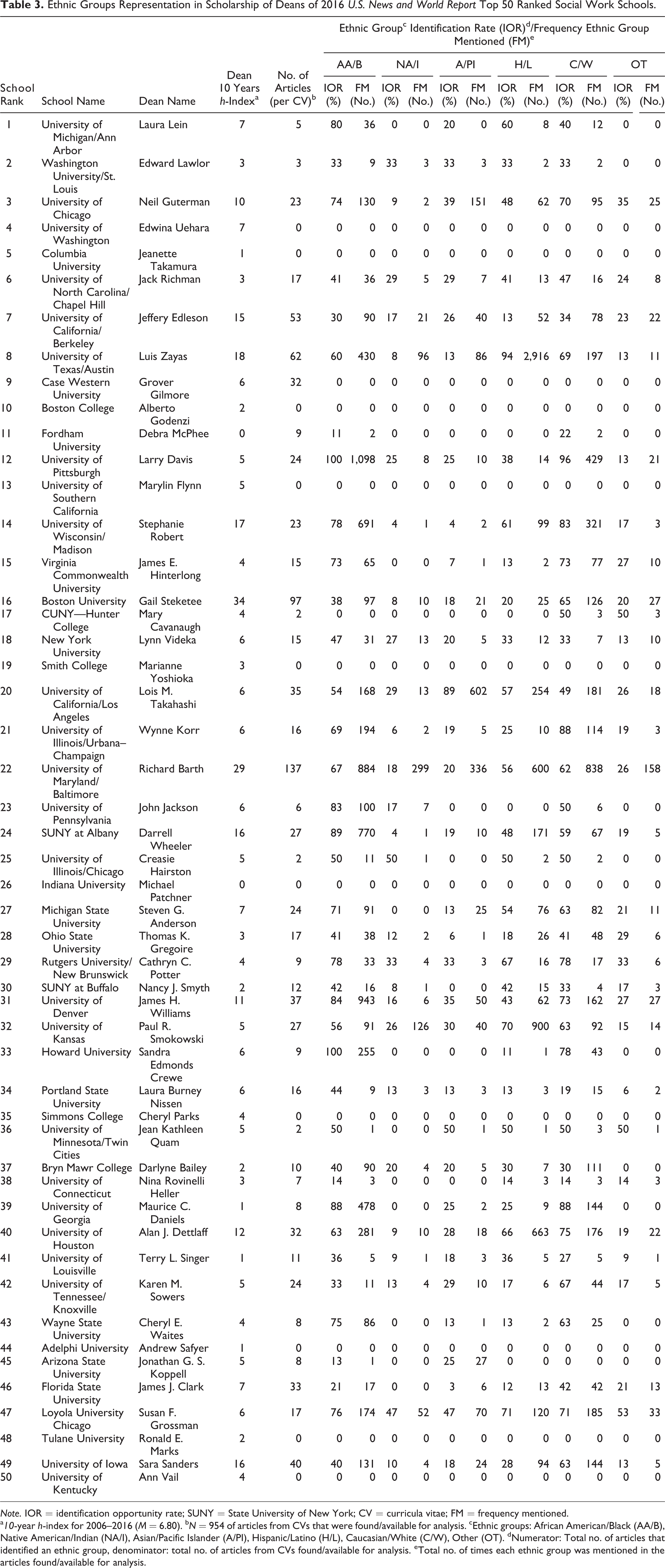
The IOR is the ratio of the number of times an ethnic group is mentioned (maximum of once per article) divided by the total number of articles published by each dean. Also, a total frequency of the number of times a particular group was mentioned was used to approximate a rate of emphasis. The extent to which the deans’ scholarship included coverage on African Americans and other ethnic groups provides evidence of their focus on race and ethnicity. The total number of times a particular ethnic group was identified in a published article of a dean is reported in Table 3. The total articles reported in Table 3 represent the total number of articles that were available in the public domain that could be retrieved and used to conduct a word search to recognize the identification of a particular group.
The analysis also included some quantitative strategies including calculating means of the h-index scores and conducting a two-sample t-test comparing African American and non-African American deans’ mean h-index scores. The use of both quantitative and qualitative methods of analysis was deemed to be appropriate based on the level of explanation needed to answer the research questions.
Results
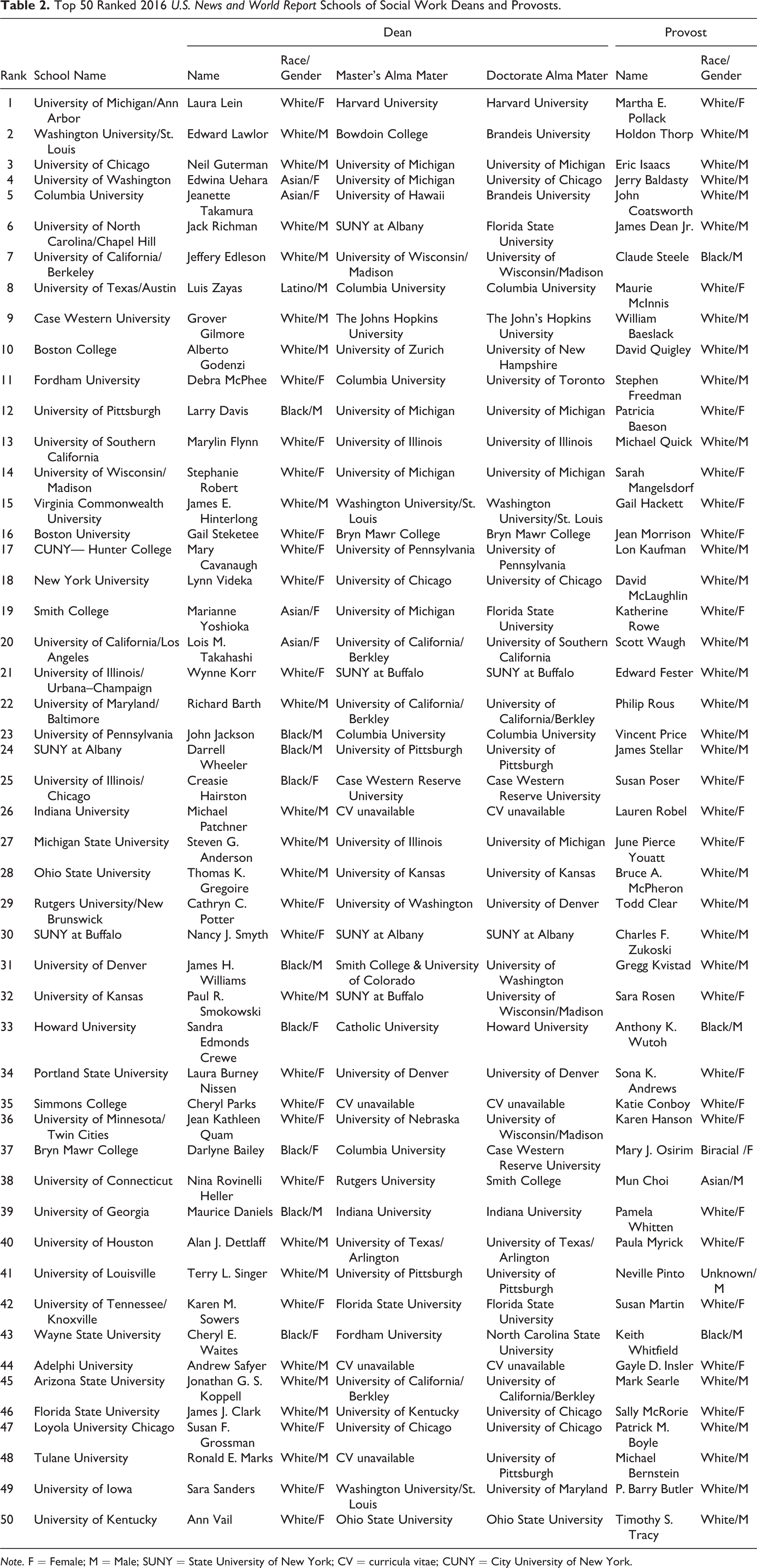
Table 2 illustrates the 2016 U.S. News and World Report (USNWR) school names and rankings of the top 50 schools of social work; the names, genders, races, graduate, and doctoral alma maters of respective deans; and names, genders, and races of respective provosts.
Top 50 Ranked 2016 U.S. News and World Report Schools of Social Work Deans and Provosts.
Note. F = Female; M = Male; SUNY = State University of New York; CV = curricula vitae; CUNY = City University of New York.
In Table 2, the 2016 USNWR top-ranked 50 schools of social work are identified. Of the 50 deans identified 18% (N = 9) were African American. Schools of social work led by African American deans include Wayne State University in Detroit, MI; University of Denver in Denver, CO; Bryn Mawr in Bryn Mawr, PA; Howard University in Washington, DC; University of Illinois at Chicago Circle in Chicago, IL; State University of New York (SUNY) at Albany in Albany, NY; University of Pennsylvania in Philadelphia, PA; University of Pittsburg in Pittsburg, PA; and University of Georgia in Athens, GA. Of particular note is the fact that only 1 of these top 50 schools of social work is a historically Black college and university (HBCU): Howard University.
The data further illustrate that of the top 10 schools of social work, there are no African American deans represented. Only four of nine African American deans lead top 25 schools of social work. Those schools are located at University of Pittsburg, University of Pennsylvania, University of Albany, and the University of Illinois at Chicago Circle. The alma maters of the African American deans illustrate that only one of a total of nine had at least one degree from an HBCU. The remaining eight of nine African American deans did not hold either a graduate or an advanced degree from an HBCU. Seven of the nine African American deans received their doctorates from tier one institutions (University of Michigan, Columbia University, University of Washington, University of Pittsburgh, Howard University, and Case Western University). Of note is that only one African American dean obtained their doctorate from an HBCU. All African American deans at top 50 schools of social work also attended graduate schools of social work programs currently ranked within the top 50. A slight majority of the deans (62%; N = 31) had an administrative position as their last job before being appointed dean. The remaining 38% (N = 19) of the deans of the top 50 schools of social work occupied a faculty rank.
Race and Gender
Overall, the data illustrate that 54% (N = 24) of these deans are women and 46% (N = 23) are men. When the variables of race and gender are combined, the data indicate that 72% of these deans are either a Caucasian male (17) or Caucasian female (19), while 18% of the deans in this sample are African American (five men and four women), 8% are Asian (four women), and 2% are Latino (one male). Interestingly, no Latina women are represented in the sample of deans. Caucasian deans made up 72% (N = 36) of the top 50 deans.
The schools of social work led by Asian American women include University of Washington in Seattle, WA; Columbia University in New York, NY; followed by University of California at Los Angles in Los Angles, CA; and Smith College in North Hampton, MA. The respective rankings of these schools of social work are 3, 5, 16, and 16. Only 1 of the top 50 schools of social work is led by a Latino male, which is currently ranked 7 (University of Texas at Austin). Two schools of social work tied with a first place ranking and are headed by either a Caucasian man or a Caucasian woman. According to data in Table 1, men lead 7 of the top 10 schools of social work, while women lead the remaining 3. Also men lead 11 of the top 25 USNWR ranked schools of social work, while women lead the remaining 14. Of the top 50 schools of social work ranked in the bottom 25, women lead 13 schools and men lead the remaining 12 schools.
Provost
As illustrated in Table 2, the provosts of the Universities comprising the top 50 schools of social work are predominantly Caucasian, representing 88% of the total provost sample (N = 44). The racial makeup of the remaining 12% of provosts is as follows: three African Americans (6%), one Asian (2%), one Biracial (2%), and one unidentified (2%). The data also show that 31 of the 50 provosts are men and 19 are women. As it pertains to race and gender, 25 of the 50 provosts are Caucasian men and 19 are Caucasian women. Only 3 of the 50 are African American men. Not one of the provosts in the 50 universities comprising the top-ranked schools of social work has an African American female as provost. The ethnic backgrounds of the remaining provosts consisted of a biracial female (N = 1), a male with an unidentified racial background, and an Asian male (N = 1). None of the people in the provost sample identified as Latino/a.
H-Index Analysis of Deans of Top 50 Schools of Social Work
The h-index is a cumulative indicator of scholarship impact (Huggins-Hoyt, 2018; Huggins-Hoyt, Holosko, Briggs, & Barner, 2014). Huggins-Hoyt (2018) says that the h-index is comprised of two key factors: the number of papers published and number of citations per published paper. The average 10-year h-index of the deans of the top 50 schools of social work are included in the third column of Table 3. The M = 6.80 and the range is 1–34. Using the mean of the end points of the range, which is 17.5 as a 10-year h-index score reference point, 4 of the 50 deans have a 10-year h-index above 17.5, while the majority of them have 10-year h-indexes below 17 (N = 46). Ten of the 50 deans have 10-year h-indexes that are rated between the scores of 10 and 34. Two deans have extremely high 10-year h-indexes (Gail Steketee at Boston University and Richard Barth at the University of Maryland) of 34 and 29, respectively.
Ethnic Groups Representation in Scholarship of Deans of 2016 U.S. News and World Report Top 50 Ranked Social Work Schools.
Note. IOR = identification opportunity rate; SUNY = State University of New York; CV = curricula vitae; FM = frequency mentioned.
a 10-year h-index for 2006–2016 (M = 6.80). b N = 954 of articles from CVs that were found/available for analysis. cEthnic groups: African American/Black (AA/B), Native American/Indian (NA/I), Asian/Pacific Islander (A/PI), Hispanic/Latino (H/L), Caucasian/White (C/W), Other (OT). dNumerator: Total no. of articles that identified an ethnic group, denominator: total no. of articles from CVs found/available for analysis. eTotal no. of times each ethnic group was mentioned in the articles found/available for analysis.
The average h-index scores for African American deans (M = 6.22, standard deviation [SD] = 4.63) did not differ significantly from the average h-index scores of non-African American deans (M = 6.93, SD = 7.14), t(17) = 0.371, p =.715. The most frequent 10-year average h-index score reported for African Americans was a score of 5 or 6, which was reported for four of the nine African American deans. Only one African American dean had a 10-year average h-index score of 16 (Darrell Wheeler at the State University of New York at Albany).
Ethnic Content in Published Scholarship of Deans
Twenty-one of the deans identify African American or Black in at least 50% or more of their retrievable published articles. Larry Davis at University of Pittsburgh, James Williams at the University of Denver, Richard Barth at the University of Maryland, Darrell Wheeler at the SUNY at Albany, Stephanie Robert at University of Wisconsin at Madison, Maurice Daniels at the University of Georgia, Luis Zayas at the University of Texas at Austin, Alan Dettlaff at University of Houston, and Sandra Edmonds Crew at Howard University represent the deans who mentioned Black or Africans Americans in their collections of work at least 250 times or more, respectively.
Hispanic and Latino/a are most frequently mentioned by Luis Zayas at 2,916 times with an IOR of 94% of the 100% of retrievable published articles. No other group has this amount of coverage by one single author. Paul Smokowski mentioned Hispanics/Latino/as a total of 900 times with an IOR of 70% for this same group. Alan Dettlaff at the University of Houston reports the third highest mention of Hispanics/Latino/as in his retrieved works at 663 times for this same group. His IOR for Hispanics and Latino/as is 66%. Richard Barth at the University of Maryland mentioned Hispanics and Latino/as 600 times with an IOR of 64%.
Two of the 50 deans mention Asian and Pacific Islanders at a high rate. Lois Takamura at the UCLA (University of California at Los Angeles) School of Social Work mentioned Asian and Pacific Islanders 602 times across the collections of work, with an IOR of 89%. Richard Barth mentioned the Asian and Pacific Islander group 336 times, with an IOR of 20%.
Native Americans receive frequent mentions by 2 of the 50 deans. Richard Barth at the University of Maryland mention Native Americans 299 times, with an IOR of 18%.
Discussion
The data on the lack of African Americans in decanal roles raise additional questions. What can we learn from the gains in African American leadership of schools of social work from the mid-1970s to 2000s? What if any impact was made on the profession of social work at the universities where African American deans were appointed? Why the lack of African American deans since 2000? Why the rise of Caucasian women as deans of schools of social work?
The data from this study show the vast majority of the deans of the top 50 schools of social work are Caucasian men and women. Too few African Americans, Latinos/as, and Native Americans occupy these leadership roles. In addition, the majority of provosts from this data set are Caucasian. Whether this is a coincidence or was not assessed because these data do not allow us to discern cause and effect. Whether or not we have uncovered a coincidence or an intractable pattern of both racial and gender discrimination is an empirical question that should be used to guide future inquiries. Historical trends point to the existence of a covert system of structural racism (Wolfe & Dilworth, 2015).
The current demographics of leadership of schools of social work and their university provosts mirror the demographics of the profession at its inception in the early and mid-20th century. Little, if any, information has been published about key African Americans in providing leadership and scholarship with schools of social work. There were possible exceptions such as W. E. B. Du Bois, a sociologist, and E. Franklin Frazier, a psychologist. Also, there was Whitney M. Young Jr., a civil rights leader, advisor to three U.S. Presidents, and the first African American President of NASW (National Association of Social Workers). There were other influential colleagues who were mostly located at HBCU’s (Bowles, Hopps, & Clayton, 2016; Carlton-LaNey, 2000).
All of the stakeholders of the social work profession as well as university leadership need to be reminded of a basic truth: The manifestations of the myriad of problems that the profession of social work purports to address are overwhelmingly bourn by vulnerable and marginalized African Americans and other people of color (Hopps, 1982). In our estimation, the hiring of more African American and other persons of color as deans would strengthen the diversity and quality of student and faculty recruitment at schools of social work. Diverse leaders are connected to different: social and professional networks, enabling such leaders to attract, reach, and recruit more students and faculty of other races and ethnicities. While leaders of higher education profess to practice equal justice via colorblind hiring of administrators, our data provides some evidence that contradicts these claims.
Our study suggests that African Americans and other historically oppressed groups are often excluded, while Caucasian women and Caucasian men are favored for deanship at top social work universities. The effect of unfairly biased hiring practices is best captured by Wolfe and Dilworth (2015) who state: “In today’s society, the struggle remains due to traditional practices that either overlook or support biased behavior against minority groups” (p. 12). Wolfe and Dilworth (2015) go on to say that …racial and ethnic minority leaders in higher education have had to play by the rules of competition established by the dominant status group-white males…therefore, traditionally marginalized groups compete with one another, while the dominant group does not due to their already inherent status of power and privilege. (p. 12).
The data on the average 10-year h-index score of the deans are informative. The study shows that African American deans in the top 50 schools produce the same level of scholarship despite all the structural barriers identified in previous research. These data are consistent with the observations by others who report the scholarship achievements and productivity of African American faculty in the top 25 schools of social work despite structural and interpersonal barriers (Allen, Huggins-Hoyt, Briggs, & Holosko, 2018). The 10-year average h-index scores for African American and Caucasian deans of the top 50 schools of social work were comparable to the average h-index scores (M = 6.62) of the top 25 schools of social work.
This finding is not expected, given the significant threats to scholarship productivity among African Americans deans and faculty. African American deans face an array of structural challenges that limit their ability to accumulate a high h-index score. For example, lack of admission to graduate and doctoral programs reduces the pool of potential African American scholars to produce high-impact work. Historically, employment as faculty of top schools of social work was largely closed to African Americans. Schools of social work did not take the responsibility for employing African Americans until after the Civil Rights Movement and the expansion of schools of social work in the 1960s and early 1970s.
From that time until now, many African American faculty (who are current deans now) have encountered alienation and limited opportunities to connect with mentors. Such mentors would have coached them how to navigate the complex world of academic publishing. Consequently, many African American faculty members have been forced to learn publishing procedures by themselves. In addition, African American faculty often feel a social justice obligation to mentor a majority of minority students at an institution, which severely cuts into publishing productivity (Allison, 2016). Finally, African American research interest, particularly race-related topics, are not as valued as clinical topics in many high-impact journals (Delgado & Stefancic, 2000; Griffin, Bennett, & Harris, 2013; Jackson-Weaver, Baker, Gillespie, Ramos Bellido, & Watts, 2010).
One interpretation of the similarity of h-index scores across race is that structural impediments to publishing for African American faculty are not significant anymore. However, several studies suggest otherwise (Delgado & Stefancic, 2000; Griffin et al., 2013; Jackson-Weaver et al., 2010). Purposefully, disqualifying African American faculty with low h-index scores is another interpretation of the similarity of h-index scores across race. It is possible that many African American faculty members were never considered for a decanal role because their h-index scores were not high enough, thus leaving only African American scholars with extraordinarily high scholarly impact as candidates. This interpretation would also explain why there are low levels of African American deans in the top 50 schools of social work. Such a practice would be an example of institutional racism rooted in academic structures, as dean-selecting committees would not have actively considered the historical and current impediments to scholarship of African American faculty when measuring productivity indicators such as h-index scores.
Top 50 deans seldom mentioned African Americans and other ethnic groups in their published scholarship (see Table 3). This raises questions about the social justice focus of many of these deans and their respective provosts and schools. The lack of attention paid to African Americans and other ethnic groups in social work journals has been an issue observed by Hopps (1982), McMahon and Allen-Meares (1992), Schiele and Hopps (2009), and recently by Briggs, Holosko, Banks, Huggins-Hoyt, and Parker (2018). Also, African Americans are rarely covered across a number of social work venues such as the mission statements of the top 50 schools of social work, courses titles of the top 25 HBCU graduate and BSW (Bachelor of Social Work) curricula, editors in chief of the top 16 U.S. social work journals, and the Encyclopedia of Social Work (Briggs et al., 2018). Based on discussions with the data collectors, in many cases, African Americans were mentioned in a published article only because the group was used as a source for comparison to Caucasians. Future studies in this area should employ more robust measures to track the mention of ethnic groups in published articles that further delineate the purposes, the context, and the social justice implications of particular articles. Taken together, the lack of content focus on African Americans and other minority groups in top 50 deans’ body of publishing, along with the underrepresentation of African Americans in decanal roles in the top 50 schools of social work; and the similarity in h-index scores between African American and non-African American deans supports the notion that social work still discriminates against African Americans, which has been true since the profession’s origins (Briggs et al., 2018).
Summary of Key Findings
Based on the data, the following main observations are offered: (1) a minimal percentage of racial diversity is reflected in the leadership among the 50 schools; (2) though the difference is small, more women serve in the decanal role than men; (3) the majority of the deans’ racial backgrounds reflect the racial makeup of the university’s central administration, which is Caucasian; (4) there are more Caucasian men as provosts with Caucasian women representing the second largest group of provosts; (5) the ethnic content reflected in the published scholarships of deans on African Americans and other ethnic groups was limited; and (6) there was no difference between the mean 10-year h-index score of African American and non-African American deans. Also, 10-year average h-index scores of 17 and above were held exclusively by two Caucasian women (17 and 34), one Caucasian man (29), and one Latino man (18). The highest 10-year h-index score among the African American deans is held by Darrell Wheeler at the State University of New York at Albany (16).
These findings reinforce Wolfe and Dilworth’s (2015) observations regarding the sustainability of power and privilege and the relative importance attached to the preservation of whiteness. What is absent in this discussion is any examination of data that assesses how whiteness is preserved at each of the decision points involved in the hiring process. Future studies in this area are needed to assess the transparency and integrity of each stage of the dean search process. The study should include nominations, reference checks, and especially the off-the-record vetting process through the decision to hire and the salary negotiation process. The study of experiences of Caucasian, African American, male, and female applicants for deanships will provide the data needed to explicate some of the factors that may contribute to racial and gender disparities among applicants. Also, future research should investigate how successful candidates are selected for social work deanships. However, it is quite possible that the off-the-record vetting process is the actual selection and hiring process that goes undetected due to its covert nature and industrywide sanction. In this case, it may be difficult and unrealistic to assess the origins, causes, correlates, and consequences for the lack of equal justice and the racial inequalities among deanships of schools of social work. The sanctioned lack of transparency that reinforces off-the-record vetting is a questionable process that may prevent the recruitment of study participants and prohibit authentic disclosure to those who wish to research this phenomenon. Until this process is discontinued, we may not be able to study or secure solutions that will result in the increased hire of ethnically diverse deans at schools of social work. This is ironic given the social justice foundations of social work and the fact that most schools of social work actively use hiring practices that sanction racial and gender preference.
Recommendations
The authors recommend four main action items to help alleviate the critical shortages of African American deans in social work. First, groups such as Council on Social Work Education (CSWE), National Association of Deans and Directors of Schools of Social Work (NADD), and the Society for Social Work Research (SSWR) should acknowledge that the lack of social justice in social work dean selection is an issue that requires change. This issue needs to be courageously discussed within schools of social work preparing to search for new senior leadership. Our data not only confirm the lack of African American representation in the decanal function, but it also reflects the lack of deans from other ethnically diverse groups including Native Americans, Hispanic and Latino/as, and Native Hawaiians and other Pacific Islanders. The shortage of racial and ethnic diversity in deans of schools of social work does not reflect the social justice foundations of the profession.
Second, more attention should be given to the lack of African Americans in doctoral social work programs. The National Center for Educational Statistics (n.d.) report indicates that of the 140,505 PhDs conferred in 2009–2010, only 10,417 (6.6%) were obtained by African Americans. Fischer (2010) further explicates an overall lack of candidates in the pipeline by highlighting that only 5% of African American women occupy the office of president at major colleges and universities. In conjunction with increasing the pool of African American social work doctoral students, there also needs to be concerted efforts to create legitimate pathways to leadership for African Americans and other ethnically diverse groups (i.e., creating executive leadership programs).
Third, as Wolfe and Dilworth (2015) pointed out, African Americans who received their PhD from HBCUs universally receive less respect from mainstream academic settings. This perspective prevails despite the fact that an HBCU is in the top 50 schools of social work. Mainstream academic institutions need to recognize the talent, qualifications, and unique perspectives of social work leaders who are graduates of HBCUs. Fourth, the CSWE needs to include in its accreditation standards a statement that affirms that social work education is committed to racial diversity in senior academic and scholarly leadership roles. Currently, CSWE, NADD, and SSWR do not maintain data on race and gender of the deans and directors of schools of social work. Including racial diversity in the selection of social work search committee members and search firms will accomplish the following: (1) help address questions relative to integrity and authenticity of the search process, (2) provide a mechanism to ensure the inclusion of well qualified racially diverse candidates, and (3) encourage respect of unique cultural values and nuances that are often overlooked or misunderstood by the predominantly Caucasian and female dominated academic culture. In addition, all future search efforts should build in transparency and appropriate checks and balances in the process. To avoid exclusionary practices and ensure a fair process, the authors recommend discontinuing the use of informal references derived from off-the-record vetting in dean selection. Based on Guillory (2001), Cox (1993), and Wolfe and Dilworth (2015), the use of informal references can contribute to the exclusion of African Americans from advancement to senior administrative roles in the academy. They conclude, “decisions to hire and promote into administrative positions rely less on qualifications than on the extent to which the candidate ‘fits’ with the established dominant group” (Wolfe & Dilworth, 2015, p. 10).
Limitations and Conclusion
This study is the beginning of an authentic conversation about racial equality in schools of social work leadership roles. However, four main limitations need to be addressed. First, the researchers did not have the resources to interview the deans of the respective schools to determine how they identify racially. Second, the same can be said in respect to the demographic data collected through the hiring authorities. Such interviews would have confirmed publicly available demographic data and improved overall validity of the study. Third, there is no recorded data on deans who served in the past since the professional organizations CSWE, NADD, and SSWR have not developed such data banks. Therefore, the names of the deans in Table 1 are derived through the use of retrospective baseline procedures to document recalled memories of observations. Finally, interviews with the deans of color from the identified schools would have helped in identifying other salient variables that assisted them in becoming deans at PWIs. Despite limitations, these exploratory data are instructive for guiding future research in this area.
Given the roles that African Americans have played (see Allen et al., 2018; Hoyt, in this special section of the scholarly impacts of African American social work scholars) as early as Du Bois, we ought not to abandon the richness they contribute to social work (Bowles, Hopps, and Clayton., 2016; Hopps, 1982). This important social welfare theme requires deliberate attention. It first needs to be acknowledged as an issue by those with influence and power in the academy of social work and then by practitioners and faculty. To further understanding of the lack of African Americans in decanal roles at schools of social work, the leaders of the profession need to legitimize further study of this important subject to move toward greater social justice not only in the academic community but also within the profession.
Footnotes
Acknowledgment
Special thanks to Jana Leigh Woodiwiss-Geter and Megan Woodruff for their superb data collection support.
Declaration of Conflicting Interests
The authors declared no potential conflicts of interest with respect to the research, authorship, and/or publication of this article.
Funding
The authors received no financial support for the research, authorship, and/or publication of this article.