




Abstract
Purpose:
The factor structure of the Child and Youth Resilience Measure (CYRM-28) was originally established using a Canadian sample. This factor structure was not confirmed in a study with New Zealand youth. Given such variability, the current study investigated the factor structure of the CYRM-28 in a sample of Sesotho-speaking South African youth who participated in Pathways to Resilience Study.
Method:
Using latent variable modeling, we tested six varied models in two randomly selected samples (n 1 = 559; n 2 = 578).
Results:
Fit statistics indicated that a three-factor variation of the New Zealand model, namely, individual, family/relational, and composite context, fitted best. The contextual composite synthesizes the CYRM-28 clusters that measure social skills, educational, spiritual, community, and cultural resources.
Conclusion:
The contextual composite reflects traditional African ways of being. Accordingly, understanding the factor structure of the CYRM-28 precedes practitioner capacity to promote resilience in an evidence-informed way.
A growing number of resilience researchers from countries in the Northern Hemisphere (e.g., the United Kingdom, Canada, the United States) endorse an ecological systems approach to explain how and why young people adjust well to chronic or acute stressors that predict negative life outcomes (Cicchetti, 2013; Masten, 2001; Panter-Brick, 2015; Rutter, 2013; Ungar, 2011; Wright & Masten, 2015). There is a similar tendency among resilience-focused researchers from countries in the Southern Hemisphere (e.g., South Africa, Colombia, New Zealand; e.g., Bottrell, 2009; Montoya, Restrepo, Duque, & Ungar, 2011; Sanders & Munford, 2014; Theron, 2015; van Breda, 2015). Implicit in this global endorsement is recognition that resilience is a process that (i) shows variation across developmental stages and historic time, sociocultural contexts, type of adversity, and demographic factors and (ii) draws on multiple systems, from molecular through to family, community, and even the physical environment. Accordingly, and in contrast to earlier explanations of resilience that accentuated individual traits and skills (e.g., Anthony & Cohler, 1987), current explanations of human resilience tend to account for personal, relational, and contextual (e.g., structural, political, cultural, social) determinants of positive development. These explanations draw attention to the variability of resilience processes and caution against a one-size-fits-all account of the factors and processes that enable resilience (Sanders, Munford, Thimasarn-Anwar, & Liebenberg, 2015).
The variability of resilience processes is reflected in how resilience is measured. As synthesized by Windle, Bennett, and Noyes (2011), various resilience scales have been developed over the years (e.g., Connor–Davidson Resilience Scale, Youth Resiliency: Assessing Developmental Strengths [YR:ADS], The Resiliency Attitudes and Skills Profile, and Resilience Scale for Adolescents [READ]). Windle and colleagues’ review of 15 resilience scales demonstrated that although none of these scales has identical foci, the majority has tended to measure personal constructs associated with resilience (e.g., psychological hardiness, ego resilience, self-esteem). A few (i.e., Resiliency Attitudes and Skills Profile, READ, YR:ADS, and California Healthy Kids Survey—The Resilience Scale of the Student Survey) also measure the social determinants of resilience such as social resources or social support. With the exception of the Child and Youth Resilience Measure (CYRM-28; Liebenberg, Ungar, & van de Vijver, 2013), the resilience instruments reviewed by Windle and colleagues (2011) were not responsive to how cultural context shapes resilience. As explained below, the resilience process is sensitive sociocultural contexts (Masten, 2014, 2016), and so it is important to measure the sociocultural dimensions of resilience.
The 28-item CYRM-28 is a survey instrument that was purposefully designed to measure children’s perceptions of the protective resources available to them at the level of individual, relational, and contextual systems (Liebenberg et al., 2013). Sociocultural supports form part of the contextual protective resources measured by the CYRM-28. There have been attempts to validate the CYRM-28 for use with Canadian youth (Liebenberg et al., 2013), New Zealand youth (Sanders et al., 2015), and Iranian youth (Zand, Liebenberg, & Shamloo, 2016). Although the CYRM has been used with South African youth (e.g., Malindi, 2014; Malindi & Theron, 2010; Theron, Liebenberg, & Malindi, 2014, van Rensburg, Theron, Rothmann, & Kitching, 2013), to date, there has been no investigation of whether its factor structure holds for youth populations in Global South communities like Sesotho speakers in rural South Africa. Drawing on the latent variable analyses reported below, this article investigates how well the abovementioned published factor structures of the CYRM-28 explain the resilience of a sample of South African young people.
Sociocultural Determinants of Resilience
Masten and Wright (2010) report universally accepted pathways of resilience (i.e., attachment relationships, agency and mastery, intelligence, meaning making, self-regulation, culture, and religion) but highlight that how these manifest and are perceived within a specific context or culture will vary. Ungar (2008), Ungar, Ghazinour, and Richter (2013), and others (de Jong et al., 2015; Panter-Brick, 2015; Ruiz-Casares, Guzder, Rousseau, & Kirmayer, 2014; Ungar, Ghazinour, & Richter, 2013) too caution that how resilience is defined differs from culture to culture. Acknowledging that context and culture are likely to shape what resilience means and which resilience-supporting resources are valued invites contemplation of the normative dimensions of resilience (Panter-Brick & Leckman, 2013). For instance, the resilience processes of young people who were challenged by the political conflict that characterized Bosnia and Palestine during the late 1980s and 1990s were shaped by the political ideology that these young people had been socialized to accept and enact (Barber, 2013). Similarly, the factor structure of resilience scales might vary across sociocultural groups. For example, validation studies of the CYRM among young people in New Zealand (Sanders et al., 2015) and Iran (Zand et al., 2016) resulted in different factor structures and varied numbers of items for each subscale, compared with the original structure of the measure validated in Canada (Liebenberg et al., 2013). The validation of the CYRM in a variety of contexts and cultural groups (including South Africa) is therefore essential to accurately understand and measure resilience processes (van Rensburg, Theron, & Rothmann, 2015).
The CYRM-28 Factor Structure: Canada
Using a 5-point Likert-type scale, the Canadian factor structure includes three subscales that measure individual, relational, and contextual supports (Liebenberg et al., 2013). Each subscale consists of specific clusters. The individual subscale includes personal skills (5 items; e.g., “I cooperate with people around me” and “I am aware of my own strengths”), social skills (4 items; e.g., “I know how to behave in different social situations” and “I have opportunities to show others that I am becoming an adult and can act responsibly”), and peer support (2 items; i.e., “My friends are on my side” and “I feel supported by my friends”). The relational subscale clusters into psychological caregiving resources (5 items; e.g., “My caregiver(s) know a lot about me” and “I talk to my caregivers about how I feel”) and physical caregiving resources (2 items; i.e., “My caregiver(s) watch me closely” and “If I am hungry there is enough to eat”). The contextual subscale includes spiritual resources (3 items; e.g., “I participate in organized activities” and “Spiritual beliefs are a source of strength to me”), cultural resources (5 items; e.g., “I am proud of my nationality” and “I enjoy my community’s traditions”), and educational resources (2 items; i.e., “I feel I belong at my school” and “Getting an education is important to me”). Response options range from “not at all” to “a lot.”
The CYRM-28 Factor Structure: New Zealand
In contrast to the Canadian factor structure, the New Zealand factor structure includes four subscales: 10 items measuring young people’s social and cultural contexts, 7 items measuring family resources, 7 items measuring young people’s individual resources, and 4 items measuring spiritual and community contexts. The family resources subscale is the same as the Canadian relational subscale, without the psychological and caregiving clusters. However, with regard to the individual subscale, the items that cluster under social skills fit better in the social and cultural context subscale in the New Zealand cultural context. Further, whereas there is only one contextual subscale (consisting of three clusters) in the Canadian factor structure, New Zealand has two contextual subscales, that is, social and cultural context as well as spiritual and community context (Sanders et al., 2015). Lastly, one item included under the Canadian cultural cluster (“I enjoy my community’s traditions) was found to belong to the spiritual and community context subscale.
The CYRM-28 Factor Structure: Iran
Findings from an exploratory and confirmatory factorial analysis using the CYRM-28 with Iranian youth resulted in an 11-item version of the CYRM. The 11-item version consists of three factors assessing peer resources (2 items), caregiver resources (4 items), and religious and cultural resources (5 items; including 1 item originally in the psychological caregiving cluster [“I enjoy my family’s/caregiver’s cultural and family traditions”]). Factorial analyses led to the removal of the resource clusters (as per the Canadian model) measuring personal skills, social skills, and educational resources. In addition, the following items from the original Canadian clusters were discarded: 1 item of the physical caregiving subscale (“If I am hungry, there is enough to eat”), 1 item of the psychological caregiving subscale (“I talk to my family/caregiver(s) about how I feel”), 1 item of the spiritual resource subscale (“I think it is important to serve my community”), and 3 items from the cultural resource subscale (“I have people I look up to,” “I am proud of my ethnic background,” and “I am treated fairly in my community”). The authors suggested that these removals might be a result of the collectivistic culture to which Iranian youth subscribe (Zand et al., 2016).
Purpose Statement
Given the above variations in the reported factor structure of the CYRM-28, it would be optimal research practice to investigate the factor structure of the CYRM-28. In addition to this being good research practice, an understanding of the goodness of fit of the published factor structures of the CYRM-28 (i.e., those based on studies with youth in Canada, New Zealand, and Iran) for South African young people can potentially support service professionals to identify resilience-supporting resources within South African young peoples’ social ecologies.
Method
Testing the CYRM-28 Factor Structure in South Africa
To evaluate the CYRM-28 factor structure, we drew on a data set that was generated as part of a South African collaboration in the Pathways to Resilience Study (P2RS) that included completion of the CYRM-28. The P2RS was a multiyear, multisite (Canada, China, Colombia, New Zealand, and South Africa) mixed-methods research project (see www.resilienceresearch.org). It investigated which resilience-enabling resources supported young people to achieve functional outcomes (such as school or civic engagement) despite being made vulnerable by structural and social disadvantage and other adversities.
Participants and Samples
In South Africa, a total of 1,137 young people from the Thabo Mofutsanyana District, Free State province, generated usable quantitative data. Young people living in this community experience multiple daily risks such as poverty, a high burden of communicable diseases, and crime (Berry, Biersteker, Dawes, Lake, & Smith, 2013; Theron et al., 2014). With the assistance of an Advisory Panel (consisting of local adults who were engaged with and/or serving young people living in the Thabo Mofutsanyana District), young people were recruited from local schools, shelters, children’s homes, and nongovernmental organizations for youth who were vulnerable (Theron, 2015, 2016).
As also detailed elsewhere (Theron, 2015, 2016; Theron, Theron, & Malindi, 2013), the participants were mostly Sesotho-speaking and socialized to respect and enact traditional African ways of being. Traditional African ways of being valorize interdependence or Ubuntu values (Bujo, 2009; Ramphele, 2012). Accordingly, children are socialized to rely on, but also contribute to, the collective. The collective extends beyond immediate and extended family: All human beings are respected and represent potential social capital (Mkhize, 2006). The collective also comprises spiritual beings (e.g., religious gods and/or ancestors). In line with this, traditional socialization encourages spirituality and faith-based practices (Bujo, 2009), along with a set of social skills that support respectful reciprocity. As part of this reciprocity, children are encouraged to invest in education and to use educational pathways as an opportunity to make material contributions to the collective and elevate its status (Gqola, 2011; Mandela, 1995). For the South African participants in the P2RS, social skills, education, and spirituality were intertwined with the traditional African culture they had been socialized to enact.
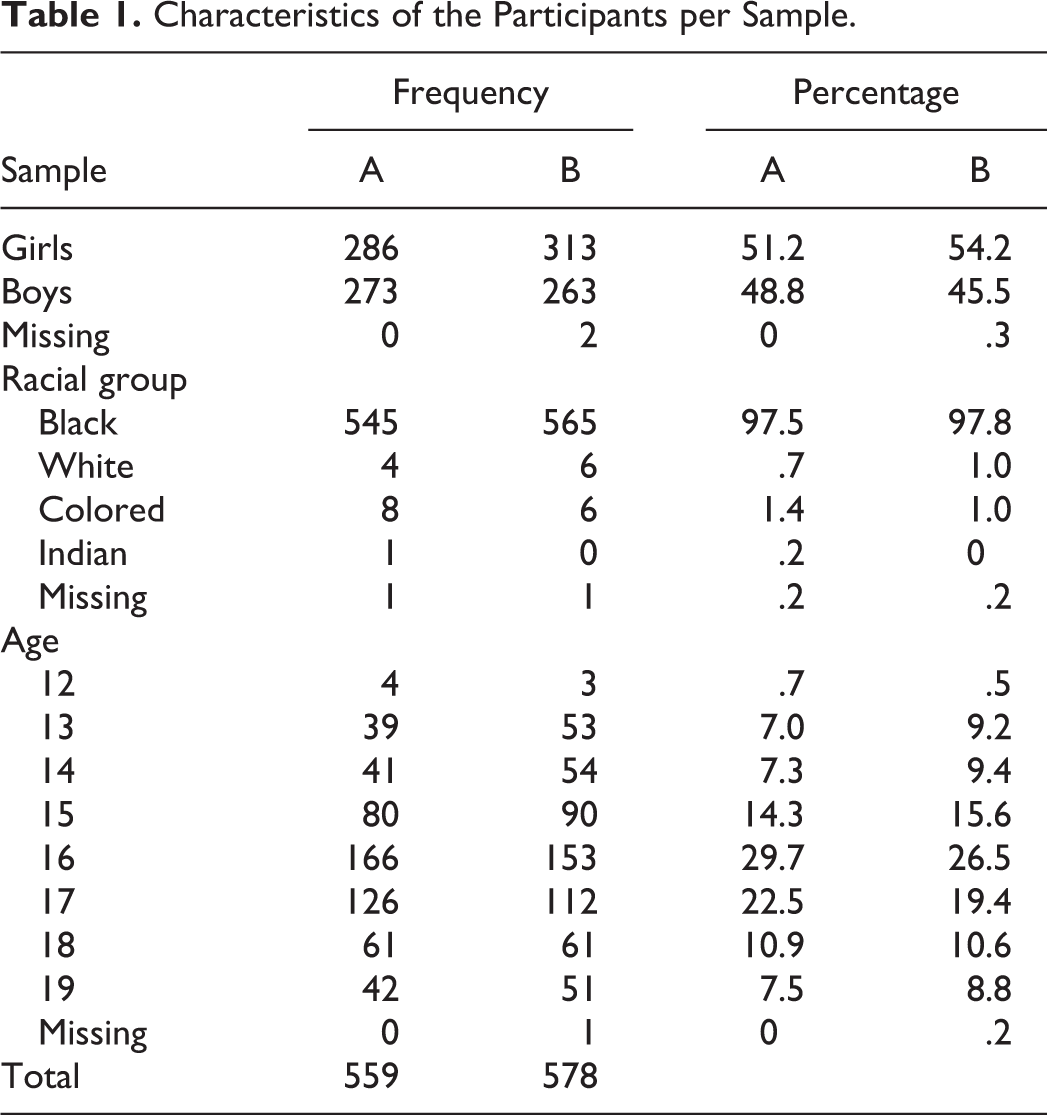
For the purposes of the analysis being reported in this article, the total sample was randomly divided with the use of the case selection function in SPSS (IBM Corp, Released 2015). This resulted in two groups; each approximately 50% of the total sample (Sample A = 559 and Sample B = 578). The total sample consisted of 599 (52.8%) girls and 536 (47.2%) boys (2 undeclared) aged 12–19 (M = 16.09; SD = 1.64; see Table 1 for demographics of the participants).
Characteristics of the Participants per Sample.
Administration of the CYRM-28
Researchers and trained field-workers from the Thabo Mofutsanyana District administered the CYRM-28 to groups of participants (30–45 at one time). They read each CYRM-28 item aloud in English; in turn, participants recorded their response in writing. On the advice of the South African Advisory Panel, the survey was not translated into Sesotho (the mother tongue of the majority). This decision was informed by the fact that all participants were attending English-medium schools at the time of the study. Instead, the Advisory Panel helped the field-workers to compile a list of code switches (i.e., Sesotho synonyms) for words/phrases that were more complex (e.g., affection, adoptive mother, and nationality). Each participant received a meal as a token of gratitude.
Ethical Consideration
Ethical clearance was obtained from the institutional review board of North-West University (the first and second author’s institution during the P2RS) as well as from the Department of Basic Education, Free State Province. Informed consent was obtained from both the young person and their legal guardian/trusted adult (see Theron, 2016) before completion of the CYRM-28. Young people were ensured of anonymity of participation and could terminate their involvement with the study at any time.
Data Analysis
Latent variable modeling in Mplus 7.4 was used to evaluate the Canadian and New Zealand factor structures of the CYRM-28 (Muthén & Muthén, 1998–2016) in two subsamples of rural Sesotho-speaking young people. Mplus makes use of full information maximum likelihood (FIML) estimation when handling missing values. Also, a maximum-likelihood estimator with robust standard errors (MLR) using a numerical integration algorithm was employed. The following goodness-of-fit indices were used to determine acceptability of the models/factor structures (cutoff scores are indicated in brackets): (a) chi-square (χ2) degrees of freedom (df), (b) the Tucker–Lewis index (TLI; ≥.90), (c) the comparative fit index (CFI; ≥.90), (d) root mean square error of approximation (RMSEA; ≤.08), (e) standardized root mean square residual (SRMR; ≤.08), (f) the 90% confidence interval (CI; ≤.08) of RMSEA and its significance (p; p ≥ .05), (g) Akaike information criterion (AIC), and (h) Bayes information criterion (BIC; when comparing models, lower AIC and BIC scores indicate the better fitting model; Schreiber, Stage, King, Nora, & Barlow, 2006). The first round of model evaluation was completed in Sample A; the best fitting model (i.e., lowest AIC and BIC values) was then validated in Sample B. Since the assumptions that each item contributes equally to a latent variable (i.e., τ equivalence) was violated, point-estimate reliability, as opposed to Cronbach’s α, was used to calculate each latent variable’s reliability score (Raykov, 2012).
Results
Testing the Measurement Models
Given the complexity of the resilience process (Masten, 2014; Ungar, 2015), the authors did not assume that a single iteration of a published factor structure could fit the South African data. To this end, we tested six variations (i.e., measurement models) of the published factor structures in Sample A. The measurement models consisted of three versions of the Canadian model (Liebenberg et al., 2013), two versions of the New Zealand model (Sanders et al., 2015), and a one-factor model testing for common method variance (Johnson, Rosen, & Djurdjevic, 2011; Podsakoff, MacKenzie, Lee, & Podsakoff, 2003). The Iranian version of the CYRM-28 was excluded since a validation study reduced the CYRM from 28 to 11 items (Zand et al., 2016). All factors/subscales were allowed to correlate in all models. Table 2 illustrates the six variations of CYRM-28 factor structures tested. Table 3 presents the goodness-of-fit statistics of each model.
Factor Structures of Measurement Models Tested.
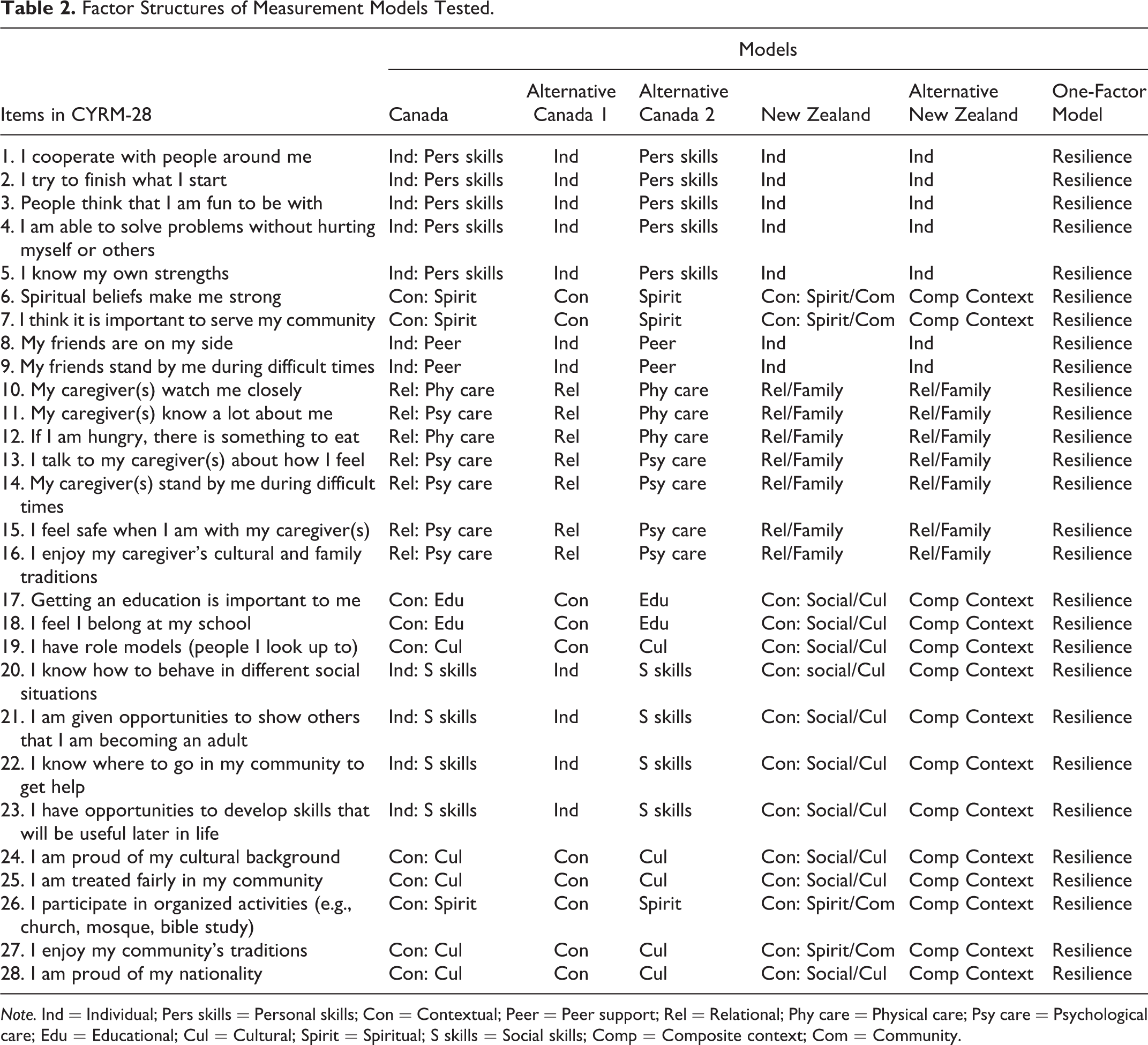
Note. Ind = Individual; Pers skills = Personal skills; Con = Contextual; Peer = Peer support; Rel = Relational; Phy care = Physical care; Psy care = Psychological care; Edu = Educational; Cul = Cultural; Spirit = Spiritual; S skills = Social skills; Comp = Composite context; Com = Community.
Goodness-of-Fit-Statistics for Measurement Models.
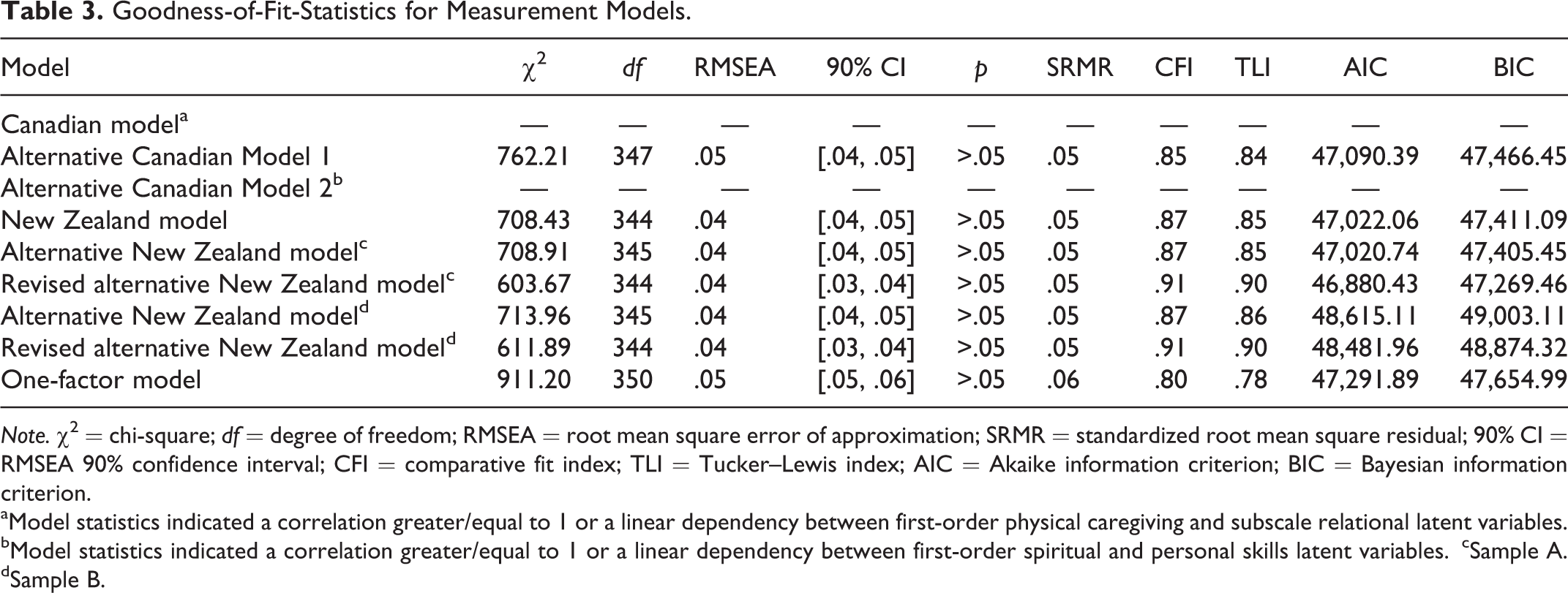
Note. χ2 = chi-square; df = degree of freedom; RMSEA = root mean square error of approximation; SRMR = standardized root mean square residual; 90% CI = RMSEA 90% confidence interval; CFI = comparative fit index; TLI = Tucker–Lewis index; AIC = Akaike information criterion; BIC = Bayesian information criterion.
aModel statistics indicated a correlation greater/equal to 1 or a linear dependency between first-order physical caregiving and subscale relational latent variables. bModel statistics indicated a correlation greater/equal to 1 or a linear dependency between first-order spiritual and personal skills latent variables.
cSample A. dSample B.
The Canadian model
This three-dimensional model derived from the original Canadian factor structure. The first subscale measured individual resources and was made up of three first-order latent variables (i.e., personal skills [5 items], peer support [2 items], and social skills [4 items]). The second subscale measured relational resources and consisted of two first-order latent variables (i.e., physical caregiving [2 items] and psychological caregiving [5 items]). The third subscale measured contextual resources and comprised three first-order latent variables (i.e., spiritual resources [3 items], educational resources [2 items], and cultural resources [5 items]).
Alternative Canadian Model 1
As an alternative to the above, the authors combined the items that made up each of the three first-order latent variables in the original Canadian factor structure. This meant that the first subscale (i.e., individual resources) consisted of all 11 items that measure personal skills, peer support, and social skills. The second subscale (i.e., relational resources) consisted of all 7 items that measured physical and psychological caregiving. The third subscale (i.e., contextual resources) consisted of all 10 items that measured spiritual, educational, and cultural resources. This three-dimensional model allowed the authors to evaluate a conceptually and statistically simpler model. It also offered opportunity to evaluate the direct interactions of the three subscales.
Alternative Canadian Model 2
In this alternative, the authors formulated a model that did not cluster the eight first-order latent variables from the original Canadian factor structure into subscales. Instead, the model was made up of eight dimensions. These dimensions corresponded to the eight first-order latent variables, namely, personal skills (5 items), peer support (2 items), social skills (4 items), physical caregiving (2 items), psychological caregiving (5 items), spiritual resources (3 items), educational resources (2 items), and cultural resources (5 items). This eight-dimensional model allowed the authors to evaluate a conceptually and statistically simpler model as well as the direct interactions of all first-order latent variables.
New Zealand model
This four-dimensional model derived from the original New Zealand factor structure. The first subscale, measuring individual resources, consisted of 7 items. The second subscale, measuring family resources, also consisted of 7 items. The third subscale, measuring social/cultural resources, consisted of 10 items. The fourth subscale, which measured spiritual/community resources, consisted of 4 items.
Alternative New Zealand model
As an alternative to the above, the authors combined the items making up the social/cultural and spiritual/community subscales in the original New Zealand model to form one subscale measuring social, cultural, spiritual, and educational resources. This scale was labeled composite context. The authors did not adjust the original individual and family subscales. Thus, the alternative three-dimensional model was made of the individual and family subscales, as per the original New Zealand model, and the newly conceptualized composite context subscale. This allowed the authors to test whether one subscale that integrated context-related resources (i.e., social, cultural, spiritual, and educational resources) better explained the resilience of South African participants. Traditionally, African culture prioritizes holistic conceptualizations, and so, this alternative model allowed the authors to test a model that fits with African emphases on holism.
One-factor model
This one-dimensional model consisted of all 28 items of the CYRM. The broad rationale behind this model was to test for common method variance. The more specific rationale was to test whether resilience could be explained as a unidimensional construct in the South African context (Johnson et al., 2011; Podsakoff et al., 2003).
Table 2 depicts the factor structures, and Table 3 depicts the goodness-of-fit statistics of all six measurement models tested. In Sample A, the Canadian and alternative Canadian Model 2 indicated errors and were not considered for further evaluation. The Canadian model results indicated that a correlation greater/equal to 1 or a linear dependency between the physical caregiving and relational scales might exist. The results of the alternative Canadian Model 2 indicated similar errors between the spiritual and personal skills factors, indicating that spirituality and personal skills might be highly related in this specific sample of young people.
The AIC and BIC indicated that neither the original Canadian, alternative Canadian Model 1 nor the New Zealand factor structures yielded the lowest AIC and BIC scores. The lowest AIC and BIC scores indicate the best fitting model for the data being investigated. Therefore, these models were not suitable for this sample of Sesotho-speaking South African young people. Furthermore, the simplistic representation of the CYRM-28 (i.e., the one-factor model) also did not yield the lowest AIC and BIC score. The fact that the one-factor model was not identified as the best fitting model probably relates to current understandings that resilience processes are complex and cannot be explained using simplistic models (Masten, 2014; Ungar, 2015). In short, results showed that the alternative New Zealand model (i.e., the one that integrated social/cultural and spiritual/community resources in ways that fit with African emphases on holism) was the better model (CFI = .87, TLI = .85, RMSEA = .04, 90% CI [.04, .05], p ≥ .05, SRMR = .05). However, acceptable goodness of fit was not achieved. As a result, model development was employed with the use of the modification index (MI). The MI indicated that 2 items (i.e., “My friends are on my side” and “My friends stand by me during difficult times”) of the individual subscale were highly related (MI = 100.92) and were subsequently correlated. The revised alternative New Zealand model indicated acceptable fit (CFI = .90, TLI = .90, RMSEA = .04, 90% CI [.03, .04], p ≥ .05, SRMR = .05).
A graphic depiction of the alterative New Zealand model is shown in Figure 1. Factor loadings of the 28 items ranged from .38 to .74, and the correlations between the three subscales ranged from .74 to .86. All items, factors, and subscales in this model were statistically significant (p = .00).
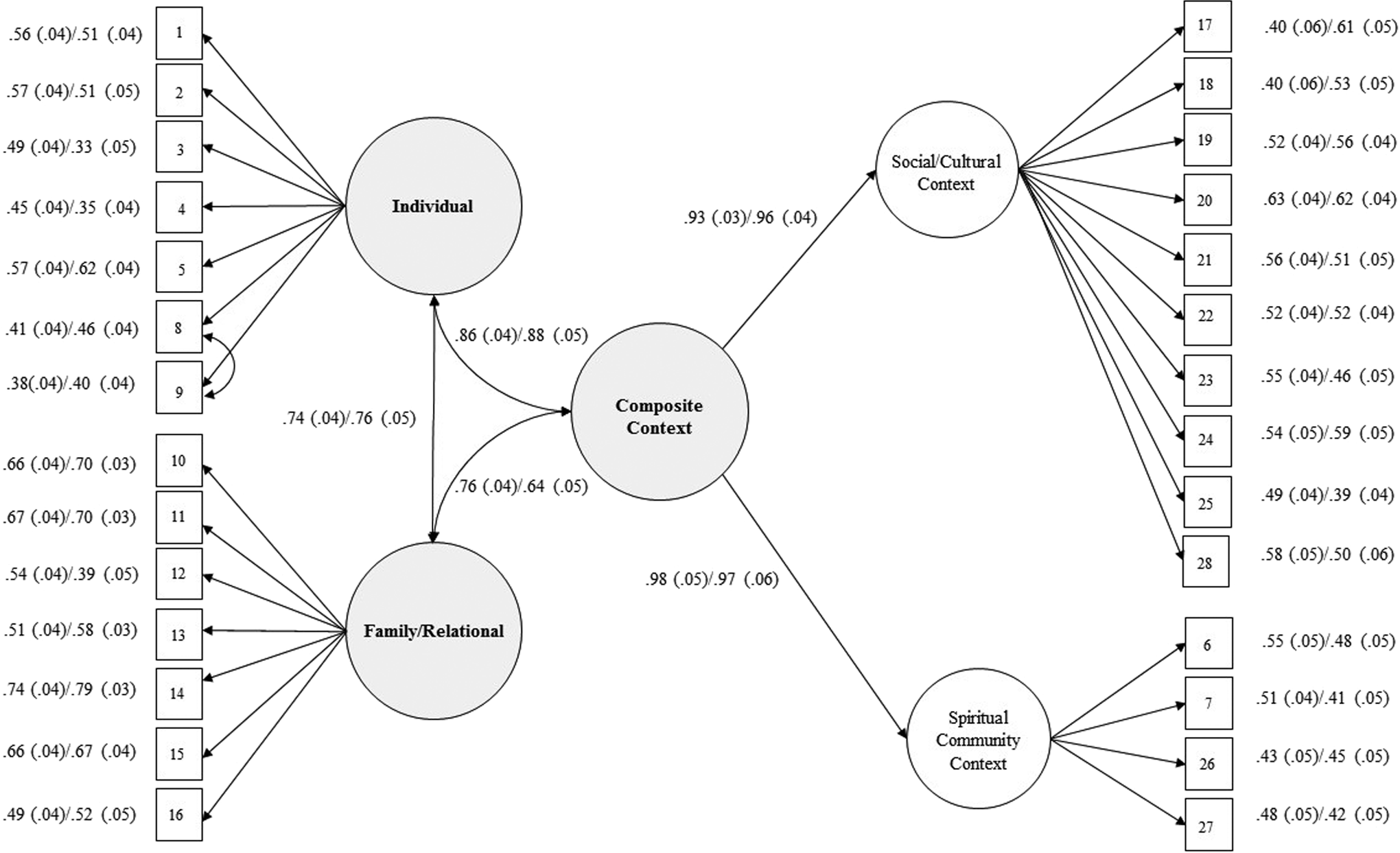
Final measurement model per sample.
Validation of the three-factor Model
The alternative New Zealand model was validated in an independent sample (Sample B; CFI = .87, TLI = .86, RMSEA = .04, 90% CI [.04, .05], p ≥ .05, SRMR = .05). However, once more acceptable fit was not achieved. Again, model development was employed. The MI (99.02) indicated that as in the case of the alternative New Zealand model in Sample A, the same items of the individual latent variable were highly related. These items were then correlated. The revised alternative New Zealand model indicated acceptable fit (CFI = .91, TLI = .90, RMSEA = .04, 90% CI [.03, .04], p ≥ .05, SRMR = .05). In Sample B, the factor loadings of the 28 items ranged from .31 to .79, and correlations between three subscales ranged from .64 to .88 (see Figure 1). All items, factors, and subscales in this model were statistically significant (p = .00). Reliability scores were acceptable (<.60) for the subscales of the alternative New Zealand model (see Table 3) in both samples (see Table 4).
Reliability Scores per Model and Sample.

Note. Reliability scores per composite context subscales - Sample A: social/cultural: .79 and spiritual/community: .57; Sample B: social/cultural: .78 and spiritual/community: .49.
Discussion and Applications to Practice
The CYRM-28 factor structure that best fits the South African sample that participated in the P2RS is a three-factor structure comprising individual, family/relational, and composite context resources (i.e., spiritual/community and social/cultural resources). To some extent, this factor structure fits with preceding validations of the CYRM-28. The family/relational subscale corresponds with that of the validation studies in Canada and New Zealand. The individual subscale that was validated for the New Zealand sample holds in the South African sample.
The principal difference between the suggested South African factor structure and the structures of the Canadian and New Zealand studies is that of the composite context subscale. This subscale combines social/cultural (including educational resources) and communal/spiritual resources as one subscale and best explains resilience processes for Sesotho-speaking South African youth. Similar to the New Zealand analysis, the 4 items measuring social skills do not load onto the individual subscale (as per the Canadian CYRM-28 validation). Instead, for Sesotho-speaking South African youth, social skills are included in the composite context subscale. However, in contrast to the New Zealand analysis, social, educational, spiritual, and cultural resources do not load as two individual subscales.
We argue that the contextual composite, which synthesizes the CYRM-28 subscales that measure social skill and educational, spiritual, and cultural resources, reflects traditional African ways of being and its emphasis on respectful interdependence. As reported earlier in this article, being interdependent is about being a person in community (rather than an individual) who enacts the collective appreciation of education, harmony, and spirituality (Mkhize, 2006; Ramphele, 2012). Seen in this way, it would have been strange if social skills had loaded onto the individual subscale, as in the Canadian factor structure. Our finding that social skill coheres with educational, spiritual, and social resources to form a contextual composite fits with the qualitative accounts of resilience for this same sample of Sesotho-speaking young people (see Theron, 2015). Qualitative evidence showed that resilience was intertwined with respectful and reciprocal social skills that were expressed as investment in education, allegiance to Ubuntu values, and deep spirituality.
The above variation does not invalidate the CYRM-28 as a resilience scale. Instead, it supports more recent contentions that resilience processes are likely to manifest differently across cultures and contexts and that generalized explanations need to be tested for goodness of fit within a specific sample (Ungar, 2011, 2015; Wright & Masten, 2015). It seems that in both the South African and New Zealand contexts, which are home to indigenous people who embrace interdependence, social skills are more related to contextual than individual factors. Despite this similarity, the emergence of a single contextual composite in the South African analysis (rather than two contextual subscales as in the case of New Zealand) serves as a reminder that variations in the expressions of resilience are not limited to culturally dissimilar groups. As illustrated in the New Zealand and South African samples, members of groups with similar sociocultural values (e.g., collectivism) will not necessarily interpret constructs relating to resilience in identical ways.
These results should, however, be viewed in the light of some limitations. Since this evaluation of the known factor structures of the CYRM-28 included one South African context and one cultural group (i.e., Sesotho speakers) at one point in time, further studies are needed to validate the suggested factor structure for a broader South African sample. Also, since it was not the purpose of this study to test invariance among groups, item and construct biases might be present (He & van de Vijver, 2015).
Implications for Practice
The above results have important implications for measuring and leveraging resilience. The Canadian and New Zealand validation studies speak to the use of the CYRM-28 by practitioners and researchers wishing to identify which resilience-enabling resources are lacking in young people’s social ecologies and subsequent promotion of these resources (Liebenberg et al., 2013; Masten, 2016; Sanders et al., 2015). However, while we agree that augmenting resilience-enabling social ecological resources is important, the current study cautions against basing such resilience-promoting initiatives on the CYRM-28 without prior evaluation of its factor structure for the young people in question and sensitivity to how context and culture are likely to influence this factor structure. For instance, in Canada, interventions that are informed by CYRM-28 evidence of inadequate social skills and directed at westernized Canadian youth would target individual resources. In South Africa, however, when working with young people who endorse and enact traditional African values and practice CYRM-28 evidence of inadequate social skills would need to prompt an intervention that augments contextual supports that span educational, spiritual, and cultural resources. An intervention that focuses on enabling only one of these resources is likely to have suboptimal impact. Thus, the South African evaluation invites sensitivity to the complexity of resilience processes, how these processes reflect sociocultural dynamics, and interventions that address such complexity.
In order to be responsive to the complexity of resilience and its sensitivity to sociocultural dynamics, Ungar (2016) argues for interventions that draw on and/or impact multiple systems (i.e., holistic interventions). There is significant scientific evidence for this argument. For example, because young people who are affected by HIV/AIDS face complex risks (including depression, low self-esteem, marginalization, poor health), they would benefit from an intervention program that enables and/or sustains resilience-enabling resources at multiple systemic levels. Only targeting their physical or mental health will have limited benefits if family systems, communities, and nations continue to marginalize young people affected by HIV (Betancourt, Meyers-Ohki, Charrow, & Hansen, 2013). Similarly, a study investigating nutrition as a pathway of resilience for disadvantaged young people from middle- and low-income countries cautions that the provision of nutrition interventions alone might not fully promote resilience. This caution relates to the multifaceted nature of the risk associated with disadvantage, such as poor motor skills and reduced affective functioning. Although the provision of good nutrition is an important intervention in disadvantaged contexts, it is not enough in and of itself and so a more comprehensive biopsychosocial approach (including programs on a family, community, and policy level) needs to be implemented in order to support resilience (Yousafzai, Rasheed, & Bhutta, 2013).
Similarly, social workers in South Africa have realized that more complex interventions are needed to meaningfully enable South Africa’s orphans and vulnerable children (Gray & Mazibuko, 2002). van Breda (2015) notes, “Recognizing and cherishing the unique resilience profile of each child, as well as the social and cultural resilience of the social environment, is vital.” The Isibindi program (meaning “courage”) is one example of a South African intervention program that acknowledges the complexity of resilience and harnesses multiple systemic resources to enable orphans and vulnerable children. Accordingly, Isibindi programs prioritize an integrated provision of resources (e.g., via the program orphans and vulnerable children access physical, psychosocial, educational, and spiritual resources such as meals, life skills training, educational and health services, stress management, and culturally appropriate grief counseling). The effectiveness of Isibindi programs is linked to its facilitation of nonfragmented, culturally aligned resilience-supporting resources (Kidman, Nice, Taylor, & Thurman, 2014; Visser, Zungu, & Ndala-Magoro, 2015).
Despite constructive initiatives such as Isibindi, there are continued calls for South African service professionals (such as social workers) to design and facilitate resilience-enabling interventions that mirror the complexity of positive adaptation processes (van Breda, 2015). In this regard, it is our cautious conclusion that the CYRM-28 could be useful to South African service professionals. The need for caution relates to the multicultural reality of South Africa and allied acknowledgment that resilience processes will not necessarily be identical across diverse racial and/or ethnic groups (Mampane, 2012). Similarly, resilience processes have been known to vary across rural and urban South African contexts and across developmental stages (Kritzas & Grobler, 2005; Theron, 2016). To this end, service professionals need to first explore the factor structure of the CYRM-28 for specific groups of children in a specific cultural and contextual milieu (e.g., isiZulu-speaking primary school children in a rural village or Afrikaans-speaking adolescents in a metropolis). Once they have an accurate understanding of how the CYRM-28 explains the resilience of this group, they will be in a good position to develop customized (i.e., relevant) resilience-enabling interventions that harness relevant social ecological resources across multiple systems.
Conclusion
The findings of the South African validation of the CYMR-28 reinforce understandings of the resilience process as variable and calls to guard against a one-size-fits-all account of the factors and processes that enable resilience (Sanders et al., 2015). The emergence of a contextual composite (i.e., a composite context subscale which combines social/cultural and communal/spiritual resources) and how this subscale fits with traditional African emphases on interdependence remind adults who work with youth that the variability of resilience processes relates to the cultural values that youth endorse. Essentially then, continued validation of the CYRM-28 for other South African ethnicities (i.e., people whose mother tongue is not Sesotho as in the case of the current study’s participants) will enhance its value to South Africa service professionals who wish to enable youth resilience. The same applies to service professionals globally: Repeated CYRM-28 validation with samples of youth from diverse cultures and ethnicities can only strengthen practitioner understanding of the complexity of resilience and the complex responses required to champion it.
Footnotes
Declaration of Conflicting Interests
The authors declared no potential conflict of interest with respect to the research, authorship, and/or publication of this article.
Funding
The authors received financial support from the IDRC, Canada for the research, authorship, and/or publication of this article.