



Abstract
Objective:
The main purpose is to empirically investigate the outcomes of a Western-style Master of Social Work program that was designed by School of Social Work, University of Southern California and contextually implemented in School of Social Development and Public Policy, Beijing Normal University.
Method:
A three-wave panel study was used and a focus group discussion was conducted to evaluate the program.
Results:
Students reported a significant improvement in professional competence and satisfaction and a moderate decline in professional commitment after classroom training. However, after field training, there was almost no significant difference in professional competence and satisfaction, but there was a decline in professional commitment.
Conclusions:
The results come down to gaps between organizational development and students’ personal development, between education and practice, and between students’ expectation and reality. This study highlights the importance to fill in the gaps and sheds light on the way to indigenize social work education in China.
The first 33 Master of Social Work (MSW) programs in China officially started in 2010, and by 2014, there were 108 colleges and universities providing MSW degree education (Cai, Bo, & Hsiao, 2018; Liu, 2017). Led by the ethos of “bring-to-use” and “education first” (Law & Gu, 2008), social work education in China has widely adopted Western social work knowledge, in terms of models, theories, approaches, skills, and so on, in its curriculum design and field education. A shortcut for Chinese universities is to introduce Western MSW programs or to cooperate with international prestigious universities in building their own MSW program. Along with the development of social work education, there has been a debate from the very beginning on whether Western knowledge works in the Chinese context. However, the discussion has mainly stayed on the conceptual level and lacks empirical evidence that fully details the effect of Westernization. In response to the need for empirical evidence, this article presents the findings of a panel study that examined the educational outcomes of a Western-style MSW program.
Social Work Education in China—A Western Model and the Attempt to Indigenize
The Westernization–indigenization debate is one of the interrelated debates of “universal social work.” Western social work is the term used to describe British and North American social work, which was transported into developing contexts such as Africa, Eastern Europe, and Asia during the 20th century (Gray & Fook, 2004). Indigenization, on the other hand, essentially refers to the extent to which social work education and practice fit local contexts in terms of the cultural, economic, political, and social realities of a particular country or culture (Gray, 2005). Some social work educators who received their social work education in Western universities took “Western” ideas directly back home; however, during the universalizing process, questions have been raised about the global diffusion of this contextualized profession’s principles, values, and practice methods or approaches (Gray, 2005). Therefore, some social work scholars and educators have brought up the concept of indigenization, which questions the dominance of Western influence on social work (Gray & Fook, 2004) and raises awareness of the need to develop indigenous education and practice (Campfen, 1988; Ife, 2000; Mupedziswa, 1997). On the contrary, a number of scholars contended that indigenization is misdirected and necessary because the conditions social work address in the West are the same as those in developing countries, and it is not necessary to blindly believe in indigenous cultural and social structure while questioning Western social work’s values and principles (Bar-On, 1999; Yunong & Xiong, 2008). However, the necessity of culturally relevant social work practice and education has not been informed by empirical evidence.
In China, it was not until the late 1980s that social work education was restored as a recognized discipline in universities (Yan & Tsang, 2005; Yuen-Tsang & Wang, 2002). However, the restoration was based on little experience in curriculum planning as well as little teaching material and other resources. Therefore, social work education programs were largely modeled on those of the West, especially those of North America and Britain (Yuen-Tsang & Wang, 2002), as were the MSW programs developed after 2010 (Li, Han, & Huang, 2012). Nevertheless, the need to develop a unique pattern of social work education to suit the contextual needs of China has been recognized by Chinese social work educators right from the very beginning (Yuen-Tsang & Wang, 2002). The indigenization often has been explained in two aspects—in theory and practice. Theoretically speaking, the Chinese social work profession cannot borrow Western theories and apply to the Chinese context without much adaptation and modification. Rather, the profession should develop theories that fit in the Chinese society (Yuen-Tsang, 1996). On the practical level, social work in the Chinese context has to consider the traditional Chinese culture, the impact of the market economy on people’s livelihood, as well as the impact of collectivism and welfarism on the mentality of individuals (Wang, 1997). However, the idea of “education first” emphasizes that education should precede social work practice, and this drove the establishment of social work programs in colleges and universities before the effective (not potential) program of social work placements had been developed. By 2014, the number of MSW programs had increased to 148 from 0 (Liu, 2017). In response to this rapidly developing process, many MSW curricula were modeled generally on social work programs in Hong Kong or the United States, and thus, knowledge and methods are often taught academically rather than professionally (Leung, 2007). In addition, even though National MSW Education Steering Committee instruct the field practicum should be no less than 800 hr, the quality of field education has been challenged by the lack of field supervisors, the mismatch between students’ interests and agency needs, and the inadequate field curricula (Liu, Sun, & Anderson, 2013). Programs in China have been criticized for directly incorporating Western-style programs and teaching in their design (Shi, 2004). However, there are those who argue that borrowing from Western contexts, especially in curriculum design and field education, could ensure that Chinese social work programs adhere to universal standards, which would help to guarantee the quality of the programs and reduce irregularities (Yuen-Tsang & Wang, 2002). Moreover, the use of a universal set of standards would also help the Chinese social work profession to have more interactions with the international social work community (Wang, 2004). Even though there may be some problems of Westernization in social work education, most of the criticisms of these problems are too general and superficial (Leung, 2007; Tsang & Yan, 2001; Yan & Tsang, 2005). The Chinese context is facing the same problem of lacking empirical evidence to inform social work indigenization, neither the educational outcomes of Western-style programs. Therefore, Chinese scholars have been criticizing the Westernization of social work with little knowledge on what Westernized social work programs have and have not done well.
As a practice-focused discipline, social work education often consists of two dimensions: classroom training and field practice. According to Liu, Sun, and Anderson (2013), the most commonly used learning process in social work education is the integrated placement model, in which students first complete selected foundation courses to orient them to the profession and then take more advanced or specific classes as they work in field placements. Therefore, the debate between Westernization and indigenization in social work education focuses not only on classroom training but also on field practice.
Curriculum Design
Curriculum design decides what students should learn in the classroom. According to Yuen-Tsang and Wang (2002), tension relating to the curriculum design of social work programs is one of the most acute conflicting tensions in the process of integrating Western knowledge with Chinese conditions. Some social work educators have advocated for the adoption of the U.S. national curriculum for social work education, citing reasons such as ensuring adherence to the normally expected universal standards, ensuring the quality of the programs, and helping to improve international interactions (Tsang & Yan, 2001; Yip, 2007). However, some educators have rejected this view, saying that adherence to international curriculum standards would be too prescriptive and thus limit the autonomy of Chinese educators in contextualizing their programs (Gray, Coates, & Bird, 2008). Generally speaking, a standardized social work curriculum is crucial to the development of the social work profession, especially during the stage when professional identity and public recognition are being established (Yan & Tsang, 2005). However, in China, many curricula in general are modeled on social work programs from the United States or Hong Kong, there has been little attempt to standardize or regulate, let alone accredit, curriculum design (Leung, 2007). One of the few attempts that have been made came in 2004, when the China Association for Social Work Education published guidelines for teaching social work for all universities and colleges offering degree programs and established 10 social work foundation courses (Xiong & Wang, 2007). However, this basic guidance is too general for social work educators to follow and insufficient for helping to buildup contextual, competitive, and professional social work programs in Chinese universities. Given this situation, cooperating with universities from developed contexts such as Britain, the United States, and Hong Kong to import their advanced experience and knowledge in terms of, but not limited to, curriculum design has been a popular and widely used model, especially by those prestigious universities with various abundant international connections.
Field Education
Field education is at the heart of social work training and enhances students’ values, knowledge, and skills in helping vulnerable people (Bogo, 2010; Fortune, Cavazos, & Lee, 2005; Xiong & Wang, 2007). It should be mutually supported with classroom training in the educational process because classroom training enables students to apply classroom-oriented knowledge to real-world problems simultaneously (Raskin, Wayne, & Bogo, 2008). On the one hand, Westernized social work programs are able to provide universal field placement requirements and social work ethics and values to regulate social work students’ behaviors during their interactions with clients, and ethics and values are important components when we talk about the Westernization and indigenization of social work. On the other hand, there is also the high risk of Westernized social work programs creating gaps between the curriculum and the needs of clients. Therefore, understanding the educational outcomes of Westernized social work programs in the aspects of both classroom training and field placements could provide information on whether (or to what extent) the teaching matches what students really need for problem-solving in their field placements (Xiong & Wang, 2007); if the answer is no, social work educators might want to figure out whether the Westernized programs are mutually promoted or damaged.
Educational Outcomes Assessment
The goal of social work education is to develop competent social work practitioners (Bogo, 2010). It is crucial that graduates are well prepared and able to practice as competent, effective, and ethical social workers; to contribute to productive community building, policy development, and social reform; and to advocate for and advance the mission of social work. Therefore, professional competence (PC) is considered one of the most important educational goals of social work programs. PC is more about professional practice that is associated with effective outcomes for clients rather than the evident behavior of professionals (Bogo, 2010). The Council on Social Work Education proposed using a competency-based outcome approach, replacing the content and structure-based model, in designing curriculum and field education in order to identify the essentials of professional social work practice (Commission on Curricular Education and Innovation (COCEI), 2007). On the basis of Bogo’s hierarchy competence model (Bogo, 2010), Wang and Chui (2017) developed and validated the Perceived Social Work Competence Scale for assessing social work students’ competence in Mainland China.
Satisfaction is a very common concept in the studies relating to social workers since these professionals are working in a highly demanding environment. Job satisfaction acts as a central determinant of the turnover, work performance, outcome, and general well-being of social workers (Hochwarter, Perrewe, Ferris, & Brymer, 1999; Mor Barak, Nissly, & Levin, 2001), and with work stress, a lack of job satisfaction may lead to burnout (McNeese-Smith & Crook, 2003). Although social work students have not entered the workplace, they are often acting in the same role as a full-time social worker in their field placements. Therefore, students’ perceived satisfaction with school education and field education is also considered as one of the factors when evaluating the outcomes of social work education programs.
Another important factor when assessing social work programs’ educational outcomes is students’ commitment to the profession (CP). CP is defined as the extent to which workers feel tied to and involved with their profession (Lodahl & Kejner, 1965). According to Weick and McDaniel (1989), for the development of a profession, it is necessary to have a deep commitment by all members that goes beyond a desire for pecuniary gain and requires the adoption of specific values. Professionally committed employees are considered to have positive implications for professional development since they view the profession’s success or failure as their personal success or failure (Giffords, 2003). CP also serves as a stabilizing force that acts to maintain behavioral direction when expectancy conditions are not met (DeCoutis & Summers, 1987). In the context of China, where professional identity is relatively low, a larger proportion of social work graduates never reach initial entry to the profession. Under this circumstance, the establishment of CP among Chinese social work students plays a vital role in the development and stabilization of the profession. Therefore, whether it promotes students’ CP is considered to be an important factor in assessing a social work education program.
Aims of the Current Study
The main purpose of this study is to empirically test the outcomes of a Western-style MSW program that was designed by the University of Southern California School of Social Work (USC-SSW) and contextually implemented in Beijing Normal University School of Social Development and Public Policy (BNU-SSDPP) in Mainland China. Specifically, the study examines how this international cooperative MSW program promotes students’ PC, satisfaction, and CP. We investigate these outcomes from two dimensions, classroom training and field education, and take students’ educational background (social work as undergraduate major or not) into consideration as well. This study will shed light on the exploration of contextual social work education in China by assessing a Western-style social work program to gain an understanding of what to keep and even help to develop and what to abandon.
Method
Study Design
The study employed a longitudinal repeated measures design with MSW students of the class of 2015 from BNU-SSDPP who were the first batch of students admitted to the BNU-USC international cooperative MSW program. The study design was preexperimental: Data were collected in three stages from all students that attended the MSW program in 2015, with no control group. The study used a mixed-methods approach to better interpret the outcomes for the study participants because neither a quantitative nor a qualitative method in itself is sufficient to understand how well this Westernized MSW program is functioning in educating Chinese social work students not only in terms of PC but also in terms of students’ satisfaction and CP. Quantitative and qualitative methods were used in parallel and sequence (Teddlie & Tashakkori, 2010) to illuminate the effects of adopting Western pedagogy in the MSW program in the Chinese context. The research design and methods were approved by the Research Ethics Committee of BNU-SSDPP (ethical approval number 20150002).
Case Selection and Program Design
The best practices rooted in social work were used to establish guidelines for universities and colleges starting MSW programs. Because both the social work profession and the social work education originate from the Western world, those guidelines are often seen as Westernization strategies. Those strategies center on the curriculum requirements for MSW programs, field placement requirements, social work ethics and values, and teaching qualifications (Shi, 2004). However, how they work in guiding social work education in contexts other than Western societies is still questioned.
The MSW program at BNU-SSDPP is a very international cooperative program that was designed by USC-SSW; in addition, most of the courses include lectures by international teachers from USC-SSW in 2015-2016. Therefore, the Westernization of BNU-SSDPP’s MSW education is evident not only in its curriculum design but also in its pedagogy, which makes it a perfect case to study the Westernization of MSW education in Mainland China. The program was designed on the basis of the concept that China’s social work education should adhere to a combination of international professional standards and local practice to create a fully professional, highly international MSW program that meets local needs. The goal of the cooperation is to explore a characteristic, high-end, standardized, and popularized international cooperative MSW model; the hope is that the curriculum will be certified internationally and that the Chinese social work education brand will be established.
Three concentrations of USC-SSW and its course system and syllabus were selected: Concentration 1: community, organization, and business innovation; Concentration 2: children, youth, and families; and Concentration 3: adults and healthy aging. A theory course, a practical course, and an evaluation methods course were established. USC-SSW shared its standardized teaching PowerPoints of 20 curricula with BNU-SSDPP, and Chinese teachers were arranged to supplement the Chinese teaching materials. The field education basically duplicated that of USC-SSW and involved setting up a series of field education courses, increasing the field time from 800 hr to 1,000 hr, and quantifying the tasks and hours of each semester. However, to accommodate the Chinese context where social work agencies rarely do casework, BNU-SSDPP students are required to complete two casework assignments, two group work assignments, and one community work assignment. Classroom training adopts the 1 + 1 model (teachers of USC-SSW + teachers of BNU-SSDPP), and the teaching methods include face-to-face, distance, and video case teaching, and field exercises. The first year of lectures are taught in English mainly by USC-SSW teachers, who taught for 2 weeks in Beijing and the rest of the lectures remotely in the United States; the relevant BNU-SSDPP teachers listen to the courses, communicate with the USC-SSW teachers on the basis of the actual situation in China, talk about the combination between internationalization and localization, give some lectures in Chinese, and tutor the students.
Procedure and Participants
The participants in this study comprised all those registered on the MSW program at BNU-SSDPP in 2015. Data were gathered in two stages, which aimed to answer the two research questions. First, the quantitative data were collected in three waves from online precourse, postcourse, and follow-up surveys, administered during the first day of class and 1 month before graduation, in which students assessed their PC, satisfaction with program, and commitment to the social work profession as educational outcomes of the MSW program. Between 2015 and 2017, anonymous online questionnaires were sent to all MSW students through wjx.cn on three occasions: in September 2015, during orientation week before the start of classes (T1); in June 2016, at the time of the end of instruction by USC-SSW teachers (T2); and in May 2017, at the end of the 2-year program (T3). Respondents were identified by a self-generated code. The code was used to match respondents at different time points. All 51 MSW students of the class of 2015 participated at T1, 43 students participated at T2, and 36 students participated at T3. In total, 35 students completed all three waves. Please find the procedure in detail in Figure 1.
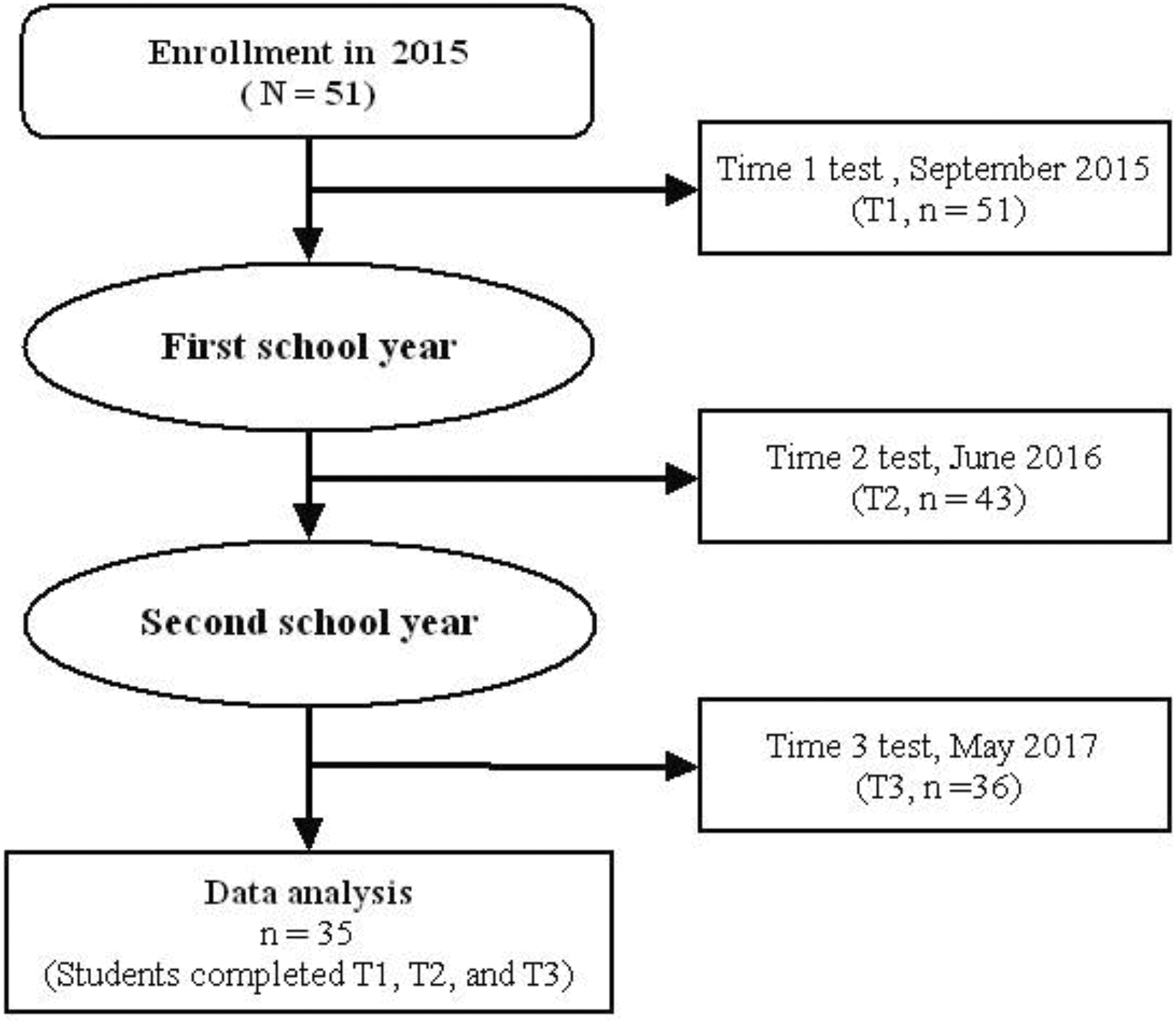
A flowchart describing the study procedure in T1–T2–T3.
We used the data from these 35 students in the data analyses. Among the 35 participants, there were 29 female students (82.9%), 16 students from rural areas (45.7%), and 21 students who held a Bachelor of Social Work (BSW) diploma (60%). The initial survey requested detailed demographic information from the participants, including their undergraduate major, the reason why they applied for the MSW program (voluntary or adjusted), the financial status and annual income of their family, and their registered permanent residence. The variables used to assess the educational outcomes of the MSW program included PC (Wang & Chui, 2017), satisfaction (Bogo, 2010), and CP. The questionnaire consisted of 107 items and took students an average of 10–15 min to complete. Based on the professional competency framework, the PC project was designed with reference to the “9-48 professional competency” scale developed by Wang and Chui (2017). Originally, this 48-item scale had nine dimensions: (1) Professional Values and Ethics (PVE), (2) Professional Knowledge Development (PKD), (3) Professional Resilience Development (PRD), (4) Team Working (TW), (5) Community Work Skills (CWS), (6) Relationship Formation (RF), (7) Case Management Skills (CMS), (8) Supportive Skills (SS), and (9) Therapeutic and Insight Skills (TIS); responses are indicated using a 5-point Likert-type scale (1 = strongly disagree, 5 = strongly agree; Wang & Chui, 2017). The reliabilities of PC are .954 (T1), .881 (T2), and .910 (T3) indicated by Cronbach’s α. The students were also asked how satisfied they were with the university, the MSW program, the teachers giving them lectures (1 = extremely unsatisfied, 5 = extremely satisfied; Bogo, 2010). The reliabilities of students’ satisfaction are .693 (T1), .794 (T2), and .755 (T3) indicated by Cronbach’s α. Finally, to measure their CP, the students were asked if they were going to enter the social work field and conduct social work–related work.
In addition, a focus group was conducted on April 2018 to gain a deeper understanding of the changing trajectory of MSW students’ PC, satisfaction with the program, and CP. Seven MSW graduates from the 35 students who completed all three waves were selected to participate in the focus group discussion on the basis of their undergraduate background (three had a BSW and four did not) and current work type (four were social workers and three were not). Moreover, these seven students had shown a quite distinct changing trajectory on their CP throughout all three waves. The focus group focused on further investigating the educational outcomes that we found through the quantitative study to explore the reasons that led to the outcomes. The focus group took 2 hr.
Data Analysis
To examine differences between groups in terms of PC, satisfaction, and CP at the three time points and help address the research questions, analysis of variance (ANOVA) was conducted and then paired t tests as post doc test. It was expected that during the 2-year program, statistically significant increases would be shown in MSW students’ PC, satisfaction, and CP. To decrease the risk of either a Type I or Type II error, the per comparison was adjusted using a modified Bonferroni correction of p < .10, which set the experimentwise at .01 (.10/9) as the criterion for statistical significance for each of the t tests (Warner, 2013). Estimates of effect sizes were determined by calculating Cohen’s (1988) d statistic by subtracting the mean confidence score at pretest from the score at posttests divided by the pooled standard deviation for paired t tests (T2 and T3) (Lipsey & Wilson, 2001). In addition, focus group was digitally recorded and transcribed verbatim. To avoid overlooked elements, the literally transcribed interviews were checked several times. Initial data analysis was conducted alongside data collection through researcher self-debriefing and the use of memos during transcription. It was then corroborated by another researcher. A structured coding process was then undertaken, from which three themes were extracted organizing and structuring the categories. Then, the final analysis was presented to the participants and they were asked to comment on the contents, which helped to determine whether we has adequately understood and interpreted the data. Furthermore, the findings were discussed within the research team to improve the quality of analysis. Since the focus group was conducted in Chinese, the data were analyzed in Chinese and then the results were translated in English, in terms of the themes and comments. To assure the translation validity, the back-translation method was implemented. A bilingual researcher translated the focus group interview results from Chinese into English. Then, another bilingual researcher translated from English back to Chinese, who did not attend the focus group and did not see the original version of the transcript. The original analyzed interview result was then compared to the back-translated version, and items with discrepancies were modified further.
Results and Findings
Results From T1–T2–T3
Descriptive findings and ANOVA analyses
One-way ANOVA (with Bonferroni correction, to allow for multiple comparisons) was used to examine between-group differences in social work students’ PC, satisfaction, and CP. The independent variables for these ANOVAs were constructed by classifying three periods into categorical variable representing T1, T2, and T3. Three outcome variables have homogeneity of variance. The ANOVA indicated that students reported a significant effect of the development of their PC in RF, TW, PKD, PVE, PRD, TIS, CMS, SS, and CWS (see Table 1). The effect sizes of all the nine dimensions of the development of PC are large (>.4). In addition, they reported a significant increase of their satisfaction and decline of CP (see Table 1). The effect size of the change of satisfaction is medium (>.25) and that of commitment is small. According to the purpose of this study, we further examines how this international cooperative MSW program promotes students’ PC, satisfaction, and CP by comparing compare T1–T2 and T2–T3 in the following postdoc tests.
ANOVA of MSW Students’ PC, Satisfaction, and CP.

Note. PVE = Professional Values and Ethics; PKD = Professional Knowledge Development; PRD = Professional Resilience Development; TW = Team Working; CWS = Community Work Skills; RF = Relationship Formation; CMS = Case Management Skills; SS = Supportive Skills; TIS = Therapeutic and Insight Skills; CP = commitment to the profession; PC = professional competence; ANOVA = analysis of variance; MSW = Master of Social Work.
a Effect size = √(F/n) > .10 indicated small, >.25 medium, >.4 large.
*p < .05. **p < .01. ***p < .001.
Postdoc tests
In all, 35 MSW students completed the T1, T2, and T3 questionnaires, which mainly assessed the development of their PC, the variation trend of satisfaction, and the shift of CP during their 2-year learning experiences.
The development of PC
In the Time 1, there was no significant difference between the students with a BSW background and those without a BSW except in the case of TW (t = 2.15, p < .05), but the students with a BSW reported slightly higher PC. Then, we conducted two groups of paired t test: T2 compared to T1 and T3 compared to T2. We found that regardless of whether they had a BSW background or not, all the students reported statistically significantly developed PC, as indicated by the medium and large effect size after their classroom training: .572 for RF, .443 for TW, .486 for PKD, .684 for PVE, .421 for PRD, .657 for TIS, .638 for CMS, .572 for SS, and .616 for CWS. However, except for RF and SS (effect size = .18 and .20, respectively), there was no statistically significant difference in the dimensions of PC after the students’ practice learning.
The variation trend of satisfaction
After two groups of paired t test were conducted, T2 compared to T1, and T3 compared to T2, we found that regardless of whether they had a BSW background or not, all the students reported statistically significant more satisfaction with their program, as indicated by the medium effect size (effect size = .307) after their classroom training. However, there was no statistically significant difference after practice learning.
The shift of CP
Among the 35 students, there were 21 students with a BSW background and 14 students without. We found that all students’ social work CP declined after classroom training and practice learning. At the beginning of the MSW program, 9 (64.3%) of the students without a BSW background and 12 (57.1%) of the students with a BSW background reported that they wanted to take social work–related jobs which decline to 7 and 8 after classroom training and eventually decline to 3 and 7 after practice learning. Specially, the CP of the students with a BSW declined more sharply compared with those who without after classroom training, while the CP of the students without a BSW declined more sharply compared with those who with after practice learning.
Findings from the Focus Group
Three major themes emerged from the qualitative data analysis which might help us to further understand (a) why the MSW students, regardless of background, did not report a greater development of their PC after the field education and (b) why the CP of the students with a BSW declined more sharply after classroom training, while the CP of the students without a BSW declined more sharply after practice learning.
Gap Between Organizational Development and Students’ Personal Development
The focus group discussion revealed that the gap between organizational development and students’ personal development was a crucial factor affecting students’ PC after field education. The gap was reflected in the lack of learning opportunities, which ultimately prevented students’ PC being promoted by field practice. Students made the following comments: I thought I would play a role at work, but then I realized that I wasn’t really needed. They barely assigned me work that full-time workers do and believed that they only needed to help me finish my required time there, but what I had done during the time didn’t seem important to them. (F1-3) The work I was given was mostly case assistant work rather than case management because I could only come in three days a week. (F1-2)
Participants reported that their field placement sites did not provide them with enough learning opportunities to practice what they had learned in class. First, many organizations do not have a clear arrangement for interns, and they are generally unwilling to assign important tasks to students. Therefore, many of the students in this study were doing administrative work that was pretty simple and low tech during their field practice. Second, students were engaged in class part of the time and in their field placements for the remainder. This discontinuous time arrangement prevented field placement sites from assigning students important jobs. The lack of learning opportunities in the field hindered the development of students’ PC.
Conflict Between What Is Provided in Education and What Is Needed in Practice
The education–practice conflict also plays a pivotal role in influencing social work students’ PC and their satisfaction with the program. Education here refers to both classroom and field education. The education–practice conflict was reflected in terms of tensions relating to curriculum design, the purpose of MSW education, and professionalization. Students made the following comments: I felt that some of the theories and methods we learned in class are not applicable in the Chinese condition. Except for the advanced theories and methods adopted from the West, I think we also need indigenized content to guide us in real practice. (F1-6) I felt that sometimes the school supervisors didn’t show their professionalism. They only cared about whether or not we finished the tasks required by the school, but sometimes what we did in field practice went far beyond. I think social work is not just about group, case, and community work; we did a lot of other things in fieldwork. Therefore, their supervision should not only follow the school’s requirement but should also be flexible according to what we have done in real practice. (F1-4)
The students reported that the theories and methods learned from class could not perfectly guide their work in field practice, and the school supervisors were considered to be too result oriented and to neglect the fact that students’ PC increases during the learning process, and thus, they did not provide enough support to students during their field practice. Moreover, field placement sites could not provide students with professional supervision. The lack of preparation of field supervisors to provide an enriching practical experience during their field placement may retard students’ development of their PC. Whether or not we can use the theory taught in the classroom training mainly depends on field supervision during field placement. On the practical level, depends on if he has a lot of his own skills and on his guidance. For example, when we are in the group work, we expect the field supervisor tells us that if the design is unreasonable as well as the quality of our process recording. However, the professionalism of the staff in the agencies who always plays field supervisors’ roles is low. (F1-7)
Classroom training and field placement are supposed to be mutually supportive and complementary in the social work education process, and both play an important role in developing students’ PC. However, it is not enough for the Western-style MSW program simply to consider the actual situation of field placements.
The students were satisfied with the MSW program in terms of the advanced learning content, the opportunity to interact with the Western instructors who brought many advanced ideas about social work, and the field education opportunities it provided. However, they also reported that the professionalism of the school supervisors, the diversity of the field placements options, and the indigenization of classroom training contents were aspects that needed to be improved.
Gap Between Personal Expectation and Real Practice
The gap between students’ personal expectation and real practice plays an important role in affecting their CP. In addition, a BSW educational background influences the changing trajectory of MSW students’ CP. The interviewees who had not majored in social work at undergraduate level indicated that their CP experienced an up and down process during their two years of study. Students made the following comments: I barely knew the profession before I got into the program, and that’s why at the very beginning I chose not to become a professional social worker after graduation. After I got to know more and more about social work, I found that this helping profession is extremely meaningful and I was proud of being a social work student. However, I became really disappointed after the start of my field placement, which was basically administration work that made me feel so meaningless and started to challenge the value of my work. (F1-1) During class, the American instructors told us that social work was a profession that requires professional knowledge, skills, and methods in practice, which increased my expectation about the profession in real practice. However, I barely saw any of these in my fieldwork, and I also couldn’t see myself as a professional social worker there. (F1-5)
So, the profession gave non-BSW students a high CP, but the unprofessional and even meaningless work content in real practice in field placements prevented them from working in a social work organization after graduation. Moreover, field placement sites’ attitudes toward students raised their doubts about the value of their work and even about their professional identity as a social worker. There has been a tension in social work education regarding indigenization in China related to the professionalization of social work. Some social educators believe that for social work education to make any impact on Chinese society, it has to produce social workers like their counterparts in the developed countries, namely, social workers who possess expertise in terms of knowledge and skills, enjoy job security and career prospects, and possess professional authority and public recognition (Xue, 1996), while others believe that professionalization is only meaningful if it endeavors to enhance the continued improvement of service quality and the social development of the country (Yuen-Tsang & Wang, 2002). Therefore, the wide use of American lectures in classroom training might neglect the necessity for social work education to be firmly grounded in the desires of the people and to understand the pragmatic needs of the Chinese community.
Although the CP of the participants with a BSW background also went down at the end of the 2-year program, they experienced a different trajectory compared to that of the non-BSW students. The CP of the students with a BSW background declined more sharply after classroom training. A student made the following comments: I found repetitions from my undergraduate study in the MSW program’s learning contents, such as the theories, skills, approaches and so forth. I was expecting more detailed contents, such as how to conduct a specific case or group, but the learning still stayed on the level of understanding the knowledge rather than focusing on utilizing the knowledge. (F1-4)
In addition to the “unprofessionalism” of field practice, the BSW interviewees reported a gap between their expectations in classroom training and the real educational content. These students understood what social work is, and thus, they expected to deepen their study of the profession and utilize professional knowledge in real practice. After their undergraduate study, they were expecting that the MSW program could provide them with more practical knowledge and that the field placement sites could provide them an environment to practice what they had learned. However, once they started their MSW program, they first found gaps between their expectation and the classroom training. Therefore, the students with a BSW background showed a sharp decline in their CP after classroom training.
Moreover, the students reported that their personal values corresponded to social work values to a large extent, which also increased their CP. Even when they had finished their field placements, their CP still remained high, but their commitment to the occupation of social worker went down dramatically. Therefore, some students mentioned that although they were not engaged in social work currently, they were still adopting social work values in their present employment.
Discussion and Applications to Practice
In the present study, changes in educational outcomes in terms of PC, satisfaction, and CP among MSW students were tracked against the background of the wide establishment of Western-style MSW program in Mainland China. This study used a mixed-methods approach (a three-wave, 2-year panel study with a sample of MSW students and followed by one focus group) that integrated quantitative and qualitative approaches to comprehensively evaluate the effectiveness of Western-style MSW programs’ educational outcomes and better interpret the reasons behind the changes. It has been found that students developed a lot in their PC, felt an increase of satisfaction, but reported a decline in their CP after their classroom training (from T1 to T2). However, after their field training (from T2 to T3), there was almost no development of their PC and a sharp decline in their CP. This might be explained by the findings from focus group. First, conflicts between education and real practice, as well as gaps between organizational development and personal development, prevented the MSW students from developing their PC through field practice. Second, the gaps between students’ personal expectation and reality in field practice led to a decline in MSW students’ CP. However, the commitment of students with a BSW degree fell more after classroom training, while the CP of students without a BSW degree experienced a sharp decline after they finished their field placements. Third, all the MSW students from focus group reported a significant improvement in their satisfaction with school after their classroom training but no significant change after field practice. This results have insistent with the studies that students perceived less satisfying and less skills after field education than at the start of their training in Ireland (Redmond, Guerin, & Devitt, 2008), a significant level of disjunction between academic and practice learning in United Kingdom (Wilson & Kelly, 2010), and novice social workers evaluated lower association between academic course and field education in Israel (Zeira & Schiff, 2014).
The Westernization of MSW programs plays an important role in leading the rapid development of social work education in China. However, the education–practice conflicts cannot be neglected. Chinese social work educators have realized the importance of developing indigenous social work education, but with the promulgation of a series of decisions, such as the 2006 decision to build a socialist harmonious society and the 2012 decision to produce 1.45 million professional social workers by 2020, social work education in China has become pace oriented. The social ethos of education first (Jiaoyu xianxing) and bring-to-use (Nalai jiyong) rooted in Chinese society has encouraged social work educators to borrow wholesale from foreign examples and apply what they borrow to the Chinese context without much adaptation and modification (Yuen-Tsang, 1996). Concepts and theories from the West might not be applicable in the Chinese context, and this gap restricts the development of students’ PC. In addition to classroom training, field education does not provide enough training and supervision to advance MSW students’ professional knowledge and skills. Social work field education has been regarded as the signature pedagogy of social work education in the community of social work worldwide. Signature pedagogy is a central form of instruction and learning to socialize students to perform the role of practitioner—it contains pedagogical norms with which to connect and integrate theory and practice; these forms of instruction serve the purpose of preparing students in the profession’s fundamental ways of thinking, performing, and acting with integrity in the real world. (CSWE, 2008, p. 8)
In another word, it is necessary for social work student to develop themselves in the profession’s ways of thinking, performing, and acting through field education. In addition, it has been highlighted by Bogo (2010) that the crucial role of field education played is to achieve students’ social work competence. Based on the findings from this study, we argue it should pay more attentions to the indigenization of field education which highlight the importance of social work agencies to enhance the competency of field supervisors and to enlarge the capacity of agencies to provide enough learning opportunities in China. Moreover, according to Liu, Sun, and Anderson (2013), social work field education in China needs to develop continuing education strategies to allow social work educators to improve their social work practice experience, to link social work field practice with future job opportunities, to enhance student competency, and to provide supportive environment as well (Liu et al., 2013), which also provide a specific direction for the indigenization process.
Conflict between organizational development and personal development is mainly due to the excessive dependency of social work organizations on government. The overall perception of the primary function of social work agencies is running successful community projects, which guarantees their financial stability through services purchased by government partnerships (Cai et al., 2018). The shortage of qualified professional social workers in China has led to a high expectation from field agencies for MSW interns, and this high expectation makes agencies focus on project outcomes rather than supporting interns to meet the university’s field practicum goals (Cai et al., 2018). Therefore, they are not willing to spend too much time and resources on intern training and supervision, let alone compromise a project’s progress for the personal development of MSW students. This is another reason why the PC of the social work students in this study remained unchanged after field practice.
We found that the BSW graduates were consistently better prepared than their counterparts with no social work training in nearly every dimension of skills and knowledge (Lieberman, Hornby, & Russell, 1988). Students without a BSW degree barely knew the profession before starting the MSW program, and thus, what the Western teachers delivered to them in class, such as the profession’s social identity and the degree of professionalization of social work organizations in America, might be different from the real situation in China. Therefore, there was a high risk that the reality these students faced in field placements would have an adverse effect on them and dramatically reduce their CP. It is necessary for Chinese social work educators to evolve a model of social work practice that is appropriate to the needs of China (Wang, 1997). In addition to classroom training, university field education is faced with a lack of well-defined learning objectives and learning agreements (Cai et al., 2018), which negatively affected the field experience of the students in this study and played a role in reducing their CP. Although this MSW program has written goals and learning agreements, it is difficult to fully achieve those goals and complete the agreements.
Results from this study lead us to put more emphasis on the integration of social work education, social work agencies, and social workers. In Mainland China, social work practice and education have demonstrated a fragmented situation, at least from students’ perceptions that there are gaps or conflicts among their expectation, organizational development, and education in school which assumed the principal of mutual support and mutual development in social work field education (Parker, 2007). Chinese social workers should be more involved in social work education. On the other hand, educators should introduce more wisdom from social workers in practice. We advocated that in the field of Chinese social work, it should enhance the congruence of students’ development, peer accountability, appropriate and adaptive pressure, and supportive and accountable supervision (Wayne, Raskin, & Bogo, 2010). In addition, Chinese social workers have to realize that social work education is an indispensable part of the sustainable development of social work profession in China. It is generally agreed that supervision is a key component of field education (Wayne et al., 2010; Bogo, 2010; Parker, 2007). Thus, social workers’ provision of continuous supervision in the field play an important role in leading the indigenization in the Chinese context because those sophisticated workers can act as a buffer between the inexperienced newcomers and the demands of the rapid changing agency (Homonoff, 2008). In addition, those experienced social workers play a crucial role in applying theories written on the book to real practice as well as solving the dilemma of students’ needs and organizational development (Wilson & Kelly, 2010).
As the BNU-SSDPP case is a prototype, it raises the issue of the external validity or generalizability of this case study. Therefore, this study is considered as exploratory rather than explanatory. Our aim was to open up the door for further examination of the phenomenon observed in Western-style social work education. Three limitations of this study should be considered before exploring the implications of the study’s findings. First, 51 students (i.e., all of those registered on the program) attended at T0, while 35 students attended at both T1 and T2. The participants lost to follow-up during the three trials might have caused an attrition issue, thus preventing a full analysis and possibly introducing bias. However, for the panel study, and on the basis of the anonymous research design, the current attrition rate is acceptable. Between the attrition issue and the social desirability issue, the latter might cause a more negative impact. Secondly, we only investigate the issues of Western-style program from the perspective of MSW students, neglecting other related parties such as school and field supervisors, American teachers, field agency staff, and so on. Additional research may benefit from a more diverse perspective of all related parties. Third, the research was based on the assumption that students’ competence was developed through field education and the qualifying courses prepared them for practice. Our new insights shed light on the indigenization of social work education in China. However, although the challenges of field education found in this study might not be simply caused by the transfer of Western-style programs, but it does reflect certain problems that social work education is facing per se worldwide (Zeira & Schiff, 2014). Future research could focus on investigating the process of indigenization in social work education in more detail, which will shed a light on the development of social work education in China.
The issue of Westernization–indigenization in social work is not only faced by China but by all non-Western countries. However, the indigenization process is extremely complicated, and thus, although indigenization has become a popular term in the social work literature, being able to learn from the West, on the one hand, and being able to integrate this with the realities of local society, on the other hand, is attractive in theory but demanding in practice (Yuen-Tsang & Wang, 2002).
Footnotes
Declaration of Conflicting Interests
The authors declared no potential conflicts of interest with respect to the research, authorship, and/or publication of this article.
Funding
The authors disclosed receipt of the following financial support for the research, authorship, and/or publication of this article: Youth Funds of Research for Humanities and Social Sciences by the Ministry of Education, China (17YJC840039) and National Social Science Foundation of China (18BSH154).
