



Abstract
Purpose:
The purpose of this study was to (1) evaluate the overall quality and prestige of all currently active disciplinary social work periodicals and (2) determine whether perceptions of quality among the top 10 journals varied by age, gender, race/ethnicity, and academic rank.
Method:
To perform this cross-sectional study, we used a national sample of tenure-track faculty (N = 307) affiliated with PhD granting social work programs.
Results:
Journals (N = 64) were rank ordered based upon perceptions of overall quality and prestige. Analysis revealed overall quality and prestige scores were highly correlated (rs = .93, p < .001). Race/ethnicity was unrelated to perceptions of quality among top-tier journals, but age, gender, and academic rank were significantly associated with perceptions of quality in some cases, although the effect sizes were relatively small.
Discussion:
The results provide guidance for faculty seeking to disseminate their work in highly regarded disciplinary periodicals, especially junior faculty seeking tenure and promotion.
The perceived quality and prestige of a profession’s periodicals are a matter of concern to essentially all disciplinary stakeholders (Allen, Huggins-Hoyt, Holosko, & Briggs, 2018; Law, Chan, & Zhao, 2019). The dissemination of scholarship is a central task of any academic discipline and plays an important role in its advancement (Howard & Garland, 2015). At the faculty level, it has long been recognized that the venues in which scholarship is published can have a significant, determinative effect on decisions regarding tenure, promotion, funding, merit increases, and professional visibility (Hodge, Lacasse, & Benson, 2012). In short, a successful academic career is often contingent upon the perceived quality and prestige of the journals in which one’s work is disseminated (Allen et al., 2018).
But how are quality and prestige determined? This study provides one answer to this question by examining the perceptions of a national sample of social work faculty affiliated with PhD granting programs. Building upon previous reputational-based studies, we sought to determine values for all currently active disciplinary periodicals. We then sought to determine whether perceptions of quality among the top 10 journals varied by key demographic traits, namely, age, gender, race/ethnicity, and academic rank. We begin, however, by providing a brief review of the increasing pressure on faculty to disseminate their work in top-tier social work journals.
The Pressure to Disseminate Scholarship
Social work faculty are under growing pressure to publish (Teater & Mendoza, 2018). Efforts have been made to quantify this increase in sociology, perhaps the nearest disciplinary neighbor in which research on this topic has been conducted (Warren, 2019). In this allied discipline, sociologists seeking their first assistant professor position must publish roughly twice as much as their peers did in the 1990s. Likewise, faculty seeking promotion to the associate level must also be approximately twice as productive as their peers did a generation ago. These trends are not unique to sociology but also appear to exist in social work (Allen et al., 2018; Teater & Mendoza, 2018).
Furthermore, the pressure on social work faculty to disseminate scholarship is not restricted to faculty housed in Research I universities (Green, 2008). Faculty at nonintensive research universities are also increasingly expected to publish (Teater & Mendoza, 2018). Publications can serve as a ranking tool for universities and their associated programs, with more publications in highly prestigious venues equating to higher standing in the academic hierarchy (Blyth et al., 2010).
These developments have important ramifications in numerous areas including tenure and promotion (Howard & Garland, 2015). The salience is illustrated by a survey of social work deans and directors regarding tenure and promotion expectations (Green, 2008). At programs offering only Master of Social Work degrees, a plurality endorsed the view that scholarship was equally important as teaching for assistant and associate professors. For full professors, a plurality endorsed the notion that scholarship was the most important factor. At programs offering doctoral degrees, scholarship was the most important factor in tenure and promotion decisions across all three ranks—assistant, associate, and full.
Seipel (2003) assessed the weight given to various scholarly products among a national sample of social work faculty. The highest scores were attributed to scholarship disseminated in peer-reviewed journals, as opposed to books, monographs, and other venues. Refereed articles in social work journals were also ranked higher than articles in social work–related disciplines such as sociology and psychology. Furthermore, first-tier social work journals were given more weight than lower tier disciplinary journals. In other words, top-tier disciplinary social work journals were viewed as the optimal venue for disseminating scholarship.
Although publishing in top-tier disciplinary journals is important for all faculty, it may be particularly important for junior faculty members (Warren, 2019). Recently, there has been a movement toward the use of individually based measures of scholarly impact, such as the h-index (Lacasse, Hodge, & Bean, 2011). Such individual metrics, however, require several years to produce valid results. Accordingly, they represent one important avenue for assessing the impact of senior scholars who have had sufficient time to establish themselves as independent researchers.
However, junior faculty have typically not had the necessary career length needed to produce an accurate picture of their scholarly impact using the h-index. For such faculty, their publication outlets play an especially important role in the assessment of their work. The journals in which junior faculty publish tend to be viewed as a proxy for the quality of their work (Sellers, Mathiesen, Smith, & Perry, 2006). Publishing in top-ranked journals is commonly thought to denote the ability to create high-quality scholarship. In turn, this raises the question of how faculty view the quality of the publication outlets in which their peers disseminate their scholarship.
Prior Reputation Research on Journal Quality
Multiple approaches exist for classifying top-tier periodicals (Law et al., 2019). In general, these approaches can be broken down into two basic methods: reputation and citation. The former typically involves surveying a group of individuals, such as faculty, with expertise in the professional literature. The latter is based upon citation counts and includes the journal impact factors produced by Clarivate Analytics (n.d.) and journal h-index values calculated with Google Scholar (Hodge & Lacasse, 2011).
Both methods are characterized by certain strengths and weaknesses (Fischer & Steiger, 2018; Holden, Rosenberg, Barker, & Onghena, 2006; Lariviere et al., 2016). For instance, citation approaches purport to be more objective. Citation approaches do not, however, indicate how a given journal is viewed or provide information on how widely it is known (Cnaan, Caputo, & Shmuely, 1994). This is a significant limitation. It is how a given journal is regarded by one’s peers which is often of critical importance in academic settings.
This issue is particularly salient for junior faculty members who are dependent upon their peers’ evaluation of their publishing outlets (Seipel, 2003). It matters little if a given journal has been highly cited, if it not viewed positively by other faculty. It is the subjective understandings of faculty—especially senior faculty—that may guide the evaluation of junior faculty.
In this sense, the consensus faculty view of disciplinary periodicals serves as the gold standard for evaluating journal quality. It is faculty who typically serve as search committee members, external reviewers, and grant evaluators and conduct annual performance reviews. In these and other settings, they regularly evaluate the venues in which their peers disseminate scholarship.
At least two studies have examined faculty perceptions of journal quality in social work. In a seminal study, Cnaan, Caputo, and Shmuely (1994) evaluated the overall quality and prestige of 120 journals in which social workers commonly publish. To conduct the study, the authors used a sample of senior social work faculty drawn from all social work programs accredited by the Council of Social Work Education.
Sellers, Mathiesen, Perry, and Smith (2004) built upon this work with a subsequent study of 38 journals. As was the case in the study by Cnaan et al. (1994), journals were ranked based upon overall quality and prestige. The national sample used in this study was comprised of adjunct, assistant, associate, and full professors, as well as instructors and lectures. In both studies (i.e., Cnaan et al., 1994; Sellers, Mathiesen, Perry, & Smith, 2004), the authors highlighted the need for additional reputational studies in the future to help guide the decision-making process of various disciplinary stakeholders.
The Present Study
Faculty perceptions, as well as the quality of various journals, can change over time. In addition, new periodicals may be launched and some may stop publishing. Both Cnaan et al. (1994) and Sellers, Mathiesen, Smith, and Perry (2006) suggested that reputational studies be conducted approximately every 5 years to address such concerns. Yet, to the best of our knowledge, no other reputational studies of disciplinary journals have been conducted in the roughly two decades since Sellers et al.’s study was conducted in 2000.
It should also be noted that both studies included a number of periodicals that are commonly considered interdisciplinary or extradisciplinary (e.g., the American Sociological Review and American Journal of Community Psychology). To be clear, social workers commonly publish in such outlets and some of these periodicals are even listed in Clarivate Analytics social work category. Furthermore, such journals can represent ideal venues for certain types of scholarship produced by social work faculty.
However, as observers going as far back as Flexner (1915/2001) have noted, a distinct disciplinary literature is a central feature of a profession. Since then, others have echoed the need to distinguish social work journals from non-social work journals (Blyth et al., 2010). In response to such calls, efforts have been made to delineate a list of disciplinary social work journals (Hodge & Lacasse, 2011; Martinez, Herrera, Contreras, Ruiz, & Herrera-Viedma, 2015; Perron et al., 2017; Thyer, 2005). To be included in these disciplinary lists, a journal’s stated mission and/or aims must typically focus on social work in some form (Perron et al., 2017).
These developments suggest that the profession would benefit from a new reputational study of disciplinary periodicals. Accordingly, this study sought to address this need. Toward that end, we employed a national sample of social work faculty invested in knowledge dissemination to assess the overall quality and prestige of all currently active disciplinary social work journals.
We were also interested in the degree to which perceptions of top-tier social work journals varied based upon characteristics such as age, gender, race/ethnicity, and academic rank. Such information may be particularly helpful for junior faculty seeking tenure and promotion. For instance, it could be useful to know if the consensus opinion of junior faculty differs from that of associate and full professors regarding top-tier periodicals.
To summarize, our study was guided by four research questions: What are the top-ranked disciplinary social work journals based upon faculty perceptions of overall quality? What are the top-ranked disciplinary journals in terms of prestige? How strong is the correlation between perceptions of overall quality and prestige among disciplinary journals? Do perceptions of overall quality among the top 10 journals vary by age, gender, race/ethnicity, or academic rank?
Method
Questionnaire
To create a list of currently active disciplinary social work journals for faculty to evaluate, we began by consulting the inventory created by Perron et al. (2017). These authors sought to update previous scholarly efforts to delineate a comprehensive listing of disciplinary periodicals (Hodge & Lacasse, 2011; Thyer, 2005). To ensure that each periodical in the Perron et al. study was currently active, we visited each journal’s website. A journal had to publish at least one issue in the previous year to be considered currently active. In addition, journals had to refrain from charging mandatory publication fees to be included in the study.
Although Social Work Education met these criteria, it was inadvertently excluded from our study due to a coding error. In compiling our list, the journal Social Work Education was mistakenly coded as the Journal of Social Work Education. Given that Social Work Education is one of the premiere education journals in the profession and has been highly ranked in previous research, this represents a major oversight (Hodge & Lacasse, 2011). These procedures produced a total of 64 journals to be evaluated by faculty.
Once the journals were identified, we created a web-based questionnaire using Qualtrics. To assess the overall quality of each periodical, we used a modified version of the phrase completion method (Hodge & Gillespie, 2007). Specifically, potential respondents were asked to rate each journal on a 0–10 scale. Readers were informed that 0 represented the complete absence of quality and 10 represented the highest possible quality.
Two options existed for readers to indicate they were insufficiently familiar with a journal to provide an assessment of its overall quality. They could simply skip that journal and move on to the next periodical. Alternatively, they could select an option that stated they had insufficient familiarity to assess the journal. In addition, the survey contained four demographic items that assessed potential respondents’ age, gender, race/ethnicity, and academic rank.
Sample
To obtain our sample of faculty invested in knowledge dissemination, we began by collecting a list of social work programs offering PhD degrees (N = 75; Thyer, Smith, Osteen, & Carter, 2019). Given current expectations in the profession, faculty at such schools may be disproportionately likely to be familiar with the venues in which scholarship is disseminated (Green, 2008). Social work programs offering PhD degrees are likely to have academic cultures that prioritize the dissemination of knowledge (Smith, Jacobs, Osteen, & Carter, 2018). This list was obtained from the website of the Group for the Advancement of Doctoral Education in Social Work (GADE; http://www.gadephd.org/Membership).
From this list of GADE-affiliated programs, we compiled a list of all tenure-track social work faculty with publicly available e-mail addresses (N = 1,477). Instructors, lecturers, adjunct, and emeritus faculty were not included in the study in keeping with the fact that their positions are not typically contingent upon knowledge creation and dissemination. Likewise, tenure-track faculty who indicated they were not social work faculty were also excluded from the study, as well as two social work programs with PhD programs that did not have publicly available e-mail lists at the time of the study.
Procedures
After creating a list of tenure-track faculty, we sent an invitation to participate in the study to potential respondents along with a link to the online survey. Two subsequent e-mails were sent thanking those who finished the survey and asking nonrespondents to consider completing the survey (Babbie, 2016). Data collection was completed in March 2019. The study, which was part of a larger project on disciplinary knowledge dissemination, was conducted with the approval of the institutional review boards at Arizona State University and the University of Missouri at Columbia.
This procedure resulted in 307 respondents who provided usable data. The resulting response rate of 21% is comparable to that obtained in previous, related work examining faculty perceptions (Teater & Mendoza, 2018), including perceptions of journal quality and prestige (Sellers et al., 2004, 2006). Nevertheless, the response rate is well below 50%, and accordingly, this must be considered a study limitation (Babbie, 2016).
Analytic Strategies
Upon completion of the data collection phase, the data were analyzed using IBM SPSS Statistics software (Version 24). To answer the first research question, the mean scores of faculty’s responses to the overall quality item were used to compute the overall quality score for each journal. To answer the second research question, prestige scores for each periodical were determined using the formula employed in previous reputational studies (Cnaan et al., 1994; Marshall et al., 2011; Sellers et al., 2004). More specifically, prestige was calculated by multiplying the mean overall quality rating by the square root of the proportion of respondents indicating sufficient familiarity with a journal to provide a quality rating (i.e., prestige = overall quality × √familiarity). To answer the third research question, Spearman correlation coefficients were calculated to determine the strength of the relationship between perceptions of overall quality and prestige.
Regarding the fourth question, we conducted several bivariate analyses to determine whether perceptions of top-tier social work journals varied based upon age, gender, race/ethnicity, and academic rank. Specifically, Spearman rank-order correlation coefficients were calculated to examine the relationship between age and faculty perceptions of overall quality. Independent samples t tests were used with the gender and race/ethnicity variables. Finally, the one-way analysis of variance (ANOVA) procedure was used to determine whether faculty perceptions of quality varied by faculty rank.
Results
Regarding the sample’s demographic characteristics, the mean age was 52.24 (SD = 11.22) years. A majority of respondent faculty were female (58.6%, n = 180) and White (67.1%, n = 206). Other prominent racial/ethical self-identifications included Asian (8.8%, n = 27), African American (6.8%, n = 21), Other (6.8%, n = 21), declined to respond (6.8%, n = 21), and Latino (3.6%, n = 11). For the subsequent bivariate analyses, all self-identified non-White faculty (i.e., Asian, African American, Other, and Latino faculty) were collapsed into a new category, faculty of color. In terms of academic rank, respondents were somewhat evenly split between assistant (24.1%, n = 74), associate (34.5%, n = 106), and full (34.9%, n = 107) professors.
Table 1 depicts the mean scores on the overall quality item for each journal assessed in this study (Research Question 1). Following prior precedent (Cnaan et al., 1994; Sellers et al., 2004), the number of respondents who felt comfortable assessing a given periodical is also reported. The number of faculty who ranked journals ranged from a low of 37 to a high of 272.
Disciplinary Social Work Journals Ranked by Mean Overall Quality Scores.
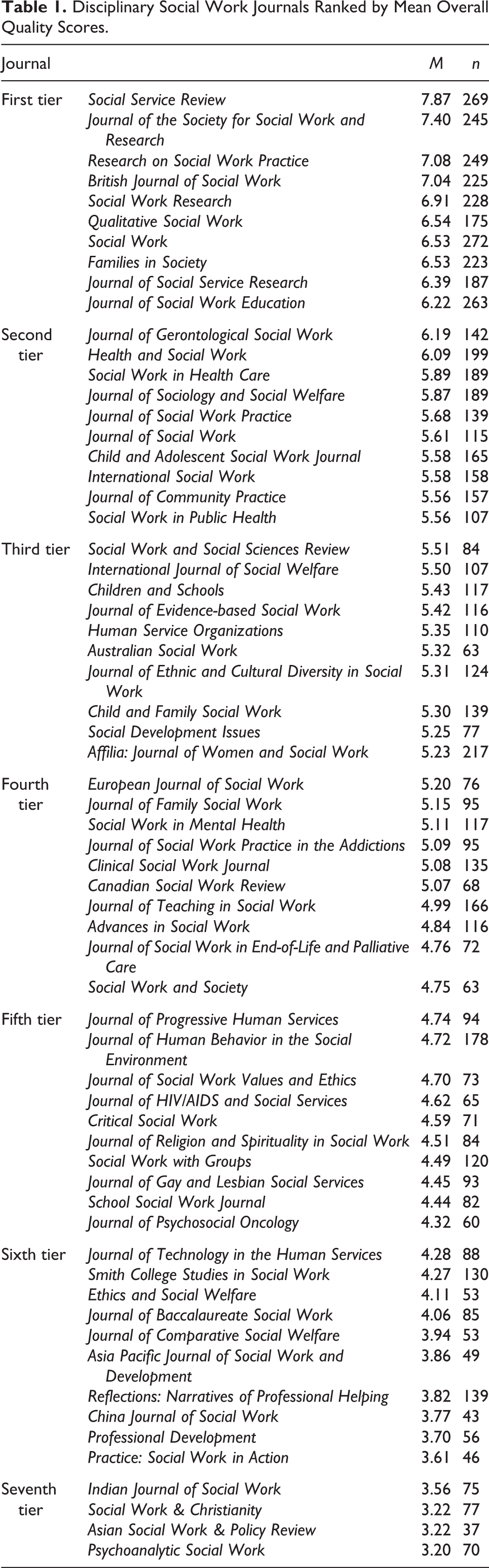
As can be seen, there was a wide range of perceived quality regarding the profession’s journals. The consensus perception regarding the top tier in overall quality was as follows: Social Service Review (M = 7.87), Journal of the Society for Social Work Research (M = 7.40), Research on Social Work Practice (M = 7.08), British Journal of Social Work (M = 7.04), Social Work Research (M = 6.91), Qualitative Social Work (M = 6.54), Social Work (M = 6.53), Families in Society (M = 6.53), Journal of Social Service Research (M = 6.39), and Journal of Social Work Education (M = 6.22).
As is apparent in this, and other tiers, the difference in scores among journals was often relatively minimal within a given tier or even between tiers. Thus, it is important not to draw sharp distinctions between journals and tiers. It should also be noted that every journal was perceived by some respondents to be a top quality journal (i.e., rated as a 9, or a 10, out of 10).
Table 2 features the mean prestige scores for each journal (Research Question 2). Consistent with prior research on this topic (Cnaan et al., 1994; Sellers et al., 2004), the proportion of respondents who felt sufficiently knowledgeable with a given periodical to provide an assessment of its overall quality is also listed. Only 19 of the 64 (30%) periodicals in this study were sufficiently familiar to at least half the respondents. The journal with which faculty were most familiar was Social Work (.89), while the periodical with the lowest level of familiarity was Asian Social Work & Policy Review (.12).
Disciplinary Social Work Journals Ranked by Mean Prestige Scores.
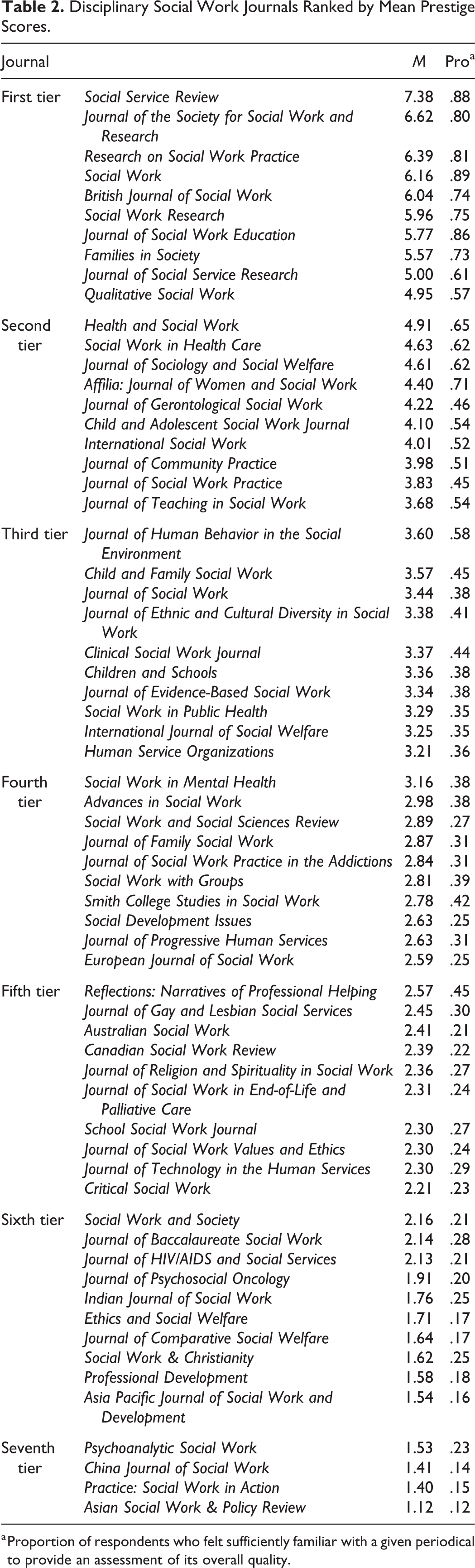
a Proportion of respondents who felt sufficiently familiar with a given periodical to provide an assessment of its overall quality.
As implied by the listings in Tables 1 and 2, overall quality and prestige scores were highly correlated (rs = .93, 95% confidence interval [CI] = [0.87, 0.95], p < .001; Research question #3). The obtained Spearman correlation coefficient is commonly considered to represent a very large effect size (Cohen, 1988). As might be expected, given the strength of this relationship, the top tier was comprised of the same set of journals in both rankings. Some movement among journals, however, did emerge within this tier. More specifically, both Social Work and the Journal of Social Work Education moved up a few positions in the prestige rankings, benefiting from their extensive visibility in the profession.
Perhaps more interesting was the difference in rankings that occurred in other tiers in the prestige rankings. The second and third tiers featured journals that increased their position substantially, sometimes moving up by one or even two tiers. For instance, Affilia: Journal of Women and Social Work moved from the bottom of the third tier in overall quality to the middle of the second tier in the prestige rankings. Similarly, the Journal of Teaching in Social Work moved from the bottom half of the fourth tier in overall quality to the bottom of the second tier in prestige. Other journals that recorded significant movement in their rankings when evaluated by prestige included the Journal of Human Behavior in the Social Environment and the Clinical Social Work Journal.
Table 3 features the results of the bivariate analyses, which were conducted to see whether faculty perceptions of overall journal quality regarding the top 10 journals varied by age, gender, race/ethnicity, and academic rank (Research Question #4). Analysis revealed a weak correlation between age and quality for two journals. Older respondents tended to assign higher levels of overall quality to Social Service Review (rs = .19, 95% CI [0.05, 0.31], p = .003) and Research on Social Work Practice (rs = .14, 95% CI [0.01, 0.27], p = .039). Although the findings were significant in these two cases, it should be noted that the effect sizes were relatively small (Cohen, 1988).
Perceptions of Overall Journal by Age, Gender, Race/Ethnicity, and Academic Rank.
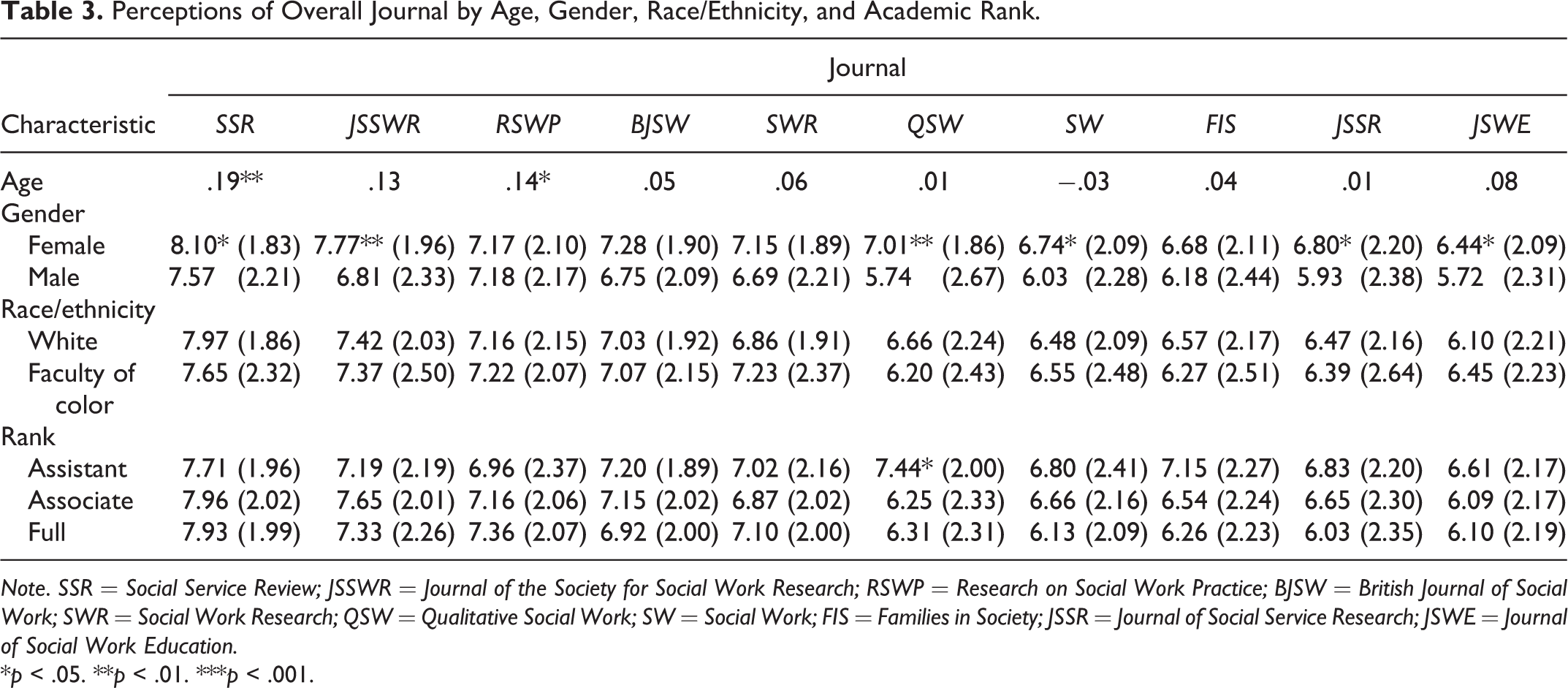
Note. SSR = Social Service Review; JSSWR = Journal of the Society for Social Work Research; RSWP = Research on Social Work Practice; BJSW = British Journal of Social Work; SWR = Social Work Research; QSW = Qualitative Social Work; SW = Social Work; FIS = Families in Society; JSSR = Journal of Social Service Research; JSWE = Journal of Social Work Education.
*p < .05. **p < .01. ***p < .001.
Gender was significant in six instances. Women tended to report higher levels of overall quality, compared to men, for Social Service Review, M = 8.10 versus 7.57, t(249) = −2.03, MD.] = −0.52, 95% CI [−1.03, −0.02], p = .043, r = .13; Journal of the Society for Social Work Research, M = 7.77 versus 6.81, t(226) = −3.33, MD = −.96, 95% CI [−1.54, −0.39], p = .001, r = .22; Qualitative Social Work, M = 7.01 versus 5.74, t(168) = −3.37, MD = −1.27, 95% CI [−2.01, −0.52], p = .001, r = .25; Social Work, M = 6.74 versus 6.03, t(252) = −2.55, MD = −0.71, 95% CI [−1.26, −0.16], p = .011, r = .16; Journal of Social Service Research, M = 6.80 versus 5.93, t(171) = −2.46, MD = −0.87, 95% CI [−1.56, −0.17], p = .015, r = .18; and the Journal of Social Work Education, M = 6.44 versus 5.72, t(241) = −2.53, MD = −0.72, 95% CI [−1.29, −0.16], p = .012, r = .16. As indicated by the r values, the effect sizes of these gender differences were relatively small (Cohen, 1988). No significant differences emerged regarding race/ethnicity. In other words, European American faculty and faculty of color tended to have the same perceptions regarding journal quality for the 10 journals examined.
One difference emerged in the area of rank. The one-way ANOVA procedure indicated a significant effect for Qualitative Social Work, F(2, 169) = 3.99, p = .020,
Discussion
Our intent in conducting this study is not to diminish or devalue any journal. Each journal has its own unique audience. Furthermore, specialized journals may rank lower than more generic periodicals due to their reduced presence in mainstream professional forums (Law et al., 2019). Yet, these journals play a vital role in the profession’s multidimensional efforts to enhance human well-being by addressing targeted audiences that deal with specific dimensions of the wider social context in which social workers ply their craft. Rather, our aim is to assist disciplinary stakeholders whose careers may depend upon placing their scholarship in highly ranked social work journals (Seipel, 2003). For example, understanding which journals are viewed as top tier by their peers, arms faculty with the knowledge they need to target certain journals when conceptualizing their research agendas.
In keeping with this aim, this study employed a national sample of social work faculty to rate currently active disciplinary social work journals. A total of 64 journals were rank ordered based upon perceptions of overall quality and prestige. The two lists were highly correlated, but there was some notable movement in a few cases. For instance, Affilia: Journal of Women and Social Work, the Journal of Teaching in Social Work, and the Clinical Social Work Journal scored relatively higher when assessed based upon prestige.
Relative to Sellers et al.’s (2004) findings, some new journals entered the top tier. More specifically, the Journal of the Society for Social Work and Research, the British Journal of Social Work, and Qualitative Social Work were ranked in the top 10 in this study in both overall quality and prestige. Yet, none of these periodicals appeared in Sellers et al.’s top tier in either overall quality or prestige. This finding underscores the need for future reputationally based research on disciplinary periodicals at systematic intervals.
Some 30% (n = 19) of the periodicals in this study were familiar to at least half of the respondents. This might be considered a relatively low level of awareness regarding the profession’s disciplinary knowledge base. Concurrently, it is important to note that social workers publish in a board array of interdisciplinary and extradisciplinary journals. In addition, the profession’s list of disciplinary journals has expanded over time (Cnaan et al., 1994; Perron et al., 2017).
This percentage does, however, represent a substantial improvement in awareness relative to previous work. In Sellers et al.’s (2004) study, only 18% (n = 7) of the 38 journals surveyed were familiar to at least half of respondents. On the other hand, the difference in familiarity may be due, at least in part, to the fact that the present study sample was comprised of faculty drawn exclusively from social work programs with PhD programs. In any case, this finding has important implications for faculty seeking to gain wide visibility for their scholarship. The results empower faculty to target journals in their area that are more widely known.
Another key aim of the study was to determine whether perceptions of quality among the top 10 journals varied by age, gender, race/ethnicity, and academic rank. Of these variables, gender displayed the most pronounced effect. In 6 of the 10 journals, women tended to ascribe higher levels of quality than men. These results are consistent with those obtained by Sellers et al. (2006) who found that women ascribed higher levels of quality to four of the five core social work journals examined.
Academic rank was significant in only one case: Qualitative Social Work. Assistant faculty viewed this journal more positively than did senior faculty. This finding has important implications for qualitative researchers, especially those seeking tenure and promotion. Faculty considering this journal as an outlet for their scholarship should be aware that senior faculty may view this journal differently. In some cases, it may be possible to have candid conversations regarding the quality of this periodical to help prevent misunderstandings during the tenure and promotion process.
This was, however, the only instance in which perceptions differed by rank, which represents a change from prior research. In two of the five core social work journals examined by Sellers et al. (2006), full professors ascribed lower levels of quality relative to assistant professors. As alluded to above, differences in perceptions can result in surprises at the time of tenure and promotion due to the difference in perceptions. It is arguably a positive development that faculty across ranks share the same general perceptions regarding disciplinary journals.
Indeed, this type of level playing field helps to mitigate some of the uncertainty in the tenure and promotion process. To the extent a shared perception exists across ranks, and other key characteristics, faculty are empowered to make the appropriate decisions to advance their careers. It effectively provides some degree of transparency regarding the ordering of journals in milieus where publication venues are evaluated, such as the tenure and promotion process.
This transparency may be especially helpful for junior faculty who feel pressure to publish in a journal with a Clarivate Analytics impact factor. Faculty who experience this pressure may not consider periodicals, such as the Child and Adolescent Social Work Journal, which do not have an impact factor. Even in cases where the periodical represents an ideal outlet for their work from a conceptual perspective, faculty may believe that disseminating their work in a journal not indexed by Clarivate Analytics is too much of a risk.
The findings provide some guidance to junior faculty in this position. Such faculty can have some degree of confidence that senior faculty will generally view such periodicals favorably. The results suggest highly ranked periodicals in Tables 1 and 2 will generally be perceived by senior faculty as quality or prestigious venues. This finding may help alleviate some of the stress faculty may experience by opening up some new options for scholarship dissemination.
The results also have implications for faculty tasked with assessing the work of their colleagues. As noted above, not all social work faculty are familiar with the universe of disciplinary periodicals. Given the importance of developing a distinct literature to facilitate social work’s advancement as a profession, it is important to have some means for assessing the quality of various journals (Flexner, 1915/2001). Faculty who elect to disseminate their work in social work periodicals—thereby contributing to the profession’s knowledge base—should not be penalized, regardless of whether or not the periodical has an impact factor. The findings provide one metric for assessing the quality and prestige of publication outlets in social work.
It is important to emphasize that multiple factors should be used in any assessment of faculty’s scholarship (Hodge & Lacasse, 2011). Factors that might be considered when evaluating scholarship include the audience to which a given manuscript is attempting to speak, the conceptual fit between a given journal’s mission/aims and the manuscript, the publication’s conceptual clarity, methodological rigor, and impact, to list just some. The findings of the present study provide one additional means to assist disciplinary stakeholders in the evaluation process. It is, however, just one method that should be used alongside others to provide a fair and balanced assessment.
Limitations
It should be mentioned that the exact parameters of the profession’s disciplinary knowledge base are contested (Blyth et al., 2010). We used Perron et al.’s (2017) list of disciplinary journals in our study, but this list excludes some well-regarded journals in which social workers regularly publish, such as Child Welfare and Children and Youth Services Review. Many scholars would consider these periodicals to fall under the banner of disciplinary journals, as evidenced by the fact that they have both been included in content analyses of the social work literature (Corley & Young, 2018; Gringeri, Wahab, & Anderson-Nathe, 2010; Hardy, 2013). Another important limitation is the inadvertent exclusion of Social Work Education from the list of journals evaluated in this study due to a coding error on our part. As noted above, this represents a major shortcoming as Social Work Education is one of the premiere education journals in the profession (Hodge & Lacasse, 2011).
The response rate was comparable to other studies examining faculty perceptions (Sellers et al., 2006; Teater & Mendoza, 2018). However, the fact that the rate was below 50% means the results are unique to the present sample since it is plausible that those who responded may not be representative of the larger population (Babbie, 2016). In other words, the findings cannot be extrapolated to all social work faculty or even all social work faculty affiliated with social work programs offering PhD degrees. The profession could benefit from additional research on this topic with a more representative sample of faculty.
Conclusion
We are sympathetic to those who question the quantification of journals and other aspects of professional discourse (Martinez-Brawley & Zorita, 2007). For many faculty, however, the success of their careers is contingent upon the quality and prestige of the periodicals in which they disseminate their scholarship. Accordingly, it is important to understand how faculty in social work view their disciplinary knowledge base. Put simply, if one’s career is riding upon the perceptions of one’s peers, then it is helpful to understand those perceptions, so the appropriate decisions can be executed.
This study sought to shed some light on this subject by delineating a consensus ordering of journals based upon perceptions of overall quality and prestige and then examining the degree to which perceptions of quality among the top 10 journals varied by key traits. With the exception of gender, we found that perceptions of overall quality were, for the most part, largely unassociated with age, race/ethnicity, and academic rank. Taken together, the study’s results provide important insights that can benefit faculty at every stage of their career, although they likely have particular utility for faculty seeking tenure and promotion.
Footnotes
Declaration of Conflicting Interests
The authors declared no potential conflicts of interest with respect to the research, authorship, and/or publication of this article.
Funding
The authors received no financial support for the research, authorship, and/or publication of this article.
