




Abstract
Purpose:
Kunjing children refer to those who endure harsh living conditions due to family poverty, health problems, and lack of parental care in Mainland China. This scoping review aims to explore interventions promoting the resilience of kunjing children in China.
Method:
Both Chinese and English studies published by January 2020 were reviewed through a comprehensive search of articles in Web of Science and Chinese National Knowledge Infrastructure. Empirical studies targeting resilience-focused interventions for kunjing children in China were selected.
Results:
A total of 12 studies were reviewed. Seven studies tested interventions involving only kunjing children, and the other five involved both children and parents/caregivers. Children with health problems and those who lack parental care participated in the programs, but children in poverty were absent. Group-based interventions were the most commonly used programs, which were effective.
Conclusion:
The current state of intervention studies calls for programs that promote resilience of kunjing children and their parents/caregivers.
Kunjing children (困境儿童) is a unique term in the Chinese context. Similar to children in need around the world, the definition of kunjing children is broad as well. In the long term of child protection and childcare in China, the term of kunjing children was not widely used until the Outline for the Development of Children in China (2011–2020) policy by the Ministry of Education of the People’s Republic of China (2001) first used the term. With the development of child protection and childcare in China, both the government officials and scholars realized that it was difficult to clarify the scope of the protection for the child protection and child welfare for kunjing children due to ambiguous definition. Therefore, the State Council (2016a) first provided an official definition, which defined kunjing children as those who live in harsh living conditions due to family poverty, health problems, and lack of parental care in Mainland China. Specifically, kunjing children are categorized as follows: (a) Type I kunjing children (children from poverty-stricken families who suffer from difficulties in living, schooling, or health), (b) Type II kunjing children (children with disabilities or health problems who are difficult to be cared for and would face challenges being integrated into society), and (c) Type III kunjing children (abused children and those who are being threatened due to a lack of parental care; The State Council, 2016a).
To date, there is no precise statistical information about the population size of kunjing children in Mainland China. However, the National Bureau of Statistics estimated that there were 305,110 orphans by the end of 2018 (The National Bureau of Statistics, 2019a) and 85,000 children with disabilities who had not been enrolled in school since late 2013 (The National Bureau of Statistics, 2019b). Also, about 500,000 children are not in parental custody since the end of 2018 (Ministry of Civil Affairs of the People’s Republic of China, 2019a). The Ministry of Civil Affairs also estimated that the number of kunjing children in Mainland China to be several million (as reported in Sohu News, 2015).
Children typically experience a variety of developmental risks. With a lack of care, health care knowledge of primary caregivers, and limited financial resources, kunjing children frequently experience health and safety problems (Aber et al., 1997; Little et al., 2004) such as malnutrition, disease (Ma, 2009; L. H. Zhang & Liu, 2006), accidents (Y. Lu & Du, 2012; Tang et al., 2018; Tao, 2009; F. Wu & Yang, 2011), and sexual abuse (Duan & Yang, 2009). They also face educational challenges, as there are approximately 85,000 school-aged children who are not enrolled at schools because of disabilities (The National Bureau of Statistics, 2019b). Of the kunjing children enrolled in school, they tend to have fewer educational opportunities than their non-kunjing peers (Croft, 2013; Engle & Black, 2008; Murnane, 2007; D. Wu, 2019; Y. B. Yan, 2012). These children have learning difficulties and lower academic performance (Luo, 2014; N. Wu, 2004; H. Zhou & Wu, 2008) and have a high prevalence of school dropout (Cao, 2007; L. L. Fan, 2011; Z. Liu, 2010). Because they are inadequately cared for by their caregivers, they are at a high risk of psychosocial problems (Greene & McGovern, 2017; Tang et al., 2018; Yoshikawa et al., 2012) such as loneliness (Chang & Huang, 2008; Han, 2016; N. Yan, 2014; M. Zheng, 2013), anxiety and depression (L. L. Fan, 2011; G. Q. Li & Zheng, 2004; S. J. Liu, 2017; Sun, 2013), low self-esteem (S. H. Chen et al., 2018; M. Wang, 2017; H. Yang, 2017; Y. Yang, 2019; S. W. Zhang, 2010; Z.-K. Zhou et al., 2005), and low level of social skills (S. H. Chen et al., 2018; Cheng et al., 2010; Q. F. Li, 2002; S. Z. Lu et al., 2004; Ye et al., 2005; S. C. Zeng, 2010; M. Zheng, 2013; S. Q. Zheng, 2019) with limited access to social support. The developmental risks faced by Chinese kunjing children are compounded by the vast geographic area of Mainland China and the geographic dispersion of this population in the rural and metropolitan areas.
In response to the large population size and the developmental challenges of kunjing children, the State Council of the People’s Republic of China issued the Guidelines of the State Council on Reinforcing Support for Children in Need in 2016 to set up a support system for these children, with family, government, and society expected to fulfill their responsibilities. To implement the social support goals, the guidelines called to establish three-tier working networks consisting of the county, town, and village as well as coordinated mechanisms between various government departments including civil administration, health and family planning, education and human resources, and social security (The State Council, 2016a). The guidelines also encouraged social workers and volunteers to provide multiple assistance and social services for kunjing children (The State Council, 2016a). However, the existing policies and social services for these children are inadequate for addressing the multiple adversities experienced by these children, and in recent years, there has been increasing emphasis on the resilience of these children.
Resilience is the capability to sustain functioning and achieve adaptive outcomes in the face of adversity (Masten, 2007). Studies suggest that resilience works to eliminate or buffer the negative outcomes associated with adverse childhood experiences (Huang et al., 2018). More specifically, research has shown that resilience moderates the effects of depressive symptoms on adverse childhood experiences (Silk et al., 2007; Z.-K. Zhou et al., 2017), mental health problems (X. Fan & Lu, 2020), trauma (Philippe et al., 2011), school maladjustment (Kim & Choi, 2010), and sleep deprivation (Chatburn et al., 2014). Given the substantial developmental adversities, resilience-focused training in intervention programs can help kunjing children avoid negative outcomes. To our knowledge, however, there is no systematic review of resilience-focused interventions for vulnerable children in Mainland China. To fill this research gap, a scoping review was conducted to describe the current state of the empirical literature on resilience-focused interventions for kunjing children.
Method
A scoping review is an appropriate methodological tool when the nature of the studies to be reviewed is heterogeneous and impossible to conduct a systematic review or meta-analysis on particular research questions (Mays et al., 2001). Through the scoping review, a map of the research scope, results, and gaps in existing studies can be provided (Hu et al., 2019; Levac et al., 2010; M. Wang, Victor, et al., 2020). In this article, the following research questions are addressed: (1) What types of kunjing children were provided with resilience-focused interventions? (2) What intervention programs were implemented to enhance the resilience of kunjing children? (3) What professionals were involved? and (4) What were the effects of the resilience-focused interventions? This scoping review process followed the Preferred Reporting Items for Systematic Reviews and Meta-Analyses guidelines (see Moher et al., 2009).
Data Sources and Search Strategy
We searched the research literature on intervention programs that were aimed to improve the resilience of kunjing children in Mainland China. Empirical research literature considered were in both English and Chinese languages. The search was first conducted on January 13, 2020, and all studies published before this time were searched.
A search of English language studies
We searched for English language research through Web of Science, which includes Science Citation Index Expanded (SCI-Expanded), Social Sciences Citation Index (SSCI), Arts & Humanities Citation Index (A&HCI), Conference Proceedings Citation Index-Science (CPCI-S), Conference Proceedings Citation Index-Social Science & Humanities (CPCI-SSH), Book Citation Index-Science (BKCI-S), Book Citation Index-Social Sciences & Humanities (BKCI-SSH), and Emerging Sources Citation Index (ESCI) journals. The search was limited to peer-reviewed empirical studies. A variety of keywords were used in the searching including resilience OR resilient (to limit the topics); child* (to limit the participants); plus intervention, treatment, program, outcomes, efficacy, effectiveness, experiment, and trial (to limit the number of intervention studies); and location (China and Chinese as well as names of four municipalities, 22 Mainland Chinese provinces [excluding Taiwan], and five districts in China). There are multiple types of kunjing children, and thus, we did not limit the participants specifically to ensure a comprehensive search of the literature.
A search of Chinese language research
We searched for empirical studies written in Chinese in the Chinese National Knowledge Infrastructure (CNKI) database. CNKI is the most widely used comprehensive academic database in China (R. Y. Zhao et al., 2018). However, we were unable to separate peer-reviewed studies from non-peer-reviewed studies in CNKI, and thus, we only limited the search to SCI, Chinese Social Science Citation Index, and Peking University Core Journals index journals, which are the most prominent index in Chinese academia (M. Li et al., 2018). We translated the aforementioned keywords into Chinese and used them in the Chinese literature search. We included commonly used Chinese translations of resilience (e.g., “抗逆力,” “复原力,” “压弹,” “心理弹性,” “韧性,” “挫折承受力,” “耐挫力”). Most of the articles in CNKI were searched in China, thus we did not include the location keywords.
Inclusion and Exclusion Criteria
Empirical research on interventions that aimed to foster the resilience of kunjing children in Mainland China was included in this review. The studies employed randomized controlled trials (RCTs), quasi-experimental design, or nonexperimental designs. The study participants were, but are not limited to, children living in poverty, children with disabilities or certain diseases (e.g., autism, cancer, HIV/AIDS), and children not in parental custody (e.g., migrant children, left-behind children, orphans). The study participants were younger than 18 years. Considering the cultural and economic differences between Mainland China and Hong Kong, Macao, and Taiwan, studies conducted in these regions were excluded. Master thesis, doctoral dissertations, and conference papers were also excluded in the search because they were not peer-reviewed, making it difficult to rate their publication quality.
Article Review Process
The authors first reviewed the titles and abstracts of the selected studies. Only studies that met the inclusion criteria were further screened. The authors then reviewed the full texts of the preliminarily included studies for further inclusion and exclusion check. All the search, screening, and review were independently conducted by two of the authors. The authors discussed if there was any disagreement until an agreement was achieved. All the review procedures are presented in Figure 1.

Search and review procedures.
A total of 270 research literature in the English language were found after initial searching. Among these, 258 studies were excluded because they did not meet the inclusion criteria after the title and abstract screening. Four additional studies were excluded after the full-text review because they were not specific to Mainland China. In total, eight studies in the English language were included after the full-text review. For the studies in the Chinese language, 219 studies were found initially. A total of 215 studies in the Chinese language were excluded because they did not meet the inclusion criteria after the title and abstract screening, although four were included. In total, 12 studies were included in this scoping review.
Study Coding
Among the studies included in this review, research designs that consisted of the characteristics (e.g., sample size, duration of the intervention, location of the intervention), types of kunjing children, intervention modalities, helping professionals, measurements, primary outcomes, and findings were coded. The coding was entirely conducted independently by two of the authors, and all disagreements were discussed until an agreement was reached.
Results
Characteristics of the Existing Research
Table 1 presents the characteristics of the empirical studies that were included in the scoping review.
Characteristics of Interventions on the Resilience of Children in Need in Mainland China.

Of the 12 studies, seven included interventions to kunjing children without a parent or adult caregivers involved (Y. Chen et al., 2014; Fu et al., 2013; Gao, 2015; Tam et al., 2020; E. J. Zeng & Silverstein, 2011; L. M. Zhang & Tian, 2014; Y. Zhao et al., 2019) and another five studies included both kunjing children and their parents or caregivers (Guan & Deng, 2019; Harrison et al., 2019; Hua & Cao, 2019; X. Li et al., 2017; P. Zhang et al., 2019). The earliest study was published in 2011 (E. J. Zeng & Silverstein, 2011).
Six utilized RCTs, three used quasi-experimental designs, and three employed nonexperimental designs. More specifically, of the seven studies which only included a child sample, three were RCT studies (Y. Chen et al., 2014; Fu et al., 2013; Tam et al., 2020), two of which conducted both pre- and posttests and had follow-up assessments (Y. Chen et al., 2014; Tam et al., 2020). Two studies used quasi-experimental designs with pre- and posttests but no follow-up assessments (L. M. Zhang & Tian, 2014; Y. Zhao et al., 2019), and the other two were conducted using nonexperimental designs (Gao, 2015; E. J. Zeng & Silverstein, 2011). Of the five studies with both children and their parents or caregivers as study participants, three employed RCTs with pre- and posttests (Harrison et al., 2019; X. Li et al., 2017; P. Zhang et al., 2019), two of which included follow-up evaluations (Harrison et al., 2019; X. Li et al., 2017). One study used a quasi-experimental design (Guan & Deng, 2019), and one used a nonexperimental design (Hua & Cao, 2019).
Of the 12 studies, the sample size for the treatment groups ranged from 20 to 1,988 participants. The duration of the intervention ranged from three weeks to three years. Regarding the location of the interventions, seven were conducted in western regions, which were less developed provinces, such as Sichuan (n = 5; Y. Chen et al., 2014; Fu et al., 2013; Guan & Deng, 2019; E. J. Zeng & Silverstein, 2011; Y. Zhao et al., 2019), Yunnan (n = 1; Gao, 2015), Chongqing (n = 1; P. Zhang et al., 2019), and Guizhou (n = 1; Guan & Deng, 2019). Two programs were implemented in Henan province (Harrison et al., 2019; X. Li et al., 2017), which is located in a central area, and three were conducted in eastern provinces with well-developed economics, such as Beijing (n = 2; Tam et al., 2020; L. M. Zhang & Tian, 2014) and Shanghai (Hua & Cao, 2019). In terms of the language, four were published in Chinese (Gao, 2015; Hua & Cao, 2019; L. M. Zhang & Tian, 2014; Y. Zhao et al., 2019). The other eight were published in English.
The study characteristics include the participants (kunjing children only and both kunjing children and their parents or caregivers). For each study, we described the type of children, intervention modality, study aim, outcome measures, and major primary findings.
Studies on Kunjing Children Only
There was a total of seven studies with kunjing children only. Three types of kunjing children, including migrant children (n = 3; Gao, 2015; Tam et al., 2020; L. M. Zhang & Tian, 2014), child survivors of earthquakes (n = 3; Y. Chen et al., 2014; Fu et al., 2013; E. J. Zeng & Silverstein, 2011), left-behind children (n = 1; Y. Zhao et al., 2019), were provided with different types of interventions. Additional information is presented in Table 2.
Characteristics of Interventions on the Resilience of Children in Mainland China: Programs With Child Participants Only.

Three studies targeted migrant children—that is, children migrating with one or both parents who were seeking non-agricultural jobs. Gao’s (2015) study on intervention for migrant children consisted of community-based social work interventions, which included a combination of social casework, social group work, and social community work with community education and psychodrama. No information was provided on the frequency of services. By analyzing qualitative data that detailed participants’ characteristics combined with family and community support, this review found a positive effect of community-based social work interventions on the cognition, behavior, and resilience of migrant children (Gao, 2015). Tam et al. (2020) delivered multiple-format programs as well; they utilized the Activating Event–Belief–Consequence (ABC) model with an emphasis on positive reinforcement and psychological education. All of the programs involved six sessions in total, and each session lasted 80 minutes and was provided once a week (Tam et al., 2020). By including Adolescent Psychological Resilience Scale (APRS) in the measures, the study found a significant improvement in resilience among migrant children (Tam et al., 2020). Also, L. M. Zhang and Tian’s (2014) study examined an intervention with migrant children, which comprised a seven-session group psychological counseling lasting 50 minutes per session. Using APRS, a significant increase in the resilience of migrant children was reported after the intervention (L. M. Zhang & Tian, 2014).
Three studies targeted child survivors who lost their parents or children suffering from the Sichuan earthquakes in 2008. Two studies were conducted by the research teams from both Chinese and foreign universities (Y. Chen et al., 2014; Fu et al., 2013), and the other study was conducted by a research team from a U.S. university (E. J. Zeng & Silverstein, 2011). Y. Chen et al. (2014) provided cognitive behavioral therapy (CBT) to children who lost both parents from an earthquake. Eight sessions were provided (each session lasted for one hour). Using the Conner–Davidson Resilience Scale (CD-RISC) measure, the finding suggested that short-term CBT group intervention was effective in enhancing psychological resilience and reducing post-traumatic stress disorder (PTSD) and depression among bereaved children (Y. Chen et al., 2014). Another study (Fu et al., 2013) provided multiple-format, sport-based psychological interventions to the child survivors of earthquakes. The program consisted of comfort for kids (to train children to develop positive coping skills) and moving forward (aim to improve coping skills through caregiver-led sports-based activities; Fu et al., 2013). Also measured with CD-RISC, the findings did not show an increase in the resilience of child survivors with PTSD (Fu et al., 2013), contrary to Y. Chen et al.’s (2014) study. E. J. Zeng and Silverstein’s (2011) study provided a community-focused participatory action project to child survivors of earthquakes. The project involved social services to assist child survivors in (a) restoring structure and routine, (b) developing group cohesion, (c) participating in research and action-oriented activities, and (d) participating in community action. The research team collected qualitative data that documented acting-out behaviors and the ability to initiate activities of child survivors. The study found a decrease in children’s acting-out behaviors, improvement in their abilities to initiate activities, and an increase in their resilience.
Y. Zhao et al.’s (2019) study targeted left-behind children (i.e., children under 16 years of age whose parents migrated to non-farming jobs). Left-behind children also include children who are living with one parent who is incapable of guardianship (The State Council, 2016b). In the study, the left-behind children were provided with the Outward Bound training (16 sessions) once a day, and each session lasted for 90 minutes. The program was administered by students who worked as voluntary teachers at local schools and research teams from universities. The outcome was measured with APRS, which found that the training significantly improved the psychological resilience, positive cognition, emotion management, and life satisfaction of these children.
Among the seven interventions with child-only participants, all the programs employed multiple-session group services, with only one study using casework as part of the group interventions (Gao, 2015). Regarding the outcome measurement, two studies utilized qualitative data (Gao, 2015; E. J. Zeng & Silverstein, 2011), while the other five studies all used analyzed quantitative data consisting of APRS (n = 3; Tam et al., 2020; L. M. Zhang & Tian, 2014; Y. Zhao et al., 2019) and CD-RISC (n = 2; Y. Chen et al., 2014; Fu et al., 2013) inventories. Six studies found significant effects of intervention modalities on the resilience of kunjing children, and only one study reported non-significant findings (Fu et al., 2013).
Studies on Kunjing Children and Parent/Caregiver Participants
Five studies focused on both children and their parents/caregivers participating in the resilience-focused intervention. All findings were presented in Table 3.
Characteristics of Interventions on the Resilience of Children in Mainland China: Programs With Both Child and Parent Participants.
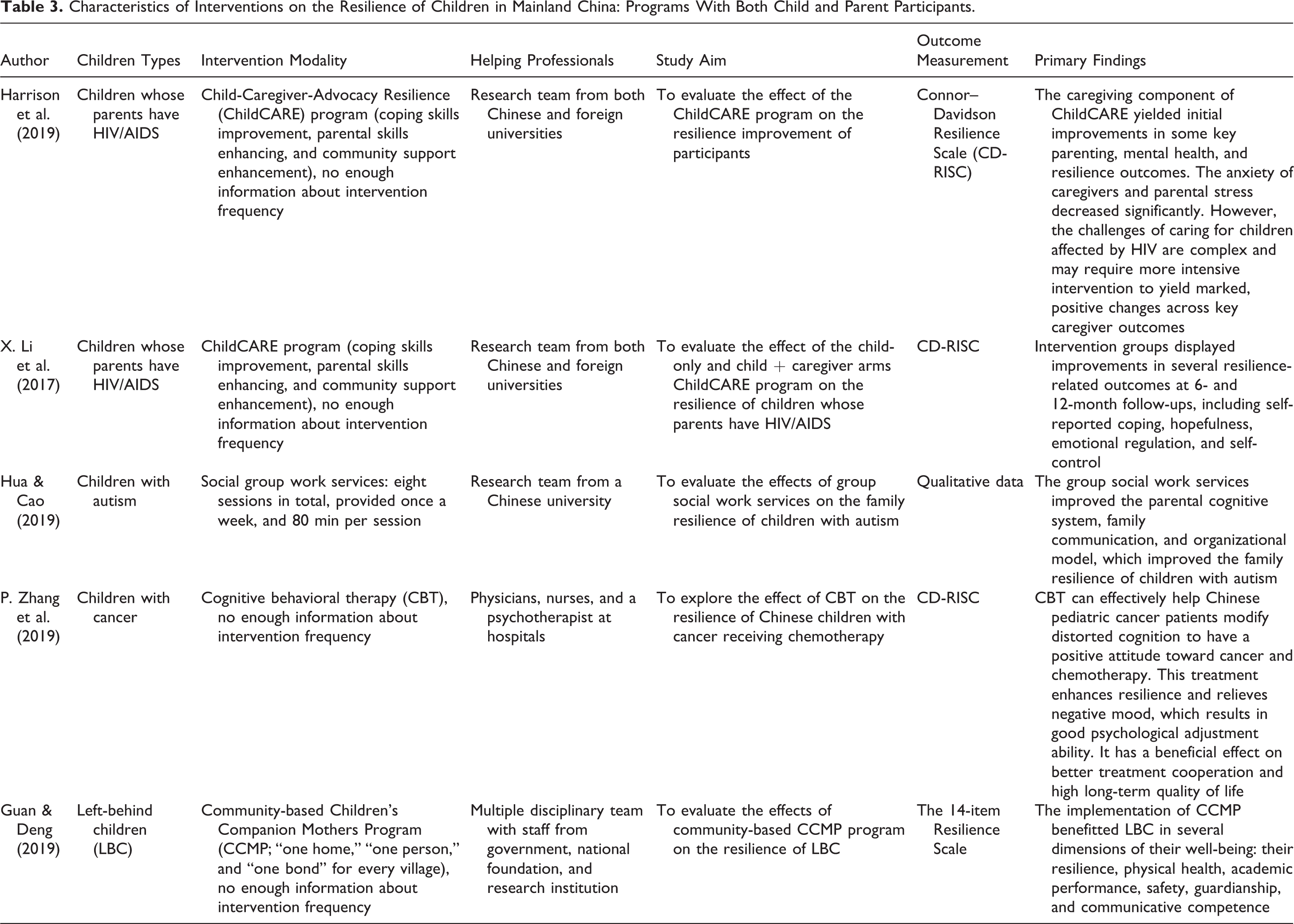
Two studies included a sample of children whose parents were diagnosed with HIV/AIDS (Harrison et al., 2019; X. Li et al., 2017). After carefully reviewing the two studies, we found that the study samples participated in the same program, but each study reported on different parts of the results. The program used in these studies was the Child-Caregiver-Advocacy Resilience (ChildCARE) program, which provided training to enhance coping skills, parental skills, and community support for children with parents who had HIV/AIDS (Harrison et al., 2019; X. Li et al., 2017). The research was conducted in collaboration between Chinese and U.S. scholars (Harrison et al., 2019; X. Li et al., 2017). Using the CD-RISC measure, Harrison et al. (2019) reported that the caregiving component of the ChildCARE program yielded improvements in some key parenting, mental health, and resilience indicators in the initial stage, but they had also mentioned that there were challenges of caring for children affected by HIV/AIDS, which require more extensive intervention programs. X. Li et al. (2017) reported significant improvements in several resilience-related outcomes at 6- and 12-month follow-ups, including self-reported coping, hopefulness, emotion regulation, and self-control.
Parents/caregivers and children with certain types of illnesses or diseases also frequently participated in resilience-focused programs. Hua and Cao (2019) explored eight-session group services for autistic children. The program was delivered once a week with each session, which lasted 80 minutes. The professionals were comprised of a research team from a Chinese university. After analyzing the qualitative data, which detailed parental cognitive systems, family communication, and organizational model, the study showed that group social services improved the resilience of children with autism and their families (Hua & Cao, 2019). Moreover, P. Zhang et al.’s (2019) study, which involved a medical team (physicians, nurses, and psychotherapists at hospitals) providing CBT to hospitalized children with cancer, yielded positive results. They reported that children had a positive attitude toward cancer and chemotherapy and showed a higher level of resilience after participating in CBT.
Guan and Deng’s (2019) study examined whether the community-based intervention Children’s Companion Mothers Program (CCMP) was effective in enhancing resilience among left-behind children. The study involved a multidisciplinary team of staff members from the local government, staff from national foundations, and research institutions. Measured by the 14-item Resilience Scale, the study demonstrated that the implementation of CCMP enhances the resilience, physical health, academic performance, safety, guardianship, and communication skills of the left-behind children.
Of the five studies on kunjing children and their parents/caregivers, group- or community-based programs were utilized. Three studies included a research team from universities (Harrison et al., 2019; Hua & Cao, 2019; X. Li et al., 2017), one study included a medical team (P. Zhang et al., 2019), and one other study included a multidisciplinary team (Guan & Deng, 2019). CD-RISC was the most commonly used scale (n = 3; Harrison et al., 2019; X. Li et al., 2017; P. Zhang et al., 2019), and Hua and Cao’s (2019) study was the only one that used qualitative data. All five studies yielded positive results from interventions tested to enhance the resilience of kunjing children.
References of the all reviewed literature in Chinese language were presented in their original language in Table 4.
References to Reviewed Research in the Chinese Language.

Discussion and Applications to Practice
This scoping review systematically described the current state of resilience-based intervention for kunjing children. Despite empirical evidence that demonstrated a need to enhance resilience among kunjing children, our review revealed that there is a paucity of intervention research in China, as only 12 studies were identified. However, the current review contributed to enhancing our understanding of the roles of social work, intervention participants, intervention strategies, and their effectiveness on behalf of kunjing children.
Among the twelve reviewed studies, the primary helping professionals in the studies consisted of research teams from universities (n = 10), but we also found two university teams from schools and departments of social work (Gao, 2015; Hua & Cao, 2019), although social work intervention studies in China are limited. Social workers were notably absent from child-related interventions in many areas in Mainland China (M. Wang, Sokol, et al., 2020; M. Wang, Victor, et al., 2020). Active participation of social workers and child welfare workers in resilience-focused interventions for kunjing children is noteworthy. Although social work is a relatively new profession in Mainland China (Jiang, 2015), the Chinese government has recognized the important role of social workers in helping children in need (Ministry of Civil Affairs of the People’s Republic of China, 2017). In 2018, the number of certified social workers also greatly increased from 43,600 in 2010 to 439,300, which increased more than ten-fold within eight years (Ministry of Civil Affairs of the People’s Republic of China, 2019b). Social workers are suggested to play a critical role in the resilience interventions by covering more types of kunjing children, involving their parents/caregivers, and employing effective intervention strategies.
The twelve studies only provided services to Type II and Type III kunjing children. Type II children include children with autism (n = 1; Hua & Cao, 2019) and children with cancer (n = 1; P. Zhang et al., 2019). Type III kunjing children consist of migrant children (n = 3; Gao, 2015; Tam et al., 2020; L. M. Zhang & Tian, 2014), child survivors of earthquakes (n = 3; Y. Chen et al., 2014; Fu et al., 2013; E. J. Zeng & Silverstein, 2011), children whose parents have HIV/AIDS (n = 2; Harrison et al., 2019; X. Li et al., 2017), and left-behind children (n = 2, Guan & Deng, 2019; Y. Zhao et al., 2019). Type I kunjing children were completely absent in the resilience-focused interventions. Social workers should aim to involve children in poverty and children with disabilities in resilience-focused interventions.
In China, over 40.08 million children live in relative poverty, and about 10.80 million children live below the poverty line (China Development Research Foundation, 2017). There are regional disparities in the poverty rates (Qi & Wu, 2014), that is, poverty in rural areas was more severe than in metropolitan and other areas. Children living in interior rural areas were 2.5 times more likely to be poor compared to those in coastal rural regions (A. Lu & Wei, 2002). Poverty in childhood is associated with poorer health outcomes, lower educational attainment and lower quality of education, fewer job opportunities, lower income in adolescence (Z. Wang & Man, 2019; Yu et al., 2011; L. H. Zhang & Liu, 2006), and difficulties in social life (Cooper & Farran, 1991). Poverty is a serious social problem; as a result, the existing intervention studies targeting children in poverty mainly focused on resolving poverty. Considering the scarcity of intervention studies on children’s resilience in China, it is apparent that there would be only a handful of resilience-focused intervention research targeting children living in poverty. Harsh living conditions of children in poverty require further development of resilience-focused intervention programs, rather than focusing exclusively on addressing and alleviating poverty.
Although children with autism and cancer participated in resilience-focused interventions, a large group of Type II kunjing children (i.e., children with disabilities) was notably absent, although these children are likely to show adverse outcomes concerning health, education, and social well-being (Chiang & Hadadian, 2010). As presented in a report from Stratford and Ng (2000), in China, a child is born with a serious disability every 40 s. Also, as estimated by a report by the United Nations Educational, Scientific and Cultural Organization, there are approximately 2.46 million children, under 6 years of age who have some types of disabilities (Corter et al., 2006). These children are at an increased risk of emotional and behavioral difficulties (Fisher & Shang, 2014). As demonstrated from this scoping review, intervention studies focusing on children’s resilience began in 2014 (Y. Chen et al., 2014). With short-term development, there is still a serious gap in the interventions for children with disabilities. Many empirical studies suggest that there is a critical need for children with disabilities in developing resilience (Mather & Ofiesh, 2005; Mu et al., 2017).
Meanwhile, of the twelve studies, only five included both kunjing children and their parents/caregivers in the program (Guan & Deng, 2019; Harrison et al., 2019; Hua & Cao, 2019; X. Li et al., 2017; P. Zhang et al., 2019). The absence of parents/caregivers in these interventions might be explained by the physical distance between parents/caregivers and children and the limited availability of parents/caregivers. It could also be explained by the limitations in the intervention delivery modes. All of the twelve reviewed interventions were delivered in offline formats, which limited parental involvement in most cases. Considering the effectiveness of parental/caregiver involvement in children’s development (Flouri & Buchanan, 2003; M.-T. Wang & Sheikh-Khalil, 2014), it is important to refine the current intervention delivery modes to involve more parents/caregivers in the intervention. Social workers could explore alternative forms of service provisions to improve accessibility and engagement of parents/caregivers. For instance, information technology (Finkel et al., 2007), robot-based technology (Feng et al., 2017), and artificial intelligence (D’Alfonso et al., 2017) have reportedly been effective in social service provisions for involving parents/caregivers. They might help engage parents/caregivers in fostering the resilience of kunjing children.
Also, we highly suggest social workers learn from the intervention strategies in the studies reviewed to promote the resilience of kunjing children. With the exception of the intervention tested by Fu et al. (2013), all the other eleven studies found that developing resilience in kunjing children is necessary. Group-based programs (n = 7; Y. Chen et al., 2014; Hua & Cao, 2019; Tam et al., 2020; L. M. Zhang & Tian, 2014; P. Zhang et al., 2019; Y. Zhao et al., 2019) and community-based group services (n = 4; Gao, 2015; Harrison et al., 2019; X. Li et al., 2017; E. J. Zeng & Silverstein, 2011) were found to be the most commonly used and highly effective in fostering resilience of kunjing children. Social workers could develop various group intervention sessions that might be most feasible for providing resilience training to kunjing children. We also suggest implementing the ABC model, the CBT model, and Outward Bounding training, which can enhance the resilience of these children. Group-based programs have been found effective to foster children’s resilience in other countries (e.g., Alvord & Grados, 2005; Coholic et al., 2012; Watson et al., 2014).
The research designs of the studies reviewed herein have several limitations worthy of discussion. Of the twelve studies reviewed, most did not have any follow-up assessments (n = 8; Fu et al., 2013; Gao, 2015; Guan & Deng, 2019; Hua & Cao, 2019; E. J. Zeng & Silverstein, 2011; L. M. Zhang & Tian, 2014; P. Zhang et al., 2019; Y. Zhao et al., 2019), which limited our understanding of the long-term effectiveness of the interventions. Also, the current measurements of resilience were about self-perceived resilience with self-reported data (e.g., “When I’m in a difficult situation, I can usually find my way out of it,” “My belief in myself gets me through hard times”). Future studies are necessary for developing a resilience scale that measures resilience more objectively. Moreover, there were insufficient data available in these studies. To elaborate, none of the twelve reviewed studies reported whether a treatment manual was developed and used, and there was insufficient information about the demographic characteristics of the participants in some studies. In addition, given the nature of the existing studies, it is impossible to evaluate the quality of the twelve studies based on standard criteria. Additionally, the focus was strictly on the individual resilience of kunjing children rather than family resilience (Masten & Monn, 2015; Walsh, 2012) or community resilience (Landau & Saul, 2004; Ungar, 2011).
These limitations aside, this scoping review systematically reviewed a total of twelve resilience-focused intervention research. The existing findings indicated that more types of kunjing children need to participate in the intervention, and technologies are suggested to increase the involvement and engagement of parents/caregivers of kunjing children in intervention efforts. Group-based programs were found to be particularly effective in fostering children’s resilience. Research networks and information exchanges are strongly encouraged, and social workers need to play a critical role. The current state of resilience-focused intervention research calls for promoting the resilience of kunjing children, which is the first important step toward promoting social justice and enhancing children’s well-being.
Footnotes
Declaration of Conflicting Interests
The authors declared no potential conflicts of interest with respect to the research, authorship, and/or publication of this article.
Funding
The authors disclosed receipt of the following financial support for the research, authorship, and/or publication of this article: This research was funded by The National Social Science Fund of China, as a part of the Youth Project of “Resilience of Kunjing Children and Social Work Intervention Research” (17CSH075).
