




Abstract
Purpose:
The present study applied the Dynamic Systems Model of Role Identity to construct an index of social work professional identity.
Methods:
The data were obtained from a longitudinal study of social work in China in 2019. Exploratory structural equation modeling and multigroup confirmatory factor analysis were used to confirm the factor structure. Independent samples t test was adopted to test the difference among different groups.
Results:
The four-factor (i.e., social, role, target, and action perceptions) index of social work professional identity showed acceptable reliability and good validity. Measurement invariance was observed across different groups (i.e., gender, education background, professional certification, job position, and work seniority). Differences were observed on professional identity among different genders, educational backgrounds, and professional certification groups.
Conclusions:
The index of social work professional identity can contribute to policymaking, educational curriculum design, and evidence-based interventions aimed at promoting professional identity.
The definition of professional identity has not been unified and clarified in previous studies. However, a clear definition and an accurate assessment of professional identity will help researchers to have precision in their analyses (Fitzgerald, 2020). Fitzgerald (2020) conducted a conceptual analysis of 60 studies on professional identity and pointed out that professional identity contains many recognized attributes, namely, skills and functions, knowledge values and ethics, personal identity, group identity, and the influence of the context of the work. In particular, social work professional identity contains a specialized knowledge base, understanding of social work values, and competence to integrate knowledge and values with the practice of social workers (Wiles, 2013). Social work professional identity can influence the cognition and behavior of social workers and then influence the professionalization of social work. The low salary and low status of social workers in China lead to the low professional identity of social workers (Xu, 2017a). As a result, the willingness of graduates of social work to engage in social work is insufficient, and the social work industry has a shortage of talents, which hinders the professionalization of social work (Xu, 2017b). Empirical research has further shown that a low level of professional identity in social work was closely related to high turnover intentions and low job satisfaction (Jiang et al., 2019). Therefore, research on social work professional identity plays an important role in influencing the cognition and behavior of social workers and promoting the professionalization of social work. However, existing studies usually employed qualitative approaches to explore the function and cultivation of professional identity among social work students or social workers (e.g., Forenza & Eckert, 2018; Moorhead, 2019). Only a few scholars have developed a few measurements to evaluate professional identity among social workers, such as the Caregiver Role Identity Scale (Siebert & Siebert, 2005) and the Emergency Medical Services Role Identity Scale (Donnelly et al., 2015). However, these measurements can only be used in medical social workers rather than in general ones. Therefore, a highly reasonable model is needed to construct the measurement of professional identity in social work.
Structuration and social identity theories are the main theoretical frameworks guiding the construction of professional identity measures. Structuration theory (Giddens, 1984) suggests that human agency and social structure are interdependent. Social identity theory complements structuration theory by addressing that social identity is constructed as individuals engage in and interact with social and cultural contexts (Operario & Fiske, 1999), in which individuals are allowed to define themselves (Ashforth & Mael, 1989). Thus, structuration theory is a top-down view from a social structure to social professional identity, whereas social identity theory is a bottom-up view from professional identity to the social context (Hotho, 2008). However, the one-way theoretical model cannot fully demonstrate the concept of professional identity because of the multiplicity, hierarchy, and cultural-contextual nature of the identity phenomena (Kaplan & Garner, 2017). Social work is a profession that should consider social and cultural factors (Carpenter & Platt, 1997; Forenza & Eckert, 2018). A comparative study involving 10 countries suggested that the professional characteristics of social work differed in various aspects (e.g., public recognition, the monopoly over types of work, professional autonomy, knowledgebase, professional education, professional organizations, the existence of codified ethical standards, and prestige and remuneration; Weiss-Gal & Welbourne, 2008). Therefore, the Dynamic Systems Model of Role Identity (DSMRI; Kaplan & Garner, 2017) was adopted to guide the construction of the professional identity index of social work because it considers the interaction between components of professional identity, social structure, culture, and the environment.
DSMRI proposed a four-factor model and explained how the four components of role identity are formed, how they interact, what are their goals, and how they are influenced by culture and environment from a dynamic perspective (Kaplan & Garner, 2017). The four factors are ontological and epistemological beliefs (indicating the knowledge about the world and the emotions tied to the knowledge), purpose and goals (indicating the recognition and endorsement of an overall purpose of the role), self-perceptions and self-definitions (indicating the perception of the attributes and characteristics associated with the role), and perceived action possibilities (indicating the perception of the actions one may take to achieve the purpose and goals). These four components of role identity are contextually constructed, interdependent, and partially overlapping (Kaplan & Garner, 2017). This model has been applied as a framework among teachers (Garner & Kaplan, 2019) and students (Kaplan et al., 2019) to define the corresponding identity. However, no specific measure was developed using this model. The present study aims to fill this gap by attempting to construct a professional identity index through the DSMRI for social workers.
Previous studies have indicated that professional identity may be influenced by different demographic characteristics. The independent samples t test and analysis of variance among 1,021 teachers showed that professional identity is affected by gender, level and background of education, job position, and years of experience in occupation (Dogan & Yatmaz, 2018). Gendron et al. (2016) surveyed professionals working in aging services and found that the length of time in the profession had an impact on professional identity. Moreover, in-depth semistructured interviews for newly qualified social workers in Australia indicated that professional identity was changed during the transition from a student to a newly qualified practitioner (Moorhead, 2019). Therefore, gender, educational background, professional certification, job position, and work seniority can influence the professional identity of social workers.
Using a national representative database (i.e., China Social Work Longitudinal Study [CSWLS]), the present study aims to construct the index of social work professional identity by evaluating internal consistency, content validity, structure validity, and measurement invariance. The psychometric properties of this index are examined. The development of the professional identity index can reflect the professional identity of social workers in the context of the rapid development of social work in China. The professional identity index is an effective tool for assessing the extent to which social work education and training enhance professional identity. Future policymaking, educational curriculum design, and evidence-based interventions to promote the professional identity of social work students and social workers can be developed.
Method
Item Pool Development and Content Validation
The items were selected from the social worker questionnaire of CSWLS 2019 (Yuan et al., 2020). CSWLS 2019 is a systematic and large-scale national survey of social work institutions and social workers. The survey contained three scholarly themes, namely, the professionalization of social work, governance and social work, and institutionalization and social work. Multiple development strategies (i.e., translated/revised/selected from a maturity scale or previous research, newly developed items based on literature review, and cognitive interviews) in the social worker questionnaire were adopted. These strategies made the survey questions about comprehensiveness, measure validity, and economical efficiency.
An expert panel responsible for item selection was first constructed according to the proposed guidelines of Lee (2018). The following inclusion criteria of the experts were used: (a) have a background of professional knowledge and practical experience as a social worker; (b) are familiar with Chinese culture, social norm, and the trend of the development of social work in China; and (c) have methodological experience in developing and testing measurements. As a result, an expert panel was established. It was led by a professor of social work, and the members include a PhD student in psychology, a PhD student in social work, and two master’s students in social work who have practical experiences as social workers. All five expert panelists agreed to participate in reviewing the items. They received by email a cover letter and related materials, such as 118 items from the social worker questionnaire of the CSWLS 2019 and a description of DSMRI. The expert panel was requested to categorize the items into the corresponding factor of DSMRI and assess the fitness of the items in the components of the model independently. They gave their responses on a 5-point Likert-type scale (1 = poor, 5 = excellent). The principal investigator received feedback from the five expert panelists in 1 week. Lee (2018) suggested that the item with a mean score above 3.0 should be retained. Items with a mean score of 4.0 or above were retained to increase reliability and validity. All 118 items were reviewed and scored. If two of the five expert panelists disagree on the classification of an item, the item is deleted. This process continues until all expert panelists agree on the final item list for each factor. Finally, the initial item pool of index contained 30 items, which comprise seven items on ontological and epistemological beliefs, seven items on purpose and goals, seven items on self-perceptions and self-definitions, and nine items on perceived action possibilities.
Of the 30 items, 23 were scored on a 5-point Likert-type scale (1 = completely disagree, 5 = completely agree). The other seven items were scored on a 7-point Likert-type scale (0 = completely disagree, 6 = completely agree). The linear stretch method, which is conventional and best applicable to the numerical response scale (de Jonge et al., 2014), was used to transform the number of response options to a common numerical scale. Items with seven response options were stretched to a common range from 1 to 5. The lowest number (0 on a 7-point Likert-type scale) assigned to a response option was projected onto 1, whereas the highest number (6 on a 7-point Likert-type scale) was projected onto 5. All the intermediate options were equally spaced.
Participants and Procedure
A multistage random sampling design that made the sample have certain national representativeness was used in CSWLS 2019. The survey included full-time social workers who have been employed in social work institutions for more than 3 months, civil social workers who were directly employed by civil affairs or welfare agencies, and medical social workers who were directly employed by hospitals. It excluded interns, volunteers, and the staff of the association of social workers. From June to October 2019, 979 valid social worker agency questionnaires and 5,965 valid individual social worker questionnaires from 57 cities were collected. Ethics approval was obtained from the Human Subjects Ethics Sub-Committee of E University.
The present study involved 5,827 participants (4,603 males and 1,223 females) after deleting samples with a large number of missing values. The mean age was 31.39 (standard deviation [SD] = 7.83) and ranged from 18 to 87 years. Only 7.68% (n = 446) of the participants have a high school degree or less, and the others hold a college degree or above. A total of 2,137 (36.62%) participants have a degree in social work. The number of certificated social workers, frontline social workers, and social work supervisors is 3,041; 4,182; and 829, respectively. The work seniority of the participants in the current sample had a mean of 3.45 years (SD = 3.44) and ranged from less than 1 year to 35 years.
Measures
The initial version of the Index of Social Work Professional Identity included four dimensions and 30 items. Participants were required to respond to the items on a 5-point Likert-type scale (1 = completely disagree, 5 = completely agree). The levels of the professional identity of a social worker can be revealed by calculating the total scores or the scores of subscales. High scores on the new index can identify social workers who consider themselves to have a high level of professional identity in social work.
Results
Exploratory Structural Equation Modeling (ESEM)
ESEM was adopted to explore and validate the factor structure of the index using Mplus Version 7.4 with a maximum likelihood robust estimator (MLR). ESEM combines the advantages of exploratory and confirmatory factor analyses by allowing for the cross-loading of items, which avoids biased measurement models and parameter estimates (Asparouhov & Muthén, 2009). Tucker–Lewis index (TLI) > .90, comparative fit index (CFI) > .90, standardized root mean square residual (SRMR) < .08, and root mean square error of approximation (RMSEA) < .08 were adopted as the evaluation criteria (Morin et al., 2016).
The initial version of the 30-item index showed an unsatisfactory degree of fit (χ2 = 11,110.046, df = 321, CFI = .897, TLI = .861, SRMR =.033, RMSEA, 90% confidence interval [CI] = .064 [.063, .066]). Thus, a revised model was needed. The criteria for item inclusion were as follows: (a) retained the structure of four components, as implied by the DSMRI, (b) achieved good to excellent internal reliabilities for each subscale (Cronbach’s α = .7–.9), (c) had corrected item-total correlations of above .30 (Nunnally & Bernstein, 1994), (d) had factor loadings on the target factor higher than .50 (Etz et al., 2019), and (e) kept the number of items of subscales measuring comparable constructs equivalent (Matlock & Turner, 2016). After removing unsatisfied items with low factor loadings, substantial cross-loadings, and theoretically unexpected factor loadings, 16 items were retained (i.e., four items for each factor) (see Online Appendix A). Of the 16 items, 15 had factor loadings higher than .547 and one item had a factor loading of .469. The corrected item-to-total correlations were higher than .34 (see Table 1). The goodness of fit of the 16-item four-factor model was excellent (χ2 = 607.989, df = 62, CFI = .988, TLI = .976, SRMR = .010, RMSEA [90% CI] = .033 [.033, .036]).
Standardized Factor Loadings (With Standard Errors in Parentheses) for the Final Version of Index of Social Work Professional Identity.
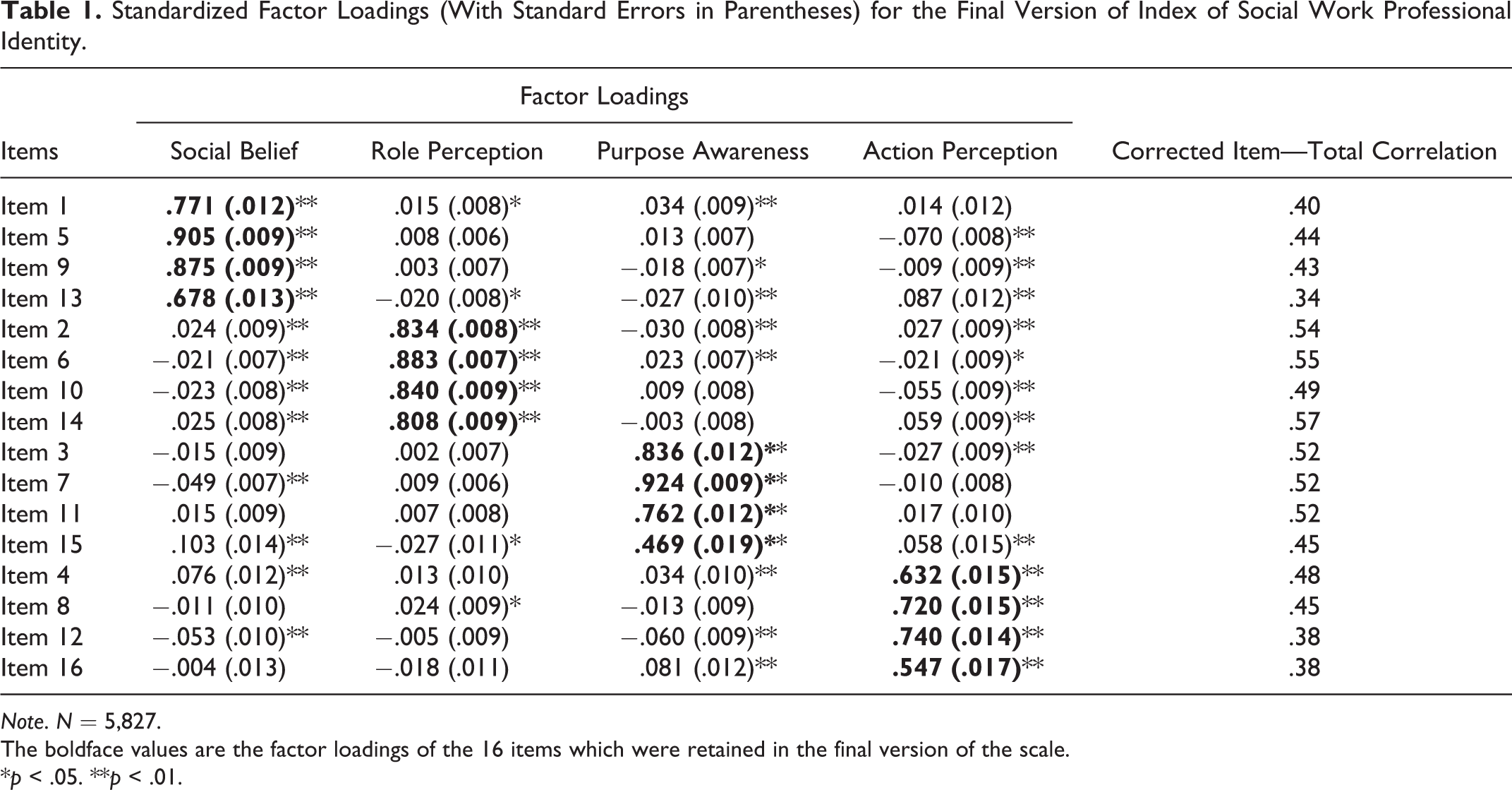
Note. N = 5,827.
The boldface values are the factor loadings of the 16 items which were retained in the final version of the scale.
*p < .05. **p < .01.
Table 2 presents the descriptive statistics, including the mean scores, SD, correlation coefficient, and internal consistency of the four components and the total score of the Index of Social Work Professional Identity. The four components were positively intercorrelated (r > .122, p < .01). The internal reliabilities (Cronbach’s α) of the four subscales and the total index were higher than .76. According to the remaining items, the four components were relabeled as social belief (i.e., indicating the epistemological knowledge about social work from the social perspective), role perception (i.e., indicating the attributes associated with the social worker), purpose awareness (i.e., indicating the endorsement of an overall purpose of the social worker), and action perception (i.e., indicating the perception of the actions the social worker may take to achieve the purpose and goals).
Descriptive Statistics, Pearson Correlations, and Cronbach’s α of the Index of Social Work Professional Identity.

Note. N = 5,827.
**p < .01.
Multigroup Confirmatory Factor Analysis
Multigroup confirmatory factor analysis using MLR was adopted to examine the measurement invariance of the index. The participants were divided into groups with and without social work education (i.e., a bachelor’s or a master’s degree in social work), groups with and without certification (i.e., passing the China Social Workers’ Professional Level Examination), groups containing only frontline social worker, and groups containing only social work supervisors. Moreover, according to the median of work seniority in the current sample (i.e., 2 years), the participants were divided into the short work seniority group (2 years or less) and the long work seniority group (more than 2 years). Three levels of equivalence were tested in the current sample, including configural, metric factorial, and scalar factorial invariance (Meredith, 1993). |ΔCFI| (change in CFI) < .010 and |ΔRMSEA| (change in RMSEA) < .015 were adopted as the measurement equivalence evaluation criteria (Pendergast et al., 2017). Table 3 summarizes the results of the multigroup confirmatory factor analysis. The results implied that the four components of the Index of Social Work Professional Identity were invariant across different genders, education backgrounds, professional certifications, job positions, and work seniority groups.
Measurement Equivalence/Invariance of the Index of Social Work Professional Identity Across Different Groups.

Note. CFI = comparative fit index; RMSEA = root mean square error of approximation; ΔCFI = change in CFI; ΔRMSEA = change in RMSEA.
Difference Analysis
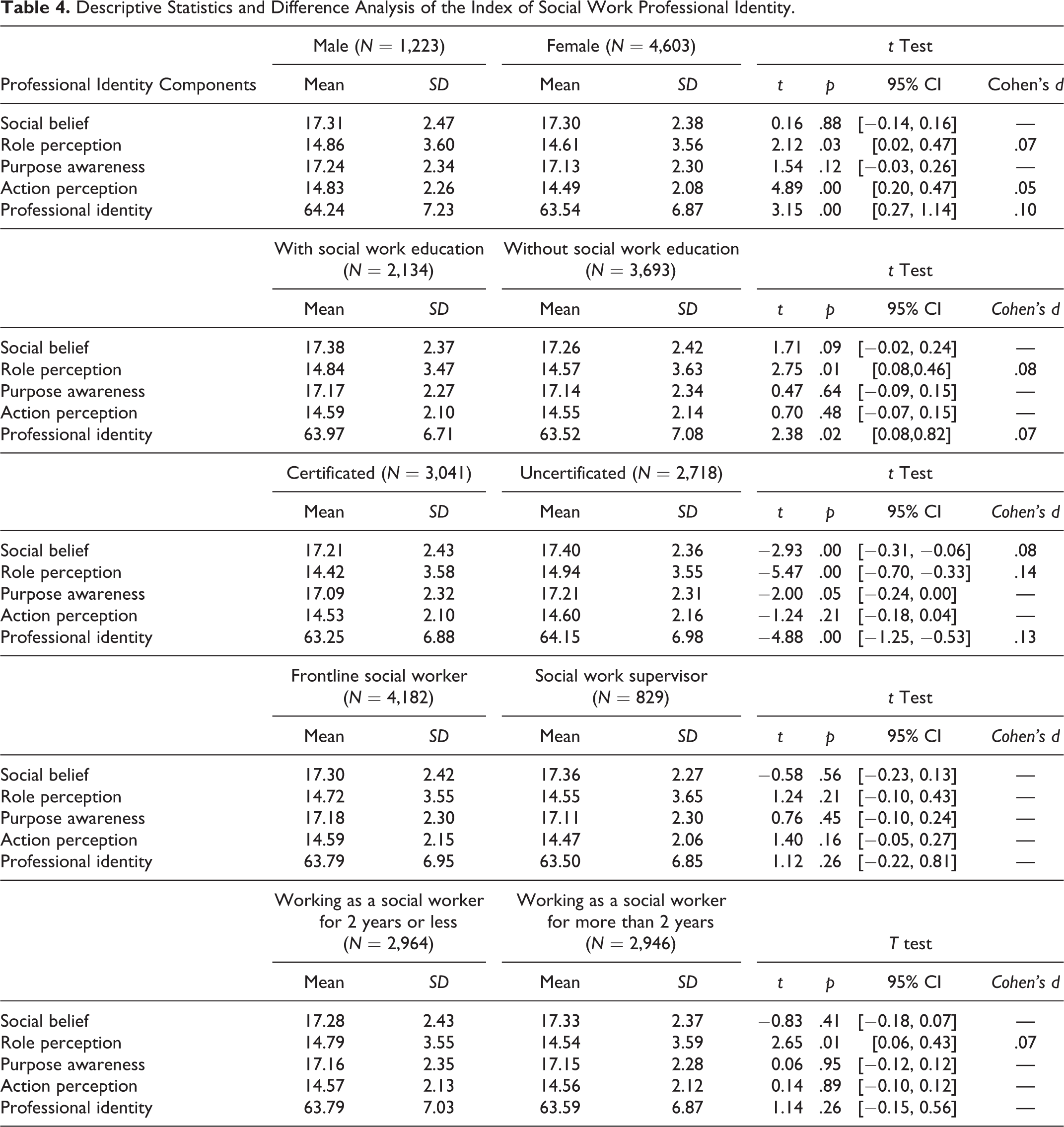
Independent samples t test with a 95% CI was used to explore whether a significant difference exists among the four factors of professional identity among different genders, education backgrounds, professional certifications, job positions, and work seniority populations. As shown in Table 4, males scored higher in role perception factor (p < .05), action perception factor (p < .01), and professional identity (p < .01) than females. Social workers with social work education scored higher in the role perception factor (p < .05) and professional identity (p < .05) than social workers without social work education. Uncertificated social workers scored higher in the social belief factor (p < .01), the role perception factor (p < .01), and professional identity (p < .01) than certificated social workers. No significant difference was observed in the scores of the four components and professional identity between frontline social workers and social work supervisors (p > .05). Social workers with short work seniority scored high in the role perception factor (p < .05). All the effect sizes were small (Cohen’s d = .05–.14).
Descriptive Statistics and Difference Analysis of the Index of Social Work Professional Identity.
Discussion and Applications to Practice
A 16-item index of professional identity in social work was developed and achieved sound psychometric properties. Reliability, factor structure, and factorial invariances were validated. All the results supported the four-factor structure (i.e., social belief, role perception, purpose awareness, and action perception) of social work professional identity. To some extent, these findings demonstrated that the four-factor social work professional identity has cultural commonality and particularity.
In general, the four-factor structure, especially the role perception, purpose awareness, and action perception, contained general perceptions of social work worldwide. The role perception factor refers to the self-perceptions, self-descriptions, and emotions related to self-perception as a social worker. For example, personal characteristics, such as independence and self-confidence, of social workers can be found in the service of the client (An & Chapman, 2014). The purpose awareness factor refers to the committed purposes of social work when it is seen as a profession. Those purposes are the outcomes of professional meaning pursued by social workers (e.g., social well-being) and responses to human needs and problems (e.g., change the life situation of clients), which are consistent with the focus of the definition of social work in the 21st century (Hare, 2004). Finally, the action-perception factor refers to what social workers can and cannot do to achieve their goals in social work. For instance, social workers can construct a professional “helping relationship” with clients to enable change and alleviate their distress (Rollins, 2019). To summarize, the four-factor social work professional identity (i.e., social, role, target, and action perceptions) should be a reasonable structure, which is worth further exploration.
The four-factor structure partly reflected the contextualized professional identity in social work. Specifically, the social belief factor revealed the connectivity between social work and the government in China. Compared with the nongovernmental organization movement in Western cultures, the professionalization and institutionalization of Chinese social work developed within the context of government management (Wong & Pearson, 2007). The instrumental role of the government in the development of social work in China was embodied in the creation of social work positions within the social service systems (Gao & Yan, 2015). The government set operational policies and targets for social work; built policy implementation infrastructure; refined the definition of social work professionals; and set specific standards for financial support and funding arrangement, the government’s purchase of services, civil society organization, the creation of social work position, salary scale, training and education, and occupational assessment (Gao & Yan, 2015; Wen, 2017).
In brief, the four-factor structure index of professional identity in social work developed based on the DSMRI has cross-cultural consistency, which is rooted in its inclusion of components with the cultural commonality of professional identity in social work. Given that the role of social workers has its particularity in different social cultures, the performance of some components of professional identity in social work (e.g., social belief) in different cultures shows superficial rather than essential differences.
The index can be used to measure the professional identity of social workers. The results obtained through the use of this scientific index for evaluation contribute to the design of an education curriculum in social work and evidence-based interventions aimed at promoting professional identity in social work, which in turn contribute to the professionalization of social work. In addition to the professional identity of social work perceived by social workers, this professional identity perceived by nonsocial workers (e.g., public and family members of social workers) can influence the cognition and behaviors of social workers. For example, Zeng et al. (2016) found that the low professional identity with social work occupation from the general public is one of the reasons why social work graduates do not choose social work as their career. The family’s attitude toward the social work profession has a significant impact on social workers’ turnover intention (Zeng, Li, He, et al., 2020). Therefore, the evaluation of the public’s professional identity of social work is also crucial. The index of professional identity in social work includes components associated with the external social structure, culture, and environment (i.e., social belief and purpose awareness) and components associated with the subjective perception and behavior of social workers (i.e., role perception and action perception). After the appropriate modification of the statements in the scale, the index can be used to assess the public awareness of the social work profession and the public recognition of social workers (see Online Appendix B).
The present study shows that social workers who are male, with professional education, and without certification are highly likely to show a high level of professional identity. Compared with female participants, male participants gravitate toward leadership positions or positions of status more and feel more empowered as they work (Healey & Hays, 2012). Social workers with professional education background show higher competency, higher commitment, and lower turnover intention than those without social work education (Li et al., 2019). Thus, improving the self-efficacy of females in the workplace and strengthening social work education may contribute to the enhancement of professional identity. In terms of the professional-level examination of social workers in China, potential loopholes, such as the lack of consensus on the knowledge base in social work, the possible contradiction between social work education and the examination, and the absence of competence standards (Zeng, Li, & Chen, 2020), indicate that passing the examination does not mean high competence nor high professional identity. Thus, the examination system needs to be improved and perfected.
This work has several limitations. First, the results were mainly obtained in the context of Chinese culture. The generalizability of the findings in the present study to other cultures is unknown. Although the four-factor index of professional identity in social work showed cultural commonality and particularity, it still needs to be verified and compared across cultures. Second, the professional identity index can reflect the extent to which social work education and training enhance professional identity. Future studies should apply the professional index to a longitudinal study design (e.g., from the period of a social work student to the period of a social work supervisor) or a controlled experimental design to reflect the changes and development of the professional identity of social work. Third, the applicability of the scale is limited to social workers. As discussed in the previous section, future studies can emphasize on testing the instrument with different populations, including but not limited to the public, family members of social workers, and other professionals whose work is similar to the nature of social workers (e.g., community workers). Finally, external factors, such as specific context, physical environment, and organizational change, can also affect professional identity (Frechette et al., 2020). Future research should explore the impact of personal factors on professional identity and consider the impact of external factors on professional identity to provide comprehensive empirical support for policymaking, educational curriculum design, and evidence-based interventions to promote a professional identity.
Supplemental Material
Supplemental Material, sj-pdf-1-rsw-10.1177_1049731520984518 - Construction of the Index of Social Work Professional Identity
Supplemental Material, sj-pdf-1-rsw-10.1177_1049731520984518 for Construction of the Index of Social Work Professional Identity by Wenjie Duan, Yumei Li and Yansi Kong in Research on Social Work Practice
Footnotes
Declaration of Conflicting Interests
The authors declared no potential conflicts of interest with respect to the research, authorship, and/or publication of this article.
Funding
The authors disclosed receipt of the following financial support for the research, authorship and/or publication of this article: This study was sponsored by “Shuguang Program” (20SG30) supported by Shanghai Education Development Foundation and Shanghai Municipal Education Commission.

Supplemental Material
Supplemental material for this article is available online.
References
Supplementary Material
Please find the following supplemental material available below.
For Open Access articles published under a Creative Commons License, all supplemental material carries the same license as the article it is associated with.
For non-Open Access articles published, all supplemental material carries a non-exclusive license, and permission requests for re-use of supplemental material or any part of supplemental material shall be sent directly to the copyright owner as specified in the copyright notice associated with the article.
