



Abstract
Purpose:
This study aims to investigate the effects of professional autonomy (PA) and person–environment fit (person–job [PJ] fit and person–organization [PO] fit) on turnover intention (TI).
Methods:
We take a total of 1,133 professional social workers with formal educational background from the China Social Work Longitudinal Study 2019 as our sample and use structural equation modeling as our analysis method.
Results:
We find that an increase in person–environment fit is significantly associated with a decrease in Chinese social workers’ organizational TI, and this relationship is mediated by PA. However, PA has greater power to buffer the effects of PJ fit than those of PO fit on TI.
Conclusions:
This finding improves existing understanding of the paradox of social workers embedded in the community. An occupational environment that promotes PA is urgently needed to address this paradox and to prevent social workers’ TI.
Research shows that the turnover rate of social workers is nearly 20% in Shanghai, Shenzhen, Guangzhou, and other cities in China where social work is rapidly developing (Jiang & Wang, 2016; Y. Li, 2014). However, 38.1% of social workers in Guangzhou, China, have strong turnover intentions (TIs; Xu, 2017). The recent turnover rate of social workers in Shenzhen is 46.2%, and 48.4% of the staff have left their profession (Lei et al., 2019; X. Li, 2016). High turnover has been recognized as a major problem in public welfare agencies for several decades because it impedes effective and efficient delivery of services (Powell & York, 1992).
Turnover and professional autonomy (PA) in human service–related fields, such as social work, have long been a topic of discussion. The rapid development of social work in China during the past decade has involved the gradual introduction of professional social work into the preexisting traditional social service delivery system, which is a process defined as embeddedness (S. Wang, 2011). The original social services in China operate on the basis of the goal of economic institutional reform and political stability rather than the goal of developing social welfare and thus cannot respond to the new needs of people (S. Wang, 2011). Hence, social embeddedness is extremely necessary. The development of a pattern of community embeddedness brings about the problem of administrative services rather than professional services and the consequent limits to PA (Yang, 2014; Zheng, 2020). Consequently, professional social workers’ competence may suffer from the administrative power in the community. This situation tends to lead to low worker autonomy, which in turn may directly cause turnover during the developmental process of embeddedness.
PA is a reflection of the match between individuals and organizations, especially among professional social workers (Lei et al., 2019). The ongoing development of social work in China involves an inherent conflict between the development of embeddedness and PA (Guo, 2016). Thus, we explore the development of embedded social work in contemporary China to investigate the mediating effect of PA on antecedents and turnover. The development of PA of social work in the embedded environment expands the research of autonomy in social work.
This study focuses on the effects of autonomy and person–environment (PE) fit on turnover among well-educated social workers (with formal educational background in social work) from professional agencies who are providing social services in the community. First, we discuss the high turnover rate of social workers globally and highlight the importance of PA to obtain an understanding of turnover among professional social workers. Then, we use structural equation modeling (SEM) to investigate the mediating effect of autonomy on the relationship between PE fit and TI. Finally, we discuss the contradiction between different types of PE fit on the basis of the paradox of Chinese social workers being embedded in the community.
Literature Review
High Turnover Intention in Social Work
Turnover includes job transfer to different positions within and out of organizations, whether voluntarily or involuntarily (Burstain, 2009). For research purposes, the organizational turnover in this article does not include intraorganizational mobility. TI, which focuses on subjective motivation, is considered to be an immediate prerequisite and precursor of voluntary resignation and often used in a variety of models as a proxy for actual turnover (Michaels & Spector, 1982; R. Sun & Wang, 2017; Tett & Meyer, 1993).The child welfare social workers’ turnover rate is 16.1% in England (Department for Education, 2020) and 24.26% in America (The Child Welfare Policy and Practice Group, 2016). Turnover is common in the social service industry, but the turnover of social workers in China is especially worrying. Increasing number of turnovers occurs within the profession due to path dependence because interprofessional turnover signifies the forfeiture of experience and capital accumulated in the original organization (Dlouhy & Biemann, 2018). Organizational turnover results in a loss of organizational human capital, and it generates increased costs (Davidson et al., 2010). Turnover in human service organizations may also disrupt the continuity and quality of care to those who need services (Braddock & Mitchell, 1992).
PA Matters
PA refers to the degree to which individuals are given freedom, independence, and discretion when they are arranging their work and determining their working methods (Hackman & Oldham, 1975). Personal characteristics, such as the skills, status, and professional qualifications, of social service practitioners and the industries they are engaged in affect their PA (Weiss-Gai & Welbourne, 2008). PA is extremely important in the social service field because it can bring about improved services and a high customer satisfaction response (Glisson & Hemmelgarn, 1998; Schmid & Bar-Nir, 2001). Further literature review shows the negative effect of PA on social service practitioners’ intention to leave (Kim & Stoner, 2008; Kubicek et al., 2017; E. Wang et al., 2019). Social workers’ job autonomy is believed to have a direct influence on their intention to leave (Kim & Stoner, 2008). Some argue that this indirect relationship is mediated by job satisfaction (E. Wang et al., 2019). Furthermore, job autonomy is generally related to positive work outcomes such as low TI (Kubicek et al., 2017). Therefore, we propose the following assumption:
Proposed Theoretical Framework for PE Fit
The most common and classic TI model in existing literature explores how personal and environmental factors affect workers’ TI (Lacity et al., 2008; Michaels & Spector, 1982). A similar model in social work turnover studies focuses on child welfare workers (Wilke et al., 2018) and Chinese social workers from a comparative perspective (Lei et al., 2019). Personal characteristics related to age, gender, tenure, and educational background (Wilke et al., 2018) influence internal factors such as burnout (Kim, 2008) and professional identity (Jiang et al., 2019). Although the overall turnover hazard rate of women is higher than men in the labor market (Lee, 2012), men are more likely to leave child welfare jobs than women (Madden et al., 2014). In addition, the organizational tenure of child welfare workers shapes their intention to leave (Boyas et al., 2013). Most studies to date focus on environmental factors such as supervisory or social support and job or role stress (Fakunmoju et al., 2010; Kim, 2008; Kim & Stoner, 2008; Wilke et al., 2018). However, research also tends to integrate individual factors with organizational factors. The person-in-environment framework from ecosystem perspectives “emphasizes processes of adaptation and goodness of fit between human beings and their physical and social environments” (Kondrat, 2002, p. 439). It also highlights the importance of fit in building an understanding of how individuals consider their work decisions in their current environment.
Considering PE fit is appropriate when exploring social workers’ intention to leave (Kennedy, 2005; Kristof, 1996). Although the levels of fit can be conceptualized in many ways, Muchinsky and Monahan (1987) provided a common distinction that organizes the conceptualizations into supplementary fit and complementary fit. On the basis of these two perspectives, existing literature frequently adopts and tests six conceptualizations (value congruence, needs–supplies, demands–abilities, goal congruence, personality congruence, and interest congruence of fit; Kristof, 1996). In addition, PE fit is regarded as a multidimensional matching process with multiple levels: person–vocation (PV) fit, person–organization (PO) fit, person–group fit, and person–job (PJ) fit (Kristof, 1996). Among these four PE fits, researchers focused on PO fit and PJ fit. They defined PO fit broadly as the compatibility between individuals and organizations and PJ fit as the compatibility between an individual’s abilities and the job demands (and/or the fit between an individual’s desires and the attributes of a job; Edwards, 1991). Wei (2015) showed that a high human capital of employees can lead to a high intention to leave. Extremely high or low abilities may cause mismatches between needs and supplies and/or between demands and abilities, and these situations increase the risk of leaving (Kennedy, 2005). Thus, the perspective of PE fit emphasizes the importance of investigating the effect of PJ fit on turnover. In countries with a collectivist culture, social norms––specifically, an employee’s beliefs that family and peers think that they should remain with the current employer––exert direct or indirect influence on workers’ intentions to leave (Lacity et al., 2008; Lobburi, 2012). This relationship reminds researchers to also consider the effect of PO fit on turnover, which can be viewed from the perspective of workers’ significant others.
For social work practitioners, the work environment plays a great role in constructing their PA. Yang (2014) implied that bureaucracy suppresses social workers’ PA and suggested that social work practice decisions are accompanied by the infiltration of administrative judgments and administrative procedures due to the development of embeddedness rather than derived from purely professional judgments (Yang, 2014). Embeddedness has become a new and continuous professional environment for social work and appears particularly complex within the community in Mainland China. Thus, social workers laboring in the community have called for the return of PA in recent years (Yang, 2014).
The effects of PO fit and PJ fit on TI and the link to PA benefit from a focus on the interaction between social workers and their organizational environment, which in turn helps in providing an understanding of social workers’ decisions to leave. First, previous studies failed to obtain evidence of the direct influence of PO fit on personal autonomy. However, we are able to obtain hints from the overlap between the consequences of PO fit and the antecedents of PA. Kennedy (2005) systematically revealed the consequences of PO fit, such as a good fit leading to improved job satisfaction and attitudes, job achievement and performance, personal skill development, vocational stability, organizational commitment, and decreased perceived stress. Personal skills and status also affect employees’ PA (Weiss-Gai & Welbourne, 2008). Thus, we feel validated in speculating on the influence of PO fit on PA. Second, although a few systematic studies determine the antecedents of PA in social workers, determinants for reference can also be found in the field of nursing and law. The ability and competence that can affect PA include inherited intellectual capacity, the ability to reason, the ability to control the self (Ballou, 1998), a verified education, and personal qualities, all of which can promote PA (Wade, 1999). Moreover, a high goal attainment capability has a positive significant association with staff’s high PA (Bularzik et al., 2013). If social workers feel that they are no longer matched with their organization or with their jobs, then TI and actions will follow. PA may also be an intermediate variable in the relationship between PE fit (in the forms of PO fit and PJ fit) and turnover, which led us to the following hypotheses:
Method
Procedure and Participants
To answer the research questions, we adopted data from the China Social Work Longitudinal Study (CSWLS) in 2019 (Yuan et al., 2021). Initiated by East China University of Science and Technology, CSWLS was the first large-scale, continuous sampling survey and research project in China focusing on the development and trends of social work. This survey used a multistage random sampling method to cover 56 cities. Its overall data quality was good under the four-round quality control. The survey collected a total of 993 questionnaires from social work institutions and 6,785 questionnaires from social workers (including 811 civil affairs and medical social workers), among which 979 and 6,776 were valid, respectively (effective response rate = 98.59% and 99.87%, respectively; Yuan et al., 2021). It finally released survey data composed of 979 social work agencies and 5,965 social workers. Among the participants, 4,714 (79%) were female, the average age is 30.44 years, 1,432 (24%) were members of the Communist Party of China, 3,330 (56%) had bachelor’s degree, and 3,611 (60.5%) hold at least assistant social work licensing.
Consistent with our research perspective, the questionnaires had multiple modes and spanned multiple domains covering the social workers’ personal, family, and professional situations and status. On the basis of the recorded responses to three questions—“What is your main service sector?” “What is your major for your bachelor’s degree?” and “What is your major for your master’s degree?”—we found that a total of 1,133 respondents had formal educational background in social work and indicated that their service sector was mainly community services. Others indicated that their sectors were family services and medical services. Of the total respondents, 78.5% were female (n = 889), the mean age was 32.69 years (SD = 8.38), 68.6% had assistant social work licensing (n = 777), and 24.4% had social work licensing (n = 277).
Measures
We used organizational TI, PA, PJ fit, and PO fit as research variables to assess professional social workers’ TI. First, we slightly revised Abrams et al.’s (1998) three-item scale (Jiang et al., 2019) measuring the items for organizational TI (“In the next 6 months, I intend to leave this organization”; “In the next 3 years, I intend to leave this organization”; and “Occasionally, I think about leaving this organization”) to fit the research context and designed a 5-point Likert-type response scale (1 = strongly disagree, 5 = strongly agree). Second, we assessed PA (Karasek et al., 1998) by adopting a three-item subscale of decision authority from the Job Content Questionnaire (e.g., “I have the autonomy to carry out my work”) and designed a 5-point Likert-type response scale (1 = strongly disagree, 5 = strongly agree). Third, for the purposes of this study, we adopted a five-item subscale to measure PJ fit from a scale used in a study of licensed social workers in America and the Center for Health Workforce Studies (U.S. Department of Health & Human Services, 2004) at the State University of New York at Albany. Sample items were “I help clients change their circumstances and improve their quality of life” and “I can effectively respond to the needs of my clients and their families.” Similarly, we designed a 5-point Likert-type response scale (1 = strongly disagree, 5 = strongly agree) for this measure. Finally, we measured PO fit by using six items about the respondents’ perceptions that their family and peers thought that they (the respondents) should remain with their current organizations (Kennedy, 2005; Lacity et al., 2008) and designed a 5-point Likert-type scale (1 = strongly disagree, 5 = strongly agree). A sample item was “My significant others think I should stay in my current organization.”
Results
This study examined the mechanisms of PA’s influence on the relationships of professional social workers’ PJ fit and PO fit with their TI. We divided the Results section into three main parts: (i) measurement model testing to confirm the reliability and validity of the latent variables (Hu & Bentler, 1999), (ii) SEM to examine the direct and indirect relationships among all four latent variables (Kline, 2010), and (iii) confirmation of a mediation effect to investigate the potential mediating effects (Hayes & Preacher, 2010). We used SPSS Version 24.0 and AMOS Version 24.0 for data analysis.
Measurement Model
To guarantee scale reliability, convergent validity, and discriminant validity, we first evaluated the adequacy of the measurement models through maximum likelihood estimation using the statistical software SPSS AMOS Version 24. The results showed that the four latent variable measurement model fit the data well [χ2/df =2.010, the comparative fit index (CFI) = .985, the relative fit index (RFI) ρ 1 = .962, and the root mean square error of approximation (RMSEA) = .030]. The model’s constructs attained composite reliability (CR) coefficients above the recommended cutoff of .7 (CR ranged from .735 to .868 in the four variables). This result represented high internal consistency. To evaluate convergent validity, we employed average variance extracted (AVE), maximum shared variance (MSV), and average shared variance (ASV) criteria (AVE > .5; CR > AVE > MSV > ASV; Hair et al., 2010). The AVE for PA, PO fit, and TI (.488, .472, and .485, respectively) indicated small concerns in the convergent validity of the two variables (less than .5) but showed acceptable results for the others. As shown in Table 1, the square root of the AVE of the four constructs exceeded the interconstruct correlation coefficient in all cases. Therefore, we presumed that the measurement model had reliability, convergent validity, and discriminant validity (Hair et al., 2014).
Descriptive Statistics, Reliabilities, Validities, and Intercorrelations.
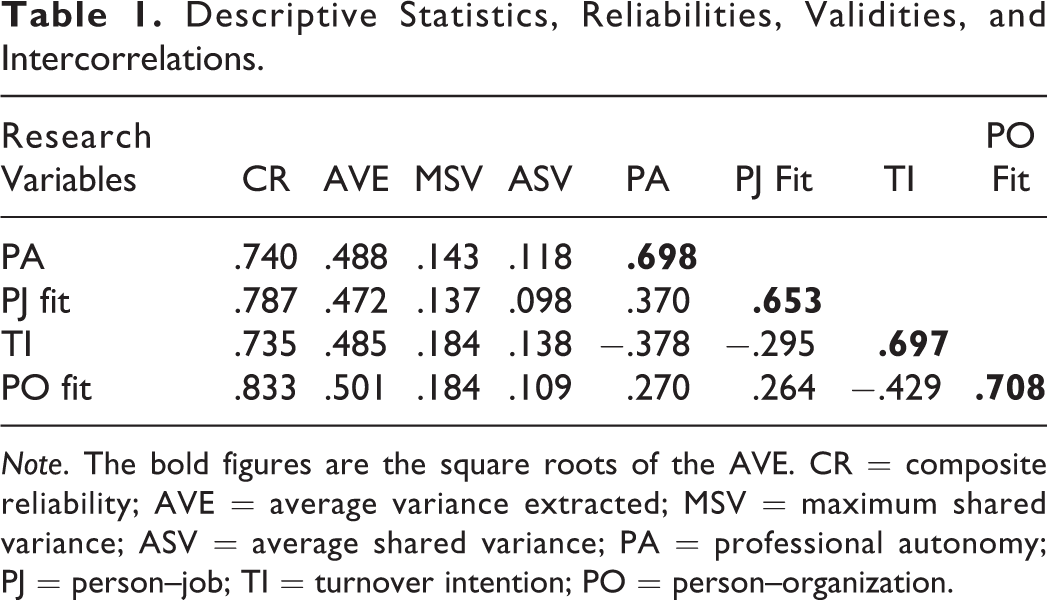
Note. The bold figures are the square roots of the AVE. CR = composite reliability; AVE = average variance extracted; MSV = maximum shared variance; ASV = average shared variance; PA = professional autonomy; PJ = person–job; TI = turnover intention; PO = person–organization.
Structural Model
We tested an initial structural model for the effects of professional social workers’ PA on their TI without adding the PJ fit and the PO fit. The initial model fit was acceptable (χ2/df = 4.632, CFI = .987, RFI ρ 1 = .964, and RMSEA = .057). The results showed that professional social workers’ PA was significantly and negatively associated with their TI (β = −.37*** and R2 = .14). Thus, Hypothesis 1 was supported. When we added the control variables, we found that gender had no relationship with TI. However, the tenure of the respondents’ current job was significantly and positively associated with their TI, implying that the professional social workers tended to leave when they had worked for a long period in their current agencies.
Second, we conducted a theory-based structural model for the mechanism of how the PJ fit and the PO fit influence the workers’ TI through PA when controlling for gender and the tenure of current job. We tested Model 1 for the effects of professional social workers’ PJ fit and PO fit on their TI, without the addition of PA as a mediator [the model fit was good: χ2/df = 2.227, the goodness-of-fit index (GFI) = .983, CFI = .986, RFI ρ 1 = .965, and RMSEA = .043]. The results showed that the professional social workers’ PJ fit and their PO fit were significantly and negatively associated with their TI (β = −.19*** and β = −.38***, respectively). Then, we conducted Model 2 by adding PA into Model 1 (the model fit was also good: χ2/df = 3.061, GFI = .964, CFI = .959, RFI ρ 1 = .928, and RMSEA = .030). Our theoretically integrated model demonstrated that professional social workers’ PJ fit and PO fit were significantly and positively associated with their PA (β = .32*** and β = .19***, respectively). In addition, the workers’ PA was significantly and negatively associated with their intention to leave (β = −.25***). However, the significant relationship between PO fit and TI became less significant (dropping from β = −.38*** in Model 1 to β = −.33*** in the integrated Model 2), and the significant relationship between PJ fit and TI became much less significant (dropping from β = −.19*** in Model 1 to β = −.12*** in the integrated Model 2). These results indicated a possible partial mediating effect in Model 2. Table 2 shows the full set of coefficients for all variables of Model 2.
Full Set of Coefficients for All Variables in the Final Model (Model 2).

Note. PO = person–organization; PJ = person–job; PA = professional autonomy; TI = turnover intention; CR = composite reliability.
*p < .05. ***p < .001.
The professional social workers’ total PJ fit and PO fit explained a total of 18% of the variance in their PA and a total of 29% of the variance in their TI. Figure 1 shows the results.

The integrated autonomy of professional social workers’ turnover intention model. **p < .01. ***p < .001.
Mediating Effect of PA
Given that the direct effects of professional social workers’ PJ fit and PO fit on their TI became less significant, we used bootstrapping in AMOS Version 24.0 to confirm the potential mediating effects. We used the recommended 95% confidence intervals (bias-corrected percentile method) and 2,000 bootstrap samples (Hayes & Preacher, 2010).
In Model 2, the direct effect of PJ fit on TI (−0.191) became statistically less significant (dropping from p = .001 to p = .009), and its indirect effect on TI (−0.130) remained statistically significant (p = .001). In addition, the direct effect of PO fit on TI (−0.330) was statistically significant, and its indirect effect on TI (−0.045) remained statistically significant. Thus, Hypotheses 3 and 4 were partially supported. As shown in Table 3, social workers’ PA had a much stronger power to buffer the effects of PJ fit on TI than it did to soften the effects of PO fit on TI.
Mediating Effect of PA on the Effects of PJ Fit and PO Fit on TI.

Note. PA = professional autonomy; PJ = person–job; PO = person–organization; TI = turnover intention.
Discussion and Applications to Practice
This study contributes to existing knowledge on social work as follows. We have verified the mediating effect of PA on social workers’ TI. Previous studies considered PA as an exogenous variable affecting turnover. Others assumed that the relationship between PA and TI is mediated or moderated by various factors (E. Wang et al., 2019). This article provides new evidence to show that PA has a direct effect on TI. Despite our contributions to the understanding of the relationships among PO fit, PJ fit, PA, and TI, our research has limitations. First, except for the scale of TI, all the variables were first used in Chinese context. Second, our research design did not allow for causal conclusions. Future research should use panel data to investigate professional social workers’ turnover further by collecting data from two sources across three time points to rule out any common method variance in our study (George & Pandey, 2017) because we measured the key variables from the same source. We also suggest a qualitative research to shed light on the extent to which significant others act as determinants because the PO fit construct (Lacity et al., 2008) is relatively novel. Future studies should examine the distinctiveness of PO fit from established PO fit, PV fit, and PJ fit (Kristof, 1996). Finally, considering the comparatively small size of the R2 value in this study, which examined PJ fit and PO fit, understanding the interactions between PA and its environment to elicit turnover should be of great interest.
As previously mentioned, PE fit can be conceptually classified into two types: supplementary fit and complementary fit (Muchinsky & Monahan, 1987). Supplementary fit means that the individuals’ characteristics are similar to those of others in their current organizational or occupational environment. These people are needed by the environment, but they are also replaceable (Guo, 2016). Complementary fit means that personal characteristics are lacking or absent from the environment and cannot be replaced. The development of embedded social work in China is a result of the conflicts between supplementary fit and complementary fit. On the one hand, well-educated professional social workers are considered to be the most suitable people for being embedded in the community. They are irreplaceable professional service personnel in the community, and they are expected to be rooted in the community to provide professional services (S. Wang, 2011; S. Wang & Yuan, 2009). On the other hand, the tasks of community workers are varied, and they are perceived as a complementary human resource for administrative tasks (B. Sun, 2016; Zhu & Chen, 2013). The services provided by social workers are subject to excessive direct intervention by grassroots bureaucrats. Without substantive support from professional agencies, social workers’ PA cannot be guaranteed, and considerable social workers may struggle in frontline services (Yang, 2014). To sum up, professional social workers are the “right people” who the community lacks. However, in the process of embedding them in the community, they are assigned to “do the wrong thing.” Thus, a loss of PA is the result of the conflict between two different types of PE fit, which in turn leads to social workers choosing to leave. A structural institutional environment, which includes training system, professional group, and rules and regulations, should be established to alleviate this inherent contradiction. In social service area, social work and other professions providing social services constitute an interdependent system, which needs clear boundaries of work jurisdiction and work content.
We also find that PA has a stronger mediating influence on the effect of PJ fit than that of PO fit on TI. This result is consistent with the current situation of social work in China. Specifically, PJ fit is more critical than PO fit for social workers embedded in communities. Once they are sent into the community to provide services, as individuals or in small teams, they have lost the professional support from their agencies (Guo, 2016; Zhu & Chen, 2013). Therefore, PJ fit needs to be promoted to raise social workers’ PA and reduce their TI after they have been embedded in the community. Researchers noticed the importance of environmental support for social workers’ PA and encouraged the transition from the development of embeddedness to the development of collaboration in social work (S. Wang, 2020). We recommend focusing on increasing PA in the community, which can be implemented in two ways: (1) by streamlining administrative affairs to allow professional social workers to devote time and decision making to direct services and encouraging them to exert their professional knowledge instead of falling into administrative chores, with the added benefit that the subsequent improvement of their services also helps to improve their PA and (2) by strengthening the professional boundaries in social work to legalize the discretion of social workers and provide them freedom for decision making, such as by providing them the opportunities to participate in professional decision making and choose their own service methods while maintaining the interests of their clients. To promote the development of embedded social work in China, management and concerned policy makers need to create an atmosphere of support and tolerance within the work environment, expand the scope of social workers’ freedom to make decisions, and foster decentralized job conditions (Kim, 2008).
On the basis of the nationwide data gathered from professional social workers, our study demonstrates that PE fit is significantly and negatively related to the workers’ organizational TI, and this relationship is alleviated by the mediating effects of PA. This finding improves existing understanding of the paradox of social workers embedded in Chinese community. Their PA is the result of the conflicts between supplementary fit expected by social work profession and complementary fit desired by the community as a founding administrative unit. We also find that PJ fit has a greater indirect effect on TI through PA than PO fit. This result is in line with the status quo that social workers in China providing services in the community are inhibited by grassroots bureaucracy rather than supported by their agencies. An occupational environment that promotes PA is urgently needed to address the paradox of social work’s embedded development and prevent social workers’ TI.
Footnotes
Declaration of Conflicting Interests
The authors declared no potential conflicts of interest with respect to the research, authorship, and/or publication of this article.
Funding
The authors disclosed the following financial support with respect to the research, authorship, and/or publication of this article: National Social Science Foundation of China, Grant/Award Number: 17BSH116.
