



Abstract
Purpose
Economic self-sufficiency is the priority of U.S. refugee resettlement policy, and opportunities for economic integration are shaped by social service contexts. While reception and placement services are typically provided for 3–8 months, extended case management (ECM) involves 2 years of services. This study examines associations between economic integration outcomes—employment, income source, income, and employment satisfaction—and exposure to ECM.
Method
We compare 243 resettled refugees, including those resettled in Salt Lake City, Utah who received ECM and those resettled in Tucson, Arizona without ECM.
Results
Participants at both sites experienced increased employment and income over time. Participants in Salt Lake City initially experienced higher rates of employment, income, and employment satisfaction than those in Tucson. Employment satisfaction increased more rapidly in Salt Lake City. Being female and older age were also associated with poorer outcomes.
Discussion
Findings point to the benefits of ECM services in promoting economic integration.
Of 82.6 million forcibly displaced persons globally, 26.4 million have been recognized by the United Nations High Commissioner for Refugees (UNHCR) as refugees (UNHCR, 2021a). Resettlement is framed as one of three primary durable solutions for refugees, alongside repatriation and local integration. Resettlement provides opportunities for permanent legal status and citizenship, a life-saving solution for the most vulnerable (UNHCR, 2020). However, only 63,726 people in 2019 and 22,800 in 2020 accessed resettlement (UNHCR, 2021b). The number of refugees resettled to the United States (U.S.) decreased post-2016 to 30,000 in fiscal year 2019 and 11,800 in fiscal year 2020 (Beers, 2020; Migration Policy Institute, 2021; U.S. Department of State, 2020). Despite this decrease, the U.S. remains one of the largest providers of resettlement worldwide (UNHCR, 2020).
Economic self-sufficiency is the central priority of refugee resettlement programming in the U.S. (Halpern, 2008). From a policy perspective, resettlement is considered successful when employment enables independence from government assistance (Chen & Hulsbrink, 2019). To meet this aim, refugees are often quickly placed in low-wage jobs with limited opportunities for growth (Chen & Hulsbrink, 2019; Curry et al., 2018). Job dissatisfaction and underemployment lead to stress regarding abilities to meet basic financial needs, and full-time employment at minimum wage rates is often insufficient for survival (Baran et al., 2018; Wachter et al., 2016). Attention to economic integration beyond simply independence from public benefits is needed to examine whether resettled refugees are able to secure a living wage and a sustainable livelihood (Baran et al., 2018; Chen & Hulsbrink, 2019; Wachter et al., 2016).
With this emphasis on early employment, U.S. resettlement services are generally brief and oriented towards rapid labor market placement for those who are deemed employable (Halpern, 2008; Grace et al., 2018). Mandated reception and placement services for new arrivals are provided by voluntary agencies under the Reception and Placement Program, funded by the U.S. State Department to provide support for up to 90 days (Bureau of Population, Refugees, and Migration, 2021). Casework and employment assistance are provided for three to 6 months, alongside access to benefits available for 8 months post-arrival (Bureau of Population, Refugees, and Migration, 2021; U.S. Department of State, 2020). As one example, the Matching Grant program (MG) is funded by the Office of Refugee Services, providing case management and employment services up to 6 months. This program is limited, and not all refugee households participate. Additional employment and community services are available in many states (U.S. Department of State, 2020), and case management services have been extended in some settings to provide assistance with employment and other priorities for 2 years post-arrival (Shaw & Poulin, 2015).
This study examines the respective economic trajectories of refugees resettled in the western United States over the course of 3 years post-arrival. We consider multiple indicators of economic integration—employment status, primary income source, household income, and employment satisfaction—and examine the influence of program context and individual characteristics and skills (gender, age, marital status, household size, English proficiency, education level) on economic outcomes over time. We consider whether participation in extended case management services beyond the initial reception and placement period has a positive association with economic outcomes. We also examine the role of gender, age, marital status, household size, English language proficiency, and education level in predicting economic integration among this sample. We hypothesized that implementation of extended case management (ECM) services in Utah during the first 2 years post-arrival was associated with improved economic outcomes when compared to those in Arizona. We also examined associations between economic outcomes and individual and family characteristics including gender, age, marital status, household size, English language, and education.
Literature Review
The centrality of employment shapes refugees’ post-resettlement experience. With legal status to work granted the first day refugees arrive, the U.S. resettlement program emphasizes the importance of early employment. Through employment, refugees access power and rights that may not otherwise be obtainable in social settings (Grace et al., 2018). Research highlights the increase of refugee self-sufficiency over time post-resettlement (Brell et al., 2020; Capps et al., 2015; Cheung & Phillimore, 2017; Evans & Fitzgerald, 2017; Kaida et al., 2019; Kerwin, 2018; Lichtenstein & Puma, 2018), documenting significant economic contributions and participation of refugees within the U.S. labor market (Evans & Fitzgerald, 2017; Kerwin, 2018). Research further indicates that refugees’ economic contributions benefit the U.S. populace as a whole (Evans & Fitzgerald, 2017; Mayda, 2017). Despite the focus on economic success, the resources and supports needed for securing sustainable employment are often out of reach (Grace et al., 2018). Further attention to the facilitators and barriers of holistic economic integration are needed, including attention to housing, health, food, education, wellbeing, and safety. Enhanced opportunities and supports are also needed, in order to address gaps in labor market access and ensure economic wellbeing over time (Arendt et al., 2020; Lee et al., 2015).
Research examines contextual and individual characteristics that affect economic outcomes, providing insight into the opportunities and barriers that shape economic trajectories. We focus on key factors identified in the literature, including social service program and community supports, gender, language, education, and family composition. Additional factors including region of origin and religious participation have been identified as salient in some studies (Capps et al., 2015; Connor, 2011; Minor & Cameo, 2018).
Program and Policy Influence on Economic Trajectories
Resettlement employment and social service programs play an important role in promoting economic integration (Halpern, 2008; LoPalo, 2019). Financial and employment supports for refugee families, including employment incentives, job training, case management, and other employment-promoting programs also led to increased family income, increased confidence, and reduced use of social welfare services (Halpern, 2008). Additional time post-arrival to develop job skills is needed to achieve longer-term sustainability in employment and economic success (Chen & Hulsbrink, 2019).
Policy context and the types of services newcomers received similarly influenced available social resources and subsequent economic integration. Comparative research identifies differences in employment rates by country of resettlement, where those resettled to the U.S. were more likely to be employed due to policy emphasis on rapid employment (Brell et al., 2020; Capps et al., 2015). The United States is an outlier, where 61% of refugees are employed at 2 years post-arrival, compared to 48% in Canada, 23% in Australia, and 14% in Germany (Brell et al., 2020). Among refugees resettled in Canada, individuals privately sponsored exceeded those assisted by the government in economic outcomes including employment and income (Kaida et al., 2019). Advantages of private sponsorship included the sponsors’ personal time and investment (DeVoretz et al., 2004), increased employment search assistance (Yu et al., 2007), and increased social capital (Lamba, 2003). In Sweden, those reuniting with family had better economic outcomes than asylum claimants, pointing again to the benefits of relationships in promoting labor market access (Bevelander, 2011). In the U.S., placement in neighborhoods near resettled refugees with a longer duration of time in country facilitated economic opportunities, while proximity to recently resettled refugees did not (Andersson et al., 2019; Beaman, 2012; Pinto, 2016). Furthermore, networks with others from the same country of origin who were entrepreneurs led to employment opportunities, though networks with others who were employees did not (Dagnelie et al., 2019). Social networks and supports are critical in assisting newly resettled refugees to not only become employed, but to build employment skills and achieve a range of economic goals (Beaman, 2012; Fang et al., 2018).
Individual Characteristics and Economic Outcomes
In addition to program and placement factors, individual characteristics such as gender play a significant role in access to labor market resources. In many resettlement contexts, women were less likely to be employed than men (Bevelander & Lundh, 2007; Cheung & Phillimore, 2017; Kaida et al., 2019; Khawaja & Hebbani, 2018; Potocky-Tripodi, 2003). Among women, lower levels of literacy and education, limited access to training programs, health challenges, and childcare responsibilities contributed to these disparities (Cheung & Phillimore, 2017). Such disparities likely related to religious, cultural, and service contexts including expectations regarding traditional gender roles, limited social networks, and a lack of tailored services (Cheung & Phillimore, 2017). Research in the U.S. found that refugee women were less likely to be considered employable, less likely to work full-time, and were paid less than refugee men (Minor & Cameo, 2018). Gender differences in employment rates and other economic outcomes within refugee communities were comparable to those found among the general U.S. population, due in part to women’s over-representation in lower-paid employment sectors such as the service industry (Capps et al., 2015; Minor & Cameo, 2018). Despite barriers, research examining long-term trends identified that 10 years post-resettlement nearly 70% of refugee women were employed, as compared to fewer than 60% of other immigrant and U.S. born women (Vijaya, 2020). These findings demonstrate that refugee women overcome some barriers to economic integration over time.
Individual skills and resources such as English proficiency and education also affect post-resettlement economic outcomes. English language proficiency was generally associated with higher rates of employment (Capps et al., 2015; Fang et al., 2018; Khawaja & Hebbani, 2018; Khawaja et al., 2019; Wachter et al., 2016), though in some settings English ability was less salient in predicting economic outcomes (Correa-Velez et al., 2015). Higher levels of education were also associated with being employed (Capps et al., 2015; Kaida et al., 2019; Senthanar at al., 2020), though among some resettled populations the effects of education on employment were mixed or associated with reduced earnings and downward mobility (Creese & Wiebe, 2012; Hou, 2020; Khawaja & Hebbani, 2018; Khawaja et al., 2019). Though contexts vary, English skills and education often facilitate stable, higher-income employment with opportunities for professional advancement (Arafah, 2017; Capps et al., 2015; Connor, 2010; Fang et al., 2018; Interiano-Shiverdecker et al., 2020; Khawaja & Hebbani, 2018; Potocky-Tripodi, 2003; Senthanar et al., 2020).
Individual and family characteristics such as age, marital status, and household composition also influence economic opportunities for resettled refugees. Younger age at the time of migration was conducive to greater economic adaption in some settings (Hou, 2020; Khawaja & Hebbani, 2018), though other studies identified no association between age and employment status (Hebbani & Preece, 2015; Khawaja et al., 2019). Being married and having two parents in the household were associated with higher employment rates (Potocky-Tripodi, 2003; Shaw & Poulin, 2015), though having more children was associated with a lower likelihood of employment (Potocky-Tripodi, 2003). Grace et al. (2018) examined the ways family networks collaborate, providing resources and supports to meet household needs as the paid labor of employable adults is often insufficient. The variability of economic outcomes based on individual and family characteristics points to barriers refugees may face in achieving economic integration.
Drawing on prior research and theory, we highlight the importance of environmental context alongside individual characteristics in facilitating economic integration (Kuhlman, 1991; Gisselquist, 2020; Halpern, 2008; Potocky-Tripodi, 2003). Refugee integration is generally conceptualized as involving both receiving communities and refugee characteristics (Strang & Ager, 2010; UNHCR, 2013). Integration frameworks conceptualize employment as a marker and a means of integration, indicating that employment contributes to integration through facilitating economic independence, encouraging planning for the future, building social capital, developing language skills, building self-esteem, and encouraging self-reliance (Ager & Strang, 2008). In practice, integration is often measured solely by economic outcomes, with minimal attention to receiving society context (Taccolini & Gonzalez-Benson, 2019). Often under-examined, opportunities and social service programs within receiving contexts play a critical role in facilitating economic success as well as integration and wellbeing more broadly (Phillimore, 2021).
Research Question
In this study, we examined the extension of case management services as a primary indicator of resettlement environmental contexts that shape possibilities for economic integration. Such services entail individualized, culturally competent, and comprehensive case management for a 24-month period as well as supportive local policy contexts and host community characteristics (Gisselquist, 2020; Kuhlman, 1991). We examined economic integration among resettled refugees in two locations: Salt Lake City, Utah, and Tucson, Arizona. Participants in both states received reception and placement services and employment supports during the early resettlement period. In addition, those resettled to Utah received ECM for up to 2 years post-arrival.
Method
Eligibility
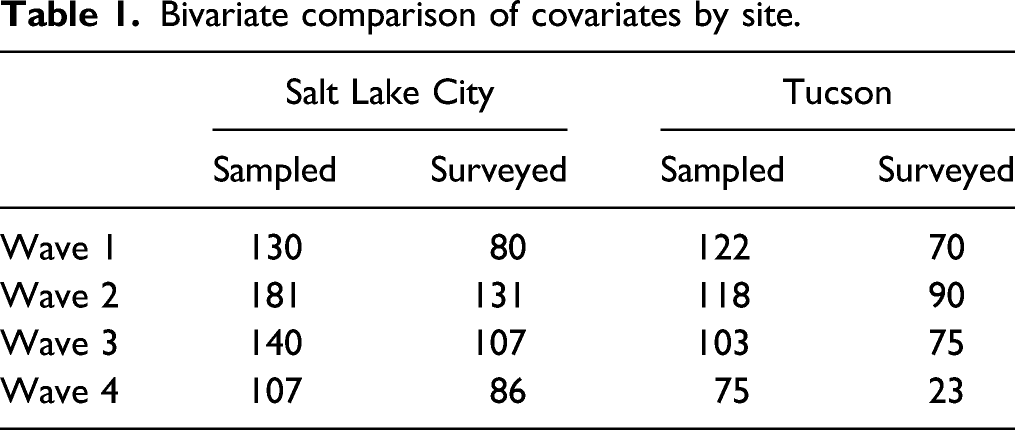
Bivariate comparison of covariates by site.
All participants completed informed consent in the language of their choice, with English language forms translated verbally by trained IRC staff members or interpreters who also administered the surveys. As participants reflected 19 nationalities and 39 native languages, IRC staff who administered the survey data were proficient in English and were either bilingual in the relevant language or had access to an interpreter. Survey enumerators were trained through both in-person and online training sessions. Training was delivered annually, prior to the start of each survey round, to ensure that the purpose and intent of each question was understood, and that data were collected accurately.
The consent process and subsequent surveys were administered in person, most often in people’s homes. In a few cases, particularly in the latter surveys, surveys were administered by phone. Research team members ensured attention to privacy and connection to service referrals when needed. Participants were ensured that participation was voluntary and engagement in the project was not related to accessing agency services. All study procedures were approved by the Institutional Review Boards at the International Rescue Committee and Brigham Young University.
Service Context
Tucson was selected as a comparison site to Salt Lake City as the two sites had similar political and social climates, office structures, and arrival demographics. Both states are in the western region of the U.S. with predominantly conservative political climates (Pew Research Center, 2014). In both locations, post-arrival employment supports were administered through resettlement agencies and state workforce agencies. The latter also administered social welfare benefits. Though eligibility standards and benefit amounts varied somewhat by state, both aligned with federal Temporary Assistance to Needy Families policy guidelines (Arizona Department of Economic Security, 2021; Department of Workforce Services, 2021). Participants with similar national origin resettled in both states, with relatively high numbers from sub-Saharan Africa (especially Burundi, Central African Republic, the Democratic Republic of Congo, and Sudan) and the Middle East (notably Iraq and Syria), though arrivals were higher in Arizona overall when compared to Utah (Refugee Processing Center, 2021). Despite comparability across states, the sites varied in terms of local historical, political, demographic, cultural, and economic characteristics that were not measured in this study.
Tucson was identified as a site where arriving refugees were not expected to receive ongoing or proactive case management services beyond 180 days post arrival, based on program and funding characteristics. Both offices received mandated reception and placement services available for new arrivals. Beyond the initial resettlement period, services in Tucson included time-limited support for households that came to the office seeking assistance. In these cases, assistance provided was of a transactional nature, addressing the presenting problem (e.g., eviction notice, employment, financial). By 12 months post-arrival there was minimal contact with previously resettled households seeking assistance.
The Utah ECM model provided up to 24 months of continuous case management to households, including periodic check-ins and an actively maintained relationship with the household. A case manager was assigned to the incoming household at arrival, with the understanding that this individual would work with the family for the following 24 months, or until such support was no longer needed. Support included regular contact and assistance to households as they navigated health, education, and social service networks. In addition to support from a case manager, clients had ongoing access to other agency personnel and programs related to employment, health, and community resources. ECM also included referrals, as needed, into state-run employment services (Department of Workforce Services, 2021). Caseworkers assisted with activities as needed over time such as obtaining interpretation support, addressing housing issues, re-enrolling children in schools, learning how to navigate health care systems, and accessing community resources (e.g., library systems, transportation, food and income supports, banking and credit building, and recreation). Caseworkers also assisted households with other requirements such as filing for taxes, change of status (green card application), address changes, and repayment of International Organization for Migration loans. Funding to cover the cost of traveling to the United States is provided by the International Organization for Migration to refugees selected for resettlement. Such funding is provided as a loan that must be repaid following arrival. The goal of ECM was to provide not only a support net for households, but to assist refugees in navigating systems, accelerating integration, and avoiding and managing personal and family crises.
Measures
Four economic outcomes were assessed, including employment, income source, household income, and employment satisfaction. While not based on previously validated measures, questions and response options were designed to be short, simple and unambiguous, in an effort to minimize risks of misinterpretation. Employment was assessed by asking, “Are you currently working?” with responses including yes (1) or no (0). Primary income source was assessed by asking, “What is your family’s main source of income?” Responses were coded as either salaried labor (1) or public assistance/other (0). The “other” category included family/friends, community support, savings, or other responses. Recognizing that household income is difficult to measure, especially for households that may be economically volatile, our calculation of estimated average monthly income was based on a single question that captured a broad monthly household income range. Household income was assessed by asking, “What is your family’s net monthly income (from all sources)?” Responses were coded to include $0–499 (0), $500–999 (1), $1000–1499 (2), or $1500+ (3). Employment satisfaction was assessed by examining participant perspectives on fit between their skills and their current employment. This was assessed only at waves 3 (year two post-arrival) and 4 (year three post-arrival), where participants were asked, “Do you feel this job reflects your education level?” Possible responses included “Yes, it reflects my education level,” “No, it is below my education level,” or “No, it is above my education level.” Responses were coded as yes (1), indicating that their job either reflected or was above their education level, or no (0), that their job was below their education level. Because employment match was only assessed twice, wave three results are the initial assessment for this indicator.
Site was the primary indicator used to compare participants, including those resettled in Salt Lake City who received ECM services and those in Tucson without ECM services. Individual and family socio-demographic characteristics assessed included gender, age, marital status, and household size. For marital status, participants were coded into three groups: married, single/never married, and divorced/widowed. Marital status was coded into dummy variables, where single participants were the comparison group. As a reflection of skills and prior opportunities, English proficiency and education level at arrival were also assessed. English levels included none (0), some (1), and good (2). Education level was combined into none (0), primary (1), secondary (2), and tertiary (3).
Data Analysis
Descriptive statistics including bivariate comparisons of participants by site at each wave were conducted in SPSS (v28), with Chi-square (χ2) tests for count variables and t-tests for continuous variables. Trends over time and their salient individual and family covariates were examined with the latent variable modeling program Mplus (v8.5). First, latent growth curve models without covariates were run separately by site to examine trends within each location. Similar linear patterns were found to fit the data of both sites satisfactorily. Second, a model with both sites was specified to incorporate covariates including gender, age, marital status, household size, English proficiency, and education level. These models allowed us to compare sites, account for multiple measured outcomes, and examine the significance of covariates included in the models. In each of the models presented, Bayesian estimation was adopted due to the small sample size and missing data. Posterior predictive p-values (ppp) were above .05, which suggested satisfactory fit of all models. All available data was used in the analyses. Unstandardized parameter estimates are reported for the unconditional models to maintain the original scale unit, while standardized estimates are reported for the conditional models for easier comparison of the effect sizes among different covariates.
Sample Characteristics
Bivariate comparison of covariates by site.

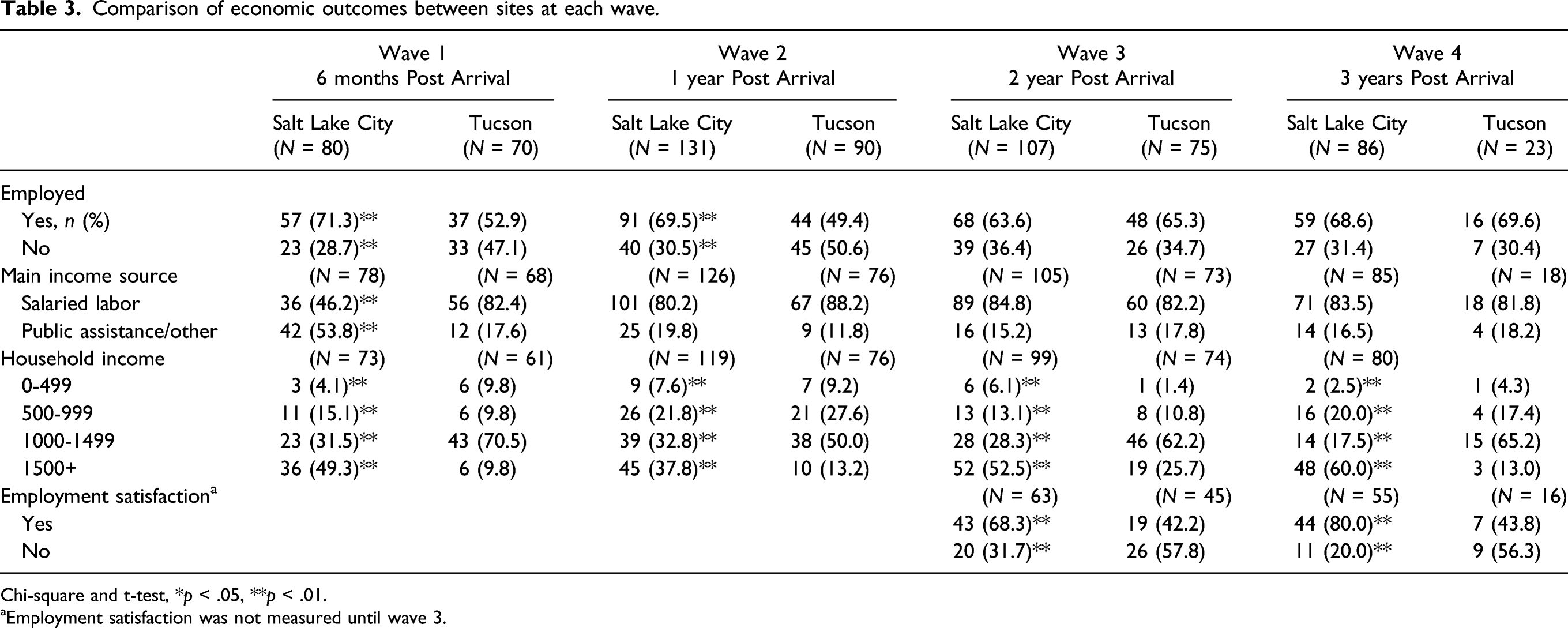
Comparison of economic outcomes between sites at each wave.
Chi-square and t-test, *p < .05, **p < .01.
aEmployment satisfaction was not measured until wave 3.
In both sites, half of the sample was female (see Table 2). Age at arrival ranged from 18 to 80 years, with an average of 35 years of age. Nearly three quarters of participants were married, 21% were single/never married, and 9% were widowed or divorced. Household size ranged from 1 to 11 individuals. The average household size was 4, and those in Tucson had higher average household size. Most participants (61%) spoke no English at arrival, 31% spoke some English, and 8% had good English at arrival. Examining education level, 28% of participants had no formal education, 24% had primary education, 36% had secondary, and 13% had tertiary education, with those in Salt Lake City more likely to have secondary or tertiary education than those in Tucson.
Results
Economic outcomes were compared by site across the four waves (see Table 3). Employment was significantly higher in Salt Lake City when compared to Tucson across waves 1 and 2, but by the second and third year post-arrival (waves 3 and 4), differences were no longer significant. Regarding primary source of income, differences were observed at wave 1, where participants in Tucson were more likely to rely on salaried labor than those in Salt Lake City, who were more likely to rely on public assistance or other resources. Total household income was higher among participants in Salt Lake City when compared to those in Tucson at each wave. Examining employment satisfaction, at two and 3 years post-arrival a higher percentage of participants in Salt Lake City, relative to Tucson, felt that their employment matched their qualifications.
Unconditional linear growth curve model estimating economic outcomes.

*p < .05, **p < .01.
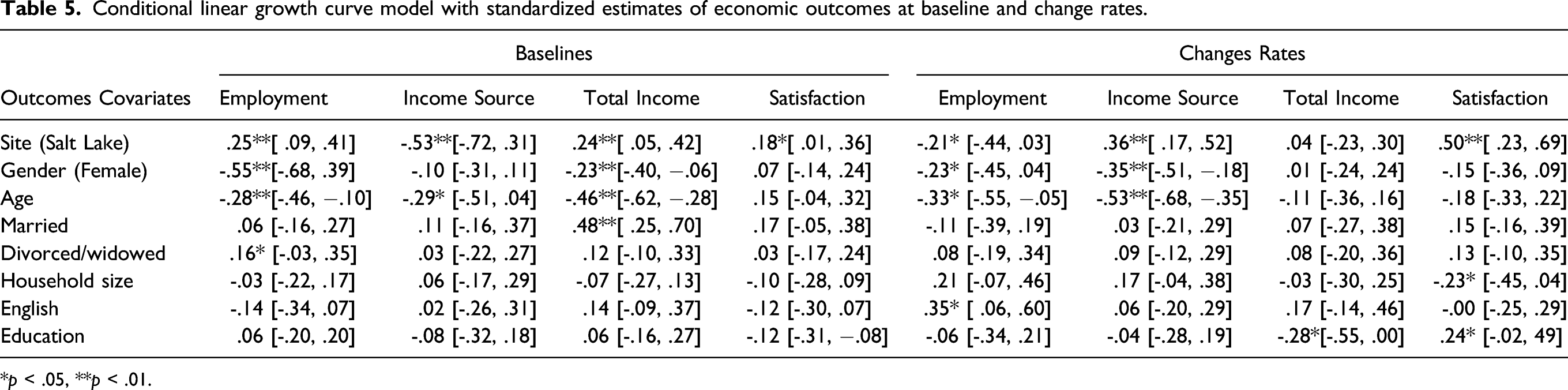
Conditional linear growth curve model with standardized estimates of economic outcomes at baseline and change rates.
*p < .05, **p < .01.
Other covariates were significantly associated with economic outcomes at the baseline assessment or in subsequent changes over time (see Table 5). At the initial assessments, female participants and older participants were less likely to be employed, less likely to rely on salaried labor, and less likely to have a higher income than male and younger participants. Married participants were more likely to have a higher income than single participants. Additionally, divorced or widowed participants were more likely to be employed when compared to single participants. Female participants and older participants achieved employment and reliance on salaried labor more slowly than male and younger participants. Additionally, those with larger households achieved employment satisfaction more slowly than those with smaller households. Participants with higher English proficiency became employed more quickly than those with limited English skills. Those with higher education levels achieved a higher income more slowly than those with less education; they also achieved employment satisfaction more rapidly.
Discussion and Applications to Practice
This study contributes to the literature examining post-resettlement refugee experiences longitudinally in the U.S. Bringing innovation to refugee services research, this study includes a sample from two states and follows participants over the course of 3 years post-arrival. Additionally, this study is unique in that it examines and promotes the value of a comprehensive social work model within U.S. refugee resettlement services. Findings demonstrate the significance of social service contexts as well as individual and family characteristics in shaping economic integration over time among resettled refugees in the U.S. Similar to previous research identifying increases in refugee self-sufficiency post-resettlement (Brell et al., 2020; Kerwin, 2018; Lichtenstein & Puma, 2018), participants in both sites experienced increased levels of employment and income over time. Additionally, employment levels among participants in both sites were higher than that typically observed among refugees resettled without ECM in the U.S. during their initial few years post-arrival (Brell et al., 2020).
Our findings demonstrate support for the study hypothesis that ECM services in Salt Lake City were associated with improved economic outcomes. Participants with extended services in Salt Lake City had higher employment rates during the first year post-arrival. Case management supports may assist refugees in achieving employment earlier post-resettlement. Refugees in Salt Lake City experienced an increase in salaried income over time, while those in Tucson did not, though this finding may relate to the lower initial reliance on salaried income among participants in Salt Lake City. Income was consistently higher among participants in Salt Lake City, which may suggest that participants receiving ECM services in Salt Lake City were able to secure higher paying employment. Among those in Salt Lake City, employment satisfaction was higher and increased more rapidly. Though employment satisfaction did not increase in the linear models over time among those in Salt Lake City, among participants in Tucson, employment satisfaction decreased. ECM services may promote sustained access to more meaningful employment through increased and prolonged interaction with case management and employment service staff members. These findings coincide with research suggesting program contexts have a significant effect on economic outcomes (Bevelander, 2011; Kaida et al., 2019) and with research identifying the benefits of case management and employment supports in helping resettled refugees achieve economic integration (Halpern, 2008).
Some findings were less indicative of improved economic outcomes in Salt Lake City but may also point to benefits of ECM. Those in Salt Lake City experienced a slower increase in employment, likely due to the higher starting employment rate. Participants in Salt Lake City were also more likely to rely on public assistance at the initial assessment, despite having higher levels of employment at the time. This may suggest that participants optimized use of public assistance during the initial arrival period, or that benefits remained more readily available in Salt Lake City as newcomers transitioned to salaried employment. Additional time to connect clients to community resources may be an important benefit of ECM. All findings also reflect differences in the forms and extent of public assistance and economic conditions by state.
While we cannot conclusively claim that the presence of ECM led to observed differences in economic integration, positive trends in early employment, income over time, and employment satisfaction point to likely benefits of prolonged connection to agency supports through case management. Having a case manager for up to 2 years post-arrival may facilitate assistance with job search and placement, connection to supportive community services, increased social capital, and social networking (Dagnelie et al., 2019; Lamba, 2003; Yu et al., 2007). Ongoing interaction not only with a case manager but with other agency resources including employment counselors, health programs, immigration resources, and community development programs may also support both formal and informal employment opportunities. Through ongoing agency interaction and resources, newcomers may learn of additional training and job opportunities, receive assistance in navigating employment challenges, and discuss longer-term goals for financial stability.
In addition to program context, individual and family characteristics were significantly associated with some economic outcomes. Females were less likely to be employed, rely on salaried labor, and have a higher income than males at the baseline assessment. Furthermore, female participants achieved employment and reliance on salaried labor more slowly than male participants. These findings coincide with other research pointing to gender disparities in employment among refugee women post-resettlement (Cheung & Phillimore, 2017; Minor & Cameo, 2018). While women face unique barriers to employment, they are increasingly likely to be employed over time (Vijaya, 2020). Extended case management and other supportive services can assist women to address employment barriers in accordance with their priorities and goals. For example, contextual barriers can be addressed through supporting accessible language and employment training, developing childcare resources, and improving access to needed transportation and other resources.
Older participants were also less likely to be employed, less likely to rely on salaried labor, and less likely to have a higher income than younger participants at the initial assessment. Older participants achieved employment and reliance on salaried labor more slowly than younger participants. Eight out of the 243 participants (3.3% of the sample) were over the age of 62 at arrival in the United States, suggesting most participants were within working age. This finding relates to other literature demonstrating the advantages of younger age in post-arrival economic adaptation (Hou, 2020; Khawaja & Hebbani, 2018) and indicates the need for tailored employment supports to assist older adults in navigating age-specific job market barriers.
Marital status and household size were associated with some economic outcomes. At the initial assessment, married participants were more likely to have a higher income than single participants. This finding coincides with previous research (Potocky-Tripodi, 2003; Shaw & Poulin, 2015), with income tending to be higher when two employable adults reside in the household. Divorced or widowed participants were also more likely to be employed when compared to single participants. Single participants were younger on average and may be more likely to reside in shared households with the ability to prioritize education or training. Over time, those with larger households achieved employment satisfaction more slowly than those with smaller households. This may suggest larger households are required to quickly secure less meaningful employment in order to meet family needs (Potocky-Tripodi, 2003).
English language proficiency and education level were also associated with some economic outcomes. Those with higher English proficiency became employed more quickly than those with limited English skills, consistent with previous research identifying the benefits of English language proficiency in securing employment post resettlement (Capps et al., 2015; Fang et al., 2018; Khawaja & Hebbani, 2018; Khawaja et al., 2019; Wachter et al., 2016). Participants with more pre-arrival education had higher levels of income across the study, though they achieved a higher income more slowly than those with less education. Some research suggests refugees with higher pre-arrival education experience downward occupational mobility (Creese & Wiebe, 2012) and lower initial earnings than those with less education (Hou, 2020). As those with higher levels of education also achieved employment satisfaction more quickly, education likely facilitated improved employment opportunities among this sample (Arafah, 2017; Capps et al., 2015; Fang et al., 2018; Interiano-Shiverdecker et al., 2020; Senthanar et al., 2020).
U.S. resettlement policies that prioritize economic self-sufficiency are paired with brief and basic mandated reception and placement services. Some individuals, particularly those arriving with established social networks and language skills, are able to access labor market opportunities quickly. Others, particularly female and older refugees, face added barriers to economic integration. Expanding reception and placement services to ensure all refugees have access to extended case management support for at least 2 years post-arrival can promote economic integration in a number of ways. Through extended case management services, refugees have a designated caseworker alongside an agency network that can guide job search efforts including career advancement, share employment opportunities, address health or housing challenges that may preclude employment, connect to immigration resources, prevent and manage crises, and raise understanding of U.S. environmental contexts.
In the absence of a nationwide expansion of reception and placement services, states and resettlement agencies can seek support for expanding social services. While the needs of resettling communities vary, many of those arriving in recent decades could likely benefit from responsive, enhanced services (Grace et al., 2018; Wachter et al., 2016). In building longer-term services, attention to the balance between managing paperwork and culturally competent engagement is needed (Fee, 2019; Lau & Rodgers, 2021). Though reporting is essential to ensure accountability within social service settings, relationships between caseworkers and clients are paramount. To create meaningful and holistic case management services, a shift away from a transactional approach is also needed. Individual and family contexts vary based on diverse experiences and goals. Caseworkers can work closely with participants in developing personalized plans for meeting household needs while recognizing individual strengths and resources. Agencies can work collaboratively with other community partners in developing cross-cultural understanding, mentoring relationships, and new economic opportunities. Examples of such efforts include programs that support entrepreneurs in developing restaurant businesses, community gardening programs, goat farming, credit building, digital literacy, and small business loans, many of which have been implemented in the Salt Lake City area as components of agency services (Eggert et al., 2015; Gerber et al., 2017; IRC, 2022; Utah Refugee Goats, 2022). Additional educational and training programs are also needed, to support long-term economic integration.
Researchers can further examine the specific components of resettlement programs that promote economic success, both through qualitative and longitudinal research. Additionally, further attention to measuring economic integration is needed. Employment or self-sufficiency from benefits are often inadequate as representations of overall economic integration or financial stability. The discrepancies in economic outcomes experienced by female and older refugees also need further attention. Programs can be adapted to respond to the economic and other needs of women, older refugees, and larger households in achieving economic integration.
Case management services are difficult to measure accurately and comprehensively as they include a wide variety of services that are shaped around individual and family needs. Therefore, one household’s experience with case management over the course of 2 years may look quite different from that experienced by another household. Additionally, our inability to withhold case management services from one cohort limited our ability to research the benefits of case management. We sought to overcome this challenge by comparing participants with extended services to a site where ECM was not available. However, many of those who continued to participate in the study in Arizona also received some form of services from the agency. Additionally, the process of data collection involved a continued connection to the agency, where information and services were provided based on participant need. While participants in Tucson were not receiving the standard ECM program provided in Salt Lake City, this ongoing connection to the agency may lead to similar improvements. Without a comparable group that received no services, we were limited in measuring the impacts of ECM.
In examining differences by sites, additional site differences likely influence study findings. Though we sought to find sites with similar political, environmental, and cultural dynamics, differences in service delivery approaches, state policy, community attitudes, benefit systems, and economic opportunities beyond those measured in the study likely influenced participant outcomes. Participant drop-out was also a challenge to examining changes in economic integration over time. Drop-out was especially challenging in Arizona at the final assessment 3 years post-arrival and likely related to the lack of longer-term connection between most clients and the resettlement agency. Despite these challenges, this study provides support for the value of extended case management services in improving economic outcomes and accelerating progress towards integration.
The aim of resettlement is not to find employable individuals who will contribute to the U.S. labor market. Refugee resettlement exists to provide refuge to forcibly displaced persons, providing opportunities for individuals and their families to achieve safety and permanence. For those who resettle, it is critical to examine the conditions under which the U.S. policy aim of economic self-sufficiency is achieved. Holistic social work services that address barriers to employment and support household adjustment in culturally responsive ways are essential. Though individual and family characteristics also influence labor market opportunities, the relevance of factors such as gender, age, education, and language are shaped by environmental conditions that reward particular identities and capabilities. A policy priority of economic integration must be paired with programmatic supports that facilitate access to economic goals within refugee communities. Extended case management is one approach that can promote economic success during the initial years post-arrival. Such holistic supports can also support newly resettled refugees in establishing a foundation for long-term economic integration and wellbeing.
Footnotes
Declaration of conflicting interests
The author(s) declared no potential conflicts of interest with respect to the research, authorship, and/or publication of this article.
Funding
The author(s) disclosed receipt of the following financial support for the research, authorship, and/or publication of this article: This work was supported by the International Rescue Committee.
