



Abstract
Keywords
To mitigate the transmission of COVID-19, most educational institutions throughout the world implemented social distancing measures, forcing teaching to switch from face-to-face to online (Shek, 2021a, 2021b; Shek et al., 2023). As face-to-face interaction was minimized under the imposition of social distancing measures, electronic service-learning (e-SL) was adopted as an alternative to the conventional face-to-face mode of service learning in universities. However, e-SL was not just mere digitization of the traditional SL experience but involved careful planning for the delivery and implementation of both instructional and service components in the online environment. The special features of active engagement and intensive interaction between students and community partners in SL pedagogy posed extra challenges to the delivery of course content and the services in e-SL. While many research studies have been conducted to investigate the impacts of traditional SL courses on students’ developmental outcomes, there were very few studies on the effectiveness of e-SL courses on students’ development and their learning experience in an experiential course in the online mode. This study examined students’ changes and their experiences in terms of subjective evaluations in an e-SL course adopting regular and intensive modes in one university in Hong Kong during the pandemic.
SL in University Education
SL has been regarded as a popular pedagogical approach and teaching philosophy widely applied in university education. It referred to “a type of experiential learning which provides an opportunity for learners to enhance their understanding of concepts and theories in a practical environment” (Salam et al., 2019, p. 573). In universities, SL was a kind of educational experience commonly delivered via credit-bearing courses, in which students were expected to carry out organized service activities that meet the recognized needs of individuals and communities and achieve desired learning outcomes by reflecting on service experiences (Jacoby, 2014; Vicente et al., 2021). Different from volunteerism and internship, SL involved strong academic connections. The reciprocal nature offered unique benefits and pervasive impacts for all participating stakeholders, including university learners, service recipients, community partners, instructors, and schools (Salam et al., 2019). For university students, the SL programs provided an opportunity to apply and consolidate acquired knowledge and develop soft knowhows to undertake development at both personal and professional levels with a broader appreciation of the discipline. It also increased students’ comprehension of community demands and fostered their civic responsibility through self-reflection and community service. Furthermore, students had opportunities to solve real-world problems more quickly and innovatively (Rutti et al., 2016). Service-learning (SL) has also been commonly used by social workers (Lemieux & Allen, 2007; Maccio & Voorhies, 2012).
Common positive outcomes of traditional face-to-face SL programs in cognitive, affective, and social aspects have been reported in previous studies, such as gaining practical experience (Meyer et al., 2016), understanding social issues (Celio et al., 2011; Yorio & Ye, 2012), developing critical thinking and problem-solving capabilities, communication and interpersonal skills, social consciousness, and improving attitudes about self and toward schools (Celio et al., 2011; Salam et al., 2019). Other studies have discovered that SL was effective in promoting students’ service leadership qualities including self-leadership attributes, caring and character building, as well as the cultivation of positive youth development (PYD) attributes (e.g., affectional skills, positive identity, and life meaning) and civic responsibility in college students (Ma et al., 2019; Shek et al., 2019; Shek et al., 2020). Meanwhile, SL can also help foster the participants’ well-being. For instance, positive impacts on students’ emotions and life satisfaction were highlighted in prior inquiries of traditional face-to-face SL courses (Shek et al., 2019; Zhou et al., 2020). Furthermore, one study on a SL project in Spain also noted that engagement in the SL program had positive impacts on the participants’ social well-being in terms of cooperation and solidarity (Chiva-Bartoll et al., 2020).
SL in the Time of COVID-19
The COVID-19 pandemic has imposed numerous challenges, one particular among which was conducting SL courses amid the pandemic. Given that it was too risky for students to go to the assigned community for social interaction and service during the pandemic, SL courses were shifted in terms of the focus and delivery methods (Ferdiansyah et al., 2022). Rather than cancelling or postponing all SL courses, one alternative was e-SL. With the growing demand for online course offerings, educators noted the potential of implementing SL programs through digital platforms and social media for fostering virtual relationships and collaborations between learners, institutions, and community partners (Bourelle, 2014). Waldner et al. (2012) identified four modes of online SL from hybrid (in which either instruction or service is online/partially online) to fully online (both instruction or service are entirely online) and suggested that e-SL took the advantage of the flexibility of removing geographical constraints in bringing students and service recipients together into the project. Other advantages of e-SL included reduction of costs, increase in privacy of various stakeholders, and enhancement of digital skills and citizenship (Said et al., 2014; Salam et al., 2019).
Yet, the deployment of e-SL programs was not common in higher education before the pandemic (Lin & Shek, 2021). Past studies also compared SL and e-SL in terms of their impacts on students’ development outcomes, with some reporting equivalence (McGorry, 2012), and others finding the e-SL slightly outperformed traditional face-to-face SL in enhancing student developmental outcomes (Schwehm et al., 2017). Yet, Faulconer (2021) reviewed published papers in the last decade on e-SL and only identified 14 studies that reported the effectiveness of e-SL for student development in multiple aspects, such as personal development (e.g., empathy and self-efficacy) and academic growth (e.g., better mastery of knowledge). The major obstacles in e-SL came from technology, communication, and course design (Bharath, 2020; Waldner et al., 2012).
Technically speaking, e-SL required the users, including students, teachers, and community partners, to have higher levels of digital competence in using online platforms; and sustaining communication between students and community partners in a virtual environment would be a challenge in the delivery of services (Said et al., 2014). Pedagogically speaking, the shift from face-to-face SL to an online mode might require extra time and effort from teachers in coordinating with community partners, arranging logistics, modifying course materials, and supervising the course product development (Waldner & Hunter, 2008). The “in-person” nature of SL might also make it unsuitable in online learning settings as a lack of “human touch” in e-SL may adversely affect the course's effectiveness due to limited communication and interaction between participants (Schmidt, 2021).
Despite the above challenges, e-SL was considered an important solution for sustaining SL subjects during the pandemic. Hybrid or fully online modes of SL courses were designed and implemented during the pandemic and students were expected to perform their services by virtual means through various digital platforms (Burton & Winter, 2021; Compare & Albanesi, 2022). As more courses went online during COVID-19, educators have attempted to gauge the effectiveness and benefits of e-SL, strategies, and factors of success, the challenges in e-SL, as well as students’ and teachers’ perceptions of the e-courses.
Recent studies employing different evaluation approaches showed that e-SL courses showed similar positive effects on the development of competencies. For example, students had positive experience in e-SL as it increased the feeling of safety and flexibility during the pandemic (Schmidt, 2021). Stanke et al. (2021) adopted a quasi-experimental design in examining the benefits and implications of an online SL course. Results showed that students demonstrated enhancement in generic skills and civic beliefs and values in both hybrid and fully online modes. Compare and Albanesi (2022) used qualitative reflexive journals and quantitative pretest–posttest survey data (n = 20) to evaluate the effectiveness of an e-SL course including exclusive online services and concluded that the course showed the capacity in promoting students’ sense of responsibility, civic engagement, and competencies such as perspective-taking, adaptability, teamwork, leadership, communication skills, creativity, and organizational competencies.
Research Gaps
Although online teaching and learning was not a new pedagogy, it was new to SL during the pandemic. In this special time, e-SL was used as an alternative to conventional face-to-face SL and it provided a prime opportunity for educators to explore the impacts of e-SL on students during a health crisis. While the effectiveness of long-established face-to-face SL has been well documented, studies examining students’ perceptions of e-SL and their changes in e-SL have been relatively fewer. A handful of recent studies revealed positive effects of e-SL participation on university students’ PYD qualities, leadership qualities, and subjective well-being such as life satisfaction (Compare & Albanesi, 2022; Ferdiansyah et al., 2022; Lin et al., 2023; Shek et al., 2022; Zhu et al., 2022). We have to verify and replicate the findings using different student groups. Thus, there is a need to have more studies on how students may change in their personal attributes and well-being after taking part in e-SL. As a new practice for students, it is important to understand their subjective perceptions of the e-SL experience on both course instruction and services they provided to the recipients as well as how their subjective evaluation (i.e., learner satisfaction) is associated with learning gains (i.e., changes after taking an e-SL course). Integration of evidence from different student samples can help portray a reliable picture of the effectiveness of e-SL, establishing the basis for generalization and connection between the existing and new knowledge (Spector et al., 2014).
Another related research gap is that previous studies failed to consider the potential effect of the intensity (e.g., intensive vs. regular implementation) of e-SL. Scholars have suggested that intensive courses could produce similar, and sometimes better, learning outcomes when compared to their regular-length counterparts (Scott, 2003). To some extent, intensive courses may lead to a more impressive and memorable learning experience for students, as both teachers and students may be more focused, motivated, and engaged in a relatively tight schedule (Caskey, 1994; Scott, 2003). In addition, since the intensive course usually involves the same curriculum content and learning objectives as compared to the regular course but is to be completed over a shorter time duration, its provision can better meet the needs of the changing demographics of students (Vlachopoulos et al., 2019). Although evidence has shown that students showed the same or even favorable learning outcomes in intensive courses compared to those taking regular courses in face-to-face teaching (Anastasi, 2007; Hall et al., 2012; Zhu & Shek, 2021), whether this is the case in online learning remains unclear (Vlachopoulos et al., 2019). Accordingly, there is a need to explore and compare evaluation findings of e-SL between regular and intensive modes.
The Current Study
This study investigated the effectiveness of an e-SL entitled “Service Leadership through Serving Children and Families with Special Needs” (“Serving Subject”) offered in the authors’ university by a department training social workers in two delivery modes (i.e., regular and intensive modes, more details were presented in the Method section) in the 2020–2021 academic year. It is noteworthy that both SL and leadership training are commonly used in youth work and social work education (Lemieux & Allen, 2007; Maccio & Voorhies, 2012).
The study assessed both students’ changes and their subjective perceptions of the learning experience. How the two aspects of course effectiveness may be correlated with each other was also explored. In addition, we also explored the effect of course intensiveness in this study. Following the common course and program evaluation practices in higher education settings (McElwain et al., 2016; Zhu & Shek, 2021), this study assessed the effectiveness of the “Serving Subject” during COVID-19 through “pretest–posttest evaluation” (i.e., changes in students’ competencies and well-being). We also used “subjective outcome evaluation”, which included students’ subjective appraisal of the subject (i.e., course evaluation) as well as the services they provided (i.e., service evaluation).
Based on previous research on SL effectiveness before and during the pandemic (Lin & Shek, 2021; Salam et al., 2019), we expected students to have significant improvements in their competencies and well-being after completing the regular or intensive course (Hypotheses 1a and 1b, respectively). In addition, we expected students would have positive perceptions of the course (Hypotheses 2a and 2b, respectively) and the services they delivered (Hypotheses 2c and 2d, respectively) in both modes. We also explored potential differences between the two modes without making any specific hypotheses.
The association between the findings derived from the two evaluation approaches was also investigated. Based on previous findings showing a positive relationship between objective and subject outcome evaluations (Shek, 2010; Shek, 2014; Zhu et al., 2021), we hypothesized that students’ positive changes would be significantly associated with their positive course evaluation (Hypothesis 3a) and service evaluation (Hypothesis 3b).
Method
“Serving Subject”: An Overview
The “Serving Subject” was a 3-credit SL subject open to all undergraduate students in the authors’ university as early as 2013. Enrolled students were required to spend a total of 135 hours studying theoretical concepts, making service plans, implementing services, and reflecting on service experiences. First, they completed a 10-hour e-learning aiming to help students understand the basic concepts of SL and cultivate positive attitudes and beliefs toward SL. Second, students attended seven 3-hour lessons, including three lectures (class size: 40–48 students) on theoretical learning on the determinants of effective services (e.g., interpersonal and intrapersonal competencies, caring, moral character, and self-leadership), developmental needs of underprivileged children and adolescents and four small-group workshops (class size: 20–24 students) on core principles and useful skills in developing and implanting service projects and discussion of students’ service proposals. Third, after developing the service proposals, students were required to apply knowledge and skills by providing 40-hour community services to local underprivileged teenagers. Taking forms of workshops, camps, talks, and tutorials, the direct services focused on promoting teenagers’ academic (e.g., English and science skills and career aspiration) and social development (e.g., emotional skills, team spirit, communication skills, and social relationships). Fourth, students also attended two 3-hour workshops during service provision and one final 3-hour workshop upon the completion of services to reflect on and consolidate their service experiences (in total 9 hours of lectures and 21 hours of small group workshops). Finally, students were expected to devote 55 hours to self-study (e.g., reading), service preparation, and post-service debriefing and reflection.
This course was delivered in two modes. The first one was a regular mode during which students completed theoretical learning and community services in two consecutive semesters (i.e., Semesters 1 + 2) from September to April of the next year. Specifically, students completed e-learning, attended three lectures and four workshops, and developed service schemes in small groups (5–6 students for each) in Semester 1. They provided services throughout two semesters (normally from November to March of the succeeding year) and completed the other three workshops in Semester 2. The second mode was an intensive delivery during which students completed all learning and service activities in the 7-week summer term (i.e., Semester 3) from late May to early July. The teaching pedagogy, materials, and learning requirements were the same in the regular and intensive delivery modes.
This SL subject using face-to-face teaching and learning has been found to be effective in promoting students’ competencies and well-being in previous studies (e.g., Shek et al., 2020). Due to the COVID-19 pandemic, teaching and learning in the present two modes of course were moved online during the 2020–2021 academic year (regular mode: September 2020 to April 2021; intensive mode: late May to early July 2021). In addition, most of the services were delivered online as well (e.g., online workshops, talks, tutorials, and virtual tours).
Participants and Procedures
The current study was conducted under ethical approval from the Institutional Review Board at the authors’ university (HSEARS20210412007). We collected data from undergraduate students enrolled in the regular and intensive “Service Subject” in the 2020–2021 academic year. Students were invited to complete a pretest questionnaire survey within a week prior to the first lecture, and the identical posttest questionnaire within one week after the final workshop. Meanwhile, upon completion of the last workshop, students were asked to respond to a course evaluation form and a service evaluation form.
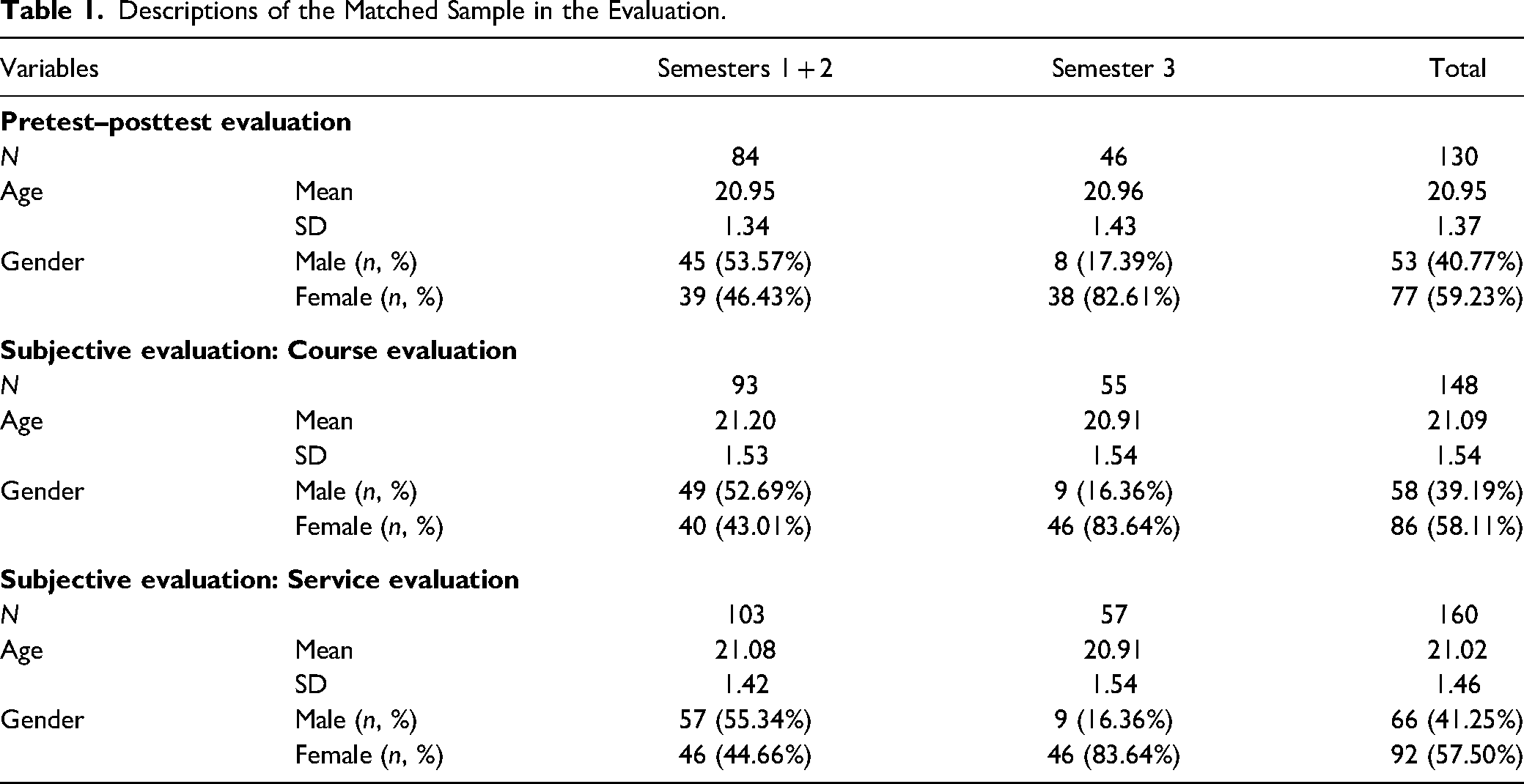
As shown in Table 1, a total of 130 students (mean age is 20.95 ± 1.37 years; 40.77% males) had matched data in the pretest and posttest. Besides, 148 (mean age is 21.09 ± 1.54 years; 39.19% males) and 160 (mean age is 21.02 ± 1.46 years; 41.25% males) students completed the course evaluation form and service evaluation form, respectively.
Descriptions of the Matched Sample in the Evaluation.
Measures
The present study employed three questionnaires, including the pretest–posttest questionnaire, course evaluation form, and service evaluation form. In the pretest–posttest questionnaire, student competencies were indicated by PYD qualities and service leadership qualities while their well-being was indexed by life satisfaction, which refers to one's cognitive assessment of his or her overall quality of life (Diener et al., 1985).
Data Analysis
SPSS 26.0 were employed for data analyses. First, reliability analyses were conducted. Second, to test whether students would show positive changes after completing the course in two delivery modes (Hypotheses 1a and 1b), the repeated-measures multivariate general linear models (RM-GLM) were used to explore the pretest–posttest differences in terms of the three outcome measures (PYD qualities, service leadership qualities, and life satisfaction). In RM-GLM, while test scores in these measures were regarded as dependent variables, the temporal factor (i.e., pretest vs. posttest) was set as the within-participants independent variable, and course mode (i.e., Semesters 1 + 2 vs. Semester 3) was a between-participants independent variable. As PYD and service leadership qualities were multi-dimensional indices, the omnibus time effect was gauged utilizing the Bonferroni procedure before performing univariate analyses for each measure. We first investigated whether the two independent variables have significant main effects or interactions on students’ scores. After this, we further performed RM-GLM separately for the individual sample in each course mode and the combined sample.
Third, to test whether students in the two delivery modes would have positive evaluations for the course (Hypotheses 2a and 2b) and services they provided (Hypotheses 2c and 2d), descriptive statistics (numbers and percentages of positive responses) were conducted to show the participants’ subjective evaluations across all items of the course evaluation form and the service evaluation form. Meanwhile, GLM was used to compare the participants’ subjective evaluations of the course and services between the two modes (Semesters 1 + 2 vs. Semester 3).
Finally, to test whether students’ changes after taking the course would be significantly associated with their course evaluation (Hypothesis 3a) and service evaluation (Hypothesis 3b), correlations of students’ posttest scores as well as pretest–posttest changes to their course and service evaluations were checked.
Results
Students’ Pretest–Posttest Changes
As aforementioned, RM-GLM were conducted to examine students’ changes after taking the e-SL course offered in regular and intensive modes regarding different outcome measures (i.e., PYD qualities, service leadership qualities, and life satisfaction). According to Hypotheses 1a and 1b, participants in the two modes would have significant positive changes in these outcome measures. As shown in Table 2, participants’ overall pretest–posttest differences (i.e., omnibus time effects) were salient regarding PYD qualities (F = 31.41, p < .001,
Results of Repeated-Measures Multivariate General Linear Model Analyses on Pretest–Posttest Differences.

Note. Age and gender were statistically controlled. CBC = Cognitive-behavioral competence; PI = Positive identity; GPYD = General positive youth development qualities; TPYD = Total positive youth development qualities; SL = Self-leadership; CS = Character strengths; CD = Caring disposition.
Adjusted Bonferroni value = 0.013.
Adjusted Bonferroni value = 0.017.
* p < .05.
** p < .01.
*** p < .001.
While the course effect was not significant for any indicators (F ranged from 0.89 to 2.01, ps > .05), significant interactions between time and course were observed for PYD qualities (F = 10.73, p < .001,
Results of Repeated-Measures Multivariate General Linear Model Analyses on Pretest–Posttest Differences by Course.

Note. Age and gender were statistically controlled. CBC = Cognitive-behavioral competence; PI = Positive identity; GPYD = General positive youth development qualities; TPYD = Total positive youth development qualities.
Adjusted Bonferroni value = 0.013.
Adjusted Bonferroni value = 0.017.
p = .06.
* p < .05.
** p < .01.
*** p < .001.
Specifically, while pretest–posttest changes were significant in all outcome measures in both regular (i.e., Semester 1 + 2) and intensive courses (i.e., Semester 3), the effect sizes of changes among students taking the intensive course were greater than that among students taking the regular course (PYD qualities:
Students’ Subjective Perceptions of Courses and Services
Descriptive analyses were conducted to examine the perceptions of the students (Hypotheses 2a and 2b) and services they provided (Hypotheses 2c and 2d) in two delivery modes. The results are presented in Table 4 and Table 5, respectively. Overall speaking, the course content was perceived as positive by students attending the two courses. Specifically, 78 to 90 percent of the students in the regular course gave positive evaluations of different aspects of course content while 67 to 95 percent of students in the intensive course rated positively on these aspects (see Table 4). In addition, the majority (over 89%) of the participants from both courses showed positive perceptions of teacher performance. Regarding the course effect, over 70% of the participants from both courses agreed that the SL subject was beneficial for their multifaceted development, including self-confidence, resilience, problem-solving, and care and compassion for others. These findings supported Hypotheses 2a and 2b.
Students’ Positive Responses on the Course Evaluation Form.

Note. Options 4 and 5 are considered positive responses.
Students’ Positive Responses on the Service Evaluation Form.

Note. Options 4–6 are considered positive responses.
For the participants’ perceptions of services they had designed and provided (see Table 5), the majority of the participants from both courses held positive feedback towards the service programs they designed (over 83%), their (i.e., service providers’) performance in the service provision (over 94%), benefits of the services for the underprivileged teenagers as service targets (over 92%), and benefits of the service experiences for students themselves as learners and service providers (91%). Thus, Hypotheses 2c and 2d were supported.
Comparisons of students’ course evaluation and service evaluation between the two courses showed that there were no significant differences (F = 1.97 and 1.17, ps > .05, see Table 6).
Results of Multivariate General Linear Model Analyses on Comparing Subjective Evaluations.
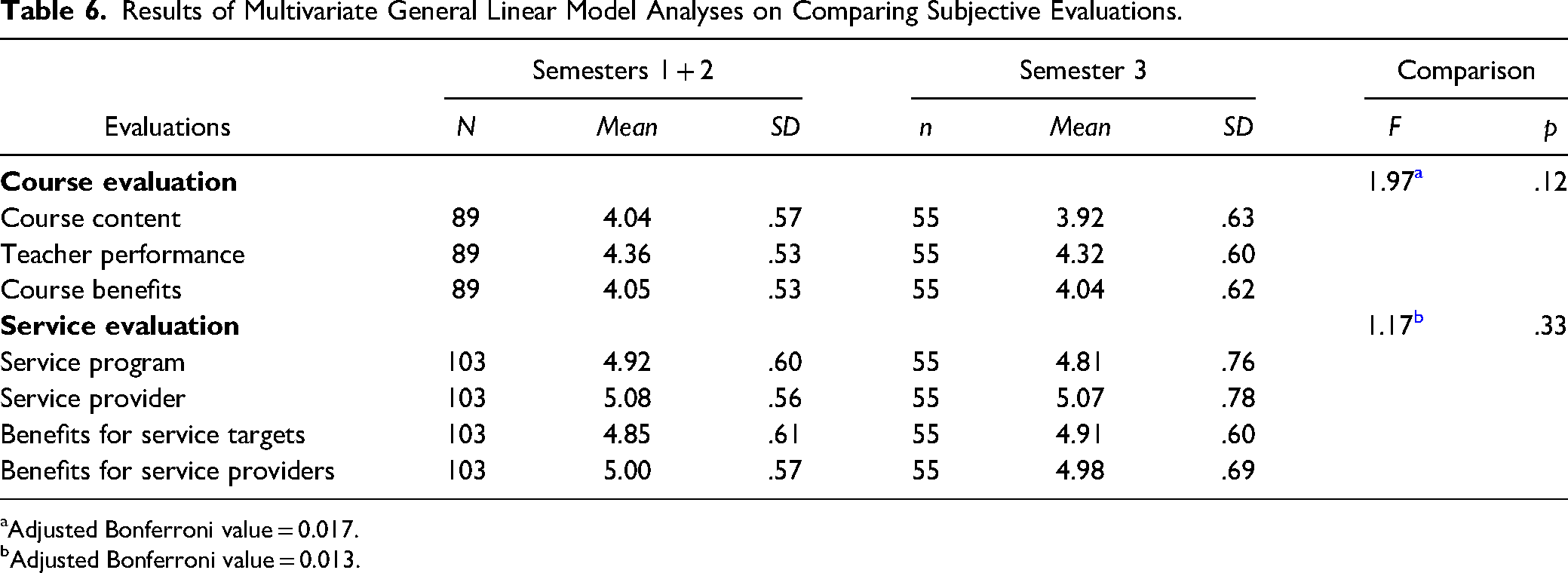
Adjusted Bonferroni value = 0.017.
Adjusted Bonferroni value = 0.013.
Correlations Between Pretest–Posttest Evaluation and Subjective Evaluation
Finally, correlational analyses were conducted to examine whether students’ changes in outcome measures after taking the course would be significantly correlated with students’ subjective course evaluation (Hypothesis 3a) and service evaluation (Hypothesis 3b). Table 7 presents the associations from students’ posttest scores and pretest–posttest changes in outcome measures (i.e., PYD and service leadership qualities and life satisfaction) to their subjective course and service evaluations. Overall speaking, both the posttest scores and the pretest–posttest changes in different outcome measures showed significant and positive correlations with students’ multi-dimensional course evaluation (posttest scores: rs ranged between 0.30 and 0.60, ps < .01; pretest–posttest changes: rs ranged between 0.24 and 0.47, ps < .05) and service evaluation (posttest scores: rs ranged between 0.37 and 0.67, ps < .001; pretest–posttest changes: rs ranged between 0.24 and 0.36, ps < .05). Thus, Hypotheses 3a and 3b were supported.
Correlations Between Student Subjective Evaluations and Their Posttest Scores and Pretest–Posttest Changes.

Note. CBC = Cognitive-behavioral competence; PI = Positive identity; GPYD = General positive youth development qualities; TPYD = Total positive youth development qualities; SL = Self-leadership; CS = Character strengths; CD = Caring disposition; LS = Life satisfaction.
* p < .05.
** p < .01.
*** p < .001.
Discussion
The COVID-19 pandemic has unprecedentedly derailed education provision worldwide. Learning and teaching activities were forced to move from face-to-face to online mode, and SL was no exception. Although e-learning overall has been deemed as a substitute and effective means to reach more students and enhance study flexibility for a couple of years, little was known about its efficacy and outcomes in SL implementation.
As Figuccio (2020) remarked, “e-service-learning is a relatively new pedagogical practice … Unlike service-learning, however, e-service-learning has not been extensively studied and evaluated” (p. 2). The present study evaluated an e-SL project implemented in a public university during the pandemic. By employing both pretest–posttest and subjective evaluation approaches, the triangulated findings in the present study showed that the e-SL was likely to be effective in promoting students’ competence in various aspects and well-being. Students were also highly satisfied with the course and the services they provided to the recipients. The findings shed insights into the potential effectiveness of e-SL and an understanding of how university students perceive online SL subjects, which will also help improve the learning experience in e-SL and its implementation in the future. In the field of Social Work, as online teaching has become more popular (Davis et al., 2019; Dawson & Fenster, 2020), there is also a need to understand the impact of online teaching and learning for students.
The results of pretest–posttest evaluation revealed that university students gained significant improvement in PYD qualities (e.g., cognitive and behavioral competence and positive identity), service leadership qualities (e.g., self-leadership and caring), and life satisfaction, regardless of course mode (i.e., regular or intensive). These positive findings were in line with observations in previous studies (e.g., Lin & Shek, 2021; Shek et al., 2022; Zhu et al., 2022), supporting that e-SL course is an effective pedagogical approach in propelling the students’ PYD qualities and well-being during the pandemic. The literature has suggested that a curriculum that covers adequate teacher support, the adaptation of content to suit the e-learning mode, effective dissemination of instructional information, and discreet contingency planning are all contributors to the success of e-learning programs (Bao, 2020). And our “Serving Subject” incorporated exactly these elements. In addition, the project provided students with opportunities for reflection, which was regarded as an effective element in SL (Celio et al., 2011). Thus, even after higher education institutions resume face-to-face teaching after the relaxation of epidemic prevention measures, the e-learning approach can be also considered an additional educational method in carrying out SL projects to promote students’ development and well-being.
Moreover, our findings particularly showed greater positive changes in students taking the intensive course (seven weeks) than those taking the regular course (two consecutive semesters). This finding suggested that more intensive SL participation experiences may lead to a greater improvement in students’ desirable qualities and well-being. As shown in some previous studies, an intensive or a condensed course design may promote learning and would not hinder learning achievement (Kucsera & Zimmaro, 2010), or even outperform the full-semester course as students must be focused and “on-task” continuously in the course, and the learned materials would be fresh in students’ mind at the time of evaluation (Ferguson & DeFelice, 2010). Previous studies investigating the association between course duration and learning outcomes also showed that short-term SL experience was effective in promoting students’ learning and beneficial to students (Ferguson & DeFelice, 2010; May, 2017; Reed et al., 2005). The current findings added further evidence to the value of intensive e-SL.
In addition to the above interpretation (i.e., the intensive mode is better) of the “better” outcomes of intensive e-SL, alternative explanations should also be considered. One possibility is that students in the two modes might be different. As the intensive e-SL was more challenging given its tight schedule, students taking this course might have particular characteristics such as being more willing to take challenges (i.e., students were different). Such characteristics might enable them to benefit more from e-SL experiences. Indeed, students in the intensive course seemed to have lower scores in some outcome measures in the pretest, making their self-evaluation have more room to increase. In addition, they might have underestimated themselves due to higher standards or lower self-confidence, which may be adjusted after they completed the challenge successfully, leading to seemingly greater improvement from the baseline. Furthermore, as teachers and service targets were also different in the two modes, this might also contribute to the differences in the outcomes. However, as students’ subjective ratings of teacher performance did not differ for the two modes, the teacher may not be the major reason underlying the differences in students’ changes. Given the relatively small sample size in the current study, only one e-SL course was investigated, and the alternative interpretations, the impacts of course duration on the effectiveness of e-SL deserve further study and replication.
Regarding the subjective outcome evaluation, students showed overall satisfaction with the course and the services they provided to the service recipients. They also considered the course and the services beneficial to themselves and the service recipients. The positive perception reflected high student satisfaction with the course content, teachers’ instructions, the salutary impacts of the learning on their development, as well as their own performance in service provision. Our findings were consistent with previous studies on e-SL which showed students were positive to e-SL as well (Marcus et al., 2021; Shek et al., 2022; Zhu et al., 2022). Furthermore, there seemed to be no significant differences in students’ subjective feelings toward the two modes of e-SL implementation. This corresponded with some prior research (e.g., Harwood et al., 2018) showing a similar level of satisfaction in regular and intensive courses. These findings suggested that course duration may have limited influence on students’ satisfaction with the course and perceived benefits. Nevertheless, although the students were satisfied with their own service provision, the feedback of the service recipients was not collected due to constraints in the special situation of COVID-19. Future research needs to collect extra information such as how service recipients evaluate the services they receive to advance our understanding of the effectiveness of e-SL from different perspectives.
As for the association of students’ changes to their subjective perceptions, the results showed significant positive correlations between students’ positive development outcomes and their satisfaction with the subject. Previous studies on online learning have demonstrated the relationship between student satisfaction with the course and their perceptions of the effectiveness of the learning experiences (Chen & Yao, 2016; Palloff & Pratt, 2010). The results of this study supported Kirkpatrick and Kirkpatrick's (2016) assumption that learning achievement may be facilitated through reactions such as satisfaction, which leads to a positive correlation between satisfaction and learning. Previous studies based on both face-to-face educational programs and online education have reported such positive relations (Alqurashi, 2019; Eom et al., 2006; Shek, 2010; Shek, 2014). The present findings served as a replication and additional support for such a relationship during COVID-19.
This study shed a positive light on the effectiveness of e-SL in an online environment under a global health crisis to foster PYD attributes, leadership qualities, as well as well-being. It also explored how students perceive the SL course in regular and intensive modes. There are several practical implications of this study. First, the study adds value to the existing literature on the integrated impact of SL and online learning. The combination of SL and e-learning pedagogy could be a promising educational approach to enhance learning flexibility and expand beneficiaries. The findings of this study showed e-SL, especially the intensive implementation, was effective in promoting students’ positive developmental outcomes. The finding is especially encouraging for carrying out SL in different ways, such as in a short period of summer camp, as long as the program content itself is well developed. The potential benefits of intensive e-SL courses should be further studied with the investigation of possible factors (e.g., student engagement) that may affect the course's effectiveness. Furthermore, the positive associations between students’ learning outcomes and their subjective evaluation support the utility of using subjective evaluation in practice, as such an evaluation strategy is easy to carry out without much demand for manpower and technics (Shek, 2014).
Despite the insights provided, this study is not without limitations. First, as the current study did not employ a control group, it is not feasible for us to conclude that students’ positive learning outcomes are a causal effect of e-SL participation. Additional research on e-SL with different research designs should be conducted in the future, such as using a quasi-experimental design involving a control group. Second, this study utilized self-report measures for outcome indicators, including leadership qualities. While the applied scales of service leadership qualities have been verified, additional measurements to evaluate their leadership behaviors should be employed in future studies. Meanwhile, qualitative methods could be used in collecting students’ comments on the e-SL courses and it will allow educators to have an in-depth understanding of students’ experience in the course, which would be helpful in the development and refinement of e-SL courses. Third, the collection of feedback from teachers and service recipients would further reveal the effectiveness of e-SL programs from multi-stakeholder perspectives. Lastly, the present study only evaluated and compared regular and intensive e-SL of one subject, it will be necessary to compare the effectiveness and students’ perceptions of face-to-face and online education in more courses utilizing different delivery modes in the future. In addition, future studies need to rule out alternative explanations for obtaining a conclusive picture of the role played by delivery modes (e.g., regular vs. intensive).
Despite the aforementioned limitations, the current study offers additional corroboration for the effectiveness of e-SL courses in improving university students’ leadership qualities and well-being. It also indicates that e-SL offered in an intensive mode may have greater benefits for students. The current findings also reveal significant associations between students’ changes and their subjective evaluations of the learning experience. The findings suggest that e-SL serves as a promising alternative to traditional face-to-face SL in universities, offering new insights for educators and other relevant practitioners in terms of re-imaging and innovating pedagogy (e.g., intensive e-SL) to help promote the holistic development of college students. The present findings are highly relevant to social workers because leadership and SL are important tools for social work educators and practitioners (Gad, 2023; Kirkpatrick & Kirkpatrick, 2016).
Footnotes
Declaration of Conflicting Interests
The author(s) declared no potential conflicts of interest with respect to the research, authorship, and/or publication of this article.
Funding
The author(s) disclosed receipt of the following financial support for the research, authorship, and/or publication of this article: Research Matching Fund from the University Grants Committee for a project supported by Chow Tai Fook Charity Foundation (1-52U9) and Keswick Foundation (1-52UK), (grant number 1-52U9, 1-52UK).
