




Abstract
In the landscape of academic research and citation practices, the emergence of ChatGPT, an artificial intelligence language model developed by OpenAI, represents a transformative leap forward. This paper delves into the multifaceted role of ChatGPT in revolutionizing scholarly endeavors beyond mere plagiarism detection. We explore how ChatGPT facilitates research collaboration, streamlines literature reviews, and assists in proper citation practices. By harnessing ChatGPT's contextual understanding and vast knowledge repository, social work researchers can unlock new avenues of creativity and efficiency in knowledge acquisition and dissemination. Moreover, this paper discusses the ethical considerations surrounding the integration of AI in academia and underscores the need for guidelines and education to ensure responsible usage. Ultimately, ChatGPT stands at the forefront of a technological revolution, empowering social work researchers to push the boundaries of knowledge acquisition and dissemination in unprecedented ways.
Artificial intelligence (AI) has reached levels of accessibility and reliability that make it impossible to overlook or ignore. The last time technology changed the entire landscape of information access was in 1998, when Google Search debuted. In the early days of the Internet, there was an adage, “Do not believe what you read on the Internet.” Nowadays, the world's most credible information sources are accessible through the Internet; databases, journals, encyclopedias, and research articles are all accessed via the Internet as standard. Before Google, most credible information needed to be accessed through a library (Bin-Nashwan et al., 2023).
While the Internet made information more accessible, it also made misinformation more accessible. This is why almost every student for the past 20 years has been told that Wikipedia is not an approved source for assignments. We are now seeing the next evolution of the Internet. This evolution will closely reflect the evolutionary process followed by Google and keyword search engines. During the last internet evolution, Google was not the only program utilizing keyword searches, but it was the most reliable and well-known. In much the same vein, a program developed by OpenAI named ChatGPT may not be the only AI chatbot on the market, but it is the most well-known as of the time of writing. ChatGPT and chatbots like it have sparked many debates across all levels of academia because, in essence, it has given computers the ability to appropriately comprehend and respond to questions with a simulated understanding of context (Cotton et al., 2024; Lo, 2023). This ability to understand context not only makes keyword searches less needed but gives the average internet user the ability to complete tasks in ways that used to be limited to science fiction.
In the realm of academic research, the integration of technology has consistently propelled the evolution of scholarly practices. One such groundbreaking innovation is the utilization of ChatGPT, a language model developed by OpenAI. While concerns about plagiarism often arise when employing automated tools, it is crucial to recognize that ChatGPT represents a revolutionary chapter in the application of technology to enhance research and citation practices rather than an avenue for academic dishonesty.
What is Artificial Intelligence?
Stanford professor John McCarthy first coined the term artificial intelligence in 1955 (Stanford University, 2013). At the time, Professor McCarthy defined AI as “The science and engineering of making intelligent machines.” Later, in 2007, Professor McCarthy expanded on his definition, saying that AI is “the science and engineering of making intelligent machines, especially intelligent computer programs. It is related to the similar task of using computers to understand human intelligence” (McCarthy, 2004). Both these definitions use the word intelligence, however, leaving much room for different interpretations. Professor McCarthy specified in 2007 that he used the word intelligence to mean “the computational part of the ability to achieve goals in the world.” He even goes on to clarify that there are different types of intelligence in humans and animals and that the same is true of machines. The term AI is now widely described as any thoughtful application of advanced computer sciences in executing tasks and processes that are usually related to intelligent beings (Copeland, 2022; Razack et al., 2021).
AI can be broken down into four major categories: reactive, limited memory, theory of mind, and self-aware. ChatGPT is a hybrid of reactive and limited memory. Reactive AI is capable of executing commands but lacks the ability to learn or retain the memory of previous actions. An example would be a robot designed to sort items by color. A robot with this kind of AI will never be able to anticipate when you will want what color sorted because it does not keep a log of when or how it is used, nor does it have the ability to analyze and try to improve its ability. A limited memory AI, however, will keep logs of how it is being used and constantly be trying to improve using past experiences to inform future actions.
Understanding ChatGPT
The ChatGPT program is a chatbot that relies on reinforcement learning from human feedback (OpenAI, 2022). It has been trained on a diverse range of internet text and exhibits an ability to generate coherent and contextually relevant responses to prompts. ChatGPT, to respond to prompts, can access the Internet, find data sources, analyze those sources, and utilize them in its response. ChatGPT operates by generating original content based on the input it receives. Traditionally, plagiarism involves directly reproducing someone else's work without proper attribution, but ChatGPT and AI can reference and cite existing works.
OpenAI's ChatGPT hit the free market in November of 2022. ChatGPT was meticulously educated to understand prompts and execute them to a specific, albeit not perfect, level of accuracy. OpenAI is transparent with how they educated ChatGPT. The process depicted below in Figure 1 has resulted in a program with many applications.
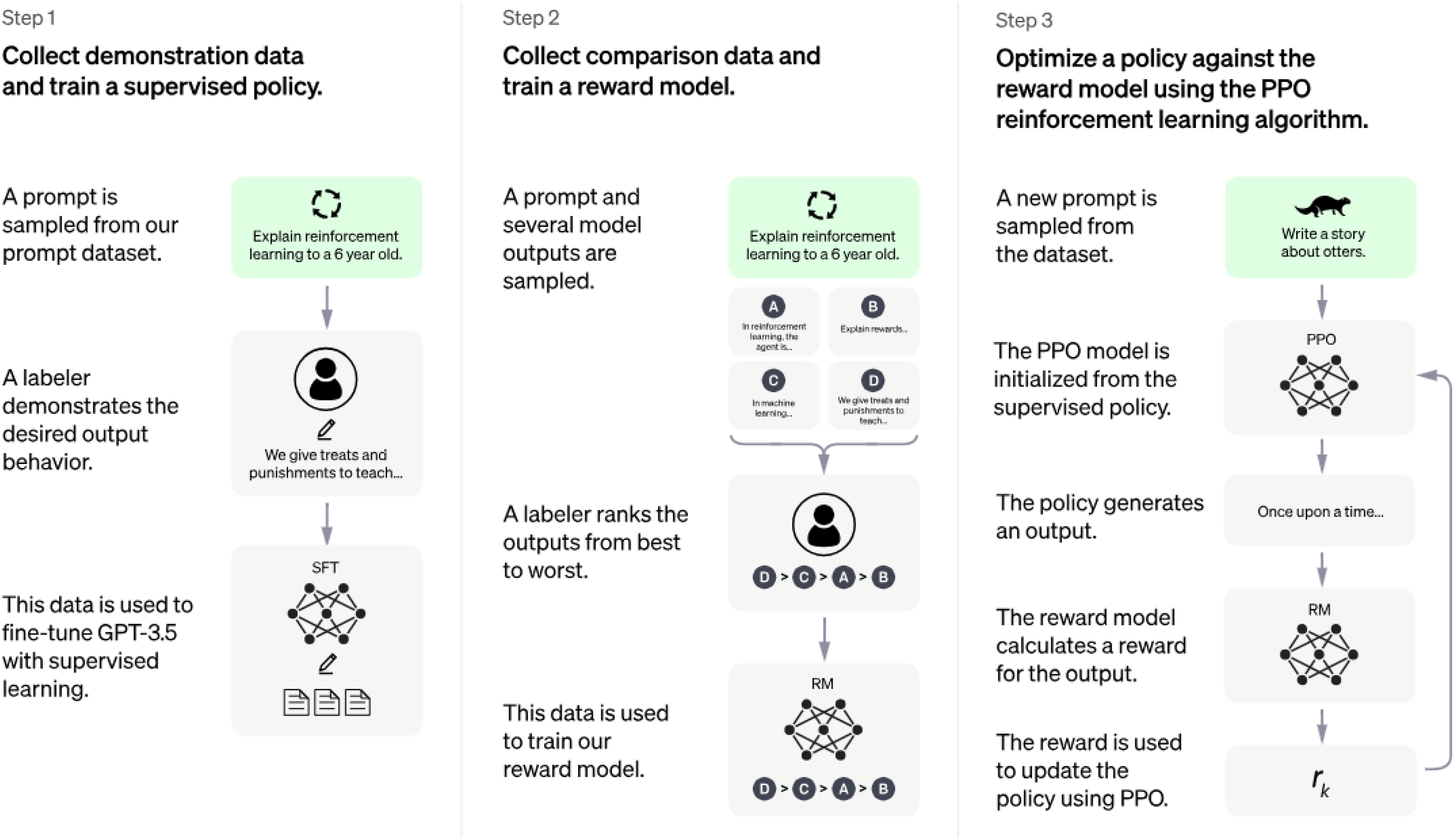
Process for educating ChatGPT (OpenAI, 2022).
ChatGPT cannot articulate human speech, nor can it think of answers to a question. The most basic explanation of what is actually happening when an individual prompts the chatbot is that it uses what it was taught by the developers to look for patterns that could satisfy the prompt and then create its own amalgamation of the patterns it saw to satisfy the prompt. For example, if one were to prompt ChatGPT to write a script for an episode of Friends, it would then look through a language model for scripts from the TV show Friends with the purpose of finding patterns in language use. After that information is in its memory, it can then use those patterns to inform how it fulfills the prompt of writing its own script. The technology could be better, and the script that just ChatGPT would produce at the time of writing this would likely be choppy.
As has been said, ChatGPT is a computer program, which means it is a mass of 1's and 0's that exists in a form that can be built upon and used to improve another AI. For example, Perplexity AI is an AI that specializes in research and uses ChatGPT in its coding. If one is researching a very niche topic, one could use an AI like this to find sources by asking it to find sources that support your research or even asking it your research question but stipulating that it has to cite academic sources. Perplexity is evident in what data it uses to inform its responses because it will link to them. An ethical researcher would see how the AI is using these sources and then read the source materials themselves, read the sources those initial sources cited, and conduct their research in their own way.
To some, this is preferable to the keyword searches that most academic databases use. With the amount of research being done and has been done in the modern age, these databases get larger and larger every year. A keyword search for an article that is relevant to your study can become akin to searching for a needle in a stack of different-sized needles, because many databases only go off of the titles and tags when searching. A search using an AI with a chatbot such as ChatGPT can look through hundreds of thousands of papers and find ones whose contents can be directly relevant to the prompt. It would not be surprising if databases started adopting AI-based searching options in addition to the keyword and filtered searches that are currently the standard.
Beyond Plagiarism
Although the use of ChatGPT remains a controversial issue and concerns about academic integrity remain, ChatGPT has benefits outside of AI-assisted cheating. When used as a vehicle for research or literature retrieval, it remains the next generation of electronic search engines. Obviously, stakeholders such as academic institutions and publishers need to produce guidelines and policies around the ethical use of AI in the academic environment; flat-out not condoning it is like trying to stop a moving train with a rubber band. This is the generation of technology, and it has taken hold of everything we do. Just like the research technology booms before it, we can harness its power for good. If not, we could return to the physical library and conduct our statistics with paper and pencil.
Enhancing Research Collaboration
One of the critical advantages of ChatGPT in the research domain is its ability to facilitate collaboration and brainstorming. Researchers can interact with the model to explore ideas, refine hypotheses, and seek inspiration for literature reviews. By engaging in dynamic conversations with ChatGPT, scholars can harness the vast knowledge within the Internet in a format that stimulates the generation of novel perspectives and insights, thereby fostering a more collaborative and innovative research environment.
Efficient Literature Review
Conducting a comprehensive literature review is a fundamental aspect of any research project. ChatGPT can streamline this process by rapidly generating summaries of existing literature, identifying key concepts, and suggesting relevant sources. Researchers can leverage the model's capabilities to navigate through vast amounts of information efficiently, ultimately saving time and effort in the initial stages of their work.
Clinical Research
AI has the potential to revolutionize clinical research in social work by streamlining data analysis, enhancing predictive modeling, and facilitating knowledge discovery. By integrating AI into research methodologies, social work students can explore innovative approaches to address complex mental health challenges. From sentiment analysis of social media data to predictive analytics of treatment outcomes, AI offers endless possibilities for advancing clinical research in social work.
Citation Assistance
Proper citation is an integral component of academic integrity. AI with contextual understanding can play a pivotal role in aiding researchers in this aspect by generating accurate and contextually relevant citations based on the input provided. ChatGPT serves as the groundwork for valuable tools that researchers striving to adhere to the highest standards of academic honesty utilize in their research by offering suggestions for citation formats and referencing sources.
Social Work Education
For social work educators, AI does not just shift how we teach but also what we teach. The benefit of incorporating AI in the classroom is well documented and well known (Hodgson et al., 2022). In social work, in particular, we must go beyond integrating AI as a teaching modality and teach how to use AI for clinical research. If we want social work to remain at the forefront of the mental health profession, we must teach students to harness the power of AI to improve their clinical skills. As we teach this generation to infuse research-based interventions and become actual evidence-informed practitioners, we must teach them this critical skill of obtaining that knowledge. ChatGBT can and should be used by the profession to access the most up-to-date knowledge, answer clinical questions, and best serve clients (Goldkind, 2021).
The foundation of effective social work practice lies in research-based interventions and informed decision-making. By teaching students how to harness the power of AI, we empower them to become true evidence-informed practitioners. AI-driven technologies, such as ChatGPT, provide access to the most up-to-date knowledge and resources, enabling social workers to answer clinical questions and best serve their clients.
The Role of Ethics
Of course, with any new technology, there is potential for misuse. This is where the academic community's ethics and future members’ education come into play. There is AI that is capable of learning from the writings of a particular individual and being able to replicate their style when responding to a prompt. One could create rudimentary literature in minutes; unfortunately, there are not many ways to detect malfeasance. It is a new kind of plagiarism. The analog version of plagiarism, where one takes credit for something they didn’t write, has plagued the academic world for centuries, and yet with programs like Turnitin, the threat of it in the higher levels of academia has been reduced (Saba‘Ayon, 2020). Ironically, Turnitin is an AI that falls under the same classification of AI as ChatGPT, a reactive limited memory AI. Analog plagiarism took hundreds of years to pacify. However, with the technological arms race going on, it would not be surprising if this AI plagiarism was pacified or at least under control in a fraction of the time.
Conclusion
The integration of ChatGPT into the research and citation process marks a revolutionary step forward in the utilization of technology to enhance scholarly efforts. Rather than being a breeding ground for plagiarism, ChatGPT empowers researchers with a tool that enhances collaboration, streamlines literature reviews, and assists in proper citation practices. Embracing this technological advancement opens up new avenues for creativity and efficiency in research, ushering in a new era where human intellect and AI collaborate to push the boundaries of knowledge acquisition and dissemination.
Further, incorporating AI into social work education is essential for preparing students to navigate the complexities of modern clinical practice and research. By teaching students how to harness the power of AI, we empower them to become evidence-informed practitioners and leverage technology to enhance client outcomes. As we embrace AI-driven tools and methodologies, social work can continue to evolve and innovate, ensuring that we remain at the forefront of the mental health profession.
Footnotes
Declaration of Conflicting Interests
The author(s) declared no potential conflicts of interest with respect to the research, authorship, and/or publication of this article.
Funding
The author(s) received no financial support for the research, authorship, and/or publication of this article.
