



Abstract
Interactionally, the workplace may be dilemmatic for a person with “invisible” chronic illness. Risks of stigmatization exist if they disclose their condition to colleagues. Meanwhile, not disclosing threatens well-being and entitlements. Using Bakhtin’s dialogism as a theoretical framework, we explored these social aspects of illness: inductively analyzing narratives from 20 participants with multiple sclerosis (MS). Capitalizing on concepts from dialogical and conversation analysis, links between (in)visibility, knowledge, and belief were examined with respect to symptoms and co-worker judgment. Perceived medical legitimacy creates a core social dilemma. At the intersection of genre and action, participants systematically used parody to subvert the traditional workplace hierarchy. “Oh-prefaced” direct reported speech (OPDRS) was deployed to exaggerate workplace interactions, undermining managers/colleagues who misattributed (in)visible symptoms. Parodic OPDRS index emotive interactional dilemmas. As subversions of organizational power, OPDRS denote those very areas where employees feel disempowered. Sensitivity to OPDRS can provide diagnostic support and complement evaluation frameworks.
Keywords
In chronic illness, employer support is important to the development of self-efficacy and symptom management in the workplace (Munir, Randall, Yarker, & Nielsen, 2009). Legislation such as the Americans With Disabilities Act (1990) and the United Kingdom’s Equality Act (2010) protects people from discrimination by obligating employers to offer reasonable adjustments where necessary. However, these benefits are contingent on disclosure of problems: a social, not legal, phenomenon (Butler & Modaff, 2016; Charmaz, 2010). Likewise, the way in which colleagues respond when chronic illness is disclosed is not only a medical and legal issue but also a moral one (Dodier, 1985).
In medical settings, presenting a legitimate, or “doctorable” (Heritage, 2009), complaint is a core interactional concern. Complaints determined to be “non-doctorable” can deprive a person of associated support (Parsons, 1951, 1975) and engender vulnerability to judgment that one is foolish and/or seeking illegitimate secondary gains (Heritage, 2009). In the workplace, people with chronic illness navigate vulnerability to judgment on a routine basis, particularly with regard to the (in)visibility of their symptoms. Depending on the illness and its stage, symptoms may manifest as observable by colleagues (e.g., physical and mobility problems), while others are more “concealed” (e.g., fatigue, pain, anxiety, depression, and cognitive impairments). Understanding the experience of perceived judgment is vital given that (anticipated) reception is central to disclosure, which in turn impacts access to appropriate entitlements fundamental to work retention (Beatty & Joffe, 2006; Charmaz, 2010; Vickers, 2012; Werth, 2015).
In this article, we focus on these social aspects of chronic illness. We use multiple sclerosis (MS) as a criterion condition, given common impacts on quality of life (e.g., depression, fatigue, and impaired cognition: Megari, 2013) and moreover that, despite reduced participation in paid employment, with appropriate accommodation, many people with MS (PwMS) can remain in productive work (Simmons, Tribe, & McDonald, 2010). MS is a chronic neurological disorder. Symptoms include impaired balance, fatigue, muscle weakness, stiffness and spasms, and problems with memory and attention. Typical onset is between the ages of 20 and 40 years. This is also a threshold period for career advancement and earning, and estimates indicate that 43% to 67% of PwMS are unemployed within 12 to15 years of diagnosis (Moore et al., 2013).
Research on the determinants of job retention in MS has focused on the impact of physical symptoms (Flensner, Landtblom, Söderhamn, & Ek, 2013; Smith & Arnett, 2005) and on the complex comorbidities of physical and psychosocial factors (Garfield & Lincoln, 2012). For example, Ford, Wicks, Stroud, and Tennant (2018) found self-efficacy had a mediating effect on the relationship between the physical symptoms of MS and job loss. This indicates a promising point for psychological intervention, which would be complemented by socially focused insights, given self-efficacy may be directly influenced by colleagues (Munir et al., 2009).
Our research focus on the perceived judgment of (in)visible symptoms in chronic illness was derived from a data-led analysis of focus group interviews with PwMS currently in employment. The theoretical orientation that precipitated this focus was Bakhtin’s (1984) dialogism. Given that the corresponding author has been involved in developing the potential of DA in health psychology (Gomersall & Madill, 2014), we wanted to explore the potential of this conceptual framework in data pertaining to occupational health. Dialogism, originally developed in literary criticism (Bakhtin, 1984), is gaining ground as an analytical approach in the social and health sciences (Frank, 2005; Sullivan, 2012). Importantly, Gomersall and Madill (2014) demonstrate how a central dialogical concept—chronotope—has utility for understanding the temporal and spatial intrusions of chronic illness as they are narrated within recognizable genre frameworks. This offers an important counterbalance to the current, dominant, cognitive paradigm in health psychology (Gomersall & Madill, 2014). Dialogism also appears appropriate for understanding the dilemmas of managing symptoms in the workplace where claims to authority, legitimacy, and entitlements are in play. Specifically, the approach draws attention to the rhetorical features of language, conceived of as addressed always to another (e.g., managers and colleagues) and pre-emptive of anticipated argumentative exchange, even when this addressee is not present. Bakhtin, who himself lived in chronic pain, makes the distinction between abstract, theoretical truth (istina) and truth as lived and embodied (pravda). His emphasis on the latter allows us to consider how personally invested, lived truths shape—and are shaped by—discussions between self and (imagined) other (Sullivan, 2012).
Conversation analysis (CA) also has a strong record for producing rich findings in health and workplace contexts (Pilnick, Hindmarsh, & Gill, 2011; Sidnell & Stivers, 2012). Moreover, it shares with dialogism a social orientation to language, focusing on how states-of-affair are produced as, what Bakhtin would term, “lived truths” through talk-in-interaction. An innovation of the present article is that we capitalize on these similarities at the intersection genre and action. Hence, alongside interest in addressee and narrative structure from DA, we draw on the CA understanding that talk is always oriented to “doing” something (Schegloff, 1996): that is, performing social actions. In terms of genre, we show how PwMS draw systematically on parody when discussing their experiences of managing the (in)visibility of their symptoms in the workplace. For Bakhtin (1984), parody permits two voices—the authorial and the overtly ridiculed—and can be used to subvert traditional hierarchies. In terms of action, we demonstrate how oh-prefaced direct reported speech (OPDRS) is used routinely as a strategy to create parody through undermining managers and colleagues who are portrayed as misperceiving and misattributing the (in)visible symptoms of MS. In doing so, we identify OPRDS as one possible diagnostic index for interactional concerns in the workplace with potentially fertile therapeutic and organizational applications.
In summary, we sought to explore further the potential of DA through analyzing focus group interviews with PwMS in paid employment. In so doing, we (a) were led to a research focus on the importance of the perceived judgment of colleagues in relation to the (in)visibility of the symptoms of chronic illness and (b) effected applied methodological developments for occupational health psychology in combining elements of CA with dialogism.
Method
Research Design
This qualitative study assumed a novel integrative methodology. While the overarching theoretical orientation was Bahktin’s dialogism, we intercede relevant concepts from DA and CA in terms of their respective focus on genre, addressee, and narrative structure (DA) and social action (CA). We also utilize quantitative frequencies of OPDRS to further illustrate the patterns observed.
Participants
Twenty participants were recruited through the West Yorkshire MS Treatment Programme specialist outpatient clinics (NHS). Consecutive patients in paid employment were provided with a patient information leaflet and invited to participate. The sample included 13 women and seven men, all who had been employed for over 28 months concurrent with a diagnosis of MS, but otherwise an opportunity sample. Participant gender was treated at face value and noted by the focus group leader in terms of name, pronoun acceptance, and self-presentation. Fifteen participants were in full-time work and five in part-time work, mostly white-collar employment spanning health care, education, non-profit, and commercial domains. Sixteen (10 female and six male) were diagnosed with Relapsing-Remitting MS and four (three female and one male) with Secondary Progressive MS. Baseline Expanded Disability Status scores (EDSS) ranged from 0 to 6.5 (16 EDSS: 0–3; 4 EDSS: 6.0–6.5) on a scale from 0 to 10, whereby 0 represents normal neurological examination and 10 represents death due to MS. Patients in 0 to 3 range are fully ambulatory. Patients with scores of 6.0 require one stick to walk 100 m, while those rated 6.5 require two sticks or bilateral support to walk 20 m.
Ethics
Ethical approval for this research was obtained from the Yorkshire and Humber NHS National Research Ethics Service Committee. All participants provided written informed consent to take part in the focus groups and were subsequently assigned a unique study ID. Privacy and confidentiality between all focus group participants was agreed and reinforced by the facilitator prior to each session. Transcripts were anonymized to ensure confidentiality and pseudonyms used throughout.
Data Generation
Participants took part in one of three focus groups: Group 1 (three women, four men), Group 2 (four women, one man), and Group 3 (six women, two men). Focus groups were led by a Senior Research Nurse with a background in qualitative research and were conducted in the Neuropsychology Department at St James’s University Hospital, Leeds. The original aim of the focus groups was to elicit a range of key psychological constructs that could be measured to develop an intervention to improve job retention with MS (Wicks, Ward, Stroud, Tennant, & Ford, 2016). Interviews were unstructured but used a topic guide in the form of eight keywords: work, coping, performance, support, future, expectations, sharing and symptoms. Focus groups lasted 65, 62, and 66 minutes, respectively. Discussions were audio-recorded with consent and transcribed verbatim.
Analytical Procedure
The detailed analysis was conducted iteratively by cycling drafts between the research team 1 with more developed versions commented on by two health practitioners, hence involving a form of triangulation known as expert validation (Sandelowski, 1998). The analysis was developed through cycles of discussion and revision in which all authors played a role interrogating analytical claims against the evidence and clarifying and honing the written analysis. This guarded against over-selectivity in our use of data or the bias of one researcher over-influencing findings.
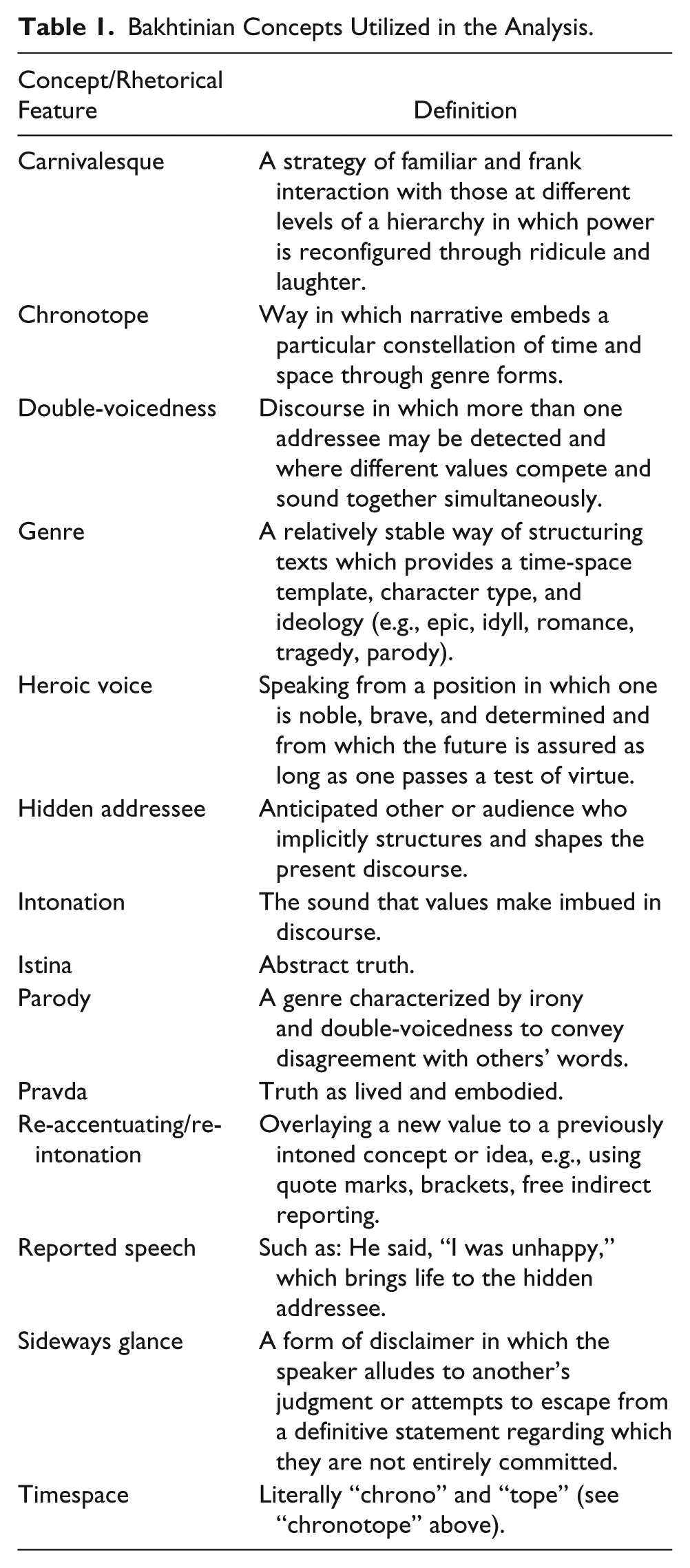
Audio-recordings and transcripts were scrutinized, and the first author identified a recurring pattern of potential interest: the way in which participants discussed challenges of managing the (in)visibility of MS symptoms in the workplace. Transcripts were then read with the aim of identifying key moments (Madill & Sullivan, 2010), defined as emotionally laden stories relevant to the agreed research focus. Key moments can vary in length but retain a narrative structure in having a recognizable beginning, middle, and end. Twenty-two relevant key moments were identified: six, four, and twelve in each focus group, respectively. Each key moment was assigned broad labels to help identify its core referents. The first author then analyzed each key moment for content which operationalized Bakhtin’s (1981, 1984) theory of chronotope: genre, emotional register, time-space elaboration, and context. This allowed the research team to identify patterns within the data, a core phenomenon reported in the first section of the analysis being the links between (in)visibility, knowledge, and belief with respect to the symptoms of MS in the workplace. During a more detailed interrogation of the key moments, an analytic commentary was written for each extract that drew upon Bahktinian concepts regarding the rhetorical features of language (Table 1). This provided insight into the participants’ particular concerns about symptoms through analysis of the ways in which their speech was constructed as addressed both to self and other (Sullivan, 2012).
Bakhtinian Concepts Utilized in the Analysis.
One striking and unexpected pattern in the key moments was the recurrent use of OPDRS to enact discussions of symptoms at work. The first author therefore returned to the dataset and identified OPDRS across the transcripts, categorizing these according to their use: (a) to report the speech of self or of other; (b) in or external to the workplace. The analysis of workplace instances revealed that these were used to convey particular forms of self-evidency, achieved in two different ways, which we label “casualizing” and “news receipts.” Hence, in the “Analysis” section, we focus on the use of workplace OPDRS involving the reported speech of others given the importance to our participants with regard how they, as PwMS, are perceived by their colleagues. Our detailed analysis of the exemplar extracts presented incorporates techniques from CA to demonstrate how OPDRS functions to build a parodic picture of their colleagues’ reaction to their symptoms. Accordingly, these extracts were re-transcribed in detail,commensurate with the focus of CA on the micro-features of talk (Jefferson, 1983: Table 2).
Conversation Analytic Transcription Conventions Used.

Analysis
The analysis is structured in two sections. In the first, we explore the links between (in)visibility, knowledge, and belief with respect to the symptoms of MS in the workplace. In the second, we examine participants’ use of OPDRS to parody their colleagues’ reaction to their symptoms.
Symptom (In)visibility: Knowledge and Belief
A key challenge participants discussed was managing the (in)visibility of MS in the workplace. Colleagues attempted to make sense of what they could, and could not, see and the boundary between knowledge and belief about the impacts of MS on the body. For example, Participant 1 describes how the (in)visibility of her symptoms can lead to distressing misunderstandings from her colleagues.
Extract 1 (Focus Group 3) . . .if you’ve got symptoms like your legs or feet whatever you know we can sort of understand it but- and because people can’t see it they think- people say “Oh you look well.” That really annoys me. And the latest one- because I’ve got either one or two sticks- “What have you done to your leg?” “Nothing.” (Participant 1)
Here Participant 1 contrasts, what are in effect, the two kinds of knowledge identified by Bakhtin as istina and pravda. She does so through the suggestion that, with regard to “symptoms like your legs or feet,” people who do not have MS “can sort of understand it” but that this conceptual knowledge can reach its limit when physical problems are not marked on the surface of the “well-looking” body. One explanation for such misunderstandings is that the symptoms are invisible: it is “because people can’t see it.” However, Participant 1 offers an anecdote demonstrating through irony that misunderstandings can occur even when her symptoms are obvious, such as when she has “one or two sticks.” Here colleagues’ (probably sympathetically intended) noticing of her difficulty implies that it has been, in some way, self-inflicted: “What have you done to your leg?” The offensiveness of this attempt at sense-making is conveyed by Participant 1 through her understated “Nothing.” Pertinently, through offering her colleagues no further explanation, she orients to the culpability of their ignorance with respect to her suffering.
Participant 1 alludes to the internal space of the body in which the symptoms of MS take hold and the misunderstandings which can arise when they are not visible on its surface, or when visible symptoms are attributed inappropriately. Interestingly, in the next extract, Participant 2 draws attention to the over-attribution of difficulties to MS. Hence, the link between symptom (in)visibility, knowledge, and belief can be problematic also in over-generalizing its impact.
Extract 2 (Focus Group 2) Well I was limping and I did say to people- people would say “You’re limping” and I’d tell them why I was limping and it was only afterwards that I discovered I was limping because I needed my knee sorting out because they do tend to put down everything- “Oh I’ve got a sore throat” “Oh well you’ve got MS.” It’s the medical profession as well they blame everything on it and it took me a long time to persuade anybody that my knee wasn’t neurological. . . (Participant 2)
Participant 2’s colleagues are presented as attempting to make sense of her visible symptoms in a comically direct and naively intrusive way: “You’re limping.” At first, Participant 2 manages this situation from the apparent knowledge that the problem is caused by her MS and she would “tell them why I was limping.” However, the anecdote is continued as an ironic undermining of expertise: through Participant 2’s “only afterward that I discovered” and the generalized other (“they do tend to put down everything”) and doctors (“the medical profession . . . blame everything on it”). Hence, paradoxically, in this example, knowledge of the invisible “neurological” space inside the body and the impact on its surface and functionality is revealed to be a mere belief that delayed Participant 2 getting her “knee sort(ed) out.”
In the third extract, Participant 3 explores the complexities of revealing his MS to colleagues, his anxieties with regard to their actual beliefs, and an additional way in which MS symptoms can be problematically invisible to others.
Extract 3 (Focus Group 3) . . .I don’t go round saying “Oh I’ve got MS” but they know about it and I’m open about it and I’m happy to talk about it. And that just helps me really I think just to deal with just the smaller things that you know some days you might struggle to get up the stairs and they don’t see. And I think that’s the difficult thing because sometimes I think “Do they think I’m being a bit of a fraud.” . . (Participant 3)
Participant 3 orients to a social threshold of acceptable disclosure within the workplace stating that “I don’t go round saying ‘Oh I’ve got MS.’” This divides the space of appropriate information-giving (structured in a three-part list suggesting completeness—“they know,” “I’m open,” “I’m happy to talk about it”) from a possible, but inappropriately burlesque, space of intrusive self-revelation. It is through this gentle self-parody that Participant 3 conveys the danger he feels in being considered foolish “going round saying.” However, the social territory of knowledge and openness, although comforting, is contrasted to a private terrain of hidden difficulties in the workplace such as when he “might struggle to get up the stairs and they don’t see.” Moreover, Participant 3 is fearful that there is also a hidden domain of unspoken criticism in which his colleagues consider him “a bit of a fraud.” That is, although they “know about” his MS, they may not really believe the problems it causes him, particular when this happens out of sight.
On the contrary, when a person with MS is relatively well, colleagues can assume a physical fragility incommensurate with the individual’s actual ability.
Extract 4 (Focus Group 1) . . .it’s just people find out and you know there’s certain staff I work with and they go “Oh you can’t lift that. No you’re not doing that.” And sometimes I wish I’d not said anything because before they knew it I’d get in and get on with my job and be lifting this and that. . . (Participant 4)
Participant 4 contrasts the way in which he is treated by “certain staff” before and after they “find out” about his MS. Before they knew, he was able to “get on with my job,” but afterward, he is told by them that he cannot do things: “can’t lift that” and that he is “not doing that.” As such, moving into a new epistemological terrain has caused problems for Participant 4 in that he feels negated by his colleagues’ over-cautious assumptions about his physical ability. Importantly, his colleagues’ beliefs are not based on visible symptoms and actually contradict Participant 4’s demonstration of “lifting this and that.”
OPDRS
In all the above extracts, participants use OPDRS to enact either themselves or others in their description of managing the (in)visibility of MS symptoms, and the impact of this on the (in)ability of others to make sense of challenges they face, in the workplace. For example, Participant 1’s colleagues annoy her when they say things like “Oh you look well” (Extract 1).
Most uses of OPDRS in our sample pertain to the workplace (82.5%) and most of these enact the speech of other people (Table 3), for example, colleagues or managers (76%). Analysis of all 33 workplace instances revealed that these were used to convey self-evidency and that this was achieved in two different ways: through casualizing and through news receipts (Table 4). While casualizing incorporates an assessment of something typically beyond the reported speaker’s domain of knowledge, hence tending to trivialize it, news receipts tended mark something, which normatively “should” be known, as obviously novel information (cf. Heritage, 1984, 1998).
Distribution of Self/Other Oh-Prefaced Direct Reported Speech by Setting.

Number, Type, and Distribution by Gender of the Use of Oh-Prefaced Direct Reported Speech of Self or Other in the Workplace.
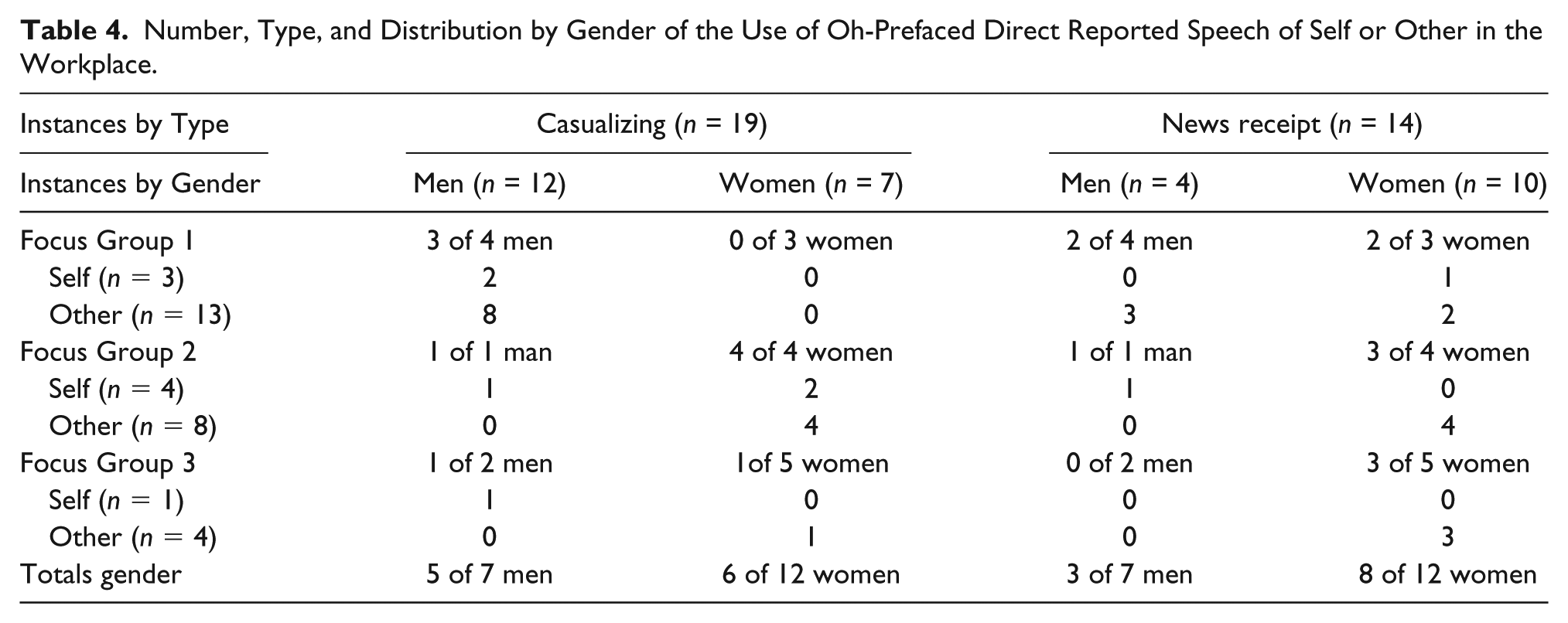
The 33 OPDRS workplace instances were reasonably well distributed across the focus groups and participants.
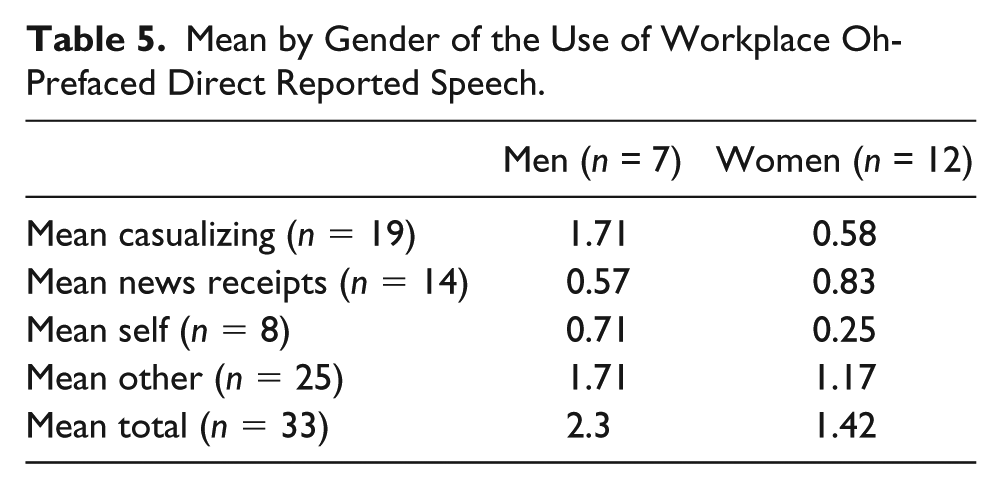
This provides evidence of the relative robustness of the phenomenon. These OPDRS were used slightly more to casualize (58%) than as news receipts, and to convey the reported speech of others (76%) as opposed to that of self. Women used workplace OPDRS as news receipts slightly more than did men; however, men used workplace OPDRS more than women and in every other type (i.e., self, other, and to casualize; Table 5).
Mean by Gender of the Use of Workplace Oh-Prefaced Direct Reported Speech.
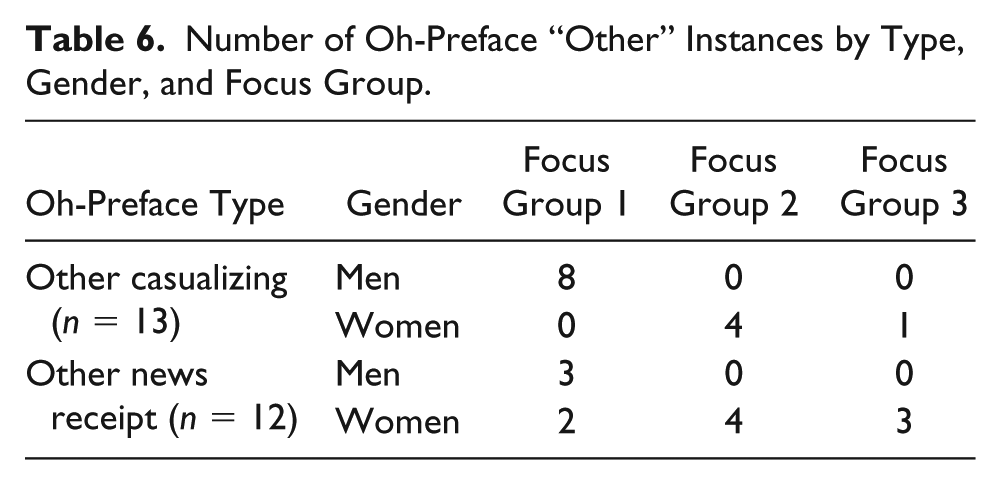
In following two subsections, we present analysis of examples of the use of workplace OPDRS, first those that casualize and then those that act as news receipts. Moreover, we present only OPDRS involving the reported speech of others, given the importance to our participants with regard how they, as PwMS, are perceived by their colleagues and managers (Table 6).
Number of Oh-Preface “Other” Instances by Type, Gender, and Focus Group.
Self-Evidency by Others in the Workplace Through Casualizing
In Extracts 5 to 7, the reported speech of colleagues and managers involves a dismissive assessment of some physical experience or effect of MS: that is, a casualizing of its impact. Moreover, colleagues are presented as breaching their domain of expertise through treating as self-evident something about which they know little. We can see this in the way that Participant 5 describes her return to work after a hip replacement.
Extract 5 (Focus Group 2) . . .I had (0.2) the: ↑hip replacement on my (0.4) So I think a lot of people thought that I- “Oh ↑↑you’ve ↑had your ↑hip operation now ↑you’ll be able to w↑alk better won’t yo:u,” (0.2) “well actually no:::” (0.2) (°you know?°) they thought (0.2) you could ↑
Placing emphasis on “left” and “right,” Participant 5 creates a contrast, and distance, between the objective site of intervention (left hip) and the counter-intuitive site of invisible effect (right side). Through reported speech, her colleagues, meanwhile, present an overly optimistic assessment of her surgery: “now ↑you’ll be able to w↑alk better.” This assessment is casualized, in part, by the oh-preface which marks it as unconsidered, spontaneous speech (Fox Tree & Schrock, 1999) and known information (Heritage, 1998), and by its negation of challenges between intervention and benefit. This affords the assessment a straightforwardness and naivety, supported by the exaggerated prosody, rendering the response overdone (cf. Holt, 2000). The casualizing action of the utterance further plays out in Participant 5’s own reaction in which she juxtaposes this simplistic optimism with an equally exaggerated, abrupt rebuttal: “well actually no:::.” The turn-initial “well” followed by “actually” serves as an alert to the relatively non-straightforwardness (Schegloff & Lerner, 2009) and contrastive (cf. Clift, 2001) nature of her response—and the reality of her physical experience.
Collectively, the features of this OPDRS serve to accentuate the intonation of two different voices (Bakhtin, 1984) to suit the end of undermining her colleagues. That is, this exaggeration reconfigures them as foolish and subverts the power relationship between them. However, Participant 5’s heroic authoritative voice is also being undermined by a sideways glance: “you could ↑see it in their faces that they thought I was being a bit negative?” This hints at anxiety about the perceived legitimacy of the invisible negative effects of MS and firmly establishes the double-voicedness of the discourse.
In Extract 6, we observe again, through OPDRS, colleagues presented as assuming a naively simplistic and linear relationship between cause and cure.
Extract 6 (Focus Group 1) Participant 6: An- and you know your own body don’t you so= Group member: =Yeah= Participant 6: =y- y- (you know) and people (they) all say ((in “whispering” voice)) “>°Oh yeah well I read this really interesting thing you know I
In claiming ownership over his body (“you know your own body don’t you”), Participant 6 delimits clear epistemic boundaries between self and other. Despite this, his colleagues (lumped together as “people”) casually counter—“>°Oh yeah well”—and breach this knowledge boundary through offering spontaneous advice: “I read this really interesting thing you know I really think you should look into this°<.” Moreover, through the personalized formulation “I really think,” and modal verb selection “you should,” rather than “could,” they are positioned as displaying an accountably high degree of entitlement to give this advice.
As in Extract 5, the reported speech is overdone, with an increased pace and “whispering” voice projecting excitement of a discovery being shared. However, Participant 6 continues to expose the questionable credentials of the advice which has an apparent asymmetrical relationship with time. By “telling” Participant 6 to “do the paleo diet and all this kind of stuff because . . . it will reverse my MS,” his colleagues negate complexities and invoke a linear path between antidote and cure: that is, that a diet change will reverse biological time and impact a serious neurological disorder. The imperative verb “telling,” rather than, for example, “suggesting,” indicates the inappropriate imposition of the advice. However, the casualized breaching of a knowledge domain through the OPDRS, and the comment that “you have to humor the guy,” enables Participant 6 to position his colleagues as foolish.
In Extract 7, we see another example of self-evidency in which OPDRS is used to casualize the etiology of an invisible symptom of MS.
Extract 7 (Focus Group 3) Participant 7: . . .my last line manager “Just let me know if there are any issues.” (0.6) And I said to her one day “I’m really struggling (.) My legs are vibrating” which (.) is a real key to (teaching) (0.8) “>O:h it’s the time of year so are mine.<” Group: ((Laughter)).
Participant 7’s manager makes her an offer of support: “Just let me know if there are any issues.” However, in this direct reported speech, the adverb “just” hearably conveys the manager’s minimization of Sarah’s potential need to take up this offer, pended also to some indefinite future. The insubstantiality of the offer is confirmed when this future actually arrives and “one day” Sarah does report an issue which presents a fundamental challenge to her work as a teacher: “I’m really struggling (.) My legs are vibrating.” However, instead of receiving help, Sarah’s problem is discounted by her manager, through an OPDRS, as caused by something already known and something which, in fact, she herself (and potentially others) has independent epistemic access too (Heritage, 2002): “>O:h it’s the time of year.” These are temporary, external circumstances, hence, inconsequential and, moreover, normative given that this is something with which other people also have to deal: “so are mine.<.” As such, Sarah’s manager is presented not only as unhelpful but as untrustworthy and foolish in trying to “fob her off” with a nonsensical, generalized, and demeaning excuse for not providing her with support. The parodying action of the utterance is supported by the pregnant pause before the “punchline.” As in Extracts 5 and 6, the exaggerated and, hence, parodying cadence of the OPDRS is shaped to convey an offensive oversimplification of a serious condition beyond the manager’s domain of subjective and objective expertise.
Self-Evidency by Others in the Workplace Through News Receipts
By marking, through OPDRS, colleagues’ knowledge claims as beyond their expertise, it is possible to parody, and in turn undermine, their dismissive assessment of MS and casualizing of its impact in the workplace. In this section, we show how it is also possible through OPDRS to mark colleagues as unhelpfully ignorant of some, arguably self-evident, aspect of MS to accomplish a similar parodying effect. This is achieved when the particle “oh” is used to register acknowledgment of new information: that is, as a news receipt (Heritage, 1984; Schiffrin, 1987).
In Extracts 8 and 9, we show how “oh” is used to mark an aspect of MS as newsworthy to colleagues in a way that is, at least, unhelpful to the person with MS. Then, in Extract 11, we show how the news receipt function of OPDRS can enable the speaker to present a seeming lack of awareness or knowledge of MS as foolish.
Extract 8 (Focus Group 3) Participant 1: I didn’t kno:w then that (.) that there was somebody there that had it [MS] so (.) hh hh £ Group: ((Laughter))
In Extract 8, Participant 1 speculates that her colleagues’ reaction to the news that a colleague had MS was to think “O::h my god.” In this, she enacts the registration of a change in their awareness (Heritage, 1998) but, importantly, one which invokes, through her elongated “O::h,” potentially troublesome consequences of this new information. This assumption of a rather irritated private response from colleagues is substantiated by the group’s sardonic laughter. Likewise, in Extract 9, the OPDRS is used by Female 2 to enact her colleagues’ likely negative reaction to the news that someone has MS, this time one of anxiety.
Extract 9 (Focus Group 2) Participant 8: I think for the Group member: Mm Participant 8: But you’d have to change (.) human tra:its? (0.4) Participant 8: Because unfortunately it’s a human trait for instantly people to think (0.4) a bit of
Participant 8 suggests the social prognosis for PwMS in the workplace is bleak given that the generic nature of “human tra:its?” is to be fearful of the unknown. The interrogative forms “‘↑Oh what’s that’ and then ‘Oo d- can I ask?’” indicate lack of knowledge and the need for clarity. However, in being able to denote this receipt of new, and through their intense surprise—“↑Oh”—newsworthy, information, a further potential platform for parody is introduced: colleagues are positioned as intensely surprised in relation to some aspect of MS that should be self-evident and absorbed less dramatically. Marking a normatively self-evident (or self-evident by virtue of prior information) aspect of illness as “news” undermines the reported speaker and provides the appropriate conditions for parody. We can see this play out in more detail in the following extract.
Extract 10 (Focus Group 1) Participant 9: . . .the main Group member: [Mm Participant 9: [and all that (yeah) it’s all (0.2) °it’s all actually fair enough and erm° (0.4) .hhh
Participant 9 states that PwMS “do have a contribution to make” in the workplace and that “reasonable adjustments” are “actually fair enough.” His emphasis on “do” and use of “actually” implies a critic who needs persuading. Indeed, he suggests that it is “other people’s perceptions and reactions” that are problematic and brings to life this hidden addressee through report of his own speech to his clients: “I’ve said ‘look’ (0.4) erm I-I’ve had this for just over a year.” His invitation—“look”—and use of a specific and reasonably long time-frame—“just over a year”—implies that his clients have had opportunity to pick-up on his MS and he has even “told a couple.” Hence, when they “came back” and ask, “O::h o- ↑oh so ↑have you hurt your leg then?” they are implied to have, apparently, disregarded the obvious signs of his condition and even his clear disclosure.
That his clients are accountable for their obliviousness is supported by the exaggerated intonation: the oh-preface and the interrogative form. This explicitly marks this “old news” as “news.” Moreover, the appended indexical—“then”—orients to the use of evidence to deduce a conclusion which, despite clear information of illness, is limited to immediate visible cues and, thus, to an inaccurate conclusion. Participant 9 is then forced to repeat his disclosure: “‘No:.<’ (you know) er I’ve got this,” responded to with an even more overdone change-of-state oh-token: “(>°they go°<) ‘↑Oh!’”, marking this as counter to expectation.Accordingly, through the use of an oh-preface and “oh” as a freestanding particle, Participant 9 has been able to establish that his clients have a culpably loose and transient awareness of his MS which allows him to configure them as foolish and, possibly, even offensive.
Discussion
Using dialogism as a theoretical framework, we analyzed focus group interviews with PwMS in paid employment. In so doing, we (a) were led to a research focus on the importance of the perceived judgment of colleagues in relation to the (in)visibility of the symptoms of chronic illness, and (b) effected methodological developments in combining CA with dialogism. Specifically, we demonstrate how, at the intersection of action and genre, OPDRS is used routinely as a strategy to create parodic stories in which managers and colleagues are portrayed as misperceiving and misattributing of the (in)visible symptoms of MS. Our research adds to a growing body of research highlighting the practical applications of DA in relation to chronic illness narratives (e.g., Gomersall & Madill, 2014). To our knowledge, it is the first study to consider symptom (in)visibility in tandem with direct reported speech.
The use of reported speech to enact co-workers highlights the emotive social dimensions of being a person with a chronic illness in an environment in which one’s symptoms are open to (mis)interpretation. Hence, we support research suggesting that functional status does not adequately account for the experience of chronic illness (Ironside et al., 2003) and that tackling the interpersonal dimensions can be as important as managing physical symptoms such as fatigue (Petrin, Akbar, Turpin, Smyth, & Finlayson, 2018). Moreover, given participants encountered difficulties in communicating about (in)visible symptoms, our study is consistent with research identifying a dilemma of disclosure in chronic illness (e.g., Charmaz, 2002; Vickers, 1997). For example, our findings complement those of Butler and Modaff (2016) who demonstrate that a core motivation to disclose (or conceal) chronic illness in the workplace is related to employees’ concerns about “explaining absence or [their] condition.” Furthermore, we highlight how people with invisible symptoms, or symptoms vulnerable to misattribution, may need to develop a politicized identity to meet challenges such as negotiating inaccessible spaces, deciding what to disclose, and managing negative reactions from others (Frederick, 2017) including social rejection and stigmatization (Markle, Attell, & Treiber, 2014). Moreover, we have confirmed in some detail how people with chronic illness often have to deal with colleagues who consider their problems to be fallacious (cf. Butler & Modaff, 2016). However, an original contribution of our study is that, through our novel methodological fusion, we have elicited a way of identifying emotive social dilemmas in the workplace, as we will now discuss.
Reasonable adjustment may improve job retention for people with chronic illness but is dependent on disclosure. Social and emotional dilemmas at work can have a direct bearing on disclosure decisions and employees are more likely to inform their manager about symptoms if they have felt secure enough to tell colleagues (Munir, Jones, Leka, & Griffiths, 2005). However, challenges exist in the recognition and management of the social and emotional dimensions of chronic illness at work—which may negatively impact decisions to disclose—and this has prompted calls for more socially oriented initiatives (Dueñas, Ojeda, Salazar, Mico, & Failde, 2016; Turner & Kelly, 2000). Our participants, unexpectedly, yet systematically, employed OPRDS speech to enact interactions with colleagues and parody their (mis)understanding of the (in)visible symptoms of MS. This finding is significant in three interlinked ways relevant to psychological interventions targeting job retention in the context of chronic illness.
First, for Bakhtin (1984), parody is irreverent, is anti-authoritarian, and permits two voices—the authorial and the overtly ridiculed—and so can be used to subvert traditional hierarchies.As such, through parody, our participants invoked their sense of the power structure at work, while their (re)created dialogues made it possible to abandon official etiquette and convey interactions unencumbered by fear and convention (Sullivan, 2012). In our focus groups, participants often conveyed carnivalesque, topsy-turvy kinds of workplace interaction through a decrowning of management and colleagues. Importantly, as potential rhetorical representations and subversions of organizational power, parody may be indicative of those very areas where people feel disempowered (Sullivan, 2012). Accordingly, these are prime areas to target in interventions aiming to identify and improve psychosocial aspects of chronic illness and quality of life in the workplace.
Second, assisting this identification, in enacting these parodic representations of colleagues, participants routinely used OPDRS. This enabled them to perform actions conducive to the parody genre: that is, casualizing (marking inaccessible and complex aspects of chronic illness as “known” or self-evident) and news receipts (conversely, marking easily accessible self-evident aspects of chronic illness as “unknown”). Once attention is drawn to this distinct linguistic structure, that is, the “oh” preface, it is relatively easily to recognize. Indeed, discourse markers have been found to be identifiable and significant to the action of talk and its potential therapeutic value.
Thompson, Howes, and McCabe (2016), for example, found the “so” in “so-prefaced” declarative questions to be instrumental in demonstrating empathy and responsivity to patient experience in psychiatry. Moreover, the use of these questions was associated with better outcomes, including therapeutic alliance and patient treatment adherence, demonstrating how the minutiae of dialogue can have potential clinical utility. Likewise, in non-clinical settings, “oh” alongside reported speech has been identified as a powerful identity resource that helps people carry out Bakhtin’s (1984) notion of double-voicing and convey other people’s intentions (Trester, 2009). By combining the dialogical concept of genre and the notion of social action from CA, we show two specific ways this double-voicedness applies in the construction of parodic anecdotes (i.e., casualizing and new receipts), which may help a range of professionals identify interactional dilemmas in the workplace.
Third, evidence suggests that direct reported speech is used frequently enough for utility as a diagnostic index in relation to emotive social dimensions of illness: reported speech is routinely used as a method of emphasizing, and evidencing, salient aspects of a narrative (e.g., Buttny, 1998; Myers, 1999; Wigginton & Lafrance, 2014); in interviews about work, participants commonly utilize direct reported speech to enact workplace scenes (James, Pilnick, Hall, & Collins, 2016), and, in our data, the 33 OPDRS were well distributed across focus groups and participants, and were most frequently used to convey the reported speech of colleagues (76%). Moreover, as reflected in our examples, research suggests that direct reported speech occurs typically in complaint narratives and in the recounting of amusing anecdotes (Couper-Kuhlen, 2007; Drew, 1998; Holt, 1996, 2000), consistent with our attribution of OPDRS to the parody genre.
These three observations point to promising applications on both the individual and organizational levels. First, in terms of individual-level interventions, approaches such as Interpersonal Psychotherapy (IPT), approved by the National Institute of Clinical Excellence (NICE), have been found useful in addressing problems relating to work (Schramm & Berger, 2013). The underlying assumption of IPT is that psychological symptoms are often a response to difficulties interacting with others. Therapists might therefore be usefully alert to moments when OPDRS is used by clients, given its likely emotional and interpersonal salience. The World Health Organization (2016) recommends that IPT is conducted in a group setting, suggesting that our findings, which are based on focus group interviews, hold a degree of ecological validity. Hence, clinician sensitivity to OPDRS could potentially provide diagnostic support within the context of NICE-approved therapeutic interventions. Likewise, a similar sensitivity could enhance coaching interventions targeting the strains of managing symptoms at work (e.g., McGonagle, Beatty, & Joffe, 2014).
Second, in terms of developing and evaluating organizational-level interventions, focus groups conducted with facilitator sensitivity to OPDRS could provide a novel method to complement more traditional evaluation frameworks in line with the recognized need in occupational health psychology for a more “broadly conceived and eclectic” approach (Cox, Karanika, Griffiths, & Houdmont, 2007, p. 348). Indeed, the comparative value of the content of direct reported speech pre- and post-intervention has been found to be potentially powerful analytic resource. Following a work-focused training program, James et al. (2016) found that intervention participants were much more likely to present themselves as active agents in direct reported speech. Relatedly, managerial sensitivity to the presence and content of reported speech in workplace interactions may provide useful insight into concerns that colleagues may be finding it difficult to raise directly.
Our analysis was based on 20 participants, virtually all of whom were in white-collar employment, diagnosed with the one chronic illness (i.e., MS) and with a greater weighting of women to men. It is possible that people in different kinds of employment, and/or with different chronic illnesses, may not employ OPDRS or employ it to alternative effect. However, at present, there appears little to suggest that this practice is specific to MS, or even the workplace.
Future research might evaluate OPDRS pre- and post-individual- or organizational-level interventions in terms of presence/absence, frequency, content, and genre/action. Given the likely ubiquity of OPDRS, coding methods could also feasibly be applied to direct reported speech, and its genre/action, to explore the relationship with salient outcomes such as chronic illness disclosure, job retention, and psychometric measures (e.g., cf. Thompson, Howes & McCabe, 2016;Thompson & McCabe, 2018). It may also be important to investigate the possibly differential gendered use of OPDRS, which would be significant for any intervention utilizing OPDRS as an index. Women used workplace OPDRS as news receipts slightly more than men, while men used workplace OPDRS more than women in every other type (i.e., self, other, and to casualize). Should these patterns hold in a larger coded sample, this could be interesting clinically. For example, while we focused primarily on “other reported speech” due to our interest in participants’ perception of colleagues, use of self-parodying versus other-parodying could be a salient cue in relation to issues such as self-worth. Indeed, self-deprecation is associated with low self-esteem (Sciangula & Morry, 2009). On the contrary, parody, in its various forms, may have differential relationships with self-esteem, interpersonal competence, and even conflict management (cf. McCosker & Moran, 2012). These are important features of workplace communication, and if robust gender differences are identified, this could provide the basis of differential workplace interventions.
The population of employees with chronic illness constitutes 15% to 20% of the total workforce (Munir et al., 2007), yet research that accounts for the subjective complexity of language, social experience, and identity in chronic illness at work is lacking (Santuzzi & Waltz, 2016). Novel interdisciplinary fusions may be one way to reconcile this gap and indeed, as we showcase here, may lead to new therapeutic prospects to help facilitate job retention in chronic illness.
Footnotes
Acknowledgements
We would like to thank Sookhoe Eng (Senior Research Nurse) for moderating the focus groups and coaching Amanda Stroud in her role as focus group facilitator. This research would not have been possible without the generosity of the people with MS who shared their experiences and we extend to them our sincere gratitude.
Declaration of Conflicting Interests
The authors declared no potential conflicts of interest with respect to the research, authorship, and/or publication of this article.
Funding
The authors disclosed receipt of the following financial support for the research, authorship, and/or publication of this article: This work was supported by a Multiple Sclerosis Society Grant (974/12).
