



Abstract
Community Health Workers (CHWs) are often incorporated into efforts to reduce health disparities for vulnerable populations. However, their voices are rarely the focus of research when considering how to increase their job effectiveness and sustainability. The current study addresses this gap by privileging the voices of 28 CHWs who work with Latinx communities in Nebraska through in-depth, semistructured interviews. Using a multilevel, Culture-Centered Approach (CCA) to Health Communication, we identified two key structural communication issues: (a) increasing language accommodation and (b) increasing (and stabilizing) network integration across three ecological levels of health behavior (individual, microsystem, and exosystem). This study shows the uniquely valuable perspective that CHWs have as they navigate hierarchical health care structures and community cultures to meet the needs of their Latinx clients. Findings suggest that CHWs should be included in health care organization and policy discussions to reduce health disparities for Latinx populations.
Keywords
The Latinx 1 (Hispanic) community faces an array of negative health outcomes within the United States. The three leading causes of death for U.S. Latinx people are cancer, heart disease, and unintentional accidents (Centers for Disease Control and Prevention [CDC], 2017). Recent statistics show that the prevalence of obesity is 39.7% for men and 45.0% for women. Likewise, over the past 30 years, physician-diagnosed diabetes has increased, and undiagnosed diabetes has remained constant. These health risks are compounded by 21.1% of the Latinx population being uninsured (CDC, 2017).
Health disparities have been addressed in countries around the world, regardless of income, through the increased use of community health workers (CHWs; Kousar et al., 2016). CHWs are public health workers who bridge the gap between health services and the communities to which they belong (Allen, McBride, Balcazar, & Kaphingst, 2016; Balcazar et al., 2011). CHWs have effectively improved health for vulnerable populations, particularly ethnic minority communities, through relationship building that increases health care knowledge and access for those patients with acute and chronic health conditions (Rosenthal et al., 2010). CHWs often share a common cultural in-group identity, including shared language (Keblusek, Giles, & Maass, 2017), with the communities in which they work (Katigbak, Van, Devanter, Islam, & Trinh-Shevrin, 2015). However, language alone does not guarantee communication effectiveness of CHWs. CHWs also encounter facilitators and barriers in meeting health needs of communities, especially as they navigate two salient group identities to which they belong—health care worker and community member (Pittman, Sunderland, Broderick, & Barnett, 2015).
Research has shown the effectiveness of CHWs in improving the health and well-being when working with Latinx populations (Lanesskog, Piedra, & Maldonado, 2015; McElmurry et al., 2009). However, extant research largely evaluates CHW effectiveness from the perspective of health care organizations and research institutions that employ them (Arvey & Fernandez, 2012), rather than solicit the voices of CHWs themselves. Because communication and relationship building are the top two valued skills for CHWs (Rosenthal, Rush, & Allen, 2016), CHWs are often used in culturally sensitive intervention approaches where top-down communication occurs and culture is viewed as a barrier to overcome in creating health solutions (Dutta, 2008). Thus, the current study focuses instead on the voices of CHWs working within Latinx communities and seeks to start with culture when recommending health equity solutions. To accomplish this goal, we turn to the Culture-Centered Approach (CCA) to Health Communication.
The Culture-Centered Approach and Latinx Health Disparities
According to Dutta (2008), CCA explores the meanings and experiences of health in marginalized populations through the concepts of structure, culture, and agency. Structure refers to the socially organized set of rules, policies, and procedures that constrain and enable cultural groups to enact health behaviors. A variety of structural barriers impact access to health care resources for Latinx individuals. For recent Latinx immigrants living in rural areas, getting insurance is difficult because of the complicated U.S. health care system (Cristancho, Garces, Peters, & Mueller, 2008). Yet even for individuals with insurance, access to health care can be impeded by coverage limitations (e.g., exclusion of family members), deductibles, and increasing costs of premiums. In comparison to U.S.-born citizens, immigrants who are insured still have less access to health care (Ku & Matani, 2001).
CHWs also experience structural barriers within health care, and they, too, may experience barriers to resource access, such as a lack of stable salary, standardized training, as well as clear and consistent role descriptions and evaluation standards (O’Brien, Squires, Bixby, & Larson, 2009). CHWs may also experience additional work-related challenges, such as burdensome paperwork and difficulty establishing trusting relationships with clients, many of whom are transient (Gale, Kenyon, MacArthur, Jolly, & Hope, 2018). However, CHWs continually work to improve health outcomes for their clients despite meeting with structural barriers themselves (Dutta, 2008; Elderkin-Thompson, Silver, & Waitzkin, 2001; McElmurry et al., 2009; O’Brien et al., 2009).
Interpersonal communication between patients and providers also contributes to Latinx health disparities. Within CCA, culture refers to the ways in which community members understand health and illness, including their cultural beliefs, values, and practices (Dutta, 2008). One aspect of cultural expression is language; a key factor associated with negative health outcomes is that English-speaking providers dominate health care. For Spanish-speaking patients, miscommunication caused by language barriers can result in specific health concerns going unaddressed. McElmurry et al. (2009) found that providers not educated in Spanish felt less confident in their ability to provide adequate care for patients. Interpreters can help balance the language barriers between doctors and patients, yet specific health concerns can be lost when translated (Elderkin-Thompson et al., 2001).
Agency within CCA refers to the ability to challenge the existing structures harming well-being while also working within the structure to find solutions to health problems facing the community (Dutta, 2008). CHWs often act as change agents within their communities by advocating for new policies, increasing access to social services and health care, offering social support and resources, interpreting medical information, and providing counseling and health education in culturally competent ways (Rosenthal et al., 1998).
CHWs and Latinx Populations in Nebraska
CCA argues for locating health communication within the unique context of a local culture (Chang & Basnyat, 2015); thus, we provide more information about CHWs and Latinx populations in Nebraska. Although the United States has experienced a decrease in Latinx population growth since the 2007 Great Recession, Latinx populations still account for more than half of the total U.S. growth from 2000 to 2014 (Krogstad, 2016). More than half of the U.S. Latinx population lives in large urban centers (e.g., Los Angeles, New York City, Miami, and Houston). Yet Midwestern rural areas continue to see sizable growth because of work opportunities (e.g., agriculture, meat packing, oil production) and lifestyle preferences (e.g., low cost of living, safe neighborhoods, high quality schools) (Krogstad, 2016).
In Nebraska, the Latinx population has grown 352% from 1990 to 2010, comprising 10% of Nebraska’s current population (Nebraska Office of Health Disparities and Health Equity [NOHDHE], 2015b). Projections are that the Latinx population will double to 20% of the state population by 2040 (Nebraska Department of Economic Development, 2013). The Latinx population continues to experience serious health disparities, though there have been some improvements in recent years. Over one-third (35%) do not have a personal physician, 20% say they do not seek medical care because of cost, and only 25% report having health insurance. Latinx rates of HIV/AIDS mortality, homicide, and severe anxiety/depression are higher than the White population (NOHDHE, 2015a; Pew Research Center, 2014).
In Nebraska, much like other U.S. rural states, a sizable proportion of CHWs work as volunteers or in temporary, grant-funded positions through state funding sources, such as the NOHDHE. They work in a complex cultural environment, with a portion of the Latinx population being recent U.S. arrivals with relatively low education levels, weak English proficiency, and undocumented status (Kandel & Cromartie, 2004). A large proportion of Latinx immigrants are from Mexico, employed in meat and poultry sectors of the economy, and increasingly located in rural communities (Mettos, 2017). Thus, CHWs are working with health disparities at the intersection of cultural and rural health care challenges.
States recognize the need for CHWs to meet the diverse needs of their growing ethnic minority populations, yet most U.S. states, including Nebraska, struggle with how to support and sustain a CHW workforce (Nebraska Department of Health & Human Services [DHHS], 2018; Hodgins, Crigler, & Perry, 2013; P. Lopez, 2015). In response, Nebraska has stepped up its efforts to work with CHWs through the following: (a) in 2006, the NOHDHE called for an increase in using CHWs to screen for health issues in ethnic minority populations; (b) in 2013, DHHS created a suggested (but not required) CHW hybrid online and face-to-face Health Navigation training course; (c) in 2014, the Public Health Association Network of Nebraska (PHAN) and DHHS created the Nebraska Community Health Workers Association (CHWA) and hosted town hall meetings and training sessions across the state; and (d) in 2018, conducted a statewide survey to create comprehensive reports detailing the status of the CHW workforce, as well as necessary training, funding, and employer support needs to support growth. Nebraska has solicited CHW voices to inform their studies about CHW effectiveness and needs. Yet much of extant health and medical literature excludes CHW voices and instead focuses the research findings on health outcomes and patient and physician perspectives (Balcazar et al., 2011). It is equally important to examine how CHWs operate in complex contexts, what they perceive as working well, and what they need to improve their effectiveness in increasing health equity among Latinx community members (Laderman, Mate, & Deen, 2015).
An Ecological Approach
An ecological model of health elucidates the varied levels of communication that influence health across five overlapping spheres of human behavior. These levels are (a) individual (i.e., knowledge, attitudes and beliefs about health), which has been highly researched and has traditionally been the focus of health communication research (Dutta, 2008; Moran et al., 2016); (b) microsystem (i.e., interpersonal relationships); (c) exosystem (i.e., community organizations); (d) macrosystem (i.e., larger social structures and communications networks, such as media and policies); and (e) mesosystem (i.e., the intersection of these four levels) (Bronfenbrenner, 1977; Moran et al., 2016). CHWs, by definition, are the linkages (i.e., mesosystem) between the human behavioral influences of the microsystem (i.e., patients, families) and the exosystem (i.e., health services, social welfare services).
The current study integrates ideas from the ecological model and the CCA to explore the multilevel communication challenges and solutions from the perspective of CHWs. We use a culture-centered, multilevel approach to explore how CHWs explain the communication-related barriers and facilitators they encounter in their dual identities of community member and health care worker when bridging Latinx patients and families with health care services. By focusing on CHW identity and communication, we answer calls for more research that (a) privileges CHW voices, (b) uses in-depth qualitative methods to better understand CHW roles, and (c) focuses on ecological approaches to study complex systems that impact health (Balcazar et al., 2011; Moran et al., 2016). The current study examines the following research question:
Method
Participants
This study was conducted in the state of Nebraska, following ethics approval from the University of Nebraska–Lincoln (UNL). Twenty-eight participants were recruited through purposive sampling (Creswell & Poth, 2018), if they worked/volunteered as CHWs in Nebraska and spoke either English (n = 12) or Spanish (n = 12) as their primary language. Four participants reported being bilingual (i.e., English and Spanish as their primary languages). Researchers partnered with Nebraska’s DHHS to contact CHWs through their biannual Health Navigation training via word-of-mouth, email invitation, and in-person solicitation. See supplemental Table 1 for participant demographics.
Procedures
A semistructured interview guide (Creswell & Poth, 2018) was created to address four main areas of CHW experiences: (a) area of expertise and clientele; (b) job-related needs; (c) experience with client needs, stress levels, and overall health; and (d) current job functions and future directions. Prior to conducting study interviews, a draft of interview questions was cognitively tested (in English) with five CHWs or community members with CHW expertise to ensure questions were understood, engaged participants, and provided appropriate interview flow and timeliness. Questions were revised or eliminated based on feedback. A final interview guide was translated into Spanish by V.C. (second-generation Mexican American). The Spanish interview guide was reviewed and edited by a native Spanish speaker in UNL’s Department of Modern Languages and Literature with experience translating and editing. All comments, questions, and revisions were reviewed by the native Spanish speaker and V.C.
Informed consent documents were signed and in-depth, semistructured interviews (Patton, 2002) were conducted by V.C. in either English (n = 13) or Spanish (n = 15) according to participant preference. Interviews averaged 1 hour (ranging from 33 minutes to just over 2 hours). Participants were interviewed at their preferred location (e.g., workplace, home, town public library, coffee shop). After the interview, participants completed a demographic survey and were given a $25 gift card for their time.
Interview Analysis
All semistructured interviews were audio recorded, transcribed verbatim, translated (by a UNL staff member with extensive translation experience), assigned a pseudonym, and uploaded to a password-protected computer and stored via cloud software. Researchers used NVivo qualitative data analysis software (QSR International Version 11) to code all interviews for meaningful units (i.e., any unit, ranging from a phrase to several paragraphs related to a CHW communication challenge; Creswell & Poth, 2018). Three cycles of coding were used in the current study: initial, focused, and axial (Charmaz, 2014; Saldaña, 2013). To remain open to all ideas present in the data, a mix of inductive and abductive thematic analysis was used across the coding phases (Deterding & Waters, 2018). In the initial coding phase, A.L.P.-W. and V.C. read over each transcript and identified any meaningful unit of analysis related to CHWs’ communication experiences. Codes that appeared most frequently and/or related to the same concept (but with different opinions about the concept) were grouped into overarching codes (Saldaña, 2013). Coders met to establish 100% reliability for all codes across 70% of the transcripts (20 of 28 transcripts) and agreed that no new overarching codes appeared. Within the initial phase of data analysis, they independently analyzed each transcript and wrote memos to capture any theoretical and analytical ideas to discuss alternative points of view with each other (Morse, 2015). During coding meetings, both authors recognized that the most common communication-related codes clustered around three overarching descriptive themes (individual, relational, and organizational ecological levels).
Themes from the first cycle then guided the second coding cycle: focused coding (Charmaz, 2014; Saldaña, 2013). Two independent coders (C.W. and A.A.) not familiar with the project reanalyzed all 28 transcripts according to a newly created codebook (see Supplemental Appendix A) while also writing memos to capture any new analytical ideas and themes to discuss during meetings with A.L.P.-W. (Morse, 2015). They met to discuss any coding discrepancies until they established 100% reliability across nine transcripts (32%). They then analyzed the remaining transcripts independently and met with A.L.P.-W. to discuss all codes to identify any discrepancies across the remaining transcripts to achieve 100% reliability across all 28 transcripts. No new themes were identified, yet several codes were questioned, discussed, and reorganized until agreement was reached (i.e., Is refusing to use an interpreter more indicative of the relational or organizational layer of communication?).
In the third and final coding phase, axial coding (Charmaz, 2014), A.L.P.-W. and C.W. met to discuss the focused themes to identify any additional thematic and theoretical insights, while also returning to the original transcripts to find any interconnected relationships between, and within, the themes to more deeply understand their meaning. The two authors recognized additional theoretical intersections with CCA as well as conceptual intersections with action-oriented process themes: (a) increasing language accommodation and (b) increasing (and stabilizing) network integration. The final analysis was presented to all authors for discussion to allow for questions and concerns, until agreement was reached about the meaning and placement of codes/themes (Morse, 2015). In sum, authors met regularly over 1 year to compare codes and themes to achieve 100% reliability.
Results
Results indicated that CHWs desired and enacted change in their health care structures in two main ways: (a) increasing language accommodation and (b) increasing (and stabilizing) network integration (see Table 1). These themes are described in more detail across the three ecological layers of communication: individual (i.e., CHW beliefs, knowledge, values), microsystem (i.e., communication with clients), and exosystem (i.e., communication with health care organizations, other community organizations).
Final Axial Codebook: CHW Communication Challenges Across Ecological Layers as Interpreted Through CCA.
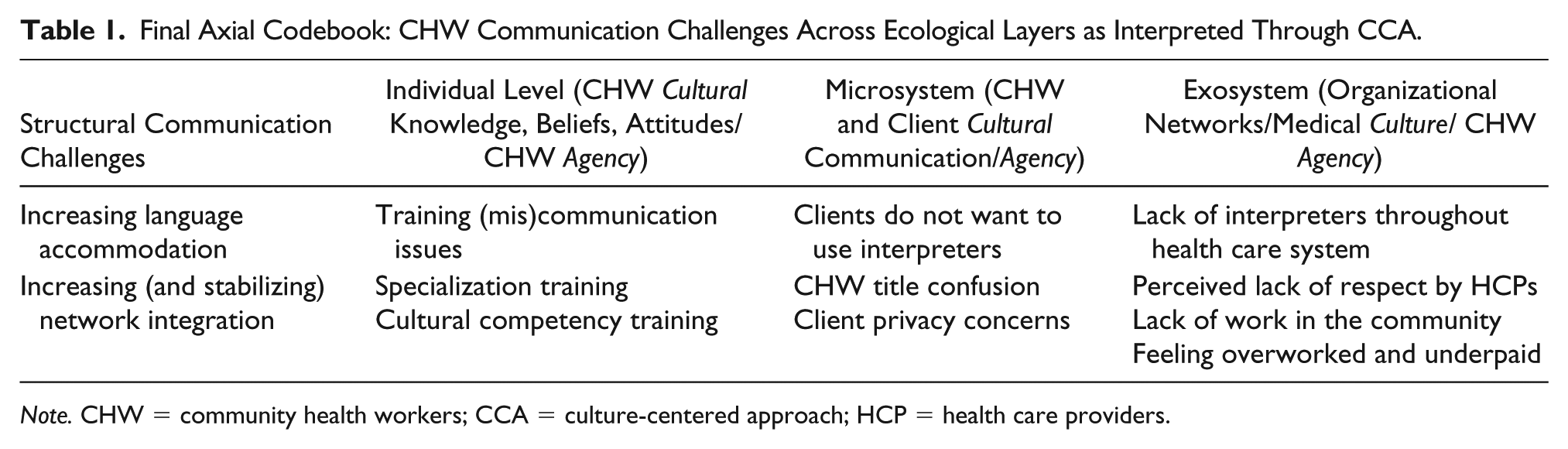
Note. CHW = community health workers; CCA = culture-centered approach; HCP = health care providers.
Increasing Language Accommodation
Results suggested that language, operating across the ecological levels as presented in Table 1, both constrained and enabled CHWs to work with community members and health care providers (HCPs) or other employers.
Individual level
Several Spanish-speaking CHWs reported that while sharing a language with clients allowed them to advocate for and facilitate trust with community members, their native Spanish created communication challenges when participating in English-only training seminars, where sometimes facilitators spoke too quickly. CHWs reported “missing out on information,” “not understanding” some of the material, having to restudy and relearn information, and experiencing trouble translating it back to others. For these CHWs, Spanish proficiency made them more valuable to their higher status employers, yet their English proficiency served as an external reminder of their lower status group identity because their individual communication needs were often not considered in their job-related training. For example, Claudia (30) was born in Mexico and has lived in the United States for 18 years. She is a CHW for a local Federally Qualified Health Center (FQHC) in a rural town (around 8,000 people) and works with mostly Latinx patients who are diabetic and/or who have high-blood pressure. She said she would prefer training in Spanish because Just knowing the vocabulary, the correct vocabulary that would be a plus. Just that we would be able to use correct vocab; vocab, that’s the main thing. ‘Cause when you take it in English, then when you try to translate that to Spanish, you lose some of it opposed to if you were to learn it I think in Spanish, you would be able to deliver the message more complete.
Santiago (42) is a CHW who promotes healthy eating to his urban and suburban community members, those of all ages and racial backgrounds, including Latinx children and families. He was born in Mexico, has lived in the United States for 16 years, and works for a community health center. Spanish is his native language, and he said an interpreter during CHW trainings could help meet the learning needs of all participants. He compared it to school-based programs, where “they have put in a system, some headphones and they have like a small apparatus and there is another person . . . They are next to the person that is presenting but they are interpreting for everyone.” Thus, CHWs wanted more of a person-centered training approach with communication accommodations related to their individual language needs and abilities (e.g., an interpreter), resulting in a deeper understanding of health topics while also keeping a connection with other HCPs in training seminars. These accommodations would allow CHWs to meet employers learning expectations (i.e., learn medical terminology), but also allow an increase in perceived effectiveness when working with community members through learning medical information in their native language.
Microsystem
Some CHWs met with a significant cultural communication barrier: Patients did not want to use interpreters who were members of their cultural in-group. Issa (40), a CHW born in Chad who works for her local health department, works primarily with immigrant and refugee women and children in her urban community, including Latinx individuals. She said, “They are worried about people talking out in the community. It happens a lot . . . I keep telling them, ‘You need to complain about that, you need to say something.’ And, they said, ‘Well if we say something they will lose their job.’” Even though interpreters know they should keep patient confidentiality, Issa explained sometimes interpreters were acquaintances and felt they should pass on information to those concerned for those patients, thereby enacting a cultural value of collective concern. Thus, patients who perceived a shared cultural identity with interpreters felt a need to protect interpreters’ economic well-being more so than their own personal well-being when talking to HCPs, who were perceived as cultural out-group members with more power.
Exosystem
CHWs were concerned about the lack of interpreters, but felt organizations did not hear their complaints. When health care organizations did not adequately staff interpreters at their facilities, CHWs said HCPs commonly used cleaning staff to fill the gaps, whereas patients asked their children to interpret on their behalf. In these instances, health care organizations privileged their high-status professional identity and communication concerns (i.e., HCPs and informed patient consent) over both the lower status professional identity concerns of cleaning staff (i.e., threat to well-being from a lack of training in how to communicate sensitive information, lack of compensation for extra work) and lower status identity concerns of patients (i.e., right to privacy and confidentiality). For example, Delores (66), a CHW born in Mexico, talked about when she was the only interpreter in her rural hospital: For an entire hospital! All the cleaning people were Hispanic women, low-income Hispanic women . . . They would call them into the room and say, “Can you explain to her that we’re going to be taking her stitches out or we’re going to be doing this or procedures consent?” I mean, that’s a liability issue.
CHWs considered the practice of using untrained, informal interpreters unethical, but did not have power to stop HCPs from using cleaning staff for certified interpreters.
CHWs also discussed the importance of having more interpreters throughout the health care delivery system, especially for discussion of medication directions, which may or may not be understood at the doctor’s office, but then are given in English at the pharmacy. During a home visit with a patient, Issa said instead of giving medication in the ear, a mother was orally giving medication to her child who had an ear infection because the mother did not understand how to use a medicine dropper. Thus, CHWs felt that the lack of language accommodation throughout the health care delivery system continued to reinforce their own and their patients’ lower out-group status, despite CHWs having been hired to bring vulnerable “others” into the health care system.
Increasing (and Stabilizing) Network Integration
The second theme focused on CHWs’ efforts to work within and change current structures to improve health disparities for the Latinx community. Some CHWs were able to enact changes within their organizations, and others were advocating for these changes to increase their perceived effectiveness. Like the first theme, we organized results around the individual level, microsystem, and exosystem of communication behavior.
Individual level
The main challenge was that CHWs desired more knowledge about health and health care policies (beyond the basics) to increase their perceived effectiveness with bringing their clients into the health care system. Desire for more training emerged in two different categories: (a) specialization training and (b) cultural competence training. For health topic training, CHWs expressed a desire for in-depth, specialized knowledge, such as diabetes prevention, linked with certifications. Karen (62) is an African American CHW born in the United States, who works with Latinx community members in an urban health clinic. She explained, My goal is that we have people who—I’ve got two people broken down in my area. One is really straight on physical exercise, the other one’s on nutrition and education. That’s how I’m doing it here. And you use what you have, you know.
She went on to explain that for these specializations she would like to implement certifications, which would standardize the education required, allow CHWs to provide evidence of knowledge, and increase credibility when working with community members and HCPs. For example, We have requirements. In other words, for somebody to sell health insurance, you have to meet a certain requirement, you have to pass the test. You have to do all these things, you have to show your knowledge base, you know. We did the same thing for ours, community health workers. And then our community health workers can specialize in certain areas that they want to, you know, their area, they liked working in pediatrics or working part-time like with children or with elderly or with pregnant women or males.
Some CHWs, like Andrea (38) want a degree instead of certification. Andrea, a Latina-CHW born in Mexico, volunteers in an urban community health center and said, I would like it if we had a legitimate title, a title that means something like a nurse that has her degree, not just a piece of paper that is a certification of assistance. I would like to see a change so that they would see that we are necessary in the community to help the medics [in] the hospital so that these people can be seen. That’s what I would like, that we would be recognized concerning the work that we do.
Not every CHW has even certification opportunities, though. In the 41 states where required certification for CHWs does not exist (such as Nebraska), CHWs typically obtain training employers require, ranging from basic training in medical terminology to more in-depth training around certain disease prevention information (e.g., breast cancer screening) (Association of State and Territorial Health Officials [ASTHO], 2017). Some CHWs believe they have “enough” training while others, such as Miriam (32), who was born in El Salvador and works in a local health department for a town of around 50,000 people, said she wants “more training concerning our job.” She said she sometimes feels “a little bit limited because I feel like I don’t have sufficient, well, sufficient understanding,” especially in connecting clients to other community resources.
In addition, as the front-line health workers in their communities, CHWs recognized the quickly changing ethnic and racial demographics, such as an influx of refugees and immigrants, and desired more “culture sensitivity” training to increase their effectiveness with different cultural groups. As Issa explained, I need training working with new like refugees who are coming into the country. . . . I haven’t worked with them but I’m sure I will be working with them anytime soon so. . .Because I don’t know anything about that culture yeah, so I need to know more about that culture on how to come, when I go to their home how do I need to, do I need to remove my shoes? Or should I walk in with my shoes? Or do I need to sit down on the floor or the couch? So, yeah, cultural things.
Caroline (42), an African American CHW born in the United States, reflected on the out-group status of her urban Latinx and African American clients and did not want other cultural groups to experience that from her care: If you have any type of prejudices, or any type of biases, you’re adding to the barriers that the person that you’re trying to face is already facing, because maybe you’re not going to work as hard, or maybe you’re not going to give them as much attention, or you know and you may or may not be aware that you’re doing that.
Because CHWs work closely with their communities and often understand the marginalization of minority voices, they are especially attuned to the changing cultural identities of the community. They want to empower themselves through additional training to meet the changing health needs of their increasingly diverse communities.
Microsystem
Two main issues with communication were identified in our data: (a) official name recognition and (b) client privacy concerns. CHWs reported desiring more official name recognition for their professional title “Community Health Worker” so that the community and HCPs more readily recognize who they are and their services. CHWs said they often use titles that are more descriptive of their roles—health promoter and health advocate—titles that have positive connotations for the community. Some CHWs avoided titles all together and instead focused on their purpose: to help others. Yolanda (53), a Latina CHW who was born in the United States, works in a local health department in a town of around 15,000 people. She said her clients mistrust the phrase “social worker,” so she avoids titles all together and explains CHWs to her clients, “we’re just here to just make sure you’re healthy and we’re here to support you in any way and that’s all.” Likewise, Esperanza (57) is a Latina CHW who works in a hospital in a town of approximately 10,000 people. She primarily works with patients who have diabetes and mental health issues, who “have no idea” what a CHW is. Because they already know her from the community, she tells them “I’m here to help them, and I talk to them a lot, you know, especially the diabetic, what services we have, what the special is that we have here in the hospital, where they can go.”
Sebastian (34), a CHW born in Mexico who has lived in the United States for 10 years and works for an urban FQHC, helps patients manage diabetes, obesity, cardiovascular health, and substance use. He explained that in the past, he used titles such as “health coordinator” or “patient support specialist.” However, now, he specifically uses “community health worker”: . . . to help promote that branding of the profession. There’s a lot of different names and I think that increases the confusion within organizations, clients; even community health workers themselves are not sure how to define what they do because, for example, my job, they weren’t looking for a community health worker. It says, it said “health coordinator” . . . so there’s so many names, so now I try to use community health worker as much as I can, to standardize, to create that standard . . . Sometimes I have to explain what a community health worker is.
This desire for official recognition also introduced tensions with trust in their overlapping roles as a CHW and a community member. Karen talked about her urban center’s sexually transmitted infection (STI) testing service and sympathized with clients’ desires to forgo testing if it meant others in the community would know their health status. Because the STI tests were culturally taboo and therefore, stigmatized, Karen arranged for another CHW from outside the community to come to the center to perform the tests: I didn’t want them thinking that if they went to church they’d see the CHW, and they’d feel somewhat embarrassed by it, seeing them out you know what I mean. [The other CHW] wasn’t going to be in their circle of their world and their neighborhood, you know. She lives somewhere else now. [If] they saw each other at a grocery store or somewhere way out where [the health care worker] lives, that’s a different matter. But day to day they wouldn’t be seeing her here every week at church or anything like that you know.
In addition to respecting cultural attitudes toward screenings, as both a member of the community and a CHW, Karen also shared the privacy concerns and mistrust that her clients often experienced when working with HCPs, even other CHWs, from outside the community: We have to sign confidentiality agreements like anybody else. But that—that sometimes concerns me you know. . . My question has always been well what happens when a person leaves that organization? What—is the HIPAA law with that organization or is it with that person? You know, you’re a nurse, or you’re a doctor with an organization and you have patient information and you leave . . . how can the organization guarantee that once you’ve left, you know, that you’ll follow [HIPAA]?
Thus, CHWs experienced tension between promoting themselves to strengthen recognition within the community and among other HCPs, including other CHWs, and explaining what CHWs are to their clients in meaningful ways that they could understand. Some CHWs were also careful to structure their health care services in a way that allowed clients to receive care for stigmatized conditions (i.e., STIs) from CHWs with similar cultural backgrounds, but who lived outside their neighborhood to preserve client privacy. This flexibility, however, occurred in an urban environment where it may be easier to preserve anonymity, versus a rural environment with a smaller population, fewer available health care resources, and thus, more overlapping roles for CHWs.
Exosystem
Results indicated that CHWs experienced three main communication challenges when navigating their role identities when working with health care organizations: (a) lack of respect from other HCPs, (b) lack of work in the community where they felt they were most beneficial to clients, and (c) feeling overworked and underpaid by employers. In regard to perceiving a lack of respect from other HCPs, CHWs talked about being referred to as “interpreters,” even though they provided several other services to clients, including connecting clients to much needed community resources, and helping them navigate the billing procedures of the health care system. For example, Claudia said that her official job title at the rural FQHC where she works used to be “interpreter” even though she did “a little bit of everything” at the community clinic, such as answering phones and scheduling appointments. She said 2 years ago, her title officially changed to “community health worker”; however, “so many think what we do is interpreting . . . so they still call us interpreters . . . so that hasn’t exactly changed yet.”
Julissa (32), a Latina CHW born in the United States, who works in a rural community health center, shared her desire for more status alongside other more traditionally powerful HCPs: I just think respect from the providers and nurses and whatnot. . . . When you come to like the hospitals, to other clinics . . . it’s kind of we’re kind of looked down upon, “Oh, she’s just a friend; are you a friend?” “No, I’m the Community Health Worker.” Um, what does that mean you know? So I think they need more education on what a Community Health Worker is and what the capabilities of that Community Health Worker can do.
Esperanza agreed and would like the HCPs she works with in her rural, regional hospital “to know what a community health worker could do for them. To let them know that we are here and we not taking nobody’s jobs, you know. Yeah, we not taking those jobs from no one.” Alejandra (31), a CHW born in Mexico who has lived 12 years in the United States, believed that the lack of respect trickled down from the higher status, more highly educated supervisors in her urban health clinic: Especially within you know, with the administration persons and it’s kind of hard to see how people with high level of education, I can say that sometimes they act like we don’t have any education you know, the way they treat you.
Angela (45), a Latina CHW who was born in Mexico and has lived in the United States for 23 years, works for a community health center educating urban and suburban patients about sexual health. She cited the need to integrate CHWs to improve health care for patients: “If there was more of a unity between promoters and medics and if the medics would give the promoters a chance to do a follow-up with the people, I think that would facilitate communication with medical services with patients.”
Another challenge for CHWs is employers’ increasing requests for CHWs to work in brick-and-mortar buildings. CHWs want employers to encourage more community outreach to help their clients access health care services, instead of waiting until patients find the clinics to help them navigate services. As Caroline explained, I think just having us and housing us quietly and secretly and saying, you know the community health worker can do this or is available to do this but we’re not out in the front lines making that difference. It’s just kind of a waste of a resource. Like I said I’d like to see us utilized in the clinic and also in the community so once the community finds its way to the clinic, they already have some knowledge about their health and what’s going on and then it’s reinforced once they come inside to get help for that.
Katherine (25), a Latina CHW who was born in Mexico and has lived in the United States for 15 years, agreed. She works for a community health center in a town of around 23,000 people and said she does not always feel she is helping patients in the way she would like because “when there are a lot of patients, I’m running around and I feel I don’t give them all the time that they need.” For that reason, she wished that they could “go out more often and let people know that we are here.”
A third challenge is that CHWs believe they are constantly “on call” for their jobs. CHWs mentioned that self-care and employer emotional support are two solutions; however, they also widely mentioned the need to sustain CHW efforts through stable salary or hourly pay and more regulation of their workload. As Karen explained, Doctor’s offices can close 8-5 then you get your answering machine. We have our home number. People call us. And they call our community health workers because they know them. They’re in church, they see them every day. That’s the other disadvantage, you want to say, you know. So it never ends you know. . . . I think we just have to find a system for—to pay our community health workers. You know I could get the grants and things, but I’m talking about on a consistent basis, ongoing basis. We have to show them how we appreciate them more, you know.
Ligia (43), a Latina CHW who was born in Mexico and has lived in the United States for 10 years, agreed. She is employed at a local health department in a town of around 50,000 people and is paid through a temporary grant: The funds will last for one more year but after that we don’t know what’s going to happen. It would also help if we had our work times more established. And once this is over, we will be able to help, but not as much since we won’t have as much time available since we have to find another job. So if we want to get this to grow, I think that there needs to be more constant support.
CHWs widely recognized the rising cost of health care, but also recognized that CHWs have demonstrated value in improving health disparities for vulnerable populations. Caroline said, You know I understand that money is a driving force for a lot of organizations, especially for nonprofits and community health centers, so I think it’s an underserved, an unsung profession. Community health workers are the boots-on-the-ground people and they have to be equipped with a lot of knowledge and skill and resource, and that’s just in training. So personally they have to be approachable and trustworthy and there’s a lot of other things that go into it to make these, to make that population, you know, open up.
As a way to advocate for themselves (as a collective group) and demonstrate their value in their respective community, some CHWs began carefully gathering and documenting evidence of their demonstrated effectiveness in meeting clients’ health needs even though they were not sure if, and when, this information would be used. Karen explained, This is volunteer for us. . . . We’re not reimbursed for anything. But I’m still collecting. I—I—because I’m building up this case for community health workers that [we] should be paid. You know, but I—I guess I’m not so sure that’s gonna ever happen though.
Yet, this data gathering adds to the risk of CHW burnout. As Beth (55) a Native American and White CHW said, she wishes she could simplify data entry of client details because it is time consuming and takes away from the time she could spend serving additional clients. In her job at a rural health department, she visits clients’ homes and each visit requires about 3.5 hours, 1 hour of which is data entry: Data’s uncomfortable. If I could do my home visits and, and you know just have a little tape recorder that says I, you know, met with the family today and they’re doing awesome or met with the family today and this is the challenge and be done, that would be like my dream [laugh].
Finally, to be hired for pay requires legal immigration status. As Sandra (41), a CHW who volunteers at an urban health center educating patients about diabetes, nutrition, and sexual health, said “Many of us don’t have that for one reason or another so that’s what really clips our wings. It clips our wings more than the language barrier does.”
Thus, CHWs are valued in terms of the services they provide in connecting clients to health care services, yet they are constantly in contact with clients and therefore, are constantly enacting their roles as CHWs even when not representing their organizations. This is doubly challenging for sustainability if they are unpaid for their job even when they are officially representing their organizations (e.g., in states that do not have a required CHW certification program). Still, as demonstrated above, within multiple levels of communication behavior, CHWs (a) feel constrained and empowered by the (lack of) language accommodations, and (b) actively seek to increase network integration as a way to amplify their voice, allowing them to better serve populations experiencing health disparities.
Discussion
The current study explored the communication challenges experienced by Community Health Workers (CHWs) when working with Latinx populations to improve health equity. Results indicated that CHWs are both constrained and enabled by multilevel communication structures in their cultural communities and health care organizations. Extant research focuses on CHW effectiveness in decreasing health disparities. The current study adds to this literature in novel ways: (a) focusing on the voices of CHWs; (b) recognizing that CHWs have unique insights based on their cultural and role identities that need to be included in any health care access and workforce discussions; and (c) showing how CHWs perceive that their voices are not often heard by other higher status HCPs and policy decision-makers, and so they are seeking to change the perception of their work by others, including community members and clinicians. Implications for this research are discussed, both for CHWs in the United States as well as within the local context of Nebraska (and other similar states).
Including CHW Voices in Health Care Policy
The current findings contribute to the goal of creating a sustainable CHW workforce by focusing on CHWs’ perceptions of what is most important to job effectiveness. The findings showed that CHWs experience a lack of accommodation in two main ways. First identified was training delivery mode (i.e., translation) and scope (i.e., more specialized training). The 2010 Patient Protection and Affordable Care Act (ACA) increased focus on CHWs as valued members of integrated health care teams to increase health care access for vulnerable populations, reduce health care costs, and improve the quality of health care services. Yet the lack of standardized requirements for education, training, and certification are key reasons that many scientific and health care communities continue to minimize CHWs. Not only did the majority of our CHWs want more training, but also without this formalized role development, CHWs were left without legal protections, which are especially important for medical personnel (O’Brien et al., 2009). Researchers have called for formal recognition of CHWs through state certification programs, enhanced medical/nursing education in how to work best with CHWs, and stable funding to support a CHW workforce. Yet few states have moved forward with these initiatives (i.e., 9 have CHW mandatory certification; ASTHO, 2017; CDC, 2016). Although the current study occurred in one state, Nebraska’s CHW policy is in flux and therefore an ideal place to conduct this study where momentum is building for CHW regulations, but no law governing certification exists.
Second, findings showed that CHWs experience a lack of interprofessional communication with other clinicians, such as physicians and nurses. Findings fill an important gap within health care team communication, especially within hospitals and community-based clinics, where hierarchical power dynamics and community issues with legitimacy and trust occur. To date, research on health care interprofessional communication conflict has focused within hospitals between nurses, physicians, and other specialists (e.g., Hewett, Watson, Gallois, Ward, & Leggett, 2009) and patient–physician communication (e.g., Hagiwara, Dovidio, Eggly, & Penner, 2016). While the CDC (2018) recognizes that integrating CHWs into clinical care teams is effective in meeting community needs, several of our participants suggested that medical schools should implement CHW certificate training programs while also training their providers how to work well with them. For example, most health care education materials are at an 11th-grade level (O’Brien et al., 2009), whereas 21% of our sample did not have a high school diploma. Likewise, a key finding in the current study was that CHWs wanted other health care providers to recognize that their job went beyond translation and included deeper level cultural knowledge and relationship building that takes considerable time and effort to develop. Understanding and improving how CHWs and other health care team members interact is an important step toward effectively integrating CHWs into clinical teams.
Finally, as researchers and practitioners work together to develop ecological solutions to complex health problems, CHWs should be viewed as an important part of the mesosystem in their communities, the layer that connects all of the other layers to each other (Moran et al., 2016). In this meso-position, CHWs experience continual tensions in communicating, navigating, and pushing against health care structures while negotiating cultural norms, beliefs, and values with their community members, building and maintaining personal relationships, advocating for them and encouraging them to access health care services. Some CHWs mentioned that organizations and communities should capitalize on CHWs’ unique strengths (i.e., relating and communicating with culturally similar others), allow CHWs to “go to where the people are” (e.g., homes, churches, schools, community centers, and health care organizations; Viswanathan et al., 2009), and organize more community health fairs, support groups, fitness and cooking classes, and community education presentations (Rhodes, Foley, Zometa, & Bloom, 2007). As vital members of health care teams for marginalized populations, CHWs’ voices are essential in informing refinements of health care research and policy development.
Building a Sustainable Workforce Across Local Co-Cultures
The current findings have implications for CHW effectiveness in communities with growing ethnic minority populations and low-resource environments, especially rural and community-based clinics, where staff shortages are problematic and community needs are high. In Nebraska, rural towns, community clinics, and hospitals are often challenged to meet language, cultural, and health needs of growing and changing immigrant and refugee populations. Latinx populations currently make up from 3% to 75% of towns’ populations (Statistical Atlas, 2018), with 36% being immigrants (Pew Research Center, 2014). Nebraska has also seen a shift in resettlement patterns, with most refugees arriving from Sudan (2002–2006), Burma (2007–2016), and Iraq (2017), adding to the diversity of health needs across the state (Pew Research Center, 2017). In the current study, CHWs primarily worked with Latinx communities but were also increasingly working with other cultural groups, even though they expressed not feeling culturally prepared to do so.
With demographic changes, perhaps it is not surprising that a key finding in our study was the amount of burnout that CHWs seem to be experiencing. Several CHWs talked about a lack of resources, training, time, and staff to meet the changing needs of Latinx populations, but also other immigrant groups, in their communities. This finding mirrors national calls for “data to make the business case” for cost-effectiveness and cost-savings of integrating CHWs into health care (Pittman et al., 2015 p. 3), as well as creating stable pay for CHWs, which is key to formalizing a CHW profession (O’Brien et al., 2009). To move toward this goal, several CHWs mentioned that they are collecting data to show their effectiveness to build a case toward stable pay. Although they were not paid for this extra documentation, CHWs tracked hours, responsibilities, need for their services, and improved health care outcomes to provide evidence of their role in closing the gap in their communities’ health disparities. Few were hopeful their working conditions would change anytime soon, yet they continued to gather documentation to enhance their credibility.
Second, several of our CHWs mentioned continued efforts to support organized professional support networks, such as the local Community Health Worker Association through Nebraska’s Public Health Association Network, which encourage mutual informational and emotional support as well as best practices among CHWs. Although a supportive professional group like this is attractive to CHWs, the challenge is finding the time and the energy while balancing current responsibilities. Third, to reduce the burden on CHWs, employers could partner with other social service providers (e.g., compañeras, shown to improve Latinx immigrants’ biopsychosocial outcomes [e.g., hope, reduced fear, higher self-esteem] by providing emotional, spiritual, and physical accompaniment; Villarreal Sosa, Diaz, & Hernandez, 2018). Finally, CHWs need to be included in discussions and decision-making about improving the efficiency of their work. This includes finding effective ways to incorporate technology to minimize paperwork (Braun, Catalani, Wimbush, & Israelski, 2013), creating standardized evaluation outcomes and standards (O’Brien et al., 2009), and creating multifaceted, multilevel interventions to improve medical outcomes as well as structural barriers (Gale et al., 2018; Rhodes et al., 2007).
Limitations and Future Directions
The findings from current study should be viewed in light of limitations. First, the study takes place in Nebraska and does not explicitly capture CHW workforce development efforts in other states. The culture-centered approach and CHWs themselves argue for in-depth examination of each local context to understand the unique cultural, structural, and agentic forces in operation in specific communities and health care systems that heavily influence CHW effectiveness (Dutta, 2008; Hodgins et al., 2013). However, as we have illustrated in this article, some common concerns exist across the majority of U.S. states (e.g., similar immigration pattern changes, lack of health insurance and other health care resources). As policy efforts continue to build the CHW workforce across the United States, evidence-based best practices to improve health and increase resources should be shared across communities, particularly those with quickly changing demographics. Indeed, several of our CHWs mentioned that they wanted to network with other CHWs to share information, learn from others, and support the profession. Second, in recent years, growth in immigrant populations in Nebraska were Latinx, but for refugee populations were not Latinx. In our study, it is unclear if the CHWs were serving Latinx people who were immigrants, refugees, or an intersection of both identities. The specification of immigrant and refugee Latinx identity is important when addressing which clients have, hope to have, or do not have access to health care and insurance, and future studies should address these intersections.
Future studies could also examine other ecological layers that may affect CHW workforce development efforts. For example, two layers not explored in the current study are the macrosystem (i.e., policies) and the chronosystem (i.e., contextual influences of sociohistorical conditions and time; e.g., immigration policy changes). The current U.S. administration’s immigration policies had not been implemented at the time these interviews were conducted. For example, there have been recent U.S. Immigration and Customs Enforcement (ICE) raids (e.g., in a small Nebraska town that resulted in the arrest of employers and more than 100 immigrant workers; Flynn, 2018), which increase immigration enforcement stress and lower self-rated health scores, especially among foreign-born Latinx community members (e.g., W. D. Lopez et al., 2017). In addition, 1 year after her interview in the current study in an institutional review board (IRB)-approved discussion of results from several studies (including this one), one Latina CHW told the research team that she and her staff were advising community members to skip health care appointments because of possible raids. Finally, in the debate over health insurance policy (Centers for Medicare & Medicaid Services, 2018), it is unclear what the future holds for a CHW workforce that was bolstered by the ACA.
In conclusion, our findings suggest that CHWs use their agency to both work within and push against current health care constraints in meeting the needs of their clients in their cultural communities. Because CHWs understand the marginalization of minority voices, they are especially attuned to the changing cultural identities of ethnic minority communities, and desire training to empower themselves to communicate in culturally competent ways. In addition to respecting clients’ cultural attitudes and norms, some CHWs shared clients’ privacy concerns and mistrust of other HCPs (e.g., STI screenings), and enacted agency to meet these concerns by intentionally employing CHWs from outside their community. Despite barriers related to training, interprofessional communication and respect, stable pay, and resources, CHWs continue to work for change on a daily basis. By combining CCA with analyzing CHW communication challenges and solutions according to multiple ecological layers, we gained a more nuanced view of CHW experiences and perspectives. Past research rarely considered the voices of CHWs to improve health care delivery to reduce health disparities. This study, through the CHW navigation of two group identities—health care practitioner and community member—across three ecological layers, is a step in that direction.
Supplemental Material
supplemental_Appendix_A – Supplemental material for Listening to the Voices of Community Health Workers: A Multilevel, Culture-Centered Approach to Overcoming Structural Barriers in U.S. Latinx Communities
Supplemental material, supplemental_Appendix_A for Listening to the Voices of Community Health Workers: A Multilevel, Culture-Centered Approach to Overcoming Structural Barriers in U.S. Latinx Communities by Angela L. Palmer-Wackerly, Virginia Chaidez, Caitlyn Wayment, Jonathan Baker, Anthony Adams and Lorey A. Wheeler in Qualitative Health Research
Supplemental Material
supplemental_Table_1 – Supplemental material for Listening to the Voices of Community Health Workers: A Multilevel, Culture-Centered Approach to Overcoming Structural Barriers in U.S. Latinx Communities
Supplemental material, supplemental_Table_1 for Listening to the Voices of Community Health Workers: A Multilevel, Culture-Centered Approach to Overcoming Structural Barriers in U.S. Latinx Communities by Angela L. Palmer-Wackerly, Virginia Chaidez, Caitlyn Wayment, Jonathan Baker, Anthony Adams and Lorey A. Wheeler in Qualitative Health Research
Footnotes
Acknowledgements
The authors are grateful for the contributions made by CHWs for participating in this study and for all that they do; Mary Lentini, Jessie Perez, Roy Rivera, & Danielle Wing for reviewing interview questions and providing feedback; Margarita Allen at the Nebraska DHHS who assisted in spreading the word; Trina Aguirre in College of Nursing at UNMC who assisted in recruitment; Bureau of Sociological Research (BOSR) for transcription of English interviews; Dina Morales for transcription and translation of Spanish interviews; and Brianna Cassidy and Erin McCready for assistance with background research.
Declaration of Conflicting Interests
The authors declared no potential conflicts of interest with respect to the research, authorship, and/or publication of this article.
Funding
The authors disclosed receipt of the following financial support for the research, authorship, and/or publication of this article: This research was supported by the Nebraska Agricultural Experiment Station with funding from the Hatch Act (Accession Number 1011764) through the USDA National Institute of Food and Agriculture; and the Social and Behavioral Sciences Research Consortium (SBSRC) Voucher Award at the University of Nebraska–Lincoln.
Notes
Supplementary Material

Author Biographies
References
Supplementary Material
Please find the following supplemental material available below.
For Open Access articles published under a Creative Commons License, all supplemental material carries the same license as the article it is associated with.
For non-Open Access articles published, all supplemental material carries a non-exclusive license, and permission requests for re-use of supplemental material or any part of supplemental material shall be sent directly to the copyright owner as specified in the copyright notice associated with the article.
