



Abstract
Filial piety is a highly relevant cultural mechanism that mediates the impacts of caregiving experiences on Chinese adult children, worldwide but perhaps especially in rural China. We undertook qualitative research with 24 migrant workers who were caring for an elderly parent diagnosed with terminal cancer. Research aims included building a comprehensive explanatory theoretical model for filial piety’s mediating role in caregivers’ lived experiences. We undertook a culturally sensitive Foucauldian discourse analysis of data, which showed that filial piety can not only function as a positive resource but also (mainly) translate to a requirement for secrecy, including about an ill parent’s prognosis and the need for support for caregivers. The findings challenge the extent of this secrecy and the burdens it places on caregivers. Policy makers should take account of the importance of filial piety and its mediating role both as a resource and hindrance to providing support to caregivers.
Keywords
Introduction
Family caregivers (adult children in this research) are critically important for the well-being and welfare of elders diagnosed with cancer (Pizzo et al., 2015). The quality of life of care receivers usually depends at least in part on the well-being of family caregivers (Sandstedt et al., 2018). However, in developing countries, there are often limited resources and services provided for caregivers. Without support, constant caregiving can lead to frustration among caregivers; these negative impacts may cause them to abandon their caregiving role (Chadda, 2014).
In rural China, patients extensively rely on family caregivers due to a lack of formal care institutions and the disadvantaged welfare status of elders in contrast with their urban counterparts (Wen, 2017). In recent years, due to an unprecedented rate of population aging and increasing incidence of cancer (Chen et al., 2016), the importance of family caregivers for elderly parents diagnosed with cancer has become increasingly amplified. While family care continues to be expected to be the main source of care for rural elders, there are rising concerns that there will be no adult children to provide this caregiving, due to massive urbanization and domestic migration from rural to urban areas among mainly young people (Wang, 2016).
Worldwide, in assuming a caregiving role, family caregivers are susceptible to various forms of care stressors (Feinberg & Spillman, 2019). For instance, taking care of an elderly parent with a terminal illness can take a physical, emotional, and psychosocial toll on caregivers (Ugalde et al., 2012). Because hospitals in China do not provide some of the cares considered basic or standard in Western hospitals, such as feeding, washing, and clothing and bed changes for patients, Chinese family members substitute for these hospital care tasks (Xu et al., 2016). Being required to be present at the bedside commonly results in reduced hours of paid work and consequent financial burdens.
There are some well-established theoretical models that have been developed to examine caregivers’ care experiences. For example, the stress process model considers burden to be comprised of lived experiences influenced by care stressors, sociodemographic characteristics, and external resources (Pearlin et al., 1990). This model considers responsibility (e.g., family responsibility) as a form of burden (Streid et al., 2014), and the potential positive outcomes of responsibility are thereby neglected. According to Corlett (2016) and Goldblatt et al. (2018), burden represents worrisome and oppressive experiences but fulfilling responsibilities can instead generate spiritual strengths and other related benefits for caregivers. In our research, we adopted their differentiated definitions of burden and responsibility. Another model, the family system illness model developed by Rolland (2005), focuses on the positive side of caregiving experiences. It views the terminal illness of parents as an opportunity for adult children to learn and gain inner strength and cultivate an ethical self. However, this model omits attention to the realistic burdens and challenges that caregivers have to face because of the illness and associated caregiving.
The two kinds of models described above overlook the cultural dimension of caregiving. According to Ebrahimi et al. (2018), cultural phenomena, such as strong family bonding and relatively high levels of social support from extended family members, often provide resources for facilitating caregivers’ coping capabilities which mitigate care burdens. Therefore, it is necessary to consider cultural context when examining caregivers’ care experiences. According to St. André (2018), filial piety is increasingly recognized to be one of the crucial concepts that can explain salient differences between Chinese and Anglo cultures. St. André also contended that filial piety is strongly and almost exclusively associated with Chinese societies, although many scholars (e.g., Aires & et al, 2019; Park, 2015) have claimed that filial piety also exists in other (usually Eastern Asian) cultures. Filial piety is an important cultural mechanism that mediates caregiving perceptions and practices in Confucian cultures (Ikels, 2004). According to C. Luo (2013), filial piety generally refers to respect and care for one’s aging parents, as well as obedience and reverence toward them. Studies such as M. Li and Dong’s (2019) demonstrated that there is an identifiable relationship between filial relations and mortality risk of elderly parents in China.
Most of the literature on filial piety and family care has been focused on caregiver research exploring the meaning of filial piety and its transformation within contemporary Chinese societies (e.g., Jiang, 2014). Research directed at exploring the mediating roles of filial piety on caregivers’ lived experiences either focuses on its positive influence as a cultural resource that assists caregivers to accept and deal with care challenges (e.g., Khalaila & Litwin, 2011; C. Y. Li & Yu, 2018) or emphasizes its potential to magnify the extensive burden of care, especially among Chinese immigrants in Western countries (e.g., Funk et al., 2013; Rozario, 2011). The tendency of this research to dichotomize positive and negative impacts resonates with the same tendencies identified in the caregiving experience models discussed earlier.
There have been a few scholars who have endeavored to achieve a more balanced view. Chan et al.’s (2012) research on lived experiences of Hong Kong Chinese adult children caregivers discussed both positive and negative impacts of filial piety on those caregivers. They found that filial piety served as a powerful motivator for providing care to dying parents; positive impacts included the facilitation of emotional connections. However, the authors emphasized participants’ feelings of guilt and shame that were generated from a strong sense of unfulfilled filial responsibilities. Discussion of the complex multilevel nature of filial influences was limited. Ng et al.’s (2016) article on caregiving motivations among family caregivers of patients with cancer in Singapore identified several motivations for caregiving such as personal values, social expectations (filial piety), and practical needs, as well as challenges for care. Although the authors recognized both positive and negative impacts of filial piety on caregivers, their research was conducted with an urban cohort of Chinese people who lived in the metropolitan and multicultural city/nation of Singapore, which means their results may not be generalizable to migrant worker families in mainland China. Moreover, the discussion of results omitted several key mechanisms for both positive and negative impacts of filial piety. For example, the reciprocity mechanism that is inherent in cultural practices of filial piety in current Chinese society through, for instance, grandchild-raising, was missing among the motivations (Pan et al., 2017), and yet, this frequently constitutes a positive impact that is of particular relevance to working parents. Another key cultural practice, the emphasis on preventing parents having to process distressing emotions means cancer patients are often kept in the dark about their illness (Shi et al., 2019). This may, among other negative consequences, increase care burdens for family caregivers.
Therefore, it is important to develop a more balanced and comprehensive model that explicates how filial piety mediates migrant Chinese workers’ lived experiences. A Foucauldian discourse approach, such as was applied in our research, is an appropriate approach to exploring complex relationships between filial piety and the caregiving practices of a “marginalized” social group, this being migrant workers in China. The Foucauldian analysis of data showed that filial piety translated to a requirement for secrecy (about a parent’s illness, about burdens of care, and about feelings of frustration to do with government policies), and the results of the discourse analysis challenged the extent of this secrecy and the burdens it placed on caregivers. However, in addition, the analysis uncovered themes that should be of great interest to health practitioners and policy makers internationally as they shed light on the intricate complex challenges and dilemmas that are likely to be faced by family caregivers of Chinese patients. In this article, we endeavor to explain the social construction of the ethics of care when underpinned by eastern cultural norms such as filial piety and Confucianism. The matters brought to light through the identification of these themes may assist not only policy makers in China but also health practitioners who encounter first- and second-generation Chinese families everywhere.
Method
Theoretical Framework
We adopted a social constructionist approach to exploring how filial piety impacted on participants’ care experiences. According to Burr (2015), social constructionist perspectives concentrate on how meanings are produced among particular groups of people, and how those groups of people interact with social and cultural institutions and contexts. It is important to note that in theorizing our results, the social constructionist perspective did not determine an extremist structuralist position, which might exclude an agentive perspective. A social constructionist view of health issues examines established understandings of a particular practice, especially through individuals’ interactions with cultural norms (Aranguren, 2017). This perspective emphasizes how people construct discursive subjectivities in different cultures and societies and make sense of those discourses. Foucauldian discourse analysis was utilized to examine discourses that revealed how complex and sometimes seemingly conflicted perspectives on filial piety mediated caregivers’ lived experiences.
Discourse analysis is a social constructionist methodology that provides a useful lens to examine people’s subjective experiences and interactions with broader contextual forces, including cultural norms (Wodak & Meyer, 2016). There are various approaches to discourse analysis, two of which are widely utilized by social scientists. Critical discourse analysis mainly integrates linguistic techniques and sociological qualitative research methods to critique the dominant discursive construction of a social phenomenon. Foucauldian discourse analysis, which we employed, mainly utilizes Foucault’s theory to explore discursive constructions of experiences and to critique established dominant beliefs and practices (Wodak & Meyer, 2016). The reasons for our choice of Foucauldian discourse analysis are further explained in the section on data analysis in the following.
Ethics
Prior to the data collection in China, ethical approval was obtained from the ethics committee of the University of Canterbury, New Zealand. 1 Once based in China, potential participants were identified in consultation with the director of the department caring for people with cancer at the city hospital in which the fieldwork was to take place. Prior to any interviews, the participants were provided with explanations of their rights to confidentiality and how this would be protected throughout the research and in any publications. The voluntary nature of their engagement in the research was emphasized and participants were informed that they would not be penalized if they chose not to participate or to withdraw at any time. All participants signed an informed consent form before responding to a questionnaire and taking part in in-depth interviews. The purpose of the questionnaire was to collect some demographic information and to stimulate opportunities for further discussion; Chinese participants may struggle to answer open-ended questions and they are comforted by being able to answer practical questions “correctly” before engaging in more discursive reflection. However, the main focus of the Foucauldian analysis was the qualitative data obtained in the interviews and through participatory observation.
The conduct of the research was required to strictly follow the directives of the director of the hospital’s gastroenterology department. These included a requirement not to pass on information to patients without permission and not to disturb the patients when rest was required. In China, the majority of the public and many medical staff adhere to a belief that it is not healthy for patients to know much about their conditions (Shi et al., 2019). It is the norm to keep the fact that people suffer from cancer and in particular that they are terminally ill secret from the patient. Instead, family members, primarily children, are the main conduit for communication. This is not considered to be unethical by a majority of people.
Sampling and Data Collection
For the purpose of this research, we defined family caregivers as adult children who provided visible or invisible assistance with daily functioning, financial management, provision of emotional and mental support, care tasks in the hospital, and so on. We included daughters-in-law among the potential participants because in traditional filial practice, daughters-in-law, especially the eldest, are the main source of elder care. These family caregivers were originally rural residents, who are currently working in metropolitan cities far from their parents. The hospital at which fieldwork took place was in a small city situated in the second biggest labor export province in China, which is Sichuan. The province has shown markedly increasing cancer rates among its rural citizens in the last decade, in particular esophageal and stomach cancer. The care receivers whose family members were interviewed for the research had been diagnosed with terminal cancer, mainly esophageal and stomach cancer.
We utilized two recruitment methods: convenience sampling and word-of-mouth acquaintance-based snowballing. The director of the gastroenterology department helped to identify which patients were diagnosed with cancer, as the patients did not know about their condition nor would their condition show on the files attached to their beds. Four additional participants were identified through snowballing; they were introduced by the recruited participants. We decided to stop recruitment after the 24th interview, on the basis that there were no new emerging themes (DeJonckheere & Vaughn, 2019).
Participant Characteristics
Only one daughter-in-law was seen and recruited in the field hospital, others were sons (14) and daughters (11). Participants were predominantly aged between 31 and 50 years (12 were aged 31–40 years, eight 41–50 years); there was only one in the age range of 21 to 30 years, and another two were aged 51 to 60 years. Of the participants, seven were an only child, and nine were sisters and brothers to each other in three family group clusters. All of the participating caregivers knew about their parents’ diagnoses.
Data Collection
Data collection took place over almost 5 months. 2 All of the interviews in the hospital took place in the afternoon because the participants, as the main caregivers in the hospital, were too distracted in the morning. During that time, they were preoccupied with waiting for the doctors’ daily morning round and exchanging patient information with the doctor, constantly checking on the medical machines and liquid transfusion signs, and attending to other care chores.
These observations were recorded in notes and provided important contextual data although we did not attempt to pursue an ethnographic methodology. A rich description of participants’ care experiences in relation to filial piety evolved. With permission from the participants, interviews were recorded and transcribed. Following this, interviews were translated into English. The accuracy of the translation of the first two transcripts were examined and confirmed by a Chinese language expert (of Chinese origin). Further checking of the English translation of Chinese concepts was undertaken as required throughout the research.
Data Analysis
Analytic frameworks and ideas from Foucauldian scholars are partially integrated into the analysis tool for this research. For instance, Andersen (2003) developed an analytic approach that examines the construction of a discourse through making sense of the emergence of the smallest of statements that might not seem meaningful at face value but that contain deep meanings that can reveal the discursive construction of social phenomena. It not only examines the social, political, historical, and cultural context of a certain discourse and involved power relations, in search for different constructions of realities in the present, but also takes into account the subjective position of participants within those contexts and how the discourse interacts with the agentive lived experiences. Willig’s (2001) emphasis on action/practice also supplemented the development of the analysis tool for our research. Discourse of filial piety is constructed through care practices and beliefs, as well as being (re)constructive of care practices and beliefs. These authors’ well-established U.S. Food and Drug Administration (FDA) tools were combined with Chinese philosophical and theoretical approaches to ensure the richness of the collected data would be appropriately apprehended. We endeavored to develop a culturally sensitive methodology by concentrating on the similarities between Foucauldian discourse theory and Chinese philosophical traditions (mainly Confucianism). We chose to employ a Foucauldian discourse analysis because this methodology is sympathetic to Confucian theorizing and practices. Three commonalities were identified that facilitated a culturally sensitive Foucauldian discourse analysis: (a) complexity, the complexity perspective derived from the Confucian concept of tianrenheyi (seeing the universe and self as a dialectical whole) corresponds with the complexity of discursivities and power relations in the Foucauldian perspective (Foucault, 1972; C. Luo, 2013); (b) action/practice orientedness, the tradition of valuing practice and action in Confucianism, Taoism, and Chinese Buddhism, corresponds with Foucault’s valuing practice and action element in the defining spectrum of discourse as well as Foucault’s concept of technologies of the self (Feng, 1995; Foucault, 1980); (c) truth telling, the Confucian concept of junzi (a man of noble ethics), emphasizing the importance of having the courage to tell the truth, including as a researcher, even if this places the truth teller in actual or perceived danger, corresponds with Foucault’s thoughts on the ancient Greek idea of parrhesia (telling the truth; Foucault, 2012; Song, 2015; Xu et al., 2019).
Results
All participants encountered similar types of care stressors resulting from the practical need to care for their parents diagnosed with terminal cancer; they were required to provide all kinds of hands-on care inside and outside of hospital, to offer financial assistance, to be health service coordinators for their parents, and so on. Built upon such care stressors, several major discourses are described in the following, which are related to their care experiences. The discourse of care burdens described in the following relates to the second, action/practice orientedness, element in our conceptual framework; despite all the constraints and difficulties the participants encountered, they still managed to accomplish the care tasks that their filial responsibilities required of them.
Care Burden
There are several kinds of care impacts that are particularly burdensome for migrant workers.
Emotional and physical impact of care
Taking care of someone ill, who is closely related, can take a toll on caregivers, both emotionally and physically. Emotional and physical impacts are often interrelated. The participant in the following described the emotional stress and physical burden she experienced while looking after her terminally ill father: When he is not around, the pain and fear of losing him is almost unbearable. I often cry with my mom in his absence. I feel like I have lost the ability to appreciate delicious meals. Sleep has become an issue since his diagnosis for me . . . I feel dizzy sometimes too.
Financial impact of care
As migrant workers, most of my participants talked about how much financial impact the parent’s cancer had brought them. The son quoted in the following explained how expensive it was for migrant workers to come back to visit their ill parents. The second participant quoted in the following explained that as a migrant worker he could not afford all the expenses generated by his mother’s illness, even if health insurance might cover some of these: All of my siblings are [migrant workers], so I had to make sure the diagnosis was right before I could call them. If it were a small issue, it would cost a fortune for them to travel back. Money is an issue for such a big disease. Money doesn’t fall from the sky, especially for peasant workers . . . We know there is medical insurance. However, we don’t know how much it will cover. It might cover some [of the expenses], but who could help for the rest and who would? It’s [inadequate] for such a big disease. It will cost tens of thousands of RMB (Chinese dollars) for her disease, which I cannot afford.
The following statement further illustrated the disadvantaged financial position of migrant workers in the big cities and highlighted discriminatory practices that might be illegal in many other countries: You see, there is a lot of discrimination against us who came from interior China. We earn much lower wages than the local people.
Work-related impact
The lack of proximity between migrant workers and their parents made care difficult to carry out, as demonstrated in the following quote: In order to come back to see him [her ill father], I need to take a 4 hour intercity coach to Guangzhou [the capital city of Guangdong Province], and then another 35 hour inter-province coach to come back. I have a quite weak stomach.
Almost all of the participants worked for private companies or factories, where leave requests were extremely difficult to make and rarely allowed. The following quote indicated that asking for leave might lead to fines or even to being laid off: My company also has strict rules about leave applications. Usually, we only get to go back home in spring festival. I have no choice. I wanted to find some work at home, but I couldn’t. When this [my parent’s illness] happens, even if I might get fined or lose the job, I would still come back.
Discourse of Tianjindiyi (Responsibility)
At the very beginning stage of interviews, when asked what they thought about their care work load and whether they felt it might be too tiring and wearying for them, all of the participants stated that taking care of their ill parents was not at all a burden but their “natural” responsibility. Only later in the interviews, did participants begin to express the care burdens reflected in the findings described earlier. Participants’ seemingly contradictory articulations about care burdens reflected the first, complexity, element of the conceptual commonalities identified between Confucianism and Foucauldian methodologies. The initial denial of caregiving as a burden can be seen reflected in the following conversations between the interviewer and participants: No, I haven’t felt it to be tiring at all because she is my mother.
The participant said she did not feel tired because she was taking care of her mother; the relationship between a child and her parent elicited a discourse of tianjindiyi (natural). Participants, such as the two sons quoted in the following, also articulated this discourse: It is an unalterable fact that your parents have raised you, and it is tianjindiyi that you need to be filial to them. It is only tianjindiyi to take care of your parents. That is our tradition and value.
Tianjindiyi can be literally translated as the righteousness of heaven and earth. In mainstream Chinese philosophies, heaven and earth are considered to be the root from which everything grows (C. Luo, 2013). In consultation with our Chinese language expert, it was considered appropriate to use “natural” to substitute tianjindiyi in the English translation.
Filial Piety as Resource
Fulfilling “natural” filial care responsibilities can provide useful outer and inner resources for participants to draw upon. Several themes were identified in the data analysis that related to filial piety as a sustaining resource.
Personal gain
Participants appeared to believe that if they provided care to their own parents, this would set a good example for the next generation, meaning that their children would in turn care for them when they grew old. Many participants echoed the next statement, which was made by a son who was caring for his dying father: I have always known that I am doing this for my children too. We should educate them by setting good examples.
Enhanced reputation
Adhering to the principles of filial piety was expected to enhance the participants’ reputation, especially within their rural communities of origin. The participant expressed a strong sense of pride when he talked about how much he had cared for his ill mother: Everybody in my village knows how much burden I have, but I still paid for my mother’s surgery even if I had to borrow much money from people. They all know how filial I am (smiling with an apparent sense of pride) . . . There was one guy in the exact same situation from my village last year, he did not fulfil his [filial responsibilities] (facial expression indicated apparent disapproval of this other man).
Reciprocity of intergenerational bonds
Participants and their parents had formed reciprocal intergenerational caregiving relationships before cancer was diagnosed, for example, through the care of grandchildren. Grandparents are one of the main sources of support for child rearing in current Chinese society (Burnette & Fei, 2013). When grandparents help to raise grandchildren, they build credit in the eyes of their children that may eventually be exchanged for migrant workers’ care during their old age: Practically, my parents have been raising my children for me . . . I have always needed her more than she needed me in so many ways.
The parent–child relationship was also strengthened through the practice of caring. As the participant in the following said, he hardly ever verbally communicated with his father before the diagnosis. After the diagnosis, he felt his bond with his father became much stronger: My father was never a man of words. He used to beat me when I was little. We hardly talked to each other . . . This time, because of his illness, he talked about our family’s past, and I told him about my work and my child’s study . . . I [can now see] his affection toward me [reflected] in his eyes sometimes.
Spiritual strength
Fulfilling filial care duties was believed to generate valuable inner mental and spiritual strengths that could help migrant workers to face obstacles in the future, as illustrated in the following quote: It will enable me to be stronger when I face obstacles life brings me in the future. It also gives me a sense of accomplishment as being a responsible child . . . I won’t find life as difficult in the big cities.
Filial Piety as Hindrance
Two unique types of hindrances, which were brought about by the discursive construction of filial piety, were discovered from the analysis of our participants’ quotes; these were emotional hindrance and the hindrances imposed by the discourse of secrecy.
Filial piety as emotional hindrance
When someone as close as one’s parent is dying, there may be an almost universal tendency to experience fear of the loss of a sense of family wholeness (Abeles et al., 2004). Filial piety might magnify such feelings, as shown in the following quote from a son whose mother was terminally ill: Parents are like the sky (or universe); if the sky (the universe) falls, the family will be destroyed.
Another feeling was that of regret, which also appeared to be amplified by the discourse of filial piety; many participants expressed their guilt for not having done enough for their parents before the diagnosis, as did the daughter quoted in the following: I just regret I often did not do well enough in terms of fulfilling my filial responsibilities (e.g., support her mother financially and emotionally). I don’t know what I am going to do if she leaves me too soon.
Such regret or guilt was intensified by the fact that migrant workers had experienced life outside the rural area, in the metropolitan cities, but that their parents had not been able to gain such knowledge of the “modern” world: Argh [sigh of frustration], I just wish she could recover for a bit, and then I would take her to the city so that I could take care of her. She has not been anywhere as far as I can remember. I want to take her out to the cities so that she can know what it is like outside [the rural area where she lives]. This has always been my wish.
Filial piety discursively reinforced the emergence of fear and guilt. To alleviate these feelings might ameliorate the emotional distress participants experienced.
Discourse of secrecy
It appeared that in the participants’ understanding, and in the context of Chinese beliefs about the harm done by knowing about a diagnosis of cancer, filial piety was discursively translated into a series of expectations around keeping secrets. Secrets that were required to be kept included the parent’s illness and the care burdens experienced by the adult child(ren).
Not telling the parents about the cancer
From my participants’ quotes, such as the one in the following, it was apparent that not telling one’s parent about the cancer was a common practice in the field: I haven’t told my father about the cancer. I fear it would add emotional burden for him. It is the critical time for a patient to be mentally strong now . . . I persuade him to keep calm and relaxed.
Not telling might result in additional emotional labor for participants, as illustrated in the following quote: We pretend nothing happened or changed. However, when he was not around, we felt so agonized that it can’t be explained in words.
To understand how this cultural practice can have come into being when Confucianism promotes parrhesia, it is necessary to consider the socially constructed nature of “truth” and that what is considered honorable truth telling in one culture may be considered dishonorable in another. In the Chinese context, the peace of mind of elders is considered a critical social good. The practice of not telling parents about their cancer is related to the first (complexity) and third (parrhesia) element in the developed conceptual framework. While participants adhered to the expectation that they should keep their parents’ illness secret, this practice brought repercussions, which are explained in the following.
Isolation from friends and colleagues
In the Confucian discourse of filial piety, a parent’s death is considered an overly sensitive topic and talking about this, even with close friends, is not encouraged. Moreover, discussing care burdens with one’s friends or co-workers might be perceived as a covert request to be visited or to receive financial contributions or gifts for oneself or the ill parent: Interviewer: Why haven’t you told others [that your parent is ill]? Participant: They have their affairs to attend to. It would add unnecessary burden to them if you told them. Interviewer: What burden? Participant: Time and money burdens, as they might need to come to visit with money.
Not telling friends or colleagues about their emotional burden might, however, interfere with the processing of various forms of stress and distress. As the following participant explained, if she could have friends to talk to about her feelings about her mother’s illness, she would not feel so anguished: All people would have sad moments. If you talk it out [with friends], you will feel happier.
Not asking for help
Discourses of filial piety dictated that the participants should accept and undertake caregiving as their own responsibility solely. As the participants in the following suggested, in addition to not asking for help from friends, they did not think they ought to ask for help from the government: You can always squeeze in time even if you are super busy . . . You should not ask for help from others. Why? Because it is our filial responsibility! It is our own responsibilities to take care of our parents. I don’t think it is the government’s job to take care of them for us.
Discussion
The mediating role of filial piety for participants’ care experiences was multiplex and include positive and negative effects. The participants’ socioeconomic status as migrant workers was also strongly associated with the care burdens that they experienced and the way in which filial piety impacted them (see Figure 1). Being migrant workers could impose extra care impacts (emotional and physical impacts, financial impacts, and work-related impacts), which could be experienced as care burdens. Their status as migrant workers, which was the main contextual factor explored in this research, influenced participants’ lived experiences through these extra care impacts. Filial piety, as the mediator for lived experiences of care, could both buffer and exacerbate care burdens. By fulfilling perceived filial responsibilities, filial piety helped caregivers to deal with care burdens through four mechanisms (personal gain, enhanced reputation, reciprocity of intergenerational bonds, and spiritual strength). At the same time, filial piety could provoke stressful care experiences. This happened due to experiences of difficult emotions such as fear and guilt, which emotions were reinforced by beliefs stemming from a culture of filial piety. Moreover, through the discursive construction of secrecy in the discourse of filial piety, most migrant workers carried their exceptional care burdens without access to effective support from friends, professional services, or local and national government agencies.
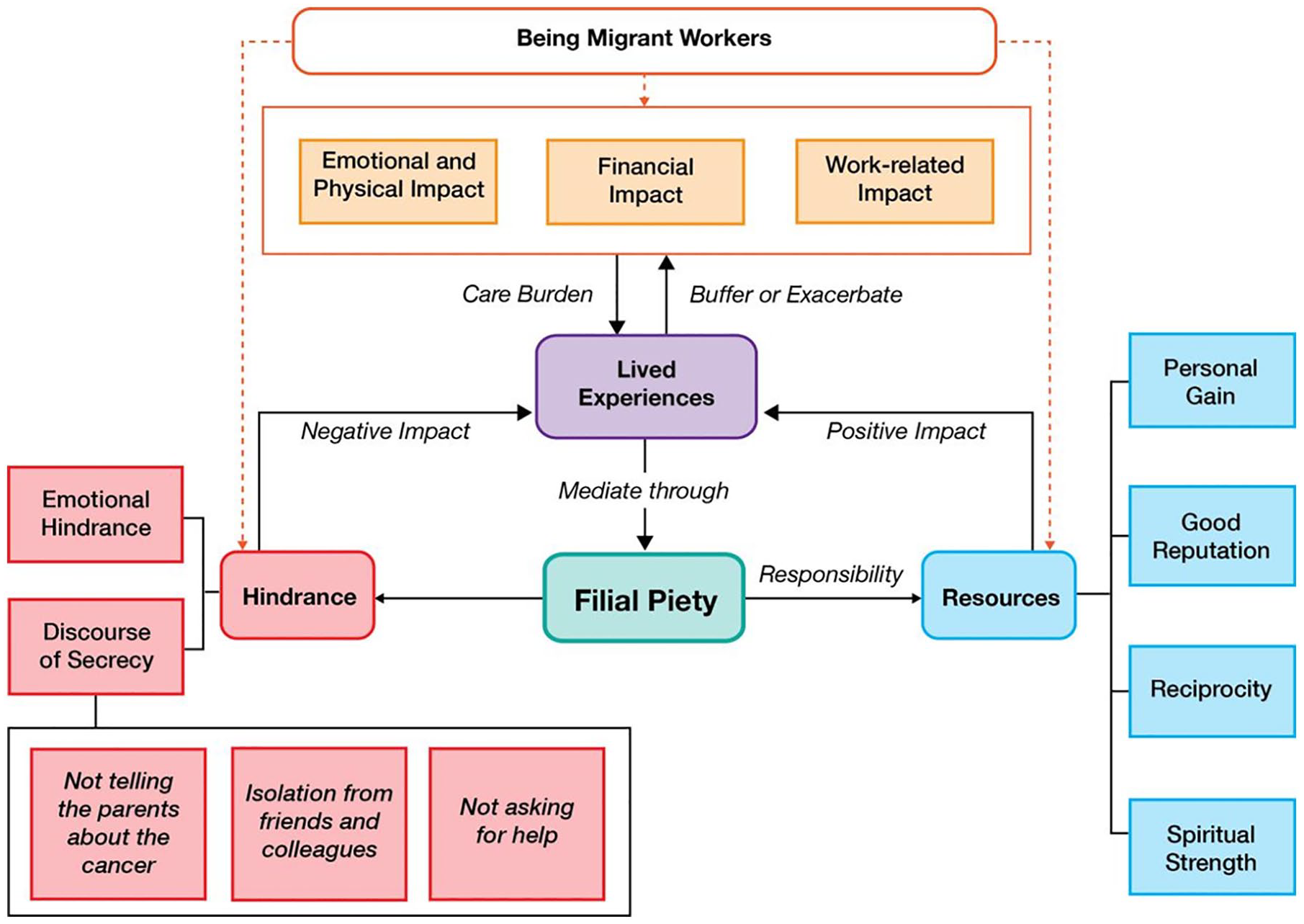
Model of the mediating role of filial piety for migrant peasant workers’ lived experiences as caregivers.
On one hand, filial piety begot practical, symbolic, and spiritual resources that migrant workers could draw on for their care experiences. First, participants believed that providing care to elder parents set a virtuous example of responsibility taking for their own children, and they hoped this might mean they would in turn be cared for in their own old age. Intergenerational reciprocity was another form of practical resource produced by adherence to filial piety; due to grandparents’ deliberate contributions to the care of grandchildren, their adult children were able to work and they wanted to repay this debt of gratitude when their elderly parents became ill. Moreover, participants expected that if they carried out their filial care responsibilities well, this would increase their cultural capital (where cultural capital refers to a series of skills, knowledge, and practices that can prove one’s cultural competence and therefore increase one’s social status in the society [Bourdieu, 1989). The belief that they would be gaining a good reputation in their community brought participants a sense of pride and satisfaction. This pride and satisfaction could further develop into a spiritual strength. Lin (2013) claimed that such spiritual strength could produce a form of resilience, which enables migrant peasant workers to handle their marginalized social status in the metropolitan cities, through occupying a cultural habitus and maintaining cultural capital of filial piety. As Ng et al. (2016) contended, filial piety emerges as a coping mechanism across all Confucian cultures when care burdens are experienced.
The abovementioned resources that migrant workers gain through their investment in filial piety are enabled through fulfilling filial care responsibilities. But participants did not carry out their filial responsibilities with a direct aim to gain resources; rather, they stated filial practices to be tianjindiyi (translated as “natural” in this research). To understand the meaning of tianjindiyi discourse, the metaphysical evolution of filial piety in the history needs to be apprehended first. Zeng (2012) stated that filial piety was gradually elevated as a revelation and embodiment of the universal truth for Chinese people, after Confucius and his followers constructed filial piety as one of the most important ethical and moral foundations for human relations. In the Kantian sense, a priori knowledge refers to true knowledge that supersedes experiences. In the Confucian perspective, such a priori truth contains moral and ethical characteristics (St. André, 2018). Therefore, moral principles, such as filial piety, are not produced socially, but exist prior to any social phenomena and practices. Thus, to fulfill one’s filial care responsibility becomes tianjindiyi, which can also be translated as universal truth (C. Luo, 2013). By abiding by a universally truthful morality, participants were able to utilize outer and inner resources to deal with the care burdens that they experienced. To some extent, the discourse of tianjindiyi, which prevented participants from talking about their care burdens, also complements the discourse of secrecy that we discuss further in the following.
While fulfilling filial piety–related responsibilities provided access to resources, filial piety could also impose obstacles on migrant workers as indicated by our participants. According to the Confucian ideology of filial piety, parents represent heaven and earth, sacrifice for one’s family, and be a backbone for children (C. Luo, 2013); as a son earlier quoted said, “Parents are like the sky (or universe); if the sky (the universe) falls, the family will be destroyed.” Other participants’ comments revealed a form of regret or guilt that many migrant workers might feel toward their parents for the lack of care and support they had provided before the diagnosis, especially due to their lack of proximity. Guilt also related to the different life experiences of the participants’ and the parents’ generations. These life experiences had been shaped by changing socioeconomic conditions and perceptions that had been encouraged to facilitate those changes. For example, as a consequence of urbanization, participants, being migrant workers, had visited and lived in metropolitan cities. These urban experiences have been ideologically constructed as something modern as opposed to backward and nonprogressive, therefore as something good for which to strive (Rofel, 2007). Participants’ parents were left behind at the rural home, for reasons such as old age, having to take care of grandchildren, and so on. This led the participants to feel guilty and regretful (Lin, 2013). Filial piety reinforced feelings of fear in relation to losing one’s parents and regret or guilt for not providing enough care before diagnosis; thus, the ideology of filial piety was implicated in increased emotional stress for migrant workers. The coexistence and interrelatedness of both supportive and stressful effects of filial piety that were identified clearly relate to the first complexity element of the conceptual framework, whereby the universe and self are seen as a complex, discursive, dialectical whole.
As mentioned previously, filial piety also translated into a discourse of secrecy through a series of discursive practices: not telling the parents about the cancer, isolation from friends and colleagues, and not asking for help. Death is considered a taboo topic in the Confucian perspective. Death should not be discussed by children in front of their parents, nor should one speak of the likely death of one’s parents to other people (Ikels, 2004). The discourse of tianjindiyi also dictates that adult children shall not talk about their care burdens as this may risk diminishing filial piety (Zeng, 2012). This belief prevented participants from asking or expecting help from others including friends, relatives, wider society, and the government. Only later on in the interview, as participants became more comfortable to discuss their burdens of care, did some critique of inefficient government policies for support begin to emerge. This critique was likely to be experienced as risky by the participants initially because it might appear to diminish their filial piety, but also because many Chinese, perhaps especially rural or less educated Chinese, are fearful of the consequences of criticizing the government. Researchers are not easily trusted with such confidences.
Furthermore, Chinese people often find it awkward to talk about death with someone who may lose a loved one, and this discomfort applies not only to friends but also to professionals. Yet, some participants overtly stated that they thought not being able to talk about a parent’s impending death with friends or colleagues hindered their processing of emotional distress.
In addition, only one participant told her mother the truth about her disease that she had cancer and was terminally ill. Not informing patients that they have cancer is a common practice engaged in by both medical staff and family members in China (Shi et al., 2019). Apart from the one participant, all other participants thought it is important not to tell, because to do so would most definitely decrease the remaining life expectancy of the patient by placing them under the unnecessary stress of knowing they had an incurable illness. However, while by keeping this secret, participants avoided having to deal with the possible emotional breakdown of their dying parent, and they also lose their chance to say goodbye and achieve emotional closure with their parent. Furthermore, although the significance of this is still not well recognized by family members and health practitioners, the ill person is left powerless in decision-making processes relating to their own health and death.
Practical Implications
Rarely do and should health care professionals work with ill elders exclusively; family members, especially those who provide informal care, should be included in a systemic approach to assessing the need for and providing interventions. The findings of this research may assist health care professionals (such as social workers, nurses, health and social welfare policy makers, doctors, and psychologists) in gaining cultural insight into the care expectations and experiences of family caring for elders with not only cancer but also other illnesses in China. To provide assistance to family caregivers in China, an understanding of the importance of filial piety and its complex mediating roles is essential. As adult children feel reluctant to ask for help, policy makers should endeavor to facilitate filial piety’s mediating role to enhance the ways in which this contributes to positive resources and overcomes the more burdensome implications of filial piety, by formulating and implementing practical and culturally sensitive supporting policies.
Services for family caregivers are still widely lacking, although some cities have started to initiate policies for the support of home-based care for elders (Albany, 2013). The recent release of the Temporary Action on Personal Tax Deduction Policy (December 2018), which reduces personal tax if the person has parents above the age of 60 years to support, may offer some financial support to caregivers of elderly parents. However, this law is less helpful for migrant workers as many employers do not deduct tax from their earnings and there can therefore be no rebate (Y. Luo, 2018). There is a need for more practical legislation and policies to directly and indirectly support migrant workers as family caregivers, in terms of increasing resources for care. For example, legislation could be put in place to institute provisions for family care related leave among private companies and factories. Employers might need to be incentivized to apply such provisions through, for example, providing for reductions in employers’ tax if such leaves are granted. Such policies would embody the second, action/practice orientedness, element of the conceptual framework.
Within China, and outside of China when working with first- and second-generation Chinese, social services can take better account also of the emotional isolation of family caregivers by, for example, offering culturally sensitive counseling services (undertaken by social workers and counselors in hospitals) to caregivers and care receivers on dealing with death. This would provide care receivers with an opportunity to confront and deal with their own impending death and may enable caregivers to achieve some emotional closure by saying goodbye and expressing gratitude to their loved one, as well as allowing them to open up to their friends and colleagues for emotional support. However, it is crucial to ensure such services are not imposed on people and that professionals do not unwittingly or deliberately and insensitively force disclosures. The third, parrhesia, element of the conceptual framework is embed in this discussion of how migrant workers and professionals might balance the importance of attending to cultural imperatives and the need to tackle practical issues and stressors arising from this cultural practice. It is also important to note that issues arising due to divergent cultural practices and deeply held beliefs are difficult to resolve through policies but require relational negotiation. How progress around this can be effectively achieved requires much further examination. Meanwhile, improved knowledge about the importance of filial piety and the different perspectives that may be held by first- and second-generation Chinese immigrants in Western cultures may go some way toward preventing cross-cultural misunderstanding and distress.
Limitations
Our research has several identifiable limitations. First, although generalizability is not expected to be pursued in qualitative research, we recognize that the applicability of our findings is limited by a relatively small sample recruited from one small city in a vast country. Second, the diversity of each family’s circumstances affects caregivers’ care experiences. Therefore, the model that has been developed to capture the dynamic interplay of resources and demands resulting from filial piety–related responsibilities may need modifications following future research with different populations. Third, the relationship between gender and lived experiences of care was not able to be sufficiently explored in our research, due to the limited recruitment of daughters-in-law (once prominent as care givers, these women now frequently remain at work while their husbands return to look after parents). Although gender equality has long been promoted in China, there are differences between expectations of daughters and sons as caregivers in current Chinese society. As gender plays an important role in caregiving for elderly parents, future research should explore how gender might influence the structure of the model. Fourth, our research did not explore how the presence of a spousal elderly caregiver might affect the experiences of adult child caregivers. Spousal caregivers are often the primary caregivers of cancer patients. Among our participants, there were families with and without spousal caregivers. The difference this might make was not explored and thus could not be taken into account in the analysis of results. This could be investigated in future research. Finally, while the current research provides information that can alert health care professionals to potential experiences of Chinese families in Western health systems, research exploring those experiences directly, in the Western context, is needed to develop a better understanding.
Conclusion
As we discovered in our research with adult children as caregivers for elders diagnosed with cancer, filial piety plays a crucial role in their care experiences and results in multiple impacts for these migrant workers. To understand the caregiving experiences of migrant workers in the Chinese context, the complex mediating roles of filial piety on caregivers should be examined more thoroughly. Thus, a comprehensive and culturally sensitive model of caregivers’ lived experiences can be realized. Local Chinese and Western health care professionals can develop greater awareness of the complexity of filial piety’s mediating impacts on care experiences and thereby gain competencies in relation to this cultural phenomenon. This can enable them to anticipate and deal with issues that arise in care settings.
Footnotes
Acknowledgements
We would like to thank graphic designer Chiachen Pan for her professional assistance in modifying the diagram.
Declaration of Conflicting Interests
The authors declared no potential conflicts of interest with respect to the research, authorship, and/or publication of this article.
Funding
The authors disclosed receipt of the following financial support for the research, authorship, and/or publication of this article: This research was partially funded by Ministry of Education in China, Youth Project of Humanities and Social Sciences (project no. 20XJC840001). This funder has no role in the research design, the writing of the article, or the decision to submit the article.
