



Abstract
By bringing together two important areas of contemporary health research—resilience among Indigenous youth and intersectionality theory—this study advances an intersectionality of resilience framework that exposes intersecting forms of oppression within inner city urban contexts, while also critically reframing intersectionality to include strength-based perspectives of overlapping individual, social, and structural resilience-promoting processes. Drawing on Indigenous methodologies, a “two-eyed seeing” approach, and Stake’s case study methodology involving multiple data sources (i.e., four sharing circles, 38 conversational interviews, four rounds of photovoice, and naturalistic interactions that occurred with 28 youth over an entire year), this qualitative study outlines three intersecting processes that facilitate youth resilience and wellness in various ways: (a) strengthening cultural identity and family connections; (b) engagement in social groups and service to self and community; and (c) practices of the arts and a positive outlook. In the end, implications for research, clinical practice, and health or community interventions are also discussed.
Keywords
Research has demonstrated that Indigenous youth residing in Canadian urban contexts tend to experience disproportionate burdens of adversity compared with their non-Indigenous peers (Bird-Naytowhow et al., 2017; Chandler & Lalonde, 2008; Toombs et al., 2016). Oftentimes, these young people can experience disparities in several measurable areas, such as having lower rates of employment, less institutional education, negative and persistent interactions with the justice system, increased involvement with child and family services, and poorer health as compared with their non-Indigenous counterparts (Isbister-Bear et al., 2017; Snowshoe et al., 2017). Individual culpability is not an adequate or appropriate explanation for such health and social inequities, however. There are social, political, and historical forces affecting Indigenous young people—such as histories of colonization, ongoing and systemic racism or oppression, and the intergenerational impacts of Canadian residential schools to name a few—that coalesce to shape the unjust conditions of adversity in contemporary urban contexts (Fanian et al., 2015; Fleming & Ledogar, 2008; Hatala et al., 2016; 2019).
Moving away from a deficit-focused research paradigm, several Indigenous health researchers today investigate aspects of wellness or resilience that increase an individual or community’s ability to challenge, resist, adapt, and thrive in the face of adversity or struggle (Hatala et al., 2017; Kral et al., 2014; Shea et al., 2013; Ungar, 2013). Despite this mounting area of research, studies exploring resilience-promoting processes with Indigenous populations draw on intersectional theory and frameworks only to a limited extent, and thereby often neglect to examine the intersecting individual and social factors that enhance resilience and wellness for youth residing in urban centers (Clark et al., 2013; Hatchel & Marx, 2018; Liebenberg, 2020).
To address a paucity of strengths-based intersectional research, this study identifies processes of resilience among urban Indigenous youth as it relates to how individual, social, and cultural processes overlap and intersect in important ways to support resilience and overall wellness. Through case studies and the stories shared by Indigenous youth living within urban contexts, we thereby argue that the promotion of resilience should not only focus on distinct sociocultural factors in isolation, but also consider intersecting, dynamic processes. By developing and advancing an intersectionality of resilience framework, this research contributes to a growing body of literature examining aspects of resilience and wellness among urban Indigenous youth. At the same time, we critically engage with and expand intersectionality theory to consider—in addition to overlapping forms of oppression or marginalization—how strengths-based and positive individual, social, and cultural factors can also intersect and coalesce.
Indigenous Youth Resilience
Although definitions of resilience can vary, it is most often defined as reduced vulnerability to environmental risk experiences, the overcoming of stress or adversity, or a relatively good outcome despite acute distress (Liebenberg, 2020; Masten, 2015; Rutter, 2012; Ungar, 2013). Albeit diverse, based on unique histories, cultures, and languages, Indigenous perspectives of resilience are often grounded at a cultural level and are focused on the relationships that exist between community and culture across generations and geographical settings (Isbister-Bear et al., 2017; Hatala et al., 2020; Rowhani & Hatala, 2017; Toombs et al., 2016). From the perspectives of First Nations in southern Canada, for example, resilience has been defined as a person’s ability to thrive despite a history of colonial influences and the effects of this history, as well as cultural connectedness and revitalization of language, spirituality, and culture (Hatala et al., 2016; Kirmayer et al., 2011; Snowshoe et al., 2017). Similarly, Inuit peoples of Northern Canada and Alaskan Natives also view resilience as being historically grounded in their persistence, resourcefulness, and adaptability to the unpredictable Arctic environment, as well as their ability to navigate uncertain environmental challenges (Isbister-Bear et al., 2017; Kirmayer et al., 2011; Kral et al., 2014). Resilience here is thus often based on connections to a place or land and processes of resistance to a history of collective trauma, oppression, transformation, and loss.
A key element of resilience supported in current research is a concept of “culture continuity,” often defined as reestablishing expressions of Indigenous identity and belonging through connections with the land or environment, language, and spiritual or cultural practices (Chandler & Lalonde, 2008; Hatala et al., 2020; Kirmayer et al., 2011; Rowhani & Hatala, 2017; Toombs et al., 2016). Connected with the histories of colonization and cultural suppression, many Indigenous youth today are keen to contribute to a new kind of future for their community, one that represents cultural pride, respect of Indigenous worldviews, and resistance to, or a challenging of, the dominant Western European ways of knowing and being (Fanian et al., 2015). The promotion and renewal of traditional cultural beliefs and practices, therefore, have been found to enhance youth resilience through several types of processes, interventions, or interactions, including: reviving traditional methods of food collection; connections to the land and land-based survival practices; practices of spirituality and connections with ceremonies; developing relationships between Elders and youth in both urban and rural contexts; providing culturally appropriate and locally controlled education; and protecting and promoting the use of traditional languages (Chandler & Lalonde, 2008; Hatala & Bird-Naytowhow, 2020; Hatala et al., 2019; Isbister-Bear et al., 2017; Kirmayer et al., 2011; Morton et al., 2020; Toombs et al., 2016).
Given the social and historical factors experienced by Indigenous young people in Canada, however, there are often complex relationships between relevant stressors in the lives of young people and resilience-promoting processes and outcomes. This highlights the importance of considering not only the characteristics of this population but also, and perhaps more crucially, the possible intersections between social, cultural, and structural factors that foster or limit youths’ resilience, health, and wellness (Clark et al., 2013; Shea et al., 2013). Although making strides in other areas, resilience theory in these contexts does not often fully acknowledge or integrate intersectionality theory into its conceptual frameworks or approach (Bauer, 2014; Hatchel & Marx, 2018; Kirmayer et al., 2011). As a result, widely explored aspects of Indigenous youth resilience—such as belonging, cultural continuity, or identity—may continue to be focused on in research and practice while potentially missing their complex connections to, and relationships with, other resilience-promoting factors and processes. The concept of intersectionality opens up possibilities for studying interactions across the different individual and social resilience-promoting factors, ensuring researchers remain focused on relationships and interactions rather than specific factors and isolated outcomes.
Intersectionality Theory
Beginning roughly in the late 1980s and early 1990s, intersectionality originated through the work of Kimberle Crenshaw, a lawyer and African American feminist scholar (Bauer, 2014; Cho et al., 2013; Moradi & Grzanka, 2017). Since then, intersectionality has become a widely used concept in contemporary social science and health research, and addresses the question of how multiple social forms of identity—such as race, class, gender, or ability—interrelate in different contexts and over time to produce inequity (Clark et al., 2013; Hatala et al., 2018; Shahram et al., 2017). Intersectionality describes the oppression structurally produced and simultaneously experienced by individuals and collectives through and across diverse social categories of identity, and aims to address social inequalities based on highlighting and disrupting positions of privilege and power (Clark et al., 2013; Hankivsky et al., 2014). Thus, as a theory of power relations, an intersectional approach seeks to uncover interlocking unjust power dynamics and considers how these categories simultaneously affect peoples’ lives, as well as how they are shaped by sameness and difference (Bauer, 2014; Hankivsky et al., 2014; Moradi & Grzanka, 2017).
To many Indigenous peoples and communities, intersectionality is not a new concept (Clark et al., 2013). Indeed, there has been increasing recognition that the concept of intersectionality “complements growing discussions about the complexity and multiplicities involved in being Indigenous, in the category of indigeneity, and in Indigenous people’s health and well-being” (de Leeuw & Greenwood, 2011, p. 54). In contemporary Indigenous health research, the concept of intersectionality has often been applied to consider multiple axes of inequity—such as race, indigeneity, poverty, gender, disability, and sexuality—and to address power and privilege that shape and produce sociocultural and historical inequalities (Clark et al., 2013; Hatala et al., 2018; Shahram et al., 2017). An intersectional lens thus has the potential to foster a recognition of the diversity of Indigenous youth contexts of adversity; highlight overlapping aspects of identity construction; expose structures and systems of power, privilege, and oppression; and offer critical reflections on static or dichotomous notions of urban/rural, male/female, or modern/traditional that can beset frameworks for theory, research, and practice (de Leeuw & Greenwood, 2011).
Although an intersectional framework has been useful in highlighting systems of power, privilege, and oppression, and posing critical insights about the overlapping social categories of identity (Hankivsky et al., 2014), to date scholars have not drawn on its framework to explore positive aspects of power or identity interactions. Although focused on vulnerable populations, maladaptive or harmful contexts of oppression and marginalization, intersectional studies and frameworks rarely give attention to overlapping strengths-based resilience processes, resistance, agency, or wellness-promoting resources (Clark et al., 2013; Hankivsky et al., 2010). By informing resilience research through an intersectional lens, there is an opportunity not only to better expose multiple layers of inequity and disadvantage occurring from intersecting forms of oppression, but also to encourage the inclusion of complex, strengths-based understandings of individual and social resilience-promoting processes. Indeed, in leaving analysis open and beyond single-factor consensus, intersectionality can address implicit researcher and practitioner bias, avoid assumptions based on single identities in isolation from one another, while also promoting greater reflexivity of power differentials and dynamics in research (Hankivsky et al., 2014; Hatala et al., 2018). By advancing this line of reasoning, we emphasize and explore in this research the intersecting individual, community, and structural factors that support resilience and wellness-promoting experiences for urban Indigenous youth in Saskatchewan, Canada.
Research Framework and Method
This research combined Indigenous Methodologies (IM) (Kovach, 2009; 2010; Wilson, 2008) with a case study approach for data generation, interpretation, and analysis (Stake, 1995; 2005; 2006). An IM framework generally emphasizes the embedded nature of knowing and informs decisions about what knowledge is sought, and how it is gained, analyzed, and used by researchers (Gerlach, 2018). Indigenous epistemologies have been described as relational where all people are related to each other, to the natural environment, and to the spiritual world (Morton et al., 2020). Thus, an IM framework places value on not only knowledge itself but also on the relationship we share with its generation and application (Gerlach, 2018; Kovach, 2009; Wilson, 2008). This IM framework also informed the use of Etuaptmumk, a Mi’kmaw word for “two-eyed seeing,” where Western and Indigenous ways of knowing (worldviews) are understood to work together (Wright et al., 2019). Two-eyed seeing framed our data generation and analysis through the strengths of both ways of knowing, and informed our research team that was collaboratively made up of Indigenous and non-Indigenous community-based researchers.
A case study approach to qualitative research facilitates an exploration of a phenomenon within its real-life context and seeks to ensure that the topic of interest is well explored from multiple angles and perspectives (Crowe et al., 2011; Harrison et al., 2017; Stake, 2005; 2006). Our decision to draw on Stake’s (2005) case study methodology was based on our consideration of the intent of the research to interpret meanings of youths’ experiences, and our philosophical orientation that was informed by Indigenous ways of knowing and constructivist epistemologies. From this view, Stake (2005) suggested that truth is largely relative and is the result of perspective and interpretation that are embedded in context. In this, Stake (1995) also recommended the use of vignettes—episodes of detailed storytelling—to illustrate aspects of the case that can include thick descriptions to convey contexts or findings, facilitate comparisons, uncover the background of the case, or detail the chronology of events and a day-by-day rendering of the activities and themes within the case. We also utilize what Stake (2005; 2006) refered to as intrinsic case studies that highlight and attempt to learn about a unique phenomenon or case, as distinguished from others. In other words, by focusing on and trying to understand “unique” strengths-based cases of youth resilience within inner-city contexts, we aim to explore what may be “working well” in these situations and contexts. Rather than focusing on a single case, we also employed a multiple case study approach where several youth cases are selected and compared to better understand the nature of resilience and its intersecting processes across a diversity of perspectives (Crowe et al., 2011; Stake, 2006).
Data Generation
The use of multiple sources of data (data triangulation) has been advocated as a way of increasing the credibility, rigor, and validity of case study research, and qualitative research in general (Crowe et al., 2011; Harrison et al., 2017; Stake, 1995; 2005; 2006). According to Stake (2005), multiple sources and methods of data collection and analysis can be used in seeking understanding and meaning, and where the researcher is positioned with participants as a partner in the discovery and data generation process. In this way, we engaged youth participants as co-researchers in the overall process. This approach ultimately fostered collaborative relationships with the youth, created an empowering and safe space where they were able to give voice, choose how and what data were collected, what parts of their stories were shared, and the ways their stories were utilized to support the overall research objectives (Bird-Naytowhow et al., 2017). Based on consultations with our Community Advisory Research Committee (CARC), participating youth, and our research team, the four data sources included in this research were: (a) seasonal sharing circles; (b) photovoice methods; (c) individual conversational interviews; and (d) participant observations. Written and verbal informed consent was obtained from all youth participants in this research. Consent was not obtained from the parents/guardians of minors (below the age of 18) who participated in this research and this was approved by the University of Saskatchewan’s Behavioral Research Ethics Board. Youth 16 years and older were deemed able to consent to participate for themselves. All youth were given pseudonyms when sharing aspects of their stories. See Table 1 for more details about the data generation procedures.
Data Generation Procedures Over Four Seasons.

Note. CARC = Community Advisory Research Committee.
Youth Participation and Demographics.
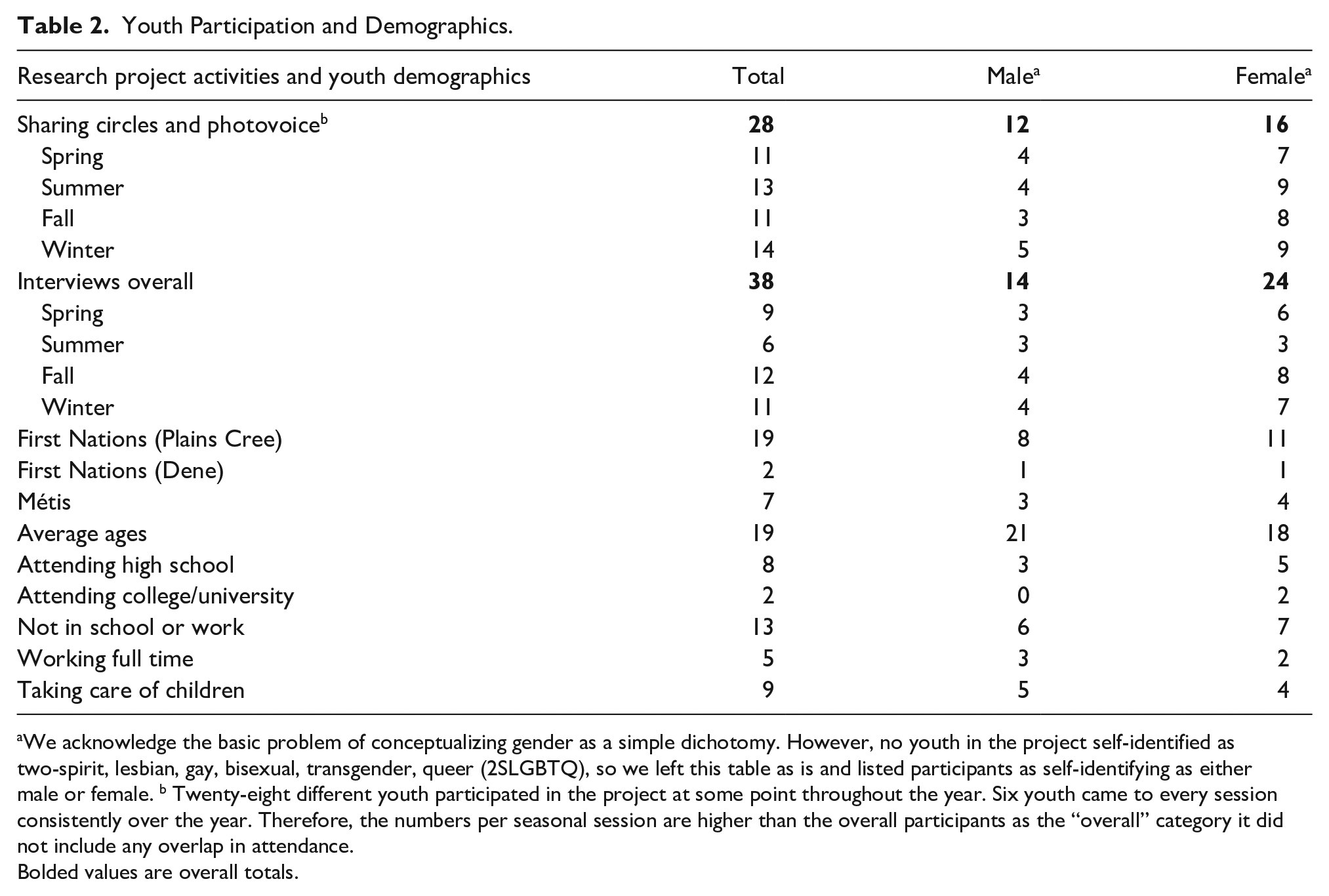
We acknowledge the basic problem of conceptualizing gender as a simple dichotomy. However, no youth in the project self-identified as two-spirit, lesbian, gay, bisexual, transgender, queer (2SLGBTQ), so we left this table as is and listed participants as self-identifying as either male or female. b Twenty-eight different youth participated in the project at some point throughout the year. Six youth came to every session consistently over the year. Therefore, the numbers per seasonal session are higher than the overall participants as the “overall” category it did not include any overlap in attendance.
Bolded values are overall totals.
Analysis
To analyze our multiple sources of data, all text (interview transcripts and field notes) and visual data (photographs) were imported into Dedoose software Version 8.3.17 (2019), a mixed-method data management software program, for thematic coding. Coding was initially done by the first and last authors and checked for consistency by all other authors. Interview and field note data were first reviewed repeatedly for significant thematic statements in an attempt to understand youths’ lived worlds, meanings of their experiences, and significant themes related to processes of resilience (Stake, 2005). The photographs then helped to inform the themes emerging from the interviews, and select photos from each youth case study are shared throughout. By formally linking the photos to the corresponding interview data, the photographs served as visual representations of the text-based findings and contributed to a greater understanding of the youth experiences and stories (Briggs et al., 2014). Our analytical procedure thus ultimately involved a description of data and specific cases, categorical aggregation, establishing patterns, delineating units of meaning from the combined data, clustering units of meaning to form thematic statements, and extracting themes and naturalistic generalizations (Stake, 2005; 2006). A “two-eyed seeing” framework also ensured we balanced Western and Indigenous knowledge systems and perspectives during coding and thematic extraction, and was done collaboratively by members of the research team who self-identify as both Indigenous and non-Indigenous (Bird-Naytowhow et al., 2017).
Member checking also occurred with youth and CARC members to further enhance credibility. This involved sharing emerging themes, photos, stories, and interpretations with the youth during group social gatherings and dinners that were held 4 times per year, once following each seasonal data collection period. This allowed the youth to collectively share how they feel the process is going and offer feedback on emerging ideas and themes. In addition, we also had four CARC meetings over the year with members of the research team to also share and highlight emerging themes and invite feedback or suggestions. We also discussed our perspectives and interpretations during regular team meetings and used a constant comparative approach to look for other ways of looking at the emerging stories and themes so that different strengths-based findings may be revealed (Stake, 1995; 2005; 2006).
Results
Although all stories, photos, and field notes were analyzed and coded, there were six youth in this project who participated in all four seasons of the project, each engaged in four rounds of data collection (i.e., sharing circles, conversational interviews, and photovoice) with accompanying naturalistic interactions throughout the year. For our case study presentation and analysis, we therefore decided to focus on these six youth and their stories and draw on other stories and experiences to support or contrast these six youth where needed or useful. In collective case studies of this kind, Stake (2006) suggested that it is helpful to analyze data relating to the individual cases first before making comparisons across cases, as attention needs to be paid to variations within each case and, where relevant, the relationship between different processes and outcomes. As such, we present the findings from individual cases relating to specific themes or intersection of themes separately before amalgamating across and comparing between youth cases and themes.
Our findings indicate that several individual and sociocultural processes intersect and contribute to resilience among Indigenous youth residing in our inner city context. Despite various forms of acute hardship (e.g., abandonment, victimization, racism), difficulties and/or periods of sustained environmental stress (e.g., poverty, discrimination), youth in this study largely described resilience as having a strong determination or will to acquire and attain lifelong development, like the pursuit of education in the face of distress, and a motivation to be responsible, lead exemplary lives, and influence others positively. In this, resilience was also supported by a safe place to escape to or something positive to focus on. Finally, resilience also meant being engaged in social or community-based activities, such as volunteer opportunities or cultural programs. Although more themes and stories emerged than can be outlined here, the dominant intersecting themes identified by our analysis include: (a) strengthening cultural identity and family connections; (b) engagement in social groups and service to self and community; and (c) practices of the arts and a positive outlook.
Strengthening Cultural Identity and Family Connections
An important theme of youth resilience was cultural engagement or identity. As the youth outlined, cultural engagement can involve participation in cultural events and activities, such as ceremonies, sweat lodges, and powwows, or learning traditional teachings from Elders in Indigenous culture and other related educational programs. Similarly, youth suggested that cultural identity entails openly showing affiliation to or pride with an Indigenous heritage or origin, culture and practices by way of dressing and/or participating in Indigenous activities and ceremonies. Current literature also suggests that greater attachment to, identifying or engagement with, a traditional culture is seen to help youth overcome or avoid specific hardships despite difficulties they have already experienced, or continue to experience in life (Hatala & Bird-Naytowhow, 2020; Hatala et al., 2017; Hatchel & Marx, 2018; Rowhani & Hatala, 2017). Cultural engagement or identity can also build youths’ capacity for positive adaption and coping mechanisms protecting against adverse life experiences, including the problems of trauma associated with colonization, historical loss, discrimination, and substance abuse (notably alcohol abuse) that beset many Indigenous communities and populations (Shahram et al., 2017). Despite the rich history of research in this area, however, most studies focus on cultural engagement or Indigenous identity in isolation without wholly considering other intersecting factors contributing to its expression. Through case study vignettes, we therefore illustrate how cultural engagement can interact with family support in important ways.
Case Study 1: Randle’s story
At birth, Randle was given up by his mother who was physically and mentally unfit to take care of him, as she was deeply affected by addictions and other priorities. Abandoned at such a young age, Randle moved in with his aunty who raised him until he was 5 years old. Randle had little knowledge of his cultural history growing up. As he got older, his mother came for him and he moved back in with her, although she continued to struggle with addictions and lacked the full support she needed. Due to his environmental influences, at age 7, Randle had started to smoke and drink alcohol. Randle’s home was a “party house”—being frequented by loud music, partying, fighting, yelling, screaming, crying, bottle smashing, and the constant smell of smoke and marijuana. During such chaotic times, Randle learned, along with his siblings, to begin stealing and stifling through pants, pockets, and jackets for a few dollars from everybody who had passed out around his living room floor. This learned practice allowed him to gain some basic resources such as food that he and his siblings often lacked. A few years later, Randle’s mom passed away from health complications and, as a result, he battled terribly with not having a mother and missed what guidance, love, affection, and support she did, on occasion, offer.
Despite advice from his teachers, Randle began to skip school in his teenage years, and became what others described as a “bully” and “nuisance” to other children and youth. As he aged further, he got introduced to “harder” drugs, and smoking cannabis with his stepbrothers who he took as family. At 15 years of age, he began experimenting further with drugs, alcohol, and more petty thefts to support his addictions and lifestyle. As he explained, he became “very disrespectful and inappropriate to women, to himself, and other people.” From there on, he was constantly involved in “one crime or another,” which ranged from abuse, excessive drinking, theft, and fighting. These activities eventually warranted Randle’s arrest, and shortly thereafter, he moved out of the city and went into hiding.
Despite the difficulties which Randle faced, connecting back with his stepdad was helpful as he was advised to turn himself in to the police rather than being “on the run” from his warrants. As he recalled, Eventually he [step dad] challenged me saying, “you got to turn yourself in. You are not like most boys. You’re a better man. If you don’t do it now, you’re going to turn around and those charges are still going to be there. The cops are going to still be waiting for you. Man up, go deal with it.” He said, “the sooner you do it, the sooner you’ll get out.”
Randle heeded this advice out of respect for his stepdad, knowing that he mentored and raised him after he lost his mom. He began for the first time to feel remorseful and acknowledged his “wrong doings” and how much he “hurt people because of his own pain.” As such, he turned himself in and spent nearly 2 years in prison. For Randle, turning himself in not only signified his acceptance of his misconducts, but also marked the first step on his healing journey.
After several months of serving his prison term, Randle become engaged with his traditional Cree cultural practices, such as participating in regular sweat lodges and listening to Elders’ teachings. From the time of his first sweat on the “inside,” Randle continued to seek out that positive energy and sense of spirituality and community—always wanting to help and be close to the Elders, the fire, and the cultural ways (Figure 1). Having regular visits from his stepdad during this time, Randle also expressed that he needed to go down a “different road,” wherein he could “explore his own path” without “negative influences” from friends or acquaintances. Cultural involvement and ongoing connections with his stepdad thus allowed and encouraged Randle to focus on himself, his healing journey, to ask questions about his life’s purpose, and the need for healing and growth. While in prison, he reflected, I’m going to quit drinking. I’m going to quit doing drugs. I’m going to quit smoking. I’m going to get my driver’s license. I want to get a place to live. I want to get a job. I’m going to start dancing and start singing. I’m going to start doing ceremonies, travelling. I really want to be around the drum.
Randle’s yearning to make behavioral, attitudinal, and lifestyle changes, including positive goals and hopes for his life, stemmed not only from the words of advice from his family, but also his connections with elders and desire to be part of his Indigenous Cree cultural ways and practices. As Randle has experienced cultural practices in prison, he believed engaging in this way of life would keep him away from “hanging out with the negative crowd” or “bad acquaintances,” because engagement in cultural practices requires one to commit oneself to the “good road” of healing. Without the influence and push from his stepfather, Randle acknowledged that he never would have fully committed to learning about and “walking the Cree spiritual path.” After getting let out of prison after one and a half years, Randle soon became a regular Sun dancer, fire keeper, and lodge helper, and therefore lost interest in that previous “negative” lifestyle. Randle has since become proud of himself, his cultural background, and how much he has changed and how far he has come in spite of facing challenges. Because Randle has grown and learned so much, he also now hopes for opportunities to continue on this path and to also help others in similar ways.

Youth’s photovoice image signified as “tending to the ceremonial fire.”
Case Study 2: Serenity’s story
Serenity had five younger sisters, and at age 2, her parents separated. At different times, she lived with each parent, yet was closest with her mom. She also lived with her grandma who was a strong feminine figure when her mom was not around. She was exposed to her Cree cultural practices at an early age, participating in a lot of powwows, ceremonies, and community feasts. As she grew up, she started to struggle with her body image and appearance. To try and overcome these developing insecurities, Serenity would sometimes stand in the mirror, and say “a bunch of positive things to herself.” Although doing this somewhat helped, getting comfortable with herself and her body still remained a central concern and form of distress. As she recounted, I’ve been trying to be positive with my body and appearance. So, I don’t know, I just took that because that’s an issue with me and I’m just trying to get over it and like the thing that is in in the mirror. I’m just trying to overcome it but it’s still an issue.
Serenity continued to face several challenges, particularly with her mental health. At one time, she was hospitalized for mental health concerns but said she felt she was never really taken seriously by staff. She tried to deal with it by herself, which was upsetting and made her feel alone. In addition, at school people were not sure of her identity or racial background of being “white’ or “native” because she did not look Indigenous even though she was. As a result, people hardly talked to her. For Serenity, the confusion about her cultural identity meant that people were not able to see her for who she really is (i.e., an Indigenous woman), which, on top of her struggles with her body image, left her to overly worry about what people think about her identity. As Serenity explained, she “had no real friends” and “rarely talked to anyone about her feelings.” This was not only frustrating but also made school challenging.
In spite of these struggles, she drew strength from the support of her family, who were most often there to listen, assist, support, and comfort her when she finds herself in these difficult and unhappy situations. Moreover, her family members also shared a similar racial or cultural identity, and therefore when being with them, she would not have to worry about what they might be thinking about her background. Knowing that her grandma had been through so much difficulty in her life, yet so successful and independent, helped Serenity also believe that despite her current challenges, she could still succeed in her goals to become a psychiatrist, not only to understand more about mental health but also to support and prevent other people and young Indigenous girls from feeling the ways she did.
At the same time, her involvement in cultural activities, such as smudging, powwow, and jingle dress dancing in school, was also helpful as it offered a space where she felt accepted and understood, regardless of her racial appearance. Practices of cultural identity and engagement provided self-esteem, self-respect, and self-confidence that made her able to “confront discrimination and racism.” As Serenity narrated, I have issues with identity, because I don’t look fully Native. I’m fully Native but kind of look White. I don’t fit in with Native kids and I don’t fit in with White kids, which is challenging. Yeah, when I tell them, they are like, “No, you’re not,” and I’m like “Yeah, I am.” But when I’m at a powwow, I do [fit in]. Yeah, because I can put on my dress and then everyone’s like “Oh, she is Native “you know.” It’s like telling the world who you are. Putting on the dress is one thing that helps me. Also, being with all my family because they all have beautiful brown skin. I got a lot of support from my family when I was in this dark place. So, they’ve helped me with that whole thing and to start dancing again and then they were like, “we support you if you ever need anything.”
Not minding discrimination from people and not having friends around, cultural engagement was a time and a place where Serenity felt confident to socialize, interact, and display her cultural abilities, rather than keeping to herself and being worried. When she is wearing her cultural regalia and dancing, she felt truly elated as she was able to show off her identity, or “be who she is,” without having to convince anyone or defend her identity to others (Figure 2).
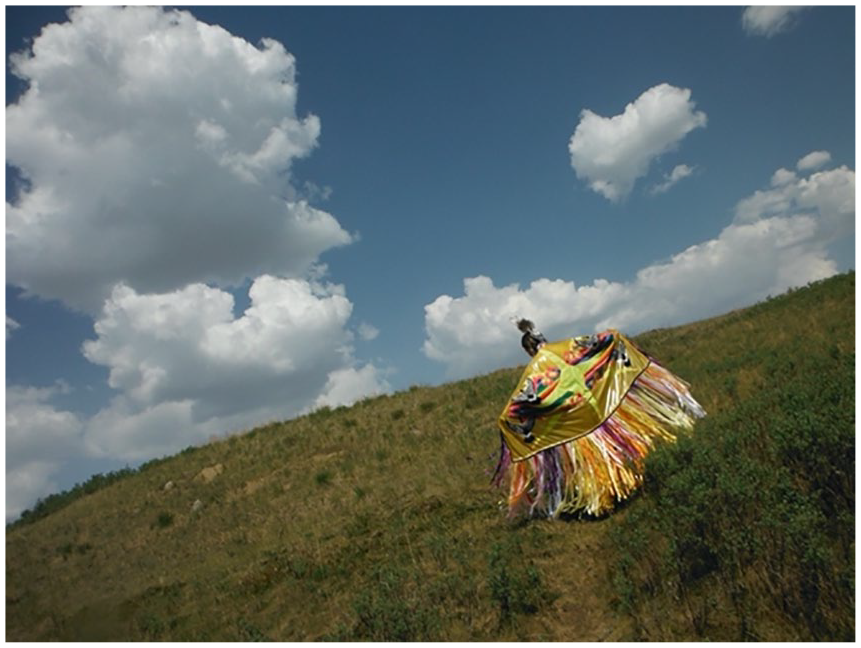
Youth’s photovoice image signified as “my identity is my culture.”
Intersecting stories of culture and family
Although Serena and Randle faced unique challenges and conditions that affected their collective well-being and personal growth, both were motivated by the intersection of family support and cultural engagement to endure challenges. For Randle, the combined interaction of these social factors built his personal desire to seek out positive community support and goals for his life to begin his healing process. He also developed a compelling desire to fulfill a cultural purpose as he became a regular Sun dancer, fire keeper, and lodge helper. The cultural expectation to be sober, thoughtful, and reflective, and commit oneself to the “good road,” therefore, played key roles to ignite and foster his resilience. Notwithstanding, Randle readily acknowledged that he would not have been involved in his cultural practices without the push and words of encouragement from his stepfather. For Serena, despite facing mental health issues, following supportive relationships, advice, and interactions with her family members, there was an underlying expectation to surmount her current challenges as her grandmother also did. With this role model and vision in her life, she engaged in cultural activities, which made her feel hopeful and more positive and, at the same time, helped to enhance her mental health and personal growth.
For both Serenity and Randle, the meaning of family support was similar and entailed having a family member such as a parent to talk to, confide in, encourage them to explore their Indigenous identity, to count on in crises, give advice, and make one feel cared for. For Randle, cultural engagement meant a space that allowed him time to focus on himself, reflect about his life, and keep away from bad lifestyles and acquaintances. For Serenity, it was a safe place where she can be her “native” self fully without having to worry about what people will think, say, or do. Cultural involvement kept her mind away from thoughts of her racial appearance and built her confidence, pride, and self-esteem. Randle also referred to cultural engagement as a “space for reflection” and having a “very welcoming and supportive environment.” For Serenity and Randle, discrimination and racism based on their Indigenous identity was common, which adversely influenced their lives. Their connection to and engagement in cultural practices together with family support offered a “safe space” for these youth to be themselves. What we observe here, then, is a powerful interplay between cultural engagement and family support, and that at each stage of their journey toward healing, these factors combined in important ways to support a turning point for Randle and Serenity that contributed to their resilience, social and emotional well-being, and allowed them to live a more positive life.
Engagement in Social Groups and Service to Self and Community
Another important area that promotes youth resilience and wellness is engaging with positive educational and social groups that are seeking to improve the community. For the youth in this research, “engagement” here meant active involvement and commitment to one or more social activities in the community or society. Reaching out to places such as community organizations provided a safe learning and supportive social environment for these youth to overcome obstacles or difficulties. This engagement also allowed them to give back to younger youth what they “lost” as a child. Inner-city community organizations have also presented an opportunity for these young people to be productively engaged in a series of life-balancing and healing activities, to overcome and cope with particular challenges, and keep away from drinking and an abusive lifestyle. The youths’ involvement in community organizations intersected with their want for change in self and within the community, which brought about resilience, comfort in life, and also let these youth grow, learn, and become respected helpers in others’ lives.
Case Study 3: Alex’s story
Alex started out his life on the reserve and was raised back and forth between his grandparents and his mom. His father had passed away before he was born. He had an older sister and two younger siblings. As a child, Alex felt “victimised” growing up in his own family home because there was a lot of physical violence done to him, which he expressed as “very depressing and traumatizing.” Alex was disciplined by being “whipped” or hit even though not knowing his mistake or error. Unsure of any reason for his pain and lack of love, he assumed “it came before his time from the residential school” as his grandmother who forcibly attended these schools was very strict and abusive. As a result, Alex felt mentally and emotionally more connected with his grandparents than he did with his mother.
After a couple years, Alex’s grandparents eventually passed on, which was really devastating as he felt it was “the end” and really wanted to “bring the world down and everybody around him.” He then lived again with his family and the abuse was “raging on.” As Alex became a teenager, having experienced a lot of pain and felt like an outcast growing up because of the way he was abused, he dealt out a lot of pain; he started abusing drugs, alcohol, and women, and joined a local inner city gang. He began to go out and hurt innocent people, as he believed people deserved to be unhappy like him—“hurt people, hurt people” he often expressed. Alex looked forward to getting mad and beating people up which landed him in jail a couple times.
Alex attributed this uncaring behavior to cyclical histories of oppression on his familiy that fostered “a lack of parental guidance, nurturing, and love” at that early stage of his life and upbringing. This environment further allowed him to internalize unhealthy behaviors, such as those associated with abuse and pain. This internalization then negatively affected his ability to function well at home, school, and in the community. As Alex recounted, As a kid, abuse was everywhere. Everybody else was abusive—my uncle, mom, my sister, grandmother, friends. Abuse was open at the time, and that kind of screwed with me mentally. Got older, and I was a victim to that lifestyle. So, I became addicted to that lifestyle. I picked up abusing drugs and alcohol and all that, joined a gang and started to hurt innocent people. It was like a learned behaviour. It was what was normal.
Despite living this lifestyle, connecting with community groups and organizations was a turning point. At one memorable event, Alex broke down crying after viewing a local presentation by a community organization that reflected his own lifestyle. For the first time, he recognized how much pain he had caused his girlfriend and partner due to his constant abuse, neglect, and lack of support, even while she was pregnant. Alex’s realization of how much his lifestyle affected others while connecting with this organization helped him decide to change, heal, and evolve his life. Alex pledged going forward with a new way of life, one that involved visiting the community group regularly, giving presentations with the other members, and sharing his stories for others to learn from (Figure 3). As Alex explained, I hooked up with [this organization] like a year ago, and they did a presentation. I was invited. I saw my lifestyle presented before me, and I saw the woman that I was hurting in those stories. I was in a relationship. She was pregnant and all. She didn’t have no support from me or whatever, being abused and all that. So, I broke down crying, and then I said, “this is my new way of life now, is coming to sit with you guys right here now doing presentations, talking, being open minded and sharing some of my stories and just giving advice.”
Since connecting with this grassroots community organization and seeing others like him who have lived through difficult childhood experiences, Alex began making efforts toward “getting his life together” and “staying away from troubles,” which he accomplished with the group’s support. Alex has since been going back to school, has been “out of trouble with the law,” and started making efforts toward reuniting with his son and former partner. Alex also worked on domestic violence, including teaching about types and forms of abuse in domestic relationships, and strives to help other male youth grow in these areas as well. As Alex further explained, There’re so many hurt Aboriginal children out there right now, nowadays being affected by modern society. I want to give back to the youth. I want to be there for them, because they lost something and that’s why they’re hurting. I felt like there was no nobody there for me, and I just want to be there for somebody, somebody who feels their life has been cut, like the way I felt. So, I’m giving my life back to helping others.
For Alex, resilience came about from his desire for change, to quit his previous lifestyle, as well as to contribute to positive change in the community around him. As a former gang member, he felt there was no community. Due to the cyclical histories of opporession and injustice inflicted on Indigenous peoples and families, everywhere he went, people were high, everybody was messed up and “screwed up” like him, and constantly fighting for survival. But since connecting with community organizations and groups within inner-city Saskatoon, Alex began to see a “community” that wants to grow and be healthier, where everybody “wants to fit in” or make “an impact on someone else’s life.” Thus, despite the pain and difficulties in Alex’s childhood, this desire for change together with his involvement in community groups was instrumental to fostering his resilience, personal growth, and general wellness.
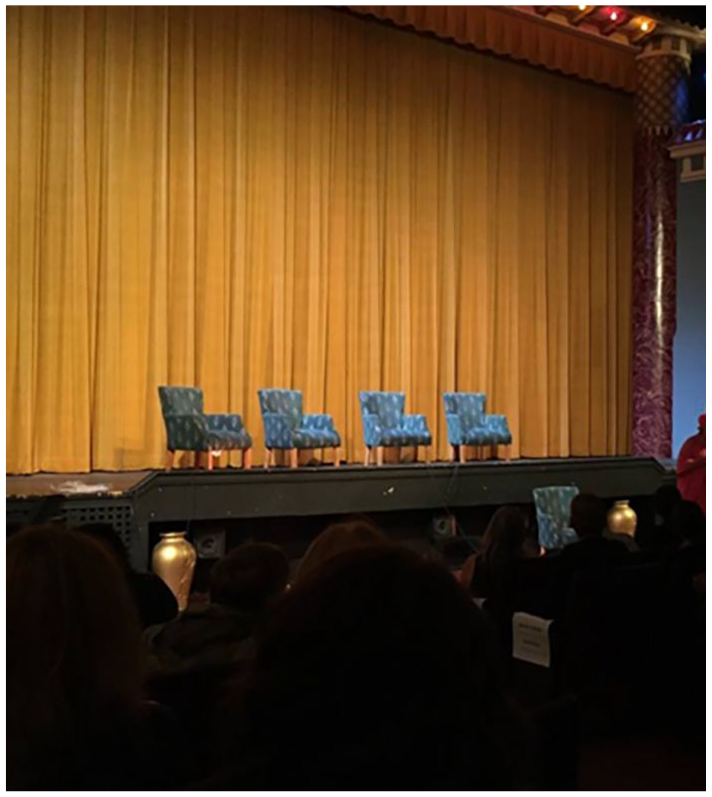
Youth’s photovoice image signified as “sharing my story with others.”
Case Study 4: Kenny’s story
Kenny was born on her reserve about 2 hours outside Saskatoon and lived in foster care mostly until she was 8 years old. At that time, her Kokum or grandmother got her out of “the system” and took full custody. After Kenny got to Grade 8, she moved to live with her dad in “the city” upon being asked by her Kokum. Kenny has three brothers, three sisters, all older who are all into gang life, and one sibling currently serving 2 years in prison. Despite having these kinds of siblings, engaging in community groups remained a positive, safe space that helped her to stay away from gang situations herself. This connection with a grassroots community organization in Saskatoon helped her be more active, like doing stake boarding every day, playing pool, and “chilling with friends.” This place was thus felt as a “safe place” for connecting socially, to build positive peer relationships with other youth like her wanting to heal and improve in life, and engage with activities that kept her away from “bad friends” and a “negative lifestyle.”
For many Indigenous young persons, the feeling of belonging as part of the community and wider circle of friends that represent who you are can be a central component of improving self-esteem, a sense of hope and future, which in turn fosters resilience (Hatala et al., 2017). Similarly, establishing opportunities for youth to engage with their communities positively not only resulted in opportunities for youth advocacy, where youth can express their needs more constructively, but more crucially, was a space that nurtured, healed, and nourished, when facing heightened distress and significant adversity. This local youth organization was such a safe place for Kenny (Figure 4). Seeing the ill effects of gang and drug life on her siblings, she decided to spend her time outside with a group of positive friends, not stealing or doing drugs. She also worked and helped out in the organization and community activities as needed. In this way, Kenny kept herself engaged with a volunteer job even while doing well at school. As Kenny shared, When I moved to Saskatoon, I went to [local organization] and that made me stay out of the gang situations that were everywhere. [This organization] helped me being more active and engaging in positive things like skateboarding and hanging out every day. So, I didn’t really hang out with them [gang members] that much, because I spend my time outside with my friends not stealing or doing drugs.
Like Alex, Kenny desired to live a healthy lifestyle, sought out positive relationships, aimed to be example for other youth, and wanted to contribute to a safe and healthy community.

Youth’s photovoice image signified as “A safe space to chill.”
Intersecting stories of self and community growth
Connections with inner city community-based organizations, along with individual desires for change and life improvement, allowed Kenny and Alex to explore their full potential and develop strategies for their personal growth and success, which in turn enhanced their ability to contribute meaningfully and positively to the community. An intersectional lens applied to the current cases deepens our understanding of overlapping themes, to understand how youths’ unique circumstances influence their experiences, their involvement in community programs and activities, while also highlighting structural factors underpinning them. Alex had a traumatizing childhood and faced a number of difficulties that contributed to his “uncaring lifestyle,” which unknown to him was hurtful to others, like his partner. Nonetheless, connecting with the community groups and individuals on a similar healing journey and learning to care for his self and others notably built his resilience and the capability to flourish despite the hardship that took place during his life. At the same time, Kenny remained fully committed and engaged in community group activities because of her desire for change. Here, her desire for change and involvement in a community group are overlapping and combined in dynamic and interactive ways to support her resilience.
Practice of the Arts and a Positive Outlook
Engaging in arts and positive decisions were also important processes that intersected to promote resilience and wellness for youth in this research. Art-making undertakings reflected the youths’ involvement in various activities and crafts, such as painting, beading, drawing, writing books, creating poems, and making music. Positive decisions were described as important life choices that youth made that brought about real meaning, improvement, or change to their lives. Along with the desire for change in self and community, positive decisions were also based on choices of what they wanted their futures to be, such as their personal goals, wants, or needs. Engaging in arts and positive decisions often provided youth with another way to get through difficulties and resist or avoid pressure to enact “negative” lifestyles. When youth were confronted with the urge to engage in “negative” activities, such as excessive drinking or drugs for example, engaging in arts kept their minds occupied and focused on positive emotional states and memories thereby allowing positive decisions to emerge.
Case Study 5: Nikki’s story
While growing up, Nikki had “negative people” around her, which she thought was “normal” because she grew up with it—a kind of “normalcy of negativity” (Hatala et al., 2017). Her two sisters would always drink, get drunk, and become real mean and abusive toward her. In her teen years, Nikki would also frequently get invited out by friends who do drugs and drink regularly. While in their midst, rather than live their dangerous lifestyle, Nikki often chose not to engage in this type of behavior. Having realized that she was 4 months pregnant at the time, Nikki knew she had more responsibilities and, therefore, chose to act more “mature” and “positive.” More crucially, Nikki was also concerned that an unhealthy lifestyle could hurt her unborn child. Nikki made the decision and committed to it and would instead go out with more “positive friends,” enjoy art activities, walking around the city, and live a “safer” life. Nikki was able to do away with these “bad influences” because of her positive acquaintances and because she wanted to be a “better” person. Faced with the reality of being a mother, Nikki made positive choices to be a more responsible mom to her daughter regardless of pressure from friends to hang out and live an “unhealthy” lifestyle. As Nikki explained, I always had negative people around me. The negative that I’ve been around was people who were drinking or doing drugs and always wanted me to come with them and hang out. I would, but I wouldn’t do anything like that,—any of that bad stuff that they were doing. I’d just sit around. And then when I found out I was pregnant, I just quit everything, and I just packed it up. I think it was easy, because I wanted to do better for me and my daughter.
For Nikki, aside from committing to her positive decisions, which helped her to overcome negative influences, engaging in arts, through writing, painting, drawing, beading, and listening to music, worked in synergy with her choices and allowed her to remain safe and happy for many parts of her life. Involving herself in beading, in particular, was helpful for her as it kept her mind occupied away from negative kinds of thoughts or activities and also provided her with a kind of cultural engagement and connection (Figure 5). As Nikki narrated, I bead sometimes, like if I have the urge to go out and drink, which I’m trying to stop that because I used to be a bad alcoholic back then, and now I keep myself busy with either beading or writing. That’s what I do. I’d make something with beads, or I’d draw, or listen to music and just go on Facebook, YouTube, or Google. I keep my mind busy and off that kind of thing, off the stuff that I don’t really want to do or have in mind.
Connected with her decisions to live a healthy life, Nikki’s art activities then gave her another way of spending her time that was more productive, reinforced her goals of “being a good mother,” and helped her avoid negative social interactions.

Youth’s photovoice image signified as “beading keeps the mind occupied.”
Case Study 6: Robert’s story
Robert grew up in Saskatoon. He had two sisters and a brother and “really great” parents who were a good influence as they did not drink or engage in “bad behaviour.” Robert’s parents were also connected strongly to “native spirituality” and always tried to be “good people” walking the “good red road.” Nonetheless, his parents had some rough years, during which Robert at age 9 began to rebel. Witnessing some distressing events in his home and family, he became an angry kid, and began to get in trouble. Although hard to pinpoint any reason for his anger, Robert blames it partly on the family life, fighting at home, confusion about the world, and the various injustices happening around him. He got into lots of trouble mostly because of the people he hung out with—the bad kids and “anti-normal people group.” As he grew older, Robert engaged in partying and hung with some of the roughest people. At 16, everything was just about “smoking weed and getting as drunk as possible,” while all the time fighting other peer groups. Robert’s siblings also had similar struggles growing up.
Despite living this lifestyle, the biggest influence on his life came from his decision to stick to positive people and art-based activities. Robert realized on his own that continuing to engage in his negative way of life is not a “right way” to live and should “not be his lifelong habit.” Robert got tired of associating with what he called “negative people” and the “wrong crowd.” Having learnt from a young age about empathy and how to be kind to other people and have a conscience about stealing anything or hurting people, this provided a solid foundation for him to come back to, to look at and learn from, as he searched for other ways of living his life. As Robert recounted, I was such a rebellious, angry kid for some years. How did I turn course? I came back after I got sick of all the nasty people I was hanging out with—negative people. Couldn’t help but come back just because I knew that positivity was there. I started to recognize the difference between positivity and negativity and started to get really jaded and cynical, just sick of the people that I was ha with. I just got sick of it and I just really hated the people that I grew up with. I started to think that I wasted so much of my youth just partying through my teenage years and I was really depressed. I’ve always been quite depressed, so I needed to find a way out.
Later in life Robert met an old family friend. He hung around him and took guitar lessons from him. As Robert recalled, “he was a really good influence on me, as he was a good person to be around because he was pretty positive.” Robert went to summer school and remembered how positive he felt to be there. It was a good place to take up his time learning guitar and engaged in positive activities away from negative influences in his environment. Aside from the positive decisions he made, Robert also alluded to his resilience being involved in arts such as jamming, photography, and making music (Figure 6). As Roberts further explained, The guitar is where I first started. I still got involved in jamming. Music in general. I started getting into photography later, taking a lot of photos which was nice too. As far as resilience goes, art activities became a place to escape to or something positive to focus on. Spend your time on doing something positive and developing your skills. That was actually big part of something that helped me.
Thus, as we saw with Nikki, making positive choices and engaging with the arts, and particularly music, became an “escape” from negative environments and social stressors that supported pathways to resilience and improved wellness.

Youth’s photovoice image signified as “guitar as an escape to something positive.”
Intersecting positive decisions and artistic outlets
Although surrounded by people with negative and questionable lifestyles, the positive decisions Nikki made for herself, including engaging in arts, remain important choices that kept her committed to the “good road.” With her decisions, Niki not only chose to be around positive friends but also began to act responsibly as she was expecting to become a mother. For Robert, his biggest influence came from his decision to engage in more positive activities and start guitar lessons with an old friend. Since engaging in arts, Robert made progress with his learning and growth and was encouraged on this path to share his learning with others. Although Nikki and Robert share some similarities in terms of engaging in arts and making positive choices, the mediums of art differed. Nikki was more into writing, beading, drawing, and painting, unlike Robert who engaged in music and photography. Nonetheless, the intersection of these factors worked in dynamic and important ways to foster resilience, helped them to build their skills, and be more productive and healthier with less daily distress. Resilience, then, was found dependent on not only both personal capacities and decisions but also the availability of relevant arts-based resources within families, friends, and communities. The interaction between these creative resources and positive decisions produced synergistic means of coping for youth as they navigated the struggles in their day-to-day lives.
Discussion
This research contributed to the knowledge about the intersecting factors supporting resilience among Indigenous youth living within an urban Canadian context. The strengths-based case study comparisons of youth experiences and use of multiple sources of data (i.e., sharing circles, photovoice, conversational and photo-elicitation interviews, and naturalistic interactions) also provided a nuanced, holistic, and context-relevant understanding of the intersecting factors that support resilience for inner-city youth. In addition, our use of “two-eyed seeing” that brought Indigenous knowledge frameworks and methodologies to work alongside more traditional constructivist case study data generation and analysis strategies was effective in facilitating a strengths-based and culturally relevant exploration of Indigenous youth experiences.
Toward an Intersectionality of Resilience
The initial focus of resilience on the qualities of an individual has evolved in the last two decades (Masten, 2015). Indeed, research has now shown that much of what seems to promote resilience despite adversity originates outside of the individual—in the family, community, society, culture, and environment (Liebenberg, 2020). Consequently, considerable health research in these areas addresses the evolving and real-life complexities for Indigenous youth, including urban contexts, as well as integral factors that enhance resilience (Rowhani & Hatala, 2017; Toombs et al., 2016). Although we do not deny the role that such resilience factors play in facilitating improved youth health and wellness (Ungar, 2013), we argue that it remains important to understand the role of intersectionality theory and the relationships among and across these resilience-promoting processes.
The concept of intersectionality serves as an analytical tool that permits access to a holistic understanding of the ways in which various individual and social factors or processes intersect (Hankivsky et al., 2014). Intersectionality helps uncover the combined impacts of multiple individual, social, and structural processes, and offers an opportunity to highlight rather than disregard complexities, which is essential to understanding the multidimensional issues of resilience at greater depth (Shahram et al., 2017). Intersectionality enables more nuanced understanding and insights of youths’ experiences, needs, interests, and capacities, and helps to uncover power dynamics that shape day-to-day resilience processes—linking individual and social circumstances of urban Indigenous youth to the structural factors underpinning or informing them (Bauer, 2014). In this way, intersectionality importantly provides a basis for enquiry where no category of resilience (or oppression) is considered the most useful (or damaging), and where some processes are not continuously highlighted to the exclusion of others (Hatala et al., 2018).
An intersectionality of resilience frameowork thus goes beyond describing or documenting specific themes or social categories, to uncover how these factors are in relationship to each other and what processes and mechanisms are involved at both individual and broader sociocultural or structural levels. For example, it was not simply because Randle engaged in cultural activities that supported his resilience, but rather it was the combined impact of his family’s support with ongoing cultural engagement that nurtured and advanced his unique journey toward wellness. Similarly, Alex was able to adapt positively through a powerful interplay of his connection with community groups and a desire for change and service to others. So too with Serena, we saw how the support and words of advice of her family members and participation in safe cultural spaces and activities were relational and simultaneously experienced. This built her understanding to believe she can surmount her current challenges and spurred her to socialize confidently and engage in cultural activities where she felt safe, happy, and proud without having to overly worry about her identity and appearance.
As Cho et al. (2013) observed, what makes a framework or analysis intersectional is “its adoption of an intersectional way of thinking about the problem of sameness and difference and its relation to power” and that the social identities or categories involved are “not distinct but as always permeated by other categories, fluid and changing, always in the process of creating and being created by dynamics of power” (p. 795). The relationship between identity and power are, therefore, central aspects of intersectionality theory and must also inform a strengths-based revision of the theory. Yet, identity here becomes more about positive aspects of the self or personhood, that is, expressions, explorations, interactions, or opportunities for social performances that reinforce self-determination, agency, and wellness in life-affirming ways, as well as traditional social roles inspired by Indigenous knowledges, teachings, and spirituality. Following our IM and “two-eyed seeing” approach, then, this aspect of self or identity might involve a holistic balance between the physical, mental, emotional, and spiritual domains, as well as a harmonious relationship among these domains that supports a journey toward the Cree notion of mino-pimâtisiwin, or a living of the “good life” (Hatala & Bird-Naytowhow, 2020). Thus, power is not so much thought of here in terms of structural oppression or discrimination, but rather in terms of “empowerment” or enhancing one’s ability to choose and walk one’s own path—the self-determination of responsible identity expression. This strengths-based reframing of intersectionality, then, also connects with aspects of a “political intersectionality” insofar as it explores and uncovers the systemic forces that shape subjects as well as the multiaxes modes of resistance for contesting and reclaiming power that informs and underlies many political struggles (Cho et al., 2013).
Strengths, Limitations, and Future Directions
From an intersectionality perspective, multiple individual and social factors are always at play in shaping people’s lives and health experiences (Hankivsky et al., 2014). Not surprisingly, an important concern that has been raised with intersectionality theory is that the demands of including multiple perspectives, processes, and factors are too high and overly challenging. This being said, as others have argued, intersectionality theory does not necessitate considering all possible factors or processes in any given research design (Bauer, 2014). Instead, it prompts researchers to be explicit about which factors are chosen and why, which are context-specific and emerge from the stories and experiences of those in the research, and highlights the relationships between processes that are uncovered or explored, and what is subsequently set aside or under-analyzed as a result (Moradi & Grzanka, 2017). The case study vignettes along with “two-eyed seeing” and IM were a valuable framework that allowed our team to share the youths’ own words and life experiences and explore the interacting presence of individual, socio-cultural, and structural factors that promote resilience and adaptive functioning while navigating oftentimes challenging urban contexts. Through comparisons of similarities and differences of young persons situated within the same context, this analysis contributed to an in-depth, strengths-based understanding of youth as they experience living within an inner-city context.
Notwithstanding, the findings of our qualitative study are subject to various limitations. No additional information was obtained from family members or youth support workers. This allowed the youths’ voices to come forward, but it also meant that we were not able to obtain a complete picture of their circumstances. Some may have chosen, for a number of reasons, to minimize the difficulties they were facing, whereas others may have chosen to magnify them. To mitigate this in future research, voices of family members or youth workers from inner-city community-based organizations could also be included to further expand our understanding of the overlapping individual, socio-cultural, and structural influences on youth resilience and wellness.
The findings from this study suggest that, despite challenging circumstances, youth were resilient in many ways based on an interaction of individual and social processes. This implies that in urban centers, to optimize youths’ resilience and wellness and tackle unique challenges faced by these young persons, individual-level supports as well as broader sociocultural programs and structural interventions may be helpful to improve opportunities and resources for support and wellness. For instance, creative educational or arts-based interventions could be developed by nonprofit community-based youth organizations or social groups that provide youth with the opportunities to develop needed skills that support pathways to resilience during difficulties and to alert them to local services available for support (Hatala & Bird-Naytowhow, 2020). Indeed, research in other contexts suggests that more accessible art-based programs and cultural groups that provide positive, safe spaces for youths’ engagement, and that foster their creative development, leadership, service to others, and personal growth, are essential for youth resilience and wellness (Fanian et al., 2015). Taking an intersectionality lens into account, such programs and interventions could also focus on relationships across multiple approaches rather than trying to support or foster aspects in isolation, as well as look at ways to engage with family- and community-level processes and Indigenous knowledge that can support and augment more individual activities (Clark et al., 2013).
Conclusion
This qualitative study advances the concept of resilience, adopting a critical intersectional approach that acknowledges the broader sociocultural and environmental context, and shows how individual and socio-cultural strengths-based processes can interact to foster resilience. The case study vignettes demonstrate the simultaneous interactions of multiple factors that played a role in Indigenous youths’ resilience. These findings contribute to an important dimension that is often missing from resilience research and intersectional theory by highlighting notable interactions between social factors and the synergistic positive impacts on the lives of urban Indigenous youth. In this way, we also advance intersectionality theory insofar as we critically address the near absence of strengths-based views and approaches within these research areas. Given the paucity of resilience research incorporating an intersectional approach, we propose that future research could continue to explore and advance an intersectionality of resilience framework—especially qualitative research considering other urban contexts to more fully understand how different social processes intersect and support youth resilience and wellness in unique ways. This framework could also inform relevant community health interventions and wellness promotion strategies aimed at advancing urban Indigenous youth health and wellness across the life course.
Footnotes
Declaration of Conflicting Interests
The authors declared no potential conflicts of interest with respect to the research, authorship, and/or publication of this article.
Funding
The authors disclosed receipt of the following financial support for the research, authorship, and/or publication of this article: Urban Aboriginal Knowledge Network’s Partnership Grant through the Social Sciences and Humanities Resarch Council (895-2011-1001); Canadian Institutes of Health Resaerch (FRN 130797); Saskatchewan Prevention Institute; and the Department of Community Health and Epidemiology at the University of Saskatchewan.
