




Abstract
In this study, we explored specific mechanisms of a board game developed to facilitate peer support among people with Type 2 diabetes attending group-based diabetes education. The game was tested with 76 people with Type 2 diabetes who participated in focus groups after the game. Data from observations of audio-recorded games and focus groups were analyzed using Interpretive Description. Six mechanisms facilitating peer support among people with Type 2 diabetes were identified: (a) entering a safe space of normality created by emotional in-game mirroring; (b) mutual in-game acknowledgment of out-of-game efforts; (c) forming relationships through in-game humor; (d) health care professionals using game rules to support group dialogues of interest to people with Type 2 diabetes; (e) being inspired by in-game exchange of tips and tricks; and (f) co-players guiding each other during the game. Peer support was inhibited by the mechanism of game rules obstructing group dialogues.
Keywords
Introduction
In Denmark, an estimated 240,000 people are diagnosed with Type 2 diabetes (Danish Health Data Authority, 2017). People with diabetes have a significant risk of developing severe physiological diabetes complications and reduced psychosocial functioning (Perrin et al., 2017; World Health Organization, 2016), which may impair diabetes self-management and adversely affect outcomes (Joensen et al., 2016a; World Health Organization, 2016). Due to treatment costs and reduced quality of life, diabetes poses a substantial challenge to the individual person with Type 2 diabetes as well as the health care systems (International Diabetes Federation, 2017; World Health Organization, 2016).
In Denmark, people with Type 2 diabetes are offered community-based educational programs when diagnosed (Danish Diabetes Association, 2018; Danish Ministry of Health, 2019), which typically include 6–8 weekly group sessions. Nurses, dietitians, and physiotherapists present guidelines on diet, exercise, and medication in a classroom setting (Danish Diabetes Association, 2018), which is often supplemented by group activities (e.g., cooking and exercising) to encourage the participants to interact. The educational programs may, therefore, be ideal settings for the implementation of tools facilitating the peer support that many people with Type 2 diabetes request and need to maintain diabetes self-management and improve psychosocial health (Boothroyd & Fisher, 2010; Debussche et al., 2018; Fisher et al., 2015b; Funnell, 2010; Harkness et al., 2010; Simmons et al., 2015; van Dam et al., 2005). According to Fisher et al. (2015a), the key functions of peer support are: (a) assistance in daily illness management; (b) social and emotional support; (c) linkage to clinical care and community resources; (d) ongoing support of chronic illness management. Peer support is associated with improved diabetes management and psychosocial and physical outcomes, including reduced stress, depression, and hospitalization (Chan et al., 2014; Heisler, 2010). People attending diabetes-specific group interventions also highly value the exchange of experiences with their peers (Christoffersen et al., 2018; Jensen et al., 2019) and may benefit as much from providing social support as from receiving it (Heisler, 2010). Furthermore, participants in previous studies have expressed their appreciation of peer interactions in educational group programs, often finding it the most rewarding part (Stenov et al., 2016; Stenov & Willaing, 2016).
A crucial part of upholding the continuous diabetes self-management that is needed when living with a chronic illness like diabetes is a successful integration of the self-management strategies into everyday life. Typically, this ongoing integration process is comprised of phases during which the individual seeks effective self-management strategies and alters these to fit their specific life circumstances, preferences, illness experiences, and social support systems (Audulv et al., 2012). Having the opportunity to present themselves as they are, including their individual illness-specific experiences and self-management strategies, may help people with a chronic illness verify their identity and feel socially accepted (Maietta, 2021), thus promoting the integration of their illness self-management (Audulv et al., 2012; Maietta, 2021). Previous research has demonstrated that peer support can create and expand social support systems by bringing together people who understand each other’s mutual situations in a way that other social networks do not (Stenov & Willaing, 2016). Health care professionals cannot create or provide this type of diabetes-specific social support as they are not in the same situation as people with diabetes—and vice versa, peer support cannot substitute the educational and informational support delivered by health care professionals (Joensen et al., 2017; Stenov & Willaing, 2016). Thus, one aim of illness-specific peer support is to provide people with a chronic illness with the opportunity to discuss and exchange their individual, but often similar, experiences and challenges living with the condition (Stenov & Willaing, 2016). This can enhance participants’ psychosocial health and may help the participants gain new perspectives on life with a chronic condition like Type 2 diabetes, which may support them in the development, integration, and upholding of beneficial strategies to continuously manage their illness as part of everyday life (Joensen et al., 2017; Stenov & Willaing, 2016). However, more knowledge on effective methods and interventions to enhance diabetes-specific peer support is needed (Joensen et al., 2016b). Peer support can occur in clinical practice as well as in settings that do not include health care professionals, for example, in groups on social media (Joensen et al., 2017). Yet, when peer support occurs in non-clinical settings, it may not be available to all people with diabetes. The outreach of peer support interventions is expected to be broadened if peer support is linked to clinical practice in which health care professionals can operate as facilitators (Joensen et al., 2017).
Steno Diabetes Center Copenhagen and Copenhagen Game Lab collaborated to develop a board game designed to promote person-centeredness, dialogues, involvement, and peer support in Danish Type 2 diabetes educational group programs (Stenov et al., 2021). The board game was intended (a) to enable the group participants to share their individual diabetes-specific experiences from everyday life with the illness and (b) to provide the participants and facilitating health care professionals with insights into the diabetes-related challenges, needs, and preferences of the group members. Despite the seriousness of the topic, the rationale for creating a board game was to allow peer support to flourish in a playful manner because humor can be a powerful aid to the exchange of personal experiences (Buiting et al., 2020; Schöpf et al., 2017).
Aim
The aim of this study was to explore specific board game mechanisms facilitating or inhibiting peer support among people with Type 2 diabetes playing the game as part of group-based Type 2 diabetes educational programs.
Method
The qualitative study included data from multicentered sessions of playing the board game and focus group interviews with people with Type 2 diabetes who participated in the board game sessions. The board game, participants, data collection, ethical considerations, and analysis are described in the following.
The Board Game
To ensure that the needs and preferences of people with Type 2 diabetes were accommodated when developing the board game, a total of 37 people with Type 2 diabetes were involved in a series of workshops (with 3–12 people with Type 2 diabetes each) in which different methods to promote ideation and game prototype development were applied (Vibeke et al., 2021). Similarly, health care professionals were involved to make sure that their knowledge on current diabetes care and the structure of the community-based educational programs was included. More information on the ideation, development, and implementation of the board game is available elsewhere (Stenov et al., 2021).
Game Content
The board game contains tangible and visual parts, including counters and laminated cards. The specific game elements are illustrated and described in detail elsewhere (Stenov et al., 2021). Each participant plays as a fictitious persona. A card describes the persona’s personal circumstances (e.g., marital and employment status), Type 2 diabetes-related strengths and challenges (e.g., physically active, but highly concerned about complications) and depicts the persona as a caricature. Players take turns making choices on the behalf of their personas by selecting among theme cards containing different tips and tricks related to one of the four themes of diet, exercise, medication, and social activities. To validate the fact that people with Type 2 diabetes may have different perspectives on diabetes management as part of everyday life, the theme cards describe varying diabetes management strategies (e.g., “I love good food and I’ll stick to my current eating habits” versus “I try eating my vegetables first. Then, I will eat less unhealthy foods afterwards”). The better the theme card fits the needs and challenges of the player’s persona, the more points the player is awarded. For instance, if the persona is described as being physically active, but constantly concerned about diabetes, the player receives more points when choosing theme cards that address the persona’s concerns (e.g., “Once in a while, I take a day off from diabetes. It is pretty liberating”) than theme cards promoting physical exercise (e.g., “I climb the stairs every day while taking a break when I’m short of breath”). As the players receive points during the game, they move their counter on a lever illustrating their total amount of points. After playing their fictitious personas, the players take turns reflecting on their own strengths and challenges with Type 2 diabetes related to the selected theme. This alternation between reflecting on the persona’s needs and the player’s own needs occurs continuously throughout the game to encourage the players to reflect on and discuss their individual diabetes management strategies whether they are similar to those of their persona and co-players or not.
Board Game-Facilitated Peer Support
The health care professionals who led the educational programs in which the board game was played facilitated the game with the support of an in-game facilitator guide. The facilitator guide instructed the health care professional to focus on ways to promote the dialogue between the participants and to encourage them to exchange their diabetes-related experiences. In addition, the facilitator guide included suggestions for questions that health care professionals could ask during the game to promote reflection and help the conversation among participants along if stuck (Stenov et al., 2021).
Participants
People with Type 2 diabetes were eligible to participate if they were: (a) diagnosed with Type 2 diabetes; (b) did not have any developmental or psychotic disorders; and (c) enrolled in a Type 2 diabetes education program in one of the included municipalities. Representing three Danish regions, municipalities were selected based on their varying socioeconomic profiles. Participants were recruited through the health care professionals leading the educational programs in municipalities that agreed to collaborate on the study. The participants were informed of the study, including its purpose and methods, by the health care professional at least one or two sessions before the game and the focus group interviews were planned to take place. The invited people with Type 2 diabetes were informed of the option to attend the session including playing the game, but without participating in the study (i.e., their data would not be collected nor included in the analysis), but none of the invited people with Type 2 diabetes declined to participate.
Data Collection
The study data were collected from observations of participants playing the game and focus group interviews conducted at municipality-administered locations (e.g., rooms at public locations, such as schools or diabetes clinics) in March–July 2019. A brief questionnaire on age, gender, administered diabetes medication, number of chronic illnesses in addition to Type 2 diabetes, education level, and co-habitation was filled by the participating people with Type 2 diabetes (Stenov et al., 2021).
Observations of Games
Seventy-six people with Type 2 diabetes participating in diabetes education programs led by 17 health care professionals were included. We observed 19 games with 1–3 games played simultaneously in 10 game sessions in 10 municipalities. Each session lasted 1–1.5 hr and included 1–2 health care professionals. Each game included 3–5 people with Type 2 diabetes. The observed games were audio-recorded, and the recordings transcribed verbatim. Two researchers (of which one was occasionally a research assistant) were present to guide and assist with the game as needed. While observing the games, the researchers took field notes on important contextual factors (e.g., multiple games being played in the same room) and nonverbal communication.
Focus Group Interviews
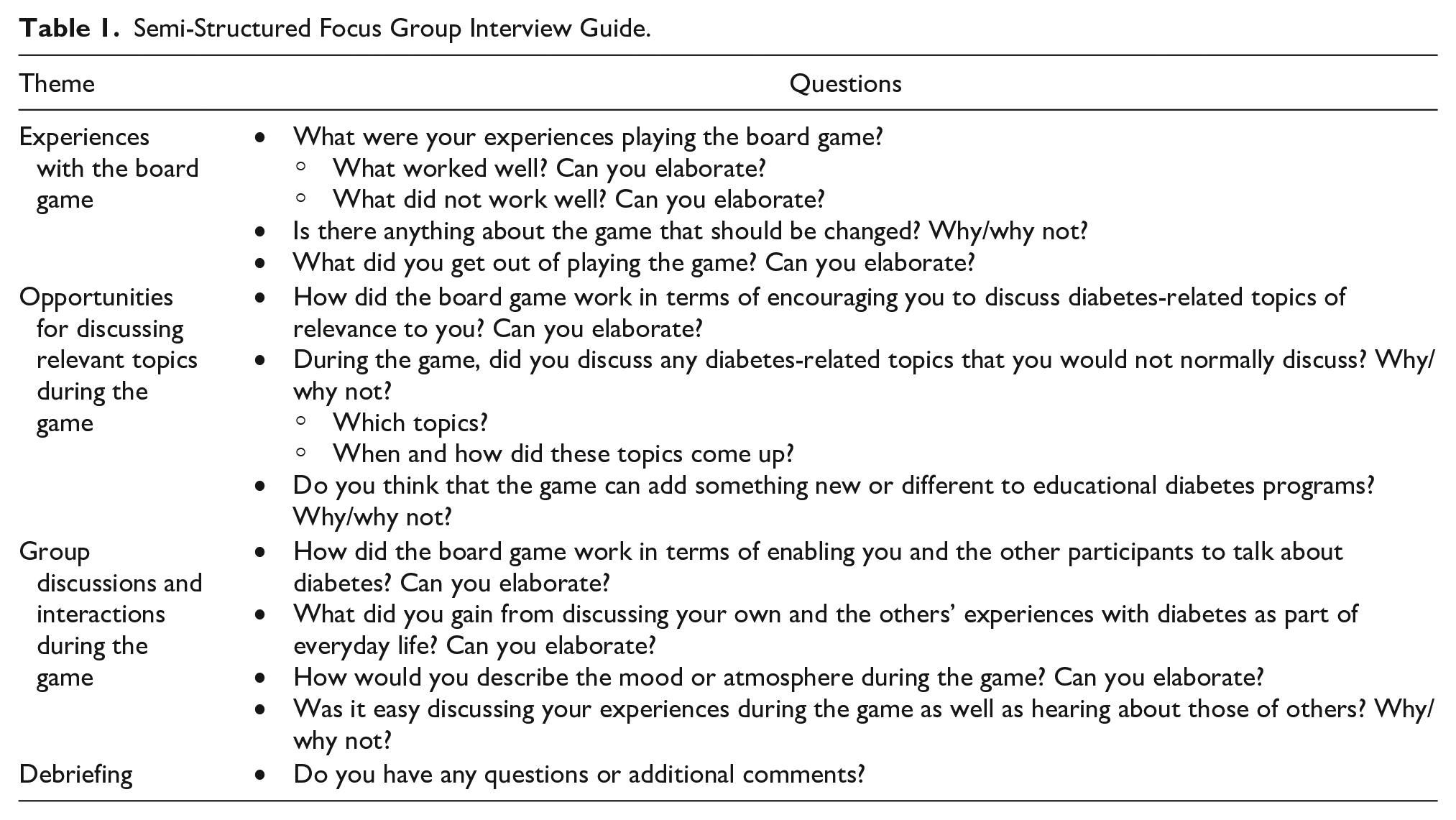
In 9 out of 10 sessions, focus group interviews were conducted immediately after the games were played. In one session, the focus group interview was not carried out due to time restraints. Participants playing games in the same session participated jointly in the following focus group interview. The focus group interviews were carried out by a researcher (Stenov, author of the paper) who has extensive training and experience conducting research interviews. A semi-structured piloted interview guide including different types of questions (e.g., probing, specifying, and structuring questions; Kvale, 2014) was developed to gain knowledge on the overall experience and satisfaction with the game, insights gained from discussions of diabetes-related topics and the perception of the group atmosphere during the game (Table 1). Focus group interviews were audio-recorded and transcribed verbatim.
Semi-Structured Focus Group Interview Guide.
Ethical Considerations
The study was approved by the Danish Data Protection Agency (project ID: VD-2018-157) and conducted according to the Helsinki Declaration (The World Medical Association (WMA) General Assembly, 2018) and current Danish legislation. No ethical approval was needed (The National Committee on Health Research Ethics, 2018). Participants provided verbal and written consent before the game and focus group interviews took place after having received verbal and written information about the study aim, objectives, and methods and their right to withdraw at any time without affecting their future treatment.
Data Analysis
Interpretive Description
Data were analyzed using the qualitative methodology of Interpretive Description as it fitted the study aim of exploring an in-practice phenomenon (i.e., the board game) and generate insights that are relevant to the clinical context of diabetes-specific educational programs (Thorne, 2016). The naturalistic approach to inquiry that is a part of Interpretive Description means that the researcher aims to understand a selected part of the social world by observing, describing, and interpreting the experiences and behaviors of its agents (Hunt, 2009). To capture both their experiences and behaviors as part of the context, people navigate in, Interpretive Description draws on selected elements of ethnography, grounded theory, and phenomenology (Thorne, 2016). Although inspired by the three traditions mentioned, Interpretive Description differs from each of them by encouraging the researcher to pursue a coherent and structured “research logic,” which permits the researcher to use and combine specific methods that are required to explore the research questions. In our study, we applied the methods of observation and focus group interviews.
Elements of ethnography
In Interpretive Description, the generation of data through ethnographic fieldwork and observations is an important way to discover how contextual factors influence the topic being studied (Thorne, 2016). In our study, the game sessions were observed and documented as field notes that were included in the data analysis.
Grounded theory
Elements from grounded theory are incorporated into Interpretive Description, as the methodology assumes that social influences are formed by people while at the same time forming people by affecting their experiences and behaviors (Thorne, 2016). In our study, we investigated the impact on and the actions of the participants who took part in the social act of playing a board game by including data from the observed game sessions as well as focus group interview data of the participants’ experiences in the analysis.
Phenomenological tradition
In line with phenomenological traditions, Interpretive Description aims to gain nuanced insights into individual experiences (Thorne, 2016). In our study, insights into experiences of people with Type 2 diabetes when playing the board game were gained by analyzing focus group interviews.
Theoretical Framework of Potential Peer Support Mechanisms
Based on previous research, the functions of peer support (Fisher et al., 2015a) can be facilitated by mechanisms such as concepts of mirroring, normalization, and recognizability; cohesiveness and reciprocity; humor and playfulness; and sharing tips and tricks. People often better understand and verbalize their thoughts, behaviors, and emotions when mirrored in their peers’ responses (Gruhl et al., 2015). Mirroring occurs among people with similar experiences and challenges and is closely linked to the process of recognizing one’s own experiences in those of others to realize that one is not that different from others, thus feeling normal (Joensen et al., 2016b). Recognizability and normalization may replace feelings of isolation with the sense of belonging and being in a “safe space” (Joensen et al., 2016b, 2017). The reciprocal exchange of diabetes experiences and management tips and tricks among group members may also engender empathy and a sense of group cohesiveness (Christoffersen et al., 2018; Heisler, 2010). These mechanisms and their interrelatedness comprised our understanding of peer support mechanisms and provided a theoretical framework for the initial steps of the analysis.
Analytic Steps
Data were organized and coded using NVivo 12®. The data analysis was an iterative four-step process in accordance with Interpretive Description (Thorne, 2016). In the first step, the researchers agreed on an initial coding structure reflecting the purpose of the board game and the theoretical framework of potential peer support mechanisms (Christoffersen et al., 2018; Gruhl et al., 2015; Heisler, 2010; Joensen et al., 2016b, 2017). To ensure the validity of the study, all data were coded by three researchers. The validity of the study was further enhanced by the inclusion of data from different sources and perspectives (Sandelowski, 1995; Thorne, 2016). Thus, the study aim was investigated externally by observing the players’ interactions during the game and from an internal perspective by exploring their experiences expressed during the focus group interviews. While coding the data, the researchers strived to remain open to the emergence of other and new coding categories. If disagreeing on the coding structure, the raw data were reviewed to identify specific data points supporting or refuting the choice of codes and preliminary findings (Thorne, 2016). For instance, the initial coding structure included the categories “The joker” and “The guide” referring to group roles taken by participants when playing the game. Although these roles did appear during the games, the raw data revealed that they occurred occasionally rather than persistently. Thus, they were removed as independent coding categories and instead collapsed and included as part of the coding categories included in the peer support-facilitating mechanisms, that is, “forming relationships through in game humor” and “co-players guiding each other during the game” (see Supplementary Material 1 for an overview of the initial and final coding structure). The coding structure was continuously discussed by the researchers and revised as new categories were identified and others were combined or eliminated. The diverse professional backgrounds (i.e., public health, psychology, communication, and nursing) of the researchers ensured that various perspectives on the interpretation of the data were continuously incorporated, thus strengthening the rigor of the study (Thorne, 2016).
In the second step of the analysis, data unrelated to the study aim (e.g., occasional comments from the focus group interviews with people with Type 2 diabetes and from health care professionals on their experiences with the game) were discarded (Thorne, 2016). In the third step, preliminary themes grounded in the remaining data were formulated through iterative assessment and discussion, while the final themes were fully described in the fourth step (Thorne, 2016).
Findings
Participants were an average of 64 years old (range 42–89), and 53% were male. In all, 44% had one or more chronic illnesses besides Type 2 diabetes (i.e., osteoarthritis [42%], chronic obstructive pulmonary disease (19%), and depression (16%)), 85% took oral Type 2 diabetes medication, and 18% injected insulin (Stenov et al., 2021). All participants had an education, 24 % had less than a bachelor’s degree (i.e., short-cycle education), 68% had equal to a bachelor’s degree (medium-cycle education), and 8% graduate level (long-cycle education). Half of the participants lived with a partner (Stenov et al., 2021).
Specific game elements (e.g., personas and theme cards) introduced different mechanisms that facilitated or inhibited peer support. Two types of peer support were identified: emotional peer support for diabetes-specific psychosocial challenges (e.g., worries about future complications) and practical peer support related to the instrumental requirements of diabetes self-management (e.g., medication adherence) and the game itself (e.g., guiding co-players about the rules). Emotional and practical peer supports were facilitated by different mechanisms but inhibited by a single mechanism (Figure 1).

Illustration of the identified mechanisms of the board game that facilitated or inhibited emotional and practical peer support.
Mechanisms Facilitating Emotional Peer Support
Emotional peer support was demonstrated when participants shared and respectfully responded to each other’s diabetes-specific emotions elicited by game elements. The mechanisms that facilitated emotional peer support were “entering a safe space of normality created by emotional in-game mirroring,” “mutual in-game acknowledgment of out-of-game efforts,” “forming relationships through in-game humor,” and “health care professionals using game rules to support group dialogues of interest to people with Type 2 diabetes” (Figure 1). The four mechanisms are presented in the following paragraphs.
Entering a Safe Space of Normality Created by Emotional In-Game Mirroring
In-game mirroring
The game rules directed players to compare themselves to their personas. This mirroring encouraged the players to reflect on, verbalize and openly share their emotional responses to and challenges with diabetes. A participant articulated: “[. . .] it can be good to say it out loud. No matter what you’re up against” (focus group 9). Participants highlighted similarities and differences between themselves and their personas: [. . .] Jens [persona] cannot feel his diabetes and doesn’t talk about his illness, but he is worried about complications. He is afraid of not being able to live as he is used to [. . .] I don’t talk much about the illness either [. . .] but I’m quite worried about complications, so I’m trying to learn more about it. So I can postpone them a bit. (game 9)
Emotional peer support was also observed when co-players mirrored themselves in each other’s narratives as illustrated in field notes: “[. . .] They listen to and acknowledge each other” and “The participants look at each other and nod when others are talking. They seem interested in what the others are saying” (game 5). Similarly, one participant said: “[. . .] what I like about this [game] is that you gain insights into your own experiences and become able to share them [. . .] And listen to what the others are saying [. . .] we were very open about everything” (focus group 2).
Feeling normal
Mutual mirroring enabled participants to share diabetes-related emotions and engendered a sense of normality by acknowledging the fact that challenging diabetes-related emotions are common. As one participant said: [. . .] we have different lives and different approaches, but you can still recognize yourself in a lot of what is being said. And it’s nice to know that you’re not the only one with these thoughts [. . .] it’s all related to the illness somehow. (focus group 9)
Another participant in the same group said, “You almost become normal.” The sense of normality was also observed: “[. . .] phrases like ‘I feel the same way as you’ and ‘Me too’ are being used” (game 4). The process of exchanging diabetes experiences also engendered a sense of group cohesiveness in participants: “[. . .] it [playing the game] creates a sort of community [. . .] we share the same kind of things. It gives you a sense of belonging to the group” (focus group 9).
Entering a safe space
Group cohesiveness was enhanced by game rules directing players to take turns. In addition to equalizing the amount of time spent on each player, taking turns ensured that all players contributed their experiences in addition to listening to those of others. This exchange created a safe space: “[. . .] some of the more vulnerable things that are sometimes difficult to talk about are definitely brought up this way. And then you get a little closer in the group somehow, you feel safer around each other” (focus group 9). Participants felt increasingly comfortable sharing experiences that they would not otherwise speak about. “You start talking about some things, you wouldn’t normally talk about,” a participant said, to which another responded, “Yes, and it’s not something you’d talk about with a co-worker. That goes for several of these [theme] cards” (focus group 2).
Mutual In-Game Acknowledgment of Out-of-Game Efforts
When discussing their choice of theme cards for their personas, participants often shared their diabetes experiences, including self-management efforts outside the game (i.e., in “real life”), in which their co-players then acknowledged. One example of emotional peer support occurred when a participant said: “[. . .] I put the green one [game piece] on ‘taking the stairs’ [. . .] I had one of those pedometers, where it exceeded 15,000,” to which a co-player responded, “Oh boy, that’s a lot! That’s bloody well done” (game 3). Similarly, when discussing diet, one participant described planning healthy meals that could be prepared in the oven. While the food cooked, she went for a walk as part of her daily exercise routine. A co-player acknowledged her planning skills: “I find it admirable that you’re thinking that far ahead [. . .] I’m impressed by that” [. . .] I think you deserve a big pat on the back for that” (game 18).
Participants acknowledged each other’s diabetes management strategies, regardless of how they were actually implemented. This approval replaced guilt, often associated with less-than-perfect compliance with official diabetes guidelines, with acceptance from the group and contributed to establishing a safe space. A participant said: “[. . .] for those experiencing it [guilt] I think they become able to let go of some of their guilt. They get a pat on the shoulder and acceptance” (focus group 9). For example, when discussing a theme card on exercise, one participant said that she skipped her walks in bad weather but took other measures to stay active: “I don’t go for walks when it’s rainy and windy [laughs] But I’m doing well with the fitness thing and actually showing up there [. . .] twice a week.” A co-player replied, “That’s good, and a great insight [. . .] Instead of walking around constantly feeling guilty, then you’re telling yourself that’s just the way it is” (game 17).
Forming Relationships Through In-Game Humor
In focus group interviews, several participants described the game as “fun.” Researchers also noted participants’ obvious enjoyment: “They laugh during the game, especially when discussing the theme cards that are sometimes very familiar” (game 1). Participants generally joked throughout the game, especially about their personas. For instance, a participant chose a theme card advising his persona to join a cooking class to learn diabetes-friendly recipes while socializing; a co-player responded wittily: “It’s a boring cooking class he’s in if he doesn’t get to have any red wine” (game 6). Humor also arose when participants played personas very different from themselves. For example, a male participant proclaimed his lack of interest in gardening when comparing himself to his female persona, who enjoyed garden work. Later, when selecting a theme card on exercise for his persona, the participant ironically noted: “I clean often and spend time gardening. It’s great exercise.” The group responded with laughter (game 13).
The use of humor contributed to a light-hearted atmosphere and promoted emotional peer support as participants bonded, sometimes by highlighting shared preferences. Two participants joked about their preference for driving over walking: “The car needs exercise, too,” one said, to which the other replied, “And you get exercise when moving your foot.” They both laughed, and the first participant added, “It [the foot] also needs exercise” (game 2). Besides helping the players to form bonds, this example may also illustrate how humor may have been used by players as a way of protecting themselves when disclosing behaviors that are not in line with typical diabetes management guidelines (i.e., driving rather than walking). Forming relationships through humor added to the sense of group cohesiveness: “[. . .] the playfulness and the lack of restraint [. . .] playing a game does something when it comes to getting to know one another,” said one participant (focus group 9). Similarly, a participant said, “[. . .] it [the board game] was inspiring [I had some] nice input from the –.” Another participant interrupted with: “The members.” The group laughed, and the first participant continued, “Yes, the members. That’s a little bit cool. You’re safe in an environment, where everyone knows what it’s about” (focus group 8). Humor contributed to the sense of a safe space, as exemplified by an exchange (focus group 8) that was followed by good-natured group laughter. One participant said “[. . .] I’m usually not open about my diabetes [. . .] I don’t think I’ve told anyone besides you guys. I think of it as something private.” Another participant replied: “We won’t gossip about it” to which the first participant said (sarcastically): “Now, are you sure about that?”
Health care Professionals Using Game Rules to Support Group Dialogues of Interest to People With Type 2 Diabetes
Health care professionals also facilitated emotional peer support. By listening attentively to participants’ diabetes-specific needs and preferences, they ensured that group dialogues were relevant to everyone. If a dialogue took an unproductive turn, health care professionals redirected participants’ attention to something new. This was legitimized by referring to the game rules, which preserved a friendly atmosphere. For instance, when a participant delivered a monologue that could have disengaged co-players from the game, the health care professional interrupted her to steer the game back on track: But I think you’re going to talk about all of that soon. Because you’re doing a lot. And that’s amazing. But right now, I think you [the group] have to proceed with it [the game] and then later, you [the group] will tell us about your experiences (game 8).
Another way for health care professionals to keep dialogues interesting to participants was by highlighting similarities between their experiences. This occurred during a discussion of a theme card that described the option to eat the same food as everyone else at social events to avoid standing out: Participant: “If you’re going out [. . .] It’s easier not making a fuss about it and simply eating what’s being served [. . .] than getting all that attention. I can’t do it.” Healthcare professional: “You mentioned the negative attention you get when eating something else. Does the rest of you experience that, too? I mean, how do you manage it? How about you [name]? you’ve had it [type 2 diabetes] for many years, right?” (game 10).
Similarly, another health care professional emphasized the similarities between the participants’ experiences after a discussion of a theme card about physical activity by summing up their responses: “So, there are some things you have in common. Having arranged to exercise with people is helpful, because having an appointment and spending time with others is motivating” (game 13).
However, health care professionals sometimes inhibited emotional peer support among the players by dominating the game, typically by replying to the participants’ questions or remarks instead of allowing time for the co-players to respond. Thus, the dialogue of the players and the possibility for them to mutually exchange their experiences was inhibited. One participant considered a theme card for her persona with the option to spend time with grandchildren to momentarily forget about Type 2 diabetes, who was described as highly concerned about future diabetes complications (game 13):
“Well, she’s an elderly lady, and some exercise would do her good.”
“She’s worried.”
“Yes, she’s worried about the illness. And, I don’t know if she has
grandchildren—”
“She has four grandchildren.”
“Four grandchildren. And when she spends time with them, she’s not thinking
about her illness.”
“So she gets a break from her illness?.”
“Yes.”
Mechanisms Facilitating Practical Peer Support
Practical peer support was provided when participants exchanged diabetes management tips and tricks as inspiration and guidance. The mechanisms that facilitated practical peer support were “Being inspired by in-game exchange of tips and tricks” and “Co-players guiding each other during the game” (Figure 1). These mechanisms are described below.
Being Inspired by In-Game Exchange of Tips and Tricks
Sharing specific diabetes management strategies provided practical peer support. Typically, it occurred when participants discussed their rationale for choosing a specific theme card. For instance, a participant commented on a theme card suggesting replacing sugary candy with a few pieces of dark chocolate: “[. . .] The one [theme card] about dark chocolate. It’s the chips [for me]. But I found a solution to that, because I found out that I can make some dip using sour cream [. . .] then I can eat carrots and cauliflower [. . .] instead of chips” (game 2).
By relating the theme card to a different personal challenge, the participant shared a diabetes management tip in enough detail that others could adopt it. In another example (game 6), a participant (X) chose a theme card on a strategy he had used of regularly eating fish with low-fat dressing because he valued healthy food that was tasty. Two co-players (Participants Y and Z) drew a parallel between this behavior and making sugar-free desserts:
“I like something sweet, right?.”
“Me, too.”
“And the Danish Diabetes Association has some good desserts. You just have to buy this strange kind of sugar [. . .] artificial sweetener.”
“Oh, I didn’t know about that.”
“Yes, you can simply add a bit of sweetener.”
“Well, I see, but I don’t have any. I have to go buy it now.”
“Yes, you’ll have to go buy some.”
“Yes, I see. There are so many options.”
By sharing this tip, the two participants inspired their co-player to adopt another diet-related behavior. Similarly, a participant told the group how she struggled to eat enough vegetables because her husband did not like them. A co-player offered a potential solution: “Have you tried hiding them [the vegetables] in lasagna and stuffing?” (game 18).
The exchange of specific strategies and tricks inspired participants. One said: “What I liked about this [game] was how we asked each other 'why are you doing that, or could you do this, and how would you do at your house’ [. . .] you got a lot of ideas” (focus group 1). These exchanges highlighted similarities between participants’ diabetes management strategies, increasing group cohesiveness. As one said: “It’s easier to talk to others who are in the same situation [. . .] you’re not alone in the world” (focus group 7).
Co-Players Guiding Each Other During the Game
Some participants actively guided co-players on the game rules (e.g., helping them understand the point system). In addition to helping game progress, game-specific guidance contributed to a friendly atmosphere and the creation of a safe space, as illustrated in field notes: “The participant reading aloud the rules is very pedagogical. She explains the rules, using examples. She is especially helpful to one co-player who finds the game a bit challenging” and “The participants are friendly and helpful towards each other” (game 5). For example, one participant was unsure how to select a theme card saying: “But there are no more [theme cards] that fit him [persona].” Another participant asked “what kind of person is he?” to which the first participant replied: “He is busy, and –“. He got interrupted by the co-player who said: ”Do you remember what his description said?.” The first participant replied: “Well, he’s busy and he’s [pauses] Shouldn’t I be talking about myself?.” The co-player responded: “No. You have to tell us what [theme] card you chose for him and [. . .] why [. . .] Do you want me to go first? Is that better?.” The first participant replied: “Yes, that’s better” to which the co-player replied: “If not, then say so.” The first participant said: “I will. It’s a bit difficult for me.”
Mechanism Inhibiting Emotional and Practical Peer Support
Game Rules Obstructing Group Dialogues
Emotional and practical peer supports were inhibited by the same mechanism. Peer support was inhibited when following the rules and completing the game were prioritized at the expense of meaningful group dialogues. This typically occurred when time was short; participants limited discussions to ensure they would finish the game. A participant said: “[. . .] you feel like you have to get through it [the game]. Then, there isn’t a lot of room for individual talking” (focus group 8). Participants preferred having enough time to let group dialogues unfold rather than worrying about completing the game: “[. . .] you’d have a better outcome, if you had a bit more time” (focus group 8). Furthermore, when advancing the game took priority, some participants felt they took too much time sharing their experiences. For example, a participant described worrying about long-term complications because she had trouble adhering to diabetes-friendly foods. While acknowledging the relevance of her concern, the health care professional also pointed out the need to continue the game to make sure everyone had a say. “Yes, of course. It’s not all about me,” the participant replied (game 18).
Difficult or confusing rules also interfered with group dialogues by disengaging participants from the game: “It was difficult getting started. The rules were difficult,” one participant stated (focus group 5). Several participants didn’t know when to play their personas and when to be themselves. This interfered with meaningful dialogues as the conversation shifted from diabetes-related issues to the game rules, illustrated in a discussion about what to eat when attending social events (game 6):
“Are you talking about your persona or yourself?.”
“No, about me.”
“But we’re not supposed to talk about ourselves, are we?.”
“Afterwards. Right now, we’re talking about the cards for [the persona].”
“I did both already.”
“You did?.”
Discussion
We explored specific board game mechanisms as facilitators or inhibitors of peer support among adult people with Type 2 diabetes. To our knowledge, the focus on peer support mechanisms makes our study the first of its kind, as previous studies on games for people with diabetes (type 1 or type 2) have primarily investigated the effect of single-player games on long-term blood glucose levels (HbA1c) (Martos-Cabrera et al., 2020). While these studies have concluded that the investigated games may promote a more physically active lifestyle, the effect on HbA1c is low, and the impact on psychosocial health unexplored (Martos-Cabrera et al., 2020). Our findings illustrate how the group-activity of playing a board game may promote normality, acceptance, and a sense of cohesiveness through the facilitation of peer support which many people with Type 2 diabetes find valuable and helpful (Christoffersen et al., 2018; Jensen et al., 2019). Thus, our study highlights the potential of board games when applied in health-related and educational settings which remains an under-researched topic (Noda et al., 2019).
Our findings showed that the board game facilitated emotional peer support and practical peer support. However, emotional and practical peer supports were inhibited when game rules were prioritized over group dialogues. Emotional and practical peer support are similar to the previously presented four key functions of peer support defined by Fisher et al. (2015a), that is, (a) assistance in daily illness management; (b) social and emotional support; (c) linkage to clinical care and community resources; (d) ongoing support of chronic illness management. First, the emotional peer support emerging when playing the board game promoted social support among the participants, while possibly laying the foundation for ongoing support of the participants’ Type 2 diabetes management through the establishment of a social network for the participants to benefit from during, and potentially following, the education program. Second, the practical peer support promoted by the board game may assist the participants in their daily management of Type 2 diabetes by encouraging them to develop individual management strategies fitting their everyday life. In addition, the board game-induced practical peer support may provide a link to clinical care and community resources, as participants are encouraged to share their experiences, tips, and tricks on diabetes treatment and local activities. Thus, the participants are encouraged to exchange information and insights into treatment offers and community-based activities (e.g., cooking classes or exercise initiatives). In all, the types of peer support identified in the study are reflected in and overlap with key peer support functions as defined by Fisher et al. (2015a).
In our study, we found the mechanisms facilitating emotional peer support differed from those facilitating practical peer support. However, both types of peer support were inhibited by the same mechanism, indicating their interrelated nature. This is consistent with previous international research demonstrating that the exchange of practical diabetes management tips adds to the foundation of trust needed for emotional, or psychosocial peer support (Fisher et al., 2015b; Joensen et al., 2017). Similarly, interventions facilitating emotional peer support can engender a sense of belonging to the group that may encourage participants to share instrumental advice (Kowitt et al., 2015). Emotional peer support may gradually develop during a peer support intervention as trust among peers emerges (Fisher et al., 2015b). Consequently, emotional peer support may be limited if playing the game occurs in early group sessions of the educational program where the level of trust may be lower than in later group sessions. On the other hand, playing the game in the initial sessions of the educational program may encourage participants to share their diabetes-specific experiences and emotions with each other early on, which may promote emotional peer support.
Entering a safe space of normality created by emotional in-game mirroring and being inspired by in-game exchanges of tips and tricks respectively, promoted emotional and practical peer supports. Similar findings have been found in other studies, for example, that people with Type 1 diabetes experienced diabetes-specific social capital when exchanging diabetes-related experiences and tips, which reduced loneliness and induced a feeling of being “normal” (Joensen et al., 2016b, 2017; Stenov & Willaing, 2016). Co-players guiding each other on how to play the game (e.g., by explaining the game rules) while playing it facilitated practical peer support along with a sense of cohesiveness. This is similar to the processes described by Heisler (2010) by which reciprocal guidance from “insiders” (i.e., peers participating in the same group or activity) enhances a sense of belonging among peers. Thus, the board game is a highly relevant way of promoting group cohesiveness and structured peer support.
Mutual in-game acknowledgment of out-of-game efforts facilitated emotional peer support, in part by reducing feelings of diabetes-specific guilt (Hilliard et al., 2015; Joensen et al., 2017; Sebire et al., 2018). Similarly, conversations with health care professionals that incorporate dialogue tools supporting the articulation of the difficulty of daily diabetes management can also reduce diabetes-specific guilt and therefore be valuable to people with Type 2 diabetes (Jensen et al., 2019). Discussions with like-minded peers, however, may more effectively reduce guilt because of shared experiences and understanding (Heisler, 2010; Stenov & Willaing, 2016).
Emotional peer support was also facilitated by the formation of relationships through in-game humor facilitated by the game (e.g., by its illustrations). Similarly, other studies have found humor to play a significant role in the formation of peer support in interventions for various medical conditions. Among people with chronic pain, collectively generated humor on relatable topics (e.g., side effects of analgesics) made participants feel included as group “members” (Finlay et al., 2018). According to Rabin (2018), young adult cancer survivors frequently used humor when sharing their cancer history with peers to keep the topic as “light” as possible. The humorous aspect of peer support can also exist outside of face-to-face group meetings. A review of online communities for people with diabetes concluded that peers frequently shared humorous diabetes-related content (e.g., personal anecdotes or comics) as a way of coping with the seriousness of living with diabetes (Hilliard et al., 2015). Among women with gynecological cancer, “black” or “gallows” humor during telephone-based peer support contributed significantly to peer bonding (Pistrang et al., 2012). Thus, health care professionals can consider various online, telephonic, and face-to-face ways of facilitating peer support in their practices. In addition to humor shared with peers, people with diabetes may benefit from humor shared with health care professionals. Studies have shown that humor can positively affect patient-provider interactions by reducing the power asymmetry and promoting a more relaxed atmosphere (Schöpf et al., 2017). Schöpf and colleagues (2017), however, pointed out that the use of humor was most successful when initiated by patients rather than the provider, who should simply mirror it. Similarly, women with gynecological cancer legitimized morbid humor when it was delivered by peers, not health care professionals (Pistrang et al., 2012). When applying humor in health-related interventions, including board games, it is seemingly important to consider whether its use and form fit the culture in which it is embedded. According to Jiang et al. (2019), the use of humor in various settings (e.g., educational and health-related) is, in general, received very positively in Western countries, whereas Eastern countries typically hold a less positive attitude toward humor, therefore applying it less. Thus, the use of humor and games in health-related settings should be carefully adjusted to fit the population for which it is intended, for instance by testing it in workshops with end-users before its application. Still, humor that is aligned with the cultural setting in question may be an effective tool to facilitate peer support by building and strengthening peer relationships and resulting in a sense of belonging. Moreover, especially when initiated by patients, light humor may benefit patient-provider relationships (Schöpf et al., 2017).
Health care professionals using the game rules to support group dialogues of interest to people with Type 2 diabetes facilitated emotional peer support, whereas game rules obstructing group dialogues inhibited both emotional and practical peer supports. Similarly, a study of various dialogue tools in Type 2 diabetes education programs found that the tools primarily promoted participant dialogues, but could also obstruct them (Jensen et al., 2019). This was the case when tools were too complicated or participants could not relate to the content (Jensen et al., 2019). Similarly, we found that game rules mostly served the purpose of encouraging group dialogues but occasionally did the opposite when players did not understand them. Thus, to promote peer dialogue through board games, elaborate instructions need to be readily available for facilitating health care professionals.
Although educational programs for people with a chronic illness may benefit those attending, a substantial part declines to participate. A report on the uptake of educational programs offered by the Capital Region of Denmark to people with chronic illnesses showed that as many as 71 % of people with Type 2 diabetes had neither attended nor were signed up for an educational program (Johansen et al., 2012). Although participation is optional, the large proportion of people with Type 2 diabetes not attending educational programs is concerning, as it may increase inequality in health, since those attending are typically those who already apply the strategies taught in the program (Schwennesen et al., 2015). According to the report by Johansen et al. (2012), the likelihood of attending an educational program is significantly lower in people under the age of 45 and people living without a partner, which may be linked to more work-related and parental duties when younger and a potential lack of social support if living alone (Johansen et al., 2012; Schwennesen et al., 2015). The characteristics of the participants in our study are in line with these findings, as their mean age was close to that of retirement and more than half were living with a partner. The rate and characteristics of those declining to attend in the educational programs in which the board game was played are unknown, as are their reasons for not attending. Thus, to gain insights into ways of potentially increasing the attendance rate to avoid further inequalities in health, future studies on educational programs for people with a chronic illness should aim to include these data.
Limitations
Several limitations should be mentioned. First, video recordings would have allowed us to completely document nonverbal communication. However, we recorded field notes while observing the games (Thorne, 2016). Second, the transferability of our findings to other countries is limited by the fact that our study was carried out in Denmark, where Type 2 diabetes educational programs and health care are free. Third, the specific cultural setting, for instance regarding the acceptance of games, humor, and open discussion of emotions, may affect the outcomes of playing the game, which should be considered when transferring the board game to other settings. Finally, information on race and ethnicity of the participants as well as sociodemographic information on those declining to attend the educational programs is lacking.
A strength of the study is the fact that the analysis was carried out by three researchers, who repeatedly discussed the coding structures and findings to maintain rigor (Thorne, 2016). In addition, the combination of data from observations and focus group interviews enabled us to explore the peer support mechanisms of the board game from different perspectives. We also collected data from several settings, which increased the representativeness and potential transferability of the findings (Thorne, 2016).
Conclusion
Our study provides novel insights into the mechanisms of a board game that facilitated or inhibited peer support among people with Type 2 diabetes participating in Type 2 diabetes educational programs. The game promoted emotional and practical peer supports in a playful and humorous way, encouraging participants to engage in structured group dialogues. The exchange of diabetes-specific experiences, needs, challenges, and management tips induced a sense of normalization, acceptance, and belonging among the participating people with Type 2 diabetes. The facilitation of peer support depended on the health care professionals’ abilities to encourage group dialogues among people with Type 2 diabetes, while at the same time adhering to the structure of the board game. Health care professionals need training and instructions on how to achieve the needed flexibility.
Supplemental Material
sj-pdf-1-qhr-10.1177_10497323211016807 – Supplemental material for Playing With Peers: Exploring Peer Support Mechanisms of a Type 2 Diabetes-Specific Board Game
Supplemental material, sj-pdf-1-qhr-10.1177_10497323211016807 for Playing With Peers: Exploring Peer Support Mechanisms of a Type 2 Diabetes-Specific Board Game by Pil Lindgreen, Vibeke Stenov, Ingrid Willaing, Henning Grubb Basballe and Lene Eide Joensen in Qualitative Health Research
Footnotes
Acknowledgements
We would like to thank the participating people with Type 2 diabetes and the health care professionals present during the games for letting us gain access to their diabetes education program sessions and enabling us to study the mechanisms of the board game in practice; we will do our best to ensure that our findings will benefit people with Type 2 diabetes in general. Furthermore, we are grateful to Copenhagen Game Lab for their extensive collaboration throughout the process of designing, testing, and evaluating the board game. Finally, we want to acknowledge student assistants, Thit Hjortskov Jensen and Maria Friis Børsting, for their assistance in collecting, transcribing, and analyzing the data.
Author’s Note
Ingrid Willaing is also affiliated with the Department of Public Health, University of Copenhagen, Denmark
Declaration of Conflicting Interests
The authors declared no potential conflicts of interest with respect to the research, authorship, and/or publication of this article.
Funding
The authors disclosed receipt of the following financial support for the research, authorship, and/or publication of this article: Financial support to conduct the study was provided by Steno Diabetes Center Copenhagen. No external funding was received.
Clinical Trial Registration Number
VD-2018-157 (Danish Data Protection Agency)

Supplemental Material
Author Biographies
References
Supplementary Material
Please find the following supplemental material available below.
For Open Access articles published under a Creative Commons License, all supplemental material carries the same license as the article it is associated with.
For non-Open Access articles published, all supplemental material carries a non-exclusive license, and permission requests for re-use of supplemental material or any part of supplemental material shall be sent directly to the copyright owner as specified in the copyright notice associated with the article.
