



Abstract
Social media influencers increasingly make health recommendations on social media. Research on influencer health messaging is mixed in that some studies show it can result in misleading or harmful health information, and others demonstrate it can lead to beneficial behavioral outcomes. However, there is little research on young adults’ beliefs about following health guidance from influencers. Guided by the reasoned action approach, this study examined young adults’ attitudes, normative beliefs, and control in seeking health information from social media influencers using focus groups (n = 31). Results suggest that young adults obtain health information from influencers and perceive them as a source of health education. Several barriers to getting health information from influencers were mentioned, including sponsorship, lack of credibility, and perceived normative pressure to critically analyze influencer content from peers and family. Practical and theoretical implications for future research are discussed.
Introduction
In February 2022, the state of Texas sued wellness and health influencer Brittany Dawn Davis when followers claimed that her online fitness brand engaged in deceptive practices. Davis promised clients individualized plans and weekly check-ins and coaching but did not follow through on these promises (Texas v. Brittany Dawn Davis, 2022). Furthermore, clients with eating disorders claimed that Davis’ online fitness brand was harmful to their recovery (Weekman, 2023). This situation exemplifies the mismatch in expectations and priorities between influencers and their followers as it pertains to health information, with potential implications on audiences’ health and well-being.
Social media is a unique online tool for increasing access to health information. Individuals report using social media to obtain health advice and share their experiences with similar communities (Niederdeppe et al., 2007). Similarly, individuals seek health information on social media because they engage with peers they trust and find social and emotional support (Zhao & Zhang, 2017). For example, adolescents and young adults share health information with their networks about mood, wellness, and acute medical conditions (Hausmann et al., 2017). However, there is mixed support from young people about whether online health information is beneficial or harmful (Fergie et al., 2013; Hausmann et al., 2017), potentially due to biased information that presents only one side of the story (Madathil et al., 2015). For example, information about hormonal contraception is often negatively framed on social media, biasing perspectives about the safety of contraception (Pfender & Devlin, 2023). Reported concerns about the quality and credibility of health information on social media are at the forefront of research (Lin et al., 2016). Despite high levels of mistrust in medical information on social media, most social media users do not verify the information they find online (Neely et al., 2021). Lack of verification and medical misinformation on social media can lead to a host of problems, such as worsened medical conditions (Suarez-Lledo & Alvarez-Galvez, 2021).
Social Media Influencers and Health Information
One important source of health information on social media is social media influencers (Hendry et al., 2022). Social media influencers, defined as “semi-professional microcelebrities on social media platforms such as YouTube, often sponsored by brands to promote lifestyle products to followers” (Johnson et al., 2021, p. 1), are partly responsible for the rise of health information on social media. Influencers gain popularity through their presence on social media (Johnson et al., 2021) and are often considered to be opinion leaders with expertise in a topic area (Bamakan et al., 2019). For example, while some influencers have a fashion niche, others have sustainability or green lifestyle niches. Influencers continue to build credibility and popularity by accruing large followings (De Veirman & Hudders, 2020). Additionally, many influencers make a living on social media through affiliate marketing, brand sponsorship, fan donations, advertising revenue, or merchandise sales (O’Connell, 2018). Research shows that influencers can shape attitudes, beliefs, and behaviors due to their influence and persuasive content on social media (Lou & Yuan, 2019).
Influencers are increasingly posting information about health and wellness and play an important role in disseminating health information to the public (Looi et al., 2022; Zou et al., 2021). They talk about health-related information on their social media platforms (Zou et al., 2021), make recommendations for living a healthier lifestyle through fitness and nutrition (Pilgrim & Bohnet-Joschko, 2019), and have been used to promote public service announcements, such as COVID-19 prevention messaging (Looi et al., 2022). Influencers discuss various health topics, including skincare, nutrition, exercise, vaccinations, and women’s sexual health (Zou et al., 2021), either specifically or in the context of other types of content. Some scholars refer to social media influencers as informal sources of health education (Hendry et al., 2022; Marks et al., 2020). However, young viewers might take influencer health guidance at face value, rather than treating them as informal sources that require further validation.
Health and wellness influencers in particular play important roles in disseminating public health messages and facilitating behavior change (Zou et al., 2022), building authenticity with their followers through various approaches. For example, fitness influencers story their everyday lives by consistently sharing mundane and vulnerable moments (Reade, 2021). Others push back against the picture-perfect body by posting raw and relatable images (Reade, 2021). In health-related content created by influencers, audience perception of an influencer’s authenticity is not necessarily about whether the content offers objectively true information and is commonly based on relatable health experiences that can be shared and discussed on social media (Hendry et al., 2022). Social media influencers could be beneficial messengers of health information, as they cover various health-related topics and have extensive reach. For example, using influencers to disseminate public health announcements can increase the acceptance and uptake of vaccines (Bonnevie et al., 2020; Looi et al., 2022; Lutkenhaus et al., 2019) and also motivate their followers to engage in physical activity (Durau et al., 2022; Sokolova & Perez, 2021).
However, suspicion of influencer content is warranted, given the lack of regulation and widespread misinformation (Lofft, 2020). Health influencers rely heavily on narrative evidence rather than statistical evidence from studies or experts (Zou et al., 2021), and narratives might also be interpreted as factual evidence. Also, most health information on social media does not come from experts (Hendry et al., 2022; Minadeo & Pope, 2022). In a traditional sense, experts are people “with comprehensive and authoritative knowledge in a particular area not possessed by many people” (Caley et al., 2014, p. 232). Health influencers without official credentials or expertise are instead validated by engagement from their users, which grows their perceived credibility and trustworthiness (Hendry et al., 2022). Accordingly, there is concern about influencers’ health communication and sharing inaccurate information.
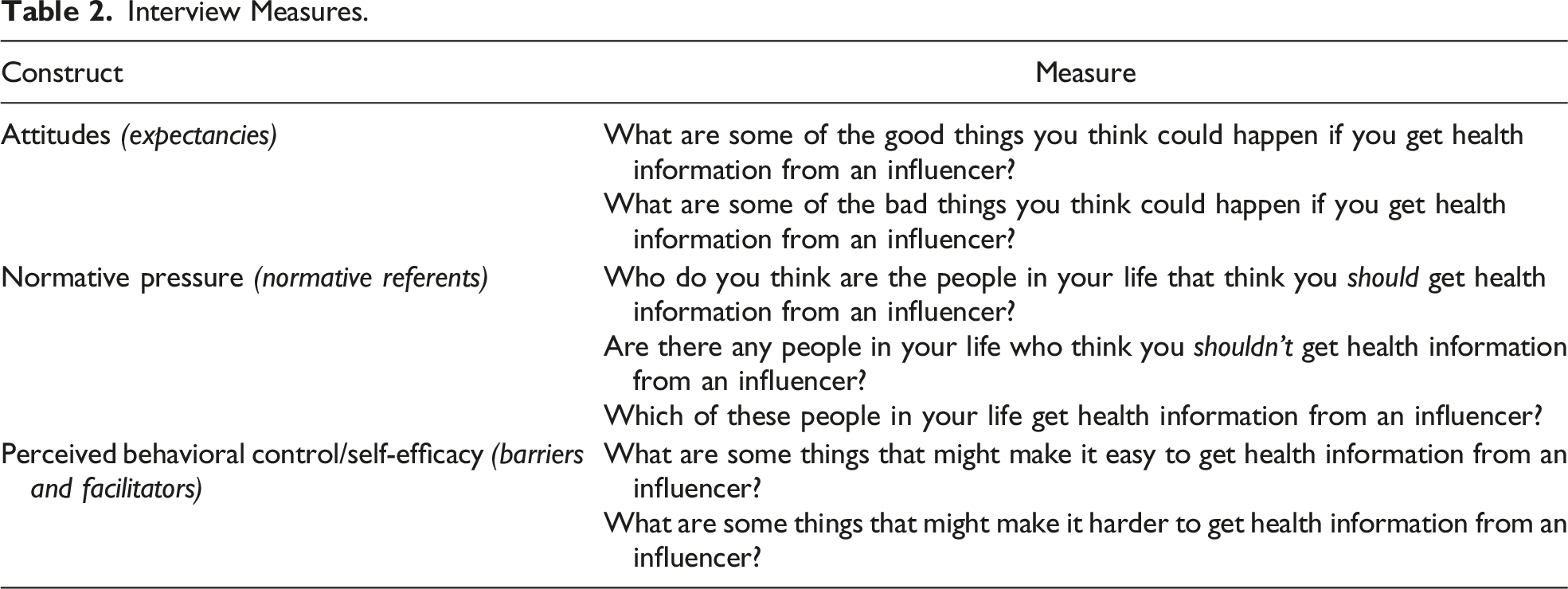
Given young people’s reliance on influencers and social media for health information, we were interested in learning more about specific beliefs pertaining to using influencers as a source of health information. Therefore, in the current study, we conduct theory-based elicitation research based on the reasoned action approach to identify attitudinal, normative, and control beliefs related to the behavior of seeking health information from social media influencers. Health information seeking refers to “intentional, active efforts to obtain specific health information above and beyond the normal patterns of information exposure and use of interpersonal sources” (Zhao & Zhang, 2017, p. 270), and online health information seeking provides many benefits, including increased knowledge, agency, and accessibility (Niederdeppe et al., 2007).
Theoretical Framework
A psychosocial model of behavioral prediction, the reasoned action approach (RAA) evolved from the theory of reasoned action (Fishbein & Ajzen, 1975), the theory of planned behavior (Ajzen, 1991), and the integrative model (Fishbein, 2000). According to the model, behavioral intention is the primary predictor of a specific behavior. The three core factors that form behavioral intention include attitudes (i.e., the extent to which one favors performing a behavior), perceived normative pressure (i.e., perceptions about what others think and do regarding a specific behavior), and perceived behavioral control (i.e., beliefs about one’s ability to perform a behavior). Attitudes, norms, and control all contain a set of salient, underlying beliefs. A change in underlying beliefs will affect the three core constructs, which impact behavioral intention and behavior, accordingly.
Little is known about what drives individuals to seek health information from influencers. The reasoned action approach provides a useful framework for understanding health information–seeking behavior on social media as it has been used to examine health information–seeking intentions (Ross et al., 2007; Silwal et al., 2022) and information seeking online (Yoo & Robbins, 2008). RAA is especially fitting for studying influencers because influencers’ unique characteristics lend themselves to attitudes, norms, and control. For example, influencers are known for accruing large followings. When followers see an influencer with a large following, they might perceive that many other people approve of the health influencers’ recommendations (e.g., descriptive norms). It is very unlikely that an influencer would grow a large following unless others supported and believed in their health information (Wellman, 2022).
Influencers posting their performance of a behavior can also affect attitudes (Fielden & Holch, 2022). For example, women exposed to an influencer discussing cervical screening were more likely to hold positive attitudes toward attending cervical screening. Parasocial relationships between influencers and followers can affect followers’ attitudes, including attitudes toward health behaviors (Fielden & Holch, 2022; Lou & Yuan, 2019). Finally, influencers are interactive on social media and have been known to provide encouragement to followers, especially in the context of encouraging followers to exercise (Sokolova & Perez, 2021). Receiving encouragement from and watching an influencer exercise might encourage followers to also engage in exercise by increasing their perceived control. However, factors such as sponsorship might make it difficult for followers to obtain health information from influencers because they cannot trust the information (Boerman et al., 2017; Evans et al., 2017). These examples are only some of the ways in which influencers’ unique characteristics could attract and affect followers looking for health information.
Considering the ways the RAA components play a role in the potential effects of influencer health information and followers’ health information seeking, we pose the following research questions (RQs):
What are young adults’ attitudinal beliefs about seeking health information from influencers?
What do important referents think about young adults seeking health information from influencers?
What barriers and facilitators do young adults mention when seeking health information from influencers?
Methods
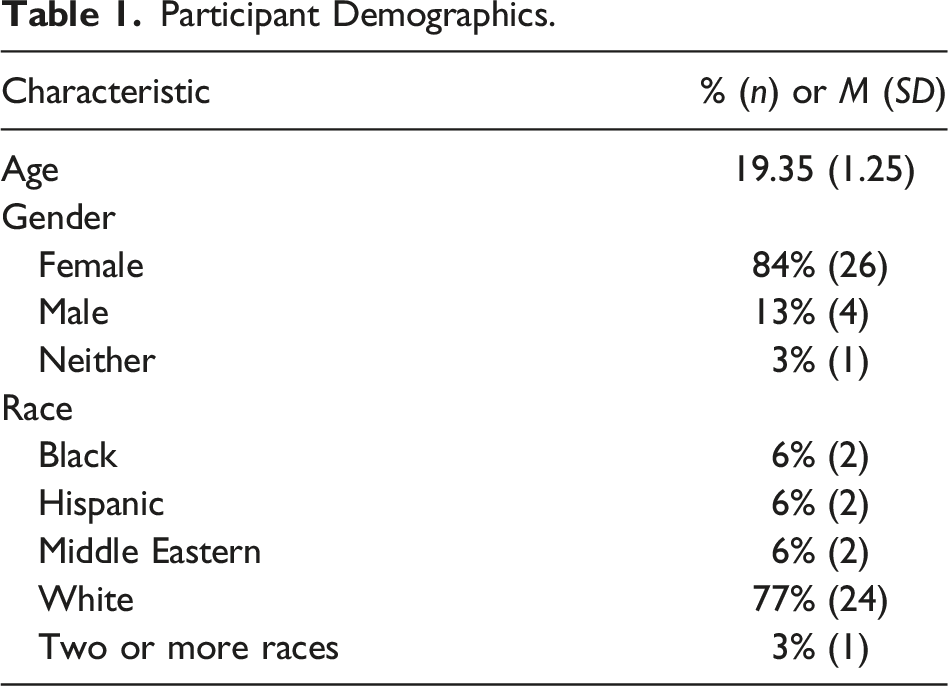
Participant Demographics.
The focus groups began with an explanation of the purpose of the study and ground rules (e.g., there are no right or wrong answers, take turns speaking). Once participants were consented and agreed to the ground rules and signed informed consent, two definitions were provided. A social media influencer was defined as “microcelebrities on social media platforms who make product and lifestyle recommendations to their followers (Johnson et al., 2021), act as opinion leaders (Bamakan et al., 2019), have large followings (De Veirman et al., 2017), and promote consumer–brand relationships across various product types” (O’Connell, 2018). Health information was defined as “the information we seek out or receive regarding illness, diagnosis, or behaviors that can improve our health, or personal experiences with topics related to fitness, nutrition, mental, and sexual health.” Health and health behaviors were contextualized for participants and limited to minor health ailments, such as skincare and acne, exercise, or the common cold. Participants were told to exclude experiences searching for serious health conditions, such as cancer and chronic illness. After defining these key terms, participants were asked to engage in a warmup activity where they discussed an influencer they currently follow and described why they like that influencer. Every participant described an influencer they follow.
Interview Measures.
Thematic Analysis
Focus group sessions were transcribed verbatim by the researcher with all identifying information removed. After transcription, thematic analysis was used to examine the data and extract key themes (Braun & Clarke, 2006) that corresponded to the primary RAA determinants. The analysis followed a 6-step guide: get familiar with the data, generate initial codes, search for themes, review themes, define themes, and produce the final analysis (Braun & Clarke, 2006).
Peer debriefing was also used to strengthen the validity and reliability of emerging themes (Spall, 1998). During data analysis, the researchers noticed that participants talked about people on social media or social media posts, which is present in some of the exemplar quotes below. It is important to note that the data reflect participants’ thoughts about social media influencers and their posts on social media rather than lay users or company advertisements. If advertisements were discussed, it was in the context of seeing an influencer speaking about a product in an advertisement.
Results
RQ1: What Are Young Adults’ Attitudinal Beliefs About Seeking Health Information From Influencers?
The first research question sought to understand young adults’ attitudes toward obtaining health information from influencers. Participants mentioned several advantages to getting health information from an influencer. Two themes that emerged were influencers as a new source of health education and as a source of tailored health information. Aside from advantages, participants mentioned several disadvantages that could happen from getting health information from an influencer, which were focused on the themes of experiencing negative health outcomes and receiving unreliable information.
Advantage: Influencers as a Credible Source of New Health Information
Participants suggested that influencers serve as a new source of health education that can introduce followers to healthier lifestyles. By following social media influencers, followers can gain nutrition tips, learn about meal prep, and experiment with different foods. For many participants, influencers are a reliable source for providing examples of what healthy eating and nutrition looks like: The eating healthy part, I think, is something that I could rely on more than other things that are health-related … Like I saw a few TikToks like meal prep, and it was just like oh, my gosh! I would have never thought to put these two things together. I feel like just experimenting with certain foods and stuff that are healthier to get more ideas of where I can incorporate that in my diet. I feel like that's something I could trust from social media influencer. (Female)
Furthermore, participants noted that influencers can gain more credibility and be more trustworthy health educators when they bring traditional experts onto their platforms to talk about different health trends, products, and services, or when the influencer is an expert. For example, one participant talked about an influencer who was also an Olympic athlete: I follow a hockey player, Hillary Knight, and she, like, obviously has a huge following. She, like competed in the Olympics, but she like promotes things for like health and well-being and stuff like that. And I was gonna say, like, I respect more of what she’s saying because she’s like kind of proven … She is an athlete herself, so like whatever works for her clearly works to some degree. (Female)
Advantage: Influencers Provide Tailored Health Information
Participants also suggested that influencers provide tailored health information. Followers can find products or workouts that work well for their body type and lifestyle. For some participants, the internet and simple Google searches provide broad information that is not uniquely tailored to their body or lifestyle. I feel like the Internet might be too broad, and it might be difficult to find exactly what you’re looking for. But if you go somewhere like TikTok, and you just search something … They always have weird, random videos that are exactly what you’re looking for. So I feel like on places like that, influencers would have more stuff that’s specific. (Female)
Tailored health information from influencers is advantageous due to the trial-and-error nature of their content. Participants explained that when influencers try health trends, products, or services, they also tend to provide a review of their experiences. In this way, influencers test health-related behaviors or products, which aids the followers in making health-related decisions that they think will be effective: “I think one thing that would also be good to like influence like with medicine with influencers is them like experimenting with it first. So you know, like, okay, it is good for me. This is what will work” (Female).
Another participant mentioned that she used social media to find more specific information about health and prefers finding relatable information from influencers: I had Mono, and I know that was like not trending on TikTok, but I feel like a lot of people [influencers] were like posting about it on TikTok, and like the mono rash. So I looked it up on TikTok. I was like, Oh, my gosh! Like this is actual stuff that I’m like dealing with, too. So I feel like that was cool to see that on TikTok and not have to like dig through Google to find it … I feel like with TikTok, it’s just stuff that actually you can relate to. (Female)
Influencer content is also tailored due to the algorithm. Participants noted that simply being on social media makes it easy to get health information because they automatically receive the information or advertisements without searching for it. For example, if a social media user follows a health influencer, they will likely receive suggestions for and information about health.
Disadvantage: Influencer Content Can Lead to Negative Experiences and Effects on Health
Participants suggested that an increase in negative health outcomes can result from getting health information from influencers. One mechanism through which negative health outcomes can occur is through social comparison. When a follower compares themself to an influencer’s health goals or content, and cannot also reach those goals, mental health can suffer. I think another huge thing is a comparison. You see, these fitness influencers, and it seems like the way they look is because of what they do and the way they eat … But, like, I know, a lot of fitness influencers like heavily edit their pictures, or like have like a surgery or whatever. But they don’t obviously, don’t let people know that because it would kind of ruin their brand. (Female)
Another participant highlighted the negative mental health effects associated with influencer health information: Because they’re seeing like this perfect person who does this and does that, and like they might not be able to afford the pre-workout or the matching like gym set, or whatever it is, or they might not to be able to, because of health concerns, and then that obviously, when everybody else is doing around them, their mentality can go down. (Female)
Similarly, influencers can feature health products that follow fad diets or trends, which can lead to harmful side effects. One participant discussed her experience using pre-workout which she learned about from influencers. Pre-workout is a supplement containing caffeine and creatine that athletes use to maintain stamina and ease recovery after a workout (Harty et al., 2018). I would take recommendations from people that I didn’t know who said they were certified fitness people online, and I like got into like supplementing and pre-workout and post-workout. But I didn’t know like the effects that some of that stuff was having like on my body and like pre-workout like I just didn’t like how it made me feel. It sped my heart up and like in my family heart problems exist. So I was like, I don’t want that to happen to me. So I’m going to stop this. So I just kind of listen to it blindly. (Female)
She further explained that she did not do outside research on the potential negative effects of the supplement and assumed the content was credible due to engagement levels: “Like everyone else was doing it, I saw how many other likes and comments they were getting, so I was like, well, I’m just one more, and I should just do it” (Female).
Participants talked about other influencer trends that can lead to harmful health consequences, including teeth whitening procedures. I’m thinking about the trend of like whitening your teeth with baking soda and hydrogen peroxide, and like, yes, it does whiten your teeth … But it strips like your teeth of enamel so much, and like anybody who would promote that clearly doesn’t talk about like the after effects, or how like it hurt after or anything like that, because it worked. It did the job of whitening. (Female)
Disadvantages: Influencer Content Can Be Unreliable
Aside from influencers providing information that can lead to harmful consequences, participants also suggested that influencers can provide unreliable information. Participants believed that influencers provide unreliable health information due to issues with brand endorsement and sponsorship as well as perceived expertise and credentials.
Participants claimed that they could receive unreliable health information from influencers due to sponsorship. Oftentimes, influencers promote products for brand deals that can lead to unreliable or misleading information. Participants questioned the trustworthiness of influencers as health educators because they might not use or believe in a product they are being paid to promote: “They’re [influencers] making a profit off of their followers buying it. So you know they aren’t going to say it’s fake because they’re getting positive reinforcements” (Female).
RQ2: What Do Important Referents Think About Young Adults Seeking Health Information From Influencers?
The second research question sought to understand important referents for young adults’ normative beliefs about seeking out health information from influencers. One theme emerged from the data regarding normative beliefs: participants described generational differences regarding the use of influencers for health information.
Generational Differences When Using Influencers for Health Information
Participants perceived high descriptive and injunctive norms among peers. However, they perceived low descriptive and injunctive norms among parents and members of older generations. For example, participants suggested that friends and people in their same age group think they should get health information from influencers and that most of those groups, including younger siblings, are doing so. However, participants think friends could also caution them when getting health information on social media: “I think they [friends] would be like, yeah, you know, get some ideas, but don’t like, look for things that could harm you, or really alter your mentality about life or yourself” (Female). Another participant noted that her friend’s first reaction to finding health information is to use social media: “I can think of a friend right now off the top of my head, who, like, first thing she does is checks her phone or Instagram, or whatever for whatever, and then follows it immediately” (Female).
In contrast, participants reported that parents and older siblings do not get health information from influencers, nor would they endorse getting health information from influencers: “My mom and my dad would be like, what are you doing with your life? You’re following someone on Instagram who’s telling you that you have cancer because you have a freckle” (Female). Some participants expressed that parents would not support their use of social media for health information because they perceive it as being unreliable. She [mother] would say it wasn’t very like reliable. It’s just different, because I spend so much time on social media, and she sends like little to none. So I feel like she doesn’t really have an understanding of like that kind of stuff is available. Even so, I feel like she wouldn’t understand. (Female)
Some attributed this difference to generational differences: “They’d [parents] be like no go to like the actual doctor because they’re just older. But maybe like someone in our generation would think like that [go to influencers for health information]” (Female).
RQ3: What Barriers and Facilitators Do Young Adults Mention When Seeking Health Information From Influencers?
The third research question sought to understand what factors contributed to young adults’ sense of control when seeking out and obtaining health information from influencers. Participants noted several things that make it easy to get health information from influencers. Among the ways young adults find it easy to get health information from influencers, one theme emerged: getting health information from an influencer is easy due to convenience. Participants also suggested that getting health information from an influencer can be difficult. Two key themes emerged regarding trust: getting health information from an influencer is difficult when influencers lack authenticity and due to social media’s limited interactivity.
Facilitator: Influencer Health Information Is Convenient
Social media is a convenient way for young adults to get health information because it saves time and has no cost. Many participants noted the scarcity of healthcare resources and availability. For example, for college students, making a doctor’s appointment means traveling hours home to get services: “especially if you were like seeing like a doctor like long term at home. Then you’d have to like go back for follow-up appointments. It would just be like so much” (Female). Similarly, another participated noted, “I think, like one upside to that is like you can avoid heavy costs that come with seeking it out like by your doctor, or like a professional in the field, because usually you know with like health insurance and stuff like … the cost can really add up and be quite pricey. But if you seek it out online … it’s free.”
Finally, the ways in which influencers post information make it easy and convenient for followers to receive health information. For example, influencers provide information in short video formats. Participants suggested that they prefer short videos compared to long videos or written content. Many felt that it is easier to get health information if the mode of communication is brief and in video format. I think, in videos, or like short videos, if they presented it in that way. It’s easier to listen to, and it’s more entertaining to overtake it better than just sitting down and like reading an article or something. (Male)
Barriers: Influencers Cannot Always Be Deemed Credible
Many participants explained that they would struggle to get health information from an influencer if they did not perceive the influencer as credible. For example, when influencers promote sponsored health products or services, perceived credibility and trust decrease. As long as they’re making the sale of that product, they’re still getting the money, so it’s like … It’s a little hard to kind of trust them in that way. It’s a little hard to kind of establish that sort of like bond. (Female)
Another participant talked about the breach in trust that occurs when influencers post sponsored content: “There’s also so many people who like want to promote these items that, like don’t work. So you don’t really know whose items work … what is a real thing versus what is just for money?” (Female).
Additionally, participants suggested that influencer health information can lack credibility because most of the information is based on personal experience rather than science. Some participants noted that an influencer does not need to be an expert to post health information and that anyone can post health information. Many participants suggested that when an influencer posts their credentials (e.g., nutritionist and personal trainer), they gain more credibility: “If they have credentials, I would trust them the most” (Female).
Barriers: Limited Opportunities for Interaction With Influencers
Limited interactivity with influencers also makes it difficult to get health information from them because participants cannot establish trust. For some participants, not being able to ask questions or get to know the influencer on a more personal level makes it difficult to trust the information: “You can’t ask specific questions, and that’s the difficult part … like they might not talk about a [specific] situation … there might not be anything that’s catering specifically to me” (Female).
Discussion
Despite the potential for influencer health information to be misleading (Pfender & Devlin, 2023), youth use influencers as sources of health information. This study used the RAA to examine young adults’ attitudinal, normative, and behavioral control beliefs associated with seeking health information from social media influencers. Findings from these focus groups demonstrate that youth find many advantages to seeking information from influencers, and it is a behavior widely accepted among their peers, but not necessarily parents and older family members. Barriers to doing so include issues with influencer credibility and trust, but the ease of using social media to find health information seems to outweigh most difficulties.
These findings suggest that followers perceive influencers as health educators whose credibility can be enhanced or reduced by message features and personal characteristics. Specifically, message features such as sponsorship detract from influencer credibility and trust. Followers question influencer sincerity as they cannot discern if influencers promote health products to fulfill brand deals and earn money or if they genuinely believe in the product. Previous research has explored the effects of sponsorship on trustworthiness and provided mixed findings. Some research suggests that sponsored content decreases trustworthiness (Boerman et al., 2017) while others suggest that sponsorship increases trustworthiness (Karagür et al., 2022). However, researchers have also found that the effect of sponsorship depends on several factors, including product–influencer congruence (De Cicco et al., 2021), message-sidedness and message framing (De Veirman & Hudders, 2020), influencer type (e.g., follower count; Karagür et al., 2022), and type of sponsorship disclosure (Lee et al., 2021). The influencer niche (e.g., wellness, beauty, and travel) and product type may alter the effect of disclosure on trustworthiness and credibility. For example, sponsored health information in particular might have negative effects on trustworthiness because unreliable health information can have harmful consequences. As this study suggests, influencers’ sponsored health information is associated with less favorable attitudes and decreased perceived behavioral control due to decreased trust.
In addition to message features, personal characteristics such as credentials increased perceived influencer credibility. In line with previous research, influencers with expertise, such as nutritionists, personal trainers, dermatologists, or athletes, are more trustworthy and credible (Rogers et al., 2021). Credentials and education also contribute to followers liking influencers’ health content. Previous research suggests that influencers are often perceived as experts in some specific field of interest (Haenlein et al., 2020). However, this study expands on these findings, highlighting that participants in the study conceptualized an expert not only as someone with professional credentials but also as someone who has embodied experience (Wellman, 2022). For instance, participants indicated that being an Olympic athlete or having similar real-world experience enhanced an influencer’s perceived expertise and credibility. This implies that individuals with both formal training and hands-on experience are more likely to garner favorable attitudes from their followers. In other words, followers have more favorable attitudes toward influencers with formal training and practical experience in a specific area.
Normative beliefs shed light on social norms and generational differences associated with obtaining health information from influencers. According to participants, older generations disapprove of getting health information from influencers. This is not surprising as the younger generation is more likely to follow influencers (Pew Research Center, 2022). Older siblings and parents were less likely to approve of using influencer health content, while peers in their early 20s or late teens provided support. However, even the younger generation was skeptical of influencer health information and disapproves of not evaluating influencer health information critically. Despite the lack of approval, using influencer health information was common practice among study participants. As a result, information seekers may experience ambivalence or mixed reactions to influencer health content while simultaneously experiencing trust and distrust toward influencer content, which has been the case in the context of influencer marketing (Ki et al., 2022). This ambivalence may be driven by the interplay of perceived normative pressure from family and friends, and the accessibility of tailored information.
Discussion in the groups also indicated that using influencer health content is a double-edged sword as it can have beneficial and detrimental effects on health (Hudders & Lou, 2022). Based on results from these focus groups, young people perceive influencer health information as tailored and relatable, which they cannot find through general Google searches. Social media users also appreciate when influencers test health products and services and provide reviews, which alleviates any effort users spend on trial and error. In this way, participants find that influencer health information is highly credible. On the other hand, influencer health information can lead to negative health outcomes that affect psychological and physiological health. In line with previous research, the negative consequences of social comparison on mental health were a concern (Marks et al., 2020). Furthermore, following influencer health information that lacks expert voices (Minadeo & Pope, 2022) can lead to the use of harmful products that worsen health. For example, participants discussed influencer-promoted products that can damage teeth or increase heart rate. As a result, participants also found that influencer content can lack credibility. Consequently, attitudes toward influencer health information varied because it can result in negative or positive outcomes.
Theoretical Implications
Across all questions pertaining to attitudes, norms, and control, participants commonly talked about the concept or credibility. Source credibility theory is a common theory used to understand the effects of influencer content on viewers (Wellman, 2023) and is commonly studied through trustworthiness, expertise, and attractiveness (Ohanian, 1990). These concepts emerged in the focus group data for each of the three reasoned action constructs. For example, participants claimed that a lack of credibility and, specifically, expertise makes it more difficult for them to get information from influencers (i.e., control). Participant attitudes and normative pressure revealed that influencers are an unreliable source of health information, calling into question their trustworthiness. Given these findings, it is possible that source credibility is an important precursor variable in the context of influencer health content shaping attitudes, norms, and control, and potentially behavioral intentions. The link between source credibility theory and the reasoned action approach deserves further investigation, especially as it applies to the effect of influencer health messaging on consumer behavior.
Limitations and Future Directions
This study is not without limitations. While young voices are beneficial because they are the largest group who actively use social media (Pew Research Center, 2021), an undergraduate student sample limits the generalizability of the study to those youth enrolled in college. Additionally, it is possible that conducting focus groups on Zoom changed the group dynamics in a way that affected participants’ desire to speak up and fully share their thoughts. Interviews rather than focus groups might elicit richer details that could not otherwise be captured in a group setting. The sample was also primarily female and white, which limits the study’s ability to draw conclusions about gender and race. Future research should explore influencer health information seeking with a more diverse sample.
Next steps in learning about the role of influencers as sources of health information might include using quantitative methods (i.e., survey) to assess which beliefs elicited from these focus groups are most salient to one’s intention to seek health information from influencers. This information could provide insight into developing digital health literacy training and the role of ambivalence in attitudes toward influencer health information. Finally, researchers might use content analysis to analyze comments on influencer-sponsored health posts to understand attitudes toward sponsored health information and improve advertising strategies.
Conclusion
This study examined young adults’ attitudes, norms, and perceived behavioral control associated with seeking health information from social media influencers. Based on these findings, young adults view influencers as health educators and believe there is value in influencer health messaging. However, several factors, such as sponsorship, shape the trustworthiness of and attitudes toward health content. Young adults also believed that while their peers approve of getting health information from influencers, they also encourage the critical evaluation of health information on social media. That is, young adults recognize that health information on social media is not always credible. Future research should explore the role of source credibility in relation to behavioral intention in relation to influencer health messaging.
Footnotes
Acknowledgments
We would like to acknowledge and thank Erin Maloney for her thoughtful comments and feedback on this draft.
Declaration of Conflicting Interests
The author(s) declared no potential conflicts of interest with respect to the research, authorship, and/or publication of this article.
Funding
The author(s) received no financial support for the research, authorship, and/or publication of this article.
