



Abstract
Functional Neurological Disorders are characterized by sensory-motor or cognitive symptoms. Recent research has revealed their complex nature involving biological, psychological, and social factors. Care requires a multidisciplinary approach, which, to date, has yet to be considered. A Constructivist Grounded Theory study was conducted to understand the reasons behind this, exploring Functional Neurological Disorders diagnosis, communication, and understanding from multiple perspectives (patients and healthcare professionals). The core category was “negotiating Functional Neurological Disorders meanings and care amid a dissatisfying dichotomy,” with sub-categories: i) seeking to “word” the disease, ii) exposing reductionism, and iii) a pluralist vision emerging. Diagnosing and communicating Functional Neurological Disorders is a process of negotiating meanings and care that hinges on participants’ diverse ontological perspectives regarding the condition. Results highlight the difficulty in finding common ground and achieving mutual understanding among the various viewpoints, creating a challenge in establishing a unified approach to Functional Neurological Disorders care. In this context, only a few healthcare professionals emphasized the potential benefits of increased integration. A shift is required from a reductionist to an integrated biopsychosocial perspective to develop a more cohesive approach. Defining a medical paradigm through dialogue with teams and patients is essential in addressing Functional Neurological Disorders effectively. Furthermore, the required interdisciplinary approach holds the potential to mitigate the dissatisfaction arising from fragmented and compartmentalized care (the “dissatisfying dichotomy”) experienced by our participants. It signifies a comprehensive strategy that could address the concerns of all involved parties and enhance the overall quality of care provided.
Keywords
Introduction
Functional neurological disorders (FNDs) represent one of the most frequent presentations in neurological wards (Stone et al., 2010). They affect 10–30% of neurology outpatients (Carson et al., 2000; Cary et al., 2019), predominantly women and individuals living in rural areas, with low levels of education, and belonging to the lower socio-economic class. The FNDs refer to several conditions characterized by sensorimotor (limb weakness and abnormal movements) or cognitive symptoms (clouded thinking, inattention, and memory difficulties) (Alluri et al., 2020; McWhirter et al., 2020). FNDs may present as attacks (American Psychiatric Association, 2013) and dissociative seizures resembling epilepsy (Brown & Reuber, 2016a; Cock & Edwards, 2018).
According to DSM-5, the symptomatology may include weakness or paralysis, abnormal movement, swallowing symptoms, globus, speech symptoms, anesthesia, sensory loss, or disturbance in visual, olfactory, or hearing functions. FNDs’ acute episodes occur when symptoms present for less than 6 months, while they are persistent if symptoms last 6 months or more. Symptoms of FNDs can trigger clinically significant distress and impairment in social, occupational, or other important areas of functioning (American Psychiatric Association, 2013; Dosanjh et al., 2021; Ganslev et al., 2020). Associated symptoms encompass chronic pain, depression, and anxiety (LaFaver, 2020). Patients report more severe psychiatric problems, such as dissociative, anxiety, mood, and personality disorders (Brown & Reuber, 2016b). FNDs’ symptoms mimic brain and nervous system disorders but occur without organic disease (Reuber et al., 2007). The DSM-5 diagnostic criteria for FNDs include the absence of clinical evidence for neurological or medical conditions and symptoms or deficits affecting voluntary motor or sensory function (American Psychiatric Association, 2013).
Initially, FNDs were considered psychogenic, attributed solely to psychological factors. The Freudian model of conversion was a prevalent psychological approach, suggesting that emotional stress is converted into physical symptoms. This perspective is still implicit in the DSM-5’s alternative conversion disorder (CD) definition. However, recent scientific explanations have shifted toward neuropathophysiological models, challenging the psychological conceptualizations of FNDs (Cretton et al., 2020). It is now understood that FNDs’ development involves complex interactions between biological, psychological, and social factors.
Reaching an FND diagnosis is challenging for healthcare professionals (HPs) due to the absence of organic pathology and unambiguous clinical evidence. To this confusing factor, the literature adds HPs’ lack of awareness of the disorders (Barnett et al., 2022), contributing to the high rate of misdiagnosis, unnecessary iatrogenic harm, and inadequate treatment (Lehn et al., 2020). On the one hand, some HPs still interpret FNDs as primarily associated with psychological factors and beyond their clinical and professional reach (Rawlings et al., 2018). In this context, patients are more likely to pass from one professional to another without receiving clear, honest information or effective treatment (Russell et al., 2022). On the other hand, HPs, even considering FNDs as psychogenic, fear missing other relevant diagnoses and complain about the lack of evidence-based therapeutic options (O’Connell et al., 2020).
Patients are not exempt from perceiving the effects of these diagnostic challenges. Many share a sense of uncertainty surrounding the diagnosis and believe it to be an enigma to the medical community (Rawlings & Reuber, 2016). Contextually, patients often report feeling ignored or doubted by HPs.
FNDs emerge as prevalent yet intricate presentations in neurological wards, affecting many neurology outpatients with diverse symptomatology. Once considered psychogenic, these disorders now reveal a complex interplay of biological, psychological, and social factors, challenging traditional conceptualizations. An integrated multidisciplinary approach, recognized as desirable in the literature (Russell et al., 2022), holds the potential to not only navigate the diagnostic complexities but also facilitate appropriate interventions for affected individuals (Canna & Seligman, 2020; Ganslev et al., 2020; LaFaver, 2020; Lehn et al., 2020; Russell et al., 2022). This approach aligns with the evolving understanding of FNDs.
However, while the merits of a multidisciplinary approach are acknowledged, a critical gap remains in understanding the dynamics and interactions that characterize the care pathway for FNDs. The need for enhanced dialogue between the perspectives of patients and HPs becomes paramount, underscoring the necessity for comprehensive and holistic management strategies. To bridge this gap, the current study takes on the role of an investigative torchbearer, embarking on a multi-informant journey to explore this issue. Adopting a multi-informant perspective, the study seeks to illuminate the nuanced interconnections between patients’ experiences and HPs’ clinical understandings. This holistic endeavor addresses a notable limitation of previous research, which has predominantly focused on a singular viewpoint: HPs or patients.
Methods
A constructivist grounded theory (GT) study was designed (Charmaz, 2014; Keane, 2022). In selecting GT methodology for our study, we aimed to employ a research approach that would allow us to explore and uncover the intricacies of the phenomenon of interest in a comprehensive and contextually rich manner. GT was deemed suitable due to its inherent flexibility and ability to generate theory directly from data (Charmaz, 2014; Keane, 2022; Mills et al., 2006), which aligns with the complex and evolving nature of FNDs. This approach enables us to delve beyond preconceived notions and theories, facilitating the emergence of novel insights into the diagnostic challenges and care dynamics associated with FNDs. Constructivist GT emphasizes interpreting data within specific contexts, capturing diverse perspectives and multiple realities (Charmaz, 2017). In the constructivist approach, researchers play an active role alongside participants, contributing to the research process and sharing in constructing meaning within the study’s context (Thornberg, 2012).
Research Setting
This study was conducted in the provincial hospital of Reggio Emilia, a city in Northern Italy, part of the province’s Local Health Authority. We recruited the participants from the Neurology Department, consisting of 40 hospital beds and several neurological outpatient clinics spread throughout the area in 5 different spoke hospitals. The staff includes 25 neurologists, 30 nurses, seven neurophysiologists, five psychologists, and one case manager. About 1200 patients are hospitalized in the neurology ward, and about 15,000 neurological outpatient visits are carried out annually. The relevant Ethics Committee (Comitato Etico di Area Vasta Emilia Nord—AVEN) approved the study (in-house prot. n. 934/2018/OSS/AUSLRE—IBIS1). All participants provided written informed consent before enrollment in the study.
Sampling
We conducted both initial and theoretical sampling. The chosen sampling techniques aligned with GT principles due to their inherent compatibility with the method’s core tenets (Conlon et al., 2020). The initial sampling is pre-defined in a purposive manner within the scope of the study’s purpose and objectives (Charmaz, 2014). This method entails deliberately selecting participants based on specific criteria, focusing on individuals possessing firsthand information and understanding of the phenomenon. In our case, we engaged patients diagnosed with the condition and healthcare professionals (HPs) with experience in aiding these patients, facilitating a focused and thorough investigation of the subject matter. So, eligibility criteria for patients included being aged 18 or above and diagnosed with an FND without concurrent psychiatric and neurological disorders or cognitive impairments. Before the initial sampling, a kick-off meeting was organized for all neurologists, outlining the study protocol and patient involvement procedures. Neurologists informed patients about the study’s purpose, procedures, and potential benefits. Upon agreement, our team contacted the interested participants. Patients were given ample opportunity to raise questions and clarify concerns before consenting. Furthermore, healthcare professionals were considered eligible if they had diagnosed or assisted patients with FNDs. Those interested were then contacted by the PI, working within the Neurology Department, to obtain their consent to participate.
Initially, we sampled three patients, three neurologists, two psychiatrists, and one psychologist. During this phase, one potential participant (a patient) opted out of the study without providing a reason. Subsequently, theoretical sampling was employed in the later stages of the research to support continuous comparison among cases and to saturate emerging categories from focused coding. In theoretical sampling, we ensured that the evolving theoretical framework guided data generation and analysis by selecting participants based on emerging concepts and theoretical insights. In particular, the focused coding phase underscored the necessity of including specific participant categories for two distinct purposes (Bagnasco et al., 2014; Charmaz, 2014; Conlon et al., 2020): − To facilitate additional comparisons, specifically among HPs such as physiatrists and general practitioners identified as having a notable role in the care process. − To achieve saturation in emerging categories, such as “receiving the diagnosis and treatment plan,” “body/mind reductionism,” and “a pluralist vision emerging.”
This entailed including more participants to deepen our understanding of these concepts and ensure a comprehensive representation. As a result, we extended invitations to an additional five patients (one declined), three neurologists, two physiatrists, five psychiatrists (three declined due to COVID-19-related workload), one psychologist, and two general practitioners (GPs).
Data Generation
We conducted semi-structured interviews. We pre-planned the interview guides, one for patients and one for HPs. The first interview questions were designed to align with the study’s central inquiry, seeking to delve into the landscape of FNDs from both HPs’ and patients’ perspectives. Inspired by Charmaz’s intensive interviewing approach (Charmaz, 2014), the formulation of questions prioritized flexibility, allowing for organic conversations and the freedom to introduce prompts that facilitate narrative exploration. By eliciting diverse viewpoints on diagnostic challenges, care dynamics, and personal experiences, these questions were anticipated to yield a comprehensive understanding of FNDs, fostering insights into the meaning-making and experiences of participants. As our study evolved, our theoretical sampling approach guided us to adapt the data generation process. This led us to employ a modified version of the initial interview guide, with focused questions tailored to the generating categories. Specifically, we requested patients to reflect on key phases within their interactions with HPs and their wishes, aiming to explore and saturate those areas. Similarly, HPs were asked to delve into their clinical reasoning, facilitating a deeper understanding of the evolving categories we were formulating, such as reductionism and interprofessional relationships. For participants involved in the theoretical sampling phase, we employed a condensed version of the initial interview guide, incorporating questions that aimed to capture their perspectives on the ongoing categorization process.
Recognizing the complexities inherent in qualitative interviewing, especially within the context of evolving GT interviews, all researchers underwent comprehensive training in GT methodology and qualitative interviewing techniques. This preparation was undertaken to ensure effective management of GT interviews’ dynamic nature and enhance the research process’s quality and rigor. The PI interviewed all the patients, while FC, VMo, VMi, and FF interviewed the remaining participants.
Data generation was conducted from February 2019 to May 2021. Most interviews were conducted face-to-face except six interviews with HPs, performed via online video call. The interviews lasted between 14 and 45 minutes (mean 25 minutes). Interviews were audio-recorded with written consent from the participants.
Memoing, Reflexivity, and Rigor
We utilized memos to steer and illuminate data analysis, fostering dynamic collaboration among researchers to refine categories and cultivate innovative ideas and insights, following Charmaz’s guidance (2014). The act of memoing fosters a deep immersion in the data, amplifying researchers’ receptiveness to underlying connotations (Birks et al., 2008). Memos extend beyond analysis, enabling reflective examination of assumptions and biases (Keane, 2022). Memoing in our study heightened team awareness of theory development (Thornberg & Charmaz, 2014).
To uphold rigor and validity (Lincoln & Guba, 1985; Morse, 2015; Morse et al., 2002), researchers began by ensuring the methodological alignment of the research questions and chosen approach. Under the guidance of a qualitative methods expert, researchers engaged in collaborative analysis co-construction. Adhering to constructivist principles, sharing analytical procedures and outcomes through memos enhances theory while upholding equilibrium between researcher subjectivity and participant encounters.
Furthermore, a cohesive approach was maintained during data generation and analysis, featuring post-interview discussions and debriefing sessions. Although participants were not engaged in analysis, a seminar disseminating results was organized, inviting participating HPs and patients to offer comments and insights on the theory.
Data Analysis
The interviews’ recordings were transcribed verbatim by the research team members and checked for accuracy by the researcher who attended the interview. Data analysis and generation were executed concurrently. We performed open, focused, and theoretical coding. The open coding was carried out on the first six interviews and analyzed using the inductive and constant comparison method by two researchers. Then, open coding included three further interviews. The researchers labeled segments of data interviews. They shared the results and agreed on a single list of codes. Each code was then revised by LG and discussed with the team. FS, VMi, VMo, and FF sorted the conceptual codes (focused coding) and formed provisional categories (n = 16). Specific categories were designed to encapsulate the emotions and viewpoints of patients, organized chronologically to outline their care trajectories. This chronological framework contextualized the remaining categories, facilitating a comprehensive understanding. By adopting this approach, we initially established a contextual foundation, enabling us to explore the intricate outcomes of the theoretical coding process subsequently. Provisional categories were analyzed against the data coming from all the interviews. Through theoretical coding and sampling, we streamlined the temporary categories and refined their interconnections. This process led to positioning categories at the juncture of both chronological and logical/conceptual relationships (Figure 1). Data generation ceased when the analysis reached the theoretical saturation of analytical concepts. We generated four macro-categories and related sub-categories (n = 9). The intersection of patients’ trajectories and conceptual categories.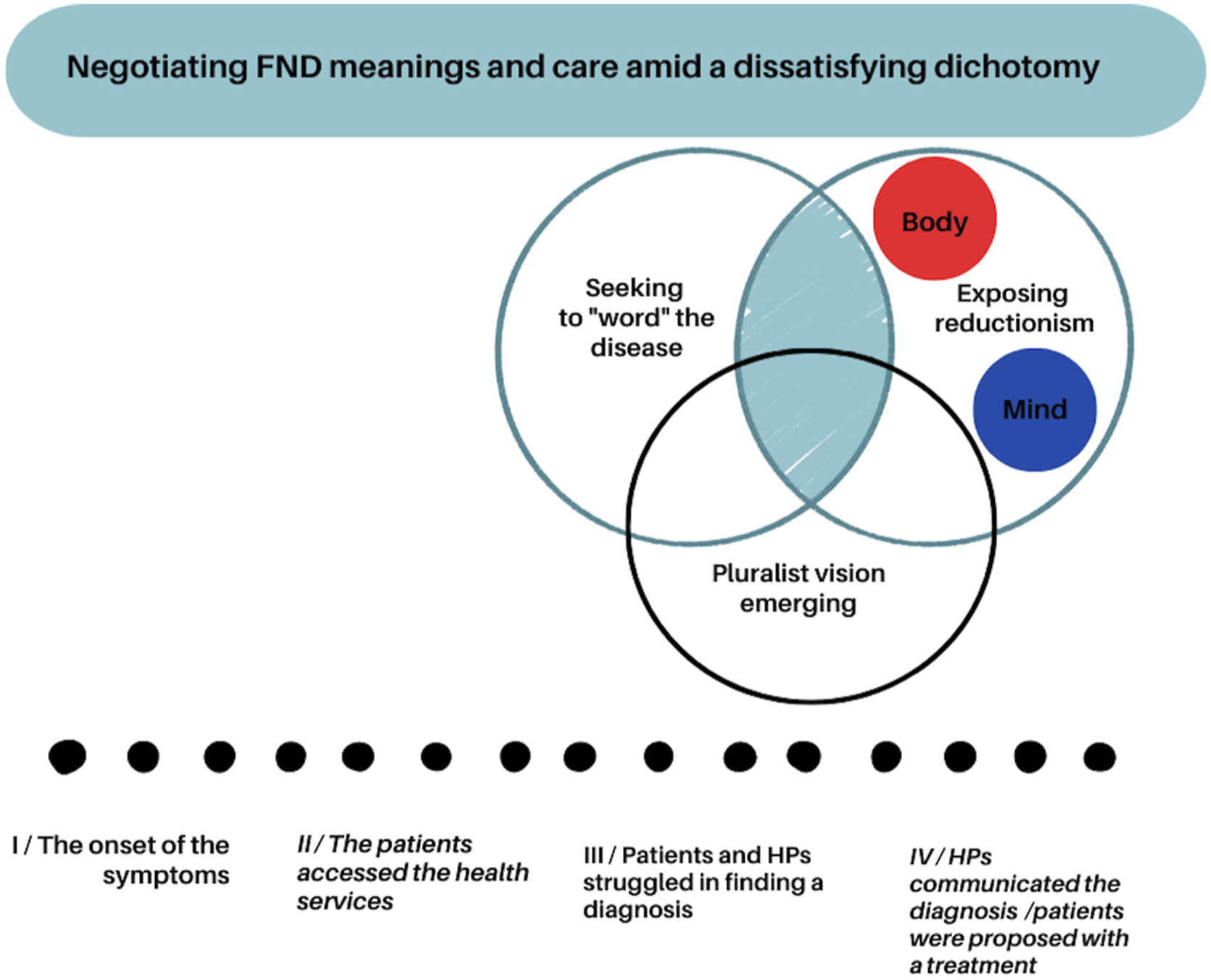
Results
Study Sample
Patients’ Characteristics.

Healthcare Professionals’ Demographics.

The Patients’ Trajectories
Analyzing patient pathways helped us understand the overall process and identify key phases: symptom onset, accessing healthcare, struggling for a diagnosis, and receiving the diagnosis and treatment plan. Patients experienced fear and worries during the symptom onset, often relating symptoms to serious conditions. Some patients sought immediate medical attention, while one patient with a history of relapses waited at home, assuming nothing would be found. After symptoms appeared, patients faced uncertainty and underwent various exams and consultations with multiple professionals. This process left them feeling tossed around and losing faith in the healthcare system. Many felt misunderstood or not taken seriously, with doctors attributing symptoms to pre-existing conditions or dismissing them altogether.
When patients were diagnosed with an FND, many were shocked and had difficulty accepting it. The explanation given often emphasized psychological or psychosomatic factors, leading to mixed feelings of relief and shame. Some patients embraced the diagnosis and started therapy, while others doubted its validity, losing faith in healthcare providers and the proposed treatment. For some patients, the FND diagnosis represented a lack of knowledge by healthcare providers. Being referred to a psychiatrist or psychotherapist offended them, and recognizing stress in their lives did not make a psychogenic explanation more acceptable. Some sought second opinions or questioned the role of other factors in their symptoms. One patient dismissed FNDs as an actual illness, attributing symptoms to medication side effects, stress, or water retention. Another patient felt offended by how the diagnosis was communicated and doubted if all necessary tests had been conducted. These experiences were further complicated by factors such as complicated family histories, migration background, unemployment, and depressive symptoms in some patients.
Negotiating FND Meanings and Care Amid a Dissatisfying Dichotomy
According to our analyses, negotiating meanings and care related to FNDs was contingent upon the diverse ontological perspectives underlying how participants comprehended FNDs. The participants’ main concerns were navigating and reconciling the various perspectives or conceptual frameworks that different HPs and patients held. Data highlighted the challenge of finding common ground and mutual understanding among diverse viewpoints. HPs and patients were entangled in an intricate negotiation, attempting to reconcile their differing perspectives and strategies for comprehending and managing FNDs. However, this negotiation ultimately fell short of presenting a definitive solution.
The outcome of this process is a concept characterized as a “dissatisfying dichotomy,” leaving both HPs and patients with limited room for a comprehensive understanding of the disorder and agreeable treatment options. This core category also suggests that the division between two contrasting aspects or viewpoints of FNDs leads to dissatisfaction among HPs and patients. In fact, how patients and HPs signified FNDs relied on a binary approach, characterized by a reductionist vision and exclusive focus on either the body or mind, failing to meet the needs and expectations of both parties. This category coagulates and gives meanings to three sub-categories: (i) seeking to “word” the disease, (ii) exposing reductionism, and (iii) a pluralist vision emerging.
The core findings are embedded in the patients’ trajectories, specifically within the phases of struggling to attain and receive the diagnosis and treatment plan. These crucial stages coincide with patients nearing diagnosis and being directed to various specialized care disciplines.
Seeking to “Word” the Disease
After a period of uncertainty, looking for a cause for the symptoms and reaching, receiving, communicating, and understanding an FND diagnosis were usually difficult experiences for both HPs and patients. How the diagnosis was reached, received, communicated, and understood was fundamental in comprehending the disease’s causes and characteristics.
A common way to define FNDs by HPs and patients was to oppose it with “real diseases.” Implicit in this perception was the idea that FNDs are not real or serious. Consequently, even the term “functional” was employed to convey the idea of the absence of an underlying organic issue, a viewpoint both patients and HPs concurred upon. For example, a physiatrist conveyed, “This is jargon; we know how to recognize the type of patient when they tell you we know this is a functional patient.” So, the interviewer asked, “But are you sure she doesn’t have anything?” She replied, “No, absolutely, everything is functional” (MD07). Complementarily, a patient reported, “I do not remember the term they used … A problem that is somewhere between an actual disease and a disease …” (PZ01).
Both sides associated this perception with strong frustration, as HPs often felt the disease was less worthy of their attention, and patients felt invalidated in their suffering, as told by a patient: “When he told me the diagnosis, I felt like I was … fake, liar, that is, I felt bad … I mean, I come here because I’m sick, I don’t come here because I like being in the hospital …” (PZ06).
Neurologists often suspected the inconsistency between the manifestation of symptoms and the absence of diagnostic results by instrumental verification. One neurologist described how it was time and energy consuming to deal with people with this type of disorder and perform some exams when he “already know(s) they will show nothing.”
In the context of important workload, this perception led HPs to complain to colleagues, referring to these patients with judgmental and stigmatizing words such as “crazy,” “simulant,” and “waste of time.”
Even how the diagnosis was communicated often reflected this definition of FNDs as something that “is not” (actual, serious, critical, etc.). According to patients and HPs, diagnosis communication often focused on excluding the organic localization (non-epileptic seizures or non-organic disease), telling what the disorder was not rather than what it was.
Similarly, psychiatrists and psychologists mainly focused on the non-organic nature of the disorders. Sometimes, the condition was described through denial of the neurological phenomena. Overall, there was a tendency to try to keep the definition of the problem as open as possible, also due to the doubt that sometimes persisted about the real causes of the problem.
In this way, uncertainty contributed to a non or partial definition of the problem. On the other side, many clinicians opted for technical-specialist rhetoric to communicate the diagnosis and explain the disorder, allowing them to remain vague regarding its specifics. He made me understand that maybe … I mean, he was more technical, so … explaining all these things to me, let’s say in one respect, put me more at ease; at the same time, I’ll confess that 10% of doubt I always have, maybe there always will be. (PZ02)
All these ways of understanding, experiencing, and communicating the FND diagnosis alienated patients. Patients often struggled to understand what they had and felt that the diagnosis was not certain or validating their experience of suffering. Even when HPs did their best to communicate the diagnosis sensibly, the message that “there is nothing” produced a specific imagination toward the disease and the sufferer that did not help the therapeutic relationship and pathway. When I was getting the hospital, I thought, “This time, they found a disease recognized by the tests!”. Instead, it’s something speculative (laughs). It should have been something certain, so I knew if it’s bad or it’s good … what I can fight against. (PZ02) The funny thing is that [the neurologist] didn’t mean I’m … I’m not crazy. But (laughs) he wanted to say that the exams showed nothing, and he didn’t want to offend, to say: “Look, you did all this; however, the exams are fine,” he put it down in a way that I don’t, I had to laugh, “look, everything is fine, and the exams are fine, so I consider that to be a factor ….” What is it called? […] in short, “neurologist,” that creates these disorders, but you have nothing, he said. Then I burst into laughter and said, “Do you think I’m crazy?” (laughs). (PZ05)
The general tendency to leave FNDs undefined carried with it a strong connotation of something not real, serious or dignified.
Exposing Reductionism
Healthcare professionals and patients tended to use a reductionist vision that converged on either side of the “body/mind” dualism, according to the disciplinary paradigm, competencies, habits, or individual and social expectations.
The patients’ accounts often revealed a tendency to think of the disease in “either–or” terms and a typical “preference” for organic explanations of their symptoms. Not receiving such an explanation frustrated the patients, who expected that after an investigation directed at the body level. Not all patients accepted that “there was nothing organic” or that “the tests came back negative”; some hypothesized different possible causes based on an organic alteration. At that moment, I said, because this thing happened to me, maybe they will find out that I have something that has nothing to do with fibromyalgia or my psychosomatic problem; I said finally! […] This time, they will finally find the disease! (PZ02)
As to HPs, each professional category defended its perspective. Explanations provided in the neurology ward tended to be centered on “the organic/the body” (or its absence) while diagnosing, explaining, and communicating FNDs. HPs working in the ward were often frustrated by not being able to define the problem that prevented them from providing a definitive and valid response. Sometimes the functional patient limits us, in the sense that the neurologist […] is happy when it’s an organic thing. Otherwise, you can shake the patient’s hand, pat him on the back and say: “It’s just stress, take two drops and sleep more at night.” (MD02)
For neurologists, the absence of an organic basis was a source of the disorder’s delegitimization. This was accompanied by the idea that the lack of an organic basis meant that they were not their kind of patients.
Among psychiatrists, the tendency to reduce the disorders’ etiopathogenesis to the domain of the mind was common. Often, psychiatrists defined the condition with terms borrowed from the DSM or traditional psychological literature: personality disorders, somatoform disorders, somatization, and hysteria. At the same time, these explanations were often given with a doubt that something organic might exist. For instance, a psychiatrist suspected hysteria in a patient who had suddenly become “almost catatonic”: This woman, I despair because even the neurologists wrote a little bit of Parkinsonism … but she doesn't tremble, she doesn’t … in short, this woman from an initial depression becomes almost catatonic […] her husband always drags her […] Obviously, inside, I also thought of the hysterical form … it fits … (MD14)
Functional neurological disorders were often described by psychiatrists and psychologists as expressing distress. In explaining personal experiences dealing with the issue, they often cited the unconscious, claiming that the symptoms were used to express needs that had no other outlet.
Even describing some level of interaction between the two domains, these ways of picturing the problem revealed a reductionistic idea based on mind/body dualism. For instance, a psychiatrist said, “It is said that hysterical syndrome can mimic any neurological disorder … examinations for students (laughs) that’s what they say” (MD11).
The interaction was explained through mimicking rather than integration, so the problem remained at the level of “either/or” the mind or the body.
The reductionist paradigm, supported by one’s professional capabilities and disciplinary paradigms, showed its inadequacy most powerfully in the physicists’ words. They, too, felt frustrated in not knowing for sure what to do about FNDs and more specifically of “having to move a body” with the suspicion that the problem was not there but, instead, in mind. How can physiotherapy create the motivation to move in a person who does not want to move? We are used to patients who want to move but cannot because of an injury; something is wrong! Instead, in these cases … we don’t have techniques; I mean we don’t have experience with this … the first feeling is always that it’s not our job. (MD07)
The strength of a reductionist vision of FNDs based on the body/mind dualism and exclusive attention on either one or the other domain generated a situation where nobody (HPs and patients) was satisfied.
A Pluralist Vision Emerging
Some data pointed to a notable revelation among certain HPs that a pluralist interprofessional perspective on FND diagnosing would be advantageous. A neurologist noted, “In my opinion, these are patients who lack […] a specific and multidisciplinary path” (MD05).
Expressing concerns about the lack of shared vision and collaboration with colleagues from different specialties when dealing with FND diagnosis, HPs emphasized the potential benefits of increased integration. For instance, the desire for better communication and collaboration and the co-construction of diagnostic and treatment pathways occurred consistently among various HPs. Physiatrists often needed help finding a satisfactory communication channel and collaboration with neurologists. Moreover, they lamented that most of the time, neurologists did not follow FND patients alongside their care pathway but were present at the time of diagnosis only and mostly never again. From their point of view, neurologists reported that psychiatrists should be more concerned with these types of patients, whom they think are often rejected. Other HPs (GPs, neurologists, and physiatrists) criticized the methods of psychiatrists, who did not take charge of the patients unless they were severe cases, which left behind FND patients.
Moreover, patient interactions prompted an evolution in HPs’ views, encouraging the exploration of a more holistic and pluralist outlook on the disorder. Some HPs started inviting patients to consider FNDs as a simultaneous expression of both mental and bodily aspects. I always use expressions like inside of us there is the lived experience, there is a suffering, life is difficult for everyone, we have conflicts, we fight, we are not well, and this generates negative energies that to some extent we have to control, let out and then afterward generally there are those who channel them […] on the digestive tract […] some people have headaches, some people here, some people there … it could be that this negative energy, this discomfort, manifests itself through the appearance of tremor, whatever it is. (MD01)
Notably, the significance of steps within the care pathway, such as physiotherapy, was acknowledged in building patient trust and considering their overall well-being. Our therapy has a different efficacy […] we didn’t think rehabilitation had anything to do with these dysfunctions. We always thought that it’s not our cases, instead […] the patient feels somehow … taken care of. He is not denied his problem; he is recognized and treated in some way […] I don’t know if it can be a deception for the patient … anyway, he believes that his functioning is determined by something organic. (MD07)
These steps underscored the importance of considering patients’ perceptions and experiences for a comprehensive understanding. This was significant as patients reported better understanding and experiencing their disorder when HPs considered their history and experiences.
However, while attempts were made to integrate mind and body explanations, it became evident that this approach might not fully encompass patients’ experiences. Patients often resisted psychosomatic interpretations, emphasizing the importance of considering social dimensions in understanding FNDs, as conveyed by this participant: “They say to me, ‘you are stressed!’ … but I am stressed as I believe all women who work, who have a home, even the ones who live alone are all stressed” (PZ05).
This sentiment highlighted the need for a pluralistic perspective incorporating the interaction between mind and body and the social context to comprehend FNDs’ intricacies comprehensively.
Discussion
Our study sought to elucidate the factors contributing to the limited adoption of a multidisciplinary approach in managing FNDs. According to our analysis, it is because dealing with FNDs is a process of negotiating meanings and care which hinged on the diverse ontological perspectives that participants held regarding FNDs. HPs and patients faced the task of navigating and reconciling the contrasting perspectives and conceptual frameworks surrounding FNDs. The data underscored the difficulty in finding common ground and achieving mutual understanding among the various viewpoints, creating a challenge in establishing a unified approach to FNDs. The conceptual outcome of this process is described as a “dissatisfying dichotomy,” illustrating that both HPs and patients are left with limited room for a comprehensive understanding of FNDs and agreeable treatment options. The “dissatisfying dichotomy” suggests that the division between contrasting viewpoints contributes to dissatisfaction among both HPs and patients. The binary approach to FNDs, characterized by reductionist views and an exclusive focus on either the body or mind, doesn’t meet the needs and expectations of either group.
By tracing the chronological evolution of patients’ experiences, we discerned how the journey toward FND diagnosis is not solely a medical phenomenon but a complex interplay of emotions, communication, and healthcare dynamics. As patients navigated the healthcare system, their narratives revealed how interactions with HPs, in terms of clinical reasoning and interprofessional relationships, contributed to constructing meaning around their condition. This entwining of narratives and healthcare practices underscored the crucial role of contextual factors, including patient–HP dynamics (Figure 1).
In trying to word the disorder, the FND label was perceived as ambiguous and subject to individual interpretations. The diagnosis usually left the patients with a sense of incomprehension, surprise, and incredulity: many found it hard to believe or accept that “they could do this to themselves.” The common suggestion of psychological care or psychotherapy was encountered with suspicion or shame by most, who often entertained (preferred) different (organic) explanations. This aligned with the study of Nielsen and colleagues (Nielsen et al., 2020), who showed that patients of a London hospital were generally dissatisfied with psychological causes and felt misunderstood by HPs. Neurologists diagnosed FNDs based on the absence of organic abnormalities, which aligned with the context of neurology and their disciplinary framework.
Additionally, investigating “stressful factors” in patients’ life histories often reinforced the diagnosis, predominantly viewed as psychogenic. This finding aligns with Lehn and colleagues (Lehn et al., 2019), who showed that 56% of participants defined FND as primarily a psychiatric or psychological problem. Often, the neurologists were frustrated by dealing with a problem they defined negatively: FNDs were what people had when “nothing was there” and something that was “not their problem.” HPs to whom the patients were later referred (psychiatrists, GPs, and physiatrists) tended to share such a “negative definition” of FNDs and a psychogenic interpretation of the problem, with significant consequences on the care pathway. Psychiatrists, for instance, were said to rarely take care of these patients as they do not fit in the type of (severe) diagnosis they usually deal with, while physiatrists found it hard to see FND patients as their patients “to have to move a body” when the motivation (the mind) is lacking (is the problem). All of this contributed to generating a short circuit where patients were left with scarce options for treatment besides psychological care or psychotherapy.
Our analysis generated an interpretation of perceiving FNDs from a dichotomous perspective, marked by reductionist views and a singular emphasis on either the body or the mind. This tendency has significant implications for the experiences of all parties involved and the care pathway. A dualistic perspective that separates the mind and body in illness perception leads to the belief that symptoms are either solely psychological (psychogenic) or purely physical (neurogenic, organic, somatic, etc.). Despite more recent biopsychosocial explanations for the etiology of FNDs, the prevailing understanding of an FND diagnosis continues to be influenced by a dualistic framework. This contributes to a fragmented approach to disease management and overall dissatisfaction among all actors involved.
Within a biomedical intake, a dualistic interpretation does not only imply an alternative and equivalent choice (either the body or the mind). Still, it underlies a hegemonic understanding of what is real (the organic) and has value (Moretti, 2013, 2019; Quaranta, 1999, 2005). This infers a question of legitimacy for those suffering from an FND diagnosis. In our research, this was implicit in the delegitimization of the disorder by HPs who did not see it as “real,” “worth it of their time,” or in the way they referred to this pathology and patients when talking with their colleagues (“they are crazy,” “you can ‘sniff’ them”), as well as in many patients’ ambivalence toward psychogenic explanations and their experience of being discriminated by HPs, also reported in other contexts (Rawlings & Reuber, 2016).
Besides, a dualistic interpretation does not account for the “social role” even when it comes to readings that seek to integrate the organic and mental dimensions, as in psychosomatic definitions (Quaranta, 2005). This is important for a disease diagnosed predominantly among individuals with vulnerabilities with prominent social components: women, individuals living in rural areas, with low cultural levels and poor socio-economic conditions, migrants, etc. (McLoughlin et al., 2023). This dimension emerges in the (actual or hoped for) social implications of the diagnosis: a male patient finally saw his boss reducing his workload, a woman who “had always used her hands for others” stopped using them “as a cry for help,” a migrant single mother who struggles with the consequences of processes of marginalization, etc. In this context, the ambiguity of patients toward psychological explanations and solutions could be read as a refusal to individualize the problem: it is the context that causes discomfort, not the person’s inability to adapt to it. This contributes to sufferers preferring organic explanations, seen as more legitimizing, as suggested for other pathologies with similar characteristics, like chronic fatigue syndrome or fibromyalgia (Moretti, 2014; Quaranta, 1999).
Inadequate psychological explanations that oversimplify FNDs (e.g., attributing it solely to stress) and explanations disregarding the participants’ narrative can lead to dissatisfaction among all parties involved. Our research revealed that physical conditions or events were often believed to contribute to symptom onset, even when psychogenic explanations were accepted. On the other hand, explanations centered solely on “stress,” and similar factors failed to acknowledge the role of contextual factors. They heightened the perception that the patients themselves were to be blamed.
A potential solution is hinted at within our data, although not fully explored by our participants. Listening to the patients’ narratives and helping them construct meaning from their illness experience is crucial, as recommended elsewhere (Nielsen et al., 2020). HPs may send patients for further investigations when they feel it would appease them (Barnett et al., 2022). However, patients interpreted this as “buck-passing” and lost confidence in the HPs. The authors recommend openly discussing their perceptions and wishes with patients to legitimize their experience and facilitate successful care relationships. In our study, patients who felt listened to tended to feel more positively about the diagnosis. Besides, some professionals perceived offering specific forms of care (e.g., physiotherapy) to acknowledge and “care for” the patients’ perspective. At the same time, they also talk about the importance for HPs to be open to dialogue with patients and include their perspectives in defining the problem and the solutions.
An integrated interdisciplinary approach, as highlighted in the existing literature (Russell et al., 2022), offers the promise not only of navigating diagnostic intricacies but also of enabling suitable interventions for those impacted by FNDs (Canna & Seligman, 2020; Ganslev et al., 2020; LaFaver, 2020; Lehn et al., 2020). The empirical basis for a non-dualistic approach to mind–body medicine is evolving, suggesting that a comprehensive understanding of health and well-being may soon necessitate a holistic approach (Fricchione, 2023). This interdisciplinary approach holds the potential to mitigate the dissatisfaction arising from fragmented and compartmentalized care experienced by our participants. It signifies a comprehensive strategy that could address the concerns of all involved parties and enhance the overall quality of care provided.
However, adopting such an interdisciplinary approach is not without its challenges. As emphasized elsewhere (Canna & Seligman, 2020), embracing a comprehensive understanding of FNDs necessitates a fundamental reevaluation of the medical ontology underpinning the assessment of symptoms. In our study, the pervasive body–mind division inherent in conventional classification systems, the varying weight attributed to organic and psychological factors, and the oversight of the “social” dimension collectively contribute to significant deficiencies within the care pathway (Chen et al., 2023).
This brings to light the ongoing debate between the medical and social models of care (Engel, 1977) in the realm of FND management. The medical model tends to emphasize the physiological aspects of the disorder, often limiting its scope to identifying and treating specific physical anomalies. This approach may overlook the intricate interplay between psychological and social factors that contribute to the development and experience of FNDs. On the other hand, the social model of care posits that biological factors do not solely determine health but are profoundly influenced by social, cultural, and psychological dynamics (Carr et al., 2023). In the context of FNDs, this model advocates for an approach that addresses the physiological symptoms and encompasses the individual’s psychological well-being and social context.
The tension between these models underscores the complexity of FND management and the need for a multidimensional approach that bridges the medical and social aspects. A shift toward an integrated care framework, as suggested by the interdisciplinary approach, acknowledges the limitations of both models when applied in isolation (Fricchione, 2023). By acknowledging the interconnectedness of physiological, psychological, and social factors, an interdisciplinary approach aims to provide a more holistic understanding of FNDs and a more effective care pathway. This shift requires healthcare practitioners to transcend the confines of traditional medical ontologies and embrace a more inclusive perspective that accounts for the multifaceted nature of FNDs and the experiences of those affected by them.
Implications for Practice and Training
The first practical implication is at the level of provider/patient communication. As we have suggested, uncertain or insensitive communication can confuse patients and decrease their trust in HPs. The literature confirms this to be an issue deserving special attention. For instance, Lehn and colleagues (Lehn et al., 2019) showed that patients had been referred to other professionals who needed to explain the diagnosis. HPs commonly experience fear when communicating the diagnosis (of saying the wrong thing, offending patients, or breaking the therapeutic relationship) (Barnett et al., 2022). They tended to pass them on to other disciplines to avoid it. Another qualitative study suggested that doctors face challenges when communicating that symptoms are medically unexplained and offering psychological treatment and try to avoid provoking patients’ resistance, thus hindering access to psychosocial support (Carter et al., 2018; Monzoni et al., 2011). The uneasiness of HPs can translate into missing opportunities for communication and care and should therefore be addressed.
Careful communication is required to help patients understand and process an FND diagnosis: the terminology and communicative mode used can influence the understanding and attitude of the patients in managing their symptoms. Some terms can be interpreted in a misleading or dysfunctional way by the patient. For example, using words such as psychogenic, psychosomatic, and somatization suggests the problem is psychological. Other expressions, such as non-organic, non-epileptic, or not explainable on a medical basis, imply that the symptoms’ cause is unknown. Communicating an FND diagnosis in negative rather than favorable terms (what is not rather than what it is) should be avoided, as negative expressions increase the patients’ dissatisfaction regarding the explanation provided and reinforce dysfunctional stereotypes of FNDs as “not real,” “not worthy,” and as something that people who suffer “do to themselves” or fake (Stone et al., 2002).
This calls for training opportunities for HPs, specifically the biopsychosocial model of care (Fricchione, 2023; Nisker, 2019) and FNDs and the relational components of communicating and managing the diagnosis in collaboration with other professionals and patients. The need for more training has been highlighted by many studies (Lehn et al., 2019, 2020). HPs are mostly undertrained in the optimum management of FNDs (Barnett et al., 2022): training packages need to be developed, evaluated, and implemented to improve the HPs’ confidence and reduce the FND stigma.
For training to be effective, contents and methods should also tackle the reductionist paradigm that subdues current interpretations of illness, thus questioning and complexifying individual epistemologies (Dossett et al., 2020). For example, we identify the method of Operative Epistemology (Fabbri & Munari, 1990), which was designed as a strategy of active exploration of the processes of knowledge construction to raise awareness of one’s cognitive processes and the use of knowledge. The objective of the training is not to transfer new knowledge but rather lead professionals to organize their knowledge in more adaptive and functional ways, embracing the multiplicity of possible epistemologies at stake (Fabbri, 2004; Munari, 1992).
Conversely, training HPs should ensure integrated and effective care if multidisciplinary care is structured (Gilmour et al., 2020). Much like our research, several studies found poor communication between different HPs dealing with FNDs and a need for more agreement about who is responsible for treating these patients. In our research, disciplinary mindset, tensions, and structural factors such as overwork and fragmentation of services played a role. However, the absence of clear multi-professional and interdisciplinary care pathways for FNDs was crucial. Improving care for FND patients entails providing HPs with clear and structured directions concerning what kind of professionals must be involved in and how they should contribute to treatment in collaboration with other specialists and the patients.
Strengths and Limitations
Strengths were assessed by validity, credibility, originality, resonance, and usefulness as the suggested criteria for GT (Charmaz, 2014). Credibility was obtained by generating adequate data to substantiate the theoretical model. Originality was reached by using the participants’ words as much as possible during coding. As to resonance, saturation achieved in our analysis gave us a comprehensive picture of the process happening around FND patients. We consider the study useful as it offers a consistent interpretation of FND diagnosis and comprehension from different perspectives.
The research setting is a hospital neurology ward. This limited our sample to patients who received care in this setting. Patients were interviewed shortly after the FND diagnosis. Thus, we did not examine the whole care pathway and patients’ experience with the treatment. Our study did not include family members of individuals with an FND. Few qualitative studies explored the point of view of patients’ relatives, even though stressors related to family are significant contributing factors in the development of FNDs (Bokharey et al., 2021). Lastly, the interviewers were part of the hospital care team. This might have influenced the answers of patients and colleagues. Within a constructivist paradigm, however, the interviewers’ subjectivity is valued as part of the data generation.
Conclusions
Our study aimed to uncover the reasons behind the underutilization of a multidisciplinary approach in managing FNDs, despite its proven benefits and the negative impact on quality of life. Besides organizational factors, we discovered that different medical specialties hold varying perspectives on illness, resulting in ineffective approaches to FNDs. This situation aligns with Popper’s notion that conflicting theories can impede progress (Canna & Seligman, 2020; Popper, 1995). In fact, an FND is still understood and approached in varied ways by different individuals or groups. These conceptions are not static but dynamic and evolving, impacting how an FND is perceived, diagnosed, and managed. This highlights the complex and multifaceted nature of diagnosing and managing FNDs and emphasizes the need for a comprehensive approach considering various viewpoints.
Given the diverse definitions of FNDs across medical disciplines, a pluralistic approach becomes necessary to acknowledge the relative perspectives of each HP. Effective management of FNDs requires a multidisciplinary approach encompassing three key components. First, open and effective communication between HPs and patients is crucial for establishing a strong therapeutic relationship. Second, HPs involved in FND patient care should receive training programs focusing on both clinical and relational aspects of FNDs. Finally, structured care pathways based on integrated biopsychosocial models involving multiple healthcare professionals must be implemented for optimal outcomes.
However, to achieve success with these components, adopting a new shared paradigm that addresses different ontological assumptions and engages in meaningful dialogue with other practitioners and patients is essential.
Footnotes
Acknowledgments
We want to thank Carlotta Mainini, Felipe Andres Mardones, Margherita Parmeggiani, and Cristina Pedroni for supporting the research.
Declaration of Conflicting Interests
The author(s) declared no potential conflicts of interest with respect to the research, authorship, and/or publication of this article.
Funding
The authors received no financial support for the research, authorship, and/or publication of this article.
