



Abstract
Healthcare organizations worldwide face challenges in retaining their healthcare workforce, with individual and organizational factors influencing their intentions to leave. This study conducted eight online co-creation workshops and four Delphi sessions to gain qualitative and in-depth insights into job retention interventions, involving healthcare workers, hospital managers, and policymakers. A thematic analysis was conducted, resulting in multiple interventions that were clustered in four pre-defined themes: professional and personal support, education, financial incentives, and regulatory measures. Professional and personal support interventions included regular interprofessional team meetings, leadership training programs, self-scheduling and sabbaticals, support for administrative and non-clinical work, and the provision of psychological counselling. Educational interventions encompassed facilitating development opportunities, periodic evaluations, onboarding, mentorship programs, and peer support groups. Financial incentives included the provision of competitive salaries, adequate infrastructure, extra benefits, transport possibilities, and permanent employment contracts. Regulatory measures addressed the need for complementary legislation across various levels, fixed healthcare worker-to-patient ratio, and instruments to monitor workload. To optimize retention strategies, healthcare organizations should tailor these interventions to address the unique factors influencing their workforce’s intentions to leave within their specific context. The study concludes that combining personal and professional support, educational opportunities, financial incentives, and regulatory measures is necessary because there is no one-size-fits-all solution.
Introduction
Healthcare organizations face challenges in retaining their workforce, leading to increased recruitment and training costs, decreased care quality, higher risk of medical errors, and lower patient satisfaction (Fibuch & Ahmed, 2015; Halter, Boiko et al., 2017; Kroezen et al., 2015; Maeda & Socha-Dietrich, 2018; OECD, 2016; Park et al., 2019; Vries et al., 2023). This retention issue has been exacerbated by demographic and epidemiologic changes, intensified healthcare demands, and financial constraints (Kroezen et al., 2015; Kuhlmann et al., 2018; OECD, 2016; Vries et al., 2023; World Health Organization, 2016). In addition, personnel shortages in combination with an already demanding workload may lead to elevated stress levels and an increased burnout risk among the remaining healthcare staff, which could potentially contribute to a higher likelihood of these professionals leaving their positions (Park et al., 2019). The COVID-19 crisis further intensified these challenges, leading to heightened job demands and increased work pressure, which, in turn, raised concerns about potential long-term mental health implications and higher intentions to leave among healthcare workers (Frogner & Dill, 2022; Godderis et al., 2020; Kowalska et al., 2023; Luo et al., 2020; Poon et al., 2022; Vries et al., 2023).
In response, there is a growing acknowledgment of the need for comprehensive and evidence-based healthcare interventions, strategies, and policies to establish a sustainable healthcare workforce for the future (Azzopardi-Muscat et al., 2016; Kroezen et al., 2015, 2018; Kuhlmann et al., 2018; Maeda & Socha-Dietrich, 2018). In 2016, the Global Health Workforce Network, established by the World Health Organization (WHO), released ‘The Global Strategy on Human Resources for Health: Workforce 2030’, a guiding document for policymakers worldwide to address health workforce challenges (World Health Organization, 2016). Furthermore, the European Union (EU) has actively engaged in mitigating this matter by implementing multiple initiatives since 2012, such as the Joint Action Plan (JAP) for the EU Health Workforce (2013–2016) (Directorate-General for Health and Food Safety, 2023; JAHWF, 2023; Kroezen et al., 2018).
The determinants that may impact intentions to leave among healthcare workers are complex and can be influenced by multiple individual and organizational factors (Halter, Boiko et al., 2017; Kroezen et al., 2015; Kuhlmann et al., 2018). Job satisfaction, stress, and high burnout risk emerge as crucial individual factors (Halter, Boiko et al., 2017; Park et al., 2019; Vries et al., 2023). Organizational factors encompass long working hours, night shifts, the number of patients per healthcare worker, a lack of autonomy, limited development opportunities, and inadequate social support (Halter, Boiko et al., 2017; Park et al., 2019; Vries et al., 2023). A comprehensive understanding of the main determinants associated with turnover intentions is crucial, as it guides interventions, strategies, and policies aimed at reducing the high turnover rates of healthcare workers.
In particular, there is an increasing recognition of the importance of mental health and well-being as determinants that influence the decision to leave the healthcare sector (Halter, Boiko et al., 2017; Heinen et al., 2013; Kovacs et al., 2019; Willard-Grace et al., 2019). Improving mental health, reducing stress, and mitigating burnout risk should be an integral dimension of health workforce development, as these professionals are highly exposed to physical, mental, and emotional challenges in their work (Halter, Boiko et al., 2017; Kovacs et al., 2019; Kuhlmann et al., 2018). In addition, healthcare workers need to be resilient and flexible to respond to complex and non-routine patient care issues, while working in complex, multi-disciplinary, and frequently stressful work environments (Maeda & Socha-Dietrich, 2018).
Consequently, the driving factors behind the retention problem are multifaceted and require tailored solutions, involving a combination of context-specific interventions (De Vries et al., 2023; Halter, Pelone et al., 2017; Kroezen et al., 2015; Kuhlmann et al., 2018). For instance, a recent systematic review by De Vries et al. (2023) investigated multiple interventions addressing job retention and categorized them into themes, such as onboarding and mentorship programs, stress-coping training, and interventions that improve work relations and interprofessional teamwork. The authors underscore the importance of implementing a combination of these interventions aligned with the attrition factors of each respective hospital, region, or country (De Vries et al., 2023).
Nevertheless, there is a need for transnational studies encompassing diverse healthcare systems to collect a comprehensive set of data on healthcare job retention interventions in different contexts (De Bont et al., 2016; Kroezen et al., 2015; Schönfelder & Nilsen, 2016). Country-specific factors that can influence the selection of job retention interventions include, for example, healthcare expenditures (De Bont et al., 2016; Eurostat, 2022; Schönfelder & Nilsen, 2016). Furthermore, evidence-based knowledge following a bottom-up approach is needed, with the involvement of all stakeholders throughout the process from design to implementation. Co-creation or user-centred design thinking, defined as the collaborative generation of knowledge and ideas characterized by an iterative and creative research process, offers the potential for a more dynamic and innovative approach to address job retention in healthcare (Benson et al., 2021; Halvorsrud et al., 2019). In addition, Delphi sessions can complement these co-creation workshops as they integrate opinions and insights from a group of experts through iterative processes and consensus building (Hasson et al., 2000).
To address the above-mentioned needs, this study conducts a transnational qualitative assessment across four European countries with different healthcare systems: Belgium, the Netherlands, Italy, and Poland. These countries were selected due to variations in their healthcare systems. For instance, there are substantial differences in per capita healthcare budget allocations: Belgium and the Netherlands allocate 11% of their GDP, Italy 9.6%, and Poland 6.5% (Eurostat, 2022). Methodologically, we used online co-creation workshops and Delphi sessions as an innovative approach to encourage iterative and collaborative knowledge generation among healthcare workers, hospital managers, and policymakers. Drawing upon a broad spectrum of qualitative data from these four countries and various stakeholders, this study will contribute to the broader discourse on effective healthcare workforce management.
Methodology
Setting and Population
The study population consisted of healthcare workers (i.e., physicians, nurses, and health assistants) and hospital managers from eight European hospitals, and policymakers from four European countries: Belgium, the Netherlands, Italy, and Poland. More in particular, our study included two hospitals from each respective country: one academic and one non-academic hospital. This selection was made to enhance the generalizability of our results, acknowledging potential differences in characteristics between both types of hospitals (Chen, Revere et al., 2019; METEOR, 2022). In Belgium, we incorporated the University Hospital of Leuven (UZ Leuven) and the General Hospital Delta (AZ Delta). In Italy, we encompassed the Palermo University Hospital and the San Giovanni Di Dio Hospital at the Local Health Agency of Agrigento. In the Netherlands, we included Spaarne Gasthuis Haarlem and the University Medical Center of Amsterdam (UMC Amsterdam). Finally, in Poland, we incorporated the Kornel Gibiński University Clinical Center of the Medical University of Silesia and the Multidisciplinary Hospital in Jaworzno. Other healthcare settings were excluded to ensure tailored results and recommendations.
Sample
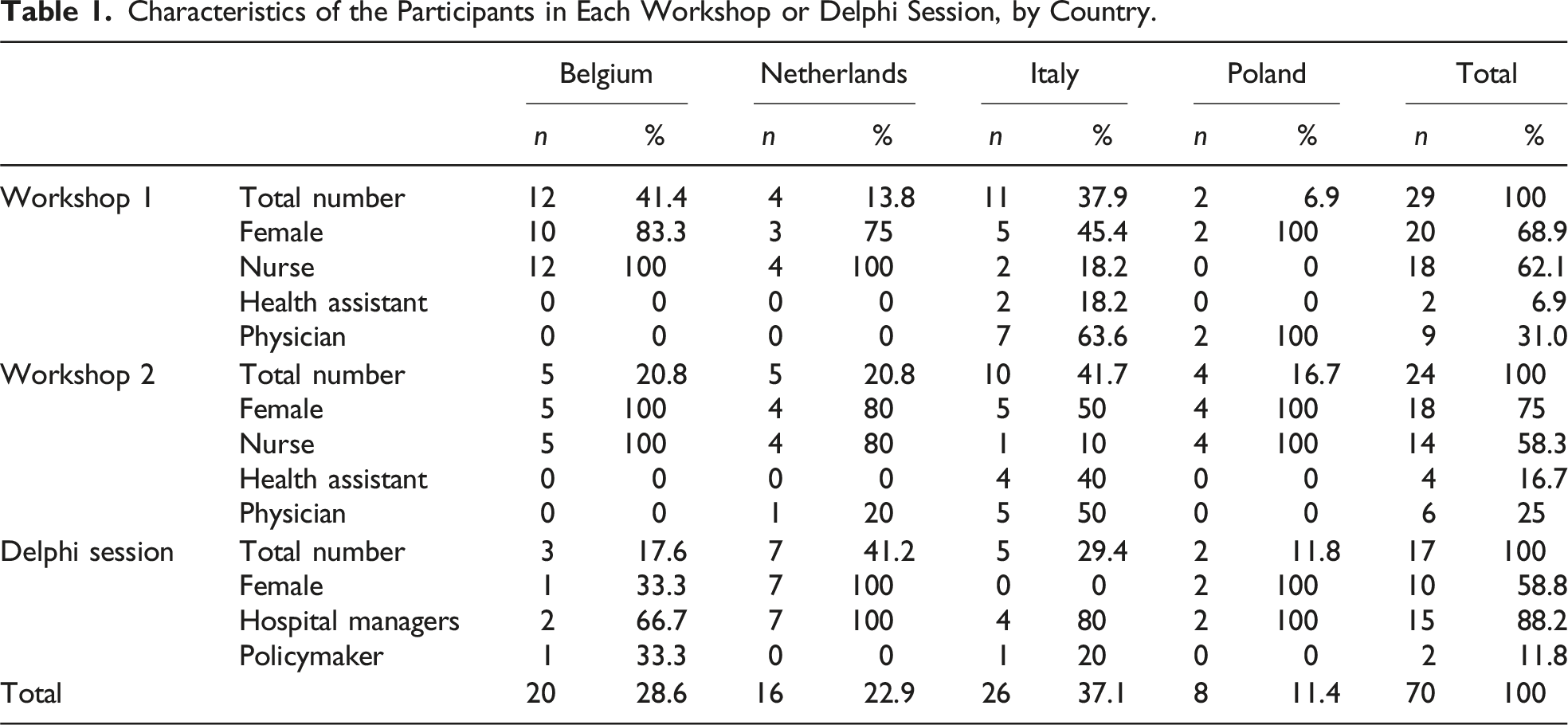
Characteristics of the Participants in Each Workshop or Delphi Session, by Country.
Recruitment
Participants were recruited through online communication channels, such as newsletters, flyers, and internal mailings. Potential participants could register online or communicate their interest via email, and their participation was always voluntary. Upon registration, they received an informative email (e.g., about the objectives of the workshop) and an electronic Microsoft Teams (MS) invite link (Microsoft, 2023). A final reminder was sent via email on the day of the scheduled workshop. Participants did not receive any remuneration for the workshops, or Delphi session, and they were made aware that the workshop or Delphi session would be recorded for research purposes only.
Data Collection
Qualitative data was collected through eight online co-creation workshops and four Delphi sessions, with two co-creation workshops and one Delphi session in each of the participating countries. The first round of online workshops for healthcare workers was administered between November and December 2022, consisting of one co-creation workshop per participating country. Subsequently, the second round of online workshops took place from February until March 2023. Between May and July 2023, four Delphi sessions were undertaken with hospital managers and policymakers at regional and national levels in each participating country.
All workshops and Delphi sessions were piloted among colleague-researchers, to address technical issues, assess time durations, and refine exercise flow. Technical aspects, for instance, utilizing breakout rooms in the online platform and recording procedures, were examined. Decisions regarding the number and duration of workshops were based on content considerations (e.g., addressing the research question) and practical issues (e.g., availability of the target audience).
To maintain consistency, each workshop was preceded by a training session provided by A.B. and O.L. for the moderators of each workshop, namely N.d.V., P.d.W., S.S., A.S., S.M., and K.B., focusing on the content and exercises. L.G., A.B., and O.L. have expertise in the co-creation process and the topic of job retention in healthcare, gained through former professional research experiences. Additionally, all moderators have extensive research experience and hold a doctoral degree in a relevant field. Further, the moderators did not have any direct hierarchical position over potential participants within the hospitals to ensure voluntary participation. During the workshop itself, the moderators were assisted by A.B. or O.L., who aided in resolving problems or addressing questions as they arose. Each workshop was conducted and organized in the native language of the respective country (i.e., Dutch, Italian, or Polish) and had a duration of 150 min, while the Delphi sessions lasted 90 min.
The workshops and Delphi sessions had a consequential flow and elaborated on each other. The main outline for each workshop, the selected exercises, and the progression throughout the workshops were decided from the outset. The first workshop centred on problem analysis, aiming to gain insights into the problem of job retention and to generate some first intervention ideas. Exercises included case-based brainstorming, idea napkin, and stakeholder mapping (Martin & Hanington, 2012; Miro, 2023b; VMware Tanzu Labs, 2022). The second workshop focused on multiple brainstorming exercises to elaborate further on the interventions, such as brainwriting and matrix analyses (IDEO, 2015; Martin & Hanington, 2012; Miro, 2023a, 2023b). The Delphi meetings consisted of an iterative multistage process, aimed at transforming opinions about the workshop results into group consensus (Hasson et al., 2000). Exercises included providing feedback on the different interventions, discussing the feasibility of implementing these interventions at either hospital or national level, and outlining participants’ roles in implementation and requirements from others. A brief description of all the exercises can be found in Supplemental Material 1 (Table S.1).
The online platform MS Teams was selected to conduct all workshops and sessions, as this platform can support meetings with multiple people, provides video- and audio-recordings, is GDPR compliant, provides the possibility of breakout rooms, and is user-friendly (Boone et al., 2023; Microsoft, 2023). Besides MS Teams, the online tool Miro (https://www.miro.com) was used to manage the interactive and creative component of the co-creation workshops (Miro, 2023b). This tool has the advantage of combining the functionality of an online whiteboard and the possibility to incorporate sticky notes and other interactive tools to increase engagement and incite creativity among participants (Boone et al., 2023). At the beginning of each workshop or Delphi session, participants were welcomed in MS Teams. They were asked to switch on their video and microphone, and they were provided with the Miro link.
Healthcare workers were invited to both workshops and had the option to decide whether they would participate in one or both. However, each participant ultimately attended one workshop only. To ensure continuity in the co-creation process, the second workshop started with a presentation summarizing the outcomes of the first workshop. Similarly, Delphi sessions commenced with an overview of the results obtained from the two workshops. The collected data included video- and audio-recordings and Miro board exports. In Supplemental Material 2 (Figure S.1), the Miro boards for the workshops and Delphi meetings are presented.
Data Analysis
All authors contributed to the transcription of the workshops and Delphi sessions verbatim. To facilitate the initial transcription of recordings, Express Scribe Transcription Software was used (NCH Software, 2022). First, a researcher fluent in the workshop’s native language conducted the transcription. Following this, the transcription was translated into English. Subsequently, the authors A.B. and O.L. reviewed English transcriptions to ensure data quality. With regard to the analysis of the Miro boards, they were translated from the native language to English. The analysis then proceeded with a thematic approach, using NVivo (QSR International Pty Ltd, 2020) and following the Braun and Clarke (2006) guidelines (Braun & Clarke, 2006). Authors A.B. and O.L. independently conducted the thematic analysis, which was subsequently followed by a comparison and discussion between them.
The researchers focused their thematic analysis on established frameworks, such as the WHO guidelines (Mäkikangas et al., 2020) and Barribal et al. (2015), which clustered interventions into four pre-defined themes (Barriball et al., 2015): (1) professional and personal support (i.e., creating a supportive and collaborative work environment), (2) education (i.e., involving different types of training and development programs), (3) financial incentives (i.e., addressing all types of financial remunerations to support healthcare workers), and (4) regulation (i.e., the provision of all types of legislative frameworks to address issues, like an excessive workload) (Barriball et al., 2015). During the first clustering phase, researchers grouped all significant codes into the four pre-defined clusters. Subsequently, codes were further organized into multiple new subthemes within each pre-defined cluster. These data were supplemented with examples and quotes from participants. As the study was part of the EU-funded METEOR project, there was a continuous collaboration among researchers. This facilitated regular meetings, exchange of knowledge regarding the four healthcare systems, and discussion of the workshop results within their respective contexts.
Qualitative research does not have defined guidelines regarding recommended sample sizes. However, suggestions typically advise between 6 and 15 participants per workshop (Boone et al., 2023; Leask et al., 2019). Table 1 shows that only four workshops achieved the desired number of participants, with a minimum of two participants in Poland. Nonetheless, researchers collected interesting data due to the adequate number of workshops and participants (i.e., 12 workshops, 4 Delphi sessions, and 70 participants). Regarding thematic data saturation, researchers adopted an inductive approach and concluded that data saturation had been achieved, as no new themes were identified, thus indicating that no new information was being observed (Saunders et al., 2018).
Ethical Considerations
This study was approved by the Ethics Committee Research UZ/KU Leuven in January 2022 (S66009), and written informed consent was obtained from all participants before participation. The informed consent included a detailed study description, emphasizing participants’ voluntary involvement and their right to withdraw at any point. Due to the online nature of the workshops, the researchers had to email the consent form to the participants, who then returned their signed consent through email.
Results
This section presents the results of the thematic analysis regarding job retention interventions among healthcare workers in hospitals, based on the four pre-determined themes: professional and personal support, education, financial incentives, and regulation. Figure 1 shows the overview of the thematic analysis, with the four main themes on the left and the subthemes on the right. Overview of the thematic analysis.
Professional and Personal Support
Job retention interventions that focused on providing and ensuring professional and personal support were clustered as the first theme. The generated subthemes were regular interdisciplinary team meetings, leadership training programs, self-scheduling and sabbaticals, support for administrative and non-clinical work, and the provision of psychological counselling.
The first subtheme was represented by ‘regular team meetings’. Participants underscored consistently the necessity of regular interdisciplinary team meetings, which may occur daily, weekly, or monthly. Participants from all countries considered these interdisciplinary meetings necessary to facilitate interactions between clinical and non-clinical disciplines, as well as within clinical disciplines. In this regard, one Italian hospital manager emphasized the importance of interdisciplinary team meetings. We organise regular team meetings with an interdisciplinary team to analyse and address problems. These meetings involve all departments, multiple operating units, and even interactions with the hospital board of directors. We organise these meetings daily and, at times, multiple times within the same day. (Hospital manager 3, Italy, Delphi session)
Occasionally, these team meetings could be held in settings outside the hospital, such as tearooms, to promote a more relaxed atmosphere. Moreover, particular attention during these team meetings should be directed towards addressing intergenerational dynamics within teams, as misunderstandings, conflicts, and frustrations often arise between generations.
Furthermore, hospital managers and policymakers in the Netherlands and Belgium highlighted the benefits of a ‘skill mix of teams’, referring to the composition of a team in terms of various skills and qualifications to meet the needs of patients. For example, a well-balanced skill mix might include a combination of medical expertise, nursing proficiency, and administrative skills within a team. It’s important to note that while interdisciplinary meetings bring together professionals from different disciplines, the skill mix of teams involves structuring the composition of the team to incorporate diverse skills from the outset.
A second theme was that of ‘leadership training programs’. Participants advocated for the implementation of structural leadership training programs and comprehensive evaluations. Italian participants raised concerns about the selection of leaders, emphasizing the importance of competencies over political connections, while in Poland, participants noted that many healthcare leaders lack proper leadership training, raising a significant concern. I suggest training programs for leaders, such as head nurses, specifically tailored to improve their leadership skills. These programs should aim to enhance their competencies and skills necessary for effective team management, workload distribution, and providing constructive feedback to employees. (Nurse 1, Poland, Workshop 2)
Across the four participating countries, there was consensus concerning the need for leaders selected based on leadership skills rather than technical expertise alone. Empathy, conflict management skills, and showing sincere appreciation were highlighted as crucial requisites for effective leadership.
Beyond leadership training programs, consensus was reached across countries on implementing flat management structures and directly involving healthcare workers in policy decisions. In this regard, Belgian participants highlighted the benefits of managers making regular and systematic visits to the work floor, for instance, once a week, as it can help bridge the gap between the healthcare workforce and management. Additionally, establishing an interprofessional advisory board with workforce representation could further enhance collaboration between managers and healthcare workers.
A third subtheme that surfaced was the facilitation of ‘self-scheduling and sabbaticals’. This subtheme was mainly instrumental in shaping work arrangements that ensure a healthy work–home balance, as it increases flexibility and a sense of autonomy. In addition, sabbaticals or longer career breaks could also be beneficial to fulfil responsibilities related to childcare or the care of a sick family member. Self-scheduling gives gigantic degrees of freedom for employees […]. Employees are actually in control of their own work schedule, which can motivate them in a team context, because actually it is team-scheduling rather than self-scheduling. (Hospital manager 1, Belgium, Delphi session)
Additionally, in the Netherlands, healthcare workers discussed the implementation of a flex pool, a pool that consists of healthcare workers who are available to work on a temporary or as-needed basis and have a diverse set of medical skills to enhance the capabilities of various teams. In Belgium, healthcare workers also debated the concept of ‘mobile healthcare leaders’. These are leaders in a hospital who are mobile and can step in to fill in for colleagues who are absent due to sickness or other reasons.
A fourth theme that was highlighted across the four countries encompassed ‘support for administrative and non-clinical work’. Outsourcing administrative work to non-clinical staff was considered a highly suitable intervention, such as providing secretarial support to assist healthcare workers in managing paperwork or the deployment of medical caregivers (i.e., a healthcare professional assisting with clinical or non-clinical tasks) and medical students during peak hours. I believe hiring medical caregivers is an excellent solution. They are already trained in medical practices and can take care of supportive medical activities, such as transporting patients for examination and more. (Nurse 2, Poland, Workshop 2)
In this regard, participants stressed the importance of automation and technology. For instance, in Poland, healthcare workers were calling for optimization of their electronic systems, as currently they were required to keep both paper and electronic patient records, because the electronic patient registration process is insufficiently functional. Furthermore, Belgian participants put forward the idea of revising the current reporting system. They advocated for a proactive approach in which reporting will only be necessary when activities deviate from the original plan.
A final subtheme was represented by the ‘provision of psychological counselling’. The hospital could facilitate easy access to counselling services, thereby lowering the threshold for healthcare workers seeking such support. All countries expressed a need for preventive measures as well as curative solutions for those already at high risk. Stimulating a health-promoting workplace involves a work environment through attentive listening, providing support, and establishing an anonymous psychological help desk. (Physician 5, Italy, Workshop 1)
Education
Interventions focusing on ‘education’ were widespread across the four countries. Subthemes that were generated were development opportunities, periodic evaluations, onboarding, mentorship programs, and peer support groups.
The first prominent theme related to the facilitation of ‘development opportunities’. Participants across countries recommended the implementation of periodic technical training, such as scenario training related to medical procedures. Beyond technical training, healthcare workers and managers mentioned the implementation of soft skills training, communication, and time management. One of the key interventions I want to discuss is specialized training. As nurses, we indeed have the responsibility of continuing our education, but these trainings frequently remain general and lack specificity tailored to our particular work. In addition, a valuable initiative would involve establishing a team dedicated to providing education to healthcare workers. (Nurse 1, Italy, Workshop 1)
Furthermore, the participants discussed the potential of a personal career coach, who should possess a broader perspective, capable of identifying opportunities both within and outside the hospital. An additional intervention explored by participants involved internal mobility. Healthcare workers in Belgium expressed their desire to explore working in different departments, as they viewed it as an opportunity to enhance their skills by learning from diverse teams.
Interventions related to providing development opportunities can also extend beyond courses and internal mobility, such as the facilitation of participation in conferences and subscriptions to specialized magazines. Overall, participants advocated for a hospital-based development budget allocated to each employee. Such a budget would be part of a comprehensive personal development plan, encompassing courses, training, conferences, and magazine subscriptions.
A second theme refers to the implementation of ‘periodic evaluations’. This theme played an instrumental role in the facilitation of development opportunities, as participants emphasized that regular periodic evaluations can catalyze the pursuit of professional ambitions. It is beneficial because it provides feedback to employees, […] and allows for discussion on areas of improvement. Employees can express their views, and they appreciate having a say in the evaluation. […] Actively listening to their ambitions and their needs is crucial to maintain their motivation and engagement. (Hospital manager 2, Poland, Delphi session)
The third theme that arose was the organization of ‘onboarding and mentorship programs’. Participants highlighted that providing a comprehensive orientation script to newcomers, organizing introduction days, and implementing mentorship programs are considered very useful. Moreover, mentorship programs can foster intergenerational relations between new and senior staff. Onboarding is really crucial in your career, namely the way you are instructed, trained, welcomed, shown the skills. That is crucial, and definitely in the context of retention. (Hospital manager 1, Belgium, Delphi session)
The last theme revolved around the implementation of ‘peer support groups’. These groups can also serve as a platform for offering support to employees following traumatic events or to discuss patient-related cases. Peer support group to discuss stress and mental health issues related to work will have a lot of impact, […]. When we communicate well with each other, it saves time and contributes to higher job satisfaction. It also, uhm, becomes easier to leave your work behind when you go home. (Nurse 1, the Netherlands, Workshop 2)
Financial Incentives
The theme of financial incentives was the third main theme. Generated subthemes were the provision of competitive salaries, adequate infrastructure, extra benefits, transport possibilities, and permanent employment contracts.
The first subtheme was the introduction of ‘competitive and transparent salaries’. Especially in Italy and Poland, healthcare workers and managers emphasized the importance of introducing competitive salaries to retain the health workforce. In Belgium, a policymaker mentioned that the salaries are sufficient, but they expressed the need to introduce adequate compensation for irregular work hours and overtime. Additionally, in Poland, healthcare workers also discussed the need for greater salary transparency, as frustrations arose regarding unequal salary distributions. Nevertheless, across countries, participants did not consider salaries to be the main reason why people stay or leave their jobs as the following citation of a Polish physician demonstrates. Yes, I am willing to earn less but I am not willing to continue working in the current work conditions. (Physician 1, Poland, Workshop 1)
A second subtheme was that of adequate ‘infrastructure’. This subtheme encompassed the provision of sufficient professional tools and medical equipment to conduct their job, the importance of facility renovation, investment in decent computers and technology, and the significance of a pleasant work environment. The latter included aspects like green spaces, on-site nursery schools, cosy canteens, sports facilities, a library, and even music. Music also plays an essential role in an individual’s mental and physical well-being. When engaging in tasks that demand greater focus, music can assist in successfully doing this. (Physician 1, Italy, Workshop 2)
A third subtheme related to providing ‘extra benefits’. On an individual level, these benefits may include rewards like a New Year’s gift, meal vouchers, or a few extra days off. It was emphasized by all participants that these gestures needed not to be great, even a small gesture of appreciation could make a difference. I would recommend additional days off, for example, or .... It doesn't always have to be monetary. I mean, that’s appreciated as well, but there are other possibilities. (Nurse 4, the Netherlands, Workshop 1)
A fourth subtheme of interventions that surfaced was related to providing ‘transport possibilities’. In healthcare, where people work night shifts, there was a need to ensure adequate transportation means that are readily available during those hours. While there are no one-size-fits-all solutions, possible approaches could involve government initiatives to improve public transportation options during off-peak hours, or hospitals establishing carpool systems, shared car, or bike leasing possibilities. If [carpooling] is organised effectively, it has multiple benefits. It reduces fuel consumption, reduces the strain on vehicles, and fosters a positive work atmosphere. It allows colleagues to share rides, which creates stronger bonds among team members and provides the opportunity for informal conversations and learning from each other. (Nurse 9, Belgium, Workshop 1)
Finally, the need to offer ‘permanent employment contracts’ was generated as a subtheme. Permanent contracts were underscored as crucial for healthcare job retention, providing stability and security to healthcare professionals, ultimately contributing to a more satisfied and committed workforce. Having a permanent contract is essential, especially when applying for a mortgage, for example. (Physician 3, Italy, Workshop 2)
Regulation
Interventions focusing on ‘regulation’ were less commonly discussed. The subthemes included the fixed healthcare worker-to-patient ratio, instruments to monitor workload, and the need for complementary legislation across various levels.
The first theme that arose was the necessity to introduce a clear ‘fixed healthcare worker-to-patient ratio’. The current situation portrayed inadequate staffing levels, resulting in multiple issues, such as the inability to take leave, unpaid overtime, and last-minute calls to cover shifts. In addition, it was considered essential to announce job openings upon staff’s retirement and strategically invest in recruiting new personnel. I would suggest to recruit a sufficient number of healthcare workers through competitive examinations and selections, based on individual qualifications and a focus on meritocracy. (Physician 5, Italy, Workshop 2)
A second related subtheme concerned the need for ‘instruments to monitor the workload’. In Belgium and the Netherlands, healthcare workers and hospital managers discussed the importance of a ‘national care burden assessment instrument’. They believed this tool to be crucial to accurately assess the workload within hospitals and ensure clear task distribution. The national care burden assessment instrument is a local policy instrument, which should be validated at national level as an instrument […] and that should enable us to compare between countries to see what works. (Hospital manager 1, Belgium, Delphi session)
Complementary healthcare workers in Italy explored the idea of a policy tool that would facilitate periodic monitoring of various work-related factors, such as working hours, overtime, staff shortages, and utilization of vacation time.
One final theme was the introduction and alignment of ‘complementary legislation across various levels’, referring to hospital, regional, national, and international levels. It underscored the necessity for a collaborative effort where each level plays a distinctive role. In terms of government, the need to create a regulatory framework was highlighted, for which the details should be filled in at the hospital level. However, the absence of action at one level should not absolve the others of their responsibilities. Decisions should not be made in isolation. There is often a discrepancy between legislative intent and the reality in hospitals when national-level decisions are made without consulting the hospital level. It should always involve both levels: hospital and national. (Hospital manager 1, Poland, Delphi session)
Discussion
Our results have highlighted that a multitude of interventions can address the issue of job retention among healthcare workers. Overall, the most commonly mentioned interventions were those focusing on professional and personal support, with an emphasis on interdisciplinary teamwork, leadership, and support for the non-clinical workload. Following closely, education and training interventions were frequently discussed, emphasizing facilitating development opportunities and implementing onboarding and mentorship programs. Additionally, financial incentives, encompassing aspects like competitive salaries, permanent contracts, and adequate infrastructure, along with regulatory measures like fixed healthcare worker-to-patient ratios and workload monitoring tools, were also mentioned.
Professional and Personal Support
In alignment with our results, organizing interdisciplinary collaborations and introducing skill mix teams are regularly cited in the literature as effective strategies to improve job satisfaction and retention (Aiken et al., 2017; Chegini et al., 2019; Freund et al., 2015; Heidari et al., 2017; Heinen et al., 2013; Schmutz et al., 2013; Schönfelder & Nilsen, 2016). Kuhlman et al. (2018) emphasized the need to reconsider the composition of the current healthcare teams, and more in particular the integration of non-clinical or other staff to support healthcare workers (Kuhlmann et al., 2018). As an example, a recent OECD study recommended a transition away from traditional occupational categories towards a focus on tasks, roles, or new professions, challenging existing uniprofessional healthcare planning models (Maeda & Socha-Dietrich, 2018). These new professions may include positions aimed at collaborating with healthcare workers on non-clinical tasks, potentially improving job satisfaction, addressing administrative workload, and consequently enhancing job retention (Kuhlmann et al., 2018; Maeda & Socha-Dietrich, 2018).
An example of the emergence of these new professions can be found in Italy, where nurse assistants are becoming more prevalent, in the Netherlands, where advanced nurse practitioners or specialized nurses are gaining recognition, and in Belgium, where the practice assistants and practice nurses are being introduced to support physicians (De Bont et al., 2016; Matthys & Remmen, 2019). Nevertheless, these emerging professions regularly encounter challenges in utilizing their new authority in actual care provision, like medicine prescription (De Bont et al., 2016; Matthys & Remmen, 2019). These difficulties often arise from a lack of awareness among healthcare workers about the national regulations giving these new roles certain decision-making powers (De Bont et al., 2016). In some cases, these new professionals may even choose to not use their legal authority to maintain traditional trust relationships, or the traditional occupational groups might be hesitant to delegate certain tasks to these new professionals (De Bont et al., 2016).
Besides the importance of teamwork, the literature affirms the crucial role of leadership styles and management structures in enhancing the retention of healthcare workers (Halter, Boiko et al., 2017; Heinen et al., 2013; Maeda & Socha-Dietrich, 2018). More in particular, transformational (i.e., centred on inspiring and motivating team members) and relational (i.e., strong focus on building and maintaining relationships) leadership styles appear to have the greatest potential for increasing job retention (Barriball et al., 2015; Halter, Pelone et al., 2017). Similarly, the adoption of flat management structures and the involvement of staff in decision-making processes can create a greater sense of empowerment; may help to reduce work-related stressors; and thus contribute to an increased connection to work, higher job satisfaction, and improved well-being (Barriball et al., 2015; Chegini et al., 2019; Schönfelder & Nilsen, 2016).
Rethinking the current healthcare teams is also closely linked to the introduction of flex pools. Research from the Amsterdam Medical University highlighted the potential of flex pools, or flexible staffing, as it allows hospitals to respond dynamically to fluctuating patient populations (Kortbeek et al., 2015). This flexibility can be achieved by employing a pool of cross-trained healthcare workers, for whom assignments to specific care units are decided at the start of their shifts or for certain short-term periods (Kortbeek et al., 2015; Spanier et al., 2021). At the same time, a flex pool can enhance the exchange of knowledge and foster collaborations across different units (Kortbeek et al., 2015).
Another theme that was discussed involved sabbaticals and self-scheduling. Sabbaticals receive support in literature as they provide healthcare workers with an opportunity to disconnect from their work (Halter, Pelone et al., 2017; Leung et al., 2020). Barriers to their implementation, such as staffing issues, can be addressed through proper planning (Leung et al., 2020). A review by Koning (2014) demonstrated that self-scheduling programs result in higher levels of job satisfaction, an increased sense of autonomy, reduced occurrences of staff being called in for last-minute shifts, decreased staff turnover, and a healthier work–life balance. Nevertheless, it’s crucial to consider potential resistance to change and power dynamics when implementing self-scheduling initiatives (Koning, 2014). Leaders and senior managers are responsible for introducing staff-led approaches that focus on practical implementation (Koning, 2014).
Further, Magnet hospitals are worth mentioning as they are renowned for improved well-being of healthcare staff, higher patient satisfaction, improved clinical outcomes, and lower intent to leave the job (Aiken & Poghosyan, 2009; dit Dariel & Regnaux, 2013; Hairr et al., 2014; Kelly et al., 2012; Kutney-Lee et al., 2015; Sermeus et al., 2022). The main characteristics of Magnet hospitals include, among others, high levels of autonomy, support for learning opportunities, respectful nurse–physician interactions, transformational leadership, sufficient staffing, and patient-centred care (Paquay et al., 2021; Sermeus et al., 2022). Although the robust body of evidence that has been provided is from the United States, studies are being conducted in England, Belgium, Russia, and Armenia to test the transferability of the Magnet Model (Aiken et al., 2008; Aiken & Poghosyan, 2009; Sermeus et al., 2022). In these cases, preliminary results show that the hospitals following the Magnet Model substantially improved their work environments (Aiken et al., 2008; Aiken & Poghosyan, 2009; Sermeus et al., 2022).
Education
With regard to development opportunities, a systematic review conducted by Schmutz et al. (2013) suggested that offering training opportunities results in improved performance and well-being among healthcare workers (Schmutz et al., 2013). Facilitating these development opportunities not only refers to technical and clinical training but also includes training that enhances healthcare workers’ cognitive, interpersonal, social, and transversal skills, enabling them to navigate increasingly complex tasks and adapt to continuous technological advances (Maeda & Socha-Dietrich, 2018). Facilitating these development opportunities begins with a comprehensive onboarding process and mentorship program to welcome and support new healthcare workers (Halter, Pelone et al., 2017; Vergara, 2017; Zhang et al., 2016). For instance, a study by Vergara (2017) investigated the effects of a mentorship program and reported that the overall staff turnover rate decreased from 18% to 14% within 1 year. Additionally, there was an increase in job satisfaction, and employees felt more empowered and supported (Vergara, 2017). According to Zhang et al. (2016), an effective mentorship program should include rigorous mentor selection and comprehensive training for mentors. Furthermore, potential obstacles, such as time constraints and scheduling limitations, should be taken into consideration from design through implementation, including the needs and feedback from all actors involved (Zhang et al., 2016).
Financial Incentives
Financial incentives, and particularly competitive salaries, were cited as a crucial measure for job retention. This aligns with prior studies, which have consistently identified perceived pay-level satisfaction as a prominent predictor of intention to leave (Chegini et al., 2019; Heidari et al., 2017; Kroezen et al., 2015; Park et al., 2019; Vries et al., 2023). However, in regions where fundamental needs, such as salaries, remain unmet, higher-level aspirations like professional growth become less important (Park et al., 2019). In this context, it is advisable for hospitals to evaluate their staff’s perceptions of (financial) rewards and enhance them when they are found lacking (Park et al., 2019). In addition, participants also emphasized the importance of permanent and fair employment contracts. This was in line with literature reporting that temporary contracts negatively impact job retention (Kroezen et al., 2015; Vries et al., 2023). Besides salaries and contracts, participants also mentioned other rewards and social benefits to serve as reasons to stay. This was confirmed by former studies, suggesting that the importance of childcare support, mean vouchers, and good maternity and annual leave arrangements make the workplace more attractive and improve job retention (Barriball et al., 2015; Park et al., 2019).
Regulation
In alignment with former studies, regulatory interventions were the least frequently mentioned (Barriball et al., 2015; Kroezen et al., 2015), possibly because these interventions are usually more demanding, politically, culturally, and economically (Barriball et al., 2015; Kroezen et al., 2015). Recent studies confirmed that the nurse-to-patient ratio is related to intentions to leave, mainly through mediating factors like stress, burnout, and job dissatisfaction (Chen, Revere et al., 2019; Hairr et al., 2014). Bruyneel et al. (2019) investigated measuring the nursing workload in intensive care with the Nursing Activities Score (NAS), which allows the calculation of the optimal nurse/patient ratio. The authors found significant differences in this ratio between regulation (1/3) and the one calculated by the NAS (1/1.5), and they recommended conducting a systematic objective assessment of shift workload to examine the workload (Bruyneel et al., 2019). The NAS could be a good instrument for intensive care unit nursing, as it is highly cited in the literature, used worldwide, and not very time-consuming (Bruyneel et al., 2019). In addition, Li et al. (2022) developed an integrated evaluation model for physicians’ comprehensive workload connected to outpatient practice which could also serve as an inspiration for hospital managers (Li et al., 2022).
Country- and Hospital-Specific Factors
The findings from this study conducted across European countries should be considered within the context of their unique healthcare systems and socio-economic contexts (Heinen et al., 2013). Noteworthy country-specific factors, apart from healthcare expenditures, that can influence the selection of job retention interventions include, for example, current skill mix and hierarchical structures (De Bont et al., 2016; Eurostat, 2022; Schönfelder & Nilsen, 2016). For instance, a study by Schönfelder and Nilsen (2016) reported high levels of skill mix in Belgium, the Netherlands, and Italy, while reporting low levels of skill mix in Poland (Schönfelder & Nilsen, 2016). In addition, the same study indicated Belgium’s lower hierarchy compared to higher levels of hierarchy in Italy and Poland (Schönfelder & Nilsen, 2016). Countries and healthcare systems should carefully assess their current situation (e.g., current levels of skill mix and hierarchy) and take into account potential limitations (e.g., available resources), when selecting the most appropriate set of interventions to address job retention in their context.
Implications for Practice and Future Research
Our study provides insights into various interventions for addressing job retention issues among healthcare workers. Healthcare organizations and policymakers should consider implementing a comprehensive strategy combining the interventions mentioned above to maximize their impact. In addition, addressing country- and hospital-specific factors when designing and implementing job retention interventions is essential. Future research should include high-quality intervention studies examining their impact on outcomes such as turnover intentions, mental health, or job satisfaction as well as longitudinal studies investigating the long-term effects of these interventions. Also, future research should explore the perspectives of diverse healthcare workers from diverse backgrounds and demographic groups to assess differences and develop inclusive interventions.
Strengths and Limitations
A key strength of the presented study can be found in the organization of successful co-creation workshops in various European countries with different political, cultural, and healthcare systems, involving healthcare workers, along with Delphi sessions that engaged hospital managers and policymakers. Consequently, our research provided valuable insights into job retention strategies derived from stakeholders operating at various levels within distinct healthcare systems. In addition, the transnational approach enhanced the transferability of our findings, with regard to their applicability and relevance across diverse European countries, thereby contributing to the broader discourse on effective healthcare workforce management.
However, we should also note several limitations and how we addressed them. First, with regard to the recruitment of nurses, physicians, and health assistants, it proved challenging to engage physicians, particularly in Belgium and the Netherlands, as well as policymakers from all four countries. Additionally, Poland presented difficulties in the overall recruitment of healthcare workers, mostly because of staff shortages and work overload. Second, regarding the sample size, only four workshops reached the desired number of participants. Nonetheless, researchers were able to collect interesting data due to the adequate number of workshops and participants. In addition, thematic data saturation was achieved following an inductive approach. Third, we should take into account a potential researcher bias, namely the possibility that researchers unintentionally skew results with personal beliefs and expectations. To mitigate this, we discussed the results during regular team meetings in the framework of the METEOR project. Fourth, respondents participated voluntarily in this study, resulting in a potential selection bias. It is plausible that those who entered the study share some characteristics that distinguished them from nonparticipants (e.g., interested in leaving the job). Fifth, our study exhibits a potential gender bias as the majority of respondents were female. However, considering the overall composition of the healthcare workforce, where women make up the majority, this demographic characteristic is reflective of the actual workforce. Sixth, our study specifically focused on hospitals, thus excluding other healthcare settings such as community healthcare centres. While this approach may limit the generalizability of our findings beyond the hospital setting, it allows for tailored recommendations to hospital settings. Seventh, we focused on physicians, nurses, and health assistants, leading us to exclude other healthcare professionals, and we only included healthcare professionals from the eight selected hospitals. Although this resulted in a comprehensive dataset allowing for in-depth analysis, this may influence the transferability and generalizability of our findings. Finally, the suggested interventions reflect the perceptions of the included participants, without an evaluation of their effectiveness. It is mainly a compilation of ideas and perceptions, serving as a crucial first step to ensure sustainability of future implementation of these interventions.
Conclusion
Our study presented a multitude of interventions that have the potential to address job retention in healthcare. The integration of different types of interventions, ranging from personal and professional support, educational opportunities, financial incentives, and legislative frameworks, is necessary because there is no one-size-fits-all solution. In addition, recognizing country- and hospital-specific factors and tailoring health policies accordingly is essential for the success of these interventions. Finally, the study provides a guideline for hospital management and health policymakers, capable of improving the working conditions of healthcare workers and contributing to the existing literature on job retention in healthcare.
Supplemental Material
Supplemental Material - Retaining Healing Hands: A Transnational Study on Job Retention Interventions for the Healthcare Workforce
Supplemental Material for Retaining Healing Hands: A Transnational Study on Job Retention Interventions for the Healthcare Workforce by Anke Boone, Olivia Lavreysen, Neeltje De Vries, Peter De Winter, Walter Mazzucco, Domenica Matranga, Laura Maniscalco, Silvana Micelli, Alessandra Savatteri, Małgorzata Kowalska, Szymon Szemik, Kamil Baranski, and Lode Godderis in Qualitative Health Research.
Footnotes
Acknowledgments
First, we want to thank all partners and project staff of the METEOR project for their assistance. Second, we want to express our gratitude to the participating hospitals in the METEOR study. In Belgium, we incorporated the University Hospital of Leuven (UZ Leuven) and the General Hospital Delta (AZ Delta). In Italy, we encompassed the Palermo University Hospital and the San Giovanni Di Dio Hospital at the Local Health Agency of Agrigento. In the Netherlands, we have included Spaarne Gasthuis Haarlem and the University Medical Center of Amsterdam (UMC Amsterdam). Finally, in Poland, we incorporated Kornel Gibiński University Clinical Center of the Medical University of Silesia and the Multidisciplinary Hospital in Jaworzno.
Author Contributions
A.B., O.L., N.d.V., P.d.W., W.M., D.M., L.M., S.M., A.S., M.K., S.S., K.B., and L.G. all meet the ICMJE criteria. A.B., O.L., and L.G. conceptualized the design and implementation of the data collection and developed the content of the workshops. A.B., O.L., N.d.V., P.d.W., S.S., A.S., S.M., and K.B. have been moderator of a workshop. All authors have contributed significantly to the recruitment for the workshops’ participants in the included hospitals and were part of the interdisciplinary research team that discussed findings. L.G. supervised the overall METEOR study. All authors contributed to the writing of the article and approved the final submitted version.
Declaration of Conflicting Interests
The author(s) declared no potential conflicts of interest with respect to the research, authorship, and/or publication of this article.
Funding
The author(s) disclosed receipt of the following financial support for the research, authorship, and/or publication of this article: This research was funded by the European Union, HaDEA – 3rd Health Programme, Multi-Beneficiary Project Grant (HP-PJ, HP-JA), Topic: PJ-01-2020-2, Type of action: HP-PJ, SEP-210693712: Project called METEOR (MenTal hEalth: fOcus on Retention of healthcare workers) and European Health and Digital Executive Agency (101018310). The source of funding did not influence the design of the study, the data collection, the data analysis, the manuscript writing, and the decision to submit the manuscript for publication. The views expressed and any errors or omissions are the sole responsibility of the author.
Ethical Statement

Data Availability Statement
Further inquiries with regard to collected data can be directed to the corresponding author.
Supplemental Material
Supplemental material for this article is available online.
References
Supplementary Material
Please find the following supplemental material available below.
For Open Access articles published under a Creative Commons License, all supplemental material carries the same license as the article it is associated with.
For non-Open Access articles published, all supplemental material carries a non-exclusive license, and permission requests for re-use of supplemental material or any part of supplemental material shall be sent directly to the copyright owner as specified in the copyright notice associated with the article.
