




Abstract
This study examines the corporate environmental reports of 100 companies listed in the 2009 Fortune 1000 in order to illustrate how this type of genre communicates a green corporate ethos to audience members who are trying to distinguish between greenwashing tactics and true environmental concerns. The authors analyze how corporate environmental reports are constructed at macro and micro discursive levels to promote a socially responsible image to in-group (e.g., employees and stockholders) and out-group (e.g., consumers) members. The results of the analysis show how these reports use ideological persuasion to influence or change audience members’ opinions about corporate environmental sustainability.
Sustainable business practices serve as blueprints for resource use that strives to meet human needs and yet preserve the environment for both present and future generations. This type of business model that weighs economic decisions with environmental concerns has become the new corporate standard for accountability for many large companies. By engaging in sustainability initiatives, and reporting such initiatives to employees, shareholders, environmental groups, and citizens at large, companies are addressing shifts in social goals (see Aras & Crowther, 2009; Green, 2008). For large companies, being green and going green is about projecting an awareness and understanding about current societal concerns in order to “open up new avenues of revenue, and help keep employees, shareholders and customers happy” (Mincer, 2008, p. 4).
Corporations address the relationship between doing business and following responsible business practices in their corporate social responsibility (CSR) policies (Clark, 2000; Herrmann, 2004; Moreno & Capriotti, 2009; Waddock, 2004). At present, (CSR) reporting is one of the three largest budgeted items for communication departments in large companies (Hutton, Goodman, Alexander, & Genest, 2001). One venue for articulating and disseminating a company’s social policies is the corporate environmental report. Addressing a company’s impact on the environment has become routine corporate practice because “consumers and other stakeholders prefer companies that embrace social responsibility” (Dawkins & Ngunjiri, 2008, p. 286). The need to reconcile income potential with the notion that companies have a responsibility to society and the planet fits into modern stakeholder theory (Freeman, 1984). This theory recognizes the corporation’s need to communicate with its inside members (e.g., stockholders and employees), with those with whom it does business, and with society at large. In this modern corporate framework, companies take on the role of political institutions with social responsibilities and a public image to protect (Brønn & Brønn, 2003).
Corporate environmental reports share many features with other types of company-controlled communication, such as mission statements and annual reports. Companies use reporting genres to stress organizational values, such as their commitment to investors, clients, and the community at large (see Bart, 1997; Bartkus, Glassman & McAfee, 2000; Morphew & Hartley, 2006; Rarick & Vitton, 1995; Stallworth-Williams, 2008; Van Riel, 1995). Corporate environmental reports also serve to address public skepticism of a company’s green image, such as charges of corporate greenwashing (Balmer & Gray, 1999; Gray & Balmer, 1998; Vanhamme & Grobben, 2009)—“tactics that mislead consumers regarding the environmental practices of a company” (Parguel, Bernoit-Moreau, & Larceneux, 2011, pp. 15–16). Studies have shown that the public’s attitude toward a company is negatively affected by the company’s token efforts toward environmental sustainability (Creyer & Ross, 1997; Laufer, 2003; Mohr & Webb, 2005; Murray & Vogel, 1997). Thus, companies that wish to remain competitive and build a strong corporate image cannot ignore public skepticism when constructing their corporate environmental reports.
This article examines the corporate environmental reports of 100 Fortune 1000 companies in order to illustrate how these reports communicate the ethos of corporate environmental stewardship to audience members who “attempt to distinguish between truly virtuous firms and firms taking opportunistic advantage of sustainable development trends or, otherwise stated, between reputation and rhetoric” (Parguel et al., 2011, p. 15). We show how companies use ideological persuasion (Van Dijk, 1998) in their corporate environmental reports in order to promote themselves as socially responsible to in-group (e.g., employees and stockholders) and out-group (e.g., consumers) members whose opinions about corporations and their role in society need to be either influenced or changed.
This approach to the discursive analysis of corporate environmental reports adds to the limited contemporary research on environmental sustainability and organizational communication, providing insight into how the discourse structure of such reports directs and shapes audiences’ perceptions within a particular corporate ideological framework, such as environmental sustainability (see Aras & Crowther, 2009; Bullis, 1997; Dawkins & Ngunjiri, 2008; Dayton, 2002; Livesey, 1999, 2001; Livesey & Kearins, 2002; Moreno & Capriotti, 2009; Stiller & Daub, 2007). In this study, we analyze the structure of the corporate environmental report so as to document the relationship between the hierarchical content of this genre and the goals companies promote in order to convince their audience members of their environmental ideology. We also analyze the microstructure, the linguistic components, of the corporate environmental report so as to examine how companies persuade their audiences of the sincerity of their efforts as environmental stewards. But first we explain our method for this study and discuss the effects of language use in influencing the mind-set of audience members.
Method
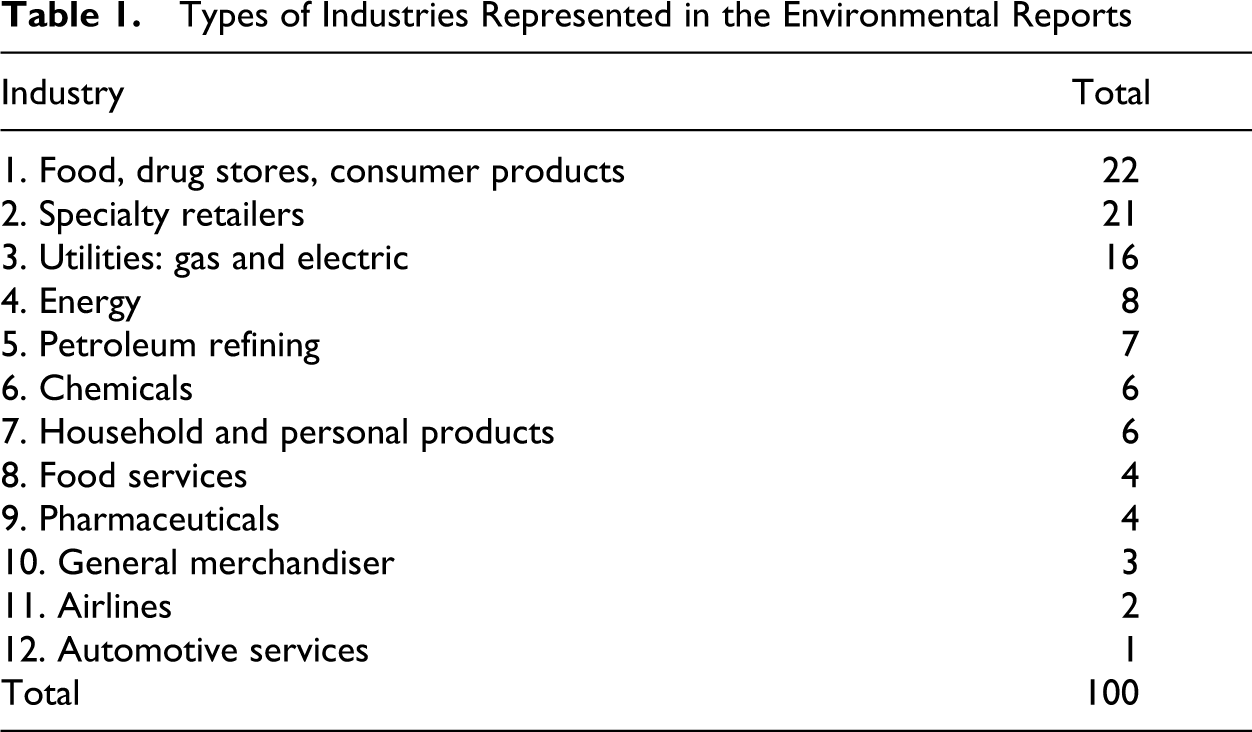
Our corpus consists of 100 corporate environmental reports of companies listed in the 2009 Fortune 1000 (see Appendix). We selected these reports by using a random-number generator. The majority of these reports are from the food, drug, and consumer-products industry; specialty retailers; and the utilities and energy sectors. These industries are among the most frequently represented in the Fortune 1000 list. Table 1 illustrates the distribution of the environmental reports in the corpus by type of industry.
Types of Industries Represented in the Environmental Reports
The environmental reports in the corpus were prepared by the companies’ communication departments. They are a type of company-controlled communication that is broadly disseminated in the companies’ corporate Web sites (see Morsing, 2006; Parguel, Bernoit-Moreau, & Larceneux, 2011; Van Riel, 1995). For these companies, and many that operate internationally, the Internet has increasingly become the preferred medium for communicating corporate environmental practices (see Clark, 2000; Esrock & Leichty, 1998; Gunnarsson, 2009). Some of the reasons that companies prefer the Internet for such purposes are that it provides a high level of accessibility at a low expense (Schlegelmilch & Pollach, 2005) and rich opportunities for argumentation and interactivity (Coupland, 2005). Figure 1 illustrates how Sara Lee, a company whose report is included in the corpus, uses the Internet to disseminate its corporate environmental mission (Sara Lee, 2010, p. 49).

Index page for Sara Lee 2010 sustainability report.
The index page shown in Figure 1 provides a visual representation of the structure, communicative devices, and imagery often found in this type of report. The imagery, although not the focus of our study, enhances and furthers the company’s message.
We examined the rhetorical and discursive devices that these corporate environmental reports use to communicate a green ideology to audience members, analyzing the data manually at both macro and micro levels. To ensure accuracy, we each independently coded the structural and linguistic components of the corpus. The authors also reviewed each other’s coding of the corpus.
Genre analysis theory and semantic-based approaches guided our coding and parsing of the data. We analyzed the macrostructure of each report by coding the type of discourse move (see Bazerman, 1989; Bhatia, 1993, 1998, 2004; Biber, Connor, & Upton, 2007; Swales, 1990). Moves are structural elements that deliver the content of the genre and are classified by type of rhetorical function or theme (Bhatia, 1993). Across reporting genres, the two common moves are to introduce and to establish credentials. Our analysis of the corpus accounts for these two moves as well as for submoves that are specific to the genre. This classification method establishes the type, rate, and frequency of each rhetorical move in order to discover the companies’ rhetorical preferences and hierarchical sequencing (i.e., priorities) when reporting on their environmental commitments, goals, and ideology. As we will show, the hierarchical sequence in this type of genre is not random but rather reflects rhetorical tools and cognitive strategies used for ideological persuasion. These strategies include recognizing the role that audience members’ prior knowledge or schema play in their understanding of the content of the genre (Fairclough, 1993).
To examine the micro features of the corporate environmental reports, we used a transitivity analysis (Halliday, 1994, 2002, 2005). Transitivity, according to Halliday (1994), examines how people use language to perceive the world: “Language enables human beings to build a mental picture of reality, to make sense of what goes on around them and inside them” (p. 106). When applied to the study of corporate environmental reports, this type of analysis provides insight into how these reports use language to shape audience members’ opinions about corporate environmental sustainability.
The Effects of Language Use in Influencing the Mind-Set of Audience Members
Before we examine the structure of corporate environmental reports and its role in expressing the company's ideology, we must consider the effects of language use in influencing the mind-set of audience members. At the crux of this discussion lies the relationship between cognition and discourse processing: Discourse understanding and influence is a complex process that is a function of both the structures of discourse as well as of the mental processing and representation of recipients. That is, whether or not, and how, people are influenced by talk and text also depends on what they already know and believe. (Van Dijk, 1998, p. 244)
People’s prior knowledge affects their evaluation of a text, such as a corporate environmental report, by helping them to distinguish between true or false conditions. For readers of corporate environmental reports to accept a view or a position that is presented to them and be persuaded, one of two conditions must be met: First, they have no alternative opinions or ideological presuppositions that would interfere with their acceptance of an ideological standpoint such as corporate environmental stewardship. Second, if their previous knowledge includes facts or opinions about companies and the environment that potentially challenge the ideological standpoint presented in corporate environmental reports, a change of knowledge must occur. The first condition facilitates ideological persuasion because the readers lack social knowledge (or knowledge about the company) that clashes with the ideologies presented to them. As Parguel, Bernoit-Moreau, and Larceneux (2011) put it, “if consumers have no other information to explain the company’s motives to communicate . . ., then no alternative inputs are accessible, and so transfer from the attribution of communication should happen automatically” (p. 18). The second condition, on the other hand, demands that ideological persuasion include changing readers’ mind-set about an ideology or an understanding that is different from their own, such as a skeptical view of companies and their role in society.
In our analyses of the macrostructure and microstructure of corporate environmental reports, we discuss how corporate environmental reports achieve ideological persuasion. We illustrate how this genre is constructed to facilitate an audience's acceptance of a company's stated green ideology. This construction entails prioritizing and selecting commitments and objectives at a macro level coupled with discursively presenting actions, events, and facts, such as those supported by (taken-for-granted) truth criteria, at a micro level.
The Macrostructure of Corporate Environmental Reports
The corporate environmental report is considered a hybrid or mixed genre (Bhatia, 2004) that draws mainly from the discursive generic values of reporting genres (e.g., narrations and arguments) and promotional genres (e.g., descriptions and evaluations). By combining these two types of genres, a corporate environmental report informs audience members of the company’s actions and efforts to protect the environment and promotes an image of good environmental stewardship.
The hybrid nature of corporate environmental reports allows companies to compete with one another for customer and worker loyalty. The macro- and micro-discursive elements of these reports are organized and selected to highlight the positive aspects of the company. From the standpoint of discourse development, the commingling of promotional and reporting activities furthers the authors’ private intentions (i.e., exploitation of discursive devices) to market the company within a contemporary (environmentally friendly) corporate paradigm (Barrow, 2005; Bhatia, 2004; Ottman, 1994).
In corporate environmental reports, two key moves deliver the reporting and promotional functions of the genre: establishing credentials and introducing sustainability initiatives. In our corpus, the establishing-credentials move is composed of one to six paragraphs that summarize the company’s stated objectives, beliefs, and values. For example, Figure 2 shows how PPG (2008) used this type of move to introduce its core values and commitment to the environment in its corporate sustainability report (p. 15). As we can see in Figure 2, the report contains images to enhance the audience’s understanding of the company’s green efforts.

Establishing-credentials move for PPG 2008 corporate sustainability report.
The second move, introducing sustainability initiatives, supports the establishing-credentials move by revealing actions that the company has taken or plans to take to promote environmental sustainability. This move may include a lead or summary section that precedes a variety of submoves or steps specific to an area of environmental sustainability, such as energy use and water conservation. Figure 3 illustrates how Kraft Foods (2010) introduced its sustainability initiatives in its corporate environmental report. In this move, companies persuade audience members of their environmentally sound business practices by presenting a goal-oriented approach.
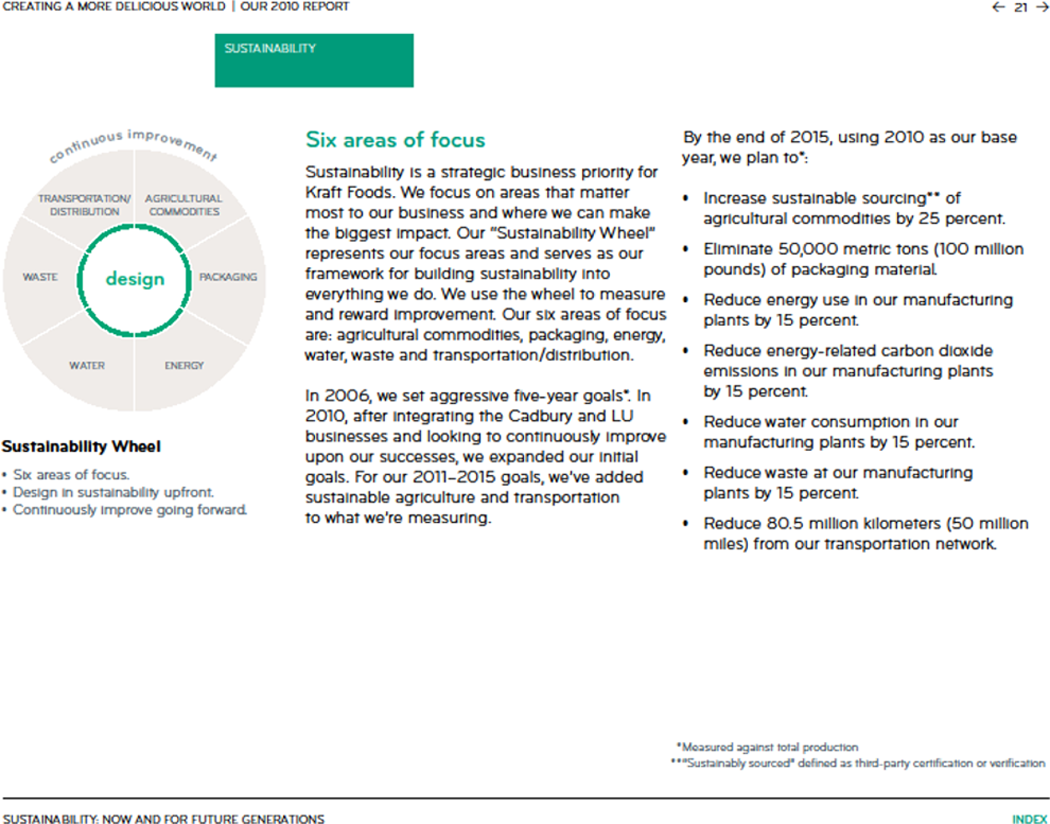
Introducing sustainability initiatives for Kraft 2010 corporate report.
Following Kanoksilapatham (2007), we classified the distribution and types of moves and submoves in the corpus as either conventional (C) or optional (O). Table 2 shows this distribution.
Distribution and Classification of Moves and Submoves in the Environmental Reports
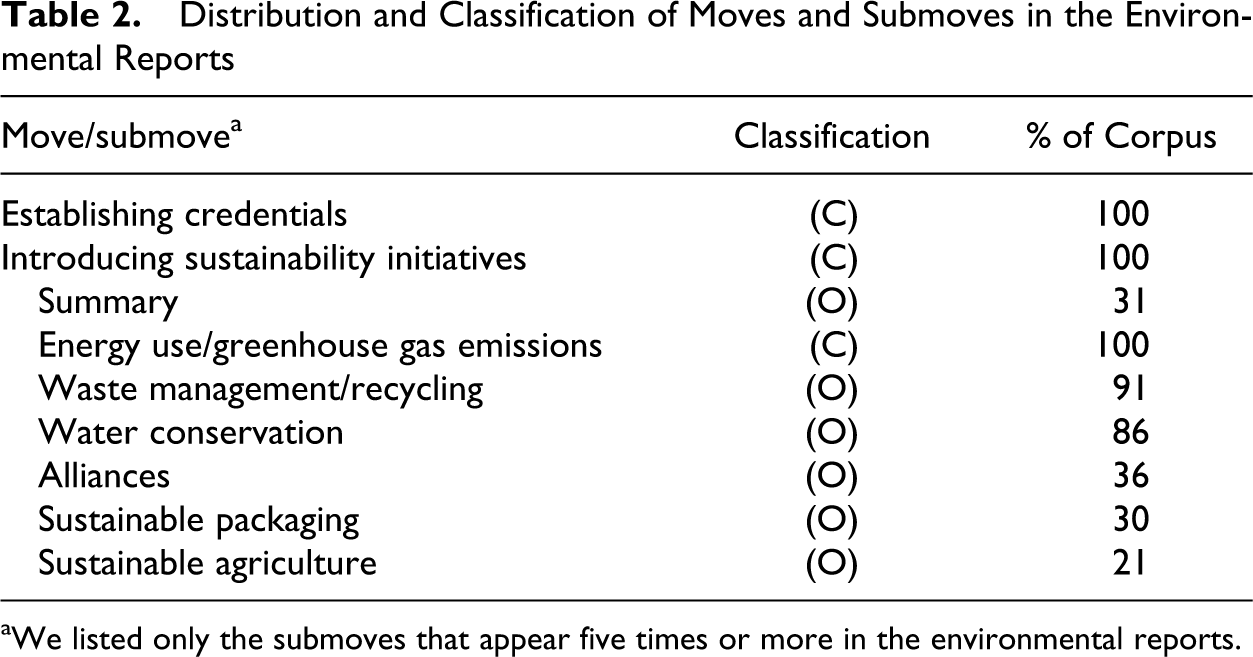
aWe listed only the submoves that appear five times or more in the environmental reports.
The establishing-credentials move is composed of at least one lead paragraph and often (84% of the time) four or more additional paragraphs. The lead paragraph lays out the company’s broad objectives and goals, as example 1 illustrates: (1) PPG is committed to operating in a manner that is protective of people and the environment. Through its business and manufacturing practices as well as its innovative products, the company is focused on stewardship and conservation, which not only helps protect the environment, but also gives PPG a competitive advantage in the marketplace. (PPG, 2008)
Subsequent paragraphs in the establishing-credentials move outline a company’s environmental policy and lay out how the policy shapes its operating practices locally or worldwide. Example 2 illustrates how a corporation uses this type of move to introduce its operating principles: (2) Dedicated to minimizing the impact of its operations on the environment, Hertz enacted a proactive Sustainability Program which enables worldwide operations to strive for consistently sound environmental behavior. The objectives of Hertz’s Sustainability Program are based on principles of preventing and minimizing environmental impact from its operations and promoting continuous improvement of the program. (Hertz, 2010)
The move introducing sustainability initiatives, on the other hand, serves to demonstrate that a company is acting on its environmental commitments, beliefs, and goals. This move addresses the company’s implied promise (i.e., commitment) that it will abide by sound environmental practices. As example 3 illustrates, some companies begin this move by including a summary section that links their corporate commitments, as initially stated in the establishing-credentials move, to their overall environmental practices: (3) Several years ago, Sara Lee Corporation adopted its Environmental Policy, which guides our global environmental practices. (Sara Lee, 2010)
Because the other submoves do not always appear in these reports, we classified them as optional. The submoves waste management/recycling and water conservation are observed often in the corpus, 91% and 86% of the time, respectively, whereas the submoves alliances, sustainable packaging, and sustainable agriculture are observed less often. With the exception of alliances, the submoves are used primarily to communicate the companies’ efforts to limit their environmental footprint, often in an active or measurable manner. Example 4 illustrates this point with the most common submove in the corpus, energy use/greenhouse gas emissions: (4) ITT uses solar energy at some sites, like our pump plant in Shenyang. We are now looking at all of our Defense sites—representing 7 million square feet of space—to determine the best candidates to use solar energy as their prime energy source. (ITT, 2009)
The submove alliances, on the other hand, has the unique function of directing audience members’ attention to the company’s sustainable business practices that are accomplished by teaming with another entity. Example 5 shows how the company uses this particular move to affirm its efforts to develop joint collaborations with an established green organization: (5) Over the last fiscal year, Sara Lee has been working closely with our infrastructure partner, HP, to find ways to save energy and reduce waste across our global IT operations. These efforts focus primarily on server virtualization, green data centers, cloud computing, employee computer and printer use and development of more transparent metrics to monitor our progress toward these goals. (Sara Lee, 2010)
The Microstructure of Environmental Reports
The macrostructure of corporate environmental reports is organized to direct readers’ attention to key areas that promote the company’s mission and its efforts to achieve it. The microstructure of these reports, on the other hand, supports the macrostructure through linguistic components that further the higher level macro functions. By examining the microstructure, we find how language is used in this genre to establish a connection between the company’s ideology and its good corporate citizenship.
To find how language is used to persuade audience members to accept ideological positions, we performed a microtextual transitivity analysis of the corpus. At its core, transitivity analysis is concerned with the mental picture that language users, for example, those who construct corporate environmental reports, have of the world and how they transmit it to an audience (see Halliday, 1994, 2005). It identifies how language users encode in their linguistic choices their views of reality and their evaluations of specific experiences. This type of analysis when applied to written discourse provides linguistic tools to examine three basic elements of a clause: participants, processes, and circumstances. These elements establish who does what (and to whom), what is done, and when or where it is done, as illustrated in example 6: (6) Alcoa [participant/actor] is meeting [process] the challenge in the communities [circumstance] in which we do business. (Alcoa, 2010)
In the next sections, we discuss how language is used in corporate environmental reports to express what companies stand for as corporate actors (i.e., environmental stewards). We focus on the discursive choices present in the lead section (usually the first paragraph) of each move and submove in the genre. We propose that by examining critically each microstructural discursive choice within a particular macrostructural move, we can uncover the types of discourse that companies in the corpus use to persuade their audience to form certain opinions about a stated green ideology.
Process Types and Discursive Goals in Establishing Credentials
The establishing-credentials move includes three types of processes that Halliday (1994, 2005) defined as material, relational, and mental. Table 3 contains examples from the corpus of each of these processes and their discursive goals. Material processes, or processes in which the actor does something, make up 72% of the processes in the corpus. In this process type, the verb committed appears in 91% of the instances. The high rate of usage for this verb is a common feature in corporate environmental reports because the verb directly aligns the company with its environmental efforts by making an explicit promise or commitment (see Laufer, 2003; Van de Ven, 2008). By making an explicit commitment that is linked to the company’s actions, the company is able to project an image in which its corporate identity, what it really is, is consonant with its communication, what it says it is (see Fukukawa, Balmer, & Gray, 2007). From a microstructural standpoint, the primary cognitive-discourse function of material processes is to persuade audience members of the company’s dedication to environmental stewardship, whether or not the company’s core business ethos matches its actions. Constructing a report that is, or appears to be, founded in ethical and actual business practices is an integral component for initiating changes in audience members’ perceptions of the connection between for-profit companies’ actions and their role in society.
Processes and Goals of Establishing Credentials
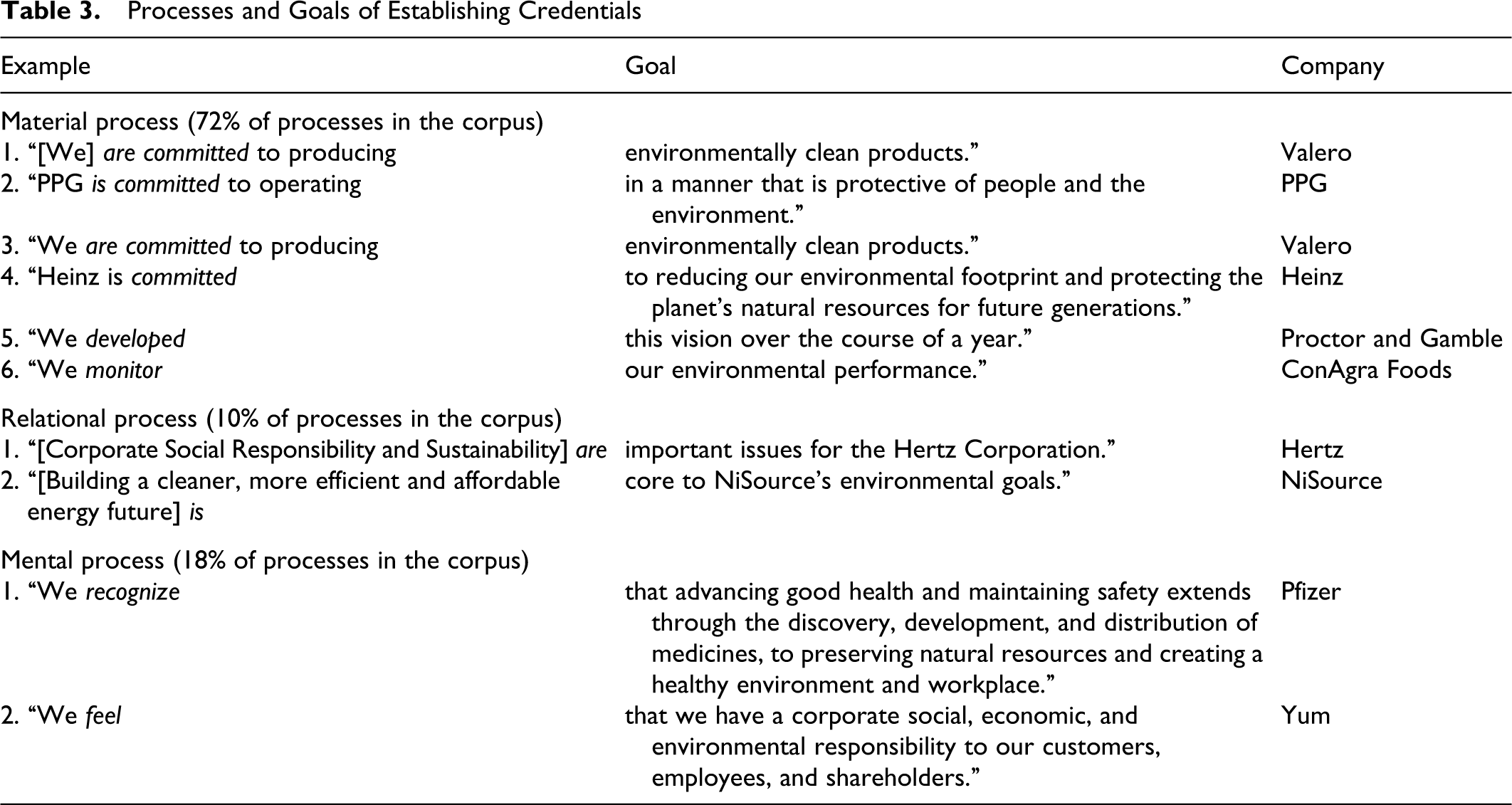
The other two process types, relational and mental processes, are used less often than material ones but play an important role in representing the company’s environmental ideology. Relational processes ascribe certain qualities or attributes to a company or entity, such as environmental stewardship. In doing so, such processes, as Hodge and Kress (1993) pointed out, tend to pass judgments on the company, encoding these attributes in the green ideological orientations and positions that the company articulates in this type of report.
Mental processes express the company’s recognition of the role that the environment plays in society. Such processes are more restricted in their discursive range and functions than material ones are. Because mental processes do not directly convey the company’s commitment toward the environment or require companies to put forth actions or efforts to be good environmental stewards, they tend to be less persuasive than those processes that can be verified or challenged—which may explain the limited use of mental processes in the genre.
Process Types and Discursive Goals of Introducing Sustainability Initiatives
Introducing sustainability initiatives is a move that presents supporting evidence for the identity the company puts forth in establishing its credentials. This move shows the company’s efforts in six areas of environmental concern: energy use/greenhouse gas emissions, waste management/recycling, water conservation, alliances, sustainable packaging, and sustainable agriculture. The microstructural processes used in introducing sustainability initiatives in the summary and six subsequent submoves are material, relational, and, very rarely, mental. Table 4 shows the distribution of these processes within the submoves of the corpus and presents examples of the processes and their discursive goals.
Processes and Goals of Introducing Sustainability Initiatives in the Submoves
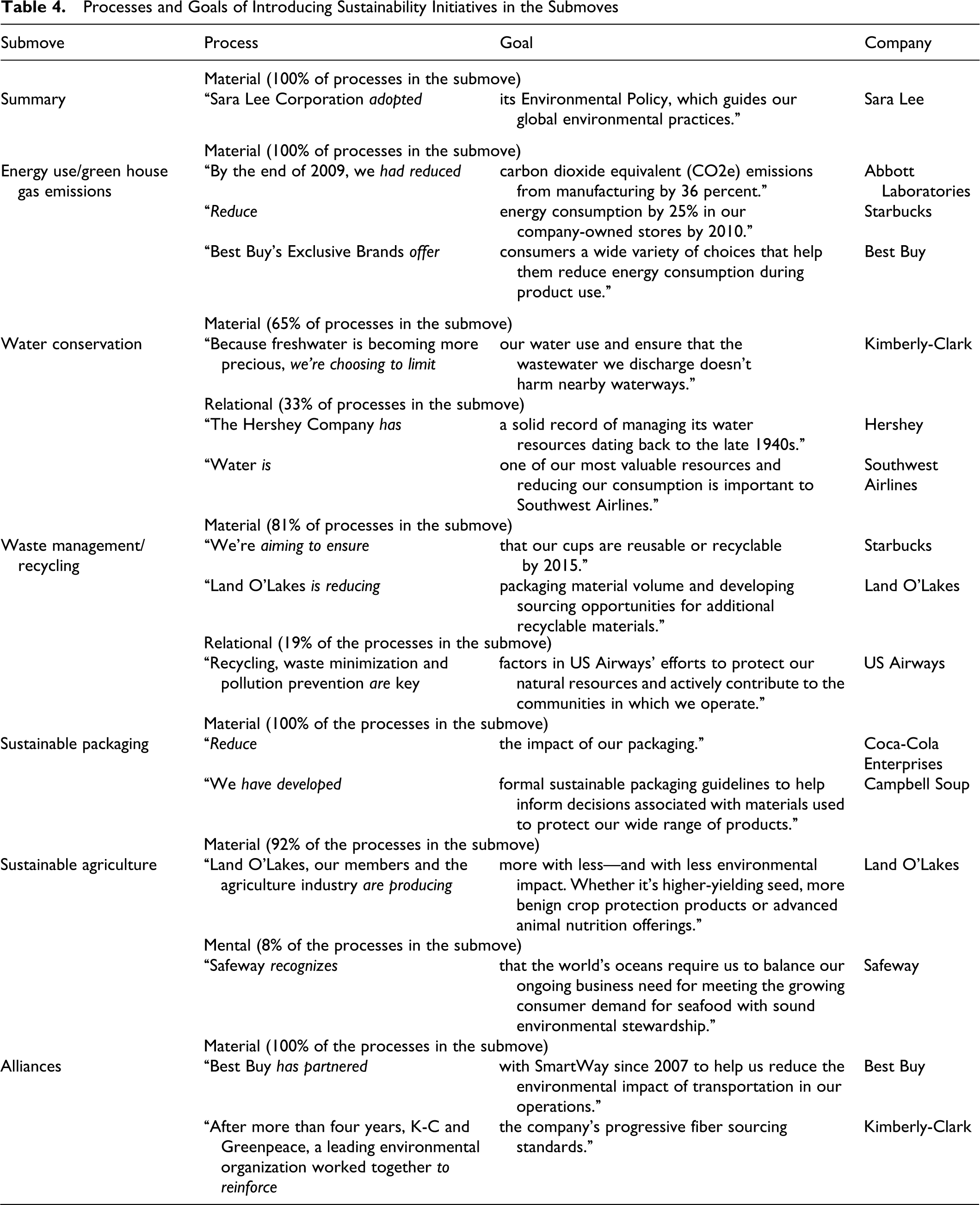
The content of the summary section provides general information about the company’s efforts to limit its environmental footprint. This rhetorical device reintroduces the content of the establishing-credentials move, specifically, the company’s stated commitments and goals, and connects it to the measures that the company has implemented to fulfill its objectives. This connection is accomplished at the microlinguistic level by using actional verbs such as adopted to express material processes, or processes of doing. Such expression of material processes in the summary component gives cohesion to the genre by reporting on the company’s actions (e.g., adopting an environmental policy) and promoting the positive outcomes of such actions (e.g., guiding corporate environmental practices globally).
For those reports without a summary section, introducing sustainability initiatives serves as a header (or organizing theme) for six types of submoves that have varying rates of usage (see Table 2). These submoves address and lay out the companies’ sustainability initiatives by type of environmental sector. They include, predominantly, material processes that are grammatically expressed by actional verbs, specifically reduce, limit, minimize, preserve, partner, work, develop, and produce. Some of these actional verbs correlate with the type of submove. For example, processes in the energy use/greenhouse gas emissions and waste management/recycling submoves are often headed by actional verbs, such as reduce and limit. The alliances submove, on the other hand, is headed by actional verbs such as partner or work. Table 5 provides a distribution of the most frequently used actional verbs in the six types of submoves in the corpus.
Distribution of Most Frequently Used Process (Material) by Submove in Reports Without a Summary Section
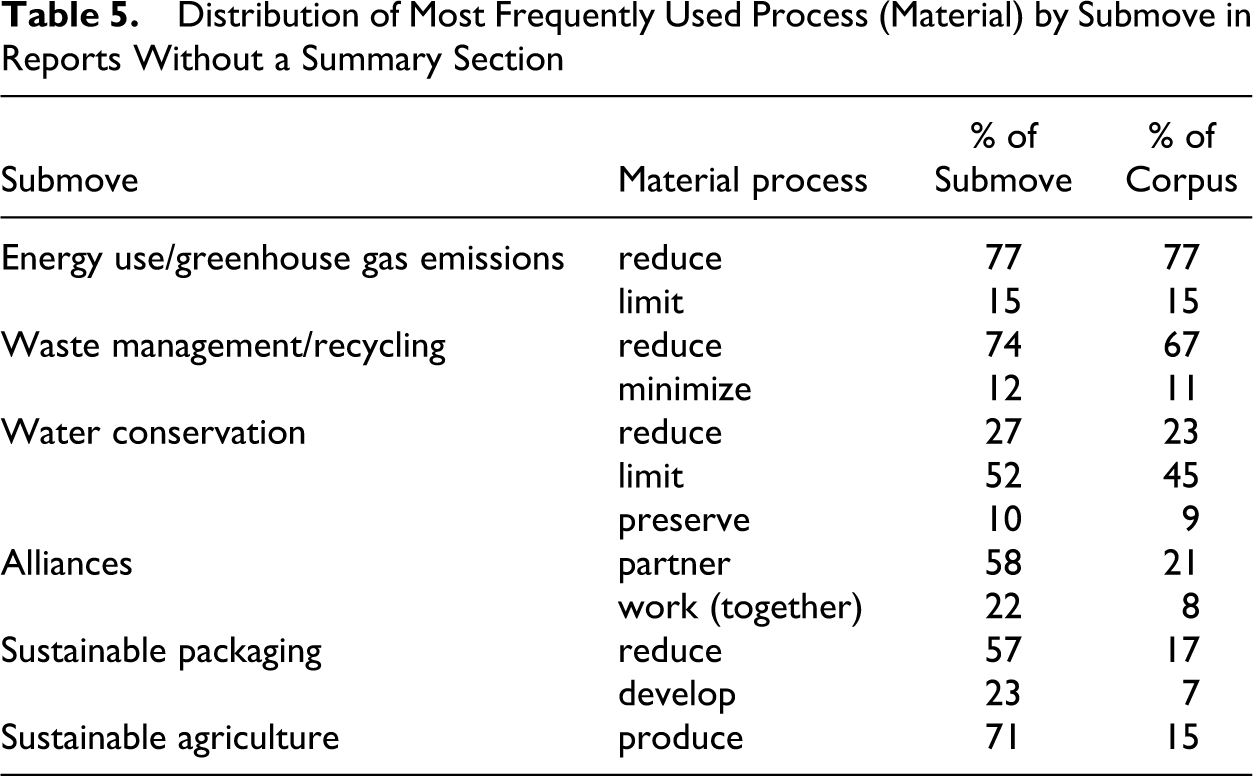
The reports have a submove related to energy use/greenhouse gas emissions (see Table 2). As Table 5 shows, 77 reports use the actional verb reduce and 15 use the verb limit. Since all the reports use this submove, the usage rate for these two verbs in the reports that include this submove is the same as the percentage for the total corpus. By contrast, only 91 of the 100 reports use a submove related to waste management/recycling. Of these 91 reports, 67 use the verb reduce; hence, reduce is used by 67% of all the reports in the corpus with a usage rate of 74% for those reports that include the submove waste management/recycling.
The pervasive use of material processes grammatically expressed by actional verbs in a variety of submoves in the corpus suggests that this type of process is effective in providing the facts that readers require to be influenced by a company’s stated green ideology. The use of facts, which are delivered by the main actor (i.e., the company) in the genre, facilitates the process of ideological persuasion through the fulfillment of plausible or accepted socially held beliefs. That is, if a company can show statistically or through specific examples that it is abiding by sound environmental practices, then the audience will more easily accept as truth the company’s projected image. In this sense, the submoves in the genre serve as a self-assessment and self-evaluation of a company’s commitments and goals. By presenting facts that, in theory, can be independently verified, companies will be more effective in influencing and changing their audiences’ minds.
Discussion
In this study, we examined how the macrostructure and microstructure of corporate environmental reports are used to direct and shape audiences’ perceptions about a company within a particular ideological framework, such as responsible environmental business practices. The first part of our analysis focused on examining the macrostructure of corporate environmental reports and the manner in which moves are organized according to their (hierarchical) importance in order to inform audience members and promote a green agenda. The second part of our analysis focused on applying a transitivity analysis to the microlinguistic structure of the genre in order to determine how language is used to inform audience members and persuade them of a company’s green ideology.
Our findings show that the companies represented in the corpus construct their corporate environmental reports to persuade audience members that the companies develop their business practices with a concern for environmental protection. To achieve this objective, they use a hybrid discourse genre to influence their audience at both macrostructural and microstructural levels. Audience members do not have uniform beliefs. Some audience members, for example, may presuppose that companies, on average, do not care about the environmental consequences of their actions while other members may presuppose that any environmental action the company takes reduces its profitability and, therefore, needs to be justified. To address disparate presuppositions of audience members, corporate environmental reports are constructed in a manner that follows the cognitive basis of ideological formation—that people hold beliefs that shape their perceptions about society and its members. The notion that the environment needs to be protected and sustained is a belief that reflects people’s assessment of situations based on social and culturally shared values. The manner in which corporate environmental reports influence audience members’ beliefs, as this study shows, lies in the macrostructural and microstructural features of the genre.
At a macrostructural level, corporate environmental reports consist of a sequence of moves (in a specific hierarchical order) reflecting areas that the company wishes to report and promote. The first move, establishing the company’s environmental credentials, serves to promote the notion that the company has commitments to society that shape its environmental practices and policies. These commitments may or may not be grounded in the company’s internal corporate ethos. The second move, introducing sustainability initiatives, serves to introduce the company’s environmentally friendly actions. This move demonstrates, in more tangible terms, how the company’s commitments are realized in factual and verifiable ways.
At a microstructural level, the discursive features of corporate environmental reports serve to shape people’s evaluative beliefs about companies and the environment. In this genre, the company is represented as an actional entity whose efforts are supported by independent sources (e.g., alliances) or by using metrics for effective corporate compliance (e.g., implementing measures that surpass regulatory standards). This discursive strategy satisfies the cognitive conditions of effective ideological persuasion and provides insight into how companies inform their audience about their role as stewards of the environment.
In summary, understanding how corporate environmental reports are structured and use language in this genre provides insight into how audience members are directed to evaluate and consume corporate green ideology. The findings of this study further contemporary analysis of environmental corporate rhetoric. This is a fairly new field in business communication and, as such, demands further investigation, particularly in light of the growth of green marketing and advertising in the last decade. We propose that understanding the (structural) realization of corporate environmental ideology and its effect in shaping audience members’ perspective of a corporation’s role as a steward of the environment will enhance our current understanding of environmental rhetoric and eco-friendly marketing practices. Future research is necessary to establish how societal changes shape the rhetorical devices used in corporate environmental reports. This type of research could examine, through time, the discursive choices of corporate environmental reports and society’s perceptions of companies’ role in environmental management. Future research could also address whether yearly reports exhibit marked differences in style and content or whether they tend to recycle all or most of the macrostructural or microstructural components. The results of such a study would address the role of intertextuality in corporate environmental reports and provide insight into the strategies companies use to communicate their green agenda.
Footnotes
Appendix—List of Fortune 1000 Companies in the Corpus
Declaration of Conflicting Interests
The author declared no potential conflicts of interest with respect to the research, authorship, and/or publication of this article.
Funding
The author received no financial support for the research, authorship, and/or publication of this article.