




Abstract
Using a narrative–semiotic approach, this article explores the decisions, plans, and actions involved in dealing with organizational risks and crises. It describes a model, or methodological framework, for crisis analysis as well as for organizational learning aimed at crisis management and prevention. The model is based on the interrelational positioning of the relevant agents (project managers, project team members, and stakeholders), the discourses produced by these agents, and their actions. This model is valuable for understanding the situations, goals, motivations, and anxieties that underlie the risk assessment and actions taken during crises. To illustrate the theoretical discussion, the article analyzes the Columbia Space Shuttle accident of 2003.
Textual or linguistic research in professional communication generally falls into four broad categories: discursive and rhetorical analyses of documents and the processes and decisions involved in producing these documents (Bazerman & Prior, 2004; Surma, 2005), genre-based approaches to the structural and stylistic expectations and conventions of particular document types (Bhatia, 1993, 2004; Swales & Rogers, 1995), sociolinguistic or ethnographic analyses of conversations and interactions taking place in particular organizational settings (Fairclough, 2003; Holmes, 2006; McHoul & Rapley, 2001; Tannen, 1993), and narrative–semiotic approaches that take their cue from literary analysis and “read” organizational practices as textual structures (Andersen, 1997; Groleau & Cooren, 1999; Taylor, 1993). Despite differences in methodology and objectives, all these approaches follow the premise that texts produced in professional settings are examples of socially and contextually situated praxis. All approaches share the epistemological framework of the “interpretive” turn in professional communication, which emphasizes the constantly changing, dynamic, and negotiative nature of professional discourse (Manning, 1992; McPhee & Zaug, 2008; Patriotta, 2004; Putnam & Mumby, 2013; Taylor & Van Every, 2000).
This article contributes to the narrative–semiotic approach to organizational communication by proposing that a narrative framework can be a valuable tool for analyzing crisis and its management in professional contexts. Although important work has been carried out on narrative approaches to organizational communication, less has been done on the narrative structure of crises (e.g., Boudes & Laroche, 2009; Morris, 1997; Taylor & Van Every, 2014). Besides the theoretical insights into human sensemaking activities, a narrative model of crisis management can also bring practical results. For example, it can help investigators who study retrospectively the success or failure of completed projects to assess the appropriateness of decisions made by team members. It can also help members of project teams to conceptualize their project in the planning stage in order to avoid omitting important elements and to develop effective risk-management strategies. The narrative model is therefore a useful tool both for organizational learning and for investigation. As Heath (2004) noted, a narrative approach “allows for persons who are engaged in crisis planning and response to sense the narrative thematic continuity that is expected of the organization and to imagine the narrative events (such as terrorism) that could occur—because they are a possible or probable narrative” (p. 186).
This article explores the ways in which a narrative–semiotic approach can be productive in understanding organizational communication—in particular, organizational crisis—and outlines a model for analyzing conflict and crisis in organizational contexts. To illustrate the theoretical discussion, I refer to the Columbia Space Shuttle accident as described in the Columbia Space Shuttle Accident Investigation Board Report (CAIBR, 2003). I start with an overview of narrative approaches to organizational communication and crisis; then I explain the narrative–semiotic approach by giving a microanalysis of selected texts describing the Columbia Space Shuttle accident. Finally, I analyze the CAIBR as a narrative text.
The Narrative Approach
Narrative approaches to professional communication vary in their focus and in how they delimit their object of study. Some concentrate on the stories told or written in particular situations and analyze these in terms of how they reflect the narrators’ professional roles, subject knowledge, and rhetorical purposes and the effects of their point of view. For example, Roe (1992) emphasized the importance of understanding point of view when analyzing the events and issues involved in policy development. Recognizing this importance, he even recommended mandatory narrative training for policy makers. Also, Boje and Rosile (2003) effectively highlighted the significance of point of view in their analysis of texts documenting the collapse of Enron. They proposed that many of these texts constructed the agents in the Enron story as tragic characters by presenting the events that took place as examples of individual faults and failings. Boje and Rosile suggested that constructing these events as systemic flaws and contradictions rather than individual faults and failings could have produced an epic narration that would have been much more effective in indicating areas that needed social changes.
Other approaches focus on the narrative form of the organizational culture. For instance, Willihnganz, Hart, and Leichty (2004) studied a company in terms of the main metaphors that made up its controlling or foundational narrative (in this case, the company as family unit), examining how changes to the company structure were perceived as hostile and unwelcome disruptions of this main narrative. Also, Gabriel (1998) used a narrative framework to examine perceptions of change in an organizational context.
A third group of approaches focus on the intergeneric and universal nature of narrative as a mode of discourse and recommend that communicators exploit this universality by making narrative the basic template for their communication. For example, management consultant Minto (2002) proposed that using story structure when writing reports makes the document more easily accessible and communicative, a view that challenges the conventional classification of reports and stories as different genres. Also, Marsen, Biddle, and Noble (2003) demonstrated that “use cases” in software engineering (a method of writing the requirements of a software application according to how it will be used by the end user) have a narrative structure. They argued that explicitly employing a narrative model to write use cases would improve communication between the software engineer and the client and could make the product itself more functional.
Regarding the application of narrative theories to organizational crisis, some recent research has focused on the storytelling strategies of individuals as they attempt to make sense of change and conflict. For example, Boudes and Laroche (2009) analyzed data from the investigative documents produced after the heat-wave crisis in France in 2003. They described how these documents aim to reestablish patterns of sensemaking that were challenged during the crisis, such as those concerning the nature of the events that took place and their degree of predictability. Similarly, Langer and Thorup (2006) examined the role of stories in conversations between employees of Scandinavian Airline Systems and demonstrated how these stories were constructed to build trust and help the individuals cope with change.
Taking a more theoretical perspective, Taylor and Van Every (2014) proposed an interpretation of communication failure in organizations in terms of semiotic “thirdness.” These authors adapt Charles Peirce’s concept of thirdness, rendering it a tool that can address the framework of authority in which organizational decisions are made. According to this approach, whereas firstness encompasses subject-related actions (I utterances) and secondness encompasses object-related phenomena, such as the agents or elements that are acted on (you utterances), thirdness includes the contextual elements in which action takes place (he, she, or it utterances). Thirdness is also evoked in organizational discourse in references to elements of authority (e.g., management requires, company policy states, company regulations permit). In this respect, thirdness acts like a cognitive schema, that is, a cognitive frame or point of reference for the actions that take place in an organization. According to Taylor and Van Every, many of the reasons why organizations fail can be found in conflicting interpretations of these “shared understandings.”
A Narrative–Semiotic Method of Analysis
Narrative–semiotic methods of analysis originate in attempts to trace common patterns in myths and folktales in order to understand the “grammar” of universal narrative (as first proposed in the work of folklorist Propp, 1924/1968). More than just a method for analyzing stories, narrative semiotics aims to throw light on the processes that humans use to make sense of and interact with their environment. Initially associated with the structural semantics that Greimas (1987) developed, narrative–semiotic conceptual tools have been used to analyze the discourses of the humanities and sciences (Marsen, 2006b) as well as the textual organization of various social practices, ranging from the marketing of products (Danesi, 2008) to the designing of buildings (Floch, 2001). In professional communication, scholars such as Taylor (1993; Taylor & Van Every, 2000) and Cooren (1999), known as the Montreal School, have highlighted the relevance of narrative–semiotic models for the ethnographic study of organizational processes.
Narrative semiotics contends that narrative structure not only underlies verbal storytelling, but it is also a fundamental part of our system of perception, cognition, and representation. In fact, the universality of stories attests to the cognitive link between making sense of and narrativizing experiences. In other words, the most common, universal way to make sense of what we perceive and experience is through creating stories. Thus, a narrative structure can be traced not only in stories as they are told or written but also in social interactions, unexpressed discourse (thoughts), and emotional reactions to situations: The stories we create when constructing and negotiating our identities are themselves manifestations of the stories that we perceive ourselves as acting in, and these stories that we create reflect our beliefs and values, making narrative structure a productive method for exploring the ideological backbone of action.
Drawing on narrative–semiotic concepts and distinctions, I divide my analysis of organizational crisis into two interrelated levels of narrative: temporal, as a sequence of actions (narrative trajectory), and spatial, as a positioning of agents (narrative configuration). Narrative trajectory unfolds on the syntagmatic axis of discourse, in which temporal enchainment dominates (the “and then…and then” of stories). Narrative configuration, on the other hand, involves the paradigmatic axis, which is linked with the identity of agents in relation to their actions (the “who’s who” of stories). Together the two levels form the narrative quest—the dynamic relational positioning of agents leading to the performance of actions that have an effect on the (actual or textual) world. The narrative trajectory is divided into these stages: an initial situation that sets the scene for the action to develop. This situation acts as the background against which the action develops. In organizational analysis, the initial situation would include the nature and culture of the organization and its status in the wider community. a complication that introduces a twist, conflict, or something that is lacking in the initial situation and triggers the sequence of events. In organizational analysis, the complication would involve a change or problem that is introduced in the organization’s structure and in some way challenges its continuity or goals. a series of events that try to address the complication. This is the main part of the narrative that includes the events and actions that propel the narrative. In organizational analysis, this stage encompasses the actions and problem-solving strategies that aim to address the issue created in the complication stage. a resolution that points back to the initial situation either by reestablishing it or by transforming it. The resolution represents the ending of the story although it could itself signal the initial situation of another story or leave the complication open ended. In organizational analysis, the resolution would include the final decisions about a project and the effect that these decisions have on the organization.
A story can be complete (Herman, 2009; O’Neil, 1996; Prince, 2000) or it can be a fragment of a whole—a narrative program (Greimas, 1987). A narrative program consists of an agent (subject) performing an action in order to fill a lack of some kind and signals a transformation of state. A main narrative can be subdivided into a series of narrative programs, or mininarratives, for analysis. For instance, consider the following extract from the narrative of the CAIBR (2003): On Sunday, Rodney Rocha e-mailed a Johnson Space Center Engineering Directorate manager to ask if a mission Action Request was in progress for Columbia’s crew to visually inspect the left wing for damage. (p. 145)
In organizational settings, the narrative quest is most clearly evident in the structure of projects, which are the foundation of professional culture. In fact, the narrative structure correlates with project management. Much of what happens in organizational settings involves projects, with each project divided into tasks and often milestones (goals to be reached at specific stages) and deliverables (objects to be created and shown to a client or the public at specific stages). These happenings compare to the elements that compose the narrative trajectory. Within the context of a project, crisis can be defined as an event that disrupts the expected progression of a task and requires urgent decisions and actions to reestablish normal function. In this respect, crisis is analogous to the complication sequence of the narrative as an extreme or disruptive manifestation.
The second level of the narrative analysis—the narrative configuration—involves the positioning of agents in specific roles as they interact in this transformational sequence. From a narrative–semiotic perspective, these agents can be classified according to six “actantial” roles (Greimas, 1987; Keen, 2003; Toolan, 2001). The actantial model is composed of a set of role categories, and each category may include one or more agents depending on the complexity of the narrative. Also, in long or complex narratives, the same agent can occupy different categories, and the agents can be human or nonhuman, which is important in organizational communication because abstract entities, tools, concepts, and policies can perform actions that facilitate or hinder project development (as noted by actor-network theorists such as Latour, 1987). The six role categories in the actantial model are defined by agents’ interrelational actions that move forward the narrative and deal with the narrative complication or problem: The sender category includes concrete agents who dictate or direct the actions of the protagonists, and it can include psychological motivating factors. In physical or embodied form, the agents filling the sender category are those who have decision-making status and can issue commands (e.g., managers and administrators in organizational settings). In abstract form, they include abilities, needs, and desires that motivate action and delimit the desired goal (e.g., curiosity or fear of failure). This category encompasses causal or trigger factors of actions. The subject category includes the main agents (the protagonists) on whom the successful completion of a project depends. Agents in the subject category are the main performers or executors of actions. The subject acts on the explicit or implicit dictates of the sender. The relations between sender and subject are known as the narrative contract. In narratives in which the sender and subject have different values or objectives, or the expectations of the agents in the sender category are not clear to the agents in the subject category, situations of misunderstanding and confusion may emerge. The object category includes the desired goal that will address the complication on which the narrative revolves. The pivotal actions of the narrative try to conjoin the subject with the object. Goals, objectives, aims, and desired outcomes, such as the organization’s public image, would fall in this category as would tangible objects, such as financial gains. Possible conflicts in the narrative could emerge if the subject has no clear idea of what the object is or if the object is a complex, multidimensional, transformational, or elusive entity. The relations between subject and object are known as the narrative struggle. The receiver category includes the agents who benefit from the subject’s actions. Agents in this category show the result of the subject’s acquisition (or not) of the desired object. For example, if the object involves financial gain, the receiver would include the stakeholders that benefit from this gain (e.g., the company, shareholders, employees, a particular community group, or a combination of these agents). The relations between sender and receiver are known as the narrative communication. The helper category includes the agents who assist the subject in the narrative quest. This category can include abstract agents (e.g., abilities, skills, or knowledge) and physical agents (e.g., collaborators, technicians, or various experts who aid the subject in reaching the goal). Brainstorming potential helpers in the initial stages of a project would help team members to conceptualize the strengths and qualities needed in order to counteract possible problems or obstacles. The opponent category includes agents who hinder the subject in the narrative quest. This category could include a lack of abilities, a shortage of knowledge or information, or ineffective tools. It could also include physical agents who have a conflictive relationship with the subject and do not want the subject to achieve the goal. In an organizational setting, competitors could be placed here, as could environmental factors, such as adverse weather. Brainstorming potential opponents in the initial stage of a project would help team members to become aware of contextual factors and to address risk factors.
When identifying the narrative trajectory and narrative configuration in texts produced during a project or during a crisis investigation, the analyst should acknowledge the pivotal role of the narrator. After all, a series of events can be told differently, resulting in different stories. It is in the narrator’s discourse that we observe the placement of agents in interrelational positions. Narrators position agents in actantial categories through the way they construct their discourse, identifying causal elements, evaluating actions, and sequencing events. Consider, for example, this extract: Schedules are essential tools that help large organizations effectively manage their resources. Aggressive schedules by themselves are often a sign of a healthy institution. However, other institutional goals, such as safety, sometimes compete with schedules, so the effects of schedule pressure in an organization must be carefully monitored. (CAIBR, 2003, p. 131)
The narrator’s importance in orchestrating the elements of the story is evident in the given or presupposed knowledge against which the narrative trajectory and narrative configuration unfold. In other words, a story not only describes certain actions, but it also presupposes a state of affairs that make these actions possible, and the narrator, as organizer of information, is pivotal in reflecting this presupposed framework (Marsen, 2006a). For example, consider the following utterance: There were two reasons for declaring the Space Shuttle “operational” so early in its flight program. One was NASA’s hope for quick presidential approval of its next manned space flight program, a space station, which would not move forward while the Shuttle was still considered developmental. The second reason was that the nation was suddenly facing a foreign challenger in launching commercial satellites. (CAIBR, 2003, pp. 23–24)
For an example of a narrative–semiotic analysis using the tools that I described, consider this extract from a NASA (2003) press release on the Columbia accident: NASA’s plans for 2003 were abruptly changed February 1 with the sudden and tragic loss of the Space Shuttle Columbia and the brave crew of STS-107. Even while mourning the loss of our courageous astronauts, NASA’s civil service and contract workforce began the challenging task of finding the problem, fixing the problem, and preparing to return the Space Shuttles to safe flight. With the Columbia Accident Investigation Board’s report and NASA’s implementation Plan for Space Shuttle Return to Flight and Beyond as guides, the agency is striving to return to safe and efficient human space exploration. The tragic Columbia accident did not disrupt NASA’s quest for discovery. In the pursuit of our mission goals, we will continue to expand the international Space Station’s remarkable capabilities, send robotic spacecraft to explore fascinating places throughout the solar system, use telescopes to find Earthlike planets orbiting nearby stars, and use satellites to help us better understand Earth’s dynamic climate.
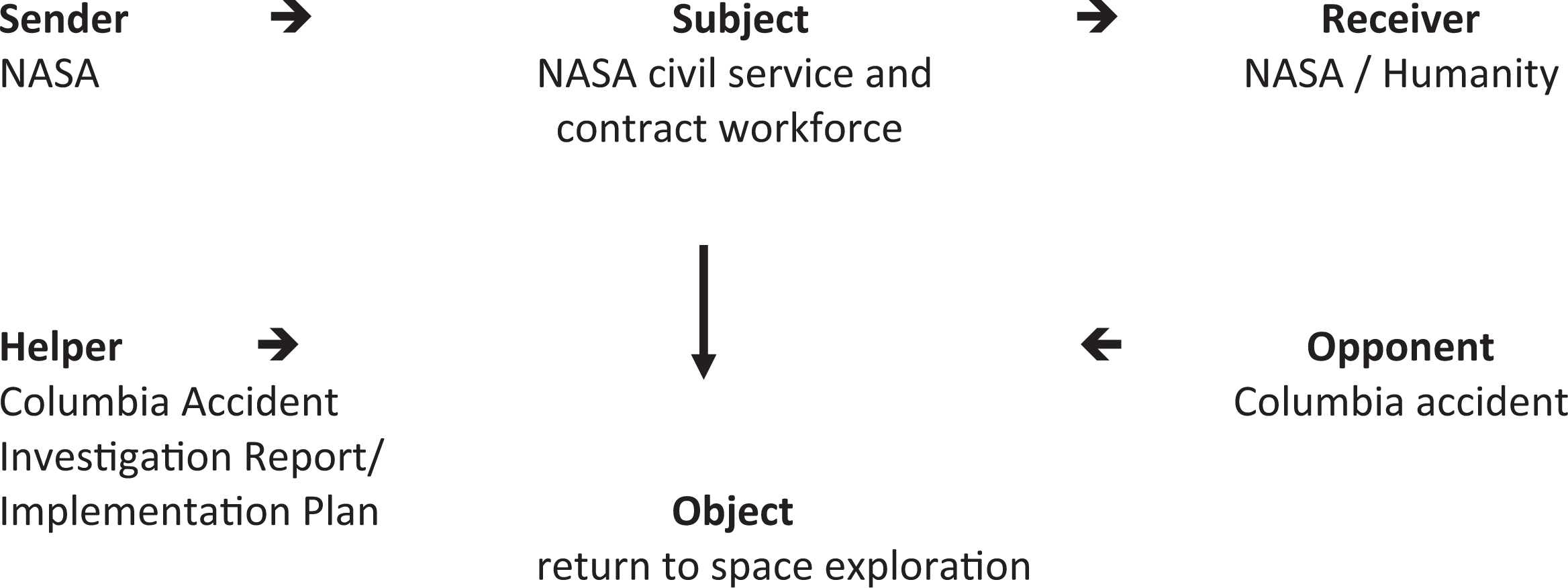
Actantial model of National Aeronautics and Space Administration press release.
An Analysis of the CAIBR as a Narrative Text
In this section, I examine the Columbia Space Shuttle accident as narrated in the CAIBR, which is read as a narrative text. My examination is based on a close reading of the whole report using an approach informed mainly by narrative semiotics such as I have described. I also use concepts from discourse analysis and rhetoric to analyze the report on the sentence and paragraph level. This narrative analysis of the CAIBR rests on the principle that participants and investigators of crisis situations make sense of the crisis experience retrospectively, after the fact: The actions that took place before, during, and after a crisis become, in the postcrisis narrative, interpreted actions. The 248-page CAIBR is divided into 11 chapters and three appendixes. For this study, I paid particular attention to the Introduction, which describes the aims of the investigation; Chapter 6, “Decision Making at NASA,” which discusses strategic actions of the main agents of the narrative; Chapter 7, “The Accident’s Organizational Causes,” which describes the role of the agents’ interrelationships in the crisis; and Chapter 11, “Recommendations,” which describes the narrator’s suggested resolution to the problems (for more on the communicative and discursive elements surrounding the Columbia accident, see Blount, Walker, & Leroy, 2005; Boin & Schulman, 2008; Dombrowski, 2006; Guthrie & Shayo, 2005; Kauffman, 2005; Ocasio, 2005; Smith, 2008; for media stories surrounding the accident, see Sumpter & Garner, 2007).
Besides the narrator’s discourse, the CAIBR contains the embedded speech of other agents, similar to the dialogue in literary narratives such as novels. This embedded speech—in interviews, participant e-mails and memos, or quotations from authoritative documents that explain or lend support to the narrator’s claims—is framed by the narrator’s discourse, which acts as the main organizer of information, selecting and prioritizing elements and positioning agents in interactional relationships. In the following analysis, I consider selected embedded utterances from pivotal sequences in the narrative trajectory that the narrator describes. These utterances, which represent different points of view on major sequences of the story, illustrate the application of the narrative elements that I outlined in the previous section. To highlight the report’s narrative structure, I begin with a chronological retelling of the event, starting with the launch and ending with the accident.
On January 16, 2003, NASA launched the space shuttle Columbia to carry out scientific research in orbit. Initial public releases indicated that the launch was successful. In the background narrative of NASA, the launch represented another mainstream episode featuring Columbia as a new protagonist in the company’s continuing quest to acquire knowledge. The first sign that something was amiss was detected on January 17 during a video viewing of the launch by members of the Intercenter Photo Working Group (IPWG), who observed that a fragment of foam insulation became dislodged from the main tank during liftoff, striking the left wing. In the CAIBR, this event constitutes the narrative complication that sets off a series of actions aimed at addressing it.
The group conveyed this information to the mission management team (MMT, the project leaders), the mission evaluation room (MER, the team monitoring engineering issues during flight), and selected engineers by sending them a digitized video clip. The ensuing crisis resulted to a large extent from the conflicting interpretations of this video clip. These conflicting interpretations demonstrate how the same event can generate a dichotomy of perspectives. To use semiotic terminology, the video clip acted as an indexical sign (Martin & Ringham, 2006) that pointed to different elements depending on the presuppositions (or worldviews) of the participants. In particular, for the engineers who recognized the novelty of the foam strike, the video clip indicated possible serious damage to the shuttle whereas for the managers who interpreted the foam strike according to existing frames of reference, it indicated a routine maintenance event. Lack of effective communication between the two groups and insufficient understanding of each other’s worldviews obscured this vital difference and affected how the two groups decoded the foam strike. From the engineers’ perspective, the foam strike constituted the complication of the story and required actions to bring about a positive resolution whereas from the managers’ perspective, it constituted a minor event that would not hinder the successful trajectory of the narrative quest (the successful return of the shuttle and the completion of the mission). Here is how the CAIBR’s (2003) narrator puts it: Even after it was clear from the launch videos that foam had struck the Orbiter in a manner never before seen, Space Shuttle Program managers were not unduly alarmed. They could not imagine why anyone would want a photo of something that could be fixed after landing. More importantly, learned attitudes about foam strikes diminished management’s wariness of their danger. (p.181)
In brief, the DAT, with the IPWG (representing the engineers’ worldview) as helper, performed the following actions, which I deliberately simplify to highlight the points of friction and conflict that led to the crisis, in the narrative trajectory of the crisis: 1. The DAT asked a representative of the Department of Defense for a plan to commence imagery of the shuttle in orbit. The team did not obtain authorization for this request from the chair of the MMT, Linda Ham. 2. The DAT attempted to obtain imagery from an outside source, again without consulting the MMT. The meeting participants…all agreed we will always have big uncertainties in any transport/trajectory analyses and applicability/extrapolation of the old Arc-Jet test data until we get definitive, better, clearer photos of the wing and body underside. Without better images it will be very difficult to even bound the problem and initialize thermal, trajectory, and structural analyses. Their answers may have a wide spread ranging from acceptable to non-acceptable to horrible, and no way to reduce uncertainty. 3. Rocha then took the matter to his own division, the engineering section at Johnson Space Center. 4. After these unsuccessful attempts to obtain imagery, the DAT notified Linda Ham, who attempted to find the original source of the request in order to ascertain that there was indeed “mandatory need.” Not finding this source, she terminated the request. She then sent an e-mail message to selected engineers asking if the debris strike caused a safety of flight risk. The replies that she got indicated that their analysis of the situation, based on the available data, did not show any serious safety risks.
This is an example in which the subject acts against the dictates of the sender, breaching the narrative contract. The consequences of this breach are likely to color the narrative. Also, the person contacted was not the appropriate contact for this kind of request. This is an example of a lack of knowledge, or misinformation, that induced the subject to elicit the actions of a helper who is not equipped to play this role.
In making this decision, the DAT bypassed established procedures, which entailed going through the MER to the MMT and then to the flight dynamics officer—another example of sender–subject conflict. Such conflict occurs when the subject does not understand or has not obtained specific instructions from the sender or when the sender has not indicated the desired course of action. In either case, the object is not constituted or understood in the same way by both parties. In fact, conflicts in the narrative contract in narratives of organizations are often signs of unclear or miscommunicated procedures and a correlating lack of good leadership. The narrator of the CAIBR identified both of these elements, concluding that decisions made during the mission “reflect missed opportunities, blocked or ineffective communication channels, flawed analysis, and ineffective leadership” (CAIBR, 2003, p. 170). As an example of the discourses produced during this stage, consider the following e-mail sent by Rocha to Johnson Space Center engineers on January 21, 2003, in order to request imaging by external sources:
The fact that no senior management was included in this discussion caused the shuttle program managers to interpret the situation as a noncritical engineering task that concerned postmission maintenance problems and not as a critical operational need. The clash of perspectives and differences in the narrative positioning of the foam strike are once again evident in this incidence. The narrative struggle (the series of actions that conjoin the subject with the object) was conceptualized differently by the engineers who placed more value on the authority of their peers than did the program managers.
Many of these replies relied on technical analyses of the situation in relation to past experiences and did not address more global issues of risk management. The engineers therefore, seemingly inadvertently, reinforced the misconception that the foam strike was an example of a common occurrence and could be fixed when the shuttle returned. This approach, misguidedly, as it turned out, did not challenge or question NASA’s definition of foam-debris losses “as an acceptable aspect of Shuttle missions, one that posed merely a maintenance ‘turnaround’ problem rather than a safety-of-flight-concern” (CAIBR, 2003, p. 121).
Much of the confusion here revolved around conflicting definitions of the phrases critical and mandatory need. Both are constructed with the modality of necessity. Modalities (the other modalities being belief, obligation, possibility, willingness, and ability) show the speaker–writer’s attitude toward the content of the utterance and therefore have a high subjective value (Gavins, 2005; White, 2003; Yule, 1996). They are often present in misunderstandings, and they can be made explicit by describing their assumptions or premises. In this case, for engineers, the lack of definite evidence of damage to the shuttle constituted enough need for imagery; for the MMT, acceptable evidence would refer to the physical results of the possible damage. To address this conflict of interpretation, the phrase mandatory need would have to be described, preferably by stating examples and taking into account the interlocutor’s discursive framework, in order for all participants in the communication to have a similar understanding of its meaning. In terms of narrative configuration, defining the meaning of mandatory need is important in delineating the foam strike as either an opponent of the quest or just a minor inconvenience.
As an example of the discourses produced in this stage, consider the e-mail sent by Calvin Schomburg to fellow engineer Ralph Roe on January 22, 2013, in response to Linda Ham’s question about whether there was a flight-safety risk: No—the amount of damage ET [external tank] foam can cause to the TPS [thermal protection system] material-tiles is based on the amount of impact energy—the size of the piece and its velocity (from just after pad clear until about 120 seconds –after that it will not hit or it will not [have] enough energy to cause any damage)—it is a pure kinetic problem—there is a size that can cause enough damage to a tile that enough of the material is lost that we could burn a hole through the skin and have a bad day—(loss of vehicle and crew—about 200–400 tile locations (out of the 23,000 on the lower surface)—the foam usually fails in small popcorn pieces—that is why it is vented—to make small hits—the two or three times we have been hit with a piece as large as the one this flight—we got a gouge about 8–10 inches long about 2 inches wide and ¾ to an 1 inch deep across two or three tiles. That is what I expect this time—nothing worst. If that is all we get we have no problem—will have to replace a couple of tiles but nothing else. 5. Rodney Rocha wrote a series of e-mails to engineers, questioning the cancellation of the imaging request. One of these messages, in particular, summarizes clearly and effectively the engineers’ concerns. Ironically, Rocha did not send this message but only printed it out and shared it with a colleague. When asked by the investigation board why he did not send it, Rocha replied that he did not want to jump the chain of command or to be seen as challenging management decisions. In my humble technical opinion, this is the wrong (and bordering on irresponsible) answer from the SSP [space shuttle program] and Orbiter not to request additional imaging help from any outside source. I must emphasize (again) that severe enough damage (3 or 4 multiple tiles knocked out down to the densification layer) combined with the heating and resulting damage to the underlying structure at the most critical location (viz. MLG [main landing gear] door/wheels/tires/hydraulics or the X1191 spar cap) could present potentially grave hazards. The engineering team will admit it might not achieve definitive high confidence answers without additional images, but, without action to request help to clarify the damage visually, we will guarantee it will not. Can we talk to Frank Benz before Friday’s MMT? Remember the NASA safety posters everywhere around stating, “If it’s not safe, say so?” Yes, it’s that serious. 6. The DAT members presented their results to the MER in a briefing meeting. Actually, they were so anxious that they crowded the briefing room, allowing standing room only. But in their presentation, they concluded that their analysis did not show conclusively that a safety of flight issue existed. In addition, during this important briefing session, these engineers relied on a PowerPoint presentation to communicate their results. This constrained them to include a significant amount of information (some of it very important) in a few slides on a screen. Subsequent analysis of their presentation revealed that the wording was vague and the information was ineffectively organized, compounding the confusion about what the recommended action was (CAIBR, 2003, p. 191). 7. Carlisle Campbell, a DAT member, contacted Bob Daugherty, an engineer at Langley Research Center who specialized in landing-gear design. Campbell asked Daugherty to simulate some scenarios of landing, using different degrees of damage. Since this request was not supported by the MMT, Daugherty could only do these simulations after hours. Having completed the simulations, Daugherty sent the most unfavorable simulation result to his peers, selected Johnson Space Center engineers, and the most favorable one to a wider NASA audience, including the DAT. WOW!!! I bet there are a few pucker strings pulled tight around there! Thinking about a belly landing versus bailout…(I would say that if there is a question about main gear well burn thru that its crazy to even hit the deploy gear button…the reason being that you might have failed the wheels since they are aluminum…they will fail before the tire heating/pressure makes them fail…and you will send debris all over the wheel well making it a possibility that the gear would not even deploy due to ancillary damage…300 feet is the wrong altitude to find out you have one gear down and the other not down…you’re dead in that case). Think about the pitch-down moment for a belly landing when hitting not the main gear but the trailing edge of the wing or body flap when landing gear up…even if you come in fast and at slightly less pitch altitude…the nose slapdown with that pitching moment arm seems to me to be pretty scary…so much so that I would bail out before I would let a loved one land like that.
This response once again shows sender–subject conflict, especially ambiguity in roles. The subject, Rocha, has difficulty undertaking a narrative struggle toward achieving an aim because the constraints and freedoms associated with this struggle are unclear. The e-mails in this case function as the subject’s communicative actions aimed toward gaining control of the narrative struggle and identifying helpers and opponents that would facilitate the attainment of the object. Here is the e-mail that Rocha wrote, but did not send, to management after imagery requests were canceled:
In this case, the engineers’ nonverbal communication (their crowding the room, a sign of urgency and concern) did not coincide with their verbal communication, which connoted a more relaxed evaluation of the situation. Also, their choice of PowerPoint slides as their main helper in gaining support for their perspective was based on an assumption regarding the abilities of this helper—an assumption that was not shared by the audience. This communicative strategy placed senior management in the opponent position in the engineer’s story (i.e., in the position of an audience that needs convincing) rather than in the sender’s position (i.e., in the position of agents that share the same goal). This strategy was discursively reflected in the heavy use of hedging, avoiding statements constructed with certainty, which reinforced the ideological rift between subject (engineers) and sender (senior management).
In this narrative program, Campbell (occupying a subject position) tried to engage the services of a helper (Daugherty) and his tools (simulations) in order to delimit the identity of the object (the degree of seriousness of the damage shown in the video clip). Once again the sender of the main narrative, the MMT, was not included, which mitigated the power of the helper (he had to work after hours). In the sequence in which Daugherty also becomes subject (sends his simulations to interested parties), he continues the engineers’ practice of treating the MMT as an opponent by sending them the most appeasing simulations. Here is an extract from an e-mail that Daugherty sent to Campbell:
In the end, no imagery was obtained, and the fault was not identified. On February 1, 2003, Columbia disintegrated upon reentry into the Earth’s atmosphere, and NASA was forced to “lock the doors” 1 and begin an investigation. From a narrative–semiotic perspective, the accident was the result of an unfilled lack in the narrative trajectory that was largely caused by the conflicting views of the subject and the sender on the nature of that lack in the initial situation of the narrative trajectory.
This narrative–semiotic analysis reveals at least two significant communication issues in the Columbia story: First, the recurrent sender–subject problems indicate that the narrative contract was ineffective in that it was not understood in the same way by both the subject and the sender. Because the subject needs an unambiguous relationship with the sender in order to acquire the object successfully and without complications, these problems indicate a need for clear risk-management procedures and role responsibilities.
Second, all the agents did not interpret in the same way the connotations and presuppositions in the discourses produced. That is a common occurrence in cases in which project members come from different discourse communities, have differing worldviews, and therefore embrace different values and priorities. As the CAIBR (2003) concludes, the DAT members “were in the unenviable position of wanting images to more accurately assess damage while simultaneously needing to prove to Program managers, as a result of their assessment, that there was a need for images in the first place” (p. 157).
Concluding Remarks
Conflict and change are defining elements of narrative (there is no narrative in which nothing happens) and, similarly, a certain amount of conflict is inherent in organizational projects. But crisis, as an extreme form of conflict, has negative connotations of urgency, anxiety, and loss of control and is therefore an undesirable outcome of organizational projects. For example, Millar and Heath (2004) defined crisis as “an untimely but predictable event that has actual or potential consequences for stakeholders’ interests as well as the reputation of the organization suffering the crisis” (p. 2; see also Fearn-Banks, 1996; Grunig & Grunig, 1992). The narrative–semiotic framework used in this article shows that conflict and crisis may be the result of project members’ differing objectives or incompatible methods. This situation is accentuated in large-scale projects that encompass participants who have different worldviews, that is, participants with different ways of conceptualizing, evaluating, and prioritizing (as is often the case, e.g., in projects that involve the collaboration of technologists, administrators, and creative specialists).
I have proposed that viewing a project in terms of interrelational role positions (based on the actantial model) and a trajectory of actions leading from an initial situation to the acquisition of a desired goal helps us to conceptualize the project as the construction of a narrative. This narrative, which contains the actions and relationships of agents and the different points of view through which agents communicate events, helps the analyst to evaluate the decisions made and actions taken during projects, clarifying the different perceptions and elements involved in a crisis situation. My narrative–semiotic analysis of the Columbia space shuttle accident, as narrated by CAIBR, suggests that communication problems in this case revolved around ineffective sender–subject relations. These problems were reflected in the actions carried out by the narrative agents as well as in discourses produced by them while carrying out these actions. They are also echoed in the following words of CAIBR’s (2003) narrator: After the accident, program managers stated privately and publicly that if engineers had a safety concern, they were obligated to communicate their concerns to management. Managers did not seem to understand that as leaders they had a corresponding and perhaps greater obligation to create viable routes for the engineering community to express their views and receive information. This barrier to communication not only blocked the flow of information to managers, but it also prevented the downstream flow of information from managers to engineers, leaving Debris Assessment Team members no basis for understanding the reasoning behind Mission Management Team decisions. (p. 169)
Footnotes
Acknowledgments
I would like to thank the two anonymous reviewers for their valuable comments on the first version of this article. I would also like to thank James R. Taylor for giving me a glimpse of his forthcoming book on crisis and for providing encouragement in writing this article.
Declaration of Conflicting Interests
The author declared no potential conflicts of interest with respect to the research, authorship, and/or publication of this article.
Funding
The author received no financial support for the research, authorship, and/or publication of this article.