




Abstract
This study applies three models of attribution to examine the public’s responses to corporate crises. Using Kelley’s covariation model and Coombs’s situational crisis communication theory, the study shows that distinctiveness information has strong and robust effects, consistency information has some effects, and consensus information has no effects on attributions of corporate responsibility, purchase intentions, and punitive opinions. Based on Weiner’s model, this study finds that attributions of corporate responsibility result in punitive opinions guided by retributive rather than utilitarian motivations.
Keywords
In response to corporate accidents, such as airplane crashes or oil spills, corporate actors need to provide appropriate crisis communication messages. Much research on crisis communication has examined corporate actors’ crisis communication strategies and the public’s evaluations of those messages (Arpan, 2002; Choi & Chung, 2013; Coombs, 1995; Dean, 2004; Horsley & Barker, 2002; Ki & Brown, 2013; Stephens, Malone, & Bailey, 2005). Much research on crisis communication is based on the attribution framework, which assumes that people attempt to explain why crises or corporate accidents happened.
Corporate accidents could occur due to a wide range of reasons, including human error, system failure, or some external situation. For example, in July 2013, Asiana Airlines Flight 214 from Seoul, South Korea, to San Francisco crashed on landing, and the event received a considerable amount of media coverage around the globe. The media have primarily explained the event as resulting from human error (e.g., Skarda, 2013); however, external situations, such as the difficulty in landing at the San Francisco airport, have also been suggested as contributing factors (e.g., Axelrod, 2013). These explanations are important because they can guide the public’s judgment of the accident as well as people’s behaviors in response to the accident. Using actual cases of aviation accidents, Hwang and Jeong’s (2012) study found that explanations for accidents that were ascribed to pilot error led to higher judgments of responsibility and punitive opinions than did explanations ascribed to external circumstances, such as bad weather.
In December 2007, an oil spill accident occurred along South Korea’s west coast, causing damage to the ecosystem, and the resulting cleanup cost more than 330 billion Korean won (about 330 million U.S. dollars). The incident occurred after an oil tanker was hit by a barge owned by Samsung Heavy Industries, part of the Korean conglomerate Samsung Group. Although the accident occurred in rough weather, much of the public anger was directed toward Samsung because it had been reported that Korean officials had previously warned the captain of the Samsung barge. The incident, however, involved two different explanations, namely, internal (i.e., the fault of Samsung) and external (i.e., rough weather). Jeong’s (2009) study shows that a news story about Samsung’s history of corporate social responsibility reduced the public’s anger toward Samsung whereas a news story about Samsung’s history of unethical management aggravated the public’s anger.
The public’s explanations for corporate accidents, which are often colored by the media, play an important role in the public’s responses to those accidents, including judgments of responsibility and purchase intentions. To examine such public responses, crisis communication research has developed a situational crisis communication theory (SCCT; Coombs, 2007) based on Kelley’s (1967, 1972) covariation model. Weiner’s (1995, 2006) attribution model has also been useful in understanding public perceptions and behaviors in response to corporate crises (see also Folkes, 1988). Although much crisis communication research has applied one or two of these models (e.g., Coombs, 2004; Coombs & Holladay, 1996, 2001; Jeong, 2009; Moon & Rhee, 2012), little research has connected all three models (i.e., Kelley’s covariation model, SCCT, and Weiner’s attribution model).
All three models stem from the attribution framework (Heider, 1958; Jones & Nisbett, 1972), which assumes that individuals seek causal explanations for events they encounter. The three models, however, involve somewhat different aspects of attribution. Whereas Kelley’s model focuses on different types of covariation information related to attributions of dispositions, SCCT applies the covariation model to explain public attributions of corporate responsibility. Weiner’s model further explains how attributions of responsibility result in supportive or punitive actions based on retributive and utilitarian motives. Although much research has tested each of the three models independently, few studies have connected the models to explain the effects and processes of crisis communication information on the public’s response to corporate accidents. Our study applies three models of attribution to explain (a) the effects of covariation information on audiences’ attributions of responsibility, (b) the relationship between attributions and subsequent actions (support vs. punishment), and (c) the extent to which two motivations (retribution vs. utility) guide punitive opinions. A theoretical understanding of the various attributional processes by which the public responds to corporate crises can help us develop practical models for crisis communication (e.g., Horsley & Barker, 2002).
Theoretical Framework
For organizations, including corporations, a crisis refers to “an event that can have a negative effect on the organization, industry, or stakeholders if handled improperly” (Coombs, 2010, p. 19). Crisis communication is defined as the “collection, processing, and dissemination of information required to address a crisis situation” (p. 20). Some crisis communication strategies focus on the organization’s actions in response to the crisis or its postcrisis actions. For example, Benoit’s (1995) image-repair or restoration strategies include crisis responses ranging from denying responsibility or attacking the accuser (i.e., challenging those who say there is a crisis) to offering compensation (e.g., money or goods) or mortification (i.e., forgiveness). Other crisis communication strategies focus on the organization’s actions before the crisis, or its precrisis actions, and this approach is guided by the attribution framework.
Attribution theory is a social psychological theory that assumes that people make sense of events by explaining the cause of the event. For example, when there is a crisis, people attempt to explain why the event occurred. Although attribution has several dimensions, including locus (i.e., internal vs. external), controllability (i.e., controllable vs. uncontrollable), and stability (i.e., stable vs. unstable), locus is the most fundamental dimension. When an event occurs (e.g., a corporate crisis), the public attempts to explain it in terms of internal (e.g., the corporation’s fault) or external factors (e.g., the environment). Although the public may generate these explanations, such public attributions may be affected by information provided in the media. Two models are particularly relevant to understanding how different types of information lead to different attributions.
Kelley’s Covariation Model
Kelley’s (1967) covariation model focuses on three dimensions of information, namely, distinctiveness, consistency, and consensus. Distinctiveness refers to the extent to which something uniquely occurs in a particular situation or context (p. 197). An actor’s performance in other contexts is a useful criterion for judging distinctiveness. For example, a student’s failure in a math exam is considered to be highly distinctive (i.e., unique to the math exam) if that student did well on other exams. On the other hand, failure in a math exam is less distinctive if the student performed poorly on other exams. Second, consistency refers to the extent to which the actor responds similarly to the object over time. For example, if a student has repeatedly failed math exams, the failure is considered to be highly consistent over time. On the other hand, if the student has never failed a math exam, the failure is not considered to be a consistent event. Finally, consensus concerns other actors’ responses to the same object. For example, there is high consensus if many other students failed the math exam whereas there is low consensus if no other students failed the math exam.
Studies (e.g., Hewstone & Jaspars, 1983; Jaspars, 1983; Major, 1980; McArthur, 1972) have consistently found that people are more likely to attribute an event to the disposition of the actor when distinctiveness and consensus are low but consistency is high. For example, a student’s failure in a math exam is likely to be explained in terms of the student’s lack of academic ability and motivation if the student has always failed math exams, if the student has done poorly on other exams, and if no other students have failed the exam. Given these findings, we can predict that information about distinctiveness and consensus would decrease attributions that an actor’s behavior is due to the actor’s disposition whereas information about consistency would increase attributions of actor disposition.
SCCT
Coombs’s (2006, 2007) SCCT applies Kelley’s covariation model to corporate crisis communication by focusing on two aspects of the covariation model: consistency and distinctiveness. SCCT suggests that the public’s attributions of corporate crises (e.g., a product failure, an airplane crash, and an oil spill) can be influenced by information about crisis and relationship history.
Crisis history refers to whether or not an organization has had a similar crisis in the past, and this history is similar to the consistency dimension in Kelley’s model. That is, consistency is low if a crisis is a first-time event whereas consistency is high if crises have occurred repeatedly. Coombs (2004), for example, found that information disclosing a history of repeated accidents (e.g., television recalls due to technical errors and product tamperings) increased attributions of corporate responsibility compared to information that did not disclose a history of accidents.
Relationship history, on the other hand, concerns “how well an organization treated stakeholders in other contexts,” which is similar to the distinctiveness dimension in Kelley’s model. That is, distinctiveness is low if a corporate organization has treated stakeholders poorly in other contexts whereas distinctiveness is high if the organization has performed well in other contexts. For example, an explosion at a truck plant is considered as a distinctive event if the corporation has maintained positive relations with employees and the community (Coombs & Holladay, 2001), and an oil spill accident is perceived as a distinctive event if the corporate actor involved in the accident has engaged in ethical management (Jeong, 2009).
Although SCCT is fairly similar to Kelley’s covariation model in that people are more likely to attribute the cause of an event to the actor when consistency is high and distinctiveness is low (Coombs, 2004; Coombs & Holladay, 1996, 2001; Jeong, 2009), the two models have some important differences. The covariation model primarily concerns explanations of people’s behavior in response to external stimuli. In this line of research, observers are asked to make attributions of dispositions about individual actors and stimuli—specifically, whether a person’s response to a stimulus is due to the disposition of the person or the disposition of the stimulus. On the other hand, SCCT focuses on accidents or crises related to corporate actors. In this area of research, observers are asked to make attributions of responsibility for crises—specifically, whether a corporate actor is at fault and the extent to which that actor is at fault.
Previous research on the covariation model typically does not examine attributions of responsibility as an outcome although we could reasonably expect that attributions of dispositions would be related to attributions of responsibility. In other words, if an event occurs because of the dispositions of an actor, then people will likely judge that actor as being responsible for the event. On the other hand, previous research on SCCT did not examine the consensus dimension of the covariation model. According to the covariation model, consensus concerns how other actors act in the same situation. This consensus dimension can be applied to corporate crisis communication by determining whether or not other corporate actors have experienced similar crises. For example, if the number of airplane accidents increases for all airline corporations under bad weather conditions or if the incidence of salmonella increases for all food corporations in the summer, consensus is high for those events. On the other hand, if an airplane accident or salmonella incident is unique to a particular corporate actor, consensus is low for those events. Given the covariation model and supporting evidence, then, we can predict that information about an event that conveys low consensus and low distinctiveness but high consistency would increase attributions of actor responsibility.
Weiner’s Attribution Model
Attributions of disposition and responsibility are important because they can affect people’s social behaviors and opinions. Weiner’s (1995, 2006) attribution–responsibility–action model predicts that people’s attributions about the cause of and judgments for a problem guide their social actions of support and punishment (Appelbaum, 2001; Bennett & Flores, 1998; Corrigan, Markowitz, Watson, Rowan, & Kubiak, 2003; Jeong, 2007, 2010; Nelson, 1999; Reyna, Tucker, Korfmacher, & Henry, 2005; Skitka, McMurray, & Burroughs, 1991; Skitka & Tetlock, 1992; Taggar & Neubert, 2004; Tygart, 2000). For example, people are more likely to support welfare policies when they judge that society is responsible for causing poverty (e.g., unavailability of jobs) rather than individuals (Appelbaum, 2001; Nelson, 1999). And people are likely to punish criminality less harshly when they attribute it to external causes (e.g., being abused as a child, emotionally disturbed, or poor) rather than to internal motivations (Cullen, Clark, Cullen, & Mathers, 1985).
Relatively little research has applied this model to explain public responses to corporate and organizational actors. Coombs and Holladay (2001), however, found that people are less likely to support an organization (e.g., sign a petition) if they perceive that the organization is responsible for an accident (e.g., an explosion at a truck plant). Combining SCCT and Weiner’s attribution model, Jeong (2009) found that an organization’s low distinctiveness (i.e., a negative relationship history) increases the public judgments of its corporate responsibility regarding an oil spill accident, which in turn increases punitive opinions (e.g., support for legal prosecution) and behaviors (e.g., boycotting).
Further elaborating on the relationship between attribution and punishment, Weiner (2000) examined the two underlying motivations for punishment—utility and retribution. Weiner explained the utilitarian motivation in terms of “future change” that is directed at preventing the misconduct from occurring again. On the other hand, Weiner explained the retributive motivation in terms of “balancing the scales of justice given the wrongdoing,” or giving a deserved punishment (p. 11). Weiner, Graham, and Reyna (1997) examined these two motivations in people’s punitive opinions about others’ academic failure and transgressions such as burglary and murder. For academic failure, people generally showed high utilitarian motivation; however, people showed relatively high retributive motivation when the causes of failure were perceived as controllable (e.g., lack of effort) rather than uncontrollable (e.g., lack of ability). For transgressions such as burglary or murder, people showed relatively low retributive motivation when the cause was less controllable (e.g., poverty or being abused as a child) compared to the high retributive motivation that they showed when the cause was controllable and stable. Regarding people’s responses to a criminal defendant, Graham, Weiner, and Zucker (1997) found that although both retributive and utilitarian motivations are related to punishment, the retributive motivation seems to mediate the relationship between attribution of responsibility and punishment. These studies suggest that retributive motivations can play an important role in the relationship between attributions and punitive opinions. Although some studies in corporate crisis communication research have focused on the public’s punitive (e.g., boycotting) actions toward corporations that are involved in accidents, few have examined the underlying retributive and utilitarian motivations that may guide those actions.
Connecting the Three Models
Using only one of these three models could limit our understanding of the crisis communication process. Figure 1 illustrates the scope of the three models, each of which accounts for only part of this process. Specifically, the covariation model only suggests that certain dimensions of information (distinctiveness, consistency, and consensus) will lead to different attributions, but it makes no predictions regarding purchase intentions or punitive opinions. Thus, its implications for consumer marketing and crisis communication are limited. On the other hand, SCCT is more relevant to crisis communication and consumer marketing, but it does not examine the consensus dimension. Finally, Weiner’s model does not examine how the three dimensions of information lead to different attributions of responsibility, but it is useful in explaining how such attributions relate to retributive and utilitarian motivations that result in punitive behavior. Because each model plays a distinct role in explaining the crisis communication process, an integrated model that connects the three models of attribution would be useful. This integrated model could help us to better understand how crisis communication influences the public’s cognitive and behavioral responses to corporate accidents.

The scope of Kelley’s covariation model, situational crisis communication theory (SCCT), and Weiner’s attribution model.
Given Kelley’s covariation model, SCCT, and Weiner’s attribution model, we can form several hypotheses concerning how corporate crisis communication affects public responses. Based on the covariation model and SCCT, we developed our first two hypotheses:
And based on the covariation model, we developed our third hypothesis:
Finally, based on Weiner’s attribution model, we propose our fourth hypothesis:
Method
We used a 2 × 2 × 2 (high vs. low consistency × high vs. low distinctiveness × high vs. low consensus) experimental design in this study.
Respondents
The respondents in this study were 128 undergraduate students who were recruited from a large private university in South Korea. They received extra credit for their participation. This study was classified as exempt from review by our institutional review board. Of the respondents, 51% were women and 49% were men; the average age was 20.64 (SD = 2.51). We randomly assigned 16 respondents to each condition.
Stimulus Messages
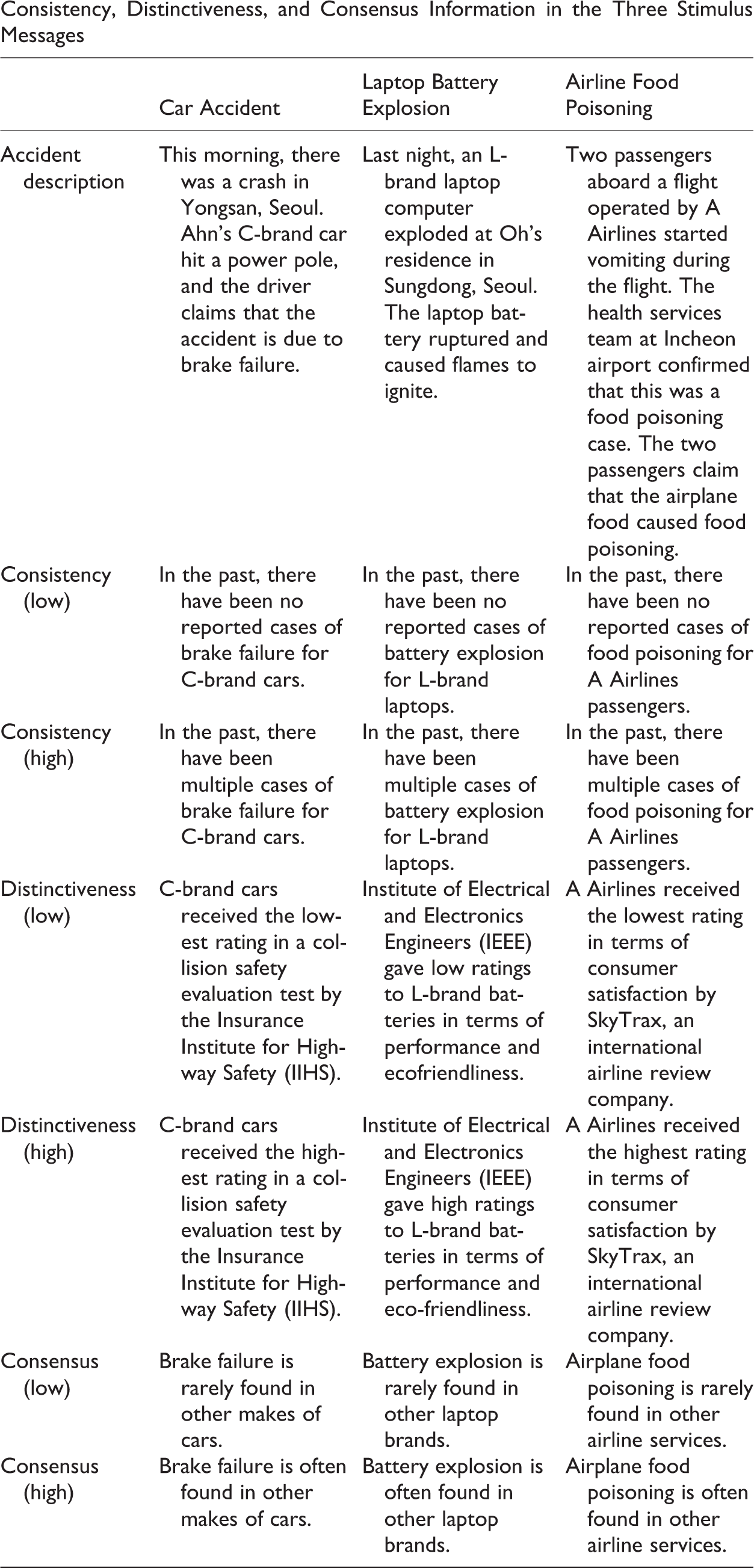
The respondents in each group read three stimulus messages describing different types of product or service failures, namely, a car brake failure leading to an accident, a laptop battery explosion, and a case of food poisoning from an airplane meal. Each message started with a description of the accident. For the car accident, the description was as follows: “This morning, there was a crash in Yongsan, Seoul. Ahn’s C-brand car hit a power pole, and the driver claims that the accident is due to brake failure.” The laptop battery explosion was described as follows: “Last night, an L-brand laptop computer exploded at Oh’s residence in Sungdong, Seoul. The laptop battery ruptured and caused flames to ignite.” Finally, the food poisoning accident was described as follows: “Two passengers aboard a flight operated by A Airlines started vomiting during the flight. The health services team at Incheon airport confirmed that this was a food poisoning case. The two passengers claim that the airplane food caused food poisoning.” We used fictitious crisis cases and corporation names to avoid the influence of preexisting attitudes toward the corporation. If the respondents had been exposed to the case before the study, they may have had preexisting attitudes toward the corporation that could bias the results of this study.
After describing the accident, the message provided information that conveyed consistency, distinctiveness, and consensus. According to Coombs’s (2007) operationalization, consistency information focused on prior accident history. In the car accident message, it took the following form: “In the past, there have been no reported cases of brake failure for C-brand cars” (low consistency), or “In the past, there have been multiple reported cases of brake failure for C-brand cars” (high consistency). The consistency information for the laptop and airline cases appeared presented in a similar format (see Appendix).
Distinctiveness information concerned the performance of the corporation in different domains. In the car accident message, this information was as follows: “C-brand cars received the lowest rating in a collision safety evaluation test by the Insurance Institute for Highway Safety” (low distinctiveness) or “C-brand cars received the highest rating in a collision safety evaluation test by the Insurance Institute for Highway Safety” (high distinctiveness). Brake failure and collision safety are both related to, but are somewhat different aspects of, product quality. While a low rating on collision safety suggests low distinctiveness, a high rating of safety suggests high distinctiveness. Distinctiveness information about the laptop battery explosion concerned the performance and ecofriendliness of the battery as rated by the Institute of Electrical and Electronics Engineers, and distinctiveness information about the airplane food poisoning case concerned consumer satisfaction as rated by an airline review company, SkyTrax.
Finally, consensus information concerned the performance of other corporations with regard to the target issue. In the car accident message, it read as follows: “Brake failure is rarely found in other makes of cars” (low consensus) or “Brake failure is often found in other makes of cars” (high consensus). Consensus information for the laptop and airline cases followed a similar format.
Measures
We assessed corporate responsibility based on measures of responsibility and blame adapted from previous research (e.g., Lee, 2004). Specifically, we asked respondents to indicate their agreement with the following items: “The corporation is responsible for the accident” and “The corporation is to blame for the accident.” We measured the purchase intention for the car using the following item: “I will purchase the product the next time I purchase a car.” The same item was modified for the laptop. For the airline service, it was stated as follows: “I will use the airline service the next time I travel by air.” We assessed the punitive opinion using the following item: “I recommend punishment for the corporation that caused the accident (e.g., fining).” Then we measured retribution and utility motivations based on items in Weiner et al.’s (1997) research. Specifically, for all three cases, we measured retributive motivation using the item “I recommend punishment because I think the corporation deserves punishment” and utilitarian motivation using the item “I recommend punishment because I think punishment will reduce the likelihood of the corporation causing this accident again.” Response options ranged from strongly disagree (1) to strongly agree (7).
Results
In this section, we report the results of our study as they pertain to each of our four hypotheses.
Distinctiveness (Hypothesis 1)
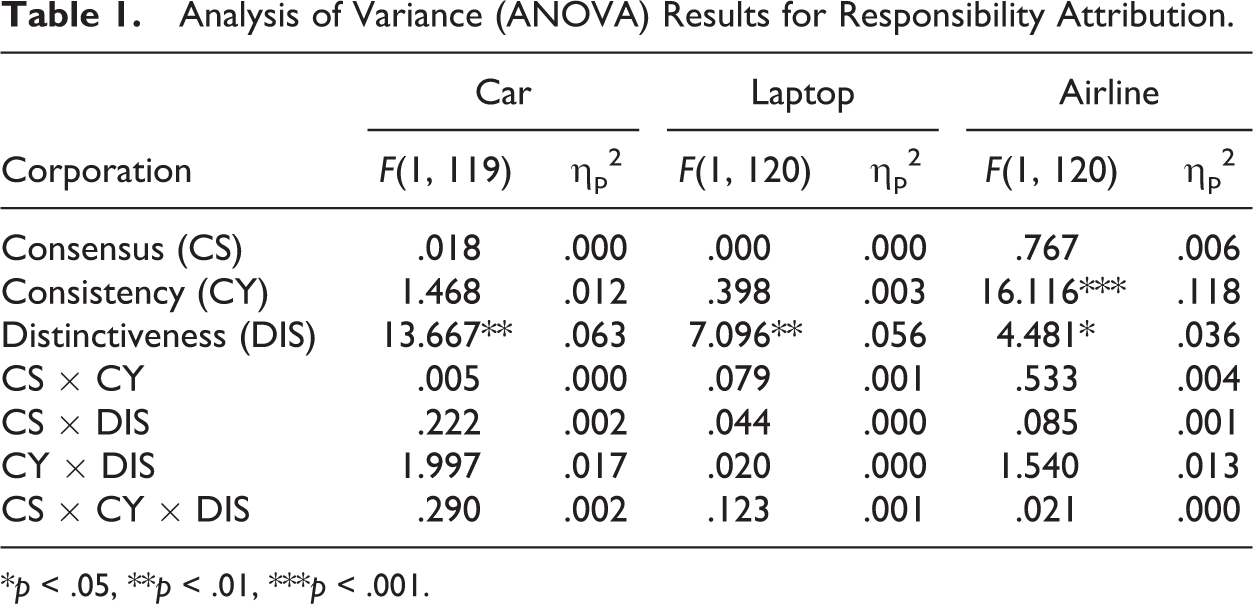
The results of our three-way analysis of variance (ANOVA) on the effects of distinctiveness, consistency, and consensus showed that the main effect of distinctiveness information on corporate responsibility attribution was significant for all three cases (i.e., the car accident, laptop battery explosion, and airline food poisoning). As we expected, low distinctiveness increased attributions of corporate responsibility whereas high distinctiveness decreased such attributions. Thus, Hypothesis 1a was supported (see Table 1).
Analysis of Variance (ANOVA) Results for Responsibility Attribution.
*p < .05, **p < .01, ***p < .001.
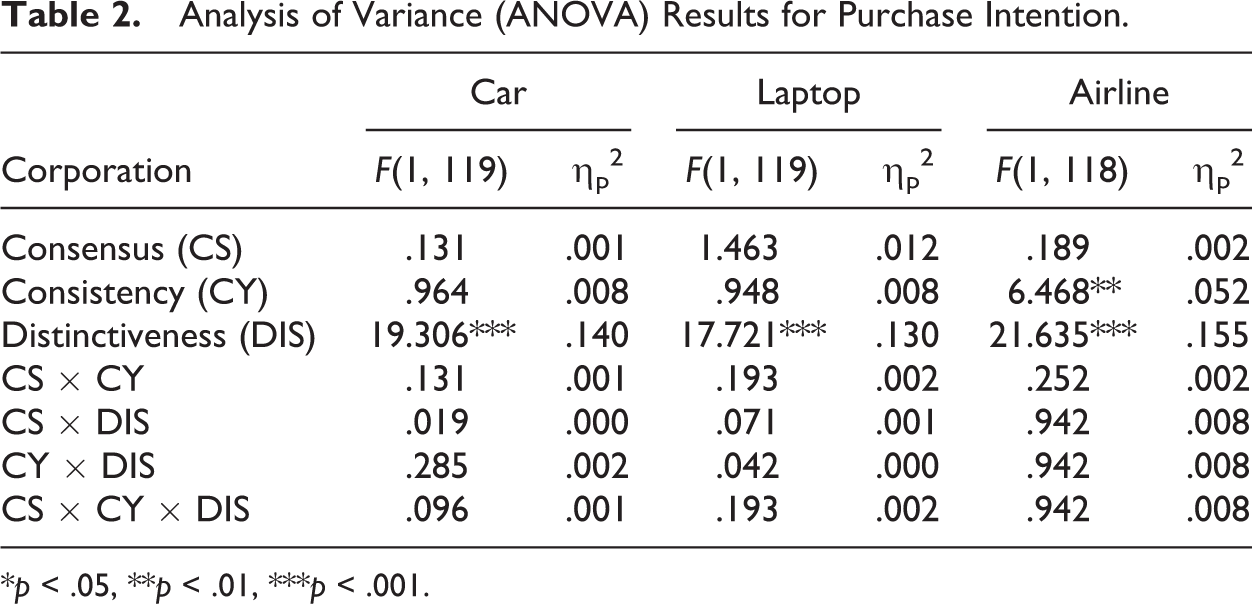
The effect of distinctiveness information on purchase intention was also significant for all three corporations. As we expected, low distinctiveness decreased purchase intentions whereas high distinctiveness increased purchase intentions. Thus, Hypothesis 1b was supported (see Table 2). But the effect of distinctiveness information on punitive opinions was not significant across all three cases. Thus, Hypothesis 1c was not supported.
Analysis of Variance (ANOVA) Results for Purchase Intention.
*p < .05, **p < .01, ***p < .001.
Consistency (Hypothesis 2)
The three-way ANOVA results showed that the main effect of consistency information on corporate attribution was not significant for the car corporation or the laptop corporation but was significant for the airline corporation. For the airline corporation, high consistency increased attributions of corporate responsibility whereas low consistency reduced such attributions. Thus, Hypothesis 2a was partially supported (see Table 1).
The effect of consistency on purchase intention was not significant for the car and laptop corporations. It was, however, significant for the airline corporation, for which high consistency decreased purchase intentions whereas low consistency increased purchase intentions. Thus, Hypothesis 2b was partially supported (see Table 2). Finally, the effect on punitive opinion was not significant for all three corporations. Thus, Hypothesis 2c was not supported.
Consensus (Hypothesis 3)
ANOVA results showed that the effects of consensus information on corporate responsibility, purchase intention, and punitive opinions were not significant across all three cases. Thus, Hypothesis 3 was not supported (see Tables 1 and 2).
Corporate Responsibility and Punitive Opinions (Hypothesis 4)
Attribution of corporate responsibility was positively associated with retributive motivation (r = .50, p < .001 for car corporation; r = .49, p < .001 for laptop; and r = .48, p < .001 for airline corporation) as well as utilitarian motivation (r = .35, p < .001 for car corporation; r = .25, p = .004 for laptop corporation; and r = .46, p < .001 for airline corporation). In addition, both retributive motivation (r = .49, p < .001 for car corporation; r = .55, p < .001 for laptop corporation; and r = .43, p < .001 for airline corporation) and utilitarian motivation (r = .32, p < .001 for car corporation; r = .37, p < .001 for laptop corporation; and r = .40, p < .001 for airline corporation) were positively associated with punitive opinion.
We used regression analysis to predict punitive opinions. In the case of the car corporation, this analysis indicated that responsibility attribution (B = .50, standard error [SE] = .09, β = .45) and retributive motivation (B = .27, SE = .10, β = .24) had an impact on punishment whereas utilitarian motivations did not (see Figure 2). Responsibility attribution had an impact on both retributive motivation (B = .50, SE = .08, β = .50) and utilitarian motivation (B = .40, SE = .10, β = .35). The Sobel test indicated that the effect of responsibility attribution on punitive opinion was mediated by retributive motivation (z = 2.48, p = .013) but not by utilitarian motivation (z = .37, p = .71).

Regression analysis results for the car corporation. *p < .05, **p < .01, ***p < .001.
In the case of the laptop corporation, responsibility attribution (B = .39, SE = .10, β = .30) and retributive motivation (B = .36, SE = .10, β = .33) also had an impact on punishment whereas utilitarian motivation did not (see Figure 3). Responsibility attribution had an impact on both retributive motivation (B = .57, SE = .09, β = .48) and utilitarian motivation (B = .32, SE = .11, β = .25). The Sobel test indicated that the effect of responsibility attribution on punitive opinion was partially mediated by retributive motivation (z = 3.13, p = .001) but not by utilitarian motivation (z = 1.50, p = .13).
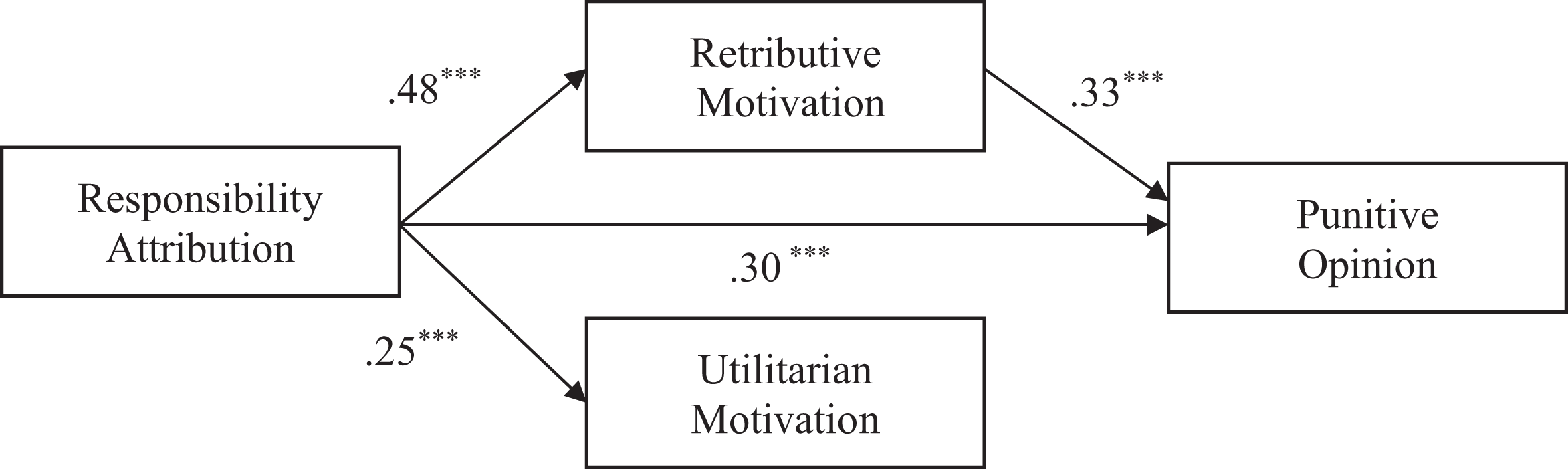
Regression analysis results for the laptop corporation. *p < .05, **p < .01, ***p < .001.
Finally, when predicting punitive opinions toward the airline corporation, only responsibility attribution had a significant impact on punitive opinion (B = .45, SE = .11, β = .36). Thus, Hypothesis 4 was partially supported in that retributive motivation mediated the relationship between responsibility attribution and punitive opinions in the car and laptop cases.
Discussion
Using three different models of attribution, this study has examined whether consistency, distinctiveness, and consensus in information about corporate crises affect the public’s attributions of corporate responsibility, purchase intentions, and punitive opinions. The effects of distinctiveness on responsibility attribution and purchase intentions were strong and robust across all three target issues. Consistent with our expectations, information that conveyed distinctiveness decreased responsibility judgments and increased purchase intentions. In other words, if the information suggests other positive aspects of the product, this information seems to reduce people’s tendency to blame the corporation for its failure and increase their willingness to use the product in the future.
We found that consistency affected responsibility and purchase intentions in the airline case. In fact, Vázquez-Casielles, Rio-Lanza, and Diaz-Mortin (2006) have found that consumer satisfaction is significantly reduced when stable attributions are made for an airline service failure (i.e., it is perceived as a consistent event). But our study did not find consistency effects for car or laptop products. Future research could test whether the role of consistency is different by product or service category. Finally, we found minimal effects of consensus information on attributions.
The effects of distinctiveness, consistency, and consensus found in this study are fairly consistent with McArthur’s (1972) findings, which suggest that distinctiveness information had the strongest impact on attributional judgments whereas consensus information had the weakest influence. Our study extends previous research on covariation by applying the theory to product or service failures and by including outcomes such as future purchase intentions and punitive opinions in addition to judgments of corporate responsibility.
This study also examined whether retributive and utilitarian motivations guided the effects of responsibility attributions on punitive opinions. Retributive motivation seemed to play a more important role than did utilitarian motivation. For the car and laptop corporations, responsibility attribution directly affected punitive opinions, and this effect was partially mediated by retributive motivation. Responsibility attribution had an impact on utilitarian motivation, but utilitarian motivation did not predict punitive opinions. This finding suggests that people are more likely to punish a corporate actor because they perceive that the actor deserves punishment for wrongdoing (retributive motivation) rather than because they expect that the punishment will prevent future accidents (utilitarian motivation). This finding is consistent with Graham et al.’s (1997) study, which suggests that punitive responses to a criminal defendant are primarily guided by retributive motivations.
We found that using multiple attribution models as opposed to a single model benefited our study. Kelley’s covariation model predicts how three types of information (distinctiveness, consistency, and consensus) affect attributions of responsibility. But the model does not predict the effects on behavioral outcomes such as purchase intentions and punitive opinions. While SCCT makes some predictions regarding the relationship between responsibility and punitive opinions, it does not explain the motivations behind this relationship. Weiner’s model explains the relationship based on retributive and utilitarian motives. By connecting the three models of attribution, this study found that distinctiveness information influenced responsibility judgments, which subsequently affected punitive opinions mediated by retributive motivations.
This study has important implications for the practices of crisis communication and consumer marketing. As the literature on crisis communication (e.g., Coombs, 2007) and consumer attribution (Folkes, 1988; Mizerski, Golden, & Kernan, 1979; Weiner, 2000) suggests, when corporations are involved in an accident (e.g., a product or service failure or an oil spill), they do not want the public to make attributions of responsibility because such attributions are likely to increase punitive actions (e.g., boycotting) and lower purchase intentions. So what type of information leads to situational rather than dispositional attributions? This study, consistent with previous research, suggests that distinctiveness information seems to be most useful, followed by consistency information; consensus information seems to be least useful. In other words, in the case of an accident, corporations should emphasize that they have performed well in other contexts (i.e., high distinctiveness) and that the accident is a one-time event (i.e., low consistency). But the argument that other corporations had similar accidents might not be useful.
Our findings could also be applied to understand the effectiveness of previous crisis communication strategies. After the 2013 Asiana Airlines accident, there was some news coverage that the corporation, including the CEO, apologized for the accident (e.g., “Asiana Airlines,” 2013). Also, after the 2007 Samsung oil spill case, the corporation first used an excuse strategy (i.e., minimizing its responsibility for the crisis) and later apologized for the accident (Lee, 2009). But Korean corporations do not often use distinctiveness strategies, such as explaining their history of ethical and socially responsible management.
On the other hand, in 2007, Mattel, the parent company of Fisher-Price, used a distinctiveness strategy when it was forced to recall tens of millions of toys containing potentially dangerous levels of lead paint. CEO Eckert announced that he, as a father of four, was concerned about the safety of children, pointing out that Mattel had a long record of safety, which is why it is one of the most trusted names of toy manufacturers with parents. By specifically explaining the company’s standards for safety, he seems to provide distinctiveness information ( Believability of Mattel CEO Bob Eckert, 2007).
Walmart also used a distinctiveness strategy for rebuilding its corporate image. Walmart has been criticized for destroying local small businesses because they cannot compete with Walmart’s low prices. In response to these criticisms, Walmart started a series of social responsibility programs, including a U.S. manufacturing program in which it spent $50 billion over 10 years buying items produced in the United States and an environmental sustainability program in which it encouraged its suppliers and employees to use renewable energy, create less waste, and sell more environmentally friendly products (Global Responsibility, n.d.).
Prior research has documented cross-cultural differences in consumer attributions in response to product or service failures (e.g., Chan & Wan, 2008; Poon, Hui, & Au, 2004). Although distinctiveness information would play an important role across different cultures, its effects might be stronger in Asian cultures than in Western cultures. Research suggests that Westerners are more likely to engage in context-independent, analytic thinking whereas Asians are more likely to engage in context-dependent, holistic thinking (e.g., Nisbett & Miyamoto, 2005). Because Asians think holistically and often consider the context of a situation, they may judge an event (i.e., a corporate crisis) based on its context (e.g., corporate history of distinctiveness and consistency) more than Westerners do. Although many studies have tested attribution theory and crisis communication in Western cultures (Choi & Chung, 2013; Coombs, 2004; Coombs & Holladay, 1996, 2001; Vázquez-Casielles, Rio-Lanza, & Diaz-Mortin, 2006), relatively few studies have tested these theories in Asian cultures (e.g., Jeong, 2009; Moon & Rhee, 2012), and little cross-cultural research directly compares the two cultures. Future research could examine how the effects of covariation information type (e.g., distinctiveness vs. consistency) on attributions vary by culture (e.g., Western vs. Asian).
This study has some limitations. It is based on a homogenous sample of college students. Thus, future research could confirm the findings of this research by using a heterogeneous sample, such as noncollege adults. Because there could be cross-cultural differences in terms of attributions, future research could examine attribution patterns based on cross-cultural samples.
Finally, future research could test the effects of distinctiveness strategy across different topics. The findings of this study can be applied to crisis communication in other contexts. For example, in the case of a political scandal (e.g., a bribery or sex scandal), we expect that the public’s anger and punitive responses toward the politician or the political organization would change based on the information about distinctiveness and consistency. In addition, most attribution studies have relied on quantitative data to test the effects of each type of covariation information on attributions and behaviors. But future research could use qualitative research methods to gain further understanding of the public’s complex interpretations of each type of covariation information and how attributions of responsibility lead to punitive opinions through retributive or utilitarian motives.
Footnotes
Appendix
Consistency, Distinctiveness, and Consensus Information in the Three Stimulus Messages
| Car Accident | Laptop Battery Explosion | Airline Food Poisoning | |
|---|---|---|---|
| Accident description | This morning, there was a crash in Yongsan, Seoul. Ahn’s C-brand car hit a power pole, and the driver claims that the accident is due to brake failure. | Last night, an L-brand laptop computer exploded at Oh’s residence in Sungdong, Seoul. The laptop battery ruptured and caused flames to ignite. | Two passengers aboard a flight operated by A Airlines started vomiting during the flight. The health services team at Incheon airport confirmed that this was a food poisoning case. The two passengers claim that the airplane food caused food poisoning. |
| Consistency (low) | In the past, there have been no reported cases of brake failure for C-brand cars. | In the past, there have been no reported cases of battery explosion for L-brand laptops. | In the past, there have been no reported cases of food poisoning for A Airlines passengers. |
| Consistency (high) | In the past, there have been multiple cases of brake failure for C-brand cars. | In the past, there have been multiple cases of battery explosion for L-brand laptops. | In the past, there have been multiple cases of food poisoning for A Airlines passengers. |
| Distinctiveness (low) | C-brand cars received the lowest rating in a collision safety evaluation test by the Insurance Institute for Highway Safety (IIHS). | Institute of Electrical and Electronics Engineers (IEEE) gave low ratings to L-brand batteries in terms of performance and ecofriendliness. | A Airlines received the lowest rating in terms of consumer satisfaction by SkyTrax, an international airline review company. |
| Distinctiveness (high) | C-brand cars received the highest rating in a collision safety evaluation test by the Insurance Institute for Highway Safety (IIHS). | Institute of Electrical and Electronics Engineers (IEEE) gave high ratings to L-brand batteries in terms of performance and eco-friendliness. | A Airlines received the highest rating in terms of consumer satisfaction by SkyTrax, an international airline review company. |
| Consensus (low) | Brake failure is rarely found in other makes of cars. | Battery explosion is rarely found in other laptop brands. | Airplane food poisoning is rarely found in other airline services. |
| Consensus (high) | Brake failure is often found in other makes of cars. | Battery explosion is often found in other laptop brands. | Airplane food poisoning is often found in other airline services. |
Declaration of Conflicting Interests
The authors declared no potential conflicts of interest with respect to the research, authorship, and/or publication of this article.
Funding
The authors received no financial support for the research, authorship, and/or publication of this article.