



Abstract
This study focuses on dominant terms whose usage generates a specific identity in the craft beer industry: revolution and crafty. Actors who engage these terms—brewers, writers, and consumers—create a narrative about the industry that gives craft beer a professional identity. The study explores how specific industries depend on the circulation of taxonomies in order to establish an identity with both a customer base and each other.
Craft beer is the designation typically applied to breweries that produce less than six million barrels annually, use adjuncts for the purpose of flavor (not cost cutting), and are independently owned rather than wholly owned by a brewing conglomerate (e.g., Anheuser Busch InBev, MillerCoors, Heineken). Examples of successful craft breweries include Three Floyds (Munster, IN), The Lost Abbey (San Diego, CA), Russian River (Santa Rosa, CA), Against the Grain (Louisville, KY), and Deschutes (Bend, OR). The craft beer industry has emerged as a quickly growing segment of the overall alcoholic beverage industry. While craft beer holds a market share of only 10–15% nationwide, it has earned considerable attention for its growth—over 3,000 breweries were online in 2014—and challenge to the larger beer producers. In 2014, craft brewers shipped 16.1 million barrels of beer, outpacing Budweiser’s 16 million total (Mickle, 2014). According to the Brewers Association (BA; 2014), craft beer’s main trade organization, in 2013, craft beer accounted for $14.3 billion of an overall $100 billion U.S. market. Such industry prominence as well as the national interest in craft beer have spurred much writing on the topic (Gummer, 2014; Wallace, 2014; Willett, 2014). Since Sierra Nevada’s founding in Chico, California, in 1979, the beer industry has rebuilt itself from both the destruction of American brewing during prohibition and the consolidation throughout the 1970s and 1980s of those breweries that survived prohibition. While there are numerous histories of craft beer, there are not yet any studies of this industry from the viewpoint of professional writing.
Surrounding craft beer’s growth is writing. An industry with minimal capital for advertising and traditional marketing, it relies on writing to tell its story to consumers and other members of the industry. “When I tell people I write about the beer industry,” industry analyst Shepard (2015) explained, “regardless of how much they enjoy drinking beer, their ears perk up, focus becomes a little more intense. They’re ready for a good story” (p. 17). As Ogle (2015) remarked about the beer industry, “It’s not easy to nudge people out of their story telling rut.” In this article, I explore some of the professional writing done in the craft beer industry—writing done by journalists, brewers, trade publications, bloggers, consumers, and industry analysts—to understand how specific terms and tropes circulate in a given profession in order to establish a craftwork identity via particular stories.
The craft beer identity has played an important role in establishing an industry ethos closely aligned with local food movements, indie attitudes, or artisan production. Craft beer uses this ethos in order to attract a significant consumer base as well as to establish a professional identity. Technical and professional writing has studied industry and identity via online product reviews (Mackiewicz, 2010), online About Us pages (Killoran, 2012), and online responses (Rice, 2009). I approach professional identity here as it is shaped by the overall narrative that various industry writings produce when those writings are read as one overall story. I offer an analysis of industry narratives in order to better understand how they become patterned by a variety of actors and how these patterns, despite their dominance, can also complicate the shaping of identity formation.
Narrative
Narrative, Mitchell (1981) argued, is the “means by which human beings represent and structure the world” (p. viii). Conglomerate brewers depend on narratives told through advertising in order to represent and structure an identity that consumers can understand and eventually purchase. Advertising, for instance, might tell the beer-as-lifestyle narrative such as in Budweiser’s classic Where There’s Life, There’s Bud campaign or the story of the conglomerate as innovative, such as in MillerCoors’s 2009 Triple Hopped campaign that attempted to associate the company’s lagers with the popular, often hoppy, India pale ales that had been gaining market traction. Or innovation might be told via Budweiser’s 2013 Cool Twist campaign that featured resealable aluminum bottles. Or the conglomerate might tell the story that correlates health and flavor, such as in Miller’s famous 1970s slogan Tastes Great/Less Filling. Craft brewers, on the other hand, have little to no advertising budgets and shy away from slogans as their primary source of identity. Instead, as I will show, craft brewers depend on repeated and widely circulated narratives. Specifically, I focus on two networked narratives, revolution and authenticity. These narratives depend on the repetition of specific topoi in the various spaces in which beer writing occurs.
Several trade magazines are devoted to craft beer: Beeradvocate, All About Beer, Draft, and Beer Connoisseur are among the most popular. The BA’s trade publishing branch, Brewers Publications, has published volumes on the topics of hops, yeast, malt, and water. Many well-known brewing personalities, such as Tony Magee (Lagunitas), Greg Koch (Stone), Sam Calgione (Dogfish Head), Jeremy Cowan (Shmaltz), and Ken Grossman (Sierra Nevada), have published books (historical, recipe based, and memoir). The genres of beer writing can be defined as production (recipes, styles, and brewing how-tos), origin (stories of the first brewers or the industry’s beginnings), cultural (the relationship to local food and artisan movements), and adversarial (the conflict with conglomerates in the beer industry). Fahnestock (1986) studied science writing in order to understand the “genre shift that occurs between the original presentation of a scientist’s work and its popularization” as well as “the change in ‘statement types’ that occurs when a larger audience is addressed” (p. 277). What is true for science writing is true for other professional writing—including trade writing—situations. Beer writing occurs and is circulated through various situations, and the ways those situations interact affect an overall shaping of industry identity.
To Fahnestock’s (1986) study, I offer a complementary approach to a specific type of professional writing. While Fahnestock identifies Aristotle’s forensic discourse as central to scientific rhetoric and the accommodations to scientific discourse as epideictic, I understand craft beer writing as largely epideictic in nature. That is, craft beer writing appeals to already-held belief systems (topoi) because of how those beliefs repeat as contagions (Sampson, 2012) over writing spaces. These beliefs can be traced to a repeated, century-old rhetorical stance fashioned by W. Morris (1915/2012) and the Arts and Crafts movement he founded in the 19th century. Morris’s thesis was that art and commerce are engaged in a battle between the industrial and the handmade, in which the handmade product represented purity and authenticity whereas the industrial product represented inauthenticity. In his dismissal of the industrial, Morris championed the overall notion of craft (handmade goods) as revolutionary because of its authentic status against a backdrop of conglomerate fakeness. “The word Revolution,” Morris wrote early in his discussion of craft, “has a terrible sound in most people’s ears” (p. 3). In Morris’s definition of two craft keywords—revolution and revolutionary—consumers cannot differentiate between consumption as pleasure and consumption as an ideological act (reacting against industrial culture). Implicit in Morris’s breakdown is a narrative of consumption in which the consumer’s purchasing habits pose rhetorical effects well beyond spending (see Table 1).
William Morris’s (1915/2012) Consumption Breakdown.
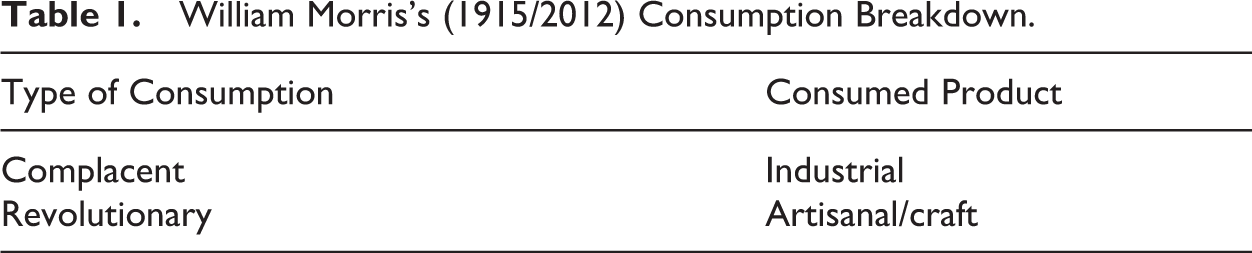
W. Morris’s (1915/2012) craft definition ties products (bowls, chairs, clothing, and buildings) to a concept or story: revolution. This rhetorical stance established a binary between the industrial and the artisanal, one that values the latter over the former for both producers and consumers. Authentic productions, according to this binary, are artisanal whereas fake products are industrial or mass produced. Thus, authentic equals revolutionary (opposing the industrial for the betterment of culture) whereas the industrial equals complicity (succumbing to big business and the demise of culture). That binary has not been lost in the more recent appearance of craft beer in beverage production.
With craft beer, the binary becomes a marker of industry identity and, in addition to its consumer address, is used to influence other industry partners. In turn, not only does the consumer identify with the product as revolutionary (and thus feel like a revolutionary opposing big business), but within the narrative produced in craft beer, producers become revolutionaries as well (fighting the forces of homogeneity). As early as 1992 (slightly more than a decade into craft brewing’s rise), popular writing declared a binary that placed craft beer in opposition to larger forces in the beer industry. “The notion of handcrafted beer,” one newspaper account stated, “stands in curious defiance of some of the strongest trends in the U.S. food and beverage industry national marketing, franchising uniformity, and advertising” (“Handcraft,” p. 8). In 1995, when craft beer was estimated to be only 1.4% of the total beer market, The New York Times reported craft beer’s success within this binary. Craft beer, it noted, “is accomplished without test marketing, major advertising campaigns and the like, something the top three beer producers—Anheuser-Busch, Miller Brewing Company and Coors Brewing Company—cannot accomplish” (Fabricant, 1995).
This oppositional rhetoric is found in current moments as well. Brewer Markowski (2004) described his interest in rustic (and handmade) farmhouse ales as an artisan response to the “rush to embrace new high-tech lager beers, products of a budding industrial age” (p. 3). “Today’s beer culture reads very much like a David versus Goliath Story,” Alstrom and Alstrom (2014) editorialized in Beeradvocate, drawing attention to the artisan as David and the industrial as Goliath (p. 2). “The craft beer revolution has returned beer to its traditional, artisanal, local roots after decades of industrialization and mass production,” Brooklyn Brewery’s Hindy (2014) proclaimed (p. 228). As Clegg, Rhodes, and Kornberger (2006) noted, “it is in reference to others that organizations define their own identity position vis-à-vis their own putatively unique characteristics” (p. 498). Craft, size, industrial, and David and Goliath—these are a few of the topoi that craft beer uses to define itself in reference to its opposition, conglomerate brewing, and to organize its own identity narrative.
Ran and Duimering (2007) offered the theory of identity claim in order to understand organizational influence on identity: An identity claim establishes an idiosyncratic system of value-laden categories, positions the organization positively or negatively within these categories, projects images of identity movement and transformation, constructs past, present, and future identities, and defines the organization in terms of categories reflecting its actions and interactions with other individuals or organizations whose identities are also constructed through the identity claim. (p. 157)
Bryson (2003) and Latour (1996) explained narrative strategies in scientific and technical communication in order to understand the ways that writings interact and affect a public identity. McNely (2012) explained the public projection of industry image (via Instagram) as discursive. Barthes (1977) offered an examination of narrative as a collection of internal images, the image reservoir, that shape identity. We do not yet have examinations, however, of narrative strategies regarding identity projection in professional writing within the craft beer industry. Businesses tell stories about themselves; consumers tell stories about the businesses with which they identify or do business. Heath and Heath (2007) emphasized the story as an essential component of sticky messages, messages that repeat and have resonance. Godin (2005) argued that effective professional stories “are the stories that aren’t just repeatable: these are the stories that demand to be repeated” (p. 132). To expand this thinking, I examine two major stories told in craft beer writing because of their repeatability and sticky nature.
I borrow my methodology largely from Latour’s (2007) actor-network theory (ANT). Latour argued for a tracing of actors engaged in a given discursive moment in order to better understand how these interactions between actors produce some kind of narrative. This tracing, Latour claimed, allows narratives to be read as complex interactions. This method borrows “from narrative theories, not all of their arguments and jargon to be sure, but their freedom of movement” (p. 55). As Latour noted, each part of a narrative moves, based on what is telling the story, and interacts with other parts of the narrative so that a larger story (or multiple stories) is constructed. Brewers, consumers, trade publications, taxonomies, topoi, and social media—these are actors I will encounter in a writing work space that affects and shapes parts of an overall industry narrative.
Potts (2009) emphasized ANT’s tracings of movement as “activity in which active participants—the actors in ANT—are engaged in distributing data about an event” (p. 285). In this article, I trace in a narrative both human (writers and brewers) and nonhuman (writings and circulated topoi) participants whose networked interactions produce an identity. Thus, unlike other studies (e.g., Faber, 2002), I do not attribute agency regarding how or why an identity is created through narrative only to the organization or industry. Instead, I understand the narrative as a larger network of interactions, with brewers, with others writing about beer, and with common topoi. The specific actors I trace include craft beer writings (magazines, newspaper articles, Web site documents, and books) as well as the key words I trace from the Arts and Crafts movement (revolution and authenticity). The craft beer narrative, I argue, is shaped by interactions between these actors, writings affecting key words and vice versa, writers affecting other writers, key words affecting writers, and so on.
While I cannot trace all interactions or actors here, I will focus on important public moments of professional writing within craft beer in order to draw larger assumptions about professional identity and writing. I draw my assumptions about craft beer and its professional identity from my understanding of how specific actors affect one another in a variety of print and digital spaces and the stories that emerge from this interaction.
The Revolution Will Not Be Televised; It Will Be Brewed
Revolution is a taxonomy as well as a topos, or a rhetorical placeholder. Revolution is a category that situates an identity by anchoring it in a specific term. By the 18th century, Williams (1983) wrote, revolution became “an application to feeling as well as to action: a feeling of disgust, of turning away, of revulsion” (p. 272). If artisan products are revolutionary, it is because of how that category suggests not only a new order but a complete rejection of and disgust for the old order. Revolution, as W. Morris (1888/2010) proposed it, suggests a capitalist overturning based on disgust as much as it is based on economics or political struggle. Craft brewers align themselves with the spirit of revolution by foregrounding their adversarial relationship with brewing conglomerates in a way that small-industry producers might foreground adversarial relationships with Walmart, Cocoa-Cola, Disney, or other large corporations often described as hostile to small producers or retail. The term revolution, then, indicates a disgust at conglomerate practices and ethics and a turning toward what Williams called “an authentic popular consciousness” (p. 196). A revolutionary, it follows, engages in a revolution, an act of disgust or rejection, by turning away from “machine production, the system against which revolt is now attempted” (W. Morris, 1888/2010, p. 147).
Disgust, as well, acts as a related topos. In the craft beer narrative, writers and writings express disgust and revulsion with Anheuser Busch InBev—the initial 2004 merger of Belgium Interbrew and Brazilian AmBev that expanded in 2008 with the acquisition of the American brewery Anheuser Busch. The narrative positions InBev as an oppositional identity, one whose focus is capitalism (an object of revulsion) as opposed to craft production as artisan work (in which community precedes profit). For instance, Leonard (2012) profiled InBev’s chief executive Carlos Brito in Bloomberg BusinessWeek via a narrative that focused on controversies regarding cost cutting and brewery closures (topoi antithetical to the craft ethos of labor). And Landeo and Spier (2007) described former Anheuser Busch chairman August Busch III as supposedly coining the “100% share of mind” contracts that rewarded distributor exclusivity with perks and cash payments, thus portraying the industry as corrupt and outside the craft ethos (p. 185). In modern brewing, Budweiser, McClelland (2008) concluded, “ended up crushing dozens of local brands that formed part of this country’s colorful drinking heritage.” Each repeated reference builds an oppositional identity to which craft beer responds, an opposition centered on the terms that W. Morris (1888/2010) introduced into the narrative: Public needs are subordinated to the interest of the capitalist masters of the market, and they can force the public to put up with the less desirable article if they choose, as they generally do. (p. 148)
Individuals who reject these capitalist practices and the market, another topos that the narrative offers, are pioneers (i.e., revolutionaries). Jack McAuliffe, a central pioneer figure in the craft beer narrative, is a focal point of craft beer’s revolutionary beginnings. McAuliffe returned to the United States from naval service in the mid-1970s only to discover that the flavorful beers he enjoyed in Scotland were not available in America. Unhappy with American, flavorless beer, he assembled a Do It Yourself (DIY) brewery in Sonoma County, California, called New Albion. The brewery was short lived—lasting only 6 years—but the image of McAuliffe as revolutionary emerged as a repeated topos. “McAuliffe clearly had no idea that he had sparked a revolution,” Hindy offered (2014, p. 16). As S. Morris (1984) wrote of McAuliffe, “while others dreamed and schemed, he did it” (p. 181). Erickson (1993) described McAuliffe as “one of California’s true microbrewing pioneers” (p. 21). From “thus diverse beginnings,” Erickson (1991) wrote elsewhere about New Albion, “the North American microbrewing revolution was born” (p. 33). Acitelli’s (2013) description of McAuliffe as a “pioneer” contrasts sharply with the image of corporate brewing. The pioneer, as craftsman, offers a true spirit of individual work ethic, not cost cutting or brewery closures: McAuliffe, especially, had spent 12- to 16-hour days building out the old fruit warehouse into a working commercial brewery, scrounging for parts—there were no suppliers of smaller-scale brewing equipment common today—and moving spider-like as he built a gravity-flow system that could eventually produce a barrel and a half, or roughly 495 12-ounce bottles, at a time.
Famed beer writer Jackson (1986) told the McAuliffe story as one of struggle, a narrative between large and small forces in which a renaissance (or even a revolution) came into being as a result: On his [McAuliffe] travels, he had spent time in Britain and enjoyed the ales there. He had also seen the power of the biggest British brewers challenged by the consumer Campaign for Real Ale, with the consequent renaissance of smaller-scale production. This was a spontaneous movement, and one that struck a chord with a public tired of processed products. (p. xviii)
Revolution, exemplified in the repeated figure, affects the product. Regarding low Alcohol By Volume (ABV) beers, Bland (2012) titled an All About Beer contribution “Session Beer Revolution.” Three headlines regarding craft beer production that Barbera wrote for All About Beer in 2011 featured the word revolution in the title: “Paulaner Joins the Canning Revolution,” “Shock Top Belgian White Joins Can Revolution,” and “Abita Brewing Company Joins the Craft Can Revolution.” The topos names products as well—Revolution Brewing in Chicago; Revolution Brewing in Paonia, Colorado; Natty Greene’s Revolution American IPA; and Olde Hickory’s Saison Revolution. There is no shortage of revolution within craft beer’s overall rhetorical stance. These moments are not isolated acts, I contend, but a network of interacting actors affecting each other as they repeat the same position or topos.
Craft Versus Crafty
Revolution, in the craft beer narrative, also affects a second and related topos, craft. Craft, as it was for W. Morris, is an extension of the revolutionary spirit attached to small businesses; in this case, craft signifies small, authentic breweries (those, we might assume, that start the revolution). Authentic, also an oppositional identification term, turns away from an “inauthentic” industrial entity and promotes a state of purity or tradition of the handmade. Often credited as being among the first to use the term craft brewery, Cottone (1986) wrote, “I use the term Craft Brewery to describe a small brewery using traditional methods and ingredients to produce a handcrafted, uncompromised beer that is marketed locally. I refer to this beer as True Beer” (p. 9). Handmade, uncompromised, small, traditional, and true—these are authentic topoi that build a craft identity as each term interacts with the other. This authenticity simultaneously creates an opposing and similarly circulated taxonomy, crafty. As a narrative indicator of the inauthentic, crafty identifies conglomerates pretending to be small craft breweries. Shock Top or Blue Moon, beers produced by Anheuser Busch InBev and MillerCoors, for instance, are labeled crafty because they are marketed as belonging to the craft beer narrative but instead are produced by conglomerates (Notte, 2015). Crafty, as a well-circulated term, creates an identity of deception, lies, and cunning.
The BA’s December 3, 2012, press release enters the craft network by defining the terms craft and crafty for consumers (much like W. Morris’s, 1888/2010, breakdown of craft and industrial). This statement, amended in 2014 to be less exclusive, aims for a political distinction of craft as an ideological terroir. Unlike terroir’s legal taxonomic appellation (the legal connection between a craft product and a region such as Burgundy or Champagne), this version projects the trade association’s distinction of us versus them onto consumers and producers. Craft, as true, signifies an industry “us” whereas crafty, as false, signifies a corporate “them.” In its press release, the BA borrowed Cottone’s (1986) sense of “true beer”: The large, multinational brewers appear to be deliberately attempting to blur the lines between their crafty, craft-like beers and true craft beers from today’s small and independent brewers. We call for transparency in brand ownership and for information to be clearly presented in a way that allows beer drinkers to make an informed choice about who brewed the beer they are drinking. (n.p.)
To assist in this distinction between craft and crafty, the BA (2012) offered a list of supposedly crafty brewers (since deleted and reposted by Macnow, 2012). This list affects consumers because it influences their beliefs regarding what is real (pure and true beer) and what is fake (industrial and false beer). A 2014 National Public Radio (NPR story, in turn, continues the BA narrative regarding craft and crafty by framing the narrative as taxonomic confusion. In this story, authenticity is difficult to ascertain because the term craft beer shapes varying behaviors: There was once a time when it was easy to throw around the term “craft beer” and know exactly what you were talking about. For decades, craft was the way to differentiate small, independently owned breweries—and the beer they make—from the brewing giants like Coors, Budweiser and Pabst Blue Ribbon. (Bland, 2014, n.p.)
Terrapin’s Cochran (2012)—whose craft brewery is partly owned by MillerCoor’s Tenth and Blake subsidiary—considered the BA’s categories not as markers distinguishing authenticity from deception but rather as narrative tools; that is, the BA is telling a particular story about beer via a specific term’s projection to an audience that anticipates the term. One reads the crafty–craft narrative, Cochran argued, as already affected by the BA and other actors’ previous circulations: Theoretically, these three [Brewers Association] criteria are all OK. Especially when one considers them as what they really are. They are an attempt by a trade organization, the Brewer’s Association, to define their clientele. Taken in that light, no big deal. (n.p.) [August Schell] used a small portion of another locally grown ingredient he called “mais” as is hand written in our old brewing logs, better known as corn. He didn’t use corn to cheapen or lighten his beer. He did it because it was the only way to brew a high quality lager beer in America at that point. By the time high quality two-row malting barley was finally cultivated and available to use, our consumers had already been drinking our high quality beers for many years. We continued to brew our beer using this small portion of corn because that was the way we traditionally brewed it.
The rhetoric of size repeats revolutionary-styled David versus Goliath stories, in which, against the odds, the small must overcome the large. A St. Louis Today response (written by craft beer insiders) to craft versus crafty distinctions declared that it makes a difference. By supporting small and independent craft brewers across the country, we are giving them a chance to thrive in business, create more jobs, boost the economy and compete against the massive corporations that have controlled the market for so long. (Papazian, Peace, & Kopman, 2012) Tired of watching mainstream beer sales fall while the craft beer craze soared, large international companies like MillerCoors and Anheuser-Busch InBev have hijacked the playbook of small, independent brewers. The results are faux “crafty” beers like Blue Moon and Shock Top, which appear to be created by smalltime operations, while actually being produced by the world’s largest brewers. Naturally, the authentic little guys aren’t pleased. (Tutle, 2012)
These binaries affecting the narrative’s construction confuse other parts of the narrative at the levels of both industry reception (Do other members of the industry identify Schell as craft or crafty?) and consumer reception (Is Blue Moon craft or crafty?). The confusion, in turn, is an actor within the overall narrative. As Stange (2015), writing in Draft magazine, argued, the binaries suggest that if caft means anything, it means that brewing decisions are based on flavor and quality over and above profit margin, rather than vice versa. But that rests on the intentions of brewers and interpretations of drinkers. It’s an ideal that winds up at the same place: businesses trying to make money. (And what’s wrong with that?)
The Sellout
In 2014, when Anheuser Busch InBev acquired the small Bend, Oregon, brewery, 10 Barrel, industry and consumer response networked topoi of authenticity as a response. 10 Barrel, at the time of the acquisition, signified both the West Coast origins (represented by McAuliffe) and the spatial authenticity of craft beer (Oregon as a site of the nation’s best breweries, Portland as Beervana). These topoi also included size (10 Barrel produces only 40,000 barrels a year), authenticity (the small brewer was no longer craft and pure), and diminishing independence (Goose Island and Blue Point had been acquired by Anheuser Busch InBev in previous years). When small becomes large, the BA definition of crafty interacts with the question of “true Beer”—as in Cottone’s (1986) appellation—so that crafty shifts from concerns regarding ingredients or business practices to the emotional claim of losing heart or soul. Size shifts intensify feelings of revulsion by returning to oppositional identity markers such as capitalism or profit, which artisan products should avoid so as not to become industrial. By losing the positive attribute of small size, the narrative contends, the brewery loses its soul. Writing on The Seattle Post-Intelligencer’s beer blog The Pour Fool, industry writer Body (2014) expressed outrage over the 10 Barrel acquisition, repeating the traditional Arts and Crafts narrative of the pure, small-community artisan who revolts against industrial capitalism: You do NOT, under any circumstances and for any amount of money, sell your craft brewery to a company whose stated objective is to bring about the ruin of that community. Even more obviously, drinkers of better beer have hundreds—nay, thousands—of legitimate small breweries to choose from, ones that have not been irrevocably bastardized by association (and ownership) with a company that’s the closest thing to a Great Beer Satan as we’re likely to see in this world … as we know it.
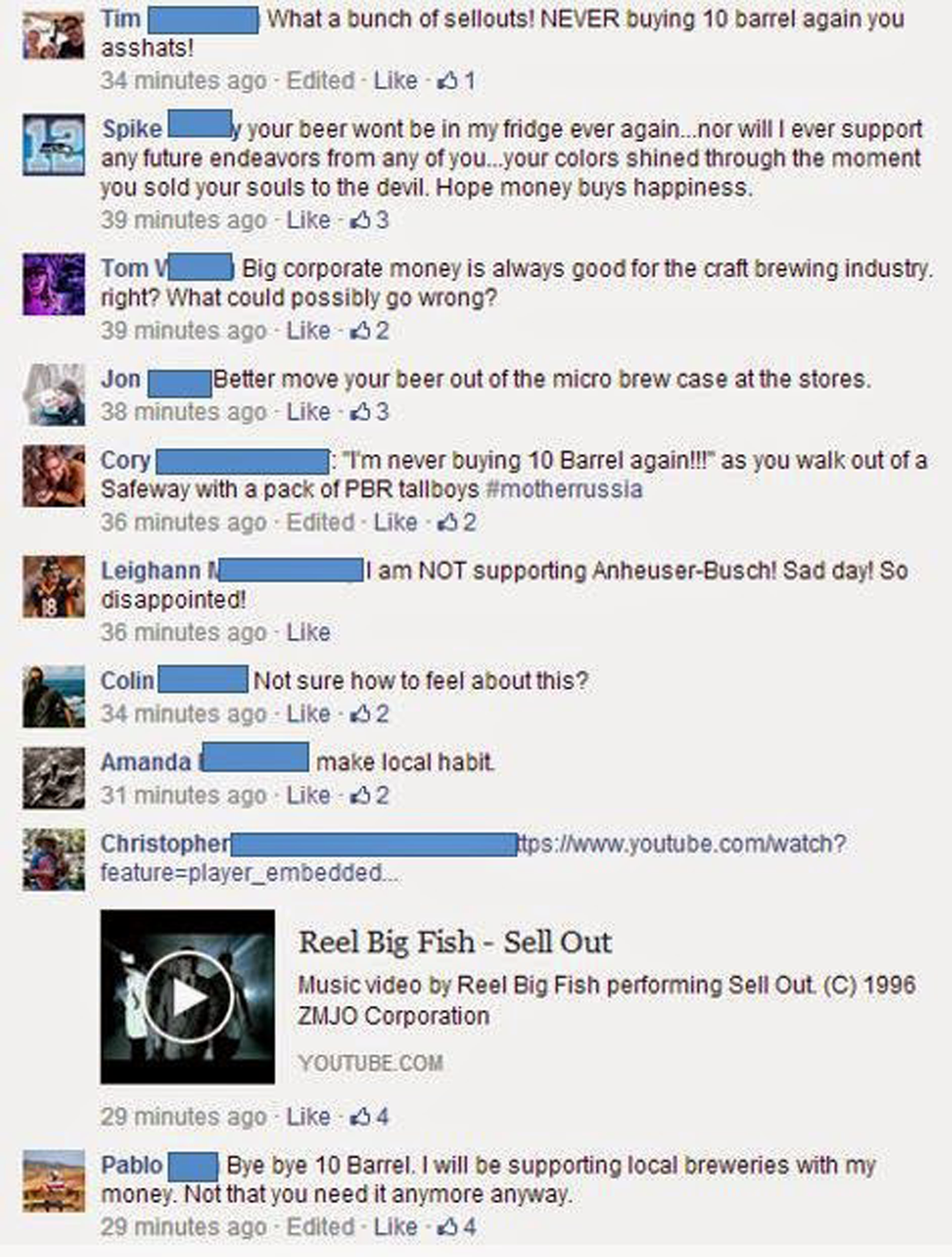
Screenshot of narrative disappointment.
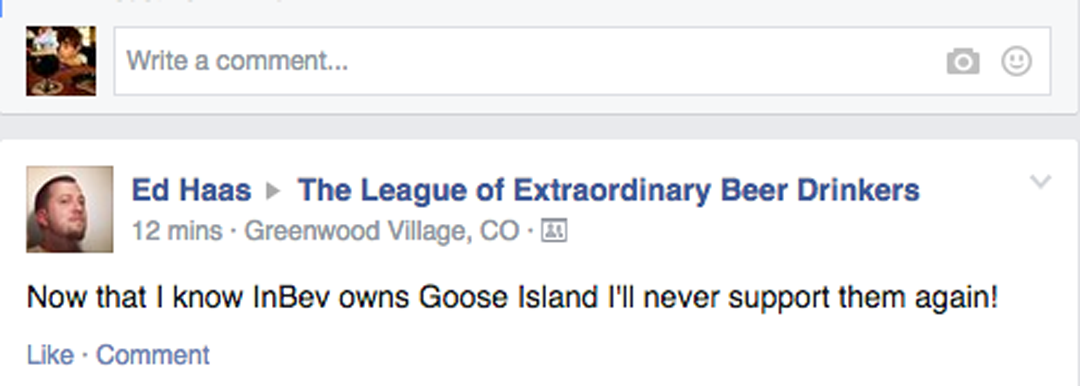
Does all consumer writing define identity?
Samurai Artist (2014), writing for the collective beer blog The New School, also referred to 10 Barrel’s loss of a soul (overtaken by cold, capitalist logic) when he remarked that conglomerates such as Anheuser Busch InBev “either forgot or never really realized the popularity of craft beer or microbrew hinges upon the fact that it is made by people, not corporations, and for the love of the craft, not the money.” By making claims of “sell out,” these responses build off of the Arts and Crafts authenticity topos. Authentic cannot willingly succumb to the inauthentic and keep its soul.
W. Morris (1880) wrote romantically about the “past art” (craft production that precedes the industrial) as a pure entity once shaping a pure world but now dying due to capitalist compromise (and, we might add, selling out). With craft, every man’s hand and soul it used, the lowest as the highest, and in its bosom at least were all men free: it did its work, not creating an art more perfect than itself, but rather other things than art, freedom of thought and speech, and the longing for light and knowledge and the coming days that should slay it … It is dead now; no longing will bring it back to us; no echo of it is left among the peoples whom it once made happy.
Newspaper writer Russell (2014), writing under his popular online name Joe Sixpack, uses the “loss of soul” topos to ask if the 10 Barrel acquisition is “the end of real craft brewing?” He noted that a European-based purchase of a small Oregon brewery has removed the “heart” of craft, killing it. Such sentiment, drawing from W. Morris, is created out of the narrative’s positioning of authenticity, for Morris and for the New Albion/West Coast origins for craft beer: “Indeed, you could make a case that Bend—or, at least, the Pacific Northwest—is where the craft-brewing sector’s true, vibrant heart began beating” (Russell, 2014). Authentic, pure, and true beer dies and loses its soul to industrial commercialism. As Russell puts it, “For when we think of craft beer as just another business, it’s not the aroma of malt and hops we’re savoring. That’s the stale smell of money.” As one commenter at the popular blog Beervana wrote about 10 Barrel’s sale, “I feel as if I just lost part of my soul” (Aichele, 2014). There is no greater revulsion than the loss of an industry’s soul, for it suggests an end to the revolution.
I could end this narrative tracing by reflecting on how the actors in the craft beer network have constructed an identity out of tales of revolution and sellout, craft versus crafty, and fake versus authentic so that a final conclusion is the fear of the revolution’s overall demise. 10 Barrel’s acquisition, I could add, solidifies this narrative as these actors (the circulated topoi) network. Instead, I conclude with a return to my previous point regarding confusion because as Latour (2007) stated, there are no purity narratives. Even if revolution is the basis of a craft beer identity—with its turning away from the corporate and industrial markers of identity—that topos is not a stable marker, and it too shifts as it interacts with other actors in the narrative, notably consumers.
Conclusion
As with 10 Barrel, public writing labeled Goose Island a sell out when the Chicago brewery was purchased by Anheuser Busch InBev. With this purchase, Goose Island shifted from a midsized, independent brewery (craft) to a corporate-owned entity (crafty). Consumer protests to stop buying 10 Barrel because of its loss of authenticity, then, should also have accompanied Goose Island’s position in the craft beer narrative since it too has supposedly lost its revolutionary and authentic status. The story, though, does not unfold so easily. In the network that produces a craft beer identity, writing is one actor, and consumption is another. These two actors engage with many of the topoi I have traced throughout this essay so that “sellout” or “crafty” can be produced as responses to size increase by acquisition. These actors, however, might also complicate the narrative’s overall story so that sellout is not a static topos dominating the story’s telling but instead interacts with other topoi associated with the craft beer narrative (e.g., revolution, artisanal, and authentic) in ways that disrupt the overall narrative. In this disruption, two sellouts can occupy different places within the narrative.
On the day after Thanksgiving (Black Friday) in 2013 and 2014, consumers rushed to retail stores in order to buy variants of Goose Island’s limited release of barrel-aged Bourbon County Bourbon Stout variants (vanilla, coconut, barleywine, and coffee versions of the popular Bourbon County Stout). Lines formed hours before retail stores opened nationwide. Members of online beer sites (Ratebeer and Beer Advocate) filled message-board threads with requests for the beer. Consumers continued to buy Goose Island products, despite an overwhelming narrative—the BA, the accusation of sellout, the acquisition—describing the brewery as crafty. Bourbon barrel beers such as the Bourbon County stouts continue to project the narrative of the handmade and artisanal (the beers are barrel aged for 5 months) and of authenticity (the stouts are produced in low numbers, so they are rare and difficult to obtain, unlike mass-produced goods).
Overall, then, the narrative has not subjected Goose Island to claims of being a sellout. In 2011, when Goose Island was purchased, the popular craft beer blog Guys Drinking Beer (with over 8,000 Twitter followers attached to the blog) questioned how Goose Island’s acquisition would affect its future craft identity: Will Goose Island suffer from AB “guilt by association?” Now that AB has purchased a major craft beer brand, does that do more to influence perception of AB by the 95% of the market that isn’t a craft beer fan? Or does it do more to impugn the reputation of GI by the people that have always known and appreciated their craft? (Klockars, 2011)
Goose Island did not revolt (turn away) from Anheuser Busch InBev, but neither did the consumer revolt since Goose Island’s reputation, in fact, was not impugned. Black Friday sales have demonstrated the brewery’s continued importance in craft beer (as have regular sales of flagship beers 312 and Honker’s Ale). The difference between the receptions of Goose Island and 10 Barrel acquisitions can be understood as the result of narrative dissemination and repetition. 10 Barrel lacks the handmade (barrel aged) and authentic (scarcity) identities that Goose Island maintains and repeats through its Bourbon County offerings. Moreover, before being acquired, Goose Island had already entered a 2006 equity agreement with the Widmer Brothers Brewery and the Anheuser Busch InBev–invested Craft Brewers Alliance (which gave Goose Island a lager distribution network), and thus the acquisition did not surprise many writers or industry insiders. Despite some sellout claims, a great deal of consumer writing about Goose Island in 2011 interpreted the purchase positively and as a continuation of the Widmer relationship. For instance, one well-read blogger made this comment: If you expected Goose Island to go on autopilot after the 2006 Widmer deal or to fall prey to some flavor-killing influence of Anheuser-Busch, you’ll have to take your beer geek insecurities elsewhere. Goose Island has done nothing but improve its operations, both in terms of efficiency and creativity, since the inking of those big deals. (Crouch, 2011)
Mainstream journalist accounts framed the Goose Island acquisition in positive terms (York & Noel, 2011) or explained it as a fair deal (Kesmodel, 2011). 10 Barrel lacks such a narrative that preempts or preexists its current status. Its purchase is described in radically different terms, as “swallow[ed] up” (Smith, 2014), a “wedding lament” (Reddy, 2014), and a confusion writers need to “make sense” of in order to “soothe the hearts of many craft beer fans” (Alworth, 2014). The narrative, in turn, projects 10 Barrel as outside craft in ways it does not do for Goose Island. The Ale Apothecary, Paul Barney’s Bend, Oregon, brewery known for small-batch rustic saisons that are “cottage instead of factory,” for instance, announced the 10 Barrel takeover on its Facebook page with a simple “wtf” post. In the comments on the same post, Ale Apothecary called out 10 Barrel as no longer craft because its beers will no longer be made with “artistry” or “care” (Ale Apothecary, 2014). In other words, 10 Barrel is not a part of the revolution narrative or of W. Morris’s well-regarded topoi.
Ale Apothecary, whose small size is already situated within the topoi of the handmade and artistry (with an overall barrel production in the 100s), defines W. Morris’s (1888/2010) craft ethos: It is a natural consequence of this ignorance of the methods of making wares, that even those who are in revolt against the tyranny of the excess of division of labor in the occupations of life, and who wish to recur more or less to handicraft, should also be ignorant of what that life of handcraft was when all wares were made by handicraft. (p. 148)
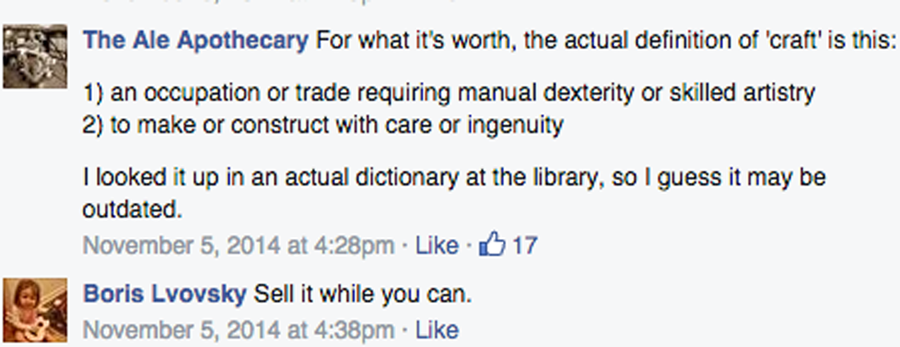
Screen shot: Ale Apothecary defines craft.
The craft ethos I began with, shaped by a circulated artisanal–industrial or craft–crafty binary, is not a homogenous identity and greatly depends on how its actors engage (as the Goose Island–10 Barrel example briefly distinguishes). An industry narrative is not composed by one actor or even by one story. It is composed by a number of actors in different print and digital spaces fashioning a collective industry identity over space and time. Clegg et al. (2006) made the key point that “organizational identity is best understood in terms of the relationship between temporal difference (i.e., the performance of a stable identity over time) and spatial difference (i.e., by locating organizational identity in relation to other firms, both similar and different)” (p. 496). Over time, temporal differences compete with origin stories (Arts and Crafts) and evolving definitions (crafty brewers such as 10 Barrel and Goose Island). The narrative struggles over the question of revolution that W. Morris (1888/2010) initiated.
With craft beer breweries, the stable identity maintained over time is that of the small scale, artisanal revolutionary who is pure and true, an identity placed in opposition—via various writings—to the larger and different large-scale brewing operations that are commonplace in the market. Although the repetition of value-based topoi has significant effect on how the story is told, it does not prevent variations of the story from being told, as is the case with Goose Island. I have focused here not only on what brewers write about themselves or their industry but on what other writers compose as well in order to trace a larger network of meaning and interaction. The spatial and temporal organizational patterns I notice are generated by consumers and industry, each contributing to the narrative in a repetitive and complementary manner with potential for deviation.
The particular identity I have traced here extended from a 19th-century celebration of the handmade to contemporary trade-industry press releases. In between these moments, I discovered a number of actors attempting to make sense of the industry of which they are either a part or a consumer. As much as industry identity can be shaped by professional writing directed by industry actors, the same identity remains dynamic and flexible as other actors contribute to the narrative in various print and digital spaces. Studies of narrative in industry-related writing—whether in food, beer, or elsewhere—should not only trace out the patterns of written discourse that project and build identity, they should also include the contradictions that too create the same identity.
Footnotes
Acknowledgment
I thank the two anonymous reviewers for their helpful comments and suggestions.
Declaration of Conflicting Interests
The author declared no potential conflicts of interest with respect to the research, authorship, and/or publication of this article.
Funding
The author received no financial support for the research, authorship, and/or publication of this article.