




Abstract
This article describes a 12-month qualitative study that analyzes how a company’s transition to component content management (CCM)—a set of methodologies, processes, and technologies that allows working with texts as small components rather than complete, static documents—influences the work motivation of its technical communicators. The analysis is based on actor-network theory and the theories of work motivation from economics. When technical communicators felt that CCM’s only focus was efficiency and savings and that they were not recognized and connected to the fruits of their labor, their motivation decreased. But their motivation increased when they were engaged in job crafting—reshaping their understanding of the fruits of their labor and gaining recognition through prosocial behavior.
In technical and professional communication (TPC), for over 15 years now, component content management (CCM) has been the epitome of efficiency and savings. CCM is a set of methodologies, processes, and technologies that allows working with texts as small components rather than complete, static documents. CCM’s underlying principles of reuse, granularity, and structure, as well as its supporting technologies, promise to make technical communication (TC) efficient, saving both time and the costs of producing information products (Freeman, 2006; Hackos, 2010, 2012; Rockley & Cooper, 2012; Samuels, 2011; Severson, 2008). But many industry and academic publications describe struggles with and multiple cases of failed CCM implementations (e.g., Andersen, 2011; Coggio, 2015; Pullman & Gu, 2008). The most commonly cited precursors to these struggles and failures are the lack of analysis and planning (e.g., Abel, 2013; Andersen, 2014b; Berg, 2007; Dayton & Hopper, 2010; Kostur, 2004; Rockley, 2001; SDL, 2009; Shumate, 2011; Trotter, 2007) and the lack of organizational readiness and a change-management plan (e.g., Bailie, 2009; Gollner, Andersen, Gollner, & Webster, 2015; Hackos, 2011; Robitaille, 2005; Rockley & Cooper, 2012; Shumate, 2011). A theme that consistently emerges in this literature on CCM implementation is the resistance to CCM and lack of buy-in, which need to be analyzed, understood, and accounted for during the transition to CCM, thereby requiring a change-management plan (e.g., Andersen, 2008, 2014a; Bailie, 2013; Coggio, 2015; Gollner et al., 2015; Hamer, 2007; Robitaille, 2005; Rockley & Cooper, 2012).
This resistance and lack of buy-in are typically attributed to the innate fear of change (Hamer, 2007; Trotter, 2007), inadequate understanding of the business case behind CCM (Hackos, 2006b; Rockley & Cooper, 2012), unmanageable workloads caused by having to learn CCM in addition to completing regular production schedules (Bailie, 2007; Hackos, 2007; Kostur, 2004; Rockley & Cooper, 2012), and cultural dynamics within organizations (Andersen, 2014a; Bailie & Huset, 2015). I argue that a key way to counteract resistance and lack of buy-in is to understand the work motivation of technical communicators who are tasked with adopting and using CCM methodologies, processes, and technologies. Two factors that influence the resistance and lack of buy-in are overlooked in the TPC literature: changes in the construction of the (a) meaning of work and (b) relations with the recipients of work. Indeed, rather than complete information products, technical communicators now create structured content components, and this new approach reshapes not only what constitutes TC work but how technical communicators interact with their colleagues and users of information products.
Further, although the top reason for CCM-related changes in TC work is typically efficiency and savings, the push for efficiency in our knowledge-based society is often at odds with the sense of meaning we see in our work (Ariely, 2012). Efficiency and savings cannot explain why people devote years to training to climb snowy, unconquered mountains, why firefighters run into burning buildings. The meaning of work in its multiple facets—including helping others, being part of something important, finding joy in accomplishing a complex, exhausting task—can. Relying on the data from a 12-month qualitative study of a TC work group in a CCM environment, I argue that a change in motivational focus from efficiency and savings to work meaning and prosocial orientation can improve work motivation in CCM environments. But management is not the only source of this motivational change. TPC practitioners themselves can improve their work satisfaction and well-being through increasing the motivational factors of work meaning and prosocial orientation by crafting their jobs to better align their internal goals with the business goals of their organization (Berg, Dutton, & Wrzesniewski, 2007; Wrzesniewski & Dutton, 2001).
In this article, first I review the literature in economics and related fields that examines work meaning and prosocial motivation, analyze the TPC literature that connects CCM with work motivation through the concepts of resistance and lack of buy-in, and introduce the theory of job crafting. Then I explain the methodology behind my 12-month qualitative study of a TC work group in a CCM environment. Next I introduce the stories of three technical communicators in my study and analyze the network of global TC that they are a part of through the lens of actor-network theory (ANT). This network analysis elucidates how the webs of alliances of individual technical communicators within the network affect work meaning and prosocial orientation as motivational factors. I examine the motivation of the three technical communicators, suggesting that specific binary parameters in work meaning and prosocial orientation can positively and negatively influence motivation. Finally, I describe ways in which the three technical communicators can shape these parameters through job crafting; discuss implications of the study results for TC practitioners, educators, and managers and the limitations of my study; and suggest ideas for future research.
Literature Review
Work motivation—the force that energizes, directs, channels, maintains, and sustains human behavior (Porter, Bigley, & Steers, 2002)—has stirred minds for more than two centuries (Grant & Parker, 2009). Work motivation has been one of the central questions in multiple fields of study, a question that is important to individuals and entire organizations because people who are unmotivated at work are “likely to expend little effort in their jobs, avoid the workplace as much as possible, exit the organization if given the opportunity, and produce low quality work”; in contrast, people who are motivated at work are “likely to be persistent, creative, and productive, turning out high quality work that they willingly undertake” (Amabile, 1993, p. 185).
First, I summarize insights from economics and related fields 1 that help analyze work motivation in CCM environments, focusing specifically on work meaning and prosocial motivation. Then, I describe how these two concepts are reflected in TPC publications on CCM; although these publications do not focus on motivation, they describe related areas such as resistance and lack of buy-in. Finally, I introduce the theory of job crafting, which conceptualizes the ways in which employees can shape their own motivation.
Insights on Motivation From Economics and Related Fields
Scholars have long recognized that motivation can come from different sources (e.g., Herzberg, 1966; Porter & Lawler, 1986; Staw, 1977). Early theories of motivation suggest that external incentives and punishments are necessary for motivation (Heath, 1999; Steers, Mowday, & Shapiro, 2004). Later, however, researchers shifted from the assumption that people dislike work and began to assume that work can be interesting and enjoyable (e.g., Herzberg, 1966; McGregor, 1960). Stemming from motivation-hygiene theory (Herzberg, 1966), theories of intrinsic motivation have become paramount to this new way of understanding work motivation. Intrinsic motivation refers to when people engage in an activity because they find it interesting or derive satisfaction from it (Amabile, Hill, Hennessey, & Tighe, 1994; Gagne & Deci, 2005; Grant, 2008; Porter & Lawler, 1986; Ryan & Deci, 2000). In contrast, extrinsic motivation refers to when people engage in an activity because they derive satisfaction from the external consequences of doing so, such as tangible or verbal rewards (Amabile, 1993; Brief & Aldag, 1977; Grant, 2008; Porter & Lawler, 1986). Within the theories of intrinsic motivation, work meaning and prosocial orientation are motivators that particularly pertain to the analysis of motivation in CCM environments because they help to address key areas of resistance to CCM.
The Meaning of Work
Our work motivation is influenced by our perception of the meaning and meaningfulness of work. The meaning of work refers to individuals’ understanding of the purpose of their work and what they believe they achieve through it (Brief & Nord, 1990), whereas the meaningfulness of work refers to how much purpose or significance the work has (Wrzesniewski, LoBuglio, Dutton, & Berg, 2012). Individuals who see purpose in their work are more engaged in what they do, influence and inspire people around them, and are more committed to their organization (Hirschi, 2011).
Research in behavioral economics
2
provides interesting insights into the connections of meaning and work motivation. Based on experiments with building Bionicle Lego models and identifying sequences of letters, Ariely, Kamenica, and Prelec (2008) confirmed that purpose (or the understanding that work is “linked, even tangentially, to some objectives”) and recognition (another person acknowledging the completed work) are the two motivational foundations of work meaning. More specifically, the authors proved that seeing the fruits of our labor makes us more engaged and productive. Seeing and associating with the direct results of our work (even for a short period of time) is positively connected to work meaning and meaningfulness. lack of recognition leads to loss of meaning, which in turn leads to decreased work motivation. When our performance is ignored, we lose the sense that our work is meaningful; in fact, feeling ignored is similar to seeing the fruits of our labor destroyed in front of our eyes.
Prosocial Motivation
Prosocial motivation is the desire to take action that benefits other people (Batson, 1998; Grant, 2008) or to see the purpose of our work as making a positive difference in others’ lives (Colby, Sippola, & Phelps, 2001; Ruiz-Quintanilla & England, 1996). Prosocial motivation is ubiquitous in a variety of work contexts and has large impacts on how employees perceive and approach work. Researchers have argued that prosocial motivation increases persistence, performance, and productivity across various tasks and jobs (e.g., Bing & Burroughs, 2001; Thompson & Bunderson, 2003) and enables dedication to a particular cause (Shamir, 1990).
Interest in prosocial motivation came out of work-design theories that aim to describe, explain, and change employees’ experiences and behaviors (Hackman & Oldham, 1980). But while work-design scholars focused on the structure of tasks as a way to increase work motivation, those interested in prosocial motivation concentrated on ways to increase employees’ interest and effort in protecting and promoting the well-being of others as a motivating factor (Grant, 2007, 2008; Grant & Parker, 2009). Although all jobs are designed with some relational aspect, relational architectures can vary both between and within job types (Grant, 2007). Prosocial motivation is most often prompted by contact with and knowledge of the recipients of one’s efforts (Batson, 1998; Grant, 2007). Contact allows workers to take the perspective of and empathize with others; this affective commitment (Parker & Axtell, 2001), combined with the awareness of being able to make a difference, increases prosocial motivation (Grant, 2007; Grant & Parker, 2009). Prosocial motivation, then, works best when coupled with intrinsic motivation. Together they have a high rate of increasing workers’ persistence, performance, and productivity (Grant, 2008).
Motivation and CCM in TPC Literature
Although no publications in TPC focus on work motivation and CCM specifically, multiple publications describe the opposite of being motivated: resistance to adopting CCM and lack of buy-in (e.g., Abel, 2012; Bailie, 2007; Coggio, 2015; Gollner et al., 2015; Hackos, 2007; Hamer, 2007; Kostur, 2004; Lewis, 2012; Trotter, 2007). Themes that describe resistance to CCM and lack of buy-in can be divided into two categories: meaning of TC work and prosocial motivation.
The Meaning of Work
A prominent critique of CCM focuses on the ways that CCM disrupts and threatens the sense of and pride in being authors of technical information products. 3 The pressure to drive costs down and expedite business processes requires high levels of automation (Gollner, 2010); as a result, the craft-oriented approach to creating content becomes outdated because it takes too much time and produces content that is too specialized and cannot be reused (Rockley & Cooper, 2012). Consequently, many writers tasked with adopting CCM struggle with issues of ownership (Coggio, 2015; Rockley, 2003). Common critiques are that methodology and technologies behind CCM can drain writers of their “artistic impulse” and motivation that come with the satisfaction of crafting documents on their own (Weiss, 2002) and that these methods and technologies can threaten the craftsperson role of a technical communicator (Albers, 2003). Dicks (2009) pointed out that “many communicators receive considerable positive reinforcement from seeing and clutching their finished documents.…Merely developing content chunks removes the sense of accomplishment and pride that, for many technical communicators, is practically their only job satisfaction” (p. 69).
Although Andersen (2014b) argued that CCM changes the nature and location of rhetorical work in whole organizations and turns technical communicators into highly valued symbolic–analytic workers, giving up the craftsperson model of TC is not easy. Giving up document ownership not only can take away writers’ sense of pride in the products they create, but it can also undermine their feelings that their expertise is valued and that their work is recognized (Trotter, 2007). Unfortunately, arguments that technical communicators can gain recognition (and better career opportunities) by engaging with CCM because CCM puts them in the center of their organizations (Bailie & Urbina, 2013; Rockley, Kostur, & Manning, 2002) lack “specific examples of this actually occurring, much less comprehensive empirical evidence” (Clark, 2016, p. 20).
Prosocial Motivation
A key argument for the rhetorical complexity of TC work in CCM contexts revolves around the prosocial orientation—the motivation to help users of information products. As adoption of CCM started to gain momentum, many were worried that CCM processes, standards, and technologies would decrease the rhetorical complexity of TC jobs because CCM is very efficiency oriented: It technologizes and streamlines processes that should be complex and rhetorical. They argued that an information-development and management approach based on structured authoring takes away the rhetorical nature of TC, devaluing the work of technical communicators, turning rhetorically complex TC jobs into easily outsourced tools jobs, and privileging organizational needs and software affordances over the needs of readers (Albers, 2003; Bacha, 2008; Clark, 2002, 2007, 2008; Gattis, 2008; Whittemore, 2008). Such views were common not only for technical communicators: Technical translators were also concerned that CCM could cause “the deepening of divisions within the labor market and the conceptual restriction of translation to narrow text-replacement activities” (Gil & Pym, 2006, p. 7).
Others, however, refuted such critiques by arguing for the rhetorical complexity inherent in CCM technologies (e.g., Eble, 2008; McShane, 2008). Sapienza (2004) maintained that usability of information products is an important part of CCM and that “usability of documents requires the integration of multiple knowledge areas, including rhetoric, information architecture, usability, and computing” (p. 407). Robidoux (2008) agreed that effective structured writing that is at the core of CCM can help technical communicators “create more rhetorically significant, customer-focused content” (p. 114). Such a prosocial motivation, however, involves not only a focus on users but also effective work across organizational departments and units, a process that encompasses involving technical communicators early on, particularly in selecting a CCM technology, and providing sufficient and appropriate training in CCM technologies, approaches, and processes (Andersen, 2008; Bailie & Huset, 2015; Hackos, 2006a; Hamer, 2007; Lanier, 2012; Pierce & Martin, 2004; Rockley, 2003) identifying and acknowledging the transition pain that stakeholders feel and soliciting and attending to their concerns (Kostur, 2004; Rockley & Cooper, 2012; Shumate, 2011) creating and maintaining open lines of communication (Kostur, 2004; Rockley & Cooper, 2012) making sure all stakeholders understand the business case for CCM (Hackos, 2006b; Shumate, 2011) promoting collaboration (Bailie & Huset, 2015; Pierce & Martin, 2004; Robidoux, 2008).
Organizational culture is a strong factor that influences work across organizational units and overall resistance to CCM (Andersen, 2014a; Bailie & Huset, 2015; Coggio, 2015; Gollner et al., 2015; Hackos, 2006b; Robitaille, 2005; Rockley & Cooper, 2012). For example, Bailie and Huset (2015) mentioned that cultures that encourage “curiosity, understanding, and experimentation” and have frequent communication, resource pooling, and a cross-pollination of skills do not show significant signs of resistance to CCM. In contrast, cultures that focus on “planning, process, and efficiency” (pp. 323–324) combined with distributed teams and shifts in the organizational positions of team members show signs of struggle.
Similar to work-design theories from economics, which focus on managers as the ones who can change various aspects of the job to improve motivation, literature in TPC suggests that leaders need to develop change-management plans in order to reduce resistance to CCM and improve buy-in (Bailie, 2007; Hackos, 2006b; Hamer, 2007; Lewis, 2012; O’Keefe & Pringle, 2012). While developing such a plan has proven to lead to successful CCM transition (e.g., Pierce & Martin, 2004; Shumate, 2011), job-crafting theory established that doing so is not the only way to improve motivation.
Job Crafting
Work-design theories traditionally put managers in the roles of top-down designers of standardized and controlled jobs, putting employees in passive roles of recipients of jobs that are one-size-fits-all and do not reflect the needs, motives, and preferences of particular employees (Hornung, Rousseau, Glaser, Angerer, & Weigl, 2010; Rousseau, Ho, & Greenberg, 2006). In other words, all employees with the same job title receive the same list of tasks, responsibilities, and reporting relationships (Wrzesniewski et al., 2012).
To counteract this view, job-crafting theory emerged as a model that accounts for proactive, agentic behaviors of workers who make changes to their own jobs (Wrzesniewski & Dutton, 2001) rather than react to a change that someone else has introduced (Grant & Ashford, 2008; Griffin, Neal, & Parker, 2007). As such, job crafting is defined as “the physical and cognitive changes individuals make in the task or relational boundaries of their work” (Wrzesniewski & Dutton, 2001, p. 179) to “move from a ‘one-size-fits-all’ job description to an individualized enactment of the job” (Wrzesniewski et al., 2012, p. 287). Job crafting is a source of positive work meaning, sense of self, engagement, commitment, and performance (Wrzesniewski et al., 2012). Job crafting positively affects the psychological well-being of employees (Berg, Grant, & Johnson, 2010), their work engagement, and their performance (Tims, Bakker, & Derks, 2012).
The literature identifies three forms of job crafting (Berg et al., 2007; Wrzesniewski et al., 2012): Task crafting refers to altering the boundaries of the tasks that people perform. Workers can take on more or fewer tasks, expand or diminish the scope of tasks, change how they perform a task, adjust the time or effort spent on various tasks, or change the nature of a task. Relational crafting refers to redefining the relationships at work by changing the nature and extent of interactions with other people. Workers create meaningful and helpful relationships with others, expand their roles to make a greater impact on others, spend more time with preferred individuals, reduce contact with or avoid unpleasant individuals, and select the contexts in which they help preferred individuals. Cognitive crafting refers to altering one’s own perception of the meaning and purpose of tasks and relationships or seeing the tasks as an integrated whole rather than separate parts in order to change the significance of work. Employees can reframe the social purpose of their work or change their beliefs about their job (Berg et al., 2007; Wrzesniewski et al., 2012).
The incentive to craft a job is influenced by the perceived opportunity to do so. Typically, employees engage in job crafting to assert control over their work and its meaning, to avoid alienation from their work, to forge human connections at work, to create a positive self-image through their work, to create meaningful interactions with people who benefit from their work, to cope with adversity at work, and to fulfill a passion for an occupation different from their own (Berg et al., 2007; Wrzesniewski & Dutton, 2001).
In the next section, I describe how I studied work motivation in a CCM environment and suggest a theoretical approach for analyzing the results of this study.
Research Design and Method
To study work motivation in CCM environments, I conducted a 12-month, Institutional Review Board (IRB)-approved qualitative case study at DreamMedi, 4 a fortune 500 manufacturer of medical devices. DreamMedi is a multibrand corporation with central offices in the United States and manufacturing and assembly facilities worldwide. It consists of a number of business units, with each unit specializing on a particular equipment line. The technical documentation it produces includes catalogs, brochures, and user guides. In addition, the company has information on its Web site (in three languages), in a desktop-based sales system (DSS; in English) that serves as an equipment configuration tool for independent sales agents, and in an online version of the DSS (in Simplified Chinese and Spanish for Mexico and Latin America).
Study Setup and Data Work
I started the study by talking with the three technical communicators in the international unit—Rose, Melissa, and Kelly—because they were the nexus of TC in DreamMedi. But as the study progressed, these three technical communicators advised me to talk to additional stakeholders. These additional stories provided critical details, helping me gain a deeper understanding of the changes in TC work brought on by CCM and the impacts of these changes on the technical communicators’ work motivation. The final list of participants in this analysis included three technical communicators in the international unit (Rose, Melissa, Kelly) the head of information technology at DreamMedi three application engineers who were the heads of business units that participated in creating technical content in English a corporate marketing department employee whose task was to make sure that corporate branding was represented adequately throughout most of the genres of the company’s technical texts a marketing specialist for Mexico and Latin America who was the main source for reviewing Spanish information and documentation a technical documentation and marketing specialist in China who reviewed all translations into Chinese an application engineer in China who was the main source for technical information for the technical documentation and marketing specialist.
In addition to recruiting participants with diverse perspectives, I used diverse methods for collecting data and sources of data in order “to address a broader range of historical, attitudinal, and behavioral issues” (Yin, 2009, p. 99) in my case study. To help ensure a sound methodological design, I combined the following methods of data collection: observations, in-depth interviews, questionnaires, document collection and content analysis, and software exploration. This approach helped me achieve methodological triangulation—one way of strengthening integrity and guarding against researcher bias (Denzin, 1978; Porter, 2002; Sullivan & Spilka, 2010; Yin, 2009). Including multiple methods for collecting data and adjusting the methods based on input from participants not only allowed me to compensate for the weaknesses of each method but also provided participants more flexibility if they could not use a certain method.
To code the data I collected, I used a mixed-method approach, following the two-cycle coding suggested by Saldaña (2009). During the first cycle, I used versus, descriptive, and in-vivo codes 5 in order to identify any possible opposing factors that influence motivation without relying on preconceived ideas. During the second cycle, I classified, prioritized, integrated, synthesized, and conceptualized my initial codes into major patterns and then themes. At this stage, I used pattern-coding and axial-coding methods. Pattern coding was particularly useful for examining patterns in stakeholders’ behaviors when they interacted with one another, with technology, and with information products as well as for establishing rules and causes in the data (Miles & Huberman, 1994). Axial coding allowed me to strategically reassemble data that were split during initial coding. The mixed-method approach to coding helped me to “capture the complex processes or phenomena” (Saldaña, 2009, p. 47) and strengthen the internal validity of the study (Yin, 2009, p. 40). In addition, the coding methods I selected allowed me to cover the broad range of methods for collecting data and the types of data collected.
Theoretical Orientation of the Analysis: ANT
ANT, developed by Callon (1986), Latour (1987), and Law (1987), provided theoretical and methodological tools for studying global TC at DreamMedi as a network built by human and nonhuman actors—a system of people or things connected by channels that allow various reciprocal exchanges to take place. In ANT, humans and nonhumans are not sufficient by themselves; they “delegate” their tasks, so they need to form alliances to achieve their aims (Johnson, 1988). In ANT, it is useful to think of a network as a flat terrain of actants who are “powerless as long as they are not linked to each other” (Myers, 1996, p. 10). These actants can be defined as collective or individual agents that serve as intermediaries between other actants (Uden & Francis, 2009); the actants are social, technical, conceptual, and textual (Law, 1992), with no distinction made between human and technical or social and natural actants (Murdoch, 1998). All actors and actants in a network identify and define other actors and actants within the network, as well as relationships that connect them (Callon, 1986; Johnson, 1988).
All actors and actants have their own goals, and to achieve these goals, they enroll other actors and actants, finding ways to convince the others to support their aims (Spinuzzi, 2007). The new alliances provide them with substance, action, intention, and subjectivity (Callon, 1986). Through building an actor network, actants overcome the resistance of other actants by weaving them into their own network (Law, 1992). Actants become “powerful by making and maintaining links” with other actants and their networks (Myers, 1996, p. 10), and networks become stronger and more durable when more entities are enrolled in them (Spinuzzi, 2007). When problems arise in networks, they are rerouted with the help of other allies (Latour, 1999; Spinuzzi, 2007).
The ANT framework allows visualizing the network of global TC at DreamMedi as a web of alliances between people (e.g., technical communicators and other stakeholders), technologies (e.g., CCM systems), and information products (text genres that organizations produce). Mapping out alliances for each technical communicator within the network helps to identify sources of increased and decreased work motivation, as well as to analyze how the length, stability, and durability of the webs of alliances influence motivation.
When actants are tightly interconnected, their goals are enmeshed, their freedom decreases, and the resulting assemblage coheres as a single actant (Spinuzzi, 2008). This tight assemblage can be “black-boxed” (Latour, 1999), or turned into a single thing that “resists decomposition and that therefore functions as a reliable building block for other work” (Spinuzzi, 2008, p. 90), as well as helps reduce work complexity by negating the necessity to think about the actants composing the black box. Approaching the network of global TC at DreamMedi with the black-box idea was particularly useful because it not only helped to conceptualize every actant as a potential black box, but it also provided a connection between black-boxing a person’s or a unit’s work and recognizing such work.
Un–black-boxing the Network of Global TC
At DreamMedi, the nexus for TC was the international unit. The three full-time employees of the international unit—Rose, Melissa, and Kelly—created print information products (catalogs, brochures, and user guides) in three languages and curated content for the English-language DSS that served as an equipment configuration tool for independent sales agents. Most recently, the unit developed a multilingual version of the DSS that was available online for the company’s sales agents in China and throughout Mexico and Latin America—the multilingual online sales system (MOSS). The MOSS provided a large competitive advantage to DreamMedi because it allowed marketing to show that DreamMedi’s equipment was easy to install and use, customers to navigate the equipment, and sales agents and postsales technicians to help customers navigate the equipment. 6 To create all content and information products, technical communicators relied on information they received from individual engineering units.
Although it provided a large competitive advantage, the MOSS was possible only after the international unit adopted the CCM methodology and a CCM system, QuickCCM, three years before my study. Having heard about the benefits of CCM at conventions and trade shows, upper management was convinced of its potential to increase the efficiency of producing technical information products and improve their quality. Upper management mentioned Melissa as the QuickCCM expert and Kelly as the guru for the MOSS. Neither upper management nor company employees outside the international unit could tell more about the workings of the unit.
The international unit functioned as a black box—as a coherent composition that retrieved information from the engineers on one side and produced technical information products on the other (see Figure 1).

Global technical communication at DreamMedi as a black box. The black-boxed international unit at DreamMedi retrieved information from the engineers on one side and provided marketing units, sales agents, and customers with information products on the other.
The international unit was seen as a single entity, so that it could function as a building block for other work (Spinuzzi, 2008)—for sales agents to configure the equipment, for marketing to advertise at sales shows, for users to start and service the equipment, and so on. Forgetting about how the network functions and what it is composed of helped reduce complexity so that work at DreamMedi with its many units would be more manageable. Black boxes, however, “tend to hide not just complexities but also local transformations” (p. 49). The shift to QuickCCM produced a surge of changes in how the global TC network functioned and technical communicators worked—a typical occurrence after a transition to CCM (Gollner et al., 2015). But these changes were not reflected in how the workings of the unit were perceived outside the unit, save for the mentioning of QuickCCM as the catalyst for efficiency and quality.
The following stories of technical communicators provide insights into the functioning of the international unit after its transition to QuickCCM. ANT allows us to analyze the complexities of this functioning and the transformations that occurred after the introduction of QuickCCM through the concept of a black box that hides how the network of international TC was shaped by and shaped its actors: the technical communicators of the international unit, the employees of DreamMedi and independent contractors they work with, the MOSS, the DSS, InDesign, print documents, QuickCCM, and users. By un–black-boxing the complexities and transformations of the global TC network, we can map out the alliances that the actors of the international unit engage in and connect alliance building with work motivation.
The Story of Rose
Eight years before my study, Rose was hired at DreamMedi for a temporary position to help a particular business unit get caught up on their TC projects. At that time, Rose’s work consisted mostly of creating catalogs, brochures, and user guides. To create these information products, Rose relied on InDesign and applied templates that the company had used for years. This temporary position at DreamMedi did not exactly match her educational background in graphic design, but she was happy with the position because its focused nature allowed her “to take [her] time and do [the job] well versus just getting it done.” Rose’s efforts did not go unnoticed: She was offered a permanent position, working with DreamMedi’s documentation in three languages.
Rose saw her first 5 years with the company in a positive light—that is until upper management became convinced that they needed to implement CCM and pushed for a QuickCCM software package. Rose did not receive enough time to evaluate the capabilities of various additional software packages in order to make a sufficient argument for a CCM technology that she perceived as the optimal solution for DreamMedi. In addition, since QuickCCM was one of the less expensive packages, the financial concerns of this medium-sized business overshadowed Rose’s argument that QuickCCM “didn’t have all its ducks in a row.”
Once the decision on QuickCCM was made, learning the publishing capabilities of the software—and Rose was the only stakeholder who needed such capabilities because she was the one to create catalogs, brochures, and user guides for print—became an impossible task. The extensive literature on QuickCCM was organized by software capabilities, included many references that did not apply to Rose’s work and, according to Rose, required experience and familiarity with CCM. The implementation specialist who the vendor sent to help DreamMedi for the first month produced “fake documents with fake data.” When he left and Rose started working with “the real stuff,” she thought that QuickCCM was a waste of her time.
She also thought that hiring an independent QuickCCM consultant was not very helpful. The consultant spent a week at DreamMedi, working 10-hour days to help Rose develop better strategies for working with QuickCCM’s publishing tool. Rose recalled that she initially thought that she did not know enough about the software, so an expert would definitely “set things straight.” But she soon became disappointed when she felt that she was the one doing the teaching. The consultant had to leave after a week but kept in touch with Rose to see if he could help solve her problems remotely. Rose appreciated his feedback, but her usual duties prevented her from spending much more time figuring out QuickCCM’s publishing tool. She wondered if the time she spent demystifying the software was really worth it or if she should rather wait until a new version of the software becomes more applicable to her particular tasks and templates and more user-friendly for her as a writer. The help offered through the software vendor was not satisfactory either: Every time the international unit filed a query, it was redirected to QuickCCM training, which would take them, yet again, through all the capabilities of the software.
Rose questioned the need to change the templates for DreamMedi’s print information products for the sake of making software work. After all, Rose relied on the “tried-and-true templates” that “people like.” Yet she failed to articulate why these templates were good and important because she had no information about the users of the product and did not see how she could gather such information—the marketing unit and sales agents were usually the only ones with access to current and potential customers.
Rose was using content components from QuickCCM to create brochures, catalogs, and user guides, but she continued relying on the InDesign software to create print-ready information products. For multilingual content, Rose used translated components from the QuickCCM database, a practice that stopped her collaboration with translation specialists. Rose continued to interact with her two TC colleagues in the international unit, Melissa and Kelly; these two generally described Rose’s work as “helping us with print documents.” They perceived Rose’s work as focused primarily on desktop publishing rather than the creation of technical texts. While both Melissa and Kelly mentioned that Rose was not working with QuickCCM’s publishing tool because it was not flexible, neither of them knew what Rose meant by flexibility and why this flexibility was so important to her. Rose’s connection to DreamMedi’s employees outside of the international unit also changed, reducing her to simply adding to the company’s server print-ready information products that were requested from outside of the international unit. As a result, none of the participants I interviewed outside of the international unit mentioned Rose or could describe what her expertise was.
Rose complained about QuickCCM most vocally, and while her complaints echoed the critiques of both academic and trade authors in TPC that CCM technologies often encourage disregarding users’ needs and rhetorical practice in pursuit of efficiency, her complaints did not rely on knowledge about the users. At the same time, her communication with the rest of the company became less frequent not only because she became the only person with a very negative view of the changing CCM practices but also because the introduction of QuickCCM and the new CCM role taken on by Melissa severed Rose’s communication channels. As a result, despite her wealth of product knowledge and years of experience at DreamMedi, Rose felt unappreciated and uninvolved with both the CCM paradigm of creating technical information products and the international unit.
The Story of Melissa
Melissa joined DreamMedi five years before my study. She started in the marketing unit, where she answered phone calls and e-mails from sales representatives and customers and managed orders. Two years later, she thought it was time for a change because her tasks no longer seemed challenging. Relying on her experience with DreamMedi’s product line, she advocated for her capabilities in creating and managing the database of content components in the newly acquired QuickCCM. As a result, she was transferred to the international unit and became responsible for transitioning legacy content to CCM, including content mining existing documents, rewriting the legacy content with the structured approach, and entering the content in the QuickCCM database. In addition, Melissa became responsible for coordinating the translation of content components into Simplified Chinese and Spanish for Mexico and Latin America.
Even though Melissa did not have much background in TPC and was not familiar with QuickCCM, she approached the new role and the new software with enthusiasm. Her philosophy was “learning as I go rather than spending a lot of time being trained on a new program.” Melissa also experimented with structured writing, learning from free online resources. Although the learning curve was steep, she discussed ways to improve her structured writing approach with Kelly, whom she perceived as the person most involved with the need for structured content—Kelly was continuously arguing for improving the MOSS, and structured writing was one way of doing so.
Melissa was quite vocal about the quality of information in the QuickCCM database and became an “information nexus”—somebody employees turned to when they needed to verify information. While Melissa did not discount the disadvantages of QuickCCM (e.g., the lack of flexibility), she consistently stressed that QuickCCM’s biggest advantage was its capability to consolidate verified, well-written information. Such consolidation helped DreamMedi’s employees to figure out what information was correct and most current. As a result, when people in one of DreamMedi’s engineering, marketing, or sales units had questions about the accuracy of information, they called Melissa and asked her to check QuickCCM and clear up any inconsistencies or disagreements.
Melissa had no knowledge of the characteristics and needs of the end users outside of the company. Yet, her engagement with other units of DreamMedi proved to be her strongest motivation. She considered other DreamMedi employees to be her main users and worked on providing them with easier ways to verify information. As a result of her reconsidering the meaning of the database of structured content, Melissa felt appreciated and deeply engaged with the international unit and DreamMedi as a whole.
The Story of Kelly
Three years before the study, Kelly was hired by DreamMedi right out of college, where she majored in computer and information sciences. Kelly’s main task was to create the MOSS that would imitate the capabilities of the English-only DSS but would also provide online access to product information—and in Chinese and Spanish. QuickCCM was to provide the database of multilingual content to be used by the MOSS.
While Kelly was unfamiliar with QuickCCM before taking the position at DreamMedi, she relied on her educational background and her “fellow co-workers, reading online documentation, and practicing” to get comfortable with the software. Kelly noted that QuickCCM might not have been the best choice, but she agreed that the system helped to “keep data consistent and provide a central place for maintenance.” She did not consider the limitations of QuickCCM as unbearable obstacles to her work—she adapted the software to fit her needs. Since the QuickCCM software package did not provide a sufficient solution that would enable end user configuration of DreamMedi’s products online, Kelly created a middleware application that allowed the MOSS to communicate with the QuickCCM’s database and extract content based on configurations that customers, sales, and marketing had input online. While Kelly was not completely happy with QuickCCM’s foreign language capabilities, she continuously looked for ways to improve them, talking to Melissa, employees in marketing and sales, and upper management about customer requirements. Kelly was also investigating alternate solutions on the market, the only employee within the international unit to devote time to this task.
As a result, Kelly was perceived by others at DreamMedi as the person with the most ideas for change and improvement and as the technology guru. Kelly’s motivation was consistently encouraged, and she was invited to information technology and management meetings; during these meetings, she showcased her recent work to improve the technological solutions at DreamMedi and described the problems that current technologies could present to global TC. Even more importantly, she framed her conversations about technological solutions to show how they could provide ways of reaching current and potential customers. By brainstorming ways of presenting information to the customers and thus making the work of sales, marketing, and technical support employees easier, she appealed to not just those in sales, marketing, and technical support but to upper management as well.
While Kelly’s education provided a foundation for her success, she was the least experienced employee in the international unit when she started: Not only was it her first job out of college, but she joined the company with no knowledge of its products, structure, culture, or customers. Yet she positioned herself as a user advocate who is also concerned about the business goals of the company and success of her colleagues. After accomplishing the task for which she was originally hired (creating the MOSS), Kelly did not stop but rather looked for ways to improve the technologies and practices of the company. Kelly confessed that she would be looking into different types of software in her free time anyway because that was her hobby.
The Network of Global TC
The stories of the three technical communicators in the international unit provided the necessary information to open the black box of the international unit in order to map the individual actors of the network unpack each individual actor and remedy any possible misunderstandings (e.g., QuickCCM as a database and a publisher, users as employees of the company who use the database and the MOSS versus current and potential customers) visualize how technical communicators of the international unit, the focus of my study, formed alliances within the network of global TC at DreamMedi.
Some technical communicators of the international unit struggled “with the kinds of uses, and even workplace writer roles” that a CCM technology suggested (McCarthy, Grabill, Hart-Davidson, & McLeod, 2011, p. 388) while others were more successful. In what follows, I focus on the positions of the three technical communicators within the network of global TC at DreamMedi and the connection of their positions to work motivation.
After the introduction of QuickCCM, Rose was not successful at making alliances with it. While she used the multilingual QuickCCM database created by Melissa, she routed around the QuickCCM publisher, relying instead on the familiar InDesign (see Figure 2). This rerouting disengaged the publisher from the network, at least in its current state. But rerouting allowed Rose to solve her immediate problems, and she felt connected to the information products she was creating (user guides, brochures, and catalogs) as their author, relying on the comfort of tried-and-true templates. At the same time, Rose hardly got any feedback on her information products, and she did not work on getting more feedback. She was disconnected from the customers for whom these products were created, as well as the other DreamMedi employees who were using these information products to communicate with the customers (e.g., marketing and sales). Her communication with translation specialists stopped, and the nature of her connection to engineers changed dramatically because she no longer needed to communicate with them for her everyday work tasks.
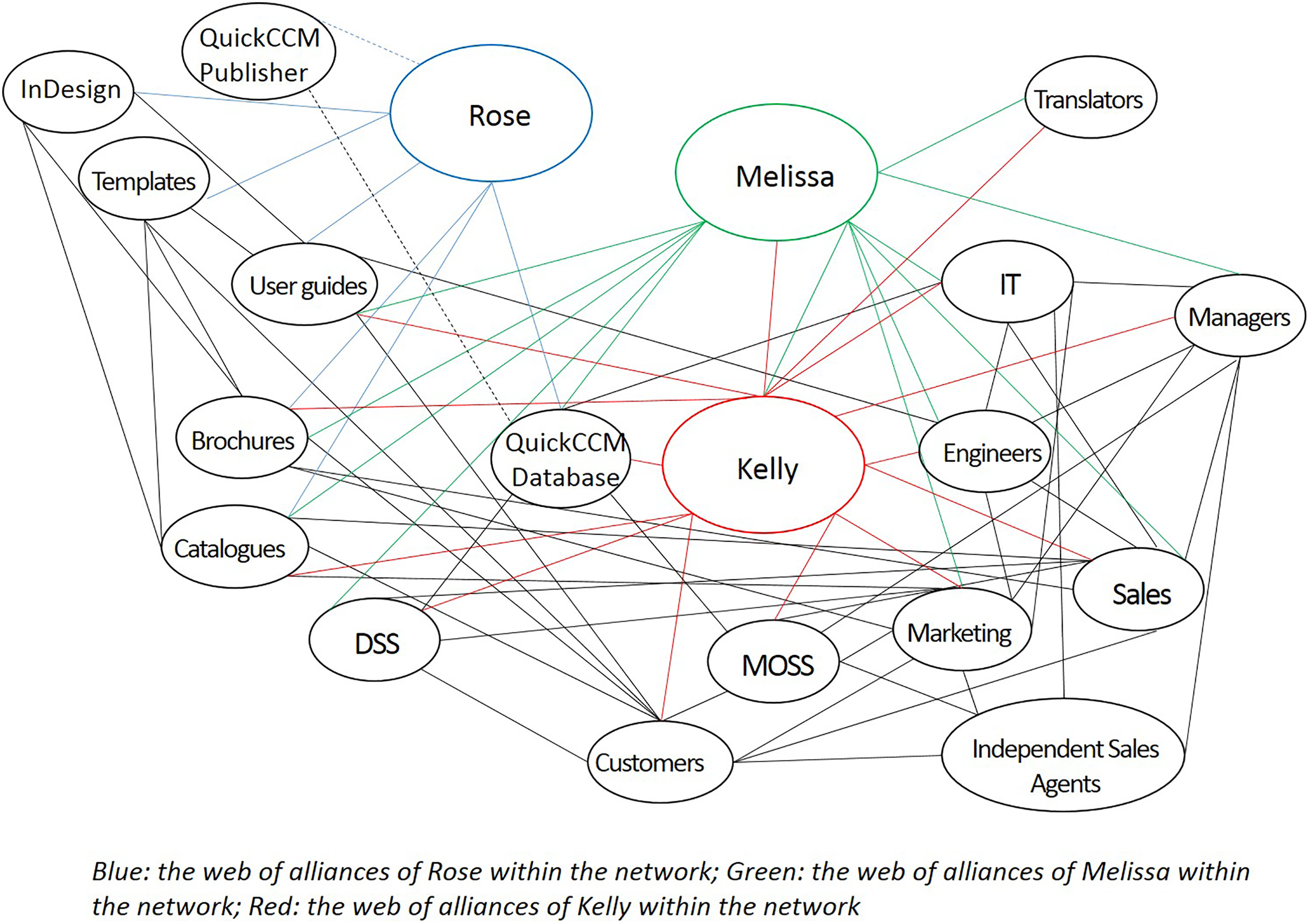
Un–black-boxed network of global technical communication. Melissa and Kelly make alliances and become entrenched in the network, ensuring the sustainability of their jobs and the strength of the network. Rose loses connections within the network, and her position within DreamMedi becomes unstable.
Rose’s new work context was immensely stressful. She felt threatened that her current work practices might soon be changed, her connection to the fruits of her labor severed, because everybody else in the unit was advocating for QuickCCM, and management was very optimistic about it. She was not connected to the international unit’s golden child, the MOSS, and her connection with QuickCCM was not particularly strong—it was a one-way connection of Rose using the content from the database. In addition, Rose was not directly connected with the organization beyond the international unit. Although her work was being shaped by the transformations in the network after QuickCCM was introduced, she did not believe that she could shape the network—her current work arounds that allowed her to reroute around QuickCCM were not stable. After the introduction of QuickCCM, Rose failed to renegotiate her position within the new network—as her number of alliances within the network dwindled, so did her satisfaction with working in the international unit and her work motivation. 7
In contrast, Melissa became entrenched in the network of global TC at DreamMedi after the introduction of QuickCCM and her transition to the international unit. She worked with translators, collaborated with Kelly, and articulated the benefits of her work and QuickCCM to management and employees outside her unit (see Figure 2). She reconfigured the meaning of her alliance with QuickCCM: Her original connection to the information products for print and the DSS (as sources for information mining) and her desire to take on a new challenge allowed her to make QuickCCM database her strongest alliance in delivering verified information to employees outside of the international unit. Melissa used QuickCCM to reach across units. By positioning herself between QuickCCM and the rest of the network, Melissa successfully made her role visible.
Melissa also took an active position in reconfiguring the meaning of her work. Central to this reconfiguring was her perception of users not necessarily as customers of DreamMedi but as employees of the company who depend on verified, consistent technical information for work success. With the help of QuickCCM, Melissa could provide just that, a database of verified, consistent technical information, which in turn led her to receive positive comments and recognition from her colleagues. As a result, Melissa felt satisfied with her position at DreamMedi and motivated to work.
The third technical communicator in my study, Kelly, was able not only to make alliances with QuickCCM but also to create new technologies that proved to be her strong allies (the MOSS); in doing so, she became the paramount link between QuickCCM and the MOSS (see Figure 2). In addition, she discussed, with Melissa, how content components were translated and stored; with translators, the requirements for storing and managing content in their particular languages; with information technology employees, the possibilities for altering the existing software and acquiring or developing new software; with marketing and sales employees, information about current and potential customers; and with management, ideas for technological solutions that could support the work at DreamMedi more meaningfully and efficiently and match business goals with customer needs.
In other words, Kelly used QuickCCM to collaborate, creating webs of alliances, reshaping the network, and establishing the network’s durability. She was the stakeholder from the international unit whose competencies were most visible within the company because she took a critical and creative stance toward QuickCCM, engaging in prosocial behavior focused on the customers. By constantly communicating with employees outside of the international unit and being able to state clearly the benefits of her actions for customers and the company as a whole, Kelly became an irreplaceable actor in the network. Consequently, she felt satisfied with her position at DreamMedi and motivated to work.
The map of the un–black-boxed network of the international unit allows us to trace the ways that transition to CCM promoted and challenged work motivation within its global TC network. On the one hand, factors such as helping colleagues to achieve their work goals; helping customers to interact with company's products; reshaping the meaning of work and the work context; communicating with colleagues about their (and customers’) needs and goals, including technologies that support these needs and goals; and being able to change the technologies based on specific needs increased work motivation. On the other hand, factors such as decreased communication within the workplace; lack of knowledge about how the information products one creates are used; lack of knowledge about the users; and the perceived inability to shape the meaning of work and work context decreased work motivation. In the next section, I further examine these findings with the help of perspectives from economics to see how technical communicators and their managers can create more motivational work environments with CCM.
Shaping Work Motivation
In the previous section, I discussed how Rose, Melissa, and Kelly adapted to a global TC network after their company’s transition to CCM and how the transition influenced their work motivation. Perspectives from economics and related fields allow us to further unpack the reasons behind the decreases and increases in the work motivation of these three technical communicators by providing language for this discussion and helping us to focus on the two areas that define work motivation: work meaningfulness (seeing the fruits of one’s labor and achieving recognition) and prosocial behavior. In addition, the job-crafting model illustrates how individual technical communicators reshaped their jobs.
The separation of work responsibilities within the international unit allowed Rose to stay connected to the documents she was creating: She did not participate in creating content components; instead, she used components that were already in QuickCCM to produce user guides, brochures, and catalogs that followed preexisting templates. Rose stayed connected with the fruits of her labor, but this connection was constantly threatened by the new paradigm of information development and management. She also hardly ever received or asked for feedback on the information products she was creating from the units (e.g., marketing and sales) that were using these information products to communicate with customers, her two colleagues within the international unit, or the customers of DreamMedi. Consequently, for Rose, both the motivation that results from the feeling of participating in the prosocial behavior of helping others and the motivation that comes from realizing that her work is meaningful because it has been recognized by others decreased dramatically.
Rose used InDesign to create the print documents that she was responsible for; she had done so for years, and she had mastered this initially challenging task. At the same time, she rejected QuickCCM’s publisher, citing the lack of appropriate training and the inability of the software to meet her needs as her main reasons for rejecting it. Why does one person approach two situations of learning in such different ways? While the specific technology shortcomings and inadequate vendor training are definitely the typical factors that can stunt work motivation, an additional culprit was the company’s efficiency- and savings-focused push to learn and adopt QuickCCM that disregarded such important motivation factors as prosocial behavior and recognition.
Melissa started working in the CCM environment from a standpoint that was completely different from that of Rose: Melissa believed that her skills and experience made her overqualified for the job she was performing, and she was looking for a challenge. So transitioning to CCM was the challenge that she needed; for Melissa the push to adopt QuickCCM did not come from management. As a result, despite having to learn the ins and outs of QuickCCM, as well as how to handle its obvious faults, she was confident in her skills to succeed in this stressful work transition.
Melissa was never connected to what is traditionally seen as the fruits of one’s labor in TC. She created structured content components and stored them in the QuickCCM database; she did not work with the complete texts with which customers would interact. But for Melissa, the notion of what constitutes the fruits of her labor was reshaped to become the CCM database itself. What allowed Melissa to perceive the database as the fruit of her labor was her focus on prosocial behavior. Even though she did not concentrate on how the content could help customers, she prided herself in enabling her colleagues within the company to solve their content problems: The QuickCCM database was the source for verifying that information was complete and accurate. Because her efforts were immediately recognized by employees who had questions about content, Melissa saw the meaning of her work and was highly motivated.
Kelly’s educational background and her self-learner spirit gave her confidence that she could not only learn QuickCCM but adapt its capabilities to fit her needs. She was up for the challenge, felt proud of her immediate successes, and actively shared and promoted the implications of her work. For Kelly, the fruit of her labor was the MOSS, and she was constantly testing it and asking employees of the company who had access to customers about their MOSS configurations and experiences. That, in turn, created recognition for Kelly in multiple units of the company.
Kelly’s work was also grounded in prosocial behavior: Not only did MOSS allow sales and marketing specialists to work remotely with potential multilingual users of DreamMedi products, these potential and existing users could configure the products in their native language from any part of the world. Kelly tested the MOSS often and communicated with the sales and marketing departments about users’ reactions to the MOSS (and her already achieved recognition got her easy access to these two departments). This communication allowed her not only to stay connected to the fruits of her labor but also to work continuously on helping users both within and outside of DreamMedi. Hence, Kelly saw the meaningfulness of her work and was highly motivated.
Research on work motivation in economics and related fields provides research-based language to unpack the factors that can dramatically increase or decrease the work motivation of technical communicators in CCM environments. First, although the argument that CCM disconnects authors from information products and thus might decrease motivation is a strong one, this case study shows that how CCM influences authors’ motivation can also depend on how the tasks and responsibilities are divided within an organization during and after its transition to CCM, as well as the individual skills and approaches of technical communicators. In addition, individual technical communicators can strive to replace their connection to information products as the fruits of their labor by reshaping what the concept fruits of one’s labor means (e.g., the database for Melissa and the MOSS for Kelly). Reshaping the meaning of this concept adds rhetorical and social complexity to the work in CCM environments (e.g., for Kelly, the work involved collecting information for possible product configurations in the MOSS in two languages). Second, the connection to information products as fruits of one’s labor is not the only factor for work motivation in CCM environments; in fact, it might not even be the strongest one. For both Kelly and Melissa, their prosocial behavior represented by helping users (even though they conceptualized users differently) was a strong work motivation. Their desire to help users gained these two technical communicators recognition within the company and, in turn, increased their work motivation. Kelly, in particular, gained a lot of recognition as she positioned her desire to help users as the grounds for collaborating with employees of various units at DreamMedi.
This analysis shows that not seeing the fruits of one’s labor, needing to focus on efficiency and savings, and not being recognized for one’s work are the factors that decrease work motivation in CCM environments (see Figure 3). At the same time, reshaping the notion of the fruits of one’s labor, engaging in prosocial behavior by focusing on the users, and being recognized due to prosocial behavior and collaboration increase work motivation and result in higher levels of work satisfaction.

Work motivation in CCM environments.
It is easy to see that Melissa and Kelly both fall in the high-motivation range, but Rose does not. By engaging in positive-oriented job crafting, Melissa and Kelly became highly motivated and gained a sense of achievement, enjoyment, and meaning. This outcome has three important implications: (a) Although all three technical communicators were engaging in job crafting, Melissa’s and Kelly’s approaches created positive outcomes, whereas Rose’s approach created negative outcomes; (b) Melissa’s and Kelly’s approaches are grounds for formulating recommendations on how to increase work motivation in CCM environments; and (c) the differences in the contexts in which the three communicators engaged in job crafting are grounds for determining how to create favorable contexts for job crafting.
Rose’s job crafting came largely from her need to deal with adversity at work caused by the push to adopt CCM, which resulted in her taking on fewer tasks and diminishing the scope of her tasks. In fact, this need stemmed from her perceived absence of control over her job and the meaning of her work. Because she gave up the tasks that were connected to other employees, Rose’s interactions with others decreased. Melissa engaged in job crafting primarily out of her desire to have control over the meaning of her work, to improve her self-image, and to have meaningful interactions with people who benefit from her work. She expanded her role in order to have a greater impact on the DreamMedi employees who relied on information in the QuickCCM database. As a result, her understanding of her job’s meaning changed as well: For Melissa, the cognitive aspect of job crafting involved more than just creating a database because it involved helping colleagues achieve work success through verified information. Kelly’s reasons for engaging in job crafting were similar to Melissa’s, but Kelly’s approach started with cognitive job crafting: She reframed the purpose of her work to align with her passion. As a result, she saw her main tasks as helping others in addition to building and maintaining the MOSS. She expanded her tasks, for example, by checking for other types of CCM software and looking into multilingual capabilities. All her tasks, then, became part of a larger whole. Because Kelly was interested in helping the customers, she communicated with employees in all units of DreamMedi, tailoring these new relationships to serve the customers.
While Melissa’s and Kelly’s technology backgrounds differed, they both were interested in the users—however differently they understood the term. While Kelly saw her job as a calling, Melissa perceived her new position as a possibility for career advancement. As a result, both welcomed the challenges of CCM. For Melissa and Kelly, working with CCM provided them with positive reinforcement and recognition: Melissa advanced her career, changing her work responsibilities and job title; Kelly received a well-paying position right after graduation. These positive events created necessary foundations for handling a new information-development paradigm and a technology with many faults. In contrast, Rose was deeply at odds with the CCM environment and technology, feeling pressed for time and generally pessimistic about learning QuickCCM. She already had a position at DreamMedi, and with QuickCCM her position did not change—yet the introduction of the new approach and software required additional time. Rose had to adopt CCM while continuing her regular work. The push for CCM was top-down, and the reason given to her was to increase efficiency and save costs. Rose’s concerns about the software went unheard. The training and support for the software were weak. All these factors led Rose to lose hope in the potential success of QuickCCM in this highly stressful transition and thus decreased her work motivation.
Conclusion
The shift to knowledge economies has altered the nature of work in organizations, and motivation has fluctuated to reflect economic and political trends and shifts in understanding the nature of work, job security, and the meaning of an organization (Amabile, 1993). As organizations search for ways to thrive and rely on CCM as a solution for cutting costs of and saving time in producing technical information products, we need to understand how to promote the motivation of technical communicators who are tasked with creating high-quality information products in the environment of CCM information development and management. CCM environments restructure how the meaning of work and the relations with work recipients are constructed as motivational factors and require a deep awareness and appreciation of the parameters shaping these two motivational factors. What parameters, then, could lead to increased and decreased motivation in CCM environments, and could TC jobs be designed to promote the parameters with positive motivational outcomes? Do technical communicators themselves have the agency to increase their work motivation, and if so, what could their approaches be? In this section, I answer these questions by summarizing the findings of this study and discussing their implications for TPC practitioners, educators, and managers. I also list the limitations of the study and outline directions for future research.
Findings and Implications
ANT and motivation theories from economics and related fields provided important insights into the parameters that shape work meaning and prosocial orientation as motivational factors in CCM environments. This study found that not seeing the fruits of their labor, having to focus solely on efficiency and savings, and lacking recognition decreased employees’ motivation. But these technical communicators managed to reshape their own notions of the fruits of their labor, altering the meaning and meaningfulness of their work. While they did not necessarily perceive themselves as authors, they saw their main role as helping broadly defined users—a rhetorically complex role that combines work meaningfulness with prosocial orientation. Their prosocial motivation encouraged these technical communicators to collaborate outside of their unit and, as a result, they received additional recognition and an improved status within the organization.
These findings are in line with the industry-wide integration of CCM into content strategy—an overarching approach that aims at integrating content from various parts of organizations by providing “a repeatable system that governs the management of content throughout the entire content lifecycle” (Bailie, 2014). Content strategy is based on the need for interdepartmental collaboration, making it paramount to create a positive collaborative environment (Andersen & Robidoux, 2011). Content strategy, in turn, is increasingly involved with the discipline of user experience design; this involvement allows combining business goals with the needs of users in information-development teams.
These findings also show the importance of carefully selecting the motivational focus of CCM transitions. Focusing on user needs and finding meaningful ways to reconsider the fruits of one’s labor rather than concentrating on efficiency and savings not only can provide a more meaningful incentive to work in CCM environments (and thus obtain buy-in and mitigate resistance) but also can be grounds for collaboration between organizational units. The promised efficiency gains from CCM can be hard to realize if motivational issues are not addressed.
The findings of this study have important implications for TPC practitioners, educators, and managers:
Practitioners
As organizational structures and cultures, technologies, and writing approaches change, TPC practitioners’ ability to craft their jobs and reimagine their roles within an organization can create strategic advantages for them. Job crafting is a way for them to improve their work life by finding more meaning and enjoyment in their work and enhancing their organizational identities. They need to see that a job is not necessarily a fixed set of tasks and relationships but rather a flexible set of building blocks that can be reorganized, restructured, and reframed to construct a customized job. These building blocks expose employees to a variety of resources—people, technology, raw materials, etc.—that can be utilized when job crafting. The success of a job crafter may depend largely on his or her ability to take advantage of the resources at hand. (Berg et al., 2007)
Educators
The success of job crafting depends on resourcefulness (Berg et al., 2007). It is important that TPC educators teach their students how to solve problems, identify stakeholders and resources, pitch ideas and renegotiate connections, and align individual interests with customer needs and business goals.
Managers
Job crafting is immensely important to TPC managers because it improves employee performance and influences the dynamics of task completion and the workplace in general. Managers should think of ways to shape work contexts in order to inspire job crafting. They can do so directly, through rewards, less restrictive job designs, conversations about job crafting, and building trust, and indirectly, through open lines of communication and decision making and through personal example. To have a positive impact, the changes to job crafters’ task, relational, and cognitive boundaries must align with organizational objectives; managers need to find ways to foster such positive job crafting (Berg et al., 2007). One way of doing so is to shift the focus of business cases for CCM from efficiency and savings to user benefits.
Ariely (2012) comes to the following conclusions in his TED talk about feeling motivated at work: “The good news is that adding motivation doesn’t seem to be so difficult. The bad news is that eliminating motivation seems to be incredibly easy.” All participants of CCM transitions should keep this advice in mind because small changes to how jobs are designed by managers and approached by employees can have large impacts on motivation.
Limitations
This analysis of how three technical communicators at DreamMedi adopted (and adapted) a CCM technology and paradigm is based on a single case study and cannot be generalized. The specifics of global TC in CCM environments depend on the organizational culture and division of labor, the products and the information products a company creates, the size and industry types of organizations, and so on. The goal of this study, however, is not to generalize: As a qualitative study, it aims to provide insights into a relatively unexplored area that can be a foundation for future quantitative validation.
Although this study is partially grounded in behavioral economics research, behavioral economics experiments usually study relatively simple tasks, whereas this study focused on the complex rhetorical work of information development and management in a CCM environment. But the results of this study support behavioral economics research, so the difference in the focus does not invalidate the findings. On the contrary, the difference provides grounds for future research that looks into the possibility of findings from simple-task experiments being applied to complex symbolic-analytic work.
Future Research
To address problems of work motivation, TPC as a field would benefit from borrowing knowledge on work motivation from other fields as well as from conducting field-specific research on what it means to have a meaningful and satisfying job in CCM environments. Such future research should analyze more cases of job crafting in various organizational contexts to see how technical communicators adapt to CCM. Additional studies will support developing sound advice for helping technical communicators to increase their job satisfaction and well-being and for helping managers to increase productivity and performance.
In addition, the argument for focusing on users is partially based on the assumption that CCM improves usability. While cognitive psychology supports some of the promises of CCM for user-experience design (e.g., that consistent genre presentation and familiarity with genres improve findability and information retention), TPC needs more field-specific empirical research that investigates how structured writing and CCM affect findability, comprehension, and other usability metrics. More research on cross-functional and interdisciplinary collaboration is essential as well, particularly in solving such psychological dissonances as how to encourage and evaluate the work of individual technical communicators when they work as part of an information-development team.
Footnotes
Declaration of Conflicting Interests
The author declared no potential conflicts of interest with respect to the research, authorship, and/or publication of this article.
Funding
The author received no financial support for the research, authorship, and/or publication of this article.