




Abstract
This study analyzes the December 2014 “nut rage” incident on Korean Air Lines by means of in-depth interviews with corporate communication experts. We examine how Korean Air managed this crisis of legitimacy, asking whether its legitimization strategy and tactics were effective. The authors argue that Korean Air breached both cognitive and moral legitimacy in terms of leadership, corporate culture, internal and external communication, and legality. The results demonstrate to other organizations what types of legitimacy resources and tactics are required in order to meet social expectations in their responses to crises.
On December 5, 2014, Heather Cho (Korean name: Cho Hyun-ah), then vice president of Korean Air Lines (KAL), ordered a flight attendant on flight KE086 departing from John F. Kennedy airport in New York City for Incheon, South Korea, to leave the plane, forcing the plane to return to the gate. Cho allegedly jabbed at the back of the attendant, Park Chang-Jin, with a rulebook over how to serve nuts aboard a plane and ordered the flight back to the gate to expel him from the plane. Instead of making a sincere apology for the arrogant behavior of its executive, KAL initially tried to excuse the incident by blaming the cabin crew’s low quality of service, triggering an outburst of public anger. This anger eventually escalated into a wave of resentment against chaebols in general as wielding too much unaccountable economic and political power. Cho was eventually compelled to resign from all her executive posts at KAL and its sister companies, and on January 7, 2015, she was sentenced to 12 months in prison on four charges of violating aviation security laws in changing the flight plan, coercing and assaulting plane staff, and interfering with the aircrew’s duty.
This high-handed conduct by a KAL executive, an heiress of the family-run conglomerate, when she became vexed by the way a snack was served to her on a plane—dubbed the “nut rage” incident—led immediately to around 2,000 negative headlines around the world. Such headlines included “Korean Air Executive Made Steward Kneel Over Nut Rage” (2014), “Korean Air Nut Rage Sparks Chaebol Backlash” (2014), “Nut Rage Exposes the Many Cracks in South Korea’s Elite” (2014), and “Nut Rage Incident Exposes South Korea’s Feudal Business Culture” (2014), to name just a few. The incident attracted the world’s attention as much as did the recent violent removal of a passenger by aircrew on an overbooked United Airlines flight.
We start this study by questioning why an ill-advised outburst by a company heiress over macadamia nuts aroused such animosity toward not just KAL but Korean family-controlled conglomerates in general. We propose that the nut rage incident was a legitimacy crisis that disrupted Korean society, unleashing a tide of serious economic, societal, and cultural forces (Levick, 2015), and that the intense public resentment it aroused was related to a more general rejection of the rightness and appropriateness of such family-run conglomerates, or chaebol, as they are known in Korea.
To analyze the discourse around the nut rage incident, we employ the concept of legitimacy as a lens. First, we examine the role and significance of chaebol in advancing Korea’s economy. Second, we analyze how KAL failed in its crisis response to address its loss of corporate legitimacy in the public eye. Finally, we suggest why considerations of corporate legitimacy—and how to restore it when it fails—are important when seeking solutions to a crisis situation.
Corporate legitimacy is socially constructed, built on the discursive struggles between an organization and its public, in which the latter is persuaded that certain activities of the organization are desirable within “a socially constructed system of norms, values, and beliefs” (Suchman, 1995, p. 574; see also Green, Li, & Nohria, 2009; Ledingham, 2003).
For this reason, organizations are always susceptible to legitimacy crises, which tend to unleash tighter political regulation and require ethical and corporate responsibility solutions. Their impacts go beyond the boundaries of a single society, as various stakeholders deliver harsh evaluations on the depth and breadth of legitimacy breaches. And when the offending corporations are seen as belonging to the highest tier of economic power, public reaction to legitimacy crises becomes especially sensitive and profound—as seen in the Occupy Wall Street (OWS) phenomenon (D. W. Kim & Kim, 2015; Shrivastava & Ivanova, 2015).
Most of the literature on crisis communication management has focused on the description of crisis events and the creation of “how-to” approaches to crisis management (Coombs, 2010). A few studies have addressed the question of legitimacy but have limited themselves to dealing with what to say in the wake of a crisis (Coombs, 1995, 2015), which types of organizational communication are most effective (Elsbach, 1994), and how to leverage transcendent appeals as part of a dissociation strategy (Hearit, 1997). Such organization-centered efforts toward crisis response and preparation might pay off in the short run, but they are often limited to offering suggestions for piecemeal organizational change and advice on conforming to social pressures in the wake of a crisis (Davis, 2005).
In the longer term, however, we need to consider the specific local and global culture at a specific time and place (Frost, 2013). Crises are collectively defined and socially constructed by various organizational stakeholders, including the public. Stakeholders may construe the crisis from a particular standpoint or try to leverage it to the point at which the organization in crisis cannot help admitting its faults and corporate violations (Blumer, 1971). We live in an era of social media in which the actions of vocal outsiders can promote change in a society’s dominant institutional logic (Maguire & Hardy, 2009), and public outcry about a crisis helps to construct the crisis itself (Frost, 2013). What is critical to understand, then, is how the public and other stakeholders, drawing on their diverse interests, values, emotions, and rationalities, collectively perceive a crisis and how this perception can be incorporated into organizational knowledge production concerning that crisis. But many corporations, when making decisions in a crisis, still tend to exclude the public, ignoring public feeling, resentment, and feedback around corporate legitimacy breaches (Frost, 2013). This study aims to enrich our understanding of corporate legitimacy and its meaning and role in organizational crises.
Before presenting our methodology and findings for the study, we first review the literature on corporate legitimacy and chaebol. We then explore what factors contribute to damaging an organization’s legitimacy and offer some theoretical and practical insights into how organizations might manage to regain their sociopolitical legitimacy in the wake of a crisis.
Corporate Legitimacy
Corporate legitimacy is a social construct that involves both an organization and its public (Ledingham, 2003). To be perceived as legitimate, organizations try to avoid conflicts and ensure that they operate within the boundaries and norms of their respective societies (Sethi, 1979). An expectancy gap between the actions of an organization and society’s expectations of it threatens the organization’s image, reputation, and standing as a legitimate member of the business community and wider society (Bridges, 2004). Organizations are always susceptible to crises—even to unsubstantiated crises that result from hoaxes or rumors. Some commentators assert that organizational crises must always be addressed, even when there has been no substantial error or wrongdoing, because taking action in response to any such challenge allows the organization to further emphasize its continued commitment to meeting the values and norms that, in doing so, has resulted in its earning social legitimacy prior to the crisis (Veil, Sellnow, & Petrun, 2012).
When evaluating corporate legitimacy, we look at the visible structural properties of an organization to decide whether it should be classified as a member of a certain industry or class (Barron, 1998; Hannan & Freeman, 1977; Meyer & Rowan, 1977; Scott, 1995; Suchman, 1995). In addition, we decide whether the organization’s form, processes, and outcomes are socially acceptable and should be encouraged or at least tolerated. If they are not, the public will expect the organization to change the way it operates, and if the organization does not respond, the public will likely force it to do so (Aldrich & Fiol, 1994; Suchman, 1995).
But as we show, successful, legally legitimate corporations can nevertheless lose their legitimacy in this wider sense because of a single unethical act or socially problematic event. We argue that such legitimacy can be strategically managed through communication, conformity with expectations, and the effective building of social relationships (Suchman, 1995); that is, a company can construct (or reconstruct) this kind of legitimacy in its relations with society by putting continuous effort into effectively communicating with the public and ensuring that company values and practices conform to social expectations. In this study, we apply Suchman’s (1995) definition of legitimacy that encompasses both the process and the outcomes of all forms of corporation–society relationships, from a company’s original establishment to its current business activities.
In analyzing discourses around the nut rage incident in the context of the chaebol and its legitimacy, we leveraged three main types of legitimacy—cognitive, moral, and practical. Cognitive legitimacy emphasizes the public’s comprehensive, taken-for-granted support of and perceived need for a company. Moral legitimacy highlights the public’s notions of a company’s legal and moral rightfulness. And pragmatic legitimacy reflects the public’s evaluation of a company’s benefits and socioeconomic contribution to the stakeholders.
Cognitive legitimacy indicates not only the public’s knowledge of a corporation’s existence and activities but also its endorsement of the company (Adrich & Fiod, 1994; Pollack, Rutherford, & Nagy, 2012). People want their experiences with an organization to be predictable and to fall within their commonsensical and cultural boundaries (Ruef & Scott, 1998), so public support for companies with cognitive legitimacy can be taken for granted, decreasing their likelihood of receiving public dissent (Suchman, 1995).
Moral legitimacy rests on meeting society’s expectation about what constitutes ethical and responsible business activities. As Suchman (1995) put it, moral legitimacy refers to “a positive normative evaluation of the organization” in terms of its outputs, procedures, structures, and leaders (p. 579). On the other hand, an organization that fails to gain this moral legitimacy and ignores social and ethical values in its management process risks invoking greater scrutiny by the media, nongovernment organizations, and the government, which could lead to much stricter regulation (Brinkerhoff, 2005; Suchman, 1995).
Finally, pragmatic legitimacy refers to public perceptions that an organization’s exchange of resources is beneficial for the public (Terryberry, 1968). From a sociostructural point of view, pragmatic legitimacy can be interpreted as influence legitimacy: whether an organization is perceived as fulfilling its founding purposes and serving the needs and benefiting the lives of self-interested stakeholders while also contributing to society. It is difficult for organizations to achieve cognitive, moral, and pragmatic legitimacy all at the same time. Some, for instance, might be considered as pragmatically legitimate because of their outstanding business performance but morally illegitimate because of their unethical behavior. In particular, cognitive legitimacy, the most powerful and desirable type, is especially difficult to achieve. An organization perceived to be sustainable is more likely to maintain not only its necessary supply of resources but also public endorsement of its right to do business in the future.
For an organization, then, loss of corporate legitimacy implies the loss of public recognition that it is a valuable societal entity with prestige and authority and the withdrawal of public support for its resources and future existence (Meyer & Rowan, 1977; Suchman, 1995; Weber, 1978). Thus, legitimacy-deficient corporations have difficulty securing the technical resources needed to meet external challenges and forming an internal consensus (Meyer & Rowan, 1977). For these reasons, delegitimized organizations need to take decisive action to meet social expectations, being careful to avoid any potential backlash as a result of overexercising their tactics to regain legitimacy (Ashforth & Gibbs, 1990).
Chaebol, Anti-corporate Culture, and Corporate Legitimacy
The word chaebol refers to a giant, multinational Korean corporation, such as Samsung, Hyundai, LG, and Korean Air. Chaebols differ from conglomerates in western countries in a number of ways. They are family-owned companies or groups of companies and subsidiaries that—even if technically public corporations—are all controlled by the chaebol owners through their personal shareholdings.
The chaebol system has been recognized as “the backbone of the rapid, shared growth which projected Korea from one of the poorest countries in the world into the ranks of the OECD countries in thirty years” (World Bank, 1993). Chaebol so dominates the Korean economy that, as of 2016, fully 85% of Korea’s gross domestic product comes from the sales revenues of the top 10 conglomerates (Park, Hwang, & Bae, 2012). Until the nation’s economic crisis of 1997, no one dared to question the legitimacy of the chaebol. This financial crisis, however, triggered an argument that “Korea’s well-known triangular economic system, connecting the government with big business and banks, resulted in an inefficient financial sector and a highly leveraged corporate sector that lacked effective market discipline” (International Monetary Fund, 1999, cited in Lim, 2003, p. 35). Thus, the concentration of economic power in the hands of large corporates began raising many questions and concerns about whether chaebol was adequately responsive to the needs of the Korean economy.
The second and third generations of the chaebols’ founding families wield massive influence over all business decision-making, and there is growing public criticism of how chaebols control corporations and entire business sectors with minimal scrutiny by investors or regulators. They have provoked allegations of “unfair business practices, corruption, mismanagement, and old-guard thinking, and it is argued that they stifle South Korean entrepreneurship” (Levick, 2015). As one of the leading economies in Asia, Korea has been undergoing major socioeconomic and cultural changes, and recent decades have seen a change in public judgment of corporations and increasingly less tolerance of the behavior of chaebols. Many have noted that the nut rage incident, while exceptional, is also symptomatic of “very routine behavior” within the chaebol (Marlow, 2015). The sensational nut rage fiasco caused long-simmering public anger against the chaebol to resurface and reinforced “popular conceptions of chaebol families as privileged, imperious and out-of-touch” (Levick, 2015). In other words, the incident threatened to break the frame of corporate legitimacy.
Anti-corporate public feelings, directed particularly against gigantic global companies, are not limited to Korean society. Multinational or global companies, especially those in such contentious industries as tobacco, chemicals, gasoline, gaming, and fast food, are subject to the vigilant scrutiny of their structures and processes and the consequences of their business practices (Hearit, 1995). These companies are likely to be more vulnerable to corporate legitimacy crises, particularly when they operate in countries with different legal, political, economic, social, and cultural environments (Long, Kuang, & Buzzanell, 2013). Furthermore, the growing prevalence of social media has added a perceptional twist to the public legitimacy of global companies and their contributions to society. The high-speed Internet and its ubiquitous social networks have enabled incidents such as the nut rage one to be instantly generalized as worldwide rather than country-specific corporate scandals.
By examining how KAL communicated with the public about this crisis and how the public reacted to the company’s communications about it, this study hopes to provide some practical guidelines as to how global companies might go about retaining public acknowledgment of their legitimacy as social entities.
Method
To analyze KAL’s crisis management activity and communications, we conducted in-depth interviews with a number of communications experts with direct or indirect experience of chaebol corporate culture and practice. Alongside this interview analysis, we conducted a network analysis of blog posts about the crisis in order to examine public perceptions of the crisis and the company’s communications about it.
Network Analysis of Blog Posts
Blogs were one of the most popular platforms for public expression of feelings and judgment about the incident, so we analyzed blog posts using network analysis to see how the public perceived KAL’s breached corporate legitimacy. Using Korean portal site Naver to search key words such as Korean Air, nut rage, and Cho Hyun-ah (Heather Cho), we retrieved the data from December 5, 2014, when the incident occurred, to March 12, 2015, when KAL flight attendant Kim Do-hee, a victim of the nut rage incident, filed a civil lawsuit in New York against KAL. As a result, we retrieved a total of 5,660 blog posts that deal with the nut rage case.
Using Textom 2.0, a big data mining solution (www.textom.co.kr), to retrieve information from these posts, we then transformed the data into an Excel file for network analysis using NodeXL Pro (a network analysis program). Our units of analysis were key words mentioned in the text. To explore hidden structures that might be obscured by networks with too many connections (Hansen, Shneiderman, & Smith, 2011), we filtered the data by words that had 500 or more matches.
The key frames of the nut rage case expressed in the blog posts were explained by centrality analysis, especially betweenness centrality, closeness centrality, and eigenvector centrality (Wasserman & Faust, 1994). In this study, betweenness centrality means that a word is positioned between other words. A high score in betweenness centrality means that the word plays a role as a bridge between other words. Closeness centrality refers to how close a word is to all the other words in a set of words. Eigenvector centrality is a measure of the influence of a word in a network.
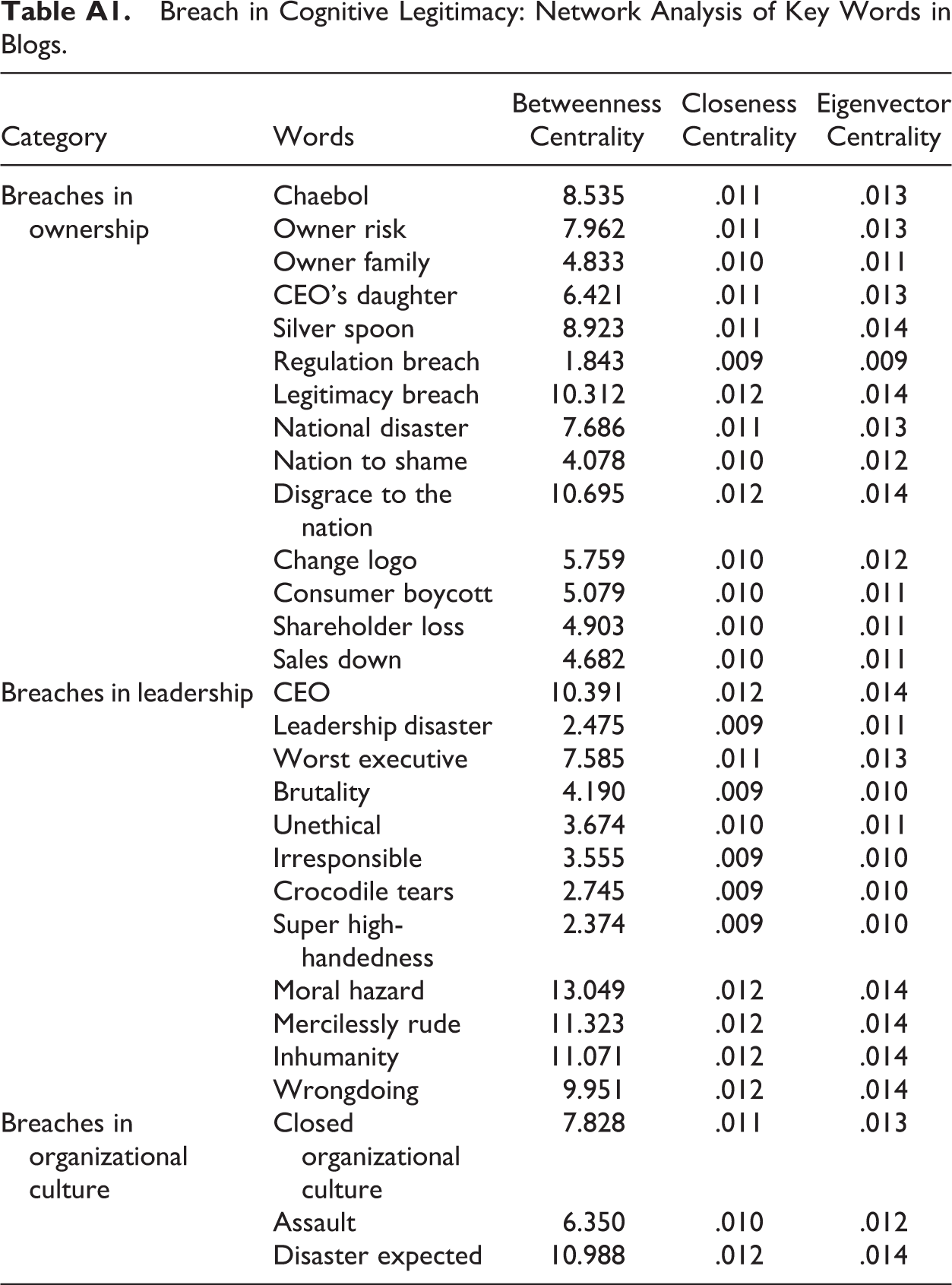
This filter extracted 80 words. Among them, the words referring simply to the events of the incident (e.g., return to the gate, KAL, Han Jin Corp, Ms. Cho, Chang-Jin Park, cabin crews, employees, NY Court, Court of Appeals, prosecution, imprisonment, and assignment release) were not selected for analysis because these words did not express bloggers’ perceptions of the crisis and the resulting breach of legitimacy. Excluding those words, we categorized the remaining 48 words into two groups: breach of cognitive legitimacy and criticism of KAL’s response to the crisis (see Appendixes A and B).
The first group of words relates to cognitive legitimacy failures, especially in terms of ownership, leadership, and organizational culture. In terms of ownership, bloggers criticized a family-run conglomerate for handing down ownership to unqualified and undisciplined family members such as Cho; for example, posts described Cho as having been born with “a silver spoon in her mouth” and as being unqualified to be a corporate executive. Some posts even proposed a change in KAL’s logo and corporate name on the ground that the airline had forfeited its right to be counted as a leading national brand. They argued that the airline had put Korea to shame, making the nation an object of global ridicule, and could therefore no longer be seen as representing the Republic of Korea. To these bloggers, KAL had lost its cognitive legitimacy. Regarding company leadership, posts criticized Cho for being rude, merciless, inhumane, insincere, disqualified, and the worst kind of executive. Some argued that Cho was a plutocratic despot with a high-handed attitude toward victims and that with her character, many had expected such a disaster to occur. In addition, many bloggers perceived KAL’s organizational culture and internal communication system to be so closed and authoritarian that nobody felt able to suggest changes to corporate culture and systems.
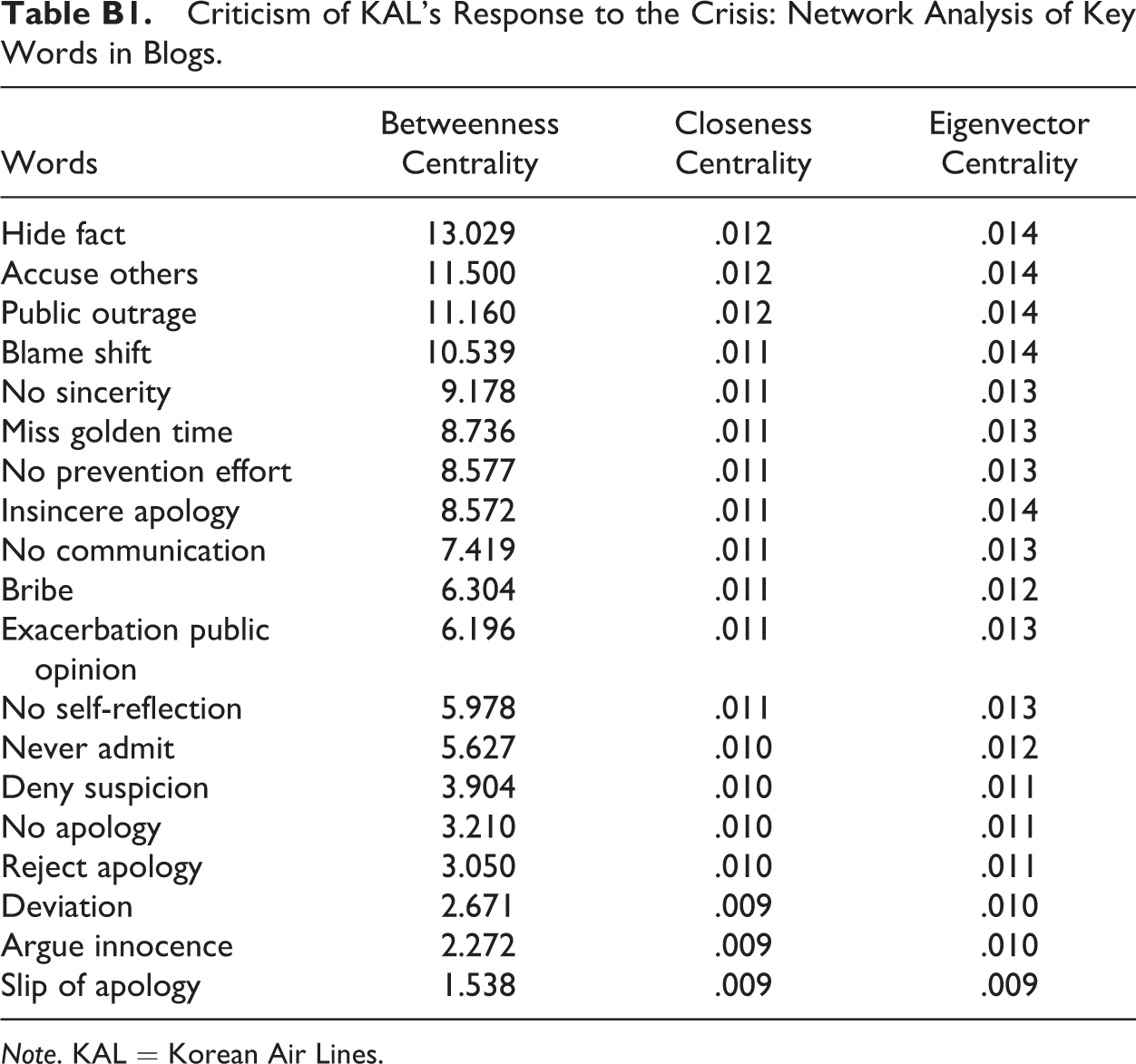
The second group of words expresses bloggers’ criticisms of KAL’s disappointing response to the crisis. Bloggers characterized it as shifting blame, accusing the victims, hiding fact, and denying responsibility whereas Cho’s tears were called crocodile tears and her apology for her actions was called insincere and inhumane. Bloggers perceived that KAL’s crisis response strategies were passive, reactive, and negative and that the company did not take full responsibility for the crisis. And many blog posts expressed disappointment that KAL had taken little action to rebuild trust and legitimacy between the company and the public.
In-Depth Interviews
Besides our network analysis of blog posts, we used qualitative analysis of in-depth interviews with communication experts who had direct or indirect experience with the corporate culture and practice of chaebols in order to elucidate how and why the nut rage case so effectively delegitimized KAL. In-depth interviews have the advantages of being data rich, flexible, stimulating to respondents, cumulative, and elaborative (Fontana & Frey, 1994). We collected data from eight semistructured interviews until we reached saturation (Calder, 1977). To achieve comprehensive experience and interpretation, we interviewed eight communication experts from both homogeneous and heterogeneous industries (Kirk & Miller, 1986). The participants included those who work or have worked at family-owned conglomerates as employees or partners. We selected these participants after considering the level or comprehensiveness of their experience with the types of crisis-related issues typically experienced by chaebol corporations over the last 20 years: namely, excessive concentration of economic power, underdiversification of business lines, inadequate responsibility for the environment, poor labor–management relations, and lack of separation between ownership and management. Table 1 shows the experiential profile of each interviewee.
Interviewee Job Title and Profiles.

Note. KAL = Korean Air Lines.
When selecting our sample, we took into the consideration the participants’ professional specialty, power status in the organization, and seniority of field experience rather than gender. As a result, all of our participants were male—an unintended result that, in retrospect, reveals the glass ceiling on women’s careers in the public relations industry and in large conglomerates in Korea. Even though the nut rage case did not in itself raise gender questions, to reduce the chances of gender bias, we took great care to avoid gender discrimination in our analysis of the interviews.
Besides the gender bias, we considered whether the interview responses of two participants, a former KAL employee and a former communication manager for a competitor airline, might be biased against KAL. We concluded, however, that any risk of bias was outweighed by the value of these participants’ knowledge of the airline industry and of KAL’s internal organization and culture, which would be helpful in interpreting and analyzing KAL’s response to the crisis.
From March 6 to March 18, 2015, we conducted eight semistructured, face-to-face, and in-depth interviews lasting from 40 to 60 minutes and digitally recorded each interview. We received the informed consent of the interviewees and guaranteed their right to privacy. 1 Despite the difficulty of making generalizations with a small number of samples, we found a repeating pattern of responses and reached a point of data saturation—that is, when extra interviews began to yield few new insights. The literature suggests cessation of data collection at this point of data saturation (Miles & Huberman, 1994; Strauss & Corbin, 1998). Each interview was transcribed, resulting in 98 double-spaced pages of transcript.
Our approach relied on a constant comparative analysis in which after every few interviews, we wrote theoretical memos to build our theory (Strauss & Corbin, 1998), refined our research questions, and developed our theoretical focus for subsequent interviews. During each round of interviews, informants described their attitudes toward KAL’s breaches of standards and subsequent legitimacy-recovery efforts. The interviews contained a mix of grand-tour questions and floating prompts to reduce interviewer bias and allow richer insights (McCracken, 1988).
As the interviews commenced, we found that informants were mostly in agreement in their initial understanding of KAL’s mistakes and ignorance. Thus, our subsequent interviews focused on understanding the nature and impact of KAL’s legitimacy-recovery process. Informants noted which factors contributed to their reevaluating KAL’s legitimacy.
Interview Questions and Analysis
We adopted Suchman’s (1995) strategic typology of legitimacy as a conceptual framework for our in-depth interview questions. We analyzed each interview transcript using Suchman’s legitimacy categories to gain a richer understanding of how and why KAL failed to come up with an effective legitimacy-seeking communications strategy. During the case analysis, we elaborated theoretical categories through open and axial coding procedures (Strauss & Corbin, 1998), drawing from research on organizational legitimacy to derive theoretical categories and subcategories of our interview data (Spiggle, 1994).
During the open-coding stage, we read and examined discrete parts of the interview transcripts to identify similarities and differences between the types of legitimacy breaches, strategies used to regain legitimacy, and reasons for failing to build legitimacy. During the axial coding stage, we reassembled the data into categories and subcategories to try to understand the role of the various legitimacy strategies and processes (Lincoln & Guba, 1985; Strauss & Corbin, 1998). Finally, we used selective coding to integrate and refine the concepts and categories of legitimacy as they emerged from the interview data. To ensure quality control, we provided independent interpretations of the findings and each conducted multiple interviews. The respondents had an opportunity to provide feedback on the initial findings—a “respondent validation” technique intended to increase the validity of the results and our analysis (Silverman, 2001).
We scripted the interviews and analyzed them thematically by relying on descriptive key words related to cognitive, moral, and pragmatic legitimacy. More specifically, we categorized KAL’s legitimacy breach and its strategies to regain legitimacy by drawing on the definitions of cognitive, moral, and pragmatic legitimacy. Cognitive legitimacy had subcategory key words and phrases such as perceptions of family-owned conglomerates, leadership, corporate culture, and internal and external communication. Moral legitimacy had subcategories such as legality, ethical obligation, fairness, prosocial logic, and social relations. And pragmatic legitimacy had subcategories such as ramp return, value of exchange, interest, and economic influence.
Results
In presenting our results, we discuss how and why KAL lost cognitive legitimacy, failed to recover moral legitimacy, and failed to achieve pragmatic legitimacy.
How and Why KAL Lost Cognitive Legitimacy
The participants described how KAL had cognitive legitimacy breaches in its leadership, corporate culture, and internal and external communications and offered comments on how it could recover cognitive legitimacy.
Leadership
Heather Cho, then vice president of the company, violated rules and abused her leadership power. KAL’s manual explained that no airplane captain should be ordered to change course once the plane has taxied away from the gate, so in forcing the plane to turn back, she violated the company rules. And she abused her executive authority by requiring the steward to kneel in servile obeisance, subjecting him to humiliation by jabbing at him. Interviewee A commented about Cho’s leadership: Korean Air’s employees seem to think that this nut rage case damaged not only the company but also all its employees. They felt humiliated because of her wrongdoing. However, Heather Cho and her family did not apologize to the employees. Ms. Cho is not qualified as a leader of the company.
Cho and KAL’s employees seemed to have different perceptions of cognitive legitimacy and the meaning of leadership. The nut rage incident indicates that Cho still has a feudal type of management style, in which “the owning family of a company wields absolute, unbridled power and the employees’ primary goal is to protect the interests of the owning family” (Wordsworth, 2014). The participant perceived Cho as someone who considered company leadership to be her automatic birthright in that she treated the flight attendant as a servant and did not consider making a sincere apology to KAL employees. Nowadays, however, KAL employees consider themselves to be stakeholders rather than subordinates, marking a radical change from the once-customary landlord–serf relationship between the company and its employees. Another participant, Interviewee H, who works for one of the top conglomerates in South Korea, commented on Cho’s leadership legitimacy: Despite the generation shifts, the chaebol operates in a way that is similar to the ancient feudal system, based on lord–serf relations. She was born with a silver spoon in her mouth. Without adequate training and experience to become a leader, she, a member of the owner family of the chaebol, was unprecedentedly promoted to a senior position. Thus, she cannot be legitimized as a leader of such a big conglomerate.
The participant’s description of a breach of cognitive leadership legitimacy aligns closely with our network analysis results, which showed that bloggers also criticized Cho for being “inhumane,” the “worst kind of executive,” and a “plutocratic despot with a high-handed attitude” toward victims and employees.
Corporate culture
KAL’s corporate culture was also indicated as being a big disaster in cognitive legitimacy. It was condemned as being closed, unequal, and dictatorial. Interviewee A, a former vice president of a competitive local airline, described KAL’s corporate culture: Yet, there is another challenge to overcome, Korean Air’s “rigid corporate culture.” The nut rage crisis is destined to occur as a result of the outdated and opaque corporate governance and decision-making system within the kingdom of the Cho family. Despite that rigid corporate culture, employees previously had a strong sense of pride in the nation’s number one airline, but times are changing. Once proud of the company’s prestige, they have now turned their backs on the company. Some are even starting to talk about filing a collective claim against the company for their psychological damage.
Internal and external communications
In addition to its breaches in leadership and corporate culture, KAL had cognitive legitimacy breaches in its internal and external communications. Interviewee E, a communications expert, described how KAL’s internal and external communications efforts had been insufficient: Korean Air had ranked first in the airline industry as the best company to work for. However, since the crisis, the airline slipped down to ninth. They have never made adequate efforts in external communications, nor in internal communications. They did not give an immediate and sincere apology to its stakeholders, not to mention the victims.
Interviewee B, an executive from one of KAL’s global Public Relations (PR) partners, explained that KAL’s legitimacy recovery activities failed because “currently nobody inside the company will say a single word regarding recovery strategy and all employees keep silent—that is its unique corporate culture.” Further, he added, “both management and staff are not ready to face up to the reality and try to find solutions. In such a situation, how can an external communication partner dare to mention a recovery plan?”
How to recover cognitive legitimacy
When asked about KAL’s strategies for recovering its cognitive legitimacy, Interviewee F, working for a communications agency, suggested this: The delegitimized company, Korean Air, should have fully explained its value of honesty and reason to exist by delivering sincere explanation and following practices, not limited to mere symbolic PR alone. However, Korean Air’s recovery strategies for cognitive legitimacy were an insincere and late apology, dissociation, and attacking the accuser.
Interviewee C, who works for a communication consulting firm, agreed that KAL’s apology was inadequate: Korean Air released an apology statement to the media 10 days after the incident. However, the apology was not sincere—the airline only tried to justify Heather Cho’s behavior. They promised to change their organizational culture, but nobody would trust it.
Interviewee H, who worked for one of the top conglomerates, explained the consequences of KAL’s delayed and inadequate response to the incident: The delayed official statement of Korean Air triggered public anger as it certainly seemed like KAL was blaming the flight attendants and using them as scapegoats. Korean Air has now fallen into jeopardy, with a growing number of bloggers vowing to boycott Korean Air and calling for changing the company name to Hanjin Air. KAL is not any longer the number one airline representing the Republic of Korea, which means that it lost its legitimacy as a national brand.
And Interviewee G, a communications professional, suggested that companies in crisis should seek to sharpen or save their tools with patience and restraint; if they attempt to display symbolic gestures too desperately, it might backfire without fundamental changes in leadership, corporate culture, and communication activities. Sanctions impair Korean Air’s legitimacy and might come back as a potential barrier for Korean Air to expand its business. The situation does not look good for the company, considering public feeling against it.
How and Why KAL Failed to Recover Moral Legitimacy
The nut rage incident can be characterized as a violation of moral legitimacy, given that KAL violated or missed many of the key aspects of moral legitimacy (e.g., legality, fairness, prosocial logic, and social relations) in its recovery efforts.
A classic “blaming” response to crises attempts to divert attention from a company’s underlying lack of managerial control by unfairly blaming individual employees or external authorities (Ashforth & Gibbs, 1990; Salancik & Meindl, 1984). KAL tried this tactic, but it backfired. First, KAL attempted to protect a member of the owner family, even forcing employees to lie for her; second, it blamed the company’s employees; third, it covered up the incident by systematically manipulating the facts; and fourth, it bought off its employees to try to get them to prevaricate or even perjure themselves. Interviewee D, a communication professional, described KAL’s reactive strategies: Korean Air’s response like this shows chaebols’ moral hazard problem. They did not seem to understand what the problem is, why the general public got upset, and what they should have done and do. The airline keeps denying and blaming the victims and employees, which will give rise to anti-corporate sentiment among the public.
But Interviewee H, who works for a top conglomerate, put it like this: Korean Air missed the “golden hour.” In emergency medical care, what you do in the first 60 minutes often determines whether your event remains manageable or erupts into a full-blown crisis. In KAL’s official statement, the company tried to shift the blame onto their flight attendants’ quality of service, without directly apologizing for Cho’s arrogance, in which she trampled on human integrity.
Our network analysis also found evidence of KAL’s breaches of moral legitimacy. For instances, bloggers accused KAL of shifting blame, accusing victims, distorting facts, denying responsibility, crying “crocodile tears,” and making insincere apologies.
KAL tried to recover from its moral legitimacy breaches, after it finally publicly apologized for Cho’s behavior, by implementing strategic restructuring tactics such as excuses, justifications, and explanations. In such circumstances, organizations usually try to “post a bond” against future backsliding by asking for tighter government oversight, engaging an ombudsperson, or instituting grievance procedures (Pfeffer, 1981). Instead, Cho Yang-ho, Cho’s father and chairman of KAL, announced that the company would launch a special communication committee consisting only of company members. Many doubted that such an internal committee could act as an independent watchdog.
Interviewee F, a PR professional, suggested what KAL’s recovery strategy should be: The key to a successful recovery plan was to reinforce and empower the role of the Korean Air department of external communications. Currently, most decisions about external messaging are made by Mr. Cho’s office. He should pay more attention to the internal PR team’s advice in dealing with the crisis.
KAL also failed to offer a sincere apology to its own employees. Instead, the company rushed to announce its pragmatic legitimacy recovery tactics, failing to consider that “seeking too frantically to re-establish legitimacy may dull the very tools” (Ashforth & Gibbs, 1990, cited in Suchman, 1995, p. 599). KAL disregarded that it needed moral legitimacy recovery tactics in order to persuade the public to at least resume pragmatic exchanges with the troubled company (Suchman, 1995).
How and Why KAL Failed to Achieve Pragmatic Legitimacy
To begin with, this incident was an issue of violating aviation security law by changing the flight plans and interfering with an aircrew’s duties. Focusing on this issue, Wall Street Journal reporter Foster-Carter (2015) perhaps oversimplified the situation: What did Ms. Cho do? No one got killed, hurt or robbed. Two people were humiliated, and 247 arrived in Seoul ten minutes late. How big a deal, really? The hubris was epic, the harm done small; the greater crime is the subsequent cover-up attempt. Why not just prosecute, instead of persecuting?
Notwithstanding that the “harm done” might have been “small,” the public was shocked and upset to learn about Cho’s “high-handed” actions when news of the incident first broke (B. Kim, 2015). But KAL attempts to reassure the public and recover its pragmatic legitimacy were somewhat halfhearted. The company dumped bargain tickets on social commerce sites in a bid to win back customers (B. Kim, 2015, p. 4); established a new frequent-flyer program; offered a discount program on medical checkups, with an additional 10% discount for those who have their KAL boarding pass; and announced a 2015 hiring plan for 900 new flight attendants, 50% more than it had hired in previous years. Many noted that the hiring plan was needed anyway to meet the rising demand for flight attendants as the airline extended its route network and introduced new airplanes. The airline also announced a scholarship program at the university it owns in Incheon. But these recovery tactics had little effect. Instead, KAL’s recovery tactics reignited questions about its contribution to South Korea’s economy and its leadership in the airline industry.
According to Interviewee C, a global communications director, “Korean Air may lose about 40 billion dollars in sales. Its stock price dropped about 5%, and its market capitalization fell by 200 billion dollars in a week.”
Interviewee G, a public relations and corporate social responsibility professional, suggested why the tactics might have failed: Korean Air’s extemporaneous monetary compensation for customers is not a desirable recovery strategy. The airline must set up a socially responsible plan on how to compensate its stakeholders for their financial losses from the incident. However, they did not announce any apology or any recovery plan particularly for shareholders, suppliers, employees, travel agencies, and distribution and logistics companies.
Interviewee B summed up the result of KAL’s failed tactics: Korean Air’s reputation plunged because of a single act of wrongdoing which resulted in making the company an object of ridicule globally. The previous contribution of the airline to the national economy has been to no avail. The company should be blamed for its socially irresponsible behavior.
This delegitimized company, “denying that it was at fault” as a matter of principle, adhered strictly to a crisis management plan that attempted to recover only its pragmatic legitimacy. The result was a negative backlash against the company, with both mainstream and social media lambasting Cho for her arrogance and mocking her for “going nuts.”
Conclusion
The nut rage case can be summed up as an incident in which the actions of a top manager of a major corporation in Korea breached the company’s moral and cognitive legitimacy and seriously disrupted Korean society, causing long-term economic, societal, and cultural repercussions. As blog entries showed, what the public perceived as Cho’s arrogance, inhumanity, and insincere apology not only raised questions about her qualifications to lead this family-run corporation but also triggered a wave of generalized anti-corporate public opinion.
We suggested that KAL’s attempt to recover its legitimacy after this incident failed for several reasons. First, the company incorrectly identified the root causes of the public criticism, so it undertook resolution measures that did not address the cause of the crisis. Even though this crisis was caused by breaches in moral and cognitive legitimacy, as our analysis of blog posts and the in-depth interviews revealed, KAL’s recovery strategy largely focused on recovering its pragmatic legitimacy, demonstrating that the company did not correctly identify the substance of its problem. KAL’s top managers, blinded by their rigid and closed internal communication systems, appeared not to understand why public opinion had turned against the company.
KAL’s attempts to apologize for the incident included offering monetary compensation, bargain tickets, a frequent-flyer program, and discounts for medical checkups (B. Kim, 2015). And one of the passengers who witnessed Cho’s outburst told reporters that the company attempted to buy her off by giving her a model plane and calendar: “An executive of Korean Air called me saying, to apologize to you, we would like to give you an airplane model and a calendar. If you have a chance to be interviewed, please say you’ve received our sincere apology” (Hankyoreh, 2014). But public did not see KAL’s crisis response as being sincere (see Appendix B). Rather than monetary compensation, the public wanted KAL to provide a sincere apology, more humane and honorable leadership, and more socially responsible contributions to the world. KAL simply failed to pay attention to public perceptions and demands. According to Sethi (1979), in a crisis, it is critical for a company not only to identify the legitimacy gap between the company and public but also to manage this gap through postcrisis communication that matches public expectations. To close its legitimacy gap, then, KAL should have attended to the types and degrees of legitimacy building that the public expected from the company.
Second, the public attributed KAL’s cognitive and moral legitimacy crisis mainly to Cho’s wrongdoings, holding her, as a corporate leader, primarily responsible for KAL’s legitimacy breach. According to Yum and Jeong (2015), members of the public are more likely to punish a corporate leader because they perceive that the leader deserves punishment for wrongdoing (retributive motivation) than because they expect that the punishment will prevent any future problem (utilitarian motivation). The public, in other words, tends to judge those who are responsible for a crisis and ask for them to be punished. A company in crisis needs to be able to manage both attributing responsibility and punishing those responsible, if appropriate, from a legitimacy perspective. In this case, to reestablish cognitive and moral legitimacy as a leader of the company, Cho clearly should have made a full and sincere apology and taken personal responsibility for the crisis.
For those who operate globally, legitimacy has become a critical issue although additional research is required to experimentally explore the extent to which retributive motivation affects punishments in different social contexts, such as Oriental versus Western countries and local versus global firms. Regardless of different cultures, every CEO of a public or private company is responsible for defining corporate culture and acting as the walking standard for its values (Kraemer, 2017). Social scrutiny of CEOs and leadership is heightened when leaders neglect to act on the dominant social norms and values across diverse cultures. The age of virtual organization, which heavily depends on social networking or culture in cyberspace, compels leadership to face global repercussions for a CEO’s irresponsibility. Amid an investigation into allegations of sexual harassment, gender discrimination, and a toxic work environment, Uber’s CEO, Travis Kalanick, stepped down in response to pressure from the company’s largest investors.
Another case of legitimacy crisis in a Western culture was initiated by the OWS movement. Under the slogan, We Are the 99%, OWS set out to raise collective anger and concern across the country about how large corporations, specifically the global financial system, benefit a minority and control the world economy. Further investigation is needed to explore the possible impacts of this movement on the organizational legitimacy of company leaders, corporate cultures, and communication initiatives.
Third, the widespread view that Cho brought disgrace upon the Korean nation, exposing it to global ridicule, indicates the collective culture of Oriental countries (Triandis, 1995). In a collective society such as Korea, individuals view themselves as parts of a whole, and the public considers that a country’s number one airline represents that nation to the world. Therefore, the higher the public expectations are that a company represents the nation, the fiercer the public humiliation is when the company is seen as bringing shame on that nation. This sense of collective humiliation because of a company crisis suggests that publics in Oriental cultures might be more concerned about breaches of cognitive and moral legitimacy than they are about breaches of pragmatic legitimacy. KAL should certainly have had a better understanding of this Asian cultural factor.
Fourth, as shown in several studies of effective crisis communication strategies on social networks (e.g., Argenti, 2006; Ngai & Jin, 2016; Ngai & Singh, 2014; Potts & Jones, 2011; Shin, Pang, & Kim, 2015), social media provide efficient platforms for the public exchange and dissemination of opinions and emotions about a crisis. With their timely transmission of information, broad public access, and interactive nature, social media can also be useful platforms for companies in crisis, which can use them to help reframe the crisis and regain the public’s trust. But as our blog-post analysis shows, KAL failed to use online social media to hear directly from its stakeholders and engage in conversation with them; the company underestimated the powerful influence that social networks can have on forming public opinion and cultivating relationships with stakeholders.
Finally, because KAL did not implement an effective recovery strategy that addressed all stakeholders, including victims of the incident, employees, shareholders, suppliers, and the media, its strategy did not meet stakeholder expectations. In other words, KAL did not build, maintain, or regain its legitimacy with the public, which resulted in a failure of legitimation. Coombs (1995, 2015) highlighted the importance of redefining systems for analyzing crisis situations so that corporations experiencing legitimacy crises can select effective crisis response strategies. But little has been said about strategies for legitimation (Johnson, Dowd, & Ridgeway, 2006; Zimmerman, 2002), especially in a crisis. Corporations in crisis need to create strategies for building legitimacy when it has faltered.
Our study will have both theoretical and practical value if it can stimulate the development of a crisis management framework that draws on definitions of organizational legitimacy. Theoretically, this study contributes to a strand of scholarship on organizational legitimacy structures in crisis response. In contrast to most crisis management studies focusing on how best to approach a crisis and redefine its meaning, this study evaluates a crisis using a legitimacy framework, reconfirming that breaches in cognitive and moral legitimacy have significant implications in stimulating negative public feelings (D. W. Kim & Kim, 2015). Compared with other studies (e.g., Alakent & Ozer, 2014; Dowling & Pfeffer, 1975; Suchman, 1995), this study suggests that the three types of corporate legitimacy work separately to affect perceptions of the organization, so organizations need to identify the type and degree of any legitimacy breach before selecting effective strategies to build, maintain, and regain each legitimacy dimension (Suchman, 1995).
Practically, our study fleshes out the evidence for persuading crisis managers and other key decision makers of the necessity of implementing a transformative restructuring strategy during and after crises. Organizational legitimacy crises are of course not limited to South Korea, and the concept of legitimacy is a useful tool for analyzing such sociopolitical organizational crises wherever they occur. This study suggests that these crises are not one-off problems that can be met and overcome on a case-by-case basis but are instead part of a tidal change in crisis management practices driven by economic, societal, and cultural forces that will only intensify in years to come.
Most previous studies regarding crises and business communication investigated issues triggered by organizational risk factors such as downsizing (Guiniven, 2001), environmental and industrial change (Marsen, 2014; Turner, 2005), and the public sector (Horsley & Barker, 2002), to name a few, but little academic research is available about business crises caused by individual risk factors such as individual CEOs. This study contributes to our understanding of the important role of senior company officers—who can display leadership, adherence to ethical standards, and an understanding of good communication—in maintaining organizational legitimacy in crisis situations.
Although this study makes a contribution to both theory and practice, the degree to which its findings can be generalized are limited. The study suggests that particular leaderships, corporate cultures, and communication initiatives can have an impact on both constructing and reconstructing organizational legitimacy and that social and wider cultural differences are key factors as well. A future study is needed to substantiate how and to what degree each element of the legitimacy framework can enhance an organization’s cognitive, moral, and pragmatic legitimacy. Additionally, the interviewees consisted of males only and included a former KAL employee and a former communications manager at a competing airline, which could raise concerns about gender bias and preconceived opinions in the interviews. To secure the validity of this study’s findings, a future study should ensure a broader selection of interviewees for analysis to eliminate any suggestion of interviewee bias.
Because businesses face the scrutiny of various stakeholders, no company can avoid exposure to increasing criticism and social sanctions for any breaches of its cognitive or moral legitimacy. To remain socially legitimate, businesses need to adapt themselves to a new industry standard—a legitimacy standard—and replace their old practices of managing stakeholder relations. As Suchan (2006) suggested, companies cannot reverse these changes in communication practices, or duck the challenges they bring, but companies can help to drive the conversation rather than simply falling victim to the next legitimacy crisis. To do so, however, they must embrace communication strategy changes rather than hide from the new challenges.
Footnotes
Appendix A
Breach in Cognitive Legitimacy: Network Analysis of Key Words in Blogs.
| Category | Words | Betweenness Centrality | Closeness Centrality | Eigenvector Centrality |
|---|---|---|---|---|
| Breaches in ownership | Chaebol | 8.535 | .011 | .013 |
| Owner risk | 7.962 | .011 | .013 | |
| Owner family | 4.833 | .010 | .011 | |
| CEO’s daughter | 6.421 | .011 | .013 | |
| Silver spoon | 8.923 | .011 | .014 | |
| Regulation breach | 1.843 | .009 | .009 | |
| Legitimacy breach | 10.312 | .012 | .014 | |
| National disaster | 7.686 | .011 | .013 | |
| Nation to shame | 4.078 | .010 | .012 | |
| Disgrace to the nation | 10.695 | .012 | .014 | |
| Change logo | 5.759 | .010 | .012 | |
| Consumer boycott | 5.079 | .010 | .011 | |
| Shareholder loss | 4.903 | .010 | .011 | |
| Sales down | 4.682 | .010 | .011 | |
| Breaches in leadership | CEO | 10.391 | .012 | .014 |
| Leadership disaster | 2.475 | .009 | .011 | |
| Worst executive | 7.585 | .011 | .013 | |
| Brutality | 4.190 | .009 | .010 | |
| Unethical | 3.674 | .010 | .011 | |
| Irresponsible | 3.555 | .009 | .010 | |
| Crocodile tears | 2.745 | .009 | .010 | |
| Super high-handedness | 2.374 | .009 | .010 | |
| Moral hazard | 13.049 | .012 | .014 | |
| Mercilessly rude | 11.323 | .012 | .014 | |
| Inhumanity | 11.071 | .012 | .014 | |
| Wrongdoing | 9.951 | .012 | .014 | |
| Breaches in organizational culture | Closed organizational culture | 7.828 | .011 | .013 |
| Assault | 6.350 | .010 | .012 | |
| Disaster expected | 10.988 | .012 | .014 |
Appendix B
Criticism of KAL’s Response to the Crisis: Network Analysis of Key Words in Blogs.
| Words | Betweenness Centrality | Closeness Centrality | Eigenvector Centrality |
|---|---|---|---|
| Hide fact | 13.029 | .012 | .014 |
| Accuse others | 11.500 | .012 | .014 |
| Public outrage | 11.160 | .012 | .014 |
| Blame shift | 10.539 | .011 | .014 |
| No sincerity | 9.178 | .011 | .013 |
| Miss golden time | 8.736 | .011 | .013 |
| No prevention effort | 8.577 | .011 | .013 |
| Insincere apology | 8.572 | .011 | .014 |
| No communication | 7.419 | .011 | .013 |
| Bribe | 6.304 | .011 | .012 |
| Exacerbation public opinion | 6.196 | .011 | .013 |
| No self-reflection | 5.978 | .011 | .013 |
| Never admit | 5.627 | .010 | .012 |
| Deny suspicion | 3.904 | .010 | .011 |
| No apology | 3.210 | .010 | .011 |
| Reject apology | 3.050 | .010 | .011 |
| Deviation | 2.671 | .009 | .010 |
| Argue innocence | 2.272 | .009 | .010 |
| Slip of apology | 1.538 | .009 | .009 |
Note. KAL = Korean Air Lines.
Declaration of Conflicting Interests
The authors declared no potential conflicts of interest with respect to the research, authorship, and/or publication of this article.
Funding
The authors received no financial support for the research, authorship, and/or publication of this article.