



Abstract
This article connects work on emotion, rhetoric, and entrepreneurial experience as it reports findings from a questionnaire issued to 80 entrepreneurs who belong to the global entrepreneur community Startup Grind. The findings from this study offer researchers a more robust representation of the rhetorical theories that guide entrepreneurs’ professional communication practices. In particular, the authors report on the distribution and dependency between two variables: operative rhetorical theory (indicated by one of four choices) and entrepreneurial experience (indicated by number of ventures and total years of experience).
In the introduction to the Journal of Business and Technical Communication's 2017 special issue on the rhetoric of entrepreneurship, readers met Ada, who was described by Spinuzzi as an innovator possessing an idea for a distinctive app. Through the persona of Ada, Spinuzzi detailed the inextricable connection between entrepreneurship and rhetoric: Rhetoric informs Ada's construction of her identity, provides her access to her communities, and facilitates her efforts to persuade her stakeholders. “In all of its forms,” Spinuzzi surmised, “entrepreneurship involves rhetoric,” and such involvement requires Ada to “perform many small arguments that form a larger coherent argument” (p. 277). While Spinuzzi's sketch of Ada explicitly connects the fields of entrepreneurial studies and rhetorical studies, the brief sketch does not detail the way in which Ada approaches the emotional dimension of her entrepreneurial communication. Indeed, a growing body of research across rhetoric and professional communication (RPC) and entrepreneurial studies suggests that the effectiveness of any argument or venture—Ada's included—depends on the way in which communication treats emotion. This research intimates that, as Ada performs her arguments and attempts to impact her stakeholders, she must decide whether her communication will draw on emotions as a means to persuasion, identification, or attunement—or whether her communication will ignore the emotional dimension all together.
In the following study, we examine how entrepreneurs like Ada approach the emotional dimension of their communication and, more specifically, how entrepreneurial experience influences these communicative approaches. But before we present our study, we expound on the convergences of RPC and entrepreneurial studies and the operative theories of rhetoric and emotion. Next we detail our research design and explain the processes by which we collected data. Then we present our data analysis and results. Finally, we discuss the study's findings, implications, and limitations.
Emotional Convergences: RPC and Entrepreneurial Studies
Emblematic of the increasing interest that RPC scholars are paying to entrepreneurial ventures as sites of meaningful study, this journal's special issue on the rhetoric of entrepreneurship attests to the way in which investigating entrepreneurs’ use of language might bring about improved understanding, refined practice, and ultimately more successful innovations. In that issue, RPC scholars outlined four strategies for solving wicked entrepreneurial problems (Gerding & Vealey, 2017), traced four strategies used by Black entrepreneurs to bring about change (Jones, 2017), and modeled frameworks for studying transnational entrepreneurial practices (Fraiberg, 2017). To be sure, these studies represent what Fraiberg (2021a) recently described as “an emergent body of technical and professional communication scholarship in entrepreneurship” (p. 175).
Other such studies within the field of RPC have examined entrepreneurs’ writing practices (Jakobs & Digmayer, 2020; Spartz & Weber, 2015), pitching practices (Belinsky & Gogan, 2016; Cabezas et al., 2020; Galbraith et al., 2014; Lucas et al., 2016; Spinuzzi et al., 2014; Spinuzzi, Nelson, et al., 2015; Spinuzzi, Pogue, et al., 2015), and value proposition development (London et al., 2015; Spinuzzi et al., 2018). A growing number of these studies have foregrounded the intersections of entrepreneurial identity and cultural context with communicative practice (Fraiberg, 2021b; Lauren & Pigg, 2016; Mara, 2008; Rajan, 2021; Van Hout & Van Praet, 2016; Williams, 2010; Williams et al., 2016, 2020). And some of these studies focus on professional communication practices associated with entrepreneurial incubators (Belinsky & Gogan, 2016; Pellegrini & Johnson-Sheehan, 2021; Spinuzzi et al., 2014; Spinuzzi, Nelson, et al., 2015).
This interest is, to a degree, reciprocated by scholars studying entrepreneurship, as a growing number of their research articles have prominently featured RPC. In fact, Rindova et al. (2009) explicitly called for entrepreneurial studies scholars to draw on “theories and methodologies to analyze the use of rhetoric, style, and symbol” in entrepreneurial declarations about ventures (p. 480). This call supports the view of rhetorically informed entrepreneurship research as “emancipatory” in so far as it “focuses on understanding the factors that cause individuals to seek to disrupt the status quo and change their position in the social order in which they are embedded—and, on occasion, the social order itself” (p. 478). Preceding this call, entrepreneurial studies that investigated rhetoric included studies on “enterprise” rhetoric (Howorth et al., 2005; Selden, 1991) and rhetoric's impact on organizations (Alvesson, 1993; Alvesson & Kärreman, 2000; Green, 2004). Since Rindova's call to take an emancipatory perspective on entrepreneurial studies, the crucial place of rhetoric “in how professions reproduce social, cultural and symbolic capital” has been emphasized, as has the view that “professionals are skilled rhetoricians” (Suddaby & Viale, 2011, p. 435).
Entrepreneurial studies scholars have researched rhetoric using analytical approaches informed by Aristotle (Anderson & Warren, 2011; Holt & Macpherson, 2010; Klamer, 2011) and Stephen Toulmin (Van Werven et al., 2015; Salmivaara & Kibler, 2020). A number of studies also target specific rhetorical schemes that entrepreneurs deploy as they use language to communicate. For instance, a study of entrepreneur loan profiles claims that political rhetoric is a central construct, dividing the construct into a seven-part rhetorical scheme that spans three different rhetorical themes (Allison et al., 2013). Further, a study of crowdfunded venture campaigns considers fundraising performance in terms of rhetoric, operationalizing a focus on narcissistic rhetoric into a seven-part rhetorical scheme that is used to analyze campaign content (Anglin et al., 2018). Likewise, a case study of 10 enterprises reveals the way in which four rhetorical devices support a strategy of hero–villain rhetoric that ultimately creates a sense of organizational legitimacy for each enterprise (Ruebottom, 2013). Studies have also analyzed televised entrepreneurial pitches, categorizing macrolevel and microlevel rhetorical devices according to Neo-Aristotelian constructs (Daly & Davy, 2016) and the rhetorical theory of stasis (Tomlinson, 2020).
Another area in which RPC and entrepreneurial studies seem convergent is in the attention each pays to emotion. For some time, both contemporary RPC scholars and entrepreneurship scholars have examined the influence of emotion on their respective fields of study. This attention to emotion illustrates a cross-disciplinary theoretical turn toward the study of affect, what Clough (2007) dubbed the “affective turn” (p. 2).
In RPC, this turn toward the study of affect and emotion has deepened understandings of rhetorical constructs from the classical to the contemporary (Gross, 2010; Hyde & Smith, 1993; Micciche, 2005, 2006, 2007, 2016; Morey, 2015; Murray, 2009; Pruchnic & Lacey, 2011; Rice, 2008, 2012; Smith & Hyde, 1991; Zhang & Clark, 2018). The turn toward affect has also influenced the way in which teachers of rhetoric, writing, and professional communication understand their work with students (Brand, 1987; Lindquist, 2004; Micciche, 2007; Murray, 2009; Richmond, 2002; Robillard, 2007; Trainor, 2006) and their professional identities (Micciche, 2002; Sano-Franchini, 2016). Indeed, emotion has been positioned as a typical response to professional communication (Schriver, 2012), a perceived weakness in the writing of MBA students (Lentz, 2013), a means of persuasion available for use by organizational leaders (Venus et al., 2013), and a positive response to managerial humor (Wijewardena et al., 2017). Additional studies (Pickering, 2018, 2019) focus on how students holding internships navigate emotional rules as they construct professional identities and “transition to workplace communication environments” (2018, p. 200).
In entrepreneurial studies, this interest in emotion has generated “recent and rapid” lines of research (García et al., 2015, p. 191), including studies that examine antecedents and consequences of emotions in terms of their effects on venturing and their arousal and valence within entrepreneurs. A portion of this research has, for instance, focused on positive emotions and their benefits to entrepreneurs (Baron et al., 2012; Baron et al., 2011; Hayward et al., 2010) whereas another portion of this research has focused on negative emotions and their impact on entrepreneurs (Doern & Goss, 2014; Patzelt & Shepherd, 2011). Other studies have examined the relationship between emotion and entrepreneurial disposition (Baron et al., 2011; Chan & Park, 2013), business failure and success (Byrne & Shepherd, 2015; Cardon et al., 2011; Mueller et al., 2017; Shepherd et al., 2009; Ucbasaran et al., 2013; Wolfe, & Shepherd, 2015a, 2015b), venture opportunity and evaluation (Baron, 2008; Goss & Sadler-Smith, 2018), and venture environment (Baron & Tang, 2011; Hmieleski et al., 2013). Across this research, the specific emotions that have received concentrated attention include joy, anger, fear (Foo, 2011; Welpe et al., 2012), and passion (Cardon, 2008; Cardon et al., 2009, 2013; Cardon & Kirk, 2015; Drnovsek et al., 2016).
As these two fields turn toward affect, they have both grappled with naming the construct of their studies, and five keywords—emotion, feeling, passion, affect, and mood—have emerged in the process. While the range of terms that different studies use to describe the affective turn is important, we focus here on the relationship between emotion, rhetoric, and entrepreneurial experience. We follow the work of Cardon et al. (2012) and adopt the term emotion to signify “the affect, emotions, moods, and/or feelings—of individuals or a collective—that are antecedent to, concurrent with, and/or a consequence of the entrepreneurial process, meaning the recognition/creation, evaluation, reformulation, and/or the exploitation of a possible opportunity” (pp. 2–3). With emotion as the site of convergence for our study, we examine theories of rhetoric that address emotion in ways germane to contemporary entrepreneurial practice.
Operative Theories of Rhetoric and Emotion
Despite the turn toward emotion across these fields, relatively little has been done to connect and systematize this theory in a way that helps to explain entrepreneurs’ approaches to communicating emotions. On account of the converging areas of research in RPC and entrepreneurial studies, such connections seem warranted as they could clarify and thereby advance a cross-disciplinary line of inquiry that more closely unites these two fields and further actualizes the emancipatory—and specifically rhetorical—perspective toward entrepreneurial research (Rindova et al., 2009, p. 485). In this section, we advance four operative rhetorical theories, each of which corresponds to one particular approach that entrepreneurs—like Ada—might assume toward emotion as they craft their professional communication.
Operative theories, according to Bunge (1966), are “theories of action” (p. 332). For Sagor (2011), operative theories are theories that describe “what is now being done” (p. 10). So unlike a substantive theory that is deliberately developed and purposefully deployed, an operative theory describes present actions and renders explicit the tacit theories that undergird those actions. Put differently, operative theories are those theories that are enacted by practitioners in present processes even though the practitioner may not have substantively considered the past elaborations and future implications of the theory. Thus, the following four operative rhetorical theories—three that chart a trajectory through the history of rhetoric and one that serves as an antithetical alternative—should be understood as useful insofar as they provide a systematic way to describe the in-the-moment work of professional communicators with respect to the emotional dimension of their communication.
The Classical (Neo-Aristotelian) Operative Rhetorical Theory
The first operative rhetorical theory that describes professional communicators’ approach to emotion assumes that the deliberate use of language can trigger emotions. Thus, practitioners work to use language in such a way that the language sparks certain emotions in audiences. This operative rhetorical theory is indebted to the classical theory outlined over 2,000 years ago by Aristotle in his Rhetoric. Understood in the context of Western thought, Aristotle's Rhetoric provides “the earliest systematic interpretation of affect” (Heidegger, 1927/1962, p. 178). More important, the interpretation of affect that Aristotle's Rhetoric advances directly connects the use of language—that is, rhetoric—with the arousal of emotion. Aristotle famously defined rhetoric as the ability “to see the available means of persuasion” (qtd. in Kennedy, 2006, p. 37), and he further understood the available means of discursive persuasion as falling under one of three categories: ethos, or those means tied to the speaker's character; logos, or those means tied to the speech's language; and pathos, or those means tied to the emotional disposition of audience members (pp. 38–39). This last means of persuasion—pathos—occupies the most important position for our study; however, it occupies the least important position with respect to Aristotle's own theory, as Aristotle elevated the use of logos and ethos in speech over the use of pathos (Garver, 1994, pp. 109–111).
Although scholars have been careful to emphasize the inconsistencies in Aristotle's treatment of pathos (Walker, 2000, p. 75), most scholars agree that Aristotle understood language as being capable of arousing or triggering emotions in the audience (Haskins, 2004, p. 105). As Kennedy (2006) explained, emotional arousal served two purposes within Aristotle's theory of rhetoric. When a speaker aroused certain emotions in an audience, the speaker used these emotions, first, in a positive sense “to facilitate the judgment sought” and, second, in a negative sense to turn “emotion against an opponent” or “refute an opponent's claims to the sympathy of an audience” (p. 114). Thus, underlying Aristotle's theory of rhetoric is a strong notion of agency and intentionality: The rhetor possesses agency to control language use, and the rhetor's intent will yield a desired effect on the audience (Garver, 1994, pp. 134–135). These strong notions of agency and intentionality undergird the first operative rhetorical theory that we investigate here because those individuals who view themselves as deliberately using language to trigger emotions understand themselves as possessing control over language and its effect.
The Modern (Burkean) Operative Rhetorical Theory
The second operative theory that describes the approach of professional communicators to emotion assumes that an individual's emotion can be communicated and used to motivate collective human action. Thus, practitioners use language in a way that draws individuals closer to one another and moves them toward shared activity. This operative theory maintains its roots in the modern rhetorical theory expounded by Kenneth Burke. Arguably, Burke's most significant contributions to rhetorical theory occur during his multivolume examination of the role that language plays in motivating humans to take action (Wolin, 2001, pp. 144–145). In A Rhetoric of Motives (1950), Burke most explicitly articulated a rhetorical theory that builds on Aristotle's rhetorical theory by suggesting that the best means of persuasion available to a rhetor is identification. “You persuade a man,” Burke suggested, “only insofar as you can talk his language by speech, gesture, tonality, image, attitude, idea, identifying your ways with his” (p. 55). For Burke, behind all general cases of persuasion are specific conditions of identification whereby a rhetor predisposes the audience to persuasion by signaling shared identity with the audience. Thus, to communicate effectively and motivate action, a rhetor must appeal to a bond with the audience and establish a collective identity. This collective identity might well be established through communicating shared attitudes or, more precisely, shared emotions.
In fact, Burke (1931/1968) discussed the communication of emotion earlier in his Counter-Statement, explaining that artists begin with their own emotion and then translate “this emotion into a mechanism for arousing emotions in others” (p. 55). Here, Burke, as Selzer (1996) recognized, “shifts emphasis from art as mere self-expression of personal emotions to art as inducing emotions in an audience” (p. 34). According to Burke’s (1931/1968) theory, then, individuals use art—from the art of poetry to the art of the venture pitch, from the art of rhetoric to the art of a bid proposal—to induce emotions and produce a desired emotional effect on an audience (p. 54). The effect, however, is one of identification, as the emotion, once communicated, becomes transcendent and unites the artist, speaker, or writer with the receiver, listener, or reader. In this second operative rhetorical theory, then, transcendent emotion becomes a motivator for collective action.
The New Materialist (Heideggerian/ Latourian) Operative Rhetorical Theory
The third operative theory that describes the approach of professional communicators to emotion assumes that emotion encompasses and conditions the communicator, the audience, and the environment in which they communicate. Thus, practitioners tap into an ambient mood, or emotion, and synch with, or attune to, the human and nonhuman factors that condition communication. This new materialist operative rhetorical theory emerges from the work of Heidegger and is closely associated with that of Latour (Gries, 2017, p. 441). To be sure, rhetorical studies scholars have been quick to illustrate how Heidegger's work on emotion is indebted to his reading of Aristotle (Gross, 2010; Gross & Kemmann, 2006; Hyde & Smith, 1993; Rickert, 2017; Smith & Hyde, 1991) and how Latour's work on rhetoric can be drawn into conversation with the work of both Aristotle (Barnett, 2015; Prenosil, 2015) and Burke (Boyle & LeMieux, 2017; Katz & Rivers, 2017; Rickert, 2013; Rivers, 2012; Wess, 2017). This new materialist theory of rhetoric, as Walsh (2017) explained, focuses on both materialism and attunement (p. 416), and it ascribes agency to humans as well as to nonhumans—to objects and materials (Pflugfelder, 2015). Affect—or what might be glossed as emotion or mood—emerges from such an inclusive, all-encompassing rhetorical environment. “Many elements,” Rickert (2013) observed, “human and nonhuman, contribute to the manifold ways affect emerges” in this new materialist theory of rhetoric, and these elements “become a variable contributing to the larger environs and hence help enable such an affect to emerge and circulate” (p. 145).
This operative rhetorical theory, then, endorses a “generalized rhetoricity that precedes and exceeds symbolic intervention” (Davis, 2010, p. 36; Davis & Ballif, 2014, p. 349). According to this theory, effective communication necessarily involves the communicative environment, which sets the mood between related elements and predisposes receptivity toward certain uses of symbols, languages, and messages. More specifically, effective communication involves attunement to the communicative environment, and attunement was of interest to both Heidegger and Latour. As Rickert (2017) documented, Heidegger's work treats two terms, Befindlichkeit and Gestimmheit, that are often translated as attunement (p. 449), and as Walsh (2017) documented, Latour expresses amenability to attunement (p. 417). Defining the term further, Rickert (2017) contended that attunement “names the disposition of a situation from within” (p. 449) and rightly foregrounds the mood and emotion that form the “background necessary for us to make sense of, experience, and interact in the world” (Rickert, 2013, p. 146). Put simply, this operative theory holds that, first, effective communication depends on the environment and emotion and that, second, attunement brings these factors and others into alignment. Viewed in terms of the history of rhetoric, this new materialist theory of rhetoric offers the most complex figuration of rhetoric: Emotion is at work as a condition of persuasion prior to a specific communicative act; a rhetor's job is to attune to these conditions.
The Antiaffective (Simonian) Operative Rhetorical Theory
Finally, in the fourth operative rhetorical theory that could be at work in professional communicators’ practice, emotion plays no role in communication. Thus, this is the antiaffective theory, for it opposes and negates the theory that emotion is a source of influence on professional communication. This antiaffective theory might be understood as a void theory as it flatly rejects attributing any value to emotion vis-à-vis communication. According to this theory, emotion is tangential to effective communication. And some practitioners who ascribe to this theory would even say that emotion stymies effective professional communication.
This perspective aligns with the once-dominant theory of bounded rationality advanced by Herbert A. Simon (1987). Especially influential in economics, business, management, and entrepreneurial studies, Simon's theory of bounded rationality holds that a model of pure, perfect, optimal rationality is flawed insofar as individual decision making occurs within particular informational and environmental contexts. For Simon, optimal decision making is therefore restricted according to context and influenced according to goals. Merits aside, Simon's theory of bounded rationality largely rejects the role of emotion in decision making and, by extension, professional communication. Simon uses the term “irrational” to describe workplace “decision making and behavior that responds to the emotions or that deviates from action chosen ‘rationally’” (p. 57). Wary of the “irrational decisions that stressful emotions may produce,” Simon concluded that “emotion-driven” workplace behavior “is more often than not inappropriate” (p. 62).
As Mumby and Putnam (1992) explained, “Simon's rationality employs a mind–body dualism by subordinating choice to organizational goals,” and in doing so, the theory of bounded rationality valorizes mental processes and marginalizes irrational emotions (p. 470; Ashkanasy et al., 2002, p. 317). Practically, the theory of bounded rationality leads to the view that emotions are “inappropriate at work” (Mumby & Putnam, 1992, p. 471), and it further seems to dismiss any positive role for emotions in professional communication. Thus, communicating emotion in professional contexts, and with respect to entrepreneurial goals, is a practice that might well be trivial and void of value when viewed in terms of bounded rationality (Mumby & Putnam, 1992, p. 471). Practitioners who subscribe to this operative theory assume that emotion interferes with communicative goals; thus, they work to “ignore” (Ashkanasy et al., 2002, p. 317), diminish, and eradicate emotions in their communication. Assuming that emotion does not positively impact their professional communication, such practitioners strive to persuade audiences without using emotion.
Research Design
To investigate the prevalence of these four operative rhetorical theories in the communicative actions of actual entrepreneurs and to examine the relationship between these theories and the construct of experience, we designed a research study that sought answers to three research questions. Our study was reviewed and approved by our university's Human Subjects Institutional Review Board (Protocol #161211). In this section, we outline our study's constructs, methodology, instrumentation, and questions.
Research Constructs: Emotion, Rhetoric, and Entrepreneurial Experience
Our study examines the relationship between emotion, rhetoric, and entrepreneurial experience. As we just detailed, the relationship between emotion and rhetoric has emerged over centuries of thought and action. Viewed historically, this relationship can be understood as taking the form of one of four operative rhetorical theories: a classical theory of persuasion, a modern theory of persuasion via identification, a new materialist theory of prepersuasive environmental factors, and a rationalist theory that ignores emotion's persuasive power. These four theories make up a historical schematic that guides our study by outlining four different approaches to the emotional dimension of communication, each of which uniquely addresses emotion and rhetoric. This schematic serves as the primary variable construct in this study.
The secondary variable construct in this study concerns experience. In RPC and entrepreneurial studies, experience is often discussed as a factor that contributes to effective communication and venturing, respectively. Across both fields, Simon’s (1987) work on decision making—which suggests that emotions are irrational and inappropriate in professional settings—is invoked in discussions of experience and expertise. The fact that both fields have turned toward emotion yet still invoke Simon's work on experience is paradoxical because Simon draws a sharp contrast between the decisions of an emotive professional and the decisions of an expert professional. For Simon, two “very different” types of intuitive behaviors are behind the decisions of “emotion-driven” professionals and “expert” professionals. Simon classified the emotive professional's behavior as “a response to more primitive urges” and the expert professional's behavior as “the product of learning and experience.” Simon further described the emotive professional's behavior as “irrational” and “more often than not inappropriate” and the expert professional's behavior as “nonrational” and “largely adaptive” (p. 62). As this contrast makes clear, Simon unambiguously endorses a process of decision making that is informed by experience rather than emotion as being crucial to achieving professional goals. Simon's notion of experience that is purged of emotion is referenced in both RPC and entrepreneurial studies.
In RPC, Simon's work is invoked when scholars distinguish experience from expertise: Experience approximates a quantification of time whereas expertise involves possessing and applying knowledge about communication effectively. Recognizing that “many workplaces fail to support the development of expertise,” Schriver (2012) contended that experience is “necessary but insufficient to acquire expertise” in RPC (p. 288). Rather, expertise is developed through deliberate practice to develop field-specific aptitudes, and such development certainly requires time. In their discussions of expertise, both Schriver (2012) and Kellogg (2018) referenced Simon's (Chase & Simon, 1973; Simon & Chase, 1973) and Simon's colleague Hayes's (1981, 2004) research on skill acquisition that sets 10 years as a minimum threshold for developing expertise. “Composers,” Hayes (1981) argued, “require about 10 years of preparation before they can produce works of outstanding quality” (p. 215). In light of these studies by Simon and Hayes, among others, Schriver maintained that “extensive experience in one's domain is absolutely crucial to developing expertise” (p. 287). And Kellogg asserted that the “ten-year rule of expert skill acquisition applies to writers and, if anything, underestimates the number of years of practice required for professional levels of achievement” (p. 426). Further, Kellogg claimed that “experienced, successful writers thus must learn to self-regulate their emotions and behavior to stay on task and complete the work” (p. 420), a claim that echoes Simon's distinction between behaviors driven by emotion and behaviors guided by experience.
In entrepreneurial studies, Simon’s (1987) work on experience appears in discussions of cognition and what has come to be known as entrepreneurial intuition. One takeaway from Simon's work on experience is that experts who possess at least one decade of intensive training in a particular domain develop familiarity with patterns of thinking in that domain. This same notion applies to the domain of entrepreneurship, and it appears in formulations of entrepreneurial thinking and entrepreneurial intuition. For example, Krueger and Day (2010) drew on Simon's work in calling for deeper investigation into the schemata that differentiate the thinking of expert entrepreneurs from that of novices. Additionally, as they recognize the way in which Simon's preferred type of intuition privileges cognition over emotion, Sadler-Smith et al. (2008) explored the “dynamic interplay” between cognition and emotion (p. 36). And widely referencing Simon's work, Blume and Covin (2011) suggested that entrepreneurs might become “more confident in their intuition” by better “developing their emotional intelligence” (p. 148). Almost paradoxically, then, Simon's work on experience and expertise has led these researchers back toward emotion.
More broadly, often without referencing Simon’s (1987) work on experience, researchers have examined entrepreneurial experience for its impact on entrepreneurs’ feelings, venture forecasting, and venture success. Across this group of studies, entrepreneurial experience is broadly defined as “past involvement in founding a business” (Toft-Kehler et al., 2014, p. 455) or as “prior business ownership” (Ucbasaran et al., 2010, p. 543). Occasionally, research on entrepreneurial experience has analyzed the experience construct according to various subcategories of experience. For instance, experience has been understood according to entrepreneur type, using subcategories such as novice entrepreneurs, serial entrepreneurs, portfolio entrepreneurs (Parker, 2013; Podoynitsyna et al., 2012; Ucbasaran et al., 2010; Zhang, 2011), or early stage entrepreneurs (Uy et al., 2017). Entrepreneurial experience has been further understood according to experience type, using subcategories such as industry experience and start-up experience (Cassar, 2014; Delmar & Shane, 2006).
Regardless of the subcategories that research on experience deploys, experience is typically represented quantitatively—as a number designating years of experience or the amount of ventures owned or founded. A study by Warnick et al. (2018) uses both kinds of experience measures—the number of years of experience and the number of ventures founded—as two controls for testing the associations between two types of entrepreneurial passions, openness to feedback, and investment probability. By its design, the study clearly positions both representations of experience as important for measuring and studying the construct of entrepreneurial experience.
Research Methodology: An Affective Survey
Having defined our study's major constructs, we decided to use a survey methodology to obtain input from entrepreneurs across the globe. We chose this survey methodology for two main reasons. First, it has achieved a notable level of acceptance across the fields of RPC and entrepreneurial studies as a means to examine the constructs including communication, emotion, and experience. Within the RPC field, for instance, survey methodology has been used to examine the relationship between entrepreneurship and written communication (Spartz & Weber, 2015). And within the field of entrepreneurial studies, survey methodology has been used, for example, to investigate the relationship between affect and entrepreneurship (Baron & Tang, 2011) and to measure the experience of entrepreneurial passion (Cardon et al., 2013). Second, survey methodology enabled us to focus our research on a particular population—entrepreneurs—and use a series of questions to measure perceptions of members of that population. As such, the methodology aligns with research approaches that recognize the survey as an apt methodology for measuring attitudes (Hayhoe & Brewer, 2020, p. 130) and feelings (Blakeslee & Fleischer, 2007, p. 145) as well as with research approaches that recognize the survey as “the primary method for ascertaining emotion, mood, and sentiment” (Brave & Nass, 2008, p. 87).
Thus, we contend that our survey methodology reinforces the topic of our inquiry and constitutes an “affective methodology,” as Knudsen and Stage (2015) have termed it. An affective methodology navigates tensions between the epistemic and the performative, the stable and the unstable. On one hand, researchers who study the construct of emotion seek to produce valid knowledge through their work. As Knudsen and Stage explained, researchers studying emotion “attempt to create knowledge about situations via empirical observations, and possibly generalize the results via cross-situational research.” On the other hand, researchers who study the construct of emotion grapple with a construct that is fluid, embodied, and performative. Knudsen and Stage observed that this focus on culturally situated “performativity” leads to “the constant destabilization of this knowledge production” (p. 7). The tension between the epistemic and the performative that Knudsen and Stage associated with affective methodologies is a tension that survey methodology perpetually navigates. In part, survey methodology balances the epistemic with the performative by encompassing a wide range of instrumentation methods that employ different question types and designs. The flexible nature of the survey instrument enables the methodology to adapt to various situations, levels of formality, and modes of analysis (Blakeslee & Fleischer, 2007, p. 145), including situated understandings of emotion as manifested in the professional communication practices of a population of entrepreneurs.
Research Instrumentation: An Online Questionnaire
Since we were interested in the relationship between emotion, rhetoric, and entrepreneurial experience, we designed a five-item questionnaire to elicit survey responses from entrepreneurs. We used Qualtrics® software to create the questionnaire instrument, generate the hyperlink for the instrument, and log responses to the questionnaire. Although the instrument contained five items, we focus here on the relationships between three of these items: total years of experience (Item 2), total number of ventures (Item 3), and choice of operative rhetorical theory (Item 4). In future research, we plan to report on the relationships involving the other two items: choice of terminology (Item 1) and advice about the emotional dimensions of venturing (Item 5).
Two of the three questionnaire items on which we focus asked respondents to indicate their relative experience as an entrepreneur: Item 2 asked respondents to enter the total number of years of experience that they have as an entrepreneur whereas Item 3 asked respondents to enter the total number of ventures for which they have served as a principal leader or stakeholder. Both items asked respondents to round their experience numbers up to the nearest integer.
The third questionnaire item on which we focus sought to elicit responses that revealed the operative rhetorical theories guiding entrepreneurial communication: Item 4 prompted respondents to complete a statement about their communicative approach by selecting one of four multiple-choice responses (see Table 1). The four response choices drew on each respondent's preferred term for emotion (Item 1) and were presented in randomized order. Each of the four choices corresponded to a different operative rhetorical theory. The response choices were structured so that each contained two clauses. The initial clause completed the statement by describing the respondent's communicative action, and the second, dependent clause articulated the assumptions behind that action. In other words, the clause that articulated the assumption behind the action clarified the corresponding operative rhetorical theory.
Instrument Item 4: the Response Choices and the Corresponding Operative Theory of Rhetoric.

Note. In the instrument, “X” was used in place of [emotion] with the acknowledgment that “X” represented the respondent's answer to a questionnaire item that asked the respondent to choose a preferred term for emotion. The main clause describing the communicative action is in roman type whereas the dependent clause clarifying the assumption behind the communicative action appears in italics.
As our research was emergent in its attempt to connect emotion, rhetoric, and entrepreneurial experience, we were interested to learn whether the responses for Items 2 and 3, the experience measures, were associated differently with the responses for Item 4, the operative rhetorical theory variable.
Research Questions: Distribution and Dependence
As the questionnaire design suggests, our study was keenly interested in distribution and dependence. Our first research question focused on the distribution of data:
Research Question 1: Are the entrepreneurs’ choices of operative rhetorical theories uniformly distributed in such a way that the distribution can be explained by chance?
The distribution of the response to Item 4 of the questionnaire was important to our study because we wanted to learn which, if any, operative rhetorical theory was most prevalent among a sample population of entrepreneurs. We sought to gauge the guiding approach that entrepreneurs took toward their professional communication practices in relation to emotion, and we were interested in whether the distribution occurred in a way that significantly differed from a uniform distribution that could be attributed to chance.
Our second and third research questions examined the dependence between data set variables:
Research Question 2: Is there a significant relationship between the entrepreneurs’ number of ventures and their operative rhetorical theories? Research Question 3: Is there a significant relationship between the entrepreneurs’ years of experience and their operative rhetorical theories?
In posing these two research questions, we wanted to see if there was any relationship between the variable of operative rhetorical theory and the variable of entrepreneurial experience. That is, we sought to understand the degree to which entrepreneurs’ choice of operative rhetorical theory was independent of their experience, as indicated either by the total number of ventures for which they have served as lead or principal or by the total number of years of experience that they have as an entrepreneur. And we wanted to see whether the approach that entrepreneurs took toward emotion in their professional communicative practices was associated with their experience.
Data Collection
Having selected our methodology and designed our instrument, we then distributed the questionnaire to entrepreneurs and recruited our respondents. Eventually, our efforts to distribute the questionnaire and recruit respondents led us to refine our distribution and recruitment strategies, directing each toward entrepreneurs who were affiliated with the global entrepreneurial network known as Startup Grind.
Our initial distribution and recruitment strategy targeted just over 25 organizations that work directly with entrepreneurs. These organizations ranged from in-person networks at the regional level to virtual networks at the international level, noteworthy nonprofit foundations to elite for-profit clubs, and government agencies to identity-driven councils. But because of repeated difficulties with distribution and recruitment (including restricted access to certain organizations and low questionnaire response rates from other organizations), we decided to focus on one California-based organization called Startup Grind.
Established in 2010, Startup Grind (2018) is a global network of entrepreneurs that aims “to educate, inspire, and connect entrepreneurs” by founding local chapters, planning social events, and hosting keynote speakers in over 120 countries and 400 cities around the globe. In addition to maintaining a robust digital presence through social media platforms, wide-ranging blog posts, and frequent podcasts, Startup Grind convenes a number of conferences annually. Through such efforts, Startup Grind has developed a sense of community across its vast network and advanced its core values of connectivity and success. Indeed, Startup Grind’s (2018) values statement recognizes that its members are “truly passionate about helping founders, entrepreneurs and startups succeed” and commits to making the “startup journey less lonely, more connected and more memorable.”
Because Startup Grind stresses its aim to decrease its members’ feelings of loneliness and isolation and its altruistic passion for helping its members succeed, it positions itself as being invested in the feelings and the passions of its membership. Such positioning aligns with the aims of our study and provides us with further rationale for focusing only on this one organization: Since the organization's self-stated values elevate the importance of entrepreneurial emotion, we reasoned that narrowing the focus of our study to this one organization might reveal more refined and subtle findings about entrepreneurial emotion as a construct.
Further, by focusing our study on Startup Grind members, we were able to bolster the survey response rate because one of us, Stacy, is a member of the organization. Stacy had established herself in the Startup Grind global network by serving as the director of a local chapter. She was therefore familiar with the various platforms that Startup Grind used to facilitate communication between members and chapter directors. We decided to capitalize on her member and director status by collecting a convenience sample (Murphy, 2002, p. 99). Targeting those platforms that applied only to chapter directors, we asked chapter directors to complete the survey and encourage their chapter membership to do so as well. We hoped that the chapter directors could use their relationships with members to drive participation in our study. And because different chapters use different platforms as their primary means of communication, each chapter director would be aware of the most effective way to reach chapter members.
Our collection methods were deliberately tailored to preserve the rapport that Stacy maintained with the organization's other chapter directors. We emailed different versions of an initial recruitment message to four different groups of chapter directors. Group 1 consisted of those chapter directors with whom Stacy maintained previously established contact. Group 2 consisted of chapter directors who were acquainted with Stacy but had not yet been contacted by her. Group 3 consisted of chapter directors located in the United States who were not acquainted with Stacy and had not yet been contacted by her. And Group 4 consisted of international chapter directors who were not acquainted with Stacy and had not yet been contacted by her. Stacy maintained the contact information for these four groups.
Across groups, the core of each recruitment message included an introductory statement, a note contextualizing the study, a description of the questionnaire, a request for participation, a link to the questionnaire, and a brief secondary recruitment message that could subsequently be distributed by the chapter director to chapter members. Recruitment messages, however, were differentiated according to the recipients’ previous communication with Stacy, their familiarity with her, and their familiarity with U.S. higher education and institutional research. Two weeks after we sent the initial recruitment message, we sent a uniform follow-up message to chapter directors across all four groups.
The questionnaire remained active for two months, and during those two months, some recruitment-related communication—for instance, responding to inquiries about the initial or follow-up recruitment message—continued. Data collection was completed by the end of July 2017 when the 2-month recruitment window expired. During these two months, a total of 216 questionnaires were opened by respondents. Of these 216 questionnaires, 130 contained no data on any of the questionnaire items, meaning that respondents consented to respond to the survey but did not elect to provide any responses. Of the remaining 86 questionnaires that did contain responses, 6 contained only partial responses and were not sufficiently complete to be included in the analysis phase of our study. Thus, we collected 80 viable questionnaire responses.
Data Analysis and Results
Our data analysis focused on the relationship between entrepreneurial experience—as expressed either by the respondents’ number of ventures or by their years of experience—and operative rhetorical theories. Focusing on the 80 viable survey responses, we used the IBM® SPSS® Statistics software platform, version 26.0, to assist us in analyzing our data and testing our hypotheses.
First, we analyzed the distribution of the survey responses for the operative rhetorical theory, noting trends in the distribution across the classical, modern, new materialist, and antiaffective theories of rhetoric. We then compared the actual distribution of choices to the expected distribution of choices using a chi-square goodness-of-fit test. This initial analysis enabled us to test our hypothesis in response to Research Question 1. Second, we coded responses to the two experience variables according to the various categorical divisions. Responses to the number of ventures variable were coded using three paired schemes whereas responses to the years of experience variable were coded using four paired schemes. We then sought to answer Research Questions 2 and 3 by testing the relationship between the operative rhetorical theory and the experience variables. To do so, we used the chi-square test of independence, which weighs the proportion of survey responses across an array of two variables to determine whether the null hypothesis—that there is no relationship between the two sets of variables or that the variables are independent of one another—should be rejected. Thus, rejecting the null hypothesis suggests that the variables are associated with one another.
Distribution of Operative Rhetorical Theory Data
We examined the response data for questionnaire Item 4 to determine the distribution of the entrepreneurs’ choice of operative rhetorical theory across the four categories. Table 2 shows the frequency of the responses (N = 80) for each operative rhetorical theory. Further, we performed a chi-square goodness-of-fit test on this frequency distribution to compare the actual distribution of responses to the operative rhetorical theory question with the expected distribution of responses. The results of this test gave us the answer to Research Question 1: Are the entrepreneurs’ choices of operative rhetorical theories uniformly distributed in such a way that the distribution can be explained by chance? The results for the chi-square goodness of fit test suggest that the responses were not uniformly distributed and thus could not be attributed to chance. Put differently, this test indicates that the data were distributed in a way that is significantly different than expected, χ2 (3, N = 80) = 69.1, p ≤ .001. Theoretically, respondents would be equally as likely to select all four answers to questionnaire Item 3. The expected distribution for each of the four responses would therefore have been equal at 20 responses and a relative frequency of 25% for each choice. Had the response data been more uniformly distributed, the possibility that the choices were a result of chance would not have been rejected.
Distribution of Survey Responses Across the Four Operative Rhetorical Theories.
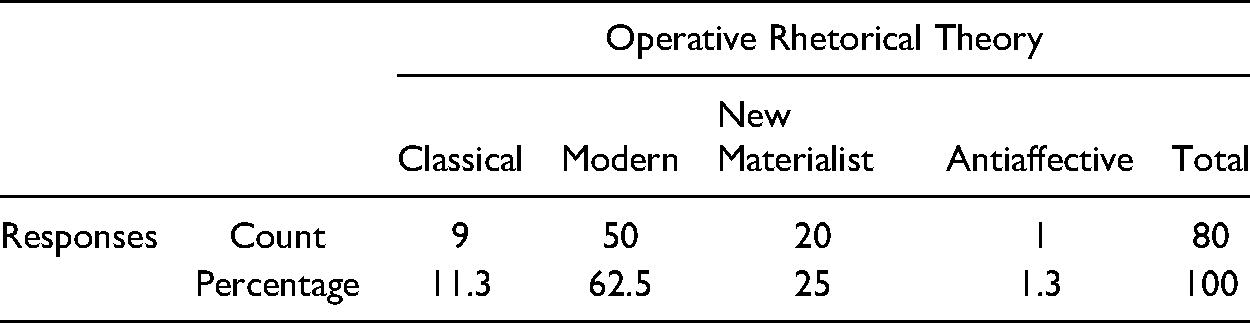
To the contrary, the distribution of the responses was not uniform, which strongly suggests that entrepreneurs did not view these choices of operative rhetorical theory as equal. The results indicate a clear preference for the modern rhetorical theory: Over 60% of the entrepreneurs chose the modern operative theory of rhetoric as most indicative of their approach to professional communication. The results further suggest that a vast majority of respondents—over 98% of participating entrepreneurs—viewed emotion as an aspect of their communication that could not be ignored whereas less than 2% endorsed the operative rhetorical theory that ignores emotion.
Dependence Between Number of Ventures and Rhetorical Theories
We performed chi-square tests of independence to examine Research Question 2: Is there a significant relationship between the entrepreneurs’ number of ventures and their operative rhetorical theories? Unlike chi-square goodness-of-fit tests, which compare observed data to an expected distribution, chi-square tests of independence compare the distribution of two or more subsets of observed data within one categorical variable. In other words, chi-square tests of independence require that the data for one categorical variable be divided into at least two subgroups before the data is tested. Then tests are run across the subsets of observed data within one categorical variable to investigate whether that variable is independent of the other categorical variable.
Data for the number of ventures variable took the form of integers that represented the number of ventures for which the entrepreneur served as a lead innovator or principal. The distribution of these 80 integers allowed the numbers to only be subdivided in three ways that would retain the statistical power needed for the chi-square test. Put differently, only three venture thresholds offered a statistically viable basis for comparison. Prior to testing, data were coded using three different bivariate schemes, each corresponding to a different venture threshold. Three new data subsets emerged that categorized the number of ventures variable pairwise in the following ways:
Subset 1: Ventures < 2 (n = 17) and ventures ≥ 2 (n = 63) Subset 2: Ventures < 3 (n = 42) and ventures ≥ 3 (n = 38) Subset 3: Ventures < 5 (n = 64) and ventures ≥ 5 (n = 16)
These data subsets present different venture thresholds that query whether there is a significant relationship between entrepreneurs’ preferred operative rhetorical theories that are below the threshold and their preferred operative rhetorical theories that are at or above the threshold.
Data for the operative rhetorical theory variable were grouped according to the entrepreneurs’ responses to questionnaire Item 4, for which they selected one of four operative theories that they perceived to be at work in their professional communication. Thus, each of the four discrete theories of rhetoric—classical, modern, new materialist, and antiaffective—was a category of the operative rhetorical theory variable.
The test results were not significant at the two-venture threshold, χ2 (3, N = 80) = 1.51, p = .681; the three-venture threshold, χ2 (3, N = 80) = 1.81, p = .614; or the five-venture threshold, χ2 (3, N = 80) = 2.94, p = .401. As such, we had no basis for rejecting the null hypothesis. Thus, we can assume that the number of ventures and operative rhetorical theory variables are independent of one another within this sample of survey responses.
Dependence Between Years of Experience and Rhetorical Theories
To answer Research Question 3—Is there a significant relationship between the entrepreneurs’ years of experience and their operative rhetorical theories?—we performed chi-square tests of independence to examine the relationship between the arrays of data for the variables of years of entrepreneurial experience and operative rhetorical theory. We wanted to determine whether associations existed between the subsets of data within each categorical variable or whether the variables of years of experience and operative rhetorical theory were independent of one another. Because the chi-square test of independence is a comparative test, the test requires that observed data for one variable be divided into at least two subsets of data. These subsets form the basis of the comparative test.
The initial data set consisted of 80 responses. The variable of entrepreneurial experience took the form of integers indicating the number of years of entrepreneurial experience that each respondent possessed. Before testing the data for this variable, we examined the distribution of the data to identify any break points that allowed the data to be divided into subsets possessing statistical viability. We identified four such break points, and to prepare this variable for testing, we coded the data for entrepreneurial experience using four different bivariate schemes, each corresponding to a different 5-year experience break point. As a result, four different data subsets emerged, each of which retained statistical power. These new data subsets presented the experience variable pairwise as follows:
Subset 1: Experience < 5 years (n = 31) and experience ≥ 5 years (n = 49) Subset 2: Experience < 10 years (n = 45) and experience ≥ 10 years (n = 35) Subset 3: Experience < 15 years (n = 59) and experience ≥ 15 years (n = 21) Subset 4: Experience < 20 years (n = 65) and experience ≥ 20 years (n = 15)
Thus, these data subsets present different experiential break points that query whether there is a significant relationship between the entrepreneurs’ preferred operative rhetorical theories that are below the break point and their preferred operative rhetorical theories at or above the break point.
We tested each of these four data subsets against the data set for the operative theory variable. This data set comprised responses that corresponded to one of the four different categories of operative rhetorical theories—classical, modern, new materialist, and antiaffective. At the break point of 20 years of entrepreneurial experience, the relationship between these variables was significant, χ2 (3, N = 80) = 7.999, p = .046. The effect size for this finding, as indicated by Cramer's V, was moderate at .316 (Cohen, 1988). These findings suggest that the variables of years of experience and operative rhetorical theory are significantly associated with one another. Stated differently, according to the test results, we reject the null hypothesis because these variables do not appear to be independent of one another (see Table 3). The standardized residuals further reveal that entrepreneurs who have 20 or more years of experience were more likely to choose the new materialist theory of rhetoric as their operative rhetorical theory than would otherwise be expected.
The Relationship Between the Years of Experience and Operative Rhetorical Theory Variables at the Break Point of 20 Years of Experience.

Test results for all other experiential break points were not significant. That is, no significance was detected at the 5-year break point, χ2 (3, N = 80) = 2.94, p = .401; the 10-year break point, χ2 (3, N = 80) = 1.16, p = .763; or the 15-year break point, χ2 (3, N = 80) = 3.51, p = .32.
Findings and Implications
The results of this research, although limited, suggest three findings that have implications for practitioners, researchers, theorists, and teachers across the fields of RPC and entrepreneurial studies.
Finding 1: Entrepreneurs Overwhelmingly Grasp the Importance of Emotion to Their Professional Communicative Practices
The most conclusive finding from our study is that ignoring emotion is seldom a viable choice for today's entrepreneurs, who overwhelmingly recognize that addressing emotion is an important part of their professional communication practices. Our study revealed that over 98% of respondents selected one of the three operative rhetorical theories that address the emotional dimension of communication. While the assumptions that undergird these three theories differ, they all support rhetorical action (i.e., persuasion, identification, or attunement) in which an entrepreneur engages emotion as a means to communicate effectively. In aggregate, the assumptions undergirding these three operative theories starkly contrast with the assumption behind the fourth, antiaffective operative theory. That is, whereas the three operative theories that account for 98% of the responses chart courses of action in which entrepreneurs engage emotion, the fourth theory—the antiaffective theory of rhetoric—assumes that entrepreneurs can ignore emotion, bracketing it as tangential to rational communication and goal attainment. Our study suggests that this assumption that emotion can be ignored rarely operates in the communicative practices of entrepreneurs.
This finding supports Sadler-Smith’s (2016) view that entrepreneurial decision making operates under a dual-processing framework that combines cognition and emotion in making decisions about ventures. Sadler-Smith's framework expands the concepts of “entrepreneurial intuition” (Dane & Pratt, 2007; Sadler-Smith et al., 2008) and “entrepreneurial alertness” (Kirzner, 1973), describing the alert and intuitive entrepreneur as an individual who reaches decisions by drawing on emotion as well as problem-solving strategies. Our study's first finding suggests that, by and large, the same dual-processing framework encompasses the communicative practices of entrepreneurs who responded to our survey. The majority of these entrepreneurs attend to emotion in their approach to communication and thereby demonstrate a degree of entrepreneurial intuition and alertness.
Emotion is not just something that entrepreneurs experience; instead, emotion is an influential part of entrepreneurial decision making, so entrepreneurs must communicate emotion. As such, this first finding suggests new directions for research on and the teaching of entrepreneurial communication. Across the fields of entrepreneurial studies, rhetorical studies, and professional communication, more attention must be given to the contemporary rhetorical action through which entrepreneurs attempt to engage the emotional dimension of communication. Researchers would do well, then, to study communicative artifacts and discern specific strategies that present-day entrepreneurs use to engage emotion. Researchers should consider which strategies seem more effective for particular communicative contexts, aims, and audiences. This research could affirm current communication approaches, translating tacit practice into explicit strategy: The practices used by entrepreneurs who successfully engage with emotion could be more explicitly identified and disseminated to practitioners through professional networks, business incubators, and academic degree programs so that entrepreneurial communities will have a greater awareness of these practices. The result could lead to an increase in entrepreneurial alertness: The operative theories that are presently at work in entrepreneurs’ rhetorical actions might further be developed into substantive theories that could enable entrepreneurs to be better aware of their communicative practices and to more deliberately engage emotion in their communications.
Finding 2: Entrepreneurs Largely Viewed the Goal of Their Approach to Communicating Emotion as Supporting Aims That Align With Modern Rhetorical Theory
Our study suggests that entrepreneurs tend to approach their professional communication with the aim of motivating collective human action by signaling shared emotions with their audiences. Over 60% of the entrepreneurs who responded to our questionnaire chose the operative theory that foregrounds the communication of shared emotion and the motivation of collective human action. This most popular choice, which aligns with Burke’s (1950/1969) modern rhetorical theory, underscores the importance of both community and identity to entrepreneurs (Spinuzzi, 2017). Both this theory and the literature on entrepreneurship focus on developing community. Just as entrepreneurs describe their work as developing a community of investors, partners, clients, and other stakeholders to back a particular venture, so too does Burke describe the rhetor's work as constituting community. The idea connecting Burke's rhetorical theory with entrepreneurs’ communicative practices, then, is indeed community. Our study reinforces Spinuzzi's observation that entrepreneurs “do not make it on their own” (p. 279).
Further, our study suggests that one of the chief ways that entrepreneurs forge community is by communicating or signaling something about themselves that they share in common with the audience. This sharing or signaling can be understood as resulting in Burkean identification because it connects identities—most basically the identity of the entrepreneur with that of the stakeholder (Cheney, 1983; Dailey et al., 2016; Green & Li, 2011). The identity of the entrepreneur is central to the literature on entrepreneurial passion (Chen et al., 2009; Galbraith et al., 2014; Lucas et al., 2016; Murnieks et al., 2014; Warnick et al., 2018); that is, communicating passion communicates identity and bridges that identity with audience members. In sum, the prevalence of the entrepreneurs’ choice of the modern theory of rhetoric makes sense when viewed in terms of extant work across RPC and entrepreneurial studies.
This second finding points to new ways of understanding well-established components of venturing as well as to new applications of rhetorical theory. The prospect of these new understandings and applications is improved professional communication. For example, practitioners, researchers, and theorists need only look to the value proposition, which is a common component of the business models used by entrepreneurs (Hixson & Paretti, 2014; London et al., 2015; Spinuzzi et al., 2018). To articulate a new venture's value proposition, entrepreneurs must not only situate the venture within a market but also distinguish the venture from its competitors based on its added value. Burke’s (1950/1969) rhetorical theory offers a new perspective on the value proposition, focusing attention to the processes of identification and division that are simultaneously at work in the proposition. According to Burke, identification is always accompanied by division (p. 25), and the two processes work in tandem when an entrepreneur articulates a value proposition: The value proposition identifies a venture with its market peers and, at the same time, divides the venture from its peers by differentiating its characteristics. Burke's theory thus provides added insight into the communicative act of formulating a value proposition.
Further, the stress that this modern rhetorical theory places on identification connects well with the establishment of a brand identity. If, as our study suggests, it is the most popular operative rhetorical theory of entrepreneurs, then perhaps it could open up new understandings of other entrepreneurial communicative practices. Nonetheless, researchers might explore whether venture support and success would improve if more entrepreneurs adopted a rhetorical theory other than the modern rhetorical theory captured by Burke (1950/1969).
Finding 3: More Experienced Entrepreneurs Seemed to Embrace the Most Complex and Contemporary Rhetorical Aims When Describing Their Approach to Communicating Emotion
Perhaps the most intriguing result of our study is that entrepreneurs with 20 years of experience or more chose the new materialist operative theory of rhetoric to describe their communicative aims more than would be expected. Indebted to the work of Heidegger and Latour, this operative theory most fully engages the concept of networked communicative action—action that emerges from an “ambient array” of human and nonhuman factors and conditions (Rickert, 2013, p. 207) and that navigates both the environment and emotion. This theory is the most expansive of the four choices presented to the respondents, and its conception of agency is also the most diffuse of the four operative theories. This theory aligns with a model of entrepreneurial emotion that views “ambient conditions” as antecedent to “entrepreneurial outcomes” (Jennings et al., 2015, p. 125). Our study suggests that in regard to these ambient conditions, emotion, rhetoric, and entrepreneurial experience converge further: The rhetorical theory supports the entrepreneurial model.
The fact that a statistically significant association exists between the new materialist rhetorical theory and the most experienced group of entrepreneurs in our sample might indicate that entrepreneurs with more years of experience also experience a shift in their approach to communication. Entrepreneurs with 20 or more years of experience might well come to realize that communicating emotion is a complex task involving a kind of distributed agency over which they have less control. This finding suggests, then, that more experienced entrepreneurs are increasingly apt to recognize the importance of environmental factors beyond human control to the effectiveness of their communication and their venturing. These individuals have perhaps come to an awareness and acceptance of the ambient conditions that prefigure their rhetoric and entrepreneurship and become better practiced at synching—or attuning—their rhetoric with those ambient conditions.
This finding brings new perspective to the construct of experience in both the fields of RPC and entrepreneurial studies. First, this finding suggests that 10 years of experience is too small to distinguish novice entrepreneurial approaches to communicating emotion from expert ones. The 10-year marker that was said to distinguish a novice from an expert, established by Simon and Chase (1973) and echoed in the research across both fields, did not result in significant differences between entrepreneurs’ approaches to communicating emotion. Nor were any significant differences identified when 15 years was used to demarcate less experienced from more experienced entrepreneurs and to compare their approaches to communicating emotion. But when 20 years of experience was the experiential break point, a significant difference in the approaches did emerge. Thus, the finding seems to support Kellogg’s (2018) assertion that the “ten-year rule of expert skill acquisition” actually “underestimates” the level of experience needed to achieve expertise in RPC (p. 426).
Second, this finding helps to elaborate on the concept of “entrepreneurial alertness” that informs an understanding of entrepreneurial intuition. Entrepreneurial alertness, as Sadler-Smith (2016) explained, “is a dimension of individual difference” between entrepreneurs (p. 220). Scholars have linked entrepreneurial alertness to entrepreneurial experience, theorizing that the “level of entrepreneurial alertness is likely to be heightened” when an entrepreneur possesses “experience in a specific product and customer market” (Ardichvili et al., 2003, p. 118). In brief, different levels of experience result in different levels of entrepreneurial alertness that impact an entrepreneur's ability to mobilize dual-process (i.e., involving both cognition and emotion) intuition in decision making.
Our third finding elaborates on the theories of entrepreneurial alertness and entrepreneurial intuition in that it points to a specific level of experience above which entrepreneurs signal an increased alertness and awareness of the ambient conditions that impact their professional communication practices. This finding begs for more research exploring the association between years of experience and rhetorical theories. In particular, it calls for more inquiry into the communicative practices of experienced entrepreneurs. Researchers would do well to consider whether entrepreneurs undergo an emotional, communicative, or cognitive shift that results from their experiences or whether entrepreneurs who continue venturing for 20 or more years have emotional, communicative, or cognitive dispositions that lend themselves to longevity. Such researchers could design studies that would help disentangle the relationship between experience and expertise (Hayes, 1981; Schriver, 2012) and inform entrepreneurial practice, especially in regard to mentorship. This future research, for example, might indicate that novice or early-stage entrepreneurs should seek to expand their approach to the emotional dimension of professional communication by soliciting communicative advice from a mentor with 20 or more years of entrepreneurial experience.
Limitations
While the three findings emerging from this study carry significant implications for practitioners, researchers, theorists, and teachers of RPC and entrepreneurship, the study is not without limitations. To be sure, the findings are limited by the study's sampling technique, its respondent pool, and its instrument.
We employed a convenience sample in order to navigate the differing communication preferences of Startup Grind chapters. This sampling technique might have resulted in data that are more representative of a few highly responsive regional chapters than of the whole Startup Grind organization. Further, even though our sample size retained statistical power, the number of viable survey responses that we received was much smaller than what we had anticipated given the size of Startup Grind. We view the relatively small sample size as a further limitation of the study.
The fact that our respondents were affiliated with one global organization suggests some cultural limitations to our study's findings. First, Startup Grind (2018) is an organization that clearly states its intention to make venturing “less lonely, more connected and more memorable” for its members. This intention and Startup Grind's mission and values might attract like-minded entrepreneurs who are not necessarily representative of all entrepreneurs in their focus on connectivity. Second, because Startup Grind is a global network, a good portion of our responses might have come from cultures that are quite different in the ways in which they approach communicating emotion. Such cultural differences might well have influenced our data and limited the representativeness of our sample. Because the study's survey instrument was designed for anonymous responses and did not query respondents about their home cultures, we could not analyze the data for associations between cultures and communicative approaches to emotion.
Finally, our questionnaire offered respondents only four choices of operative rhetorical theories. The presentation of these four choices was informed by the history of rhetoric, as the classical, modern, and new materialist theories can be understood as building off one another. Nonetheless, other operative rhetorical theories—for instance, the work focusing on Toulmin's theory of argumentation (Salmivaara & Kibler, 2020; Van Werven et al., 2015)—could be at work in the approach that entrepreneurs take to their professional communication and its emotional dimension.
Conclusion
Our study analyzed questionnaire data from a sample of Startup Grind members, offering additional insight into the communicative practices of entrepreneurs. It shows that entrepreneurs like Ada—the persona introduced in this journal's special issue on the rhetoric of entrepreneurship (Spinuzzi, 2017)—approach their rhetorical action in a way that largely pays attention to the emotional dimension of their communication. There is a good chance too that Ada's approach to communication reflects a modern operative rhetorical theory in which she attempts to motivate collective human action by signaling shared emotions. But if Ada possesses 20 or more years of experience, there is a significant chance that her approach to communication might have shifted toward a new materialist operative rhetorical theory, in which she cedes some control of her communication to nonhuman factors, including the environment and emotional mood.
In the end, then, our study has added to a more robust representation of the rhetoric of entrepreneurship because it bridges work across the fields of RPC and entrepreneurial studies, more clearly advancing a line of inquiry that sits at a convergence between the two fields. Emotion, thus, is an area traversed by rhetoricians and entrepreneurs alike—by individuals like Ada. Admittedly, our representation here of Ada and her communicative practices is still a partial one, but it is one that we hope will continue to grow as more researchers across the fields of RPC and entrepreneurial studies examine the rhetoric of entrepreneurship.
Footnotes
Acknowledgments
The authors would like to thank Western Michigan University's Statistical Consulting Center, Joshua Naranjo, and Stevie Collini for guidance and advice on the statistical analysis of our research data. Further, the authors would like to thank Jo Mackiewicz, Lori Peterson, Clay Spinuzzi, Charlotte Thralls, and four anonymous reviewers for their feedback at different stages of this project.
Declaration of Conflicting Interests
The authors declared no potential conflicts of interest with respect to the research, authorship, and/or publication of this article.
Funding
The authors disclosed receipt of the following financial support for the research, authorship, and/or publication of this article: This work was supported by two $500 Undergraduate Research and Creative Activities Awards, College of Arts and Sciences, Western Michigan University.
